automatic brake Peugeot 308 2015 Owner's Manual
[x] Cancel search | Manufacturer: PEUGEOT, Model Year: 2015, Model line: 308, Model: Peugeot 308 2015Pages: 416, PDF Size: 11.81 MB
Page 4 of 416
.
.
308_en_Chap00a_sommaire_ed01-2015
Visual search
Instrument panel 12
Indicator and warning lamps
1
3
ga
uges and indicators
2
8
Adjustment buttons
3
3
tr
ip computer
3
5
to
uch screen
3
9
Setting the date and time
4
6Remote control key
5
0
"Keyless e
n
try and Starting"
with remote control
5
7
"Keyless e
n
try and Starting"
on your person
5
9
Boot
6
2
Alarm
6
9
el
ectric windows
7
3
Panoramic sunroof
7
5
Fuel tank
7
6
Diesel misfuel prevention
7
7
Steering wheel adjustment
7
9
Front seats
8
0
Rear seats (saloon) 8 5
Rear seats (SW) 8 6
Interior fittings
8
8
Front armrest
9
0
Boot fittings (saloon)
9
4
Boot fittings (SW)
9
5
Heating and Ventilation
9
9
Heating
101
Manual air conditioning
1
01
Manual air conditioning (
to
uch screen)
1
03
Dual-zone digital air conditioning (
to
uch screen)
1
05
Front demist - defrost
1
10
Rear screen demist - defrost
1
11Driving recommendations
1
12
Starting-switching off the engine
1
13
Manual parking brake
1
20
el
ectric parking brake
1
21
Hill start assist
1
28
5-speed manual gearbox
1
29
6-speed manual gearbox
1
29
ge
ar shift indicator
1
30
Automatic gearbox
1
31
Dynamic pack
1
35
Stop & Start
1
36
Memorising speeds
1
39
Speed limiter
1
40
Cruise control
1
43
Active cruise control
1
46
Display of inter-vehicle time
1
54em
ergency collision alert system,
emergency collision braking system 1 58
Blind spot sensors 1 63
Parking sensors
1
66
Reversing camera
1
69
Park Assist
1
70
eco-driving
M onitoring Access
Comfort Driving
Contents
Page 6 of 416
4
308_en_Chap00b_aide-visuelle_ed01-2015
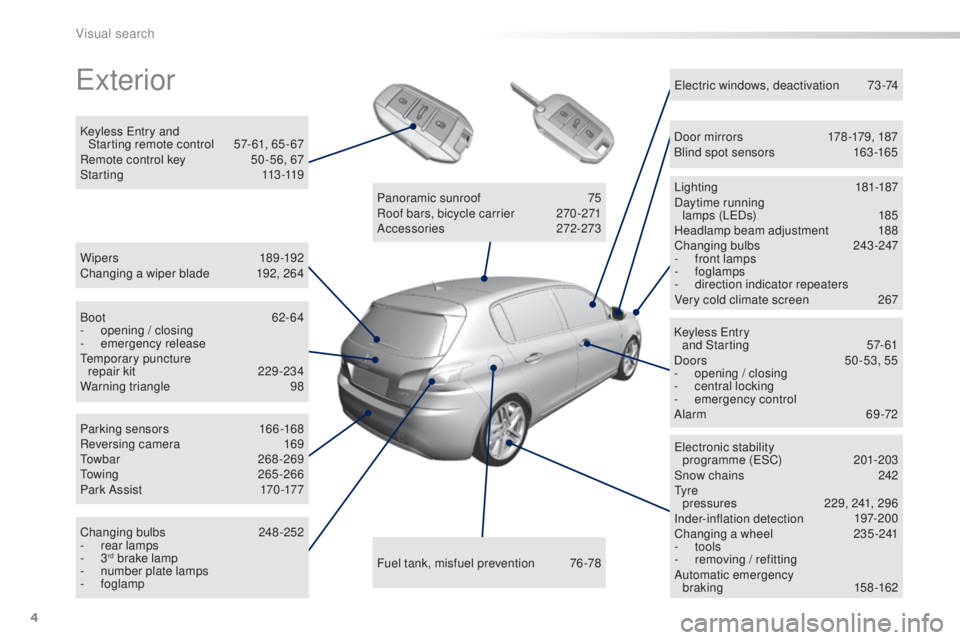
exterior
W ip e r s 18 9 -19 2
Changing a wiper blade 1 92, 264
Keyless
e
n
try and
Starting remote control
5
7- 61, 65 - 67
Remote control key
5
0 -56, 67
S t a r t i n g
113 -11 9
ele
ctronic stability
programme (
e
SC)
2
01-203
Snow chains
2
42
ty
r e
pressures
2
29, 241, 296
Inder-inflation detection
1
97-200
Changing a wheel
2
35-241
-
tools
-
r
emoving / refitting
Automatic emergency braking
158-162
Lighting
181-187
Daytime running lamps (L
eD
s)
1
85
Headlamp beam adjustment
1
88
Changing bulbs 2 43-247
- f ront lamps
-
foglamps
-
d
irection indicator repeaters
Very cold climate screen
2
67
el
ectric windows, deactivation
7
3-74
Keyless e
n
try
and Starting
5
7-61
Doors
50
-53, 55
-
ope
ning / closing
-
c
entral locking
-
em
ergency control
Alarm
69-72
Fuel tank, misfuel prevention
7
6-78
Panoramic sunroof
7
5
Roof bars, bicycle carrier
2
70 -271
Accessories
2
72-273
Boot
62-64
-
ope
ning / closing
-
em
ergency release
te
mporary puncture
repair kit
2
29-234
Warning triangle
9
8
Parking sensors
1
66-168
Reversing camera
1
69
to
wbar
268-269
to
wing
265-266
Pa r k A s s i s t
17
0 -17 7
Changing bulbs
2
48-252
-
r
ear lamps
-
3
rd brake lamp
-
n
umber plate lamps
-
foglamp Door mirrors
1
78 -179, 187
Blind spot sensors
1
63 -165
Visual search
Page 9 of 416
7
308_en_Chap00b_aide-visuelle_ed01-2015
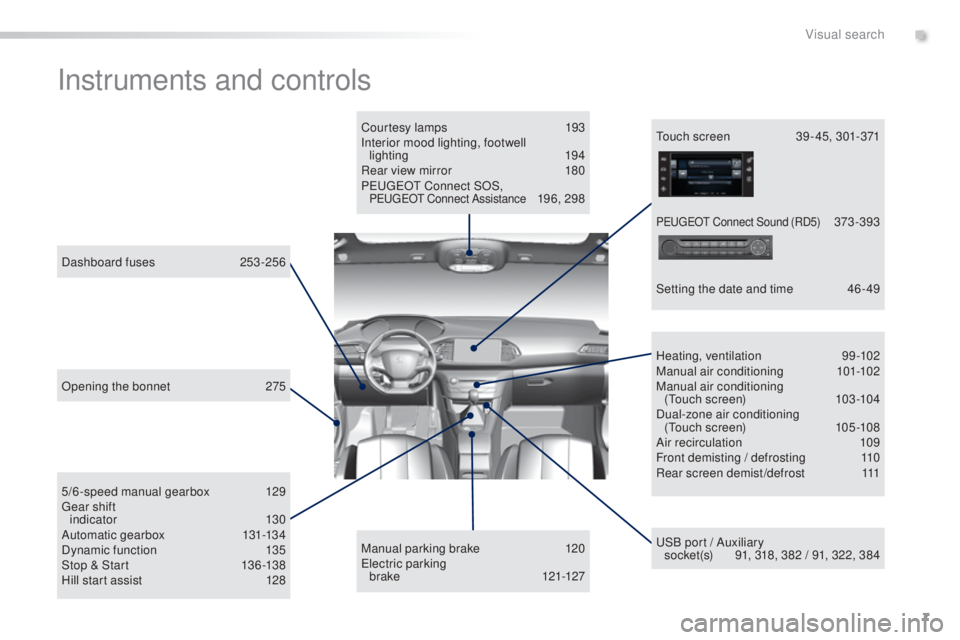
Instruments and controls
Courtesy lamps 193
Interior mood lighting, footwell lighting
194
Rear view mirror
1
80
P
e
uge
Ot
Connect SOS,
PeugeOt Connect Assistance 196, 298
uS
B port / Auxiliary
socket(s)
9
1, 318, 382 / 91, 322, 384
5/6-speed manual gearbox
1
29
ge
ar shift
indic ator
13 0
Automatic gear box
13
1-13 4
Dynamic function
1
35
Stop & Start
1
36 -138
Hill start assist
1
28
Dashboard fuses
2
53-256
Heating, ventilation
9
9-102
Manual air conditioning
1
01-102
Manual air conditioning (
to
uch screen)
10
3 -104
Dual-zone air conditioning (
to
uch screen)
10
5 -108
Air recirculation
1
09
Front demisting / defrosting
1
10
Rear screen demist/defrost
1
11
Manual parking brake
1
20
el
ectric parking
brake
121-127
to
uch screen
3
9 - 45, 301-371
Setting the date and time
4
6 - 49
Opening the bonnet
2
75
PeugeO t C onnect Sound (RD5) 373 -393
.
Visual search
Page 12 of 416
10
308_en_Chap00c_eco-conduite_ed01-2015
Optimise the use of your gearbox
With a manual gearbox, move off gently and change up without waiting.
During acceleration change up early.
With an automatic or electronic gearbox, give preference to automatic
mode and avoid pressing the accelerator pedal heavily or suddenly.
Control the use of your electrical
equipment
Before moving off, if the passenger compartment is too warm, ventilate it
by opening the windows and air vents before using the air conditioning.
Above 30 mph (50 km/h), close the windows and leave the air vents
open.
Remember to make use of equipment that can help keep the
temperature in the passenger compartment down (sunroof and window
blinds...).
Switch off the air conditioning, unless it has automatic regulation, as
soon as the desired temperature is attained.
Switch off the demisting and defrosting controls, if not automatic.
Switch off the heated seat as soon as possible.
Switch off the headlamps and front foglamps when the level of light
does not require their use.
Avoid running the engine before moving off, particularly in winter; your
vehicle will warm up much faster while driving.
As a passenger, if you avoid connecting your multimedia devices
(film, music, video game...), you will contribute towards limiting the
consumption of electrical energy, and so of fuel.
Disconnect your portable devices before leaving the vehicle.
eco-driving
eco-driving is a range of everyday practices that allow the motorist to optimise their fuel consumption and CO2 emissions.
Drive smoothly
Maintain a safe distance between vehicles, use engine braking
rather than the brake pedal, and press the accelerator progressively.
th
ese practices contribute towards a reduction in fuel consumption
and
CO
2 emissions and also helps reduce the background traffic noise.
If your vehicle has cruise control, make use of the system at speeds
above 25 mph (40 km/h) when the traffic is flowing well.
th
e gear shift indicator invites you engage the most suitable gear: as
soon as the indication is displayed in the instrument panel, follow it
straight away.
For vehicles fitted with an electronic or automatic gearbox, this
indicator appears only in manual mode.
eco-driving
Page 17 of 416
15
308_en_Chap01_controle-de-marche_ed01-2015
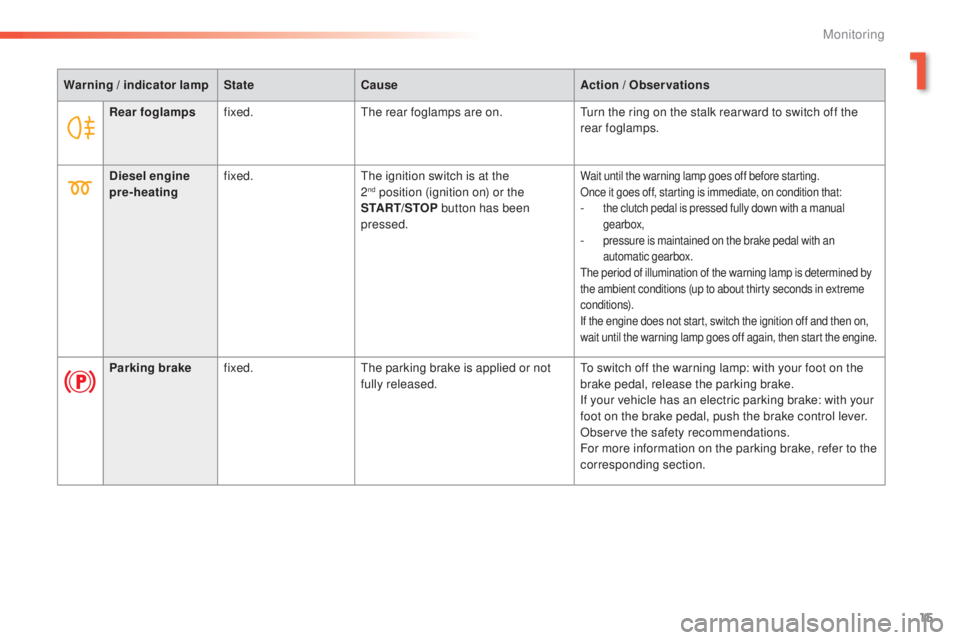
Warning / indicator lamp State Cause Action / Observations
Rear foglamps fixed.
th
e rear foglamps are on.
tu
rn the ring on the stalk rear ward to switch off the
rear foglamps.
Diesel engine
pre-heating fixed.
th
e ignition switch is at the
2
nd position (ignition on) or the
ST ART/STOP button has been
pressed.Wait until the warning lamp goes off before starting.
Once it goes off, starting is immediate, on condition that:
- the clutch pedal is pressed fully down with a manual
gearbox,
- pressure is maintained on the brake pedal with an automatic gearbox.
th
e period of illumination of the warning lamp is determined by
the ambient conditions (up to about thirty seconds in extreme
conditions).
If the engine does not start, switch the ignition off and then on,
wait until the warning lamp goes off again, then start the engine.
Parking brake fixed.th e parking brake is applied or not
fully released.to s witch off the warning lamp: with your foot on the
brake pedal, release the parking brake.
If your vehicle has an electric parking brake: with your
foot on the brake pedal, push the brake control lever.
Observe the safety recommendations.
For more information on the parking brake, refer to the
corresponding section.
1
Monitoring
Page 22 of 416
20
308_en_Chap01_controle-de-marche_ed01-2015
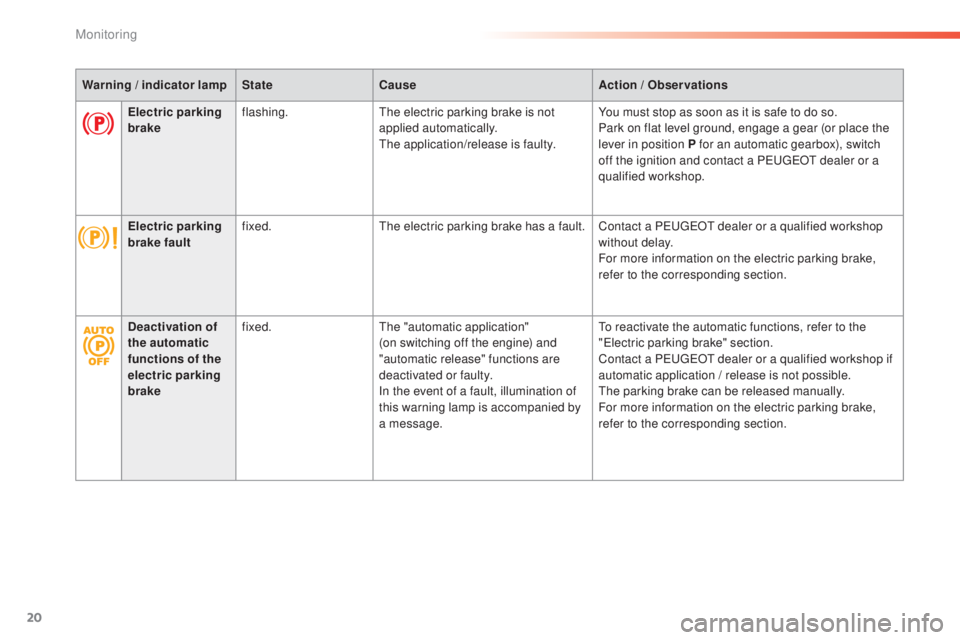
Warning / indicator lamp State Cause Action / Observations
Electric parking
brake flashing.
th
e electric parking brake is not
applied automatically.
th
e application/release is faulty.You must stop as soon as it is safe to do so.
Park on flat level ground, engage a gear (or place the
lever in position P for an automatic gearbox), switch
off the ignition and contact a P
e
uge
Ot
dealer or a
qualified workshop.
Electric parking
brake fault fixed.
th
e electric parking brake has a fault. Contact a P
e
uge
Ot
dealer or a qualified workshop
without delay.
For more information on the electric parking brake,
refer to the corresponding section.
Deactivation of
the automatic
functions of the
electric parking
brake fixed.
th
e "automatic application"
(on switching off the engine) and
"automatic release" functions are
deactivated or faulty.
In the event of a fault, illumination of
this warning lamp is accompanied by
a message.
to r
eactivate the automatic functions, refer to the
"
el
ectric parking brake" section.
Contact a P
e
uge
Ot
dealer or a qualified workshop if
automatic application
/ release is not possible.
th
e parking brake can be released manually.
For more information on the electric parking brake,
refer to the corresponding section.
Monitoring
Page 26 of 416
24
308_en_Chap01_controle-de-marche_ed01-2015
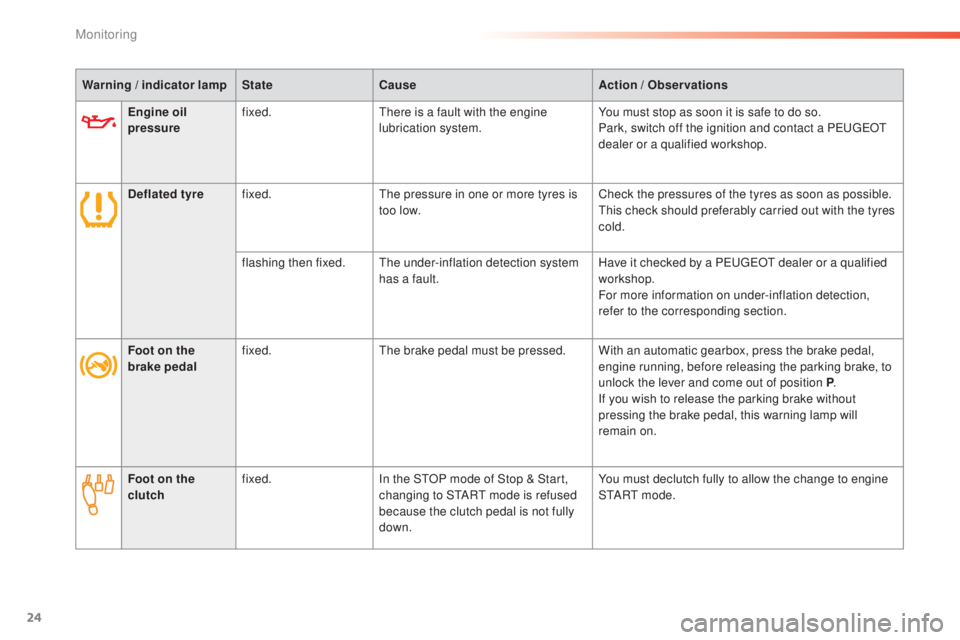
Engine oil
pressurefixed.th
ere is a fault with the engine
lubrication system. You must stop as soon it is safe to do so.
Park, switch off the ignition and contact a Pe
ugeOt
dealer or a qualified workshop.
Deflated tyre fixed.
th
e pressure in one or more tyres is
too low. Check the pressures of the tyres as soon as possible.
th
is check should preferably carried out with the tyres
cold.
flashing then fixed.
th
e under-inflation detection system
has a fault. Have it checked by a P
e
uge
Ot
dealer or a qualified
workshop.
For more information on under-inflation detection,
refer to the corresponding section.
Warning
/ indicator lamp
State Cause Action
/ Observations
Foot on the
brake pedal fixed.
th
e brake pedal must be pressed. With an automatic gearbox, press the brake pedal, engine running, before releasing the parking brake, to
unlock the lever and come out of position P .
If you wish to release the parking brake without
pressing the brake pedal, this warning lamp will
remain on.
Foot on the
clutch fixed.
In the S
tO
P mode of Stop & Start,
changing to S
tA
R
t
mode is refused
because the clutch pedal is not fully
down. You must declutch fully to allow the change to engine
S
t
A R
t m
o d e .
Monitoring
Page 115 of 416
113
308_en_Chap04_conduite_ed01-2015
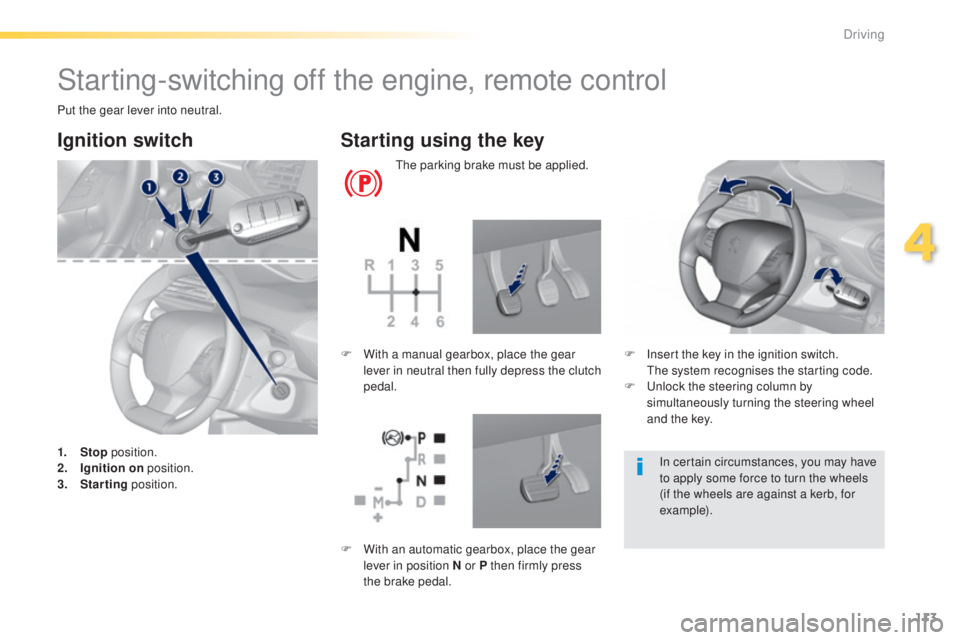
Starting-switching off the engine, remote control
Put the gear lever into neutral.
Ignition switch
1. Stop position.
2. I gnition on position.
3.
S
tarting position.
Starting using the key
the parking brake must be applied.
F
I
nsert the key in the ignition switch.
t
h
e system recognises the starting code.
F
u
n
lock the steering column by
simultaneously turning the steering wheel
and the key.
F
W
ith a manual gearbox, place the gear
lever in neutral then fully depress the clutch
pedal.
In certain circumstances, you may have
to apply some force to turn the wheels
(if the wheels are against a kerb, for
example).
F
W
ith an automatic gearbox, place the gear
lever in position N or P then firmly press
the brake pedal.
4
Driving
Page 117 of 416
115
308_en_Chap04_conduite_ed01-2015
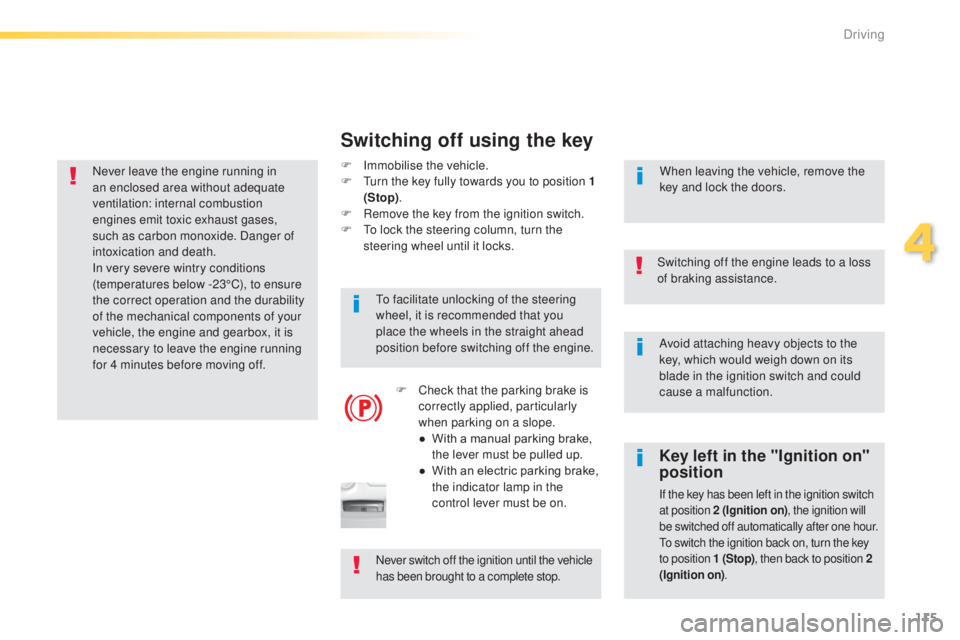
Avoid attaching heavy objects to the
key, which would weigh down on its
blade in the ignition switch and could
cause a malfunction.
Switching off the engine leads to a loss
of braking assistance.
Key left in the "Ignition on"
position
If the key has been left in the ignition switch
at position 2 (Ignition on)
, the ignition will
be switched off automatically after one hour.
to s
witch the ignition back on, turn the key
to position 1 (Stop) , then back to position 2
(Ignition on) .
Never leave the engine running in
an enclosed area without adequate
ventilation: internal combustion
engines emit toxic exhaust gases,
such as carbon monoxide. Danger of
intoxication and death.
In very severe wintry conditions
(temperatures below -23°C), to ensure
the correct operation and the durability
of the mechanical components of your
vehicle, the engine and gearbox, it is
necessary to leave the engine running
for 4 minutes before moving off. F
Imm obilise the vehicle.
F tu rn the key fully towards you to position 1
(Stop) .
F
R
emove the key from the ignition switch.
F
t
o l
ock the steering column, turn the
steering wheel until it locks.
Switching off using the key
to facilitate unlocking of the steering
wheel, it is recommended that you
place the wheels in the straight ahead
position before switching off the engine.
F
C
heck that the parking brake is
correctly applied, particularly
when parking on a slope.
●
W
ith a manual parking brake,
the lever must be pulled up.
●
W
ith an electric parking brake,
the indicator lamp in the
control lever must be on. When leaving the vehicle, remove the
key and lock the doors.
Never switch off the ignition until the vehicle
has been brought to a complete stop.
4
Driving
Page 124 of 416
122
308_en_Chap04_conduite_ed01-2015
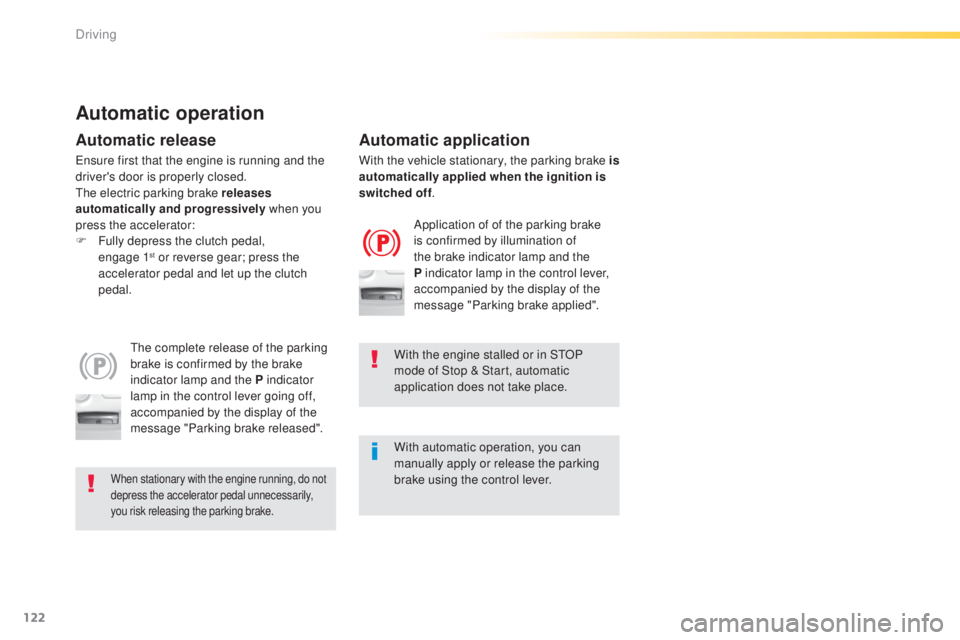
Automatic operation
Automatic release
the complete release of the parking
brake is confirmed by the brake
indicator lamp and the P indicator
lamp in the control lever going off,
accompanied by the display of the
message "Parking brake released".
When stationary with the engine running, do not
depress the accelerator pedal unnecessarily,
you risk releasing the parking brake.
Automatic application
Application of of the parking brake
is confirmed by illumination of
the brake indicator lamp and the
P indicator lamp in the control lever,
accompanied by the display of the
message "Parking brake applied".
With the engine stalled or in S
tO
P
mode of Stop & Start, automatic
application does not take place.
With automatic operation, you can
manually apply or release the parking
brake using the control lever.
en
sure first that the engine is running and the
driver's door is properly closed.
th
e electric parking brake releases
automatically and progressively when you
press the accelerator:
F
F
ully depress the clutch pedal,
engage
1
st or reverse gear; press the
a
ccelerator pedal and let up the clutch
pedal. With the vehicle stationary, the parking brake is
automatically applied when the ignition is
switched off
.
Driving