Battery Peugeot 308 2016 User Guide
[x] Cancel search | Manufacturer: PEUGEOT, Model Year: 2016, Model line: 308, Model: Peugeot 308 2016Pages: 398, PDF Size: 9.38 MB
Page 64 of 398
62
308_en_Chap02_ouvertures_ed02-2015
Changing the cell battery
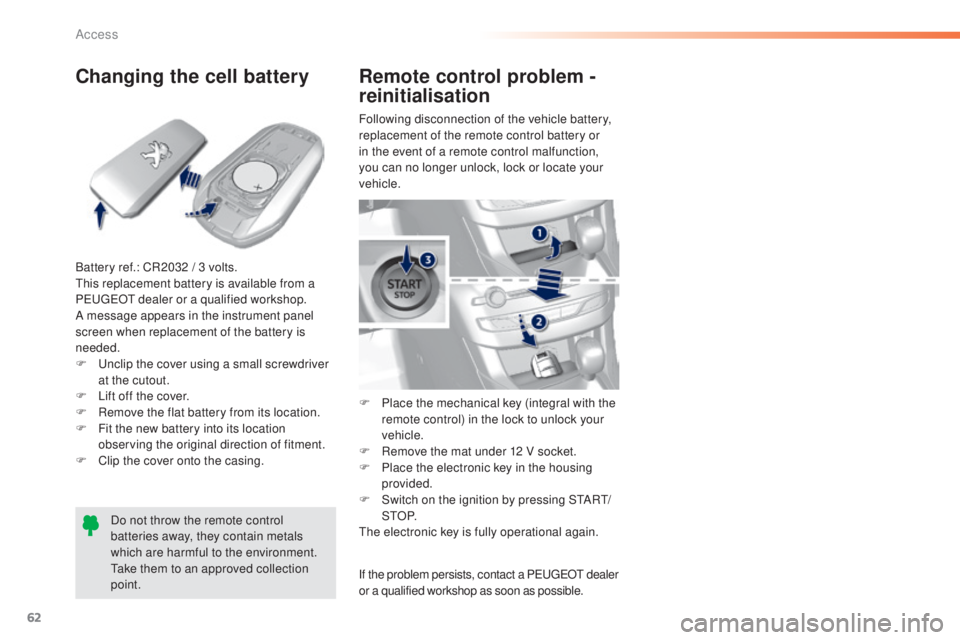
Battery ref.: CR2032 / 3 volts.this replacement battery is available from a
P
eu
ge
Ot d
ealer or a qualified workshop.
A message appears in the instrument panel
screen when replacement of the battery is
needed.
F
u
nc
lip the cover using a small screwdriver
at the cutout.
F
Li
ft off the cover.
F
Re
move the flat battery from its location.
F
Fi
t the new battery into its location
observing the original direction of fitment.
F
Cl
ip the cover onto the casing.Do not throw the remote control
batteries away, they contain metals
which are harmful to the environment.
tak
e them to an approved collection
point. Following disconnection of the vehicle battery,
replacement of the remote control battery or
in the event of a remote control malfunction,
you can no longer unlock, lock or locate your
vehicle.
F
Pl
ace the mechanical key (integral with the
remote control) in the lock to unlock your
vehicle.
F
Re
move the mat under 12 V socket.
F
Pl
ace the electronic key in the housing
provided.
F
Sw
itch on the ignition by pressing S
tARt/
StO P.the
electronic key is fully operational again.
Remote control problem -
reinitialisation
If the problem persists, contact a PeugeOt d ealer
or a qualified workshop as soon as possible.
Access
Page 67 of 398
65
308_en_Chap02_ouvertures_ed02-2015
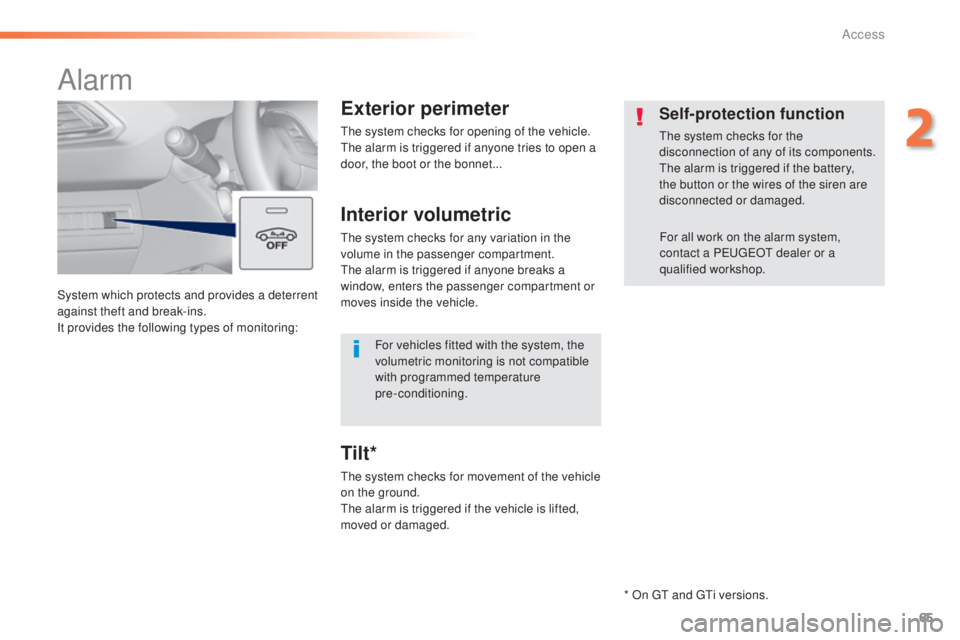
System which protects and provides a deterrent
against theft and break-ins.
It provides the following types of monitoring:
Alarm
Exterior perimeter
the system checks for opening of the vehicle.the alarm is triggered if anyone tries to open a
door, the boot or the bonnet...
Self-protection function
the system checks for the
d isconnection of any of its components.
the a
larm is triggered if the battery,
the button or the wires of the siren are
disconnected or damaged.
For all work on the alarm system,
contact a P
eu
ge
Ot d
ealer or a
qualified workshop.
Interior volumetric
the system checks for any variation in the
v olume in the passenger compartment.
the a
larm is triggered if anyone breaks a
window, enters the passenger compartment or
moves inside the vehicle.
the s
ystem checks for movement of the vehicle
on the ground.
the a
larm is triggered if the vehicle is lifted,
moved or damaged.
Tilt*
For vehicles fitted with the system, the
volumetric monitoring is not compatible
with programmed temperature
pre-conditioning.
* On
g
t
a
nd
g
t
i ve
rsions.
2
Access
Page 72 of 398
70
308_en_Chap02_ouvertures_ed02-2015
Reinitialising the electric
windows
Always remove the key when leaving
the vehicle, even for a short time.
In the event of contact during operation
of the windows, you must reverse the
movement of the window.
to do t
his,
press the switch concerned.
When operating the passenger electric
window switches, the driver must
ensure that no one is preventing correct
closing of the windows.
the d
river must ensure that the
passengers use the electric windows
c o r r e c t l y.
Be aware of children when operating
the windows.
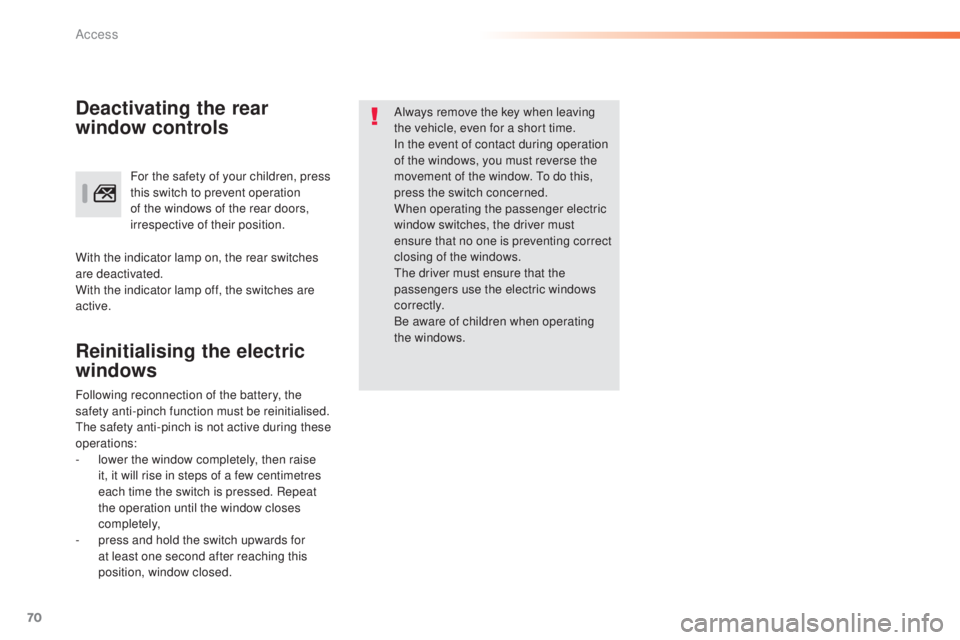
For the safety of your children, press
this switch to prevent operation
of the windows of the rear doors,
irrespective of their position.Deactivating the rear
window controls
With the indicator lamp on, the rear switches
are deactivated.
With the indicator lamp off, the switches are
active.
Following reconnection of the battery, the
safety anti-pinch function must be reinitialised.
the s
afety anti-pinch is not active during these
operations:
-
lo
wer the window completely, then raise
it, it will rise in steps of a few centimetres
each time the switch is pressed. Repeat
the operation until the window closes
completely,
-
pr
ess and hold the switch upwards for
at least one second after reaching this
position, window closed.
Access
Page 75 of 398
73
308_en_Chap03_ergonomie-et-confort_ed02-2015
electric driver's seat
Forwards-backwardsSeat backrest angleSeat cushion height and
angle
to avoid discharging the battery, carry out
t hese adjustments with the engine running.
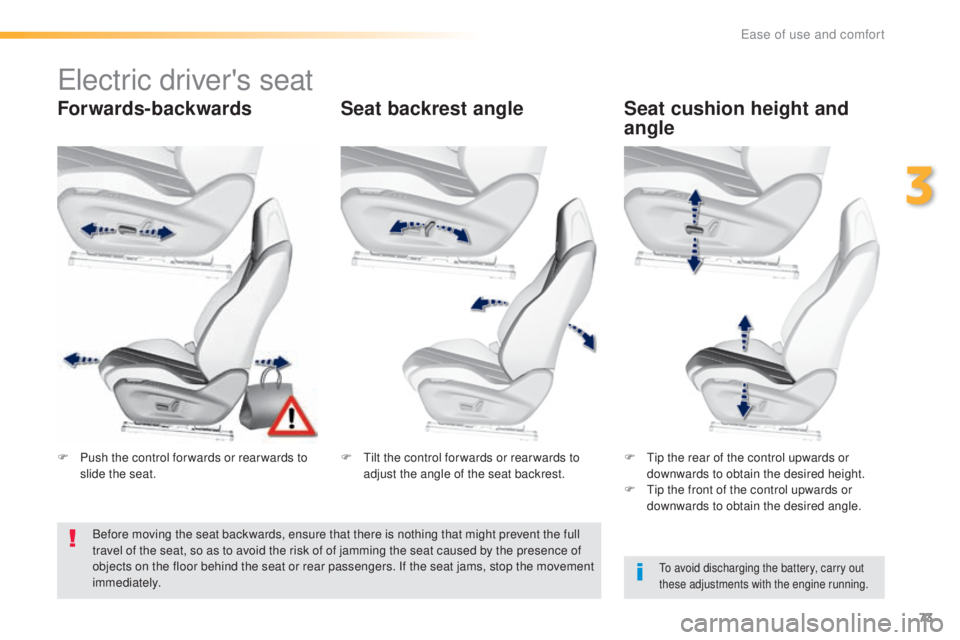
F Push the control for wards or rear wards to
sl ide the seat. F
til t the control for wards or rear wards to
adjust the angle of the seat backrest. F
tip t he rear of the control upwards or
downwards to obtain the desired height.
F
t
ip t
he front of the control upwards or
downwards to obtain the desired angle.
Before moving the seat backwards, ensure that there is nothing that might prevent the full
travel of the seat, so as to avoid the risk of of jamming the seat caused by the presence of
objects on the floor behind the seat or rear passengers. If the seat jams, stop the movement
immediately.
3
ease of use and comfort
Page 101 of 398
99
308_en_Chap03_ergonomie-et-confort_ed02-2015
"Mono" function
the comfort setting for the passenger's side
c an be indexed to the driver's comfort setting
(mono-zone).
From the secondary page of the " Air
conditioning " menu:
F
Pr
ess this button to activate /
deactivate the "Mono" function.
the i
ndicator lamp in the button
is on when the function is
activated.
the f
unction is deactivated automatically when
the passenger uses their temperature setting
buttons.
It allows you:
-
in s
ummer, to lower the temperature,
-
in w
inter, above 3 °C, to improve demisting.
Switching off Switching on
Air conditioning On/Off
the air conditioning is designed to
o perate efficiently in all seasons, with
the windows closed.
Ventilation with "ignition
on" function
With the ignition on, you can use the
ventilation system and have access to the
" Air conditioning " menu to adjust the air
flow and air distribution in the passenger
compartment.
thi
s function is available for a few minutes,
depending on the state of charge of the battery
of your vehicle.
thi
s function does not activate the air
conditioning.
You can make use of the residual heat in the
engine to warm the passenger compartment
using the temperature setting buttons.
F
Pr
ess the " A/C" button to activate the air
conditioning.
When the indicator lamp under the button is on,
the air conditioning function is activated.
the a
ir conditioning cannot operate when the
air flow is set to off.
F
Pr
ess the "A /C " button again to deactivate
the air conditioning.
When the indicator lamp under the button is off,
the air conditioning function is deactivated.
3
ease of use and comfort
Page 113 of 398
111
308_en_Chap04_eclairage-et-visibilite_ed02-2015
In good or rainy weather, both day
and night, the front foglamps and the
rear foglamps are prohibited. In these
situations, the power of their beams
may dazzle other drivers.
they
should
only be used in fog or snow.
In these weather conditions, it is your
responsibility to switch on the foglamps
and dipped headlamps manually as the
sunshine sensor may detect sufficient
light.
Do not forget to switch off the front
foglamps and the rear foglamps when
they are no longer needed.Lighting left on audible signal
An audible signal when a front door
is opened warns the driver that the
vehicle's exterior lighting is on, with the
ignition off and in manual lighting mode.
In this case, switching off the lighting
stops the audible signal.
With the ignition off, if the dipped
headlamps remain on, the vehicle goes
into "
eCO
" mode to avoid discharging
the battery.
the l
ighting goes off when you switch
off the ignition, but you can always
switch it on again using the lighting
control stalk.
Direction indicators
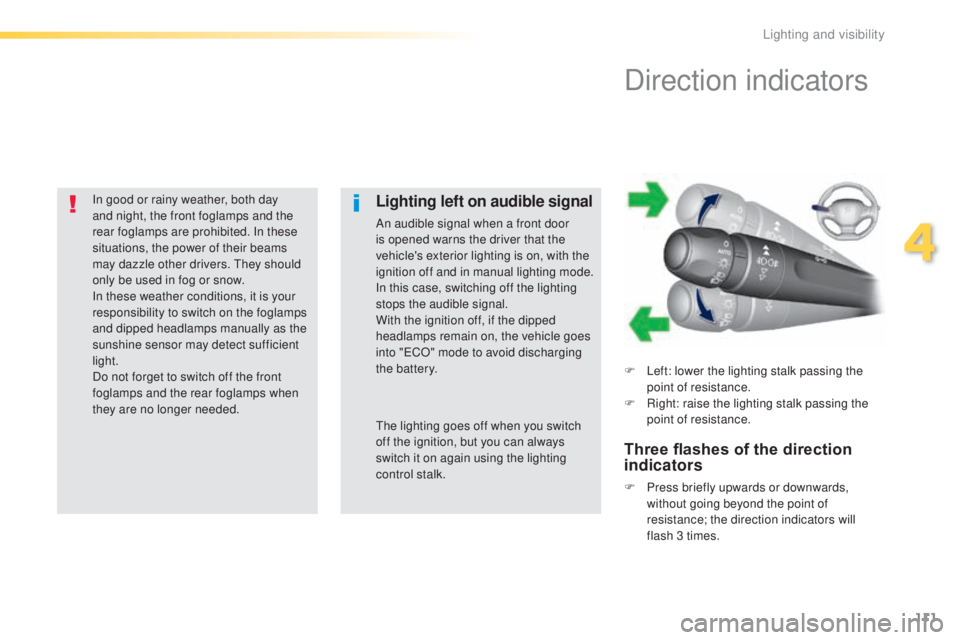
F Left: lower the lighting stalk passing the
p oint of resistance.
F
Ri
ght: raise the lighting stalk passing the
point of resistance.
Three flashes of the direction
indicators
F Press briefly upwards or downwards,
w ithout going beyond the point of
resistance; the direction indicators will
flash 3 times.
4
Lighting and visibility
Page 154 of 398
152
308_en_Chap06_conduite_ed02-2015
If the vehicle is not immobilised,
the engine will not stop.
Switching off
F Immobilise the vehicle.F
Wi
th the electronic key inside
the vehicle, press the " S TA R T/
STOP " button.
the e
ngine stops and the steering column is
locked.
Ignition on position
(accessories)
If you use the accessory position for too
long, the system automatically goes into
economy mode to avoid the risk of a flat
battery.
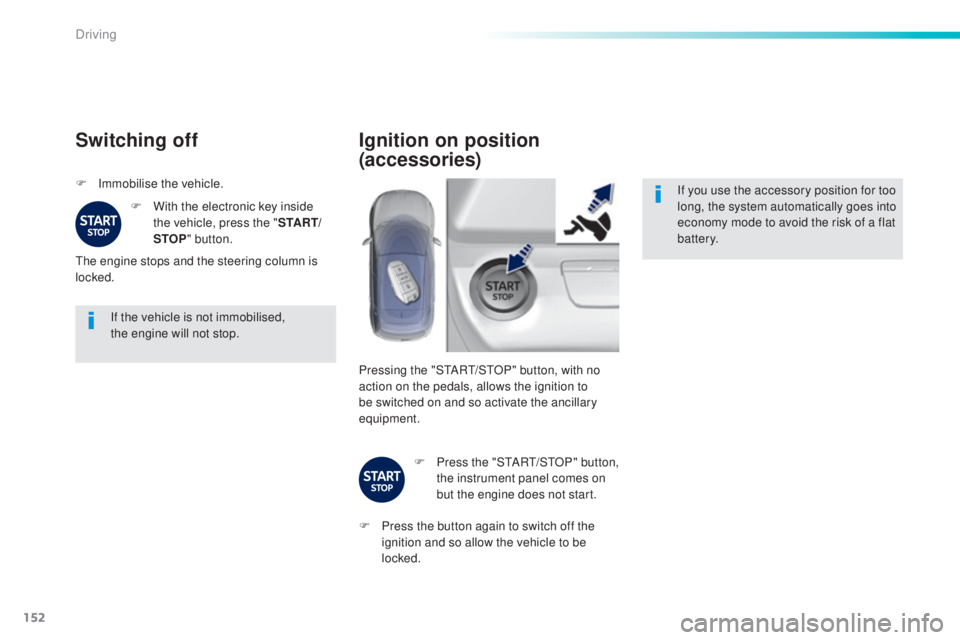
Pressing the "S
tARt/StOP
" button, with no
action on the pedals, allows the ignition to
be switched on and so activate the ancillary
equipment.
F
Pr
ess the "S
tARt/StOP
" button,
the instrument panel comes on
but the engine does not start.
F
Pr
ess the button again to switch off the
ignition and so allow the vehicle to be
locked.
Driving
Page 157 of 398
155
308_en_Chap06_conduite_ed02-2015
electric parking brake
Never leave a child alone inside the
vehicle with the ignition on, as they
could release the parking brake.
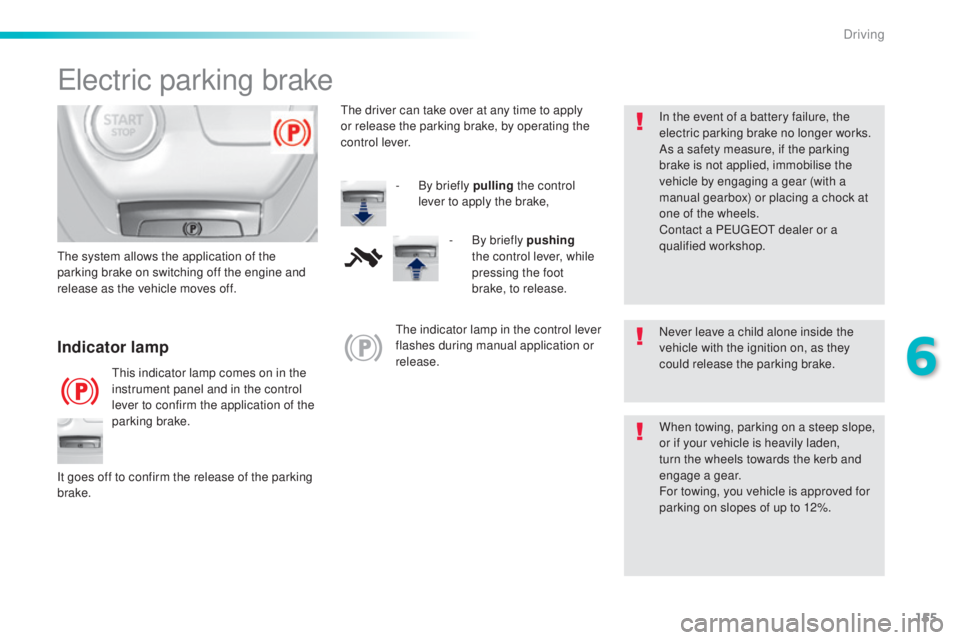
Indicator lamp
this indicator lamp comes on in the
i nstrument panel and in the control
lever to confirm the application of the
parking brake.
the s
ystem allows the application of the
parking brake on switching off the engine and
release as the vehicle moves off.
When towing, parking on a steep slope,
or if your vehicle is heavily laden,
turn the wheels towards the kerb and
engage a gear.
For towing, you vehicle is approved for
parking on slopes of up to 12%.
It goes off to confirm the release of the parking
brake.
the i
ndicator lamp in the control lever
flashes during manual application or
release. In the event of a battery failure, the
electric parking brake no longer works.
As a safety measure, if the parking
brake is not applied, immobilise the
vehicle by engaging a gear (with a
manual gearbox) or placing a chock at
one of the wheels.
Contact a P
eu
ge
Ot d
ealer or a
qualified workshop.
the d
river can take over at any time to apply
or release the parking brake, by operating the
control lever.
-
By b
riefly pulling
the control
lever to apply the brake,
-
By b
riefly pushing
the control lever, while
pressing the foot
brake, to release.
6
Driving
Page 163 of 398
161
308_en_Chap06_conduite_ed02-2015
SituationConsequences
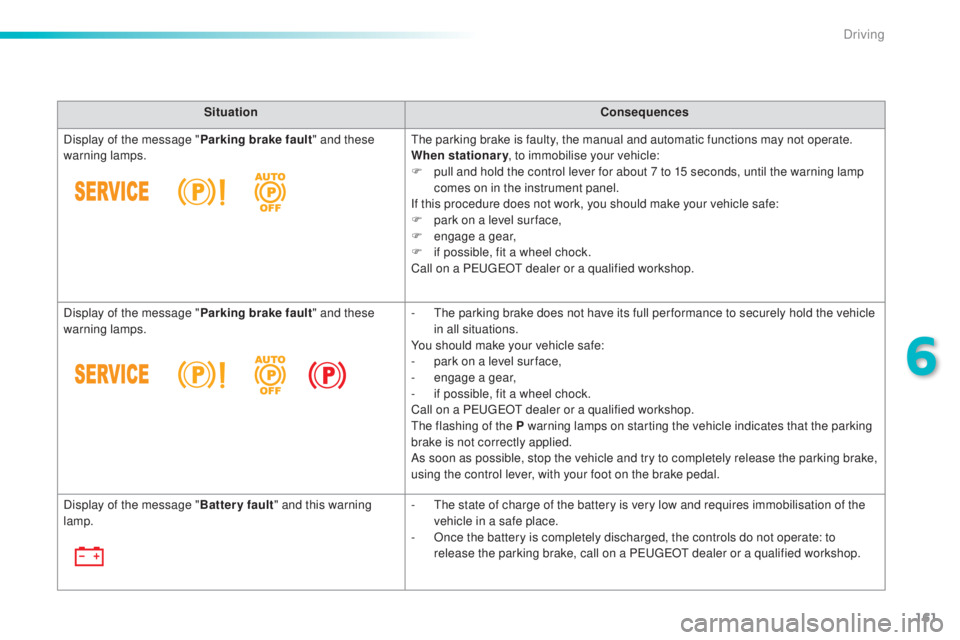
Display of the message " Parking brake fault" and these
warning lamps.
the p
arking brake is faulty, the manual and automatic functions may not operate.
When stationary , to immobilise your vehicle:
F
pu
ll and hold the control lever for about 7 to 15 seconds, until the warning lamp
comes on in the instrument panel.
If this procedure does not work, you should make your vehicle safe:
F
pa
rk on a level sur face,
F
engag
e a gear,
F
if p
ossible, fit a wheel chock.
Call on a P
eu
ge
Ot d
ealer or a qualified workshop.
Display of the message " Parking brake fault" and these
warning lamps. -
t
he p
arking brake does not have its full per formance to securely hold the vehicle
in all situations.
You should make your vehicle safe:
-
pa
rk on a level sur face,
-
engag
e a gear,
-
if p
ossible, fit a wheel chock.
Call on a P
eu
ge
Ot d
ealer or a qualified workshop.
the f
lashing of the P warning lamps on starting the vehicle indicates that the parking
brake is not correctly applied.
As soon as possible, stop the vehicle and try to completely release the parking brake,
using the control lever, with your foot on the brake pedal.
Display of the message " Battery fault" and this warning
lamp. -
t
he s
tate of charge of the battery is very low and requires immobilisation of the
vehicle in a safe place.
-
On
ce the battery is completely discharged, the controls do not operate: to
release the parking brake, call on a P
eu
ge
Ot d
ealer or a qualified workshop.
6
Driving
Page 170 of 398
168
308_en_Chap06_conduite_ed02-2015
F Select position M for sequential c hanging
of the six gears.
F
Pu
ll towards the + sign and release to
change up a gear.
F
Pu
sh towards the - sign and release to
change down a gear.
It is only possible to change from one gear to
another if the vehicle speed and engine speed
permit; otherwise, the gearbox will operate
temporarily in automatic mode.
D disappears and the gears
engaged appear in succession in the
instrument panel.
If the engine speed is too low or too high, the
gear selected flashes for a few seconds, then
the actual gear engaged is displayed.
It is possible to change from position D
(automatic) to position M (manual) at any time.
When the vehicle is stationary or moving
very slowly, the gearbox selects gear M1
automatically.
the s
port and snow programmes do not
operate in manual mode.
Manual operation
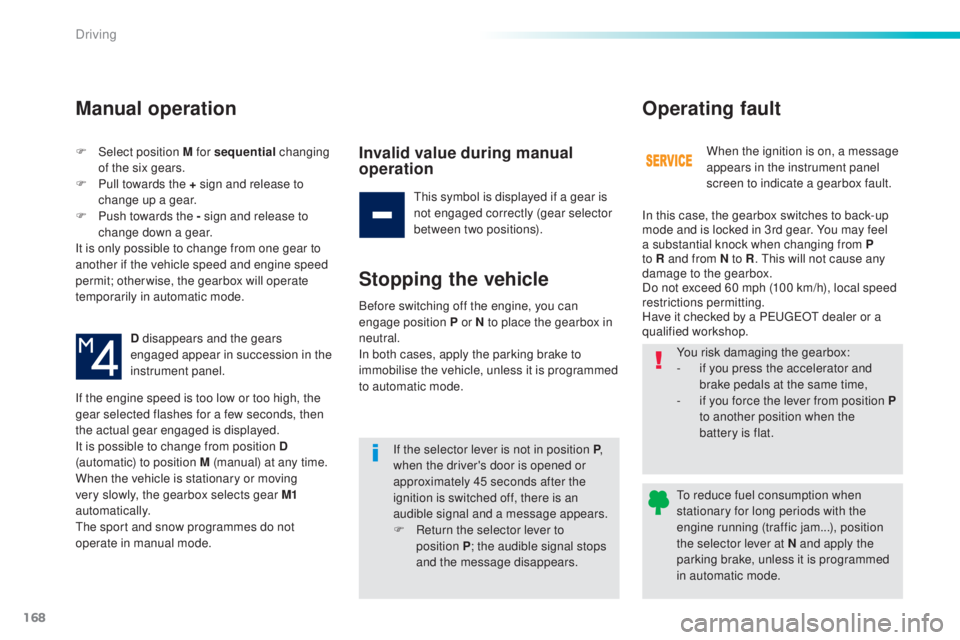
Invalid value during manual
operation
this symbol is displayed if a gear is
n ot engaged correctly (gear selector
between two positions).
Stopping the vehicle
If the selector lever is not in position P ,
when the driver's door is opened or
approximately 45 seconds after the
ignition is switched off, there is an
audible signal and a message appears.
F
Re
turn the selector lever to
position
P ; t
he audible signal stops
and the message disappears. When the ignition is on, a message
appears in the instrument panel
screen to indicate a gearbox fault.
Operating fault
In this case, the gearbox switches to back-up
mode and is locked in 3rd gear. You may feel
a substantial knock when changing from P
to R and from N to R
.
thi
s will not cause any
damage to the gearbox.
Do not exceed 60 mph (100 km/h), local speed
restrictions permitting.
Have it checked by a P
eu
ge
Ot d
ealer or a
qualified workshop.
Before switching off the engine, you can
engage position P or N to place the gearbox in
neutral.
In both cases, apply the parking brake to
immobilise the vehicle, unless it is programmed
to automatic mode. You risk damaging the gearbox:
-
if y
ou press the accelerator and
brake pedals at the same time,
-
if y
ou force the lever from position
P
to another position when the
battery is flat.
to re
duce fuel consumption when
stationary for long periods with the
engine running (traffic jam...), position
the selector lever at N and apply the
parking brake, unless it is programmed
in automatic mode.
Driving