DOORS Peugeot 308 2016 User Guide
[x] Cancel search | Manufacturer: PEUGEOT, Model Year: 2016, Model line: 308, Model: Peugeot 308 2016Pages: 398, PDF Size: 9.38 MB
Page 72 of 398
70
308_en_Chap02_ouvertures_ed02-2015
Reinitialising the electric
windows
Always remove the key when leaving
the vehicle, even for a short time.
In the event of contact during operation
of the windows, you must reverse the
movement of the window.
to do t
his,
press the switch concerned.
When operating the passenger electric
window switches, the driver must
ensure that no one is preventing correct
closing of the windows.
the d
river must ensure that the
passengers use the electric windows
c o r r e c t l y.
Be aware of children when operating
the windows.
For the safety of your children, press
this switch to prevent operation
of the windows of the rear doors,
irrespective of their position.Deactivating the rear
window controls
With the indicator lamp on, the rear switches
are deactivated.
With the indicator lamp off, the switches are
active.
Following reconnection of the battery, the
safety anti-pinch function must be reinitialised.
the s
afety anti-pinch is not active during these
operations:
-
lo
wer the window completely, then raise
it, it will rise in steps of a few centimetres
each time the switch is pressed. Repeat
the operation until the window closes
completely,
-
pr
ess and hold the switch upwards for
at least one second after reaching this
position, window closed.
Access
Page 107 of 398
105
308_en_Chap03_ergonomie-et-confort_ed02-2015
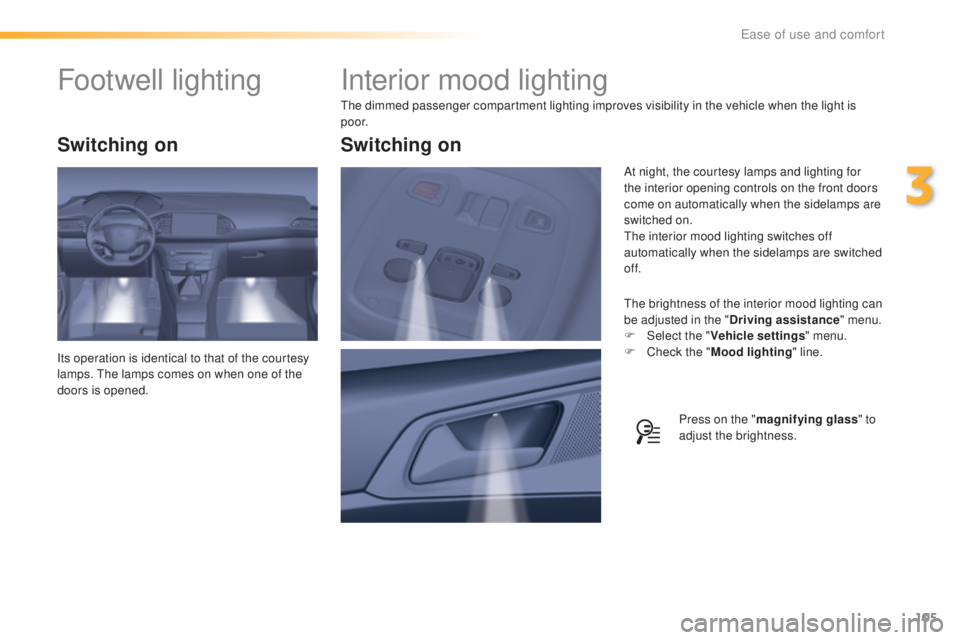
Interior mood lighting
the dimmed passenger compartment lighting improves visibility in the vehicle when the light is
p o o r.
the b
rightness of the interior mood lighting can
be adjusted in the " Driving assistance " menu.
F
Selec
t the "Vehicle settings " menu.
F
Ch
eck the "Mood lighting " line.
At night, the courtesy lamps and lighting for
the interior opening controls on the front doors
come on automatically when the sidelamps are
switched on.
the
interior mood lighting switches off
automatically when the sidelamps are switched
of f.
Switching on
Footwell lighting
Its operation is identical to that of the courtesy
lamps. the l amps comes on when one of the
doors is opened.
Switching on
Press on the " magnifying glass " to
adjust the brightness.
3
ease of use and comfort
Page 116 of 398
114
308_en_Chap04_eclairage-et-visibilite_ed02-2015
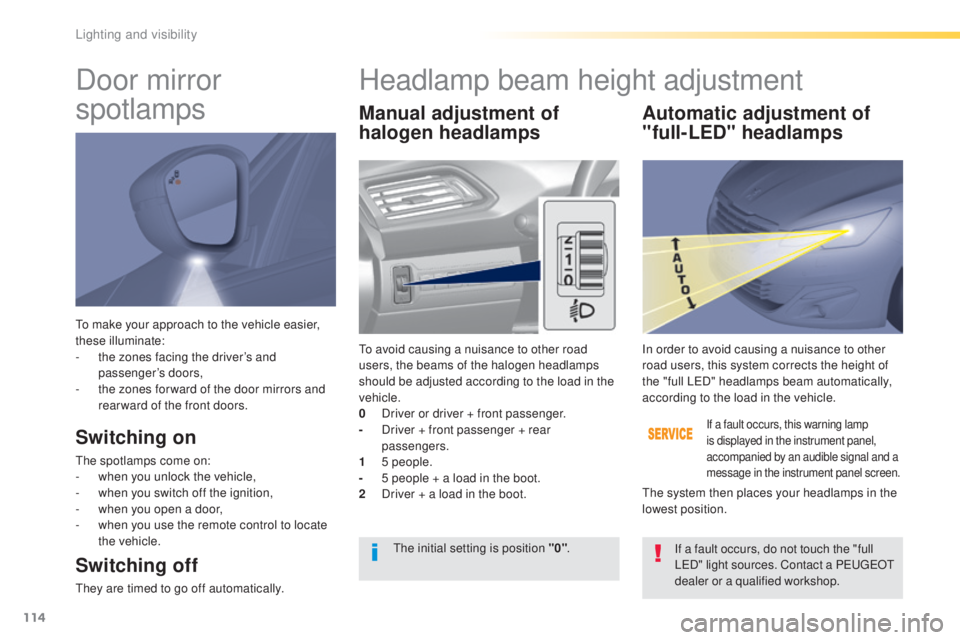
to make your approach to the vehicle easier,
t hese illuminate:
-
th
e zones facing the driver’s and
passenger’s doors,
-
th
e zones for ward of the door mirrors and
rear ward of the front doors.
Door mirror
spotlamps
Switching on
the spotlamps come on:
- wh en you unlock the vehicle,
-
wh
en you switch off the ignition,
-
wh
en you open a door,
-
wh
en you use the remote control to locate
the vehicle.
Switching off
they are timed to go off automatically.
Manual adjustment of
halogen headlamps Automatic adjustment of
"full-LED" headlamps
to avoid causing a nuisance to other road
u sers, the beams of the halogen headlamps
should be adjusted according to the load in the
vehicle.
0
Dr
iver or driver + front passenger.
-
Dr
iver + front passenger + rear
passengers.
1
5 p
eople.
-
5 pe
ople + a load in the boot.
2
Dr
iver + a load in the boot.
If a fault occurs, this warning lamp
is displayed in the instrument panel,
accompanied by an audible signal and a
message in the instrument panel screen.
In order to avoid causing a nuisance to other
road users, this system corrects the height of
the "full L
eD"
headlamps beam automatically,
according to the load in the vehicle.
the s
ystem then places your headlamps in the
lowest position.
the i
nitial setting is position "0" .
If a fault occurs, do not touch the "full
L
eD" l
ight sources. Contact a P
eu
ge
Ot
de
aler or a qualified workshop.
Headlamp beam height adjustment
Lighting and visibility
Page 146 of 398
144
308_en_Chap05_securite_ed02-2015
Child seatsInstalling a booster
cushion
Recommendations
the legislation on carrying a child on the
f ront passenger seat is specific to each
country. Refer to the legislation in force in
the country in which you are driving.
Deactivate the passenger's front airbag
when a rear ward facing child seat is installed
on the front passenger seat. Otherwise, the
child would risk being seriously injured or
killed if the airbag were deployed. For optimum installation of the forward facing
child seat, ensure that the back of the child
seat is as close as possible to the backrest
of the vehicle's seat, or in contact if possible.
the h
ead restraint must be removed before
installing a child seat with a backrest on the
passenger seat.
ens
ure that the head restraint is stowed or
attached securely so that it is not thrown
around the vehicle in the event of sharp
braking.
Refit the head restraint as soon as the child
seat is removed.
the i
ncorrect installation of a child seat in a
vehicle compromises the child's protection in
the event of an accident.
Check that there is no seat belt or seat belt
buckle under the child seat as this could
destabilise it.
Remember to fasten the seat belts or the
child seat harnesses keeping the slack in
relation to the child's body to a minimum ,
even for short journeys.
For the installation of a child seat using a
seat belt, ensure that this is well tensioned
on the child seat and that it is holding the
child seat firmly against the seat of your
vehicle. If your front passenger seat is
adjustable, move it forward if necessary.
At the rear seats, always leave sufficient
space between the front seat and:
-
a re
ar ward facing child seat,
-
th
e feet of a child seated in a for ward
facing child seat.
For this, move the front seat for ward and if
necessary straighten its backrest.
Children at the front
the chest part of the seat belt must be
p ositioned on the child's shoulder without
touching the neck.
ens
ure that the lap part of the seat belt
passes correctly over the child's thighs.
P
eu
ge
Ot r
ecommends the use of a booster
seat which has a back, fitted with a seat belt
guide at shoulder level.
As a safety precaution, do not leave:
-
on
e or more children alone and
unsupervised in a vehicle,
-
a ch
ild or an animal in a vehicle which
is exposed to the sun, with the windows
closed,
-
th
e keys within reach of children inside
the vehicle.
to pr
event accidental opening of the doors,
use the child lock.
tak
e care not to open the rear windows by
more than one third.
to pr
otect young children from the rays of
the sun, fit side blinds on the rear windows.
Safety
Page 152 of 398
150
308_en_Chap06_conduite_ed02-2015
Avoid attaching heavy objects to the
key, which would weigh down on its
blade in the ignition switch and could
cause a malfunction.
Switching off the engine leads to a loss
of braking assistance.
Key left in the "Ignition on"
position
If the key has been left in the ignition switch
at position 2 (Ignition on)
, the ignition will
be switched off automatically after one hour.
to sw
itch the ignition back on, turn the
key to position 1 (Stop) , then back to
position
2 (
Ignition on) .
Never leave the engine running in
an enclosed area without adequate
ventilation: internal combustion
engines emit toxic exhaust gases,
such as carbon monoxide. Danger of
intoxication and death.
In very severe wintry conditions
(temperatures below -23°C), to ensure
the correct operation and the durability
of the mechanical components of your
vehicle, the engine and gearbox, it is
necessary to leave the engine running
for 4 minutes before moving off. F Immo
bilise the vehicle.
F tur n the key fully towards you to
position
1 (
Stop).
F
Re
move the key from the ignition switch.
F
t
o lo
ck the steering column, turn the
steering wheel until it locks.
Switching off using the key
to facilitate unlocking of the steering
w heel, it is recommended that you
place the wheels in the straight ahead
position before switching off the engine.
F
Ch
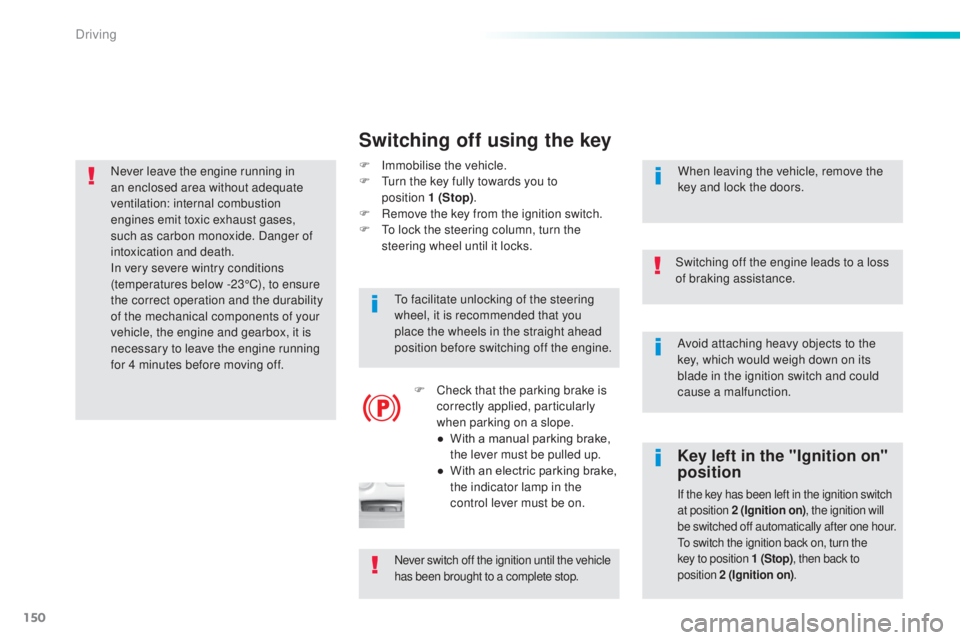
eck that the parking brake is
correctly applied, particularly
when parking on a slope.
●
Wi
th a manual parking brake,
the lever must be pulled up.
●
Wi
th an electric parking brake,
the indicator lamp in the
control lever must be on. When leaving the vehicle, remove the
key and lock the doors.
Never switch off the ignition until the vehicle
has been brought to a complete stop.
Driving
Page 159 of 398
157
308_en_Chap06_conduite_ed02-2015
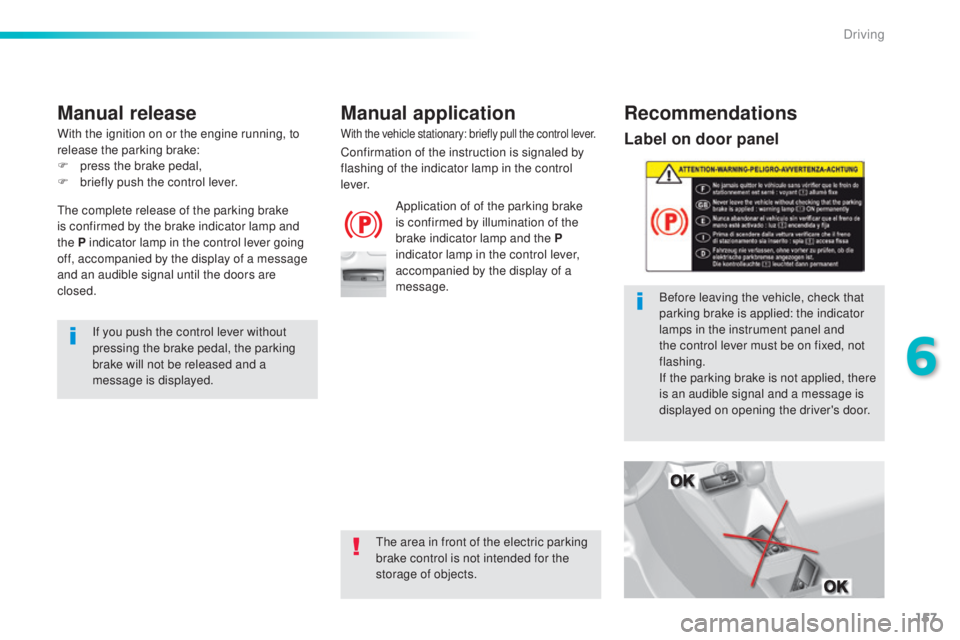
Label on door panel
Before leaving the vehicle, check that
parking brake is applied: the indicator
lamps in the instrument panel and
the control lever must be on fixed, not
flashing.
If the parking brake is not applied, there
is an audible signal and a message is
displayed on opening the driver's door.
Application of of the parking brake
is confirmed by illumination of the
brake indicator lamp and the P
indicator lamp in the control lever,
accompanied by the display of a
message.
Manual release
If you push the control lever without
pressing the brake pedal, the parking
brake will not be released and a
message is displayed.
With the vehicle stationary: briefly pull the control lever.
Confirmation of the instruction is signaled by
flashing of the indicator lamp in the control
l eve r.
With the ignition on or the engine running, to
release the parking brake:
F pr
ess the brake pedal,
F
br
iefly push the control lever.
Manual application Recommendations
the area in front of the electric parking
b rake control is not intended for the
storage of objects.
the c
omplete release of the parking brake
is confirmed by the brake indicator lamp and
the
P
indicator lamp in the control lever going
off, accompanied by the display of a message
and an audible signal until the doors are
closed.
6
Driving
Page 275 of 398
273
308_en_Chap08_en-cas-de-panne_ed02-2015
Starting using another battery
First check that the slave battery has a
nominal voltage of 12 V and a capacity
at least equal to that of the discharged
battery.
Do not try to start the engine by
connecting a battery charger.
Do not disconnect the (+) terminal when
the engine is running.
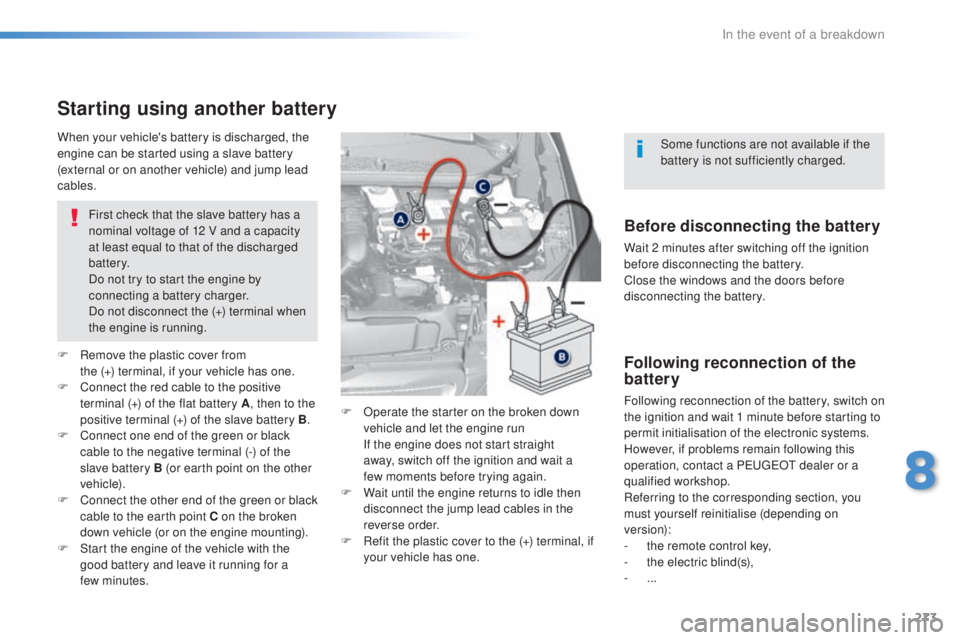
F
Re
move the plastic cover from
the
(
+)
t
erminal, if your vehicle has one.
F
Co
nnect the red cable to the positive
terminal (+) of the flat battery A , then to the
positive terminal (+) of the slave battery B.
F
Co
nnect one end of the green or black
cable to the negative terminal (-) of the
slave battery B (or earth point on the other
vehicle).
F
Co
nnect the other end of the green or black
cable to the earth point C on the broken
down vehicle (or on the engine mounting).
F
St
art the engine of the vehicle with the
good battery and leave it running for a
few
m
inutes. F
Op
erate the starter on the broken down
vehicle and let the engine run
If t
he engine does not start straight
away, switch off the ignition and wait a
few
m
oments before trying again.
F
Wa
it until the engine returns to idle then
disconnect the jump lead cables in the
reverse order.
F
Re
fit the plastic cover to the (+) terminal, if
your vehicle has one.
When your vehicle's battery is discharged, the
engine can be started using a slave battery
(external or on another vehicle) and jump lead
cables.Before disconnecting the battery
Wait 2 minutes after switching off the ignition
before disconnecting the battery.
Close the windows and the doors before
disconnecting the battery.
Following reconnection of the
battery
Following reconnection of the battery, switch on
the ignition and wait 1 minute before starting to
permit initialisation of the electronic systems.
However, if problems remain following this
operation, contact a P
eu
ge
Ot d
ealer or a
qualified workshop.
Referring to the corresponding section, you
must yourself reinitialise (depending on
version):
-
th
e remote control key,
-
th
e electric blind(s),
-
... S
ome functions are not available if the
battery is not sufficiently charged.
8
In the event of a breakdown
Page 385 of 398
383
308_en_Chap11_index-alpha_ed02-2015
ABS ...............................................................12 0
Accessories .............................. ....................220
Accessory position
....................................... 15
2
Additive, AdBlue
.............................. 26
, 235-241
Additive, Diesel
...............................
......232, 233
Adjusting headlamps
.................................... 11
4
Adjusting head restraints
....................................................... 75
Ad
justing seats
.......................................... 7
2, 73
Adjusting the air distribution
....................................... 93
, 95, 98
Adjusting the air flow
.......................... 9
2, 94, 98
Adjusting the date
..................................... 4
4 - 47
Adjusting the height and reach of the steering wheel
.................................... 71
Adj
usting the lumbar
support
.......................................................... 7
2
Adjusting the temperature
.............................. 96
Ad
justing the time
............................... 4
4, 45, 47
Advice on driving
..............................
....146, 147
Affaire version
............................................... 29
4
Airbags
...............
..................................... 23, 126
Airbags, curtain
..................................... 128
, 129
Airbags, front ......................................... 126, 129
Airbags, lateral
...................................... 12
8, 129
Air conditioning
............................ 1
0, 92, 94, 96
Air conditioning, digital
................................... 96
A
ir conditioning, manual
........................... 9
2, 94
Air intake
...............
........................................ 10 0
Air vents
..............................
............................90
Alarm
............................................................... 65
A
nti-lock braking system
(A BS)
...............
........................................... 120
Anti-pinch
................................................ 6
9, 103
Anti-theft
..............................
.............51, 63, 154
Armrest, front
............................................ 8
0, 82
Armrest, rear
................................................... 85
ASR ............................................................... 12
0
Assistance call
...............................
.......11 9 , 2 9 6 Assistance, emergency braking ...................
120
A
udible warning ............................................12
0
Audio streaming (Bluetooth)
................. 318
, 373
Auxiliary
.......................................... 8
3, 316, 371
A
B
C
Battery ....................................219, 233, 272-274
Battery, charging ............................... ............2 74
Battery, remote control
...................... 53
, 62, 63
Bicycle carrier
............................................... 2
24
Blanking screen (snow shield)
.............. 217
, 218
Blind, panoramic roof
.................................... 10
3
Blind spot sensors
.................................. 1
6, 195
BlueHDi
...............................
....................26, 235
Bluetooth (hands-free)
.......................... 3 5
0 , 374
Bluetooth (telephone)
............................ 3
5 0 , 374
Bonnet
...............
............................................ 226
Boot
........
................................................... 58, 59
Boot lamp
........................................................ 87
B
rake discs
.................................................... 234
B
rake lamps
...............................
...........261, 263
Brakes
............................................... 2
1, 24, 234
Braking, automatic on risk of collision
................
.........................22, 19 0, 193
Braking, dynamic emergency
....................... 15
9
Bulbs (changing)
................................... 2
56-265Cable, audio
..........................................
3
16 , 371
Capacity, fuel tank
........................................ 2
13
Cap, fuel filler
................................................ 2
13
CD
..............................
...........................
316 , 371
CD, MP3
................................................ 3 1
7, 3 7 2
Central locking
............................. 4
9, 54, 56, 57
Changing a bulb
.................................... 2
56-265
Changing a fuse
.................................... 2
6 6 -271
Changing a wheel
...............................
..
250-255
Changing a wiper blade
........................ 1
18, 222
Changing the remote control battery .........................................53, 62
Checking the engine oil level
.................. 3
1, 2 29
Checking the levels
............................... 2
29-232
Checking tyre pressures (using the kit) .............................................. 24 4
Checks ................................. 2
27, 228, 233, 234
Checks, routine .................................... 23
3, 234
Child lock
....................................................... 14
5
Children
.................................. 12
5, 127, 13 0 -14 5
Children (safety)
............................................ 14
5
Child seats
............................. 13 0
-132, 13 6, 141
Child seats, conventional
.............................. 13
6
Child seats, ISOFIX
...................................... 141
C
losing the boot
...............................
.........58, 59
Closing the doors
......................... 4
9, 54, 56, 57
Collision risk alert
......................................... 19
0
Compressor, tyre inflation
............................ 24
4
Configuration, vehicle
..................................... 42
C
onnection, Bluetooth
..........................3
5 0 , 374
Container, AdBlue
......................................... 23
9
Control, electric windows
................................ 69
C
ontrol, emergency boot release
...................60
C
ontrol, emergency door
................................61
C
ontrol, heated seats
......................................75
C
ontrol stalk, lighting
....................................108
C
ontrol stalk, wipers
.....................................11
5
Courtesy lamps
............................................. 10
4
Cover, load space
..................................... 87, 8
8
.
Alphabetical index
Page 388 of 398
386
308_en_Chap11_index-alpha_ed02-2015
Net, high load retaining ...................................89
N umber plate lamps ...................................... 265P
arking sensors, front ...................................19 8
Parking sensors, rear .................................... 198
P
eu
ge
Ot C
onnect Apps
.............................3
45
P
eu
ge
Ot C
onnect Assistance
...................29
6
P
eu
ge
Ot C
onnect Packs
...........................29
6
P
eu
ge
Ot C
onnect SOS
.............................296
Peu
ge
Ot C
onnect Sound (RD5)
................3
63
Plates, identification ...................................... 295
Player, Apple
® ....................................... 31 8, 373
Player, MP3 CD ............................... ......3 17, 3 7 2
Port,
uSB .................................. 80
, 83, 316, 370
Pressures, tyres
........................... 2
44, 249, 295
Pre-tensioning seat belts
.............................. 12
5
Priming the fuel system
................................ 2
77
Protecting children
................. 12
5, 127, 13 0 -14 5
Puncture
................
........................................ 244
Long objects, transporting
..............................
85
Lo
w fuel level
..............................
............
2 2, 213
Luggage retaining strap
............................ 8
6, 87
Lumbar
...............................
.......................
72, 76
Maintenance, routine
...................................... 10
M
ap reading lamps
....................................... 10
4
Markings, identification
................................. 29
5
Massage function
...............................
............. 76
Mat
.......
........................................................... 81
Memorising a speed
..................................... 17
3
Menu, main
..............................
..................... 366
Menus (audio)
...................... 3
06, 308, 310, 320,
322, 326, 346, 348
Menus (
touc
h screen)
................. 29
9, 304, 305
Mirror, rear view
............................................ 10
7
Mirrors, door .................................. 102, 10 6, 195
Misfuel prevention
......................................... 2
14
Mountings, Isofix
...............................
.... 13 9, 14 0
MP3 CD
................
................................. 3 17, 3 7 2Oil change
...............................
...................... 229
Oil consumption
............................................ 2
29
OIl, engine
...............................
...................... 229
Opening the bonnet
...................................... 226
O
pening the boot
................... 48
, 54, 56, 58, 59
Opening the doors
............................. 48
, 54, 56
Pads, brake
................................................... 23
4
Paint colour code
.......................................... 29
5
Panoramic glass sunroof
.............................. 10
3
Parcel shelf, rear
............................................. 86
Pa
rk Assist
...............................
............. 201-208
Parking brake
.................................. 15
, 15 4, 23 4
Parking brake, electric
................... 2
0, 155, 234 Radio
...............
...................................... 312, 3 6 6
Radio, digital (Digital Audio Broadcasting - DAB)
........................... 3
14, 3 6 8
Range, AdBlue
...............................
...............236
RDS
................
....................................... 313, 3 67
Rear screen, demisting
................................. 10
2
Recharging the battery
................................. 2 74
R
ecirculation, air
...............................
............10 0
Reduction of electrical load
.......................... 2
19
Regeneration of the particle filter
........
..................................................... 233
M
O
P
R
N
Alphabetical index