steering Peugeot 308 2016 User Guide
[x] Cancel search | Manufacturer: PEUGEOT, Model Year: 2016, Model line: 308, Model: Peugeot 308 2016Pages: 398, PDF Size: 9.38 MB
Page 131 of 398
129
308_en_Chap05_securite_ed02-2015
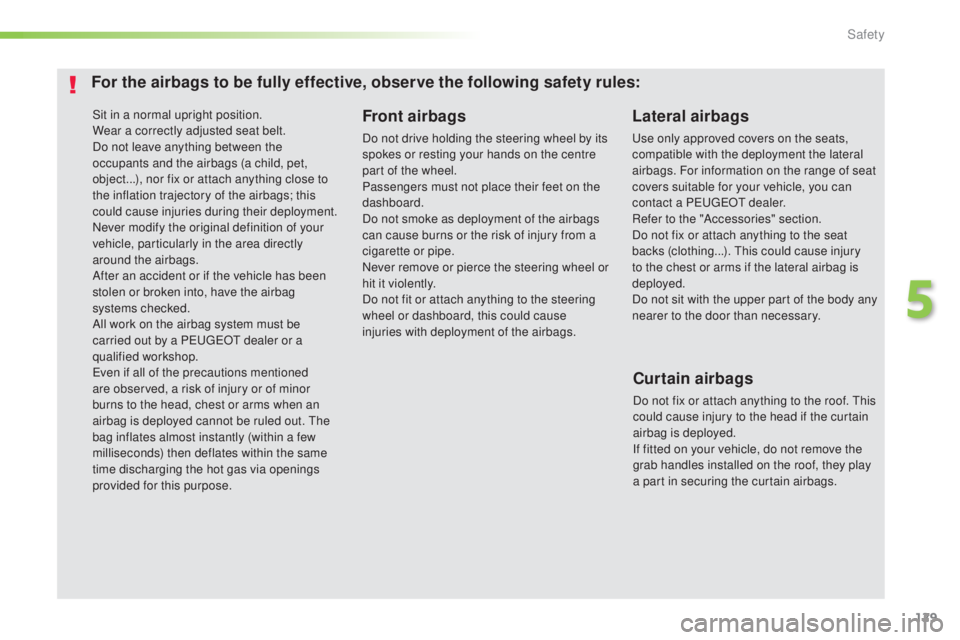
Sit in a normal upright position.
Wear a correctly adjusted seat belt.
Do not leave anything between the
occupants and the airbags (a child, pet,
object...), nor fix or attach anything close to
the inflation trajectory of the airbags; this
could cause injuries during their deployment.
Never modify the original definition of your
vehicle, particularly in the area directly
around the airbags.
After an accident or if the vehicle has been
stolen or broken into, have the airbag
systems checked.
All work on the airbag system must be
carried out by a P
eu
ge
Ot d
ealer or a
qualified workshop.
eve
n if all of the precautions mentioned
are observed, a risk of injury or of minor
burns to the head, chest or arms when an
airbag is deployed cannot be ruled out.
the
b
ag inflates almost instantly (within a few
milliseconds) then deflates within the same
time discharging the hot gas via openings
provided for this purpose.Lateral airbags
use only approved covers on the seats,
c ompatible with the deployment the lateral
airbags. For information on the range of seat
covers suitable for your vehicle, you can
contact a P
eu
ge
Ot d
ealer.
Refer to the "Accessories" section.
Do not fix or attach anything to the seat
backs (clothing...).
thi
s could cause injury
to the chest or arms if the lateral airbag is
deployed.
Do not sit with the upper part of the body any
nearer to the door than necessary.
Front airbags
Do not drive holding the steering wheel by its
spokes or resting your hands on the centre
part of the wheel.
Passengers must not place their feet on the
dashboard.
Do not smoke as deployment of the airbags
can cause burns or the risk of injury from a
cigarette or pipe.
Never remove or pierce the steering wheel or
hit it violently.
Do not fit or attach anything to the steering
wheel or dashboard, this could cause
injuries with deployment of the airbags.
For the airbags to be fully effective, observe the following safety rules:
Curtain airbags
Do not fix or attach anything to the roof. this
could cause injury to the head if the curtain
airbag is deployed.
If fitted on your vehicle, do not remove the
grab handles installed on the roof, they play
a part in securing the curtain airbags.
5
Safety
Page 150 of 398
148
308_en_Chap06_conduite_ed02-2015
Starting-switching off the engine, remote control
Put the gear lever into neutral.
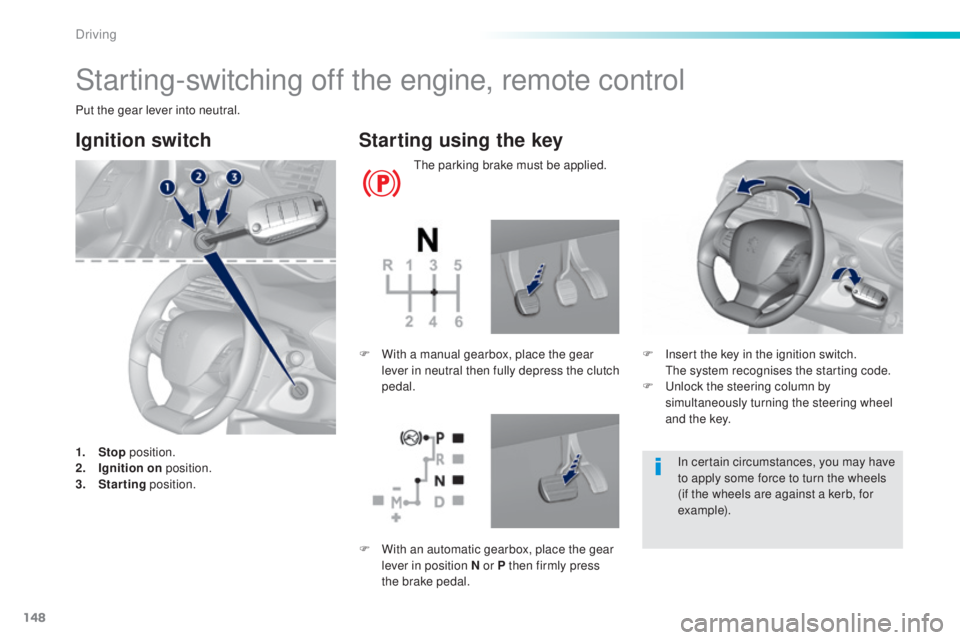
Ignition switch
1. Stop p osition.
2. Ig nition on position.
3.
Sta
rting position.
Starting using the key
the parking brake must be applied.
F
In
sert the key in the ignition switch.
the s
ystem recognises the starting code.
F
u
nl
ock the steering column by
simultaneously turning the steering wheel
and the key.
F
Wi
th a manual gearbox, place the gear
lever in neutral then fully depress the clutch
pedal.
In certain circumstances, you may have
to apply some force to turn the wheels
(if the wheels are against a kerb, for
example).
F
Wi
th an automatic gearbox, place the gear
lever in position N or P then firmly press
the brake pedal.
Driving
Page 152 of 398
150
308_en_Chap06_conduite_ed02-2015
Avoid attaching heavy objects to the
key, which would weigh down on its
blade in the ignition switch and could
cause a malfunction.
Switching off the engine leads to a loss
of braking assistance.
Key left in the "Ignition on"
position
If the key has been left in the ignition switch
at position 2 (Ignition on)
, the ignition will
be switched off automatically after one hour.
to sw
itch the ignition back on, turn the
key to position 1 (Stop) , then back to
position
2 (
Ignition on) .
Never leave the engine running in
an enclosed area without adequate
ventilation: internal combustion
engines emit toxic exhaust gases,
such as carbon monoxide. Danger of
intoxication and death.
In very severe wintry conditions
(temperatures below -23°C), to ensure
the correct operation and the durability
of the mechanical components of your
vehicle, the engine and gearbox, it is
necessary to leave the engine running
for 4 minutes before moving off. F Immo
bilise the vehicle.
F tur n the key fully towards you to
position
1 (
Stop).
F
Re
move the key from the ignition switch.
F
t
o lo
ck the steering column, turn the
steering wheel until it locks.
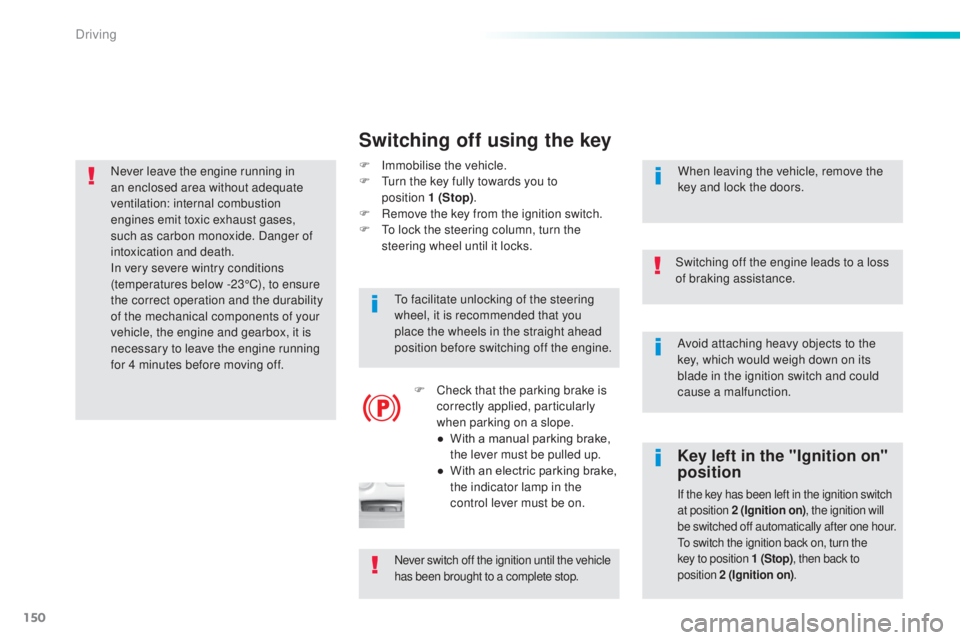
Switching off using the key
to facilitate unlocking of the steering
w heel, it is recommended that you
place the wheels in the straight ahead
position before switching off the engine.
F
Ch
eck that the parking brake is
correctly applied, particularly
when parking on a slope.
●
Wi
th a manual parking brake,
the lever must be pulled up.
●
Wi
th an electric parking brake,
the indicator lamp in the
control lever must be on. When leaving the vehicle, remove the
key and lock the doors.
Never switch off the ignition until the vehicle
has been brought to a complete stop.
Driving
Page 153 of 398
151
308_en_Chap06_conduite_ed02-2015
For Diesel vehicles, in sub-
zero temperatures the engine
will not start until the pre-heater
warning lamp has gone off.
If this warning lamp comes on
after pressing the "S
tARt/
StOP
" button, press down on
the brake or clutch pedal until
the warning lamp goes off,
without pressing the "S
tARt/
StOP
" button again, until the
engine starts and runs.
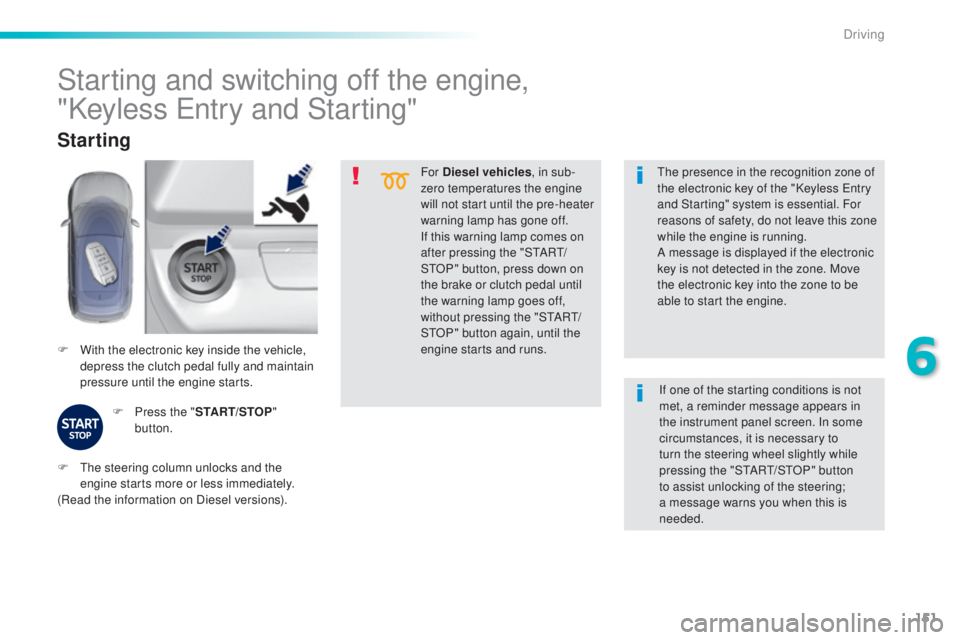
F
Wi
th the electronic key inside the vehicle,
depress the clutch pedal fully and maintain
pressure until the engine starts.
Starting
F Press the " ST ART/STOP"
button.
the p
resence in the recognition zone of
the electronic key of the "Keyless
ent
ry
and Starting" system is essential. For
reasons of safety, do not leave this zone
while the engine is running.
A message is displayed if the electronic
key is not detected in the zone. Move
the electronic key into the zone to be
able to start the engine.
Starting and switching off the engine,
"Keyless
ent
ry and Starting"
F the steering column unlocks and the
e ngine starts more or less immediately.
(Read the information on Diesel versions). If one of the starting conditions is not
met, a reminder message appears in
the instrument panel screen. In some
circumstances, it is necessary to
turn the steering wheel slightly while
pressing the "StARt/StOP
" button
to assist unlocking of the steering;
a message warns you when this is
needed.
6
Driving
Page 154 of 398
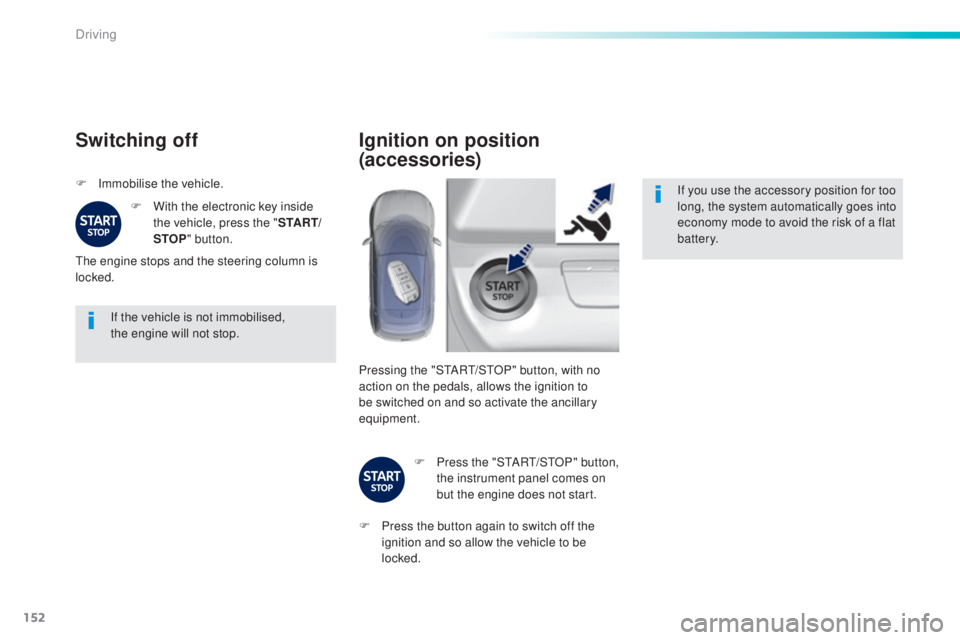
152
308_en_Chap06_conduite_ed02-2015
If the vehicle is not immobilised,
the engine will not stop.
Switching off
F Immobilise the vehicle.F
Wi
th the electronic key inside
the vehicle, press the " S TA R T/
STOP " button.
the e
ngine stops and the steering column is
locked.
Ignition on position
(accessories)
If you use the accessory position for too
long, the system automatically goes into
economy mode to avoid the risk of a flat
battery.
Pressing the "S
tARt/StOP
" button, with no
action on the pedals, allows the ignition to
be switched on and so activate the ancillary
equipment.
F
Pr
ess the "S
tARt/StOP
" button,
the instrument panel comes on
but the engine does not start.
F
Pr
ess the button again to switch off the
ignition and so allow the vehicle to be
locked.
Driving
Page 155 of 398
153
308_en_Chap06_conduite_ed02-2015
Key left in reader
You are warned by a message if the
electronic key is is still in the reader on
opening the driver's door.
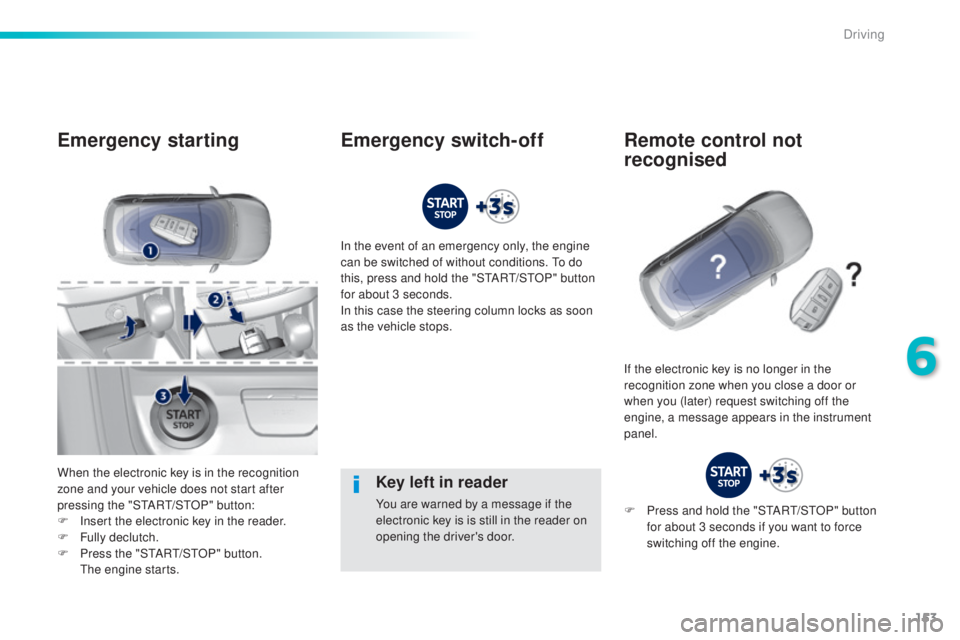
Emergency starting
When the electronic key is in the recognition
zone and your vehicle does not start after
pressing the "S
tARt/StOP
" button:
F
In
sert the electronic key in the reader.
F
Ful
ly declutch.
F
Pr
ess the "S
tARt/StOP
" button.
the
engine starts. In the event of an emergency only, the engine
can be switched of without conditions.
to do
t
his, press and hold the "S
tARt/StOP
" button
for about 3 seconds.
In this case the steering column locks as soon
as the vehicle stops.
If the electronic key is no longer in the
recognition zone when you close a door or
when you (later) request switching off the
engine, a message appears in the instrument
panel.
Emergency switch-off Remote control not recognised
F Press and hold the "StARt/StOP " button
for about 3 seconds if you want to force
switching off the engine.
6
Driving
Page 167 of 398
165
308_en_Chap06_conduite_ed02-2015
Automatic gearbox
Six speed automatic gearbox which offers a
choice between the comfort of fully automatic
operation, enhanced by sport and snow
programmes, or manual gear changing.
two d
riving modes are offered:
-
au
tomatic operation for electronic
management of the gears by the gearbox,
●
wi
th the sport programme for a more
dynamic style of driving,
●
or t
he snow programme to improve
driving when traction is poor,
-
man
ual operation for sequential changing
of the gears by the driver.
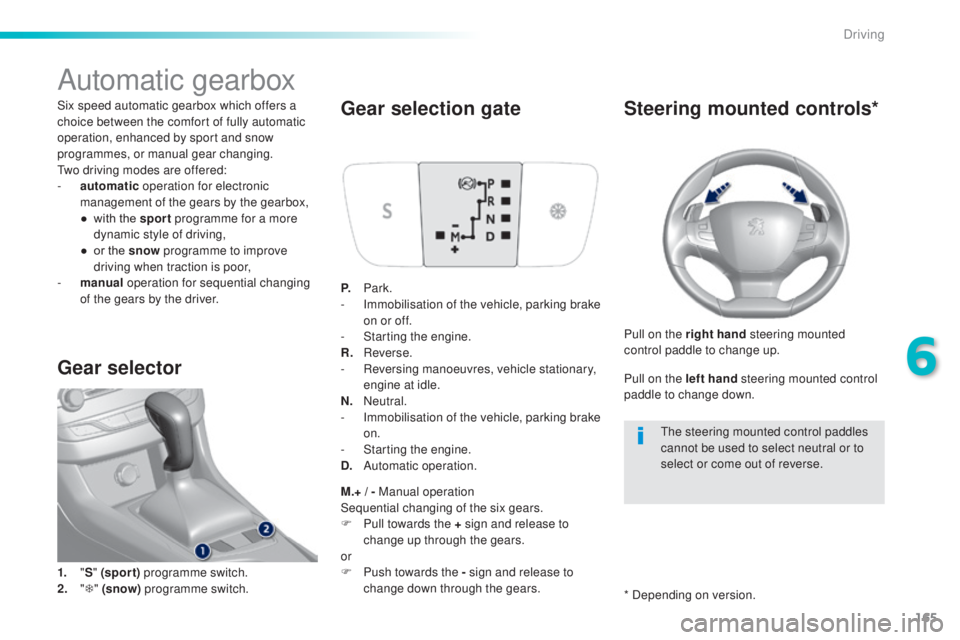
Gear selector
1. " S " (spor t) programme switch.
2. " T " (s
now) programme switch.
Gear selection gate
P. Park.
- Im
mobilisation of the vehicle, parking brake
on or off.
-
St
arting the engine.
R.
Re
verse.
-
Re
versing manoeuvres, vehicle stationary,
engine at idle.
N.
Ne
utral.
-
Im
mobilisation of the vehicle, parking brake
on.
-
St
arting the engine.
D.
Au
tomatic operation.
M.+ / - Manual operation
Sequential changing of the six gears.
F
Pu
ll towards the + sign and release to
change up through the gears.
or
F
Pu
sh towards the - sign and release to
change down through the gears.
Steering mounted controls*
Pull on the right hand steering mounted
control paddle to change up.
Pull on the left hand steering mounted control
paddle to change down.
the s
teering mounted control paddles
cannot be used to select neutral or to
select or come out of reverse.
* Depending on version.
6
Driving
Page 171 of 398
169
308_en_Chap06_conduite_ed02-2015
Dynamic pack
this pack conditions:
- th e visual ambience, with specific back-
lighting for the instrument panel,
-
th
e acoustic ambience of the engine,
-
th
e power assistance for the steering,
-
a
cceleration,
-
in
formation to the driver in the instrument
panel on dynamic settings.
thi
s function is only available when
Park Assist is not selected and snow
mode in the automatic gearbox is not
selected.
If Park Assist
i
s switched on, this
automatically deactivates the function.
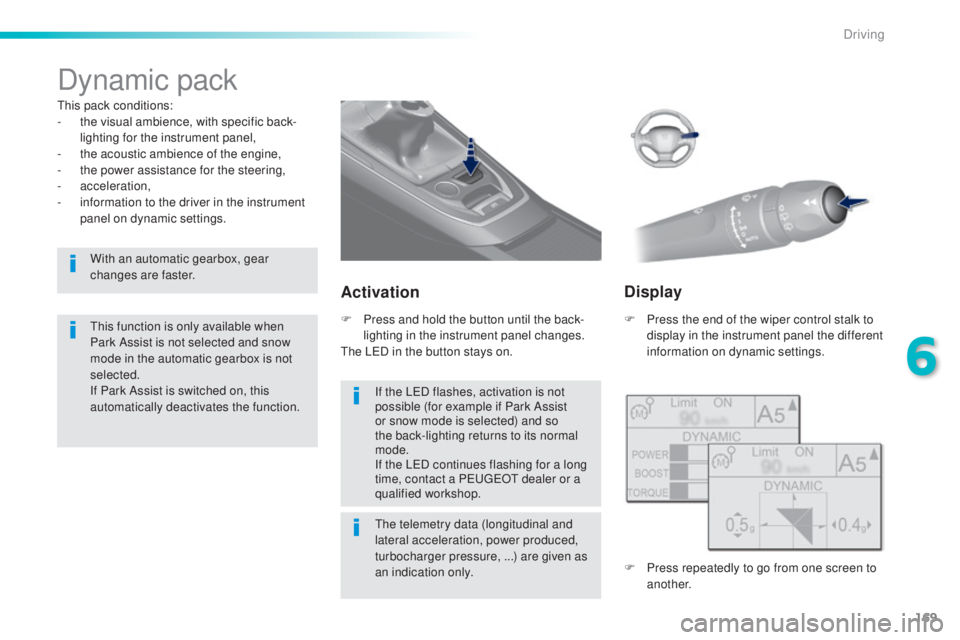
Activation
F Press the end of the wiper control stalk to
d isplay in the instrument panel the different
information on dynamic settings.
the
telemetry data (longitudinal and
lateral acceleration, power produced,
turbocharger pressure, ...) are given as
an indication only.
F Pr
ess and hold the button until the back-
lighting in the instrument panel changes.
the LeD in t
he button stays on.
Display
F Press repeatedly to go from one screen to
a nother.
If the L
eD fl
ashes, activation is not
possible (for example if Park Assist
or snow mode is selected) and so
the back-lighting returns to its normal
mode.
If the L
eD co
ntinues flashing for a long
time, contact a P
eu
ge
Ot d
ealer or a
qualified workshop.
With an automatic gearbox, gear
changes are faster.
6
Driving
Page 172 of 398
170
308_en_Chap06_conduite_ed02-2015
Stop & Start
Operation
Going into engine STOP mode
the "ECO" warning lamp comes on
in the instrument panel and the engine
goes into standby automatically:
-
Wi
th a manual gearbox , at speeds below
12 mph (20 km/h) or vehicle stationary
(depending on the engine), when you place
the gear lever in neutral, and you release
the clutch pedal.
Never refuel with the engine in S
tOP
m
ode; you must switch off the ignition
with the button. For your comfort, during parking
manoeuvres, S
tOP m
ode is not
available for a few seconds after
coming out of reverse gear.
S
tOP m
ode does not affect the
functionality of the vehicle, such as for
example, braking, power steering...
A slight delay between the vehicle
stopping and the engine cutting out may
be noticed.
Special cases: STOP mode not
available
StOP mode is not invoked principally when:
- th e vehicle is on a steep slope (up or down),
-
the
driver's door is open,
-
th
e driver's seat belt is not fastened,
-
th
e vehicle has not exceeded 6 mph
(10
k
m/h) since the last engine start by the
driver,
-
th
e electric parking brake is applied or
being applied,
-
th
e engine is needed to maintain a
comfortable temperature in the passenger
compartment,
-
dem
isting is active,
-
som
e special conditions (battery charge,
engine temperature, braking assistance,
ambient temperature...) where the engine is
needed to assure control of a system.
If your vehicle is fitted with Stop & Start,
a time counter calculates the time spent
in S
tOP m
ode during a journey.In this case, the "ECO" warning
lamp flashes for a few seconds then
goes
o
ff.
This operation is perfectly normal.
the S
top & Start
s
ystem puts the engine temporarily into standby - S
tOP m
ode - during stops in the traffic (red lights, traffic jams, or other...).
the e
ngine restarts automatically - S
tARt m
ode - as soon as you want to move off.
the r
estart takes place instantly, quickly and
silently.
Per fect for urban use, the Stop & Start system reduces fuel consumption and exhaust emissions as well as the noise level when stationary.
Stop & Start time
counter
(minutes / seconds or hours / minutes) -
Wi
th an automatic gearbox
, vehicle
stationary, when you press the brake
pedal or place the gear selector lever in
position
N .
I
t resets to zero every time the ignition is
switched on.
Driving
Page 176 of 398
174
308_en_Chap06_conduite_ed02-2015
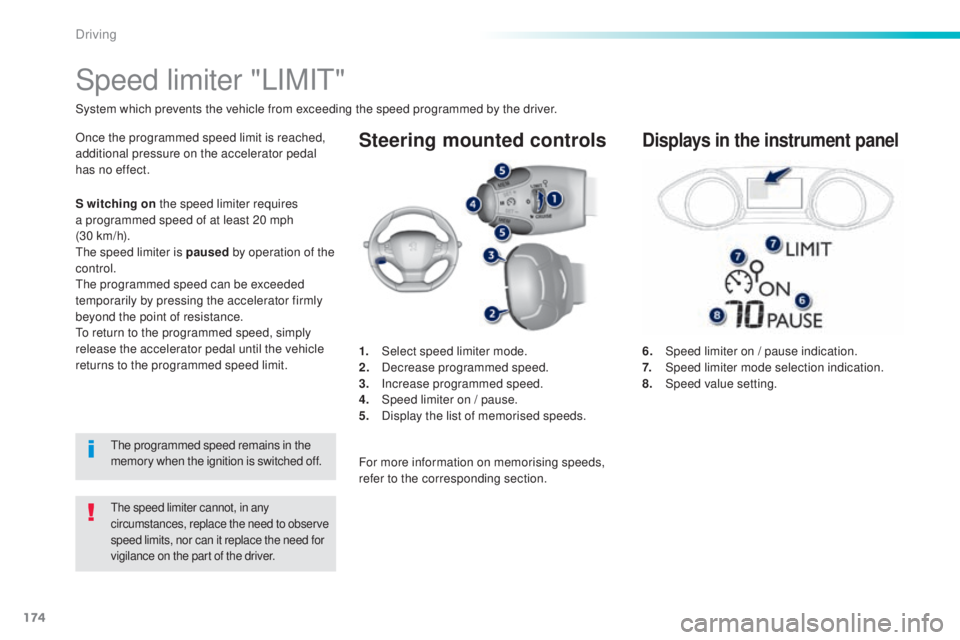
Steering mounted controls
6. Speed limiter on / pause indication.
7. Speed limiter mode selection indication.
8.
Speed
value setting.
Speed limiter "LIMIt"
System which prevents the vehicle from exceeding the speed programmed by the driver.
the speed limiter cannot, in any
c ircumstances, replace the need to observe
speed limits, nor can it replace the need for
vigilance on the part of the driver.
Once the programmed speed limit is reached,
additional pressure on the accelerator pedal
has no effect.
1.
Selec
t speed limiter mode.
2.
Dec
rease programmed speed.
3.
Inc
rease programmed speed.
4.
Sp
eed limiter on / pause.
5.
Di
splay the list of memorised speeds.Displays in the instrument panel
S witching on the speed limiter requires
a programmed speed of at least 20 mph
(30
k
m/h).
the s
peed limiter is paused by operation of the
control.
the
programmed speed can be exceeded
temporarily by pressing the accelerator firmly
beyond the point of resistance.
to re
turn to the programmed speed, simply
release the accelerator pedal until the vehicle
returns to the programmed speed limit.
the p
rogrammed speed remains in the
memory when the ignition is switched off. For more information on memorising speeds,
refer to the corresponding section.
Driving