Stop Peugeot 308 2016 Owner's Guide
[x] Cancel search | Manufacturer: PEUGEOT, Model Year: 2016, Model line: 308, Model: Peugeot 308 2016Pages: 398, PDF Size: 9.38 MB
Page 73 of 398
71
308_en_Chap03_ergonomie-et-confort_ed02-2015
Steering wheel adjustment
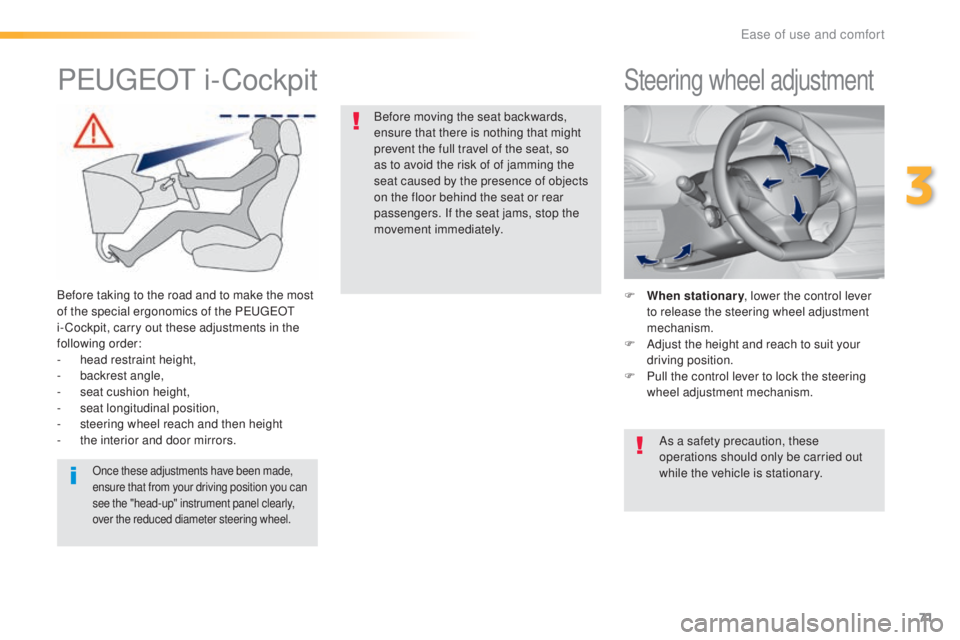
F When stationary, l ower the control lever
to release the steering wheel adjustment
mechanism.
F
Ad
just the height and reach to suit your
driving position.
F
Pu
ll the control lever to lock the steering
wheel adjustment mechanism.
As a safety precaution, these
operations should only be carried out
while the vehicle is stationary.
PeugeOt i- Cockpit
Before taking to the road and to make the most
of the special ergonomics of the Peu
geOt
i
- Cockpit, carry out these adjustments in the
following order:
-
head
restraint height,
-
ba
ckrest angle,
-
seat
cushion height,
-
se
at longitudinal position,
-
st
eering wheel reach and then height
-
th
e interior and door mirrors.
Once these adjustments have been made,
ensure that from your driving position you can
see the "head-up" instrument panel clearly,
over the reduced diameter steering wheel.
Before moving the seat backwards,
ensure that there is nothing that might
prevent the full travel of the seat, so
as to avoid the risk of of jamming the
seat caused by the presence of objects
on the floor behind the seat or rear
passengers. If the seat jams, stop the
movement immediately.
3
ease of use and comfort
Page 74 of 398
72
308_en_Chap03_ergonomie-et-confort_ed02-2015
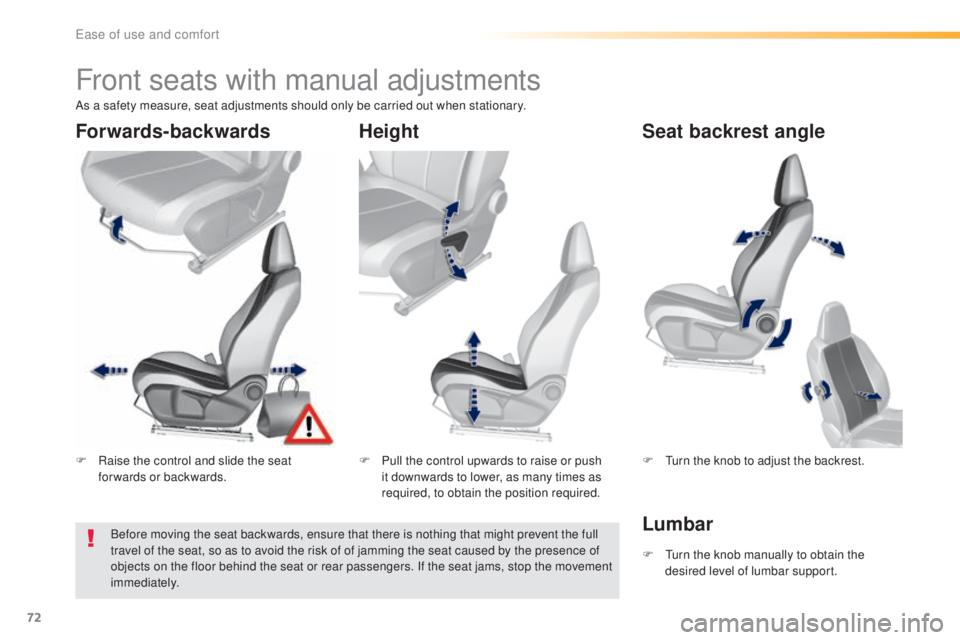
Front seats with manual adjustments
F Raise the control and slide the seat
forwards or backwards. F Pu
ll the control upwards to raise or push
it downwards to lower, as many times as
required, to obtain the position required. F
tur n the knob to adjust the backrest.
Forwards-backwards
HeightSeat backrest angle
As a safety measure, seat adjustments should only be carried out when stationary.
F
t
ur
n the knob manually to obtain the
desired level of lumbar support.
LumbarBefore moving the seat backwards, ensure that there is nothing that might prevent the full
travel of the seat, so as to avoid the risk of of jamming the seat caused by the presence of
objects on the floor behind the seat or rear passengers. If the seat jams, stop the movement
immediately.
ease of use and comfort
Page 75 of 398
73
308_en_Chap03_ergonomie-et-confort_ed02-2015
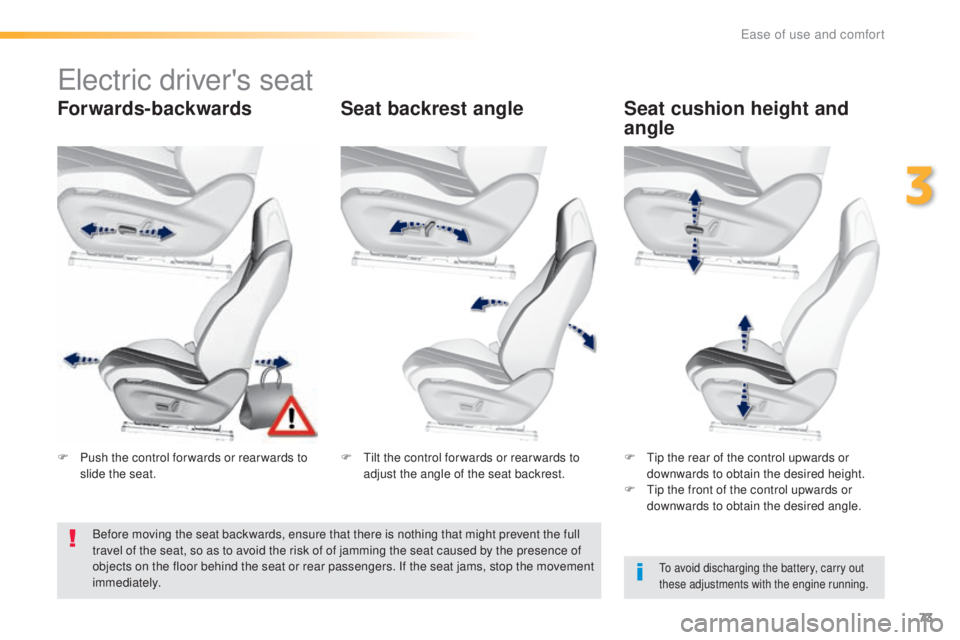
electric driver's seat
Forwards-backwardsSeat backrest angleSeat cushion height and
angle
to avoid discharging the battery, carry out
t hese adjustments with the engine running.
F Push the control for wards or rear wards to
sl ide the seat. F
til t the control for wards or rear wards to
adjust the angle of the seat backrest. F
tip t he rear of the control upwards or
downwards to obtain the desired height.
F
t
ip t
he front of the control upwards or
downwards to obtain the desired angle.
Before moving the seat backwards, ensure that there is nothing that might prevent the full
travel of the seat, so as to avoid the risk of of jamming the seat caused by the presence of
objects on the floor behind the seat or rear passengers. If the seat jams, stop the movement
immediately.
3
ease of use and comfort
Page 78 of 398
76
308_en_Chap03_ergonomie-et-confort_ed02-2015
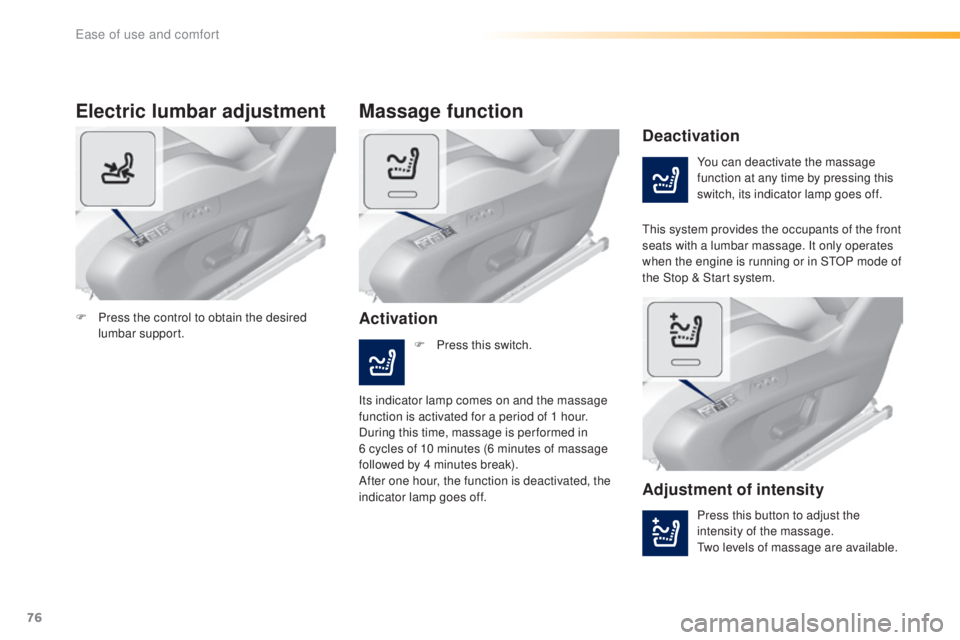
Electric lumbar adjustment
You can deactivate the massage
function at any time by pressing this
switch, its indicator lamp goes off.
Deactivation
Activation
Massage function
this system provides the occupants of the front
s eats with a lumbar massage. It only operates
when the engine is running or in S
tOP m
ode of
the Stop & Start system.
F
Pr
ess this switch.
Its indicator lamp comes on and the massage
function is activated for a period of 1 hour.
During this time, massage is per formed in
6 cycles of 10 minutes (6 minutes of massage
followed by 4 minutes break).
After one hour, the function is deactivated, the
indicator lamp goes off.
Adjustment of intensity
Press this button to adjust the
intensity of the massage.
two l
evels of massage are available.
F
Pr
ess the control to obtain the desired
lumbar support.
ease of use and comfort
Page 81 of 398
79
308_en_Chap03_ergonomie-et-confort_ed02-2015
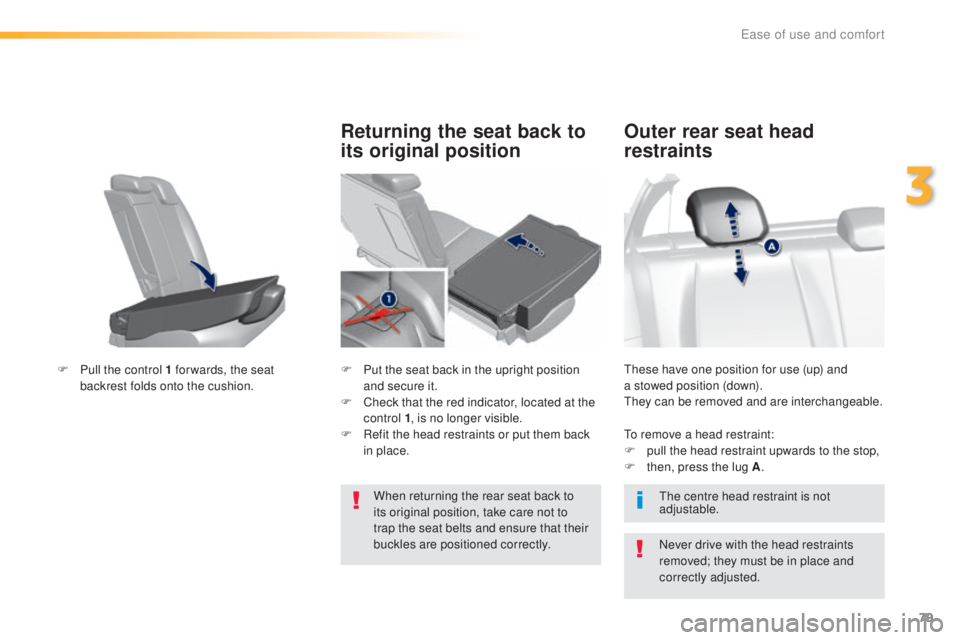
these have one position for use (up) and
a s towed position (down).
the
y can be removed and are interchangeable.
Outer rear seat head
restraints
Never drive with the head restraints
removed; they must be in place and
correctly adjusted.
to re
move a head restraint:
F
pu
ll the head restraint upwards to the stop,
F
th
en, press the lug A
.
the c
entre head restraint is not
adjustable.
F
Pu
ll the control 1 for wards, the seat
backrest folds onto the cushion.
Returning the seat back to
its original position
F Put the seat back in the upright position
a nd secure it.
F
Ch
eck that the red indicator, located at the
control 1 , is no longer visible.
F
Re
fit the head restraints or put them back
in place.
When returning the rear seat back to
its original position, take care not to
trap the seat belts and ensure that their
buckles are positioned correctly.
3
ease of use and comfort
Page 86 of 398
84
308_en_Chap03_ergonomie-et-confort_ed02-2015
230 V / 50 Hz power socket
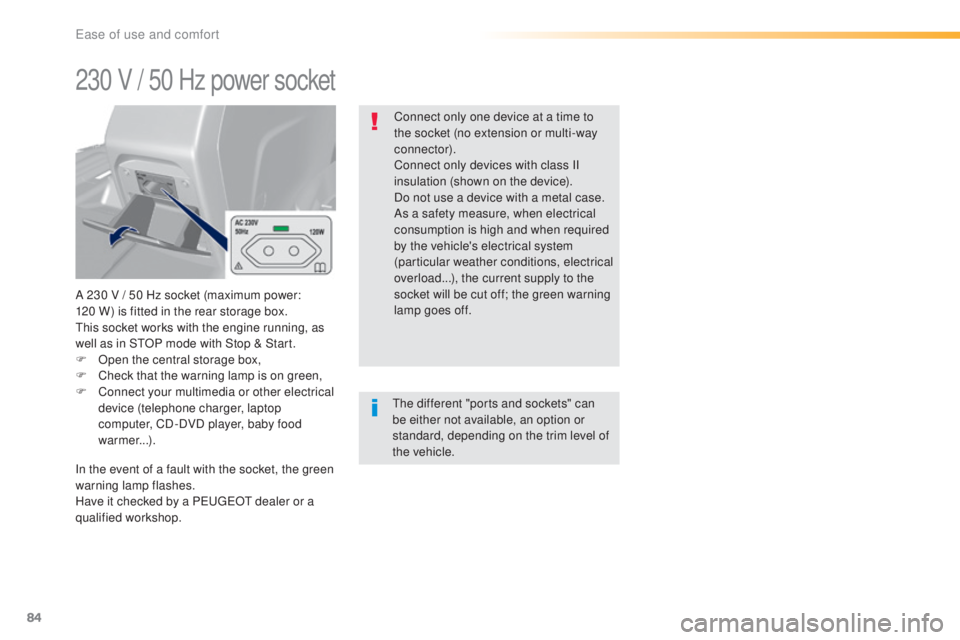
A 230 V / 50 Hz socket (maximum power:
120 W) is fitted in the rear storage box.
thi
s socket works with the engine running, as
well as in S
tOP m
ode with Stop & Start.
F
Op
en the central storage box,
F
Ch
eck that the warning lamp is on green,
F
Co
nnect your multimedia or other electrical
device (telephone charger, laptop
computer, CD-DVD player, baby food
warmer...).
In the event of a fault with the socket, the green
warning lamp flashes.
Have it checked by a P
eu
ge
Ot d
ealer or a
qualified workshop. Connect only one device at a time to
the socket (no extension or multi-way
connector).
Connect only devices with class II
insulation (shown on the device).
Do not use a device with a metal case.
As a safety measure, when electrical
consumption is high and when required
by the vehicle's electrical system
(particular weather conditions, electrical
overload...), the current supply to the
socket will be cut off; the green warning
lamp goes off.
the d
ifferent "ports and sockets" can
be either not available, an option or
standard, depending on the trim level of
the vehicle.
ease of use and comfort
Page 93 of 398
91
308_en_Chap03_ergonomie-et-confort_ed02-2015
In order for these systems to be fully effective, follow the operation and maintenance
guidelines below:
F
t
o ob
tain an even air distribution, take care not to obstruct the exterior air intake grilles
located at the base of the windscreen, the nozzles, the vents and the air outlets, as well
as the air extractor located in the boot.
F
Do n
ot cover the sunshine sensor, located on the dashboard; this is used for regulation
of the air conditioning system.
F
Op
erate the air conditioning system for at least 5 to 10 minutes, once or twice a month
to keep it in per fect working order.
F
e
ns
ure that the passenger compartment filter is in good condition and have the filter
elements replaced regularly.
We r
ecommend the use of a combined passenger compartment filter.
tha
nks to its
special active additive, it contributes to the purification of the air breathed by the
occupants and the cleanliness of the passenger compartment (reduction of allergic
symptoms, bad odours and greasy deposits).
F
t
o en
sure correct operation of the air conditioning system, you are also advised to have
it checked regularly as recommended in the warranty and maintenance record.
F
If t
he system does not produce cold air, switch it off and contact a P
eu
ge
Ot d
ealer or
a qualified workshop.
Recommendations for ventilation and air conditioning
If after an extended stop in sunshine,
the interior temperature is very high, first
ventilate the passenger compartment for
a few moments.
Put the air flow control at a setting high
enough to quickly change the air in the
passenger compartment.
the a
ir conditioning system does not
contain chlorine and does not present
any danger to the ozone layer.
the c
ondensation created by the air
conditioning results in a discharge
of water under the vehicle which is
perfectly normal.
When towing the maximum load on a steep gradient in high temperatures, switching off the
air conditioning increases the available engine power and so improves the towing ability.
Stop & Start
the heating and air conditioning
s ystems only work when the engine
is running.
to ma
intain a comfortable
temperature in the passenger
compartment, you can temporarily
deactivate the Stop & Start system (see
the corresponding section).
3
ease of use and comfort
Page 96 of 398
94
308_en_Chap03_ergonomie-et-confort_ed02-2015
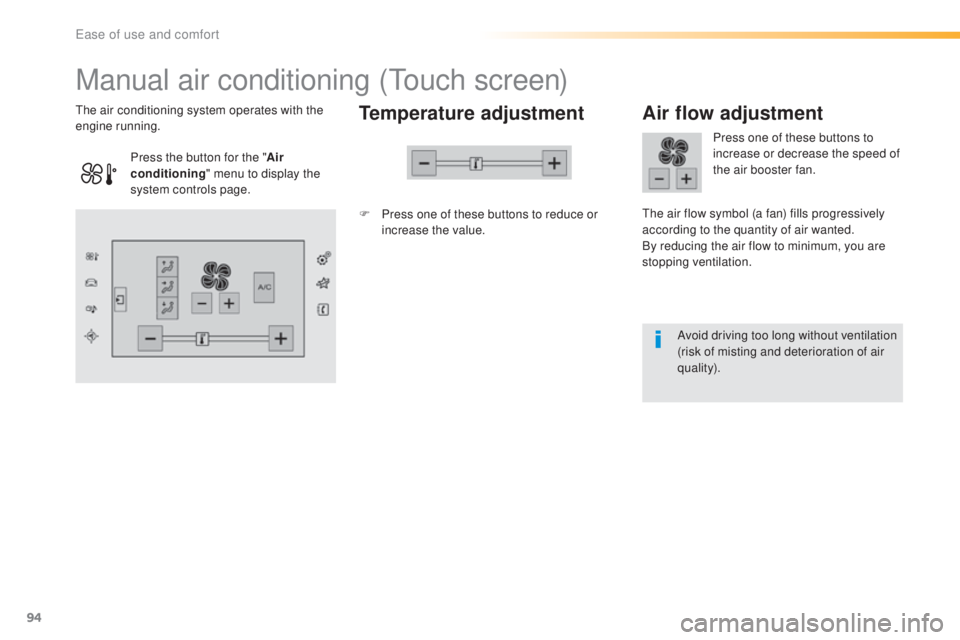
Manual air conditioning (touch screen)
Temperature adjustment
F Press one of these buttons to reduce or
inc
rease the value.
the a
ir conditioning system operates with the
engine running.
Air flow adjustment
Press one of these buttons to
increase or decrease the speed of
the air booster fan.
the a
ir flow symbol (a fan) fills progressively
according to the quantity of air wanted.
By reducing the air flow to minimum, you are
stopping ventilation.
Avoid driving too long without ventilation
(risk of misting and deterioration of air
quality).
Press the button for the "
Air
conditioning " menu to display the
system controls page.
ease of use and comfort
Page 100 of 398
98
308_en_Chap03_ergonomie-et-confort_ed02-2015
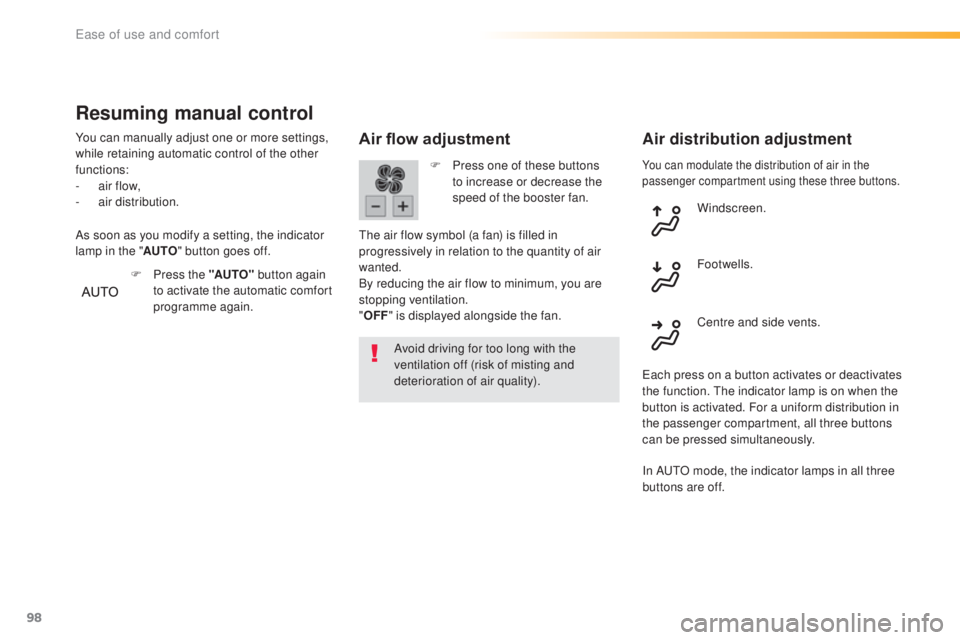
You can modulate the distribution of air in the
passenger compartment using these three buttons.
Air flow adjustment
Avoid driving for too long with the
ventilation off (risk of misting and
deterioration of air quality).
Air distribution adjustment
F Press one of these buttons
to increase or decrease the
speed of the booster fan.
the a
ir flow symbol (a fan) is filled in
progressively in relation to the quantity of air
wanted.
By reducing the air flow to minimum, you are
stopping ventilation.
" OFF " is displayed alongside the fan. Windscreen.
Centre and side vents. Footwells.
eac
h press on a button activates or deactivates
the function.
the i
ndicator lamp is on when the
button is activated. For a uniform distribution in
the passenger compartment, all three buttons
can be pressed simultaneously.
Resuming manual control
You can manually adjust one or more settings,
while retaining automatic control of the other
functions:
-
ai
r flow,
-
air
distribution.
F
Pr
ess the "AUTO" button again
to activate the automatic comfort
programme again.
As soon as you modify a setting, the indicator
lamp in the "
AUTO" button goes off.
In A
utO mo
de, the indicator lamps in all three
buttons are off.
ease of use and comfort
Page 103 of 398
101
308_en_Chap03_ergonomie-et-confort_ed02-2015
Front demist - defrost
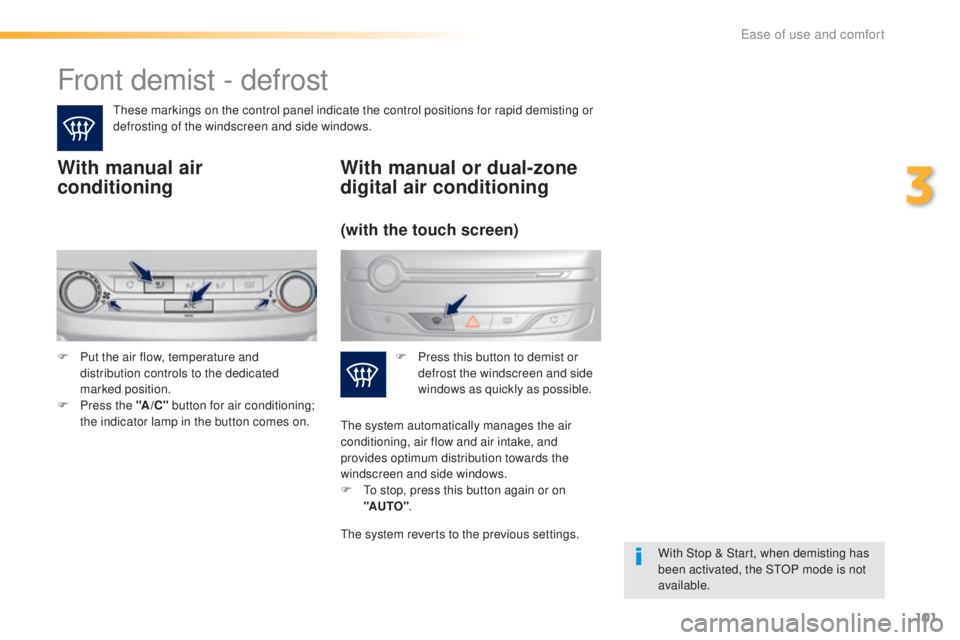
these markings on the control panel indicate the control positions for rapid demisting or
d efrosting of the windscreen and side windows.
With manual air
conditioning
With Stop & Start, when demisting has
been activated, the StOP m ode is not
available.
With manual or dual-zone
digital air conditioning
F Put the air flow, temperature and
d istribution controls to the dedicated
marked position.
F
Pr
ess the "A /C " button for air conditioning;
the indicator lamp in the button comes on. F Pr
ess this button to demist or
defrost the windscreen and side
windows as quickly as possible.
(with the touch screen)
the system automatically manages the air
c onditioning, air flow and air intake, and
provides optimum distribution towards the
windscreen and side windows.
F
t
o st
op, press this button again or on
"AUTO" .
the s
ystem reverts to the previous settings.
3
ease of use and comfort