wheel Peugeot 308 2016 Owner's Guide
[x] Cancel search | Manufacturer: PEUGEOT, Model Year: 2016, Model line: 308, Model: Peugeot 308 2016Pages: 398, PDF Size: 9.38 MB
Page 148 of 398

146
308_en_Chap06_conduite_ed02-2015
A few driving recommendations
Observe the driving regulations at all times and
remain vigilant whatever the traffic conditions.
Pay close attention to the traffic and keep your
hands on the wheel so that you are ready to
react at any time to any eventuality.
On a long journey, a break every two hours is
strongly recommended.
In difficult weather, drive smoothly, anticipate
the need to brake and increase the distance
from other vehicles.Never drive with the parking brake
applied - Risk of overheating and
damage to the braking system!
Do not park or run the engine when
stationary in areas where inflammable
substances and materials (dry grass,
dead leaves...) might come into contact
with the hot exhaust system - Risk of
fire!
Never leave a vehicle unsupervised
with the engine running. If you have
to leave your vehicle with the engine
running, apply the parking brake
and put the gearbox into neutral or
position
N
or P, depending on the type
of gearbox.
Driving on flooded
roads
We strongly advise against driving on flooded
roads, as this could cause serious damage
to the engine or gearbox, as well as to the
electrical systems of your vehicle.
Important!If you are obliged to drive through water:
-
ch
eck that the depth of water does not
exceed 15 cm, taking account of waves
that might be generated by other users,
-
de
activate the Stop & Start system,
-
dr
ive as slowly as possible without
stalling. In all cases, do not exceed 6 mph
(10
k
m/h),
-
do n
ot stop and do not switch off the
engine.
On leaving the flooded road, as soon as
circumstances allow, make several light brake
applications to dry the brake discs and pads.
If in doubt on the state of your vehicle, contact
a P
eu
ge
Ot d
ealer or a qualified workshop.
Driving
Page 150 of 398
148
308_en_Chap06_conduite_ed02-2015
Starting-switching off the engine, remote control
Put the gear lever into neutral.
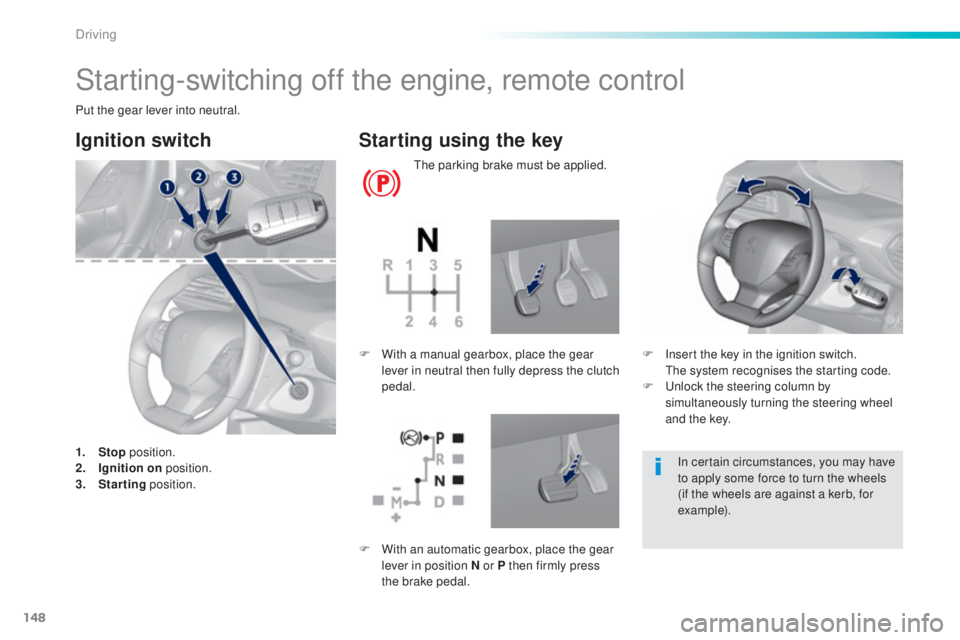
Ignition switch
1. Stop p osition.
2. Ig nition on position.
3.
Sta
rting position.
Starting using the key
the parking brake must be applied.
F
In
sert the key in the ignition switch.
the s
ystem recognises the starting code.
F
u
nl
ock the steering column by
simultaneously turning the steering wheel
and the key.
F
Wi
th a manual gearbox, place the gear
lever in neutral then fully depress the clutch
pedal.
In certain circumstances, you may have
to apply some force to turn the wheels
(if the wheels are against a kerb, for
example).
F
Wi
th an automatic gearbox, place the gear
lever in position N or P then firmly press
the brake pedal.
Driving
Page 152 of 398
150
308_en_Chap06_conduite_ed02-2015
Avoid attaching heavy objects to the
key, which would weigh down on its
blade in the ignition switch and could
cause a malfunction.
Switching off the engine leads to a loss
of braking assistance.
Key left in the "Ignition on"
position
If the key has been left in the ignition switch
at position 2 (Ignition on)
, the ignition will
be switched off automatically after one hour.
to sw
itch the ignition back on, turn the
key to position 1 (Stop) , then back to
position
2 (
Ignition on) .
Never leave the engine running in
an enclosed area without adequate
ventilation: internal combustion
engines emit toxic exhaust gases,
such as carbon monoxide. Danger of
intoxication and death.
In very severe wintry conditions
(temperatures below -23°C), to ensure
the correct operation and the durability
of the mechanical components of your
vehicle, the engine and gearbox, it is
necessary to leave the engine running
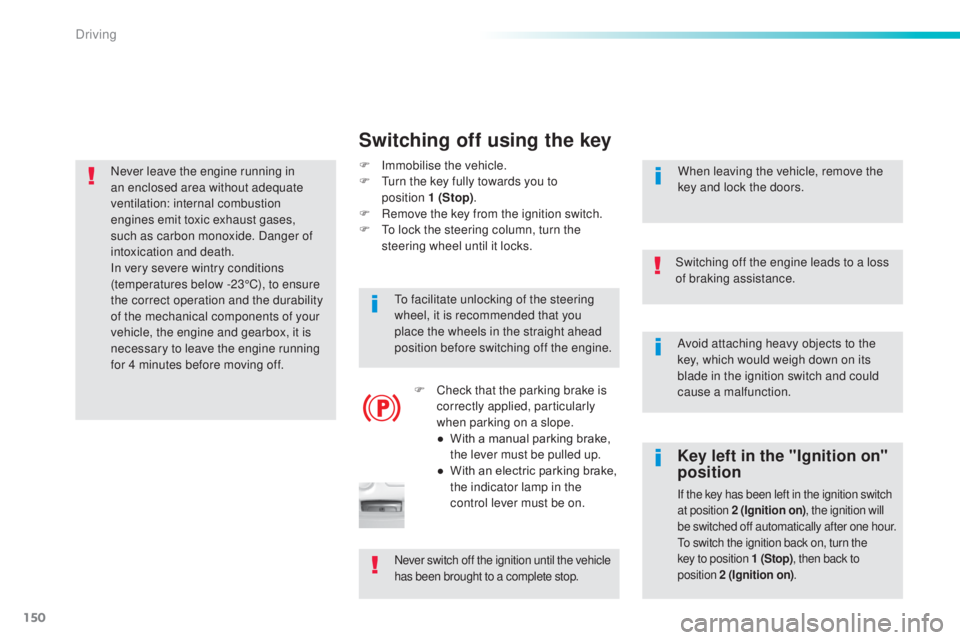
for 4 minutes before moving off. F Immo
bilise the vehicle.
F tur n the key fully towards you to
position
1 (
Stop).
F
Re
move the key from the ignition switch.
F
t
o lo
ck the steering column, turn the
steering wheel until it locks.
Switching off using the key
to facilitate unlocking of the steering
w heel, it is recommended that you
place the wheels in the straight ahead
position before switching off the engine.
F
Ch
eck that the parking brake is
correctly applied, particularly
when parking on a slope.
●
Wi
th a manual parking brake,
the lever must be pulled up.
●
Wi
th an electric parking brake,
the indicator lamp in the
control lever must be on. When leaving the vehicle, remove the
key and lock the doors.
Never switch off the ignition until the vehicle
has been brought to a complete stop.
Driving
Page 153 of 398
151
308_en_Chap06_conduite_ed02-2015
For Diesel vehicles, in sub-
zero temperatures the engine
will not start until the pre-heater
warning lamp has gone off.
If this warning lamp comes on
after pressing the "S
tARt/
StOP
" button, press down on
the brake or clutch pedal until
the warning lamp goes off,
without pressing the "S
tARt/
StOP
" button again, until the
engine starts and runs.
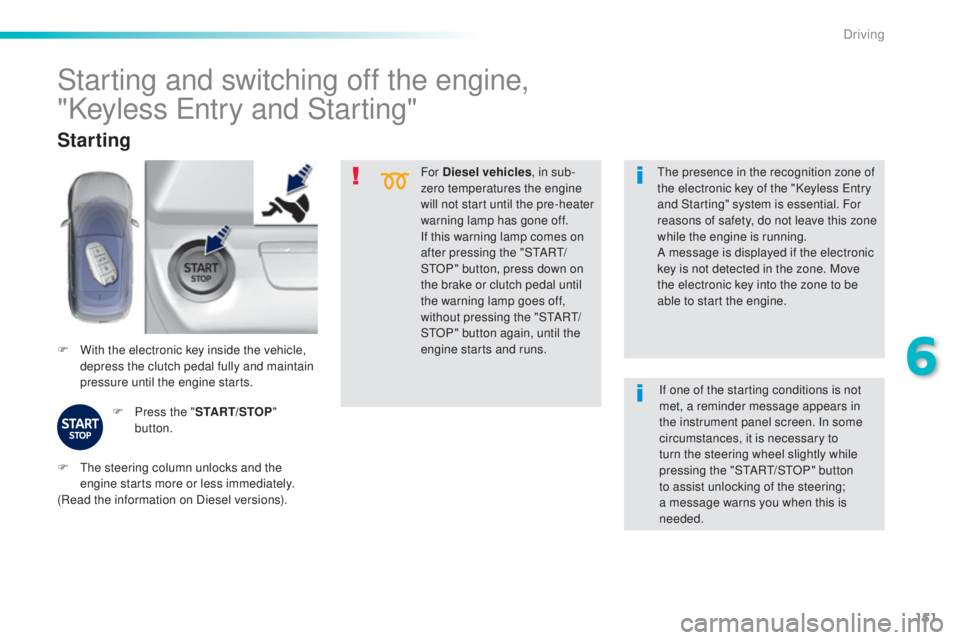
F
Wi
th the electronic key inside the vehicle,
depress the clutch pedal fully and maintain
pressure until the engine starts.
Starting
F Press the " ST ART/STOP"
button.
the p
resence in the recognition zone of
the electronic key of the "Keyless
ent
ry
and Starting" system is essential. For
reasons of safety, do not leave this zone
while the engine is running.
A message is displayed if the electronic
key is not detected in the zone. Move
the electronic key into the zone to be
able to start the engine.
Starting and switching off the engine,
"Keyless
ent
ry and Starting"
F the steering column unlocks and the
e ngine starts more or less immediately.
(Read the information on Diesel versions). If one of the starting conditions is not
met, a reminder message appears in
the instrument panel screen. In some
circumstances, it is necessary to
turn the steering wheel slightly while
pressing the "StARt/StOP
" button
to assist unlocking of the steering;
a message warns you when this is
needed.
6
Driving
Page 156 of 398
154
308_en_Chap06_conduite_ed02-2015
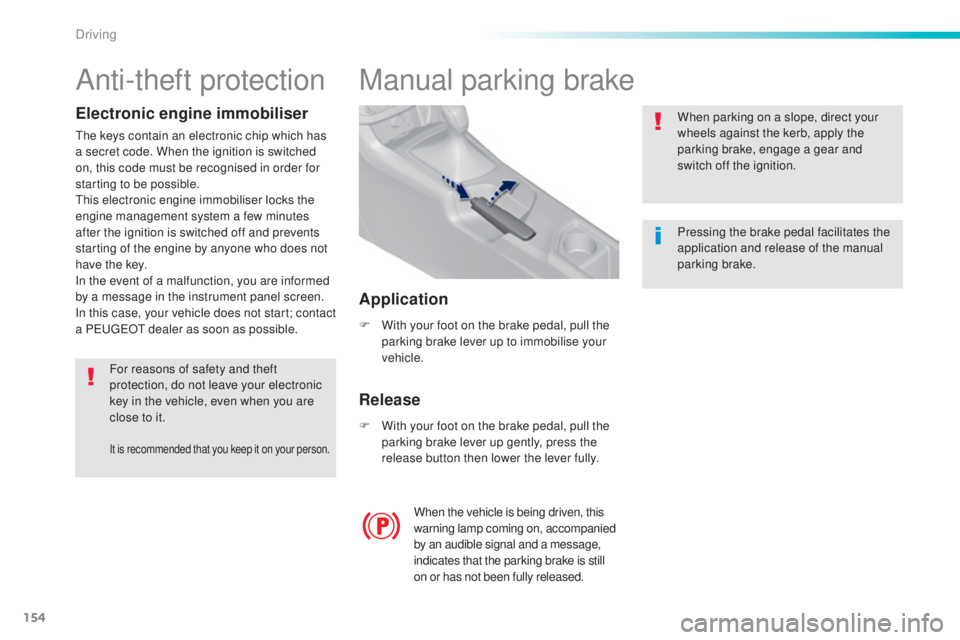
Manual parking brake
F With your foot on the brake pedal, pull the
parking brake lever up to immobilise your
vehicle.
F
Wi
th your foot on the brake pedal, pull the
parking brake lever up gently, press the
release button then lower the lever fully. When parking on a slope, direct your
wheels against the kerb, apply the
parking brake, engage a gear and
switch off the ignition.
When the vehicle is being driven, this
warning lamp coming on, accompanied
by an audible signal and a message,
indicates that the parking brake is still
on or has not been fully released. Pressing the brake pedal facilitates the
application and release of the manual
parking brake.
Release Application
Anti-theft protection
Electronic engine immobiliser
the keys contain an electronic chip which has
a s ecret code. When the ignition is switched
on, this code must be recognised in order for
starting to be possible.
thi
s electronic engine immobiliser locks the
engine management system a few minutes
after the ignition is switched off and prevents
starting of the engine by anyone who does not
have the key.
In the event of a malfunction, you are informed
by a message in the instrument panel screen.
In this case, your vehicle does not start; contact
a P
eu
ge
Ot d
ealer as soon as possible.
For reasons of safety and theft
protection, do not leave your electronic
key in the vehicle, even when you are
close to it.
It is recommended that you keep it on your person.
Driving
Page 157 of 398
155
308_en_Chap06_conduite_ed02-2015
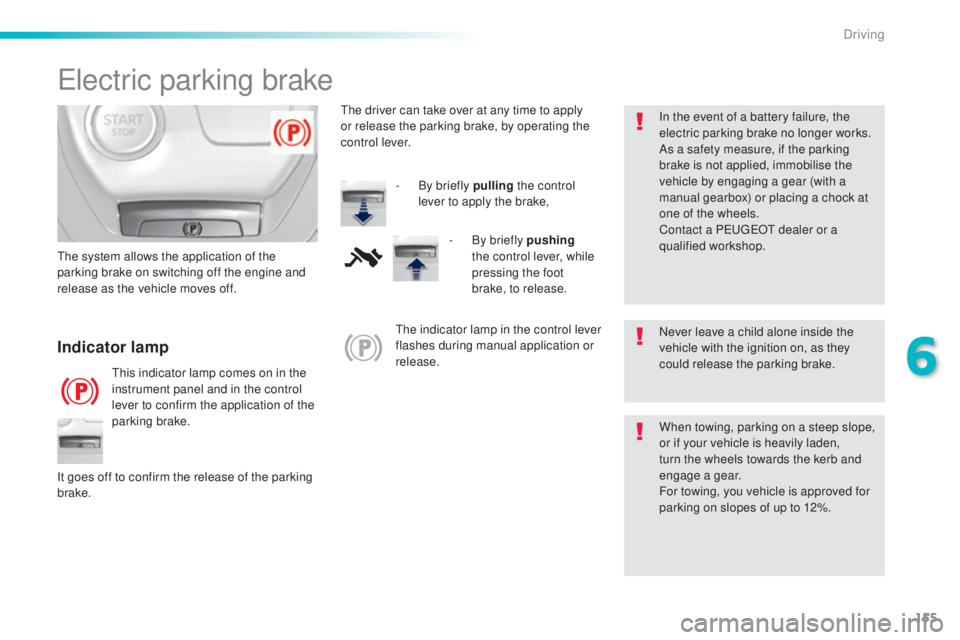
electric parking brake
Never leave a child alone inside the
vehicle with the ignition on, as they
could release the parking brake.
Indicator lamp
this indicator lamp comes on in the
i nstrument panel and in the control
lever to confirm the application of the
parking brake.
the s
ystem allows the application of the
parking brake on switching off the engine and
release as the vehicle moves off.
When towing, parking on a steep slope,
or if your vehicle is heavily laden,
turn the wheels towards the kerb and
engage a gear.
For towing, you vehicle is approved for
parking on slopes of up to 12%.
It goes off to confirm the release of the parking
brake.
the i
ndicator lamp in the control lever
flashes during manual application or
release. In the event of a battery failure, the
electric parking brake no longer works.
As a safety measure, if the parking
brake is not applied, immobilise the
vehicle by engaging a gear (with a
manual gearbox) or placing a chock at
one of the wheels.
Contact a P
eu
ge
Ot d
ealer or a
qualified workshop.
the d
river can take over at any time to apply
or release the parking brake, by operating the
control lever.
-
By b
riefly pulling
the control
lever to apply the brake,
-
By b
riefly pushing
the control lever, while
pressing the foot
brake, to release.
6
Driving
Page 160 of 398
158
308_en_Chap06_conduite_ed02-2015
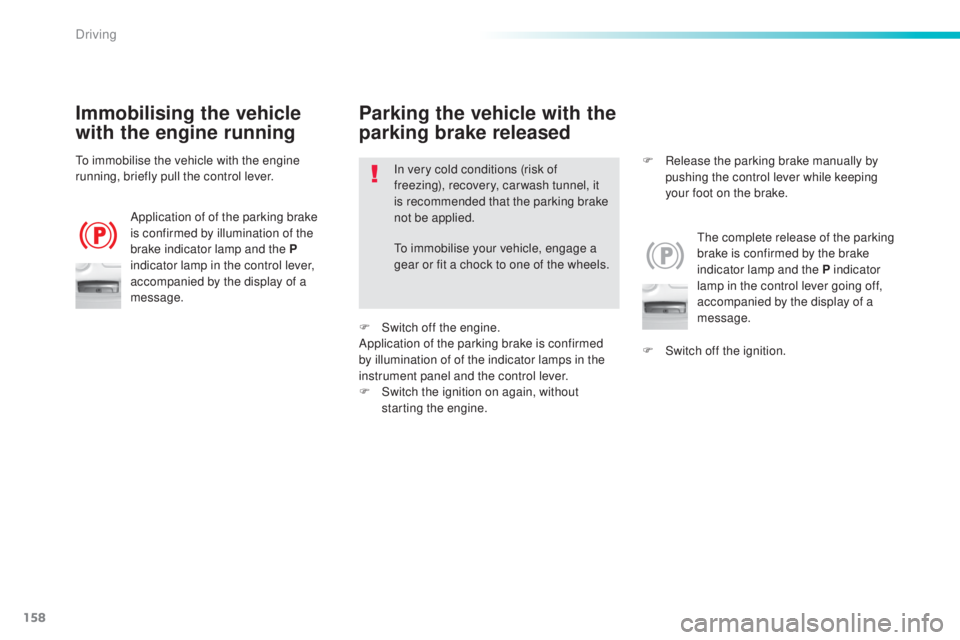
Immobilising the vehicle
with the engine running
Application of of the parking brake
is confirmed by illumination of the
brake indicator lamp and the P
indicator lamp in the control lever,
accompanied by the display of a
message.
the c
omplete release of the parking
brake is confirmed by the brake
indicator lamp and the P indicator
lamp in the control lever going off,
accompanied by the display of a
message.
to im
mobilise the vehicle with the engine
running, briefly pull the control lever. In very cold conditions (risk of
freezing), recovery, car wash tunnel, it
is recommended that the parking brake
not be applied.
Parking the vehicle with the
parking brake released
F Switch off the ignition.
F
Re
lease the parking brake manually by
pushing the control lever while keeping
your foot on the brake.
to i
mmobilise your vehicle, engage a
gear or fit a chock to one of the wheels.
F
Sw
itch off the engine.
Application of the parking brake is confirmed
by illumination of of the indicator lamps in the
instrument panel and the control lever.
F
Sw
itch the ignition on again, without
starting the engine.
Driving
Page 163 of 398
161
308_en_Chap06_conduite_ed02-2015
SituationConsequences
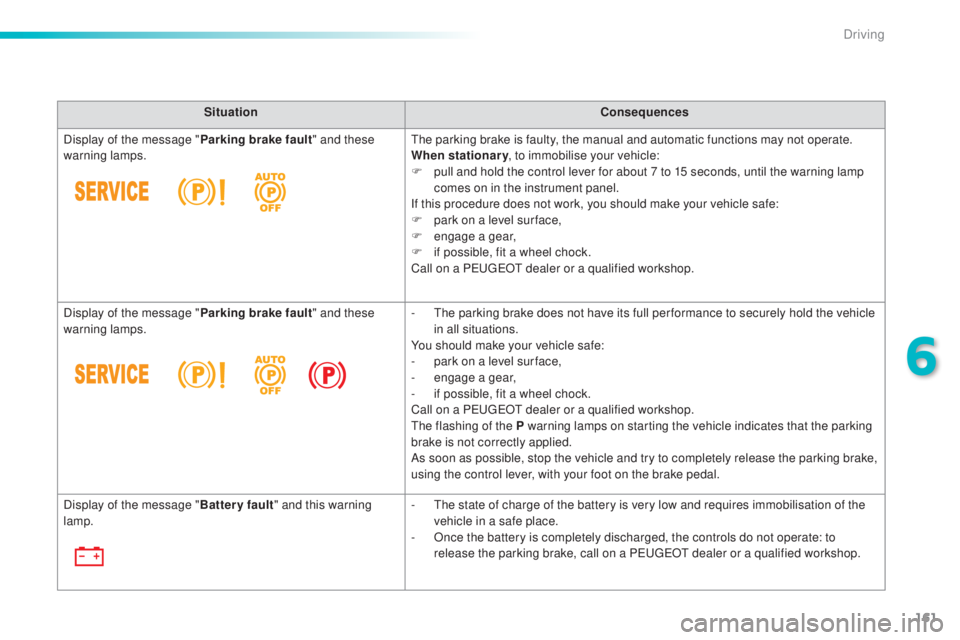
Display of the message " Parking brake fault" and these
warning lamps.
the p
arking brake is faulty, the manual and automatic functions may not operate.
When stationary , to immobilise your vehicle:
F
pu
ll and hold the control lever for about 7 to 15 seconds, until the warning lamp
comes on in the instrument panel.
If this procedure does not work, you should make your vehicle safe:
F
pa
rk on a level sur face,
F
engag
e a gear,
F
if p
ossible, fit a wheel chock.
Call on a P
eu
ge
Ot d
ealer or a qualified workshop.
Display of the message " Parking brake fault" and these
warning lamps. -
t
he p
arking brake does not have its full per formance to securely hold the vehicle
in all situations.
You should make your vehicle safe:
-
pa
rk on a level sur face,
-
engag
e a gear,
-
if p
ossible, fit a wheel chock.
Call on a P
eu
ge
Ot d
ealer or a qualified workshop.
the f
lashing of the P warning lamps on starting the vehicle indicates that the parking
brake is not correctly applied.
As soon as possible, stop the vehicle and try to completely release the parking brake,
using the control lever, with your foot on the brake pedal.
Display of the message " Battery fault" and this warning
lamp. -
t
he s
tate of charge of the battery is very low and requires immobilisation of the
vehicle in a safe place.
-
On
ce the battery is completely discharged, the controls do not operate: to
release the parking brake, call on a P
eu
ge
Ot d
ealer or a qualified workshop.
6
Driving
Page 177 of 398
175
308_en_Chap06_conduite_ed02-2015
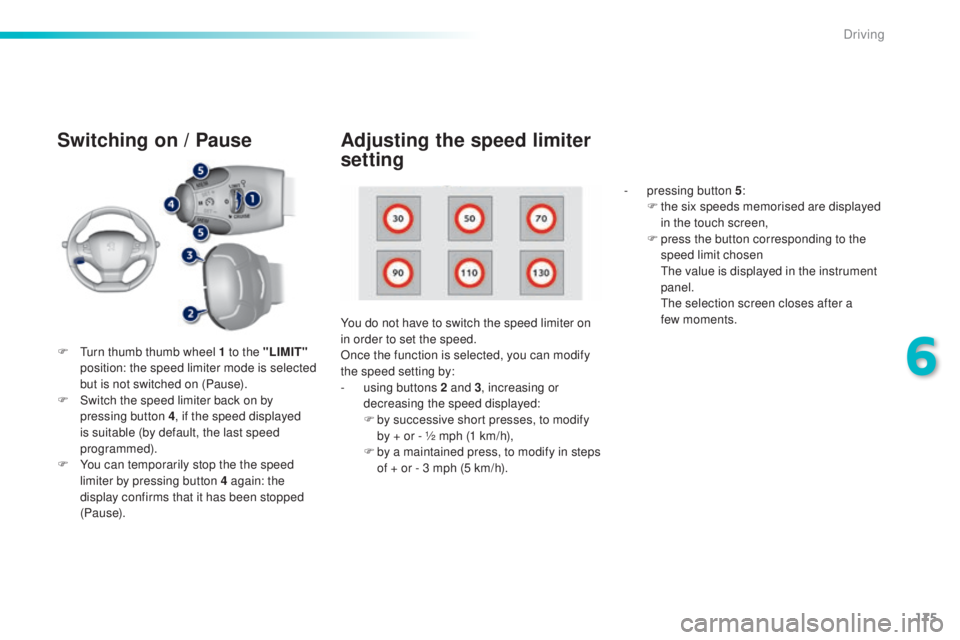
Switching on / Pause
F turn thumb thumb wheel 1 to the "LIMIT"
p osition: the speed limiter mode is selected
but is not switched on (Pause).
F
Sw
itch the speed limiter back on by
pressing button 4 , if the speed displayed
is suitable (by default, the last speed
programmed).
F
Yo
u can temporarily stop the the speed
limiter by pressing button 4 again: the
display confirms that it has been stopped
(Pause). You do not have to switch the speed limiter on
in order to set the speed.
Once the function is selected, you can modify
the speed setting by:
-
us
ing buttons 2 and 3, increasing or
decreasing the speed displayed:
F
by s
uccessive short presses, to modify
by + or - ½ mph (1 km/h),
F
by a m
aintained press, to modify in steps
of + or - 3 mph (5 km/h). -
pr
essing button 5
:
F
th
e six speeds memorised are displayed
in the touch screen,
F
pr
ess the button corresponding to the
speed limit chosen
the v
alue is displayed in the instrument
panel.
the s
election screen closes after a
few moments.
Adjusting the speed limiter
setting
6
Driving
Page 178 of 398
176
308_en_Chap06_conduite_ed02-2015
On sharp acceleration, as when
descending a steep hill, the speed
limiter will not be able to prevent
the vehicle from exceeding the
programmed speed.
the l
imiter is temporarily deactivated
and the displayed programmed speed
flashes.
An audible signal accompanies the
flashing of the programmed speed
when exceeding the speed is not due to
an action by the driver.
the u
se of mats not approved by
P
eu
ge
Ot m
ay inter fere with the
operation of the speed limiter.
to av
oid any risk of jamming of the
pedals:
-
en
sure that the mat is secured
c o r r e c t l y,
-
do n
ot fit one mat on top of another.
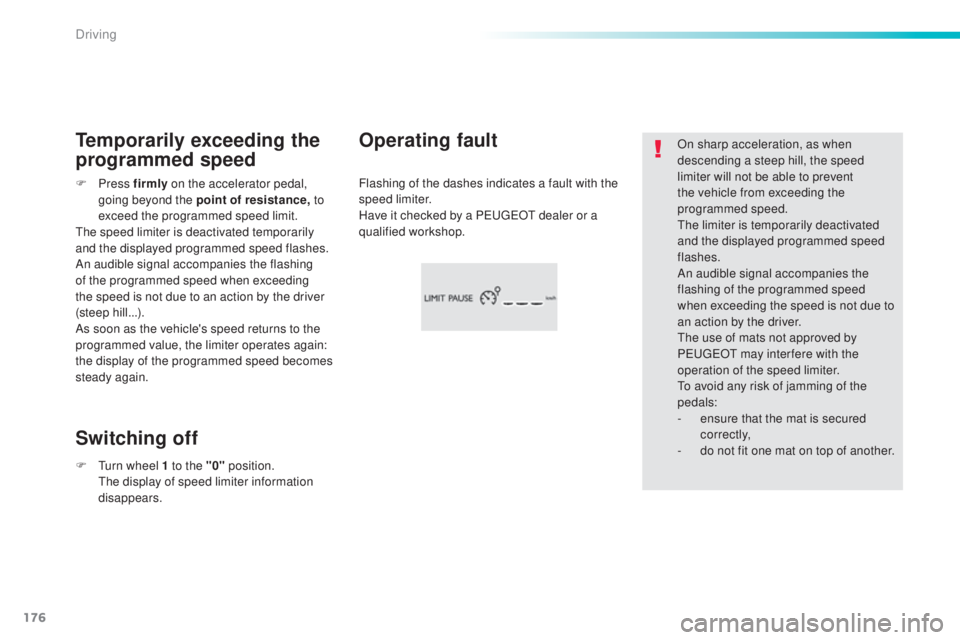
Flashing of the dashes indicates a fault with the
speed limiter.
Have it checked by a P
eu
ge
Ot d
ealer or a
qualified workshop.Operating fault
Temporarily exceeding the
programmed speed
Switching off
F Press fir mly on the accelerator pedal,
going beyond the point of resistance, t o
exceed the programmed speed limit.
the s
peed limiter is deactivated temporarily
and the displayed programmed speed flashes.
An audible signal accompanies the flashing
of the programmed speed when exceeding
the speed is not due to an action by the driver
(steep hill...).
As soon as the vehicle's speed returns to the
programmed value, the limiter operates again:
the display of the programmed speed becomes
steady again.
F
t
ur
n wheel 1 to the "0" position.
the
display of speed limiter information
disappears.
Driving