ignition PEUGEOT 308 2016 Repair Manual
[x] Cancel search | Manufacturer: PEUGEOT, Model Year: 2016, Model line: 308, Model: Peugeot 308 2016Pages: 344, PDF Size: 12.23 MB
Page 169 of 344
167
3008_en_Chap08_conduite_ed01-2015
Stopping the vehicle
Before switching off the engine, you can
engage position P or N to place the gearbox in
neutral.
In both cases, apply the parking brake to
immobilise the vehicle, unless it is programmed
to automatic mode.
Operating fault
When the ignition is on, the lighting
of this warning lamp, accompanied
by an audible signal and a message
in the multifunction screen,
indicates a gearbox malfunction.
In this case, the gearbox switches to back-up
mode and is locked in 3rd gear. You may feel
a substantial knock when changing from P
to R and from N to R . This will not cause any
damage to the gearbox.
Do not exceed 60 mph (100 km/h), local speed
restrictions permitting.
Have it checked by a PEUGEOT dealer or a
qualified workshop.
This warning lamp may also come on if a door
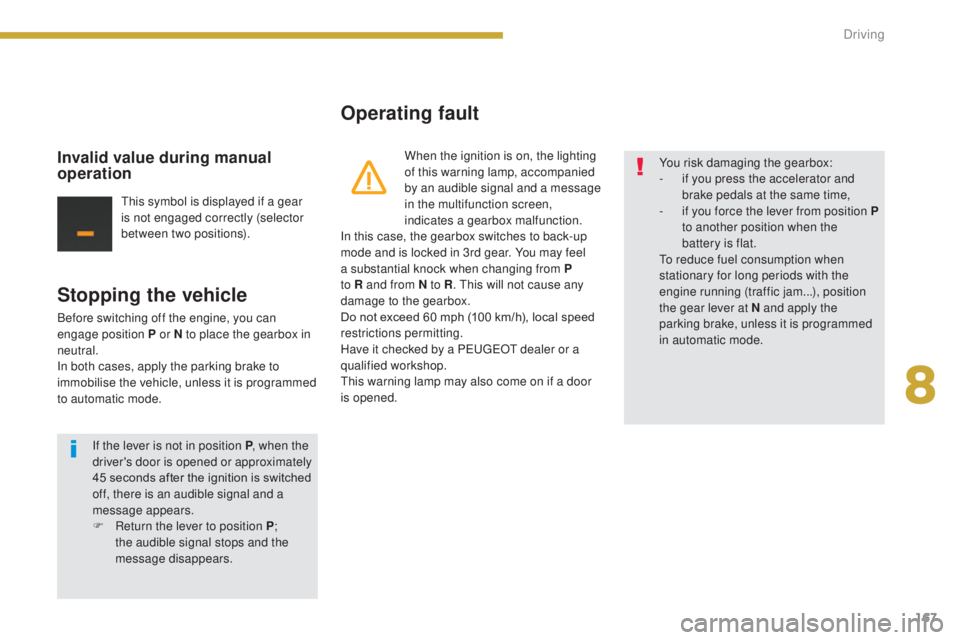
is opened.Invalid value during manual
operation
This symbol is displayed if a gear
is not engaged correctly (selector
between two positions). You risk damaging the gearbox:
-
i
f you press the accelerator and
brake pedals at the same time,
- i f you force the lever from position P
to another position when the
battery is flat.
To reduce fuel consumption when
stationary for long periods with the
engine running (traffic jam...), position
the gear lever at N and apply the
parking brake, unless it is programmed
in automatic mode.
If the lever is not in position P , when the
driver's door is opened or approximately
45 seconds after the ignition is switched
off, there is an audible signal and a
message appears.
F
R
eturn the lever to position P ;
the audible signal stops and the
message disappears.
8
Driving
Page 171 of 344
169
3008_en_Chap08_conduite_ed01-2015
The Stop & Start system puts the engine
t emporarily into standby - STOP mode - during
stops in the traffic (red lights, traffic jams, or
other...). The engine restarts automatically -
START mode - as soon as you want to move
off. The restart takes place instantly, quickly
and silently.
Per fect for urban use, the Stop & Start system
reduces fuel consumption and exhaust
emissions as well as the noise level when
stationary.
Operation
Going into engine STOP mode
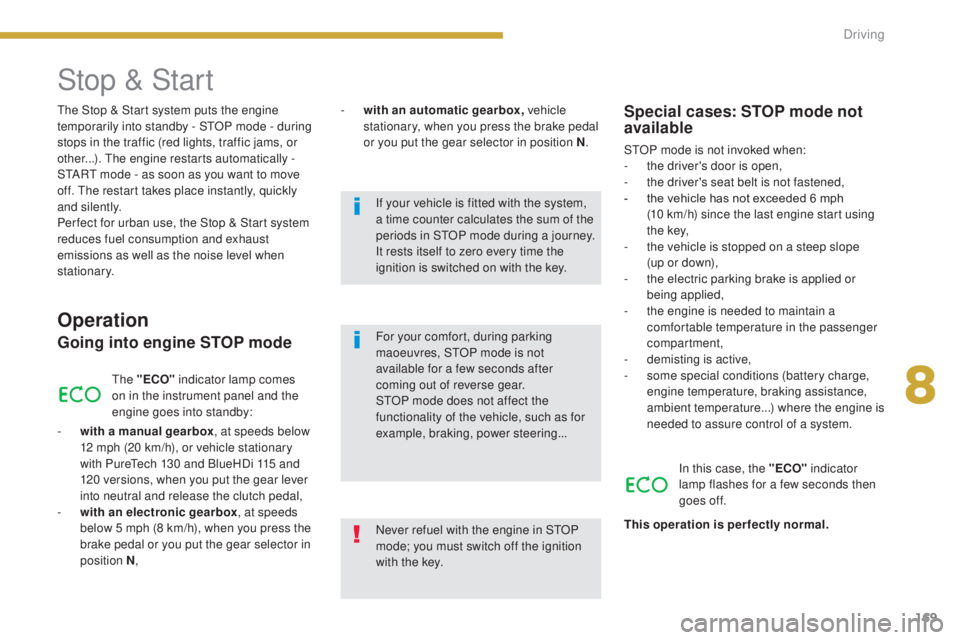
The "ECO" indicator lamp comes
on in the instrument panel and the
engine goes into standby:
-
w
ith a manual gearbox , at speeds below
12 mph (20 km/h), or vehicle stationary
with PureTech 130 and BlueHDi 115 and
120 versions, when you put the gear lever
into neutral and release the clutch pedal,
-
w
ith an electronic gearbox , at speeds
below 5 mph (8 km/h), when you press the
brake pedal or you put the gear selector in
position N ,
Special cases: STOP mode not
available
STOP mode is not invoked when:
- t
he driver's door is open,
-
t
he driver's seat belt is not fastened,
-
t
he vehicle has not exceeded 6 mph
(10
km/h) since the last engine start using
t h e key,
-
t
he vehicle is stopped on a steep slope
(up
or down),
-
t
he electric parking brake is applied or
being applied,
-
t
he engine is needed to maintain a
comfortable temperature in the passenger
compartment,
-
d
emisting is active,
-
s
ome special conditions (battery charge,
engine temperature, braking assistance,
ambient temperature...) where the engine is
needed to assure control of a system.
In this case, the "ECO" indicator
lamp flashes for a few seconds then
goes off.
This operation is perfectly normal.
Never refuel with the engine in STOP
mode; you must switch off the ignition
with the key. For your comfort, during parking
maoeuvres, STOP mode is not
available for a few seconds after
coming out of reverse gear.
STOP mode does not affect the
functionality of the vehicle, such as for
example, braking, power steering...
Stop & Start
- with an automatic gearbox, vehicle
stationary, when you press the brake pedal
or you put the gear selector in position N .
If your vehicle is fitted with the system,
a time counter calculates the sum of the
periods in STOP mode during a journey.
It rests itself to zero every time the
ignition is switched on with the key.
8
Driving
Page 173 of 344
171
3008_en_Chap08_conduite_ed01-2015
Reactivation
Press the "ECO OFF" switch again.
The system is active again; this is confirmed by
the indicator lamp in the switch going off and a
message in the screen.
Operating fault
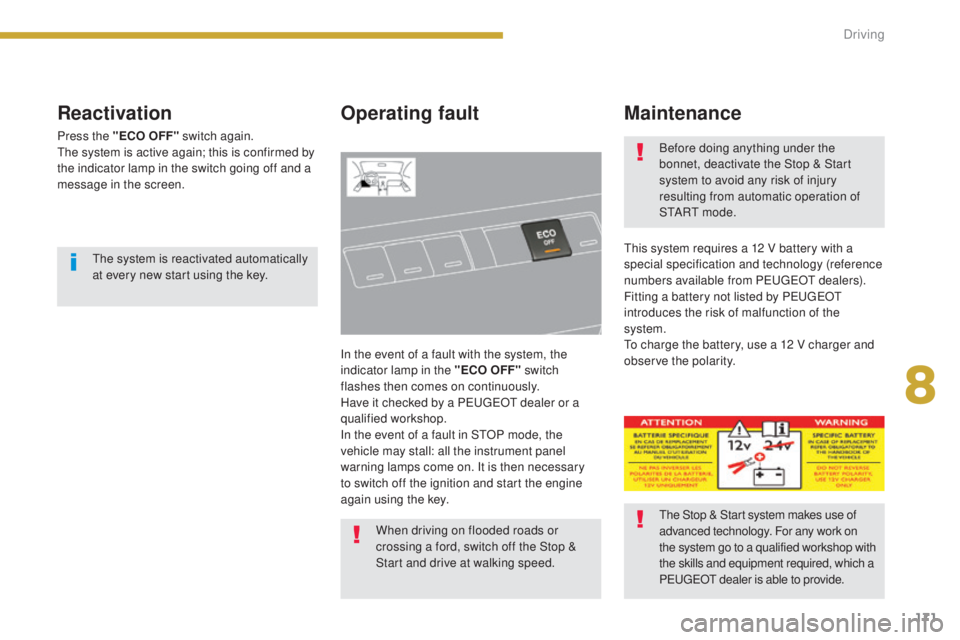
In the event of a fault with the system, the
indicator lamp in the "ECO OFF" switch
flashes then comes on continuously.
Have it checked by a PEUGEOT dealer or a
qualified workshop.
In the event of a fault in STOP mode, the
vehicle may stall: all the instrument panel
warning lamps come on. It is then necessary
to switch off the ignition and start the engine
again using the key.
Maintenance
This system requires a 12 V battery with a
special specification and technology (reference
numbers available from PEUGEOT dealers).
Fitting a battery not listed by PEUGEOT
introduces the risk of malfunction of the
system.
To charge the battery, use a 12 V charger and
observe the polarity.
The system is reactivated automatically
at every new start using the key.
The Stop & Start system makes use of
advanced technology. For any work on
the system go to a qualified workshop with
the skills and equipment required, which a
PEUGEOT dealer is able to provide. Before doing anything under the
bonnet, deactivate the Stop & Start
system to avoid any risk of injury
resulting from automatic operation of
S TA R T m o d e .
When driving on flooded roads or
crossing a ford, switch off the Stop &
Start and drive at walking speed.
8
Driving
Page 180 of 344
178
3008_en_Chap08_conduite_ed01-2015
Operation
You have identified a parking space:
F P ress button A to activate the function.
F
A
ctivate the direction indicator on the side
where the space is to be measured.
F
D
uring the measuring, go for ward the
length of the space, at a speed less than
12 mph (approximately 20 km/h), to
prepare for your manoeuvre.
T
he system then measures the size of the
space.
F
T
he system informs you of the level of
difficulty of the manoeuvre via a message
in the multifunction screen accompanied
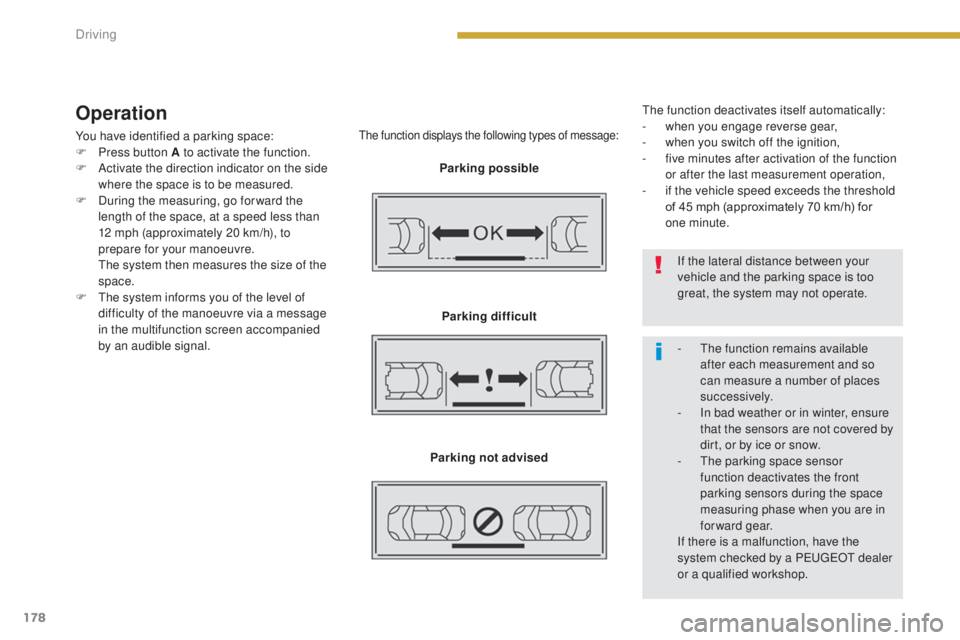
by an audible signal.The function displays the following types of message:
Parking possible
Parking difficult
Parking not advised The function deactivates itself automatically:
-
w
hen you engage reverse gear,
-
w
hen you switch off the ignition,
- f ive minutes after activation of the function
or after the last measurement operation,
-
i
f the vehicle speed exceeds the threshold
of 45 mph (approximately 70 km/h) for
one minute.
If the lateral distance between your
vehicle and the parking space is too
great, the system may not operate.
-
T
he function remains available
after each measurement and so
can measure a number of places
su c c e s s i ve l y.
-
I
n bad weather or in winter, ensure
that the sensors are not covered by
dirt, or by ice or snow.
-
T
he parking space sensor
function deactivates the front
parking sensors during the space
measuring phase when you are in
forward gear.
If there is a malfunction, have the
system checked by a PEUGEOT dealer
or a qualified workshop.
Driving
Page 182 of 344
180
3008_en_Chap09_verifications_ed01-2015
Fuel tank
Low fuel levelRefuelling
A label affixed to the inside of the filler flap
reminds you of the type of fuel to be used
according to your engine.
More than 5 litres of fuel must be added in
order to be registered by the fuel gauge.
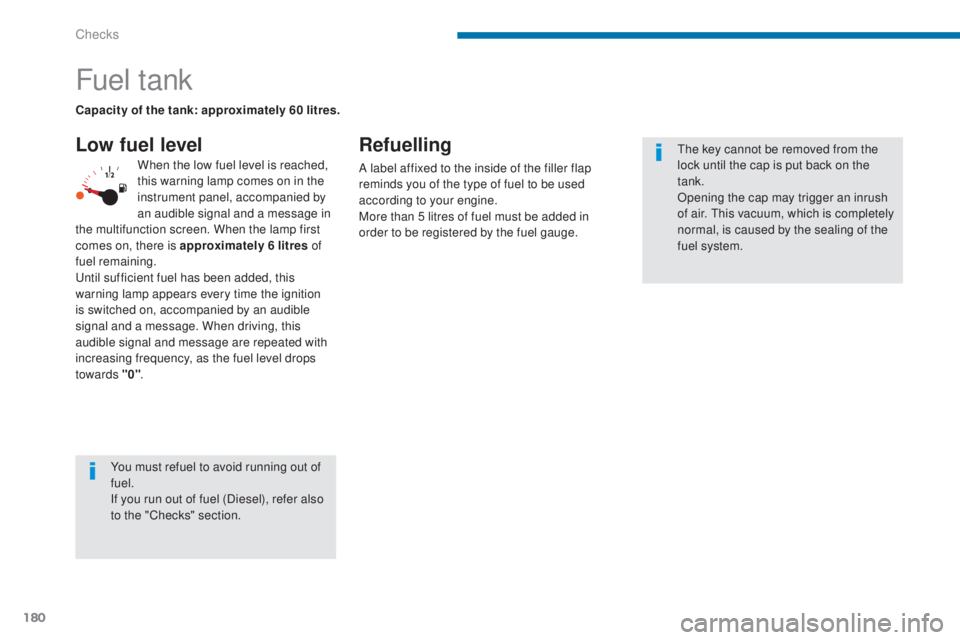
When the low fuel level is reached,
this warning lamp comes on in the
instrument panel, accompanied by
an audible signal and a message in
the multifunction screen. When the lamp first
comes on, there is approximately 6 litres of
fuel remaining.
Until sufficient fuel has been added, this
warning lamp appears every time the ignition
is switched on, accompanied by an audible
signal and a message. When driving, this
audible signal and message are repeated with
increasing frequency, as the fuel level drops
towards "0" .
Capacity of the tank: approximately 60 litres.
You must refuel to avoid running out of
fuel.
If you run out of fuel (Diesel), refer also
to the "Checks" section. The key cannot be removed from the
lock until the cap is put back on the
tank.
Opening the cap may trigger an inrush
of air. This vacuum, which is completely
normal, is caused by the sealing of the
fuel system.
Checks
Page 183 of 344
181
3008_en_Chap09_verifications_ed01-2015
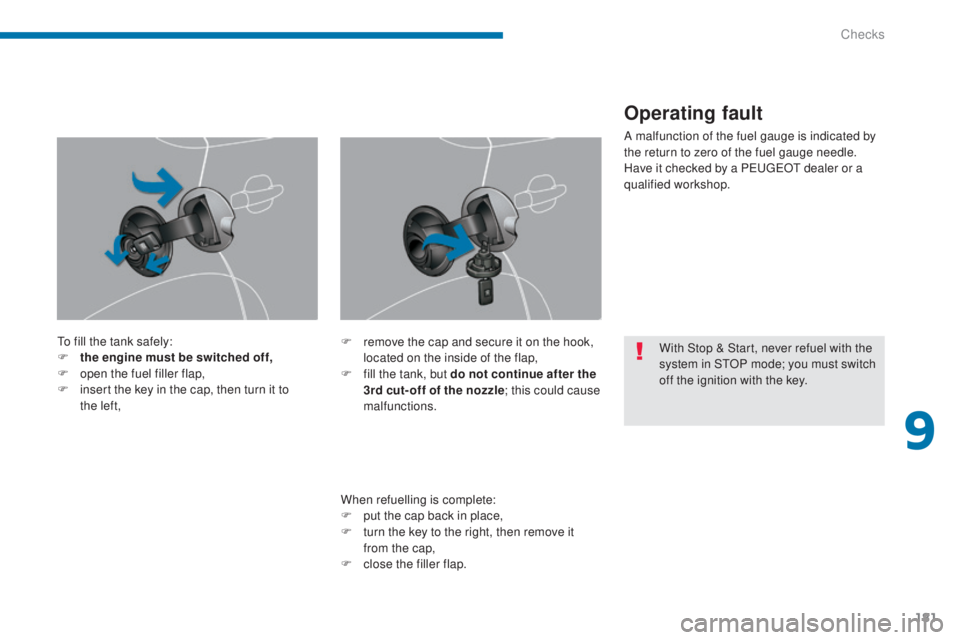
To fill the tank safely:
F t he engine must be switched off,
F
o
pen the fuel filler flap,
F
i
nsert the key in the cap, then turn it to
the
left,
When refuelling is complete:
F
p
ut the cap back in place,
F
t
urn the key to the right, then remove it
from the cap,
F
c
lose the filler flap.
F
r emove the cap and secure it on the hook,
located on the inside of the flap,
F
f
ill the tank, but do not continue after the
3rd cut- off of the nozzle ; this could cause
malfunctions.
Operating fault
A malfunction of the fuel gauge is indicated by
the return to zero of the fuel gauge needle.
Have it checked by a PEUGEOT
dealer or a
qualified workshop.
With Stop & Start, never refuel with the
system in STOP mode; you must switch
off the ignition with the key.
9
Checks
Page 186 of 344
184
3008_en_Chap09_verifications_ed01-2015
Running out of fuel (Diesel)
Other engines
F Add at least five litres of Diesel fuel to the tank.
F
O
pen the bonnet.
F
I
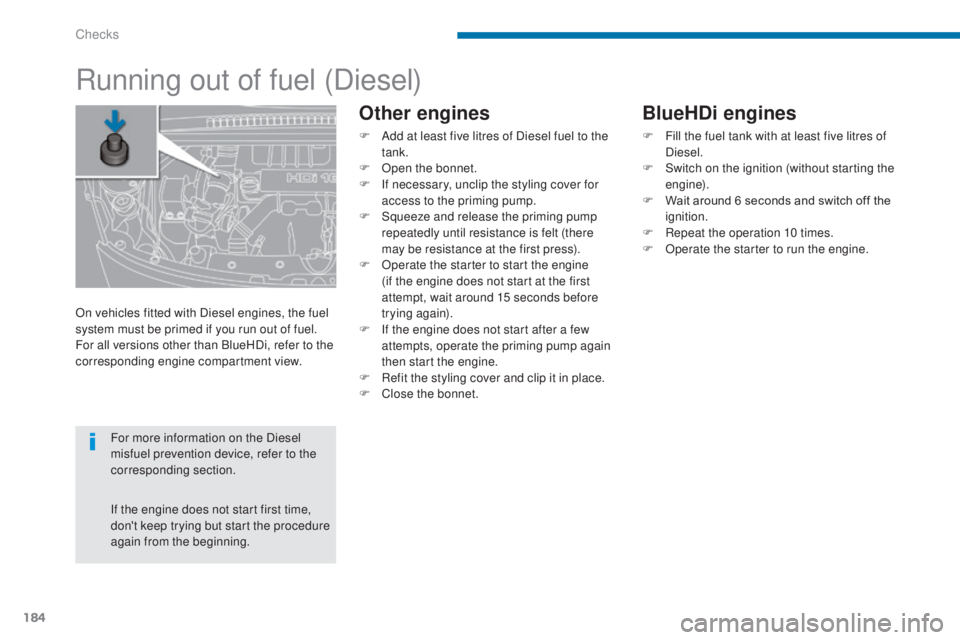
f necessary, unclip the styling cover for
access to the priming pump.
F
S
queeze and release the priming pump
repeatedly until resistance is felt (there
may be resistance at the first press).
F
O
perate the starter to start the engine
(if the engine does not start at the first
attempt, wait around 15 seconds before
trying again).
F
I
f the engine does not start after a few
attempts, operate the priming pump again
then start the engine.
F
R
efit the styling cover and clip it in place.
F
C
lose the bonnet.
On vehicles fitted with Diesel engines, the fuel
system must be primed if you run out of fuel.
For all versions other than BlueHDi, refer to the
corresponding engine compartment view.
For more information on the Diesel
misfuel prevention device, refer to the
corresponding section.
If the engine does not start first time,
don't keep trying but start the procedure
again from the beginning.
BlueHDi engines
F Fill the fuel tank with at least five litres of Diesel.
F
S
witch on the ignition (without starting the
engine).
F
W
ait around 6 seconds and switch off the
ignition.
F
R
epeat the operation 10 times.
F
O
perate the starter to run the engine.
Checks
Page 190 of 344
188
3008_en_Chap09_verifications_ed01-2015
Checking levels
Engine oil level
The check is carried out either when
the ignition is switched on using the
oil level indicator in the instrument
panel for vehicles so equipped, or
using the dipstick.
Check all of these levels regularly, in line with the manufacturer's service schedule. Top them up if necessary, unless other wise indicated.
If a level drops significantly, have the corresponding system checked by a PEUGEOT dealer or a qualified workshop.
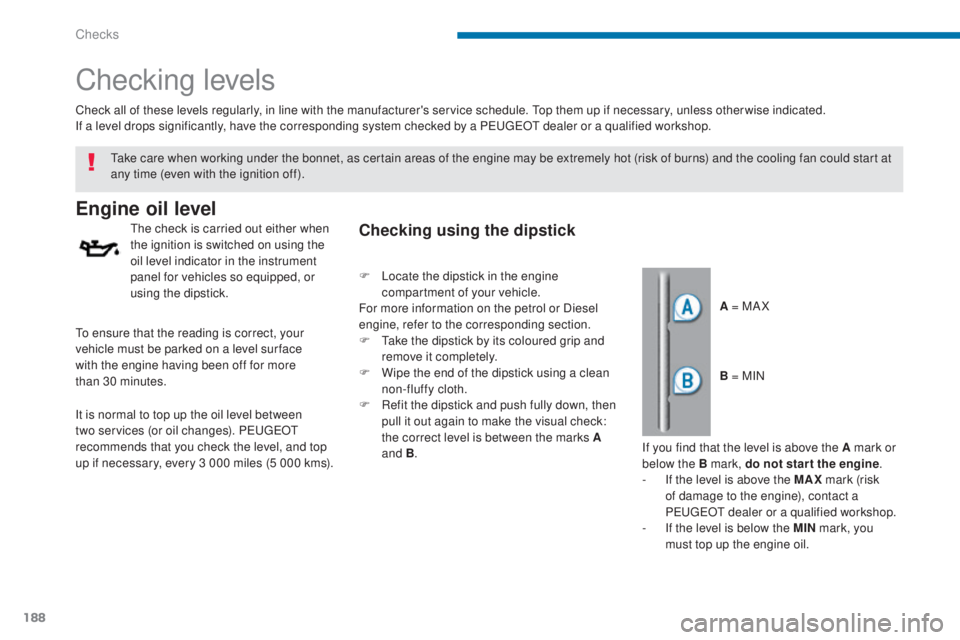
A = MA X
Take care when working under the bonnet, as certain areas of the engine may be extremely hot (risk of burns) and the cooling fan could start at
any time (even with the ignition off).
To ensure that the reading is correct, your
vehicle must be parked on a level sur face
with the engine having been off for more
than
30
minutes. B = MIN
It is normal to top up the oil level between
two services (or oil changes). PEUGEOT
recommends that you check the level, and top
up if necessary, every 3 000 miles (5 000 kms).Checking using the dipstick
If you find that the level is above the A mark or
below the B mark, do not star t the engine .
-
I
f the level is above the MAX mark (risk
of damage to the engine), contact a
PEUGEOT dealer or a qualified workshop.
-
I
f the level is below the MIN mark, you
must top up the engine oil.
F
L
ocate the dipstick in the engine
compartment of your vehicle.
For more information on the petrol or Diesel
engine, refer to the corresponding section.
F
T
ake the dipstick by its coloured grip and
remove it completely.
F
W
ipe the end of the dipstick using a clean
non-fluffy cloth.
F
R
efit the dipstick and push fully down, then
pull it out again to make the visual check:
the correct level is between the marks A
and B .
Checks
Page 191 of 344
189
3008_en_Chap09_verifications_ed01-2015
Power steering fluid level
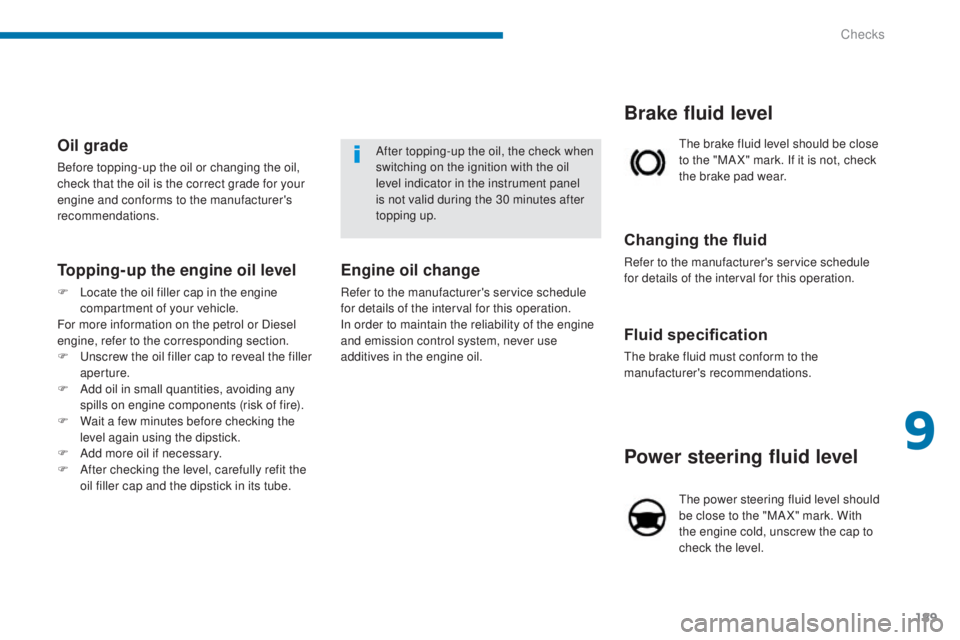
The power steering fluid level should
be close to the "MA X" mark. With
the engine cold, unscrew the cap to
check the level.
Fluid specification
The brake fluid must conform to the
manufacturer's recommendations.
Changing the fluid
Refer to the manufacturer's service schedule
for details of the interval for this operation.The brake fluid level should be close
to the "MA X" mark. If it is not, check
the brake pad wear.
Brake fluid level
After topping-up the oil, the check when
switching on the ignition with the oil
level indicator in the instrument panel
is not valid during the 30 minutes after
topping up.Oil grade
Before topping-up the oil or changing the oil,
check that the oil is the correct grade for your
engine and conforms to the manufacturer's
recommendations.
Engine oil change
Refer to the manufacturer's service schedule
for details of the interval for this operation.
In order to maintain the reliability of the engine
and emission control system, never use
additives in the engine oil.
Topping-up the engine oil level
F Locate the oil filler cap in the engine
compartment of your vehicle.
For more information on the petrol or Diesel
engine, refer to the corresponding section.
F
U
nscrew the oil filler cap to reveal the filler
aperture.
F
A
dd oil in small quantities, avoiding any
spills on engine components (risk of fire).
F
W
ait a few minutes before checking the
level again using the dipstick.
F
A
dd more oil if necessary.
F
A
fter checking the level, carefully refit the
oil filler cap and the dipstick in its tube.
9
Checks
Page 196 of 344
194
3008_en_Chap09_verifications_ed01-2015
Range indicators
The engine start prevention system
required by regulations is activated
automatically once the AdBlue
® tank is
e m pt y.
Once the AdBlue
® tank is on reserve or after
detection of a fault with the SCR emissions
control system, when the ignition is switched
on, an indicator displays an estimate of the
distance that can be covered, the range, before
engine starting is prevented.
In the event of simultaneous system fault and
low AdBlue
® level, the shortest range figure is
the one displayed. Range greater than 1 500 miles (2 400 km)
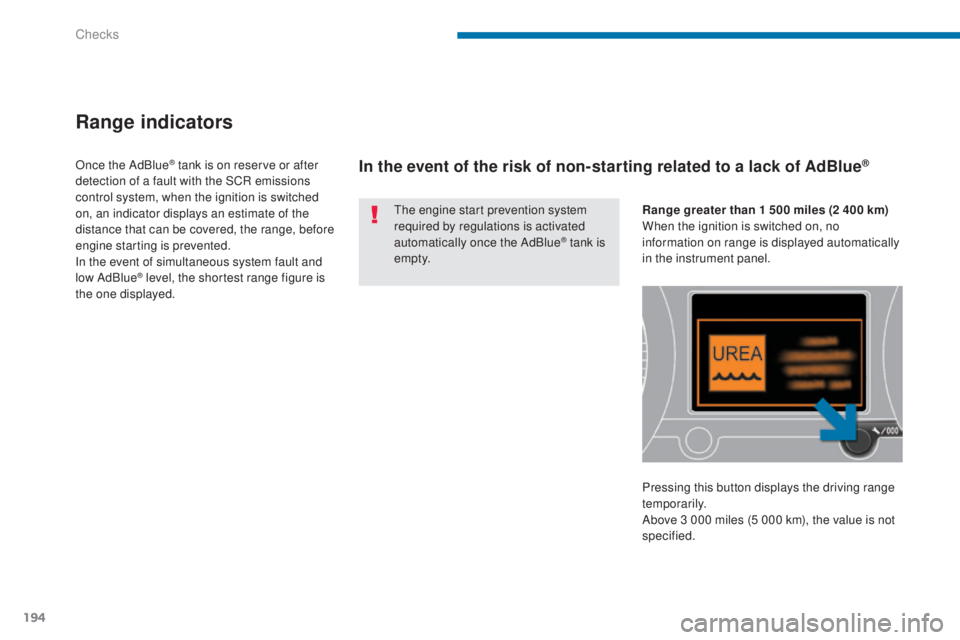
When the ignition is switched on, no
information on range is displayed automatically
in the instrument panel.
Pressing this button displays the driving range
temporarily.
Above 3 000 miles (5 000 km), the value is not
specified.
In the event of the risk of non-starting related to a lack of AdBlue®
Checks