warning light Peugeot 308 2017 User Guide
[x] Cancel search | Manufacturer: PEUGEOT, Model Year: 2017, Model line: 308, Model: Peugeot 308 2017Pages: 392, PDF Size: 10.16 MB
Page 118 of 392
116
308_en_Chap04_eclairage-et-visibilite_ed01-2016
Screenwash/headlamp wash
level low
In the case of vehicles fitted with headlamp
washers, when the fluid reservoir low level
is reached this warning lamp comes on in
the instrument panel, accompanied by an
audible signal and a message.
Automatic rain sensitive windscreen wipers
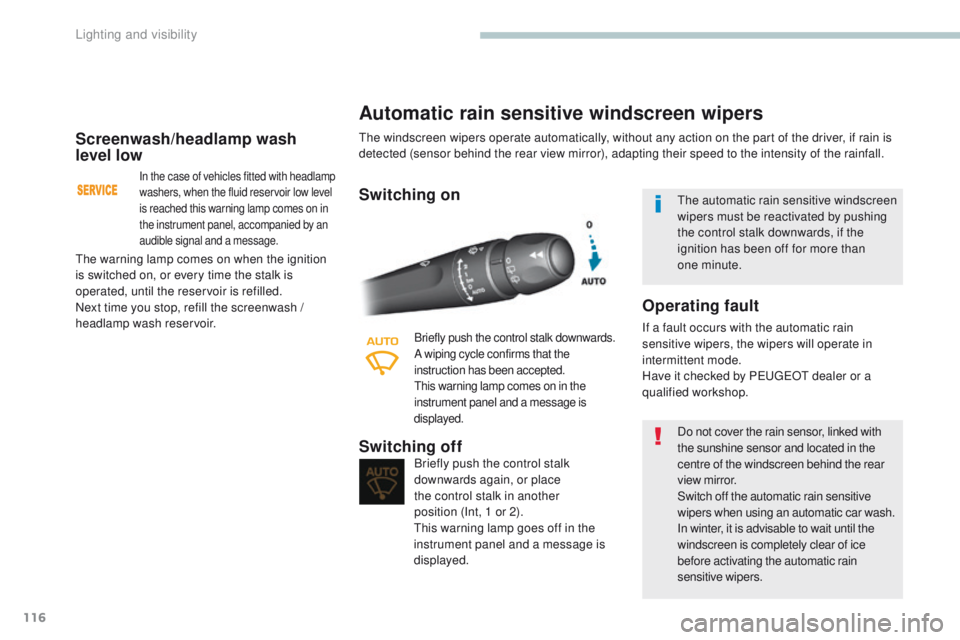
Switching on
Briefly push the control stalk downwards.
A wiping cycle confirms that the
instruction has been accepted.
th
is warning lamp comes on in the
instrument panel and a message is
displayed.
Briefly push the control stalk
downwards again, or place
the
control stalk in another
position
(Int, 1 or 2).
th
is warning lamp goes off in the
instrument panel and a message is
displayed.Switching off
the automatic rain sensitive windscreen
wipers must be reactivated by pushing
the control stalk downwards, if the
ignition has been off for more than
one
minute.
th
e warning lamp comes on when the ignition
is switched on, or every time the stalk is
operated, until the reservoir is refilled.
Next time you stop, refill the screenwash /
headlamp wash reservoir.
th
e windscreen wipers operate automatically, without any action on the part of the driver, if rain is
detected (sensor behind the rear view mirror), adapting their speed to the intensity of the rainfall.
Do not cover the rain sensor, linked with
the sunshine sensor and located in the
centre of the windscreen behind the rear
view mirror.
Switch off the automatic rain sensitive
wipers when using an automatic car wash.
In winter, it is advisable to wait until the
windscreen is completely clear of ice
before activating the automatic rain
sensitive wipers.
Operating fault
If a fault occurs with the automatic rain
sensitive wipers, the wipers will operate in
intermittent mode.
Have it checked by P
e
uge
Ot
dealer or a
qualified workshop.
Lighting and visibility
Page 124 of 392
122
308_en_Chap05_securite_ed01-2016
Anti-lock braking system
(ABS) and electronic brake
force distribution (EBFD)
the fixed illumination of this warning lamp
indicates that there is a fault with the ABS.In emergency braking, press ver y
firmly and maintain this pressure. When changing wheels (tyres and
rims), ensure that these are approved
for your vehicle.
Normal operation of the ABS may make
itself felt by slight vibrations of the brake
pedal.
th
e vehicle retains conventional
braking. Drive carefully at moderate
speed.
When this warning lamp comes on,
coupled with the STOP and ABS warning
lamps, accompanied by an audible signal
and a message, it indicates that there
is a fault with the electronic brake force
distribution (
eB
FD).
Intelligent traction control
system
the use of snow tyres is strongly recommended
on sur faces offering low levels of adhesion. You must stop as soon as it is safe to do so.
In both cases, have the system checked by a
P
e
uge
Ot
dealer or a qualified workshop as
soon as possible.
Depending on version, your vehicle has a
system to help driving on snow: intelligent
traction control
.
th
is system detects situations of difficult
sur face grip that could make it difficult to move
off or make progress on deep fresh snow or
compacted snow.
In these situations, the intelligent traction
control limits the amount of wheel spin to
provide the best traction and trajectory control
for your vehicle.
Safety
Page 128 of 392
126
308_en_Chap05_securite_ed01-2016
Advice
Recommendations for children
use a suitable child seat if the passenger is
less than 12 years old or shorter than one
and a half metres.
Never use the same seat belt to secure more
than one person.
Never allow a child to travel on your lap.
For more information on Child seats, refer
to the corresponding section.
In order to be effective, a seat belt must:
-
b
e tightened as close to the body as
possible,
-
b
e pulled in front of you with a smooth
movement, checking that it does not
twist,
-
b
e used to restrain only one person,
-
n
ot bear any trace of cuts or fraying,
-
n
ot be converted or modified to avoid
affecting its performance.
In accordance with current safety
regulations, for all repairs on your vehicle's
seat belts, go to a qualified workshop with
the skills and equipment needed, which a
P
e
uge
Ot d
ealer is able to provide.
Have your seat belts checked regularly by a
P
e
uge
Ot
dealer or a qualified workshop,
particularly if the straps show signs of
damage.
Clean the seat belt straps with soapy
water or a textile cleaning product, sold by
P
e
uge
Ot d
ealers.
After folding or moving a seat or rear bench
seat, ensure that the seat belt is positioned
and reeled in correctly.
In the event of an impact
Depending on the nature and
seriousness of the impact , the
pretensioning device may be deployed
before and independently of the airbags.
Deployment of the pretensioners is
accompanied by a slight discharge of
harmless smoke and a noise, due to the
activation of the pyrotechnic cartridge
incorporated in the system.
In all cases, the airbag warning lamp comes
on.
Following an impact, have the seat belts
system checked, and if necessary replaced,
by a P
e
uge
Ot
dealer or a qualified
workshop.
the
driver must ensure that passengers use
the seat belts correctly and that they are all
fastened before setting off.
Wherever you are seated in the vehicle,
always fasten your seat belt, even for short
journeys.
Do not interchange the seat belt buckles as
they will not fulfill their role fully.
th
e seat belts are fitted with an inertia reel
permitting automatic adjustment of the
length of the strap to your size.
t
h
e seat belt
is stowed automatically when not in use.
Before and after use, ensure that the seat
belt is reeled in correctly.th
e lower part of the strap must be
positioned as low as possible on the pelvis.
th
e upper part must be positioned in the
hollow of the shoulder.
th
e inertia reels are fitted with an automatic
locking device which comes into operation in
the event of a collision, emergency braking
or if the vehicle rolls over. You can release
the device by pulling the strap firmly and
then releasing it so that it reels in slightly.
Safety
Page 149 of 392
147
308_en_Chap06_conduite_ed01-2016
When towing
Distribution of loads
F Distribute the load in the trailer so that the
heaviest items are as close as possible to
the axle and the nose weight approaches
the maximum permitted without exceeding it.
Air density decreases with altitude, thus
reducing engine performance. Above
1 000 metres, the maximum towed load must
be reduced by 10
% for every 1 000 metres of
altitude.
Side wind
F take into account the increased sensitivity to side wind.
Cooling
towing a trailer on a slope increases the
temperature of the coolant.
As the fan is electrically controlled, its cooling
capacity is not dependent on the engine speed.
F
t
o l
ower the engine speed, reduce your
speed.
th
e maximum towed load on a long incline
depends on the gradient and the ambient
temperature.
In all cases, keep a check on the coolant
temperature.
F
I
f the warning lamp and the
STOP warning lamp come on,
stop the vehicle and switch off
the engine as soon as possible.
Braking
towing a trailer increases the braking distance.to a void overheating of the brakes, the use of
engine braking is recommended.
Ty r e s
F Check the tyre pressures of the towing vehicle and of the trailer, observing the
recommended pressures.
Lighting
F Check the electrical lighting and signalling on the trailer and the headlamp beam
height of your vehicle.
For more information on Weights
, refer
to the corresponding section.
th
e rear parking sensors will be
deactivated automatically to avoid the
audible signal if a genuine P
e
uge
Ot
towbar is used. For more information on Adjusting the
headlamp beam height
, refer to the
corresponding section.
6
Driving
Page 153 of 392
151
308_en_Chap06_conduite_ed01-2016
For Diesel vehicles, in sub-
zero temperatures the engine
will not start until the pre-heater
warning lamp has gone off.
If this warning lamp comes on
after pressing the "S
tA
R
t/
StO
P" button, press down on
the brake or clutch pedal until
the warning lamp goes off,
without pressing the "S
tA
R
t/
StO
P" button again, until the
engine starts and runs.
F
P
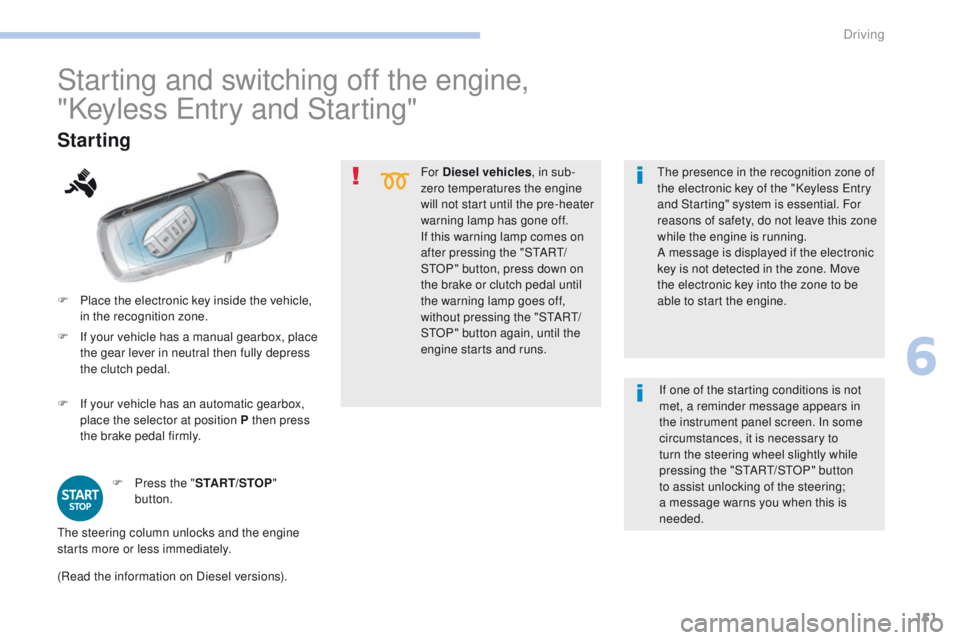
lace the electronic key inside the vehicle,
in the recognition zone.
Starting
F Press the " START/STOP"
button.
th
e presence in the recognition zone of
the electronic key of the "Keyless e
n
try
and Starting" system is essential. For
reasons of safety, do not leave this zone
while the engine is running.
A message is displayed if the electronic
key is not detected in the zone. Move
the electronic key into the zone to be
able to start the engine.
Starting and switching off the engine,
"Keyless e
n
try and Starting"
the steering column unlocks and the engine
starts more or less immediately. If one of the starting conditions is not
met, a reminder message appears in
the instrument panel screen. In some
circumstances, it is necessary to
turn the steering wheel slightly while
pressing the "S
tA
R
t/
S
tO
P" button
to assist unlocking of the steering;
a message warns you when this is
needed.
(Read the information on Diesel versions). F
I
f your vehicle has a manual gearbox, place
the gear lever in neutral then fully depress
the clutch pedal.
F
I
f your vehicle has an automatic gearbox,
place the selector at position P then press
the brake pedal firmly.
6
Driving
Page 172 of 392
170
308_en_Chap06_conduite_ed01-2016
Stop & Start
Operation
Going into engine STOP mode
- With a manual gearbox, with the speed
below 12 mph (20 km/h) or with the vehicle
stationary (depending on the engine), when
you put the gear lever into neutral and
release the clutch pedal.
Never refuel with the engine in S
tO
P
mode; you must switch off the ignition. For your comfort, during parking
manoeuvres, S
tO
P mode is not
available for a few seconds after
coming out of reverse gear.
th
e Stop & Start system does not affect
the functionality of the vehicle, such as
for example, braking, power steering...
A slight delay between the vehicle
stopping and the engine cutting out may
be noticed.
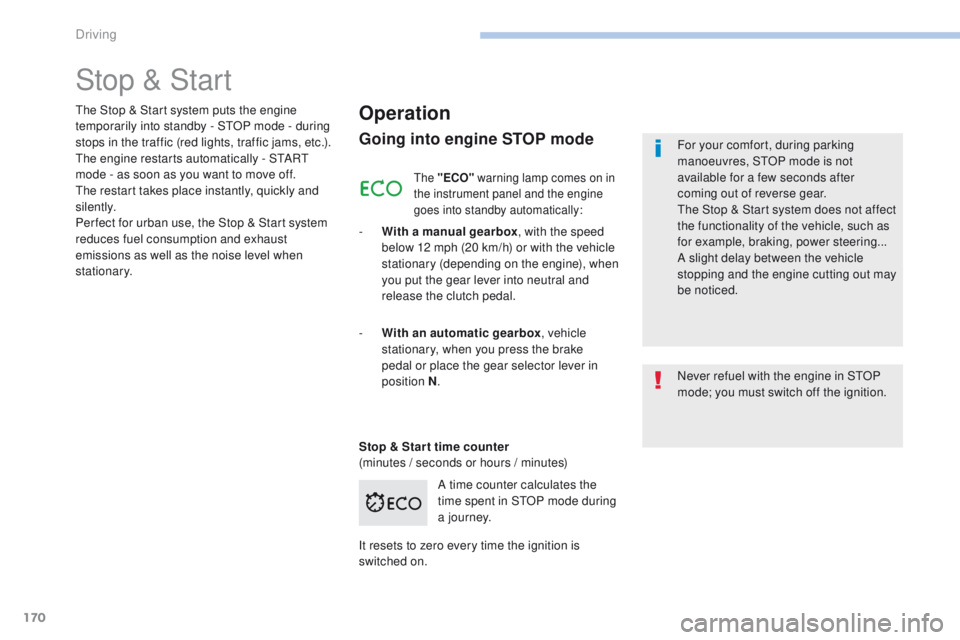
A time counter calculates the
time spent in S
tO
P mode during
a j o u r n ey.
th
e Stop & Start system puts the engine
temporarily into standby - S
tO
P mode - during
stops in the traffic (red lights, traffic jams, etc.).
th
e engine restarts automatically - S
tA
R
t
mode - as soon as you want to move off.
th
e restart takes place instantly, quickly and
silently.
Per fect for urban use, the Stop & Start system
reduces fuel consumption and exhaust
emissions as well as the noise level when
stationary.
Stop & Star t time counter
(minutes / seconds or hours / minutes) -
W
ith an automatic gearbox , vehicle
stationary, when you press the brake
pedal or place the gear selector lever in
position
N.
It resets to zero every time the ignition is
switched on.
the "ECO" warning lamp comes on in
the instrument panel and the engine
goes into standby automatically:
Driving
Page 198 of 392
196
308_en_Chap06_conduite_ed01-2016
the alert is given by a warning lamp which
comes on in the door mirror on the side in
question as soon as a vehicle - car, lorry,
bicycle - is detected and the following
conditions are fulfilled:
-
a
ll the vehicles are moving in the same
direction and on adjacent lanes,
-
t
he speed of your vehicle is between 7 and
87 mph (12 and 140 km/h),
-
w
hen you overtake a vehicle with a speed
difference of less than 6 mph (10 km/h),
-
w
hen a vehicle overtakes you with a speed
difference of less than 16 mph (25 km/h),
-
t
he traffic is flowing normally,
-
i
n the case of an overtaking manoeuvre,
if this is prolonged and the vehicle being
overtaken remains in the blind spot,
-
y
ou are driving on a straight or slightly
curved road,
-
y
our vehicle is not pulling a trailer, a
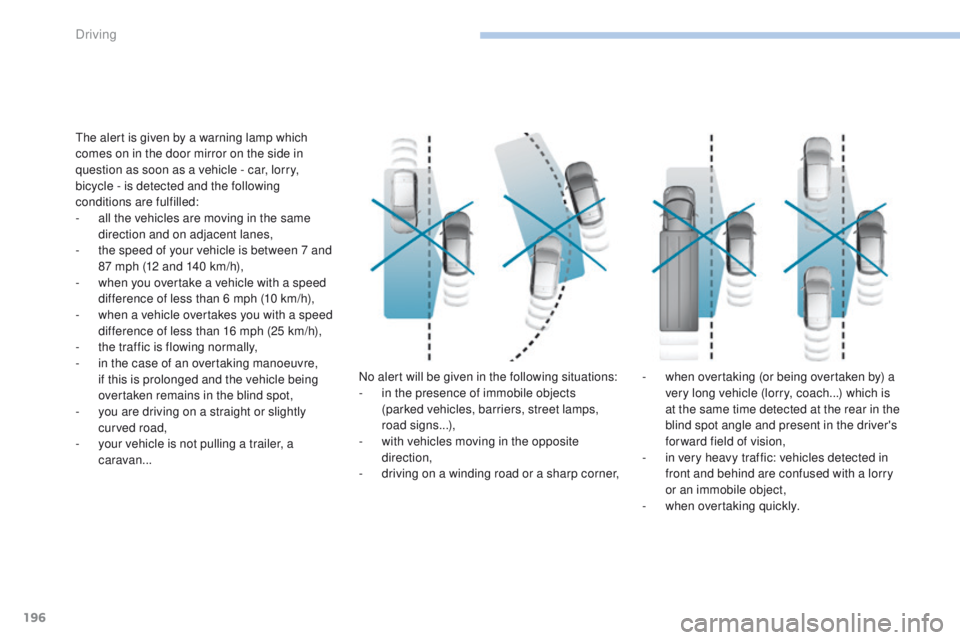
caravan... No alert will be given in the following situations:
-
i
n the presence of immobile objects
(parked vehicles, barriers, street lamps,
road signs...),
-
w
ith vehicles moving in the opposite
direction,
-
d
riving on a winding road or a sharp corner,-
w
hen overtaking (or being overtaken by) a
very long vehicle (lorry, coach...) which is
at the same time detected at the rear in the
blind spot angle and present in the driver's
forward field of vision,
-
i
n very heavy traffic: vehicles detected in
front and behind are confused with a lorry
or an immobile object,
-
w
hen overtaking quickly.
Driving
Page 222 of 392
220
308_en_Chap07_info-pratiques_ed01-2016
"Multimedia"
Multimedia support, hands-free kit, DVD player,
driving aids, vehicle tracking system, ...
Accessories
A wide range of accessories and genuine parts is available from the PeugeOt dealer network.th
ese accessories and parts are all suitable for your vehicle and benefit from Pe ugeOt' s recommendation and warranty.
"Transport solutions"
Boot liners, roof bars, bicycle carrier on roof
bars, ski carrier, roof box, towbar harness, ...
to
w bar, which mst be fitted by P
e
uge
Ot
dealer or a qualified workshop.
Conversion kits
You can obtain an "en terprise" kit to convert a
trade vehicle to a private car and vice-versa.
"Styling"
alloy wheels from 15 inch to 18 inch, finishers
for wheels, door sills, gear lever knobs, ...
"Ligne S": 16 and 17 inch alloy wheels, body
kit, stickers, interior and exterior mirror shells,
gear lever knob, door sills, mats*, …
"Comfort"
Door deflectors, side blinds and rear blind,
cigarette lighter, boot dividers, coat hanger
fixed to head restraint, front centre armrest,
under shelf storage, front and rear parking
sensors, styling mudflaps, window film, boot
management system, ...
*
t
o a
void any risk of jamming of the pedals:
-
e
nsure that the mat is positioned and
secured correctly,
-
n
ever fit one mat on top of another.
"Security and safety"
Anti-theft alarm, window engraving, wheel
security bolts, child seats and booster
cushions, breathalyzer, first aid kit, warning
triangle, high visibility jacket, stolen vehicle
tracking system, temporary puncture repair kit,
snow chains, non-slip covers, front foglamps
kit, dog guard, ...
"Protection"
Mats*, seat covers compatible with lateral
airbags, mud flaps, side protection rubbing
strips, bumper protection rubbing strips,
bumper protectors, boot sill finishers, boot
mat,
...
Practical information
Page 257 of 392
255
308_en_Chap08_en-cas-de-panne_ed01-2016
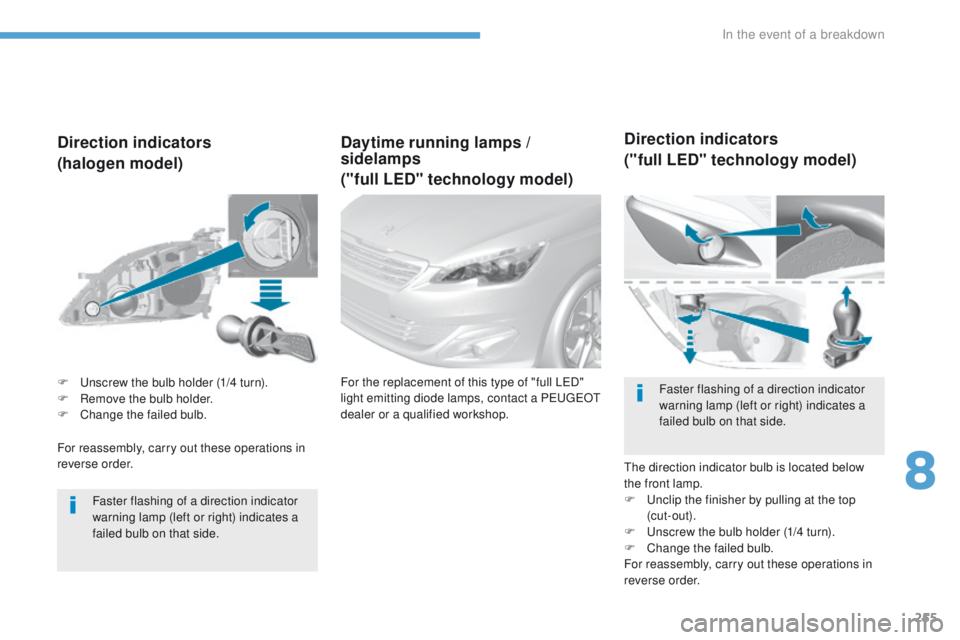
For reassembly, carry out these operations in
reverse order.
Direction indicators
(halogen model)
Faster flashing of a direction indicator
warning lamp (left or right) indicates a
failed bulb on that side.
Daytime running lamps /
sidelamps
("full LED" technology model)
For the replacement of this type of "full LeD "
light emitting diode lamps, contact a Pe ugeOt
dealer or a qualified workshop.
Direction indicators
("full LED" technology model)
the direction indicator bulb is located below
the front lamp.
F
u
n
clip the finisher by pulling at the top
(cut-out).
F
u
n
screw the bulb holder (1/4 turn).
F
C
hange the failed bulb.
For reassembly, carry out these operations in
reverse order. Faster flashing of a direction indicator
warning lamp (left or right) indicates a
failed bulb on that side.
F
u
n
screw the bulb holder (1/4 turn).
F
R
emove the bulb holder.
F
C
hange the failed bulb.
8
In the event of a breakdown
Page 381 of 392
379
308_en_Chap11_index-alpha_ed01-2016
ABS ...............................................................121
Accessories ................................. 152, 220, 222
AdBlue
® additive ....................... 26, 32, 233-237
Additive, Diesel ............................................. 230
Adjusting headlamps
.................................... 113
Adjusting head restraints
................................ 77
Adjusting the seat
..................................... 7 3 , 74
Adjusting the air distribution
...........................95
Adjusting the air flow
....................................... 95
Adjusting the date
...................................... 47- 4 9
Adjusting the height and reach of the steering wheel
.................................... 72
Adjusting the lumbar support
..........................73
Adjusting the temperature
.............................. 95
A
djusting the time
...................................... 47- 4 9
Advice on driving
.................................. 146, 147
Affaire version
............................................... 291
Airbags
............................................ 23, 127, 134
Airbags, curtain
..................................... 1
2 9, 13 0
Airbags, front ......................................... 1 2 7, 1 3 0
Airbags, lateral
...................................... 12 9, 13 0
Air conditioning
............................ 10, 93, 95, 98
Air conditioning, automatic
.......................92, 95
Air conditioning, digital
................................. 10 0
Air conditioning, manual
...................92-94, 100
Air intake
......................................................... 99
Air vents
.......................................................... 91
Alarm
............................................................... 67
Anti-lock braking system (ABS)
....................121
Anti-pinch
................................................ 70, 102
Anti-slip regulation (ASR)
............................. 121
Anti-theft
................................................. 53, 15 4
Armrest
............................................................ 82
Armrest, front
.................................................. 84
Armrest, rear
................................................... 86
A
ssistance call
.............................................. 11 9
Audible warning
............................................ 121
Audio streaming (Bluetooth)
......... 3
12, 314, 3 69
Auxiliary
........................................................ 312
AB
C
Back-up key..................................................... 63
Battery .................................... 219, 231, 268 -271
Battery, charging
........................................... 270
Battery, remote control
................ 5
4, 55, 64, 65
Bicycle carrier
............................................... 222
Blanking screen (snow shield)
.............. 21
7, 218
Blind, panoramic roof
.................................... 102
Blind spot sensors
.................................. 16, 195
BlueHDi
..................................... 28, 32, 233, 274
Bluetooth (hands-free)
.................. 3
46, 347, 370
Bluetooth (telephone)
...........................346, 347
Bonnet
........................................................... 225
Boot
................................................................. 61
Boot lamp
........................................................ 88
Brake discs
.................................................... 2
32
Brake lamps
...............................
...........257, 259
Brakes
............................................... 21, 25, 232
Bulbs (changing)
........................... 25
2, 257, 259
Cable, audio
.................................................. 312
Cable, jack
.................................................... 312
Capacity, fuel tank
..............................
..........213
Cap, fuel filler
................................................ 213
CD, MP3
........................................ 3
12, 367, 368
Central locking
.............................. 51, 56, 58, 59
Changing a bulb
............................ 252, 257, 259
Changing a fuse
........................... 262, 264, 266
Changing a wheel
................................. 246, 247
Changing a wiper blade
........................117, 222
Changing the remote control battery
........54, 64
Checking the engine oil level
..........................31
Checking the levels
...............................228-230Checking tyre pressures
(using the kit) ..............................
................239
Checks
...............
...................226, 227, 231, 232
Child lock
...............................
..................63, 14 4
Children
...............................
..........13 8, 142, 143
Children (safety)
...............................
.............14 4
Child seats
............1
26, 131-13 3, 137, 13 8, 14 5
Child seats, conventional
..............................137
Child seats, ISOFIX
......................14
0, 142, 143
Closing the boot
..............................................61
Closing the doors
..........................51, 56, 58, 59
Collision risk alert
..............................
...........19 0
Compressor, tyre inflation
............................239
Configuration, vehicle
.....................................44
Connection, Bluetooth
.........................346, 347
Control, electric windows
................................70
Control, emergency boot release
...................62
Control, emergency door
................................63
Control, heated seats
......................................76
Control stalk, lighting
.............................. 14
, 107
Control stalk, wipers
..............................114 -11 6
Courtesy lamps
.............................................103
Cruise control
........................ 1
73, 177, 180, 181
Cruise control, dynamic
................................180
Cup holder
...............................
........................82
DAB (Digital Audio Broadcasting) - Digital radio
.........................310, 311, 364, 365
Date (setting)
...............................
...............47- 4 9
Daytime running lamps
................. 1
08, 110, 252, 253, 255, 256
Deactivating the passenger airbag
.................................................. 1
2 7, 1 3 4
D
.
Alphabetical index