warning Peugeot 308 2017 Manual PDF
[x] Cancel search | Manufacturer: PEUGEOT, Model Year: 2017, Model line: 308, Model: Peugeot 308 2017Pages: 392, PDF Size: 10.16 MB
Page 233 of 392
231
308_en_Chap07_info-pratiques_ed01-2016
Checks
12 V battery
the battery does not require any maintenance.
However, check regularly that the terminals
are correctly tightened (versions without quick
release terminals) and that the connections
are clean.Refer to the manufacturer's
service schedule for details of the
replacement intervals for these
components.
Air filter and passenger compartment filter
Replace the oil filter each time the
engine oil is changed.
Refer to the manufacturer's
service schedule for details of
the replacement interval for this
component.Oil filter
Versions equipped with Stop & Start are
fitted with a 12 V lead-acid battery of
specific technology and specification.
Its replacement should be carried
out only by a P
e
uge
Ot
dealer or a
qualified workshop.
Particle filter (Diesel)
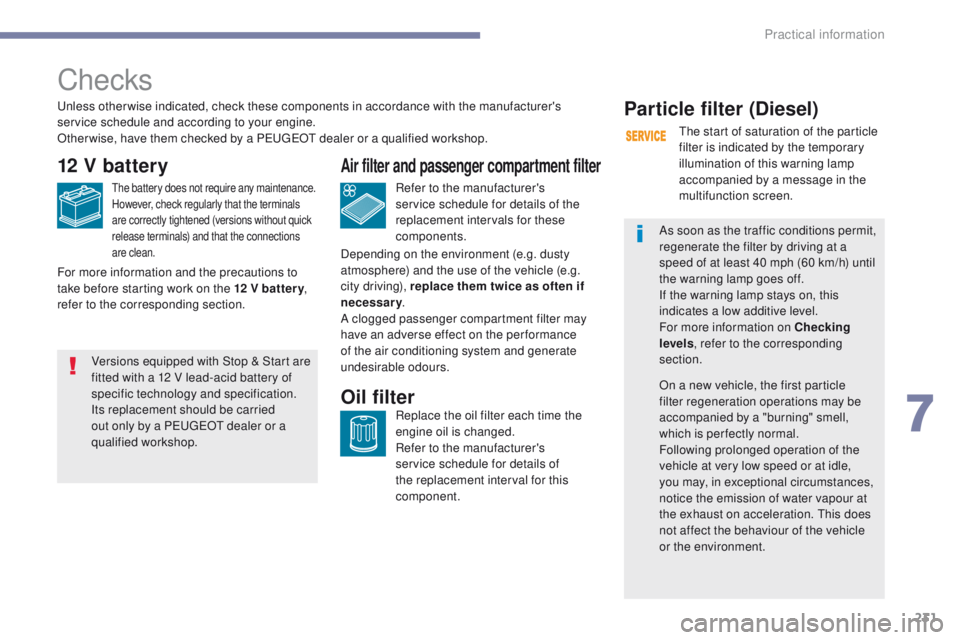
the start of saturation of the particle
filter is indicated by the temporary
illumination of this warning lamp
accompanied by a message in the
multifunction screen.
As soon as the traffic conditions permit,
regenerate the filter by driving at a
speed of at least 40 mph (60 km/h) until
the warning lamp goes off.
If the warning lamp stays on, this
indicates a low additive level.
For more information on Checking
levels , refer to the corresponding
section.
On a new vehicle, the first particle
filter regeneration operations may be
accompanied by a "burning" smell,
which is per fectly normal.
Following prolonged operation of the
vehicle at very low speed or at idle,
you may, in exceptional circumstances,
notice the emission of water vapour at
the exhaust on acceleration.
t
h
is does
not affect the behaviour of the vehicle
or the environment.
un
less otherwise indicated, check these components in accordance with the manufacturer's
service schedule and according to your engine.
Other wise, have them checked by a Pe
ugeOt
dealer or a qualified workshop.
For more information and the precautions to
take before starting work on the 12 V batter y ,
refer to the corresponding section. Depending on the environment (e.g. dusty
atmosphere) and the use of the vehicle (e.g.
city driving), replace them twice as often if
necessary
.
A clogged passenger compartment filter may
have an adverse effect on the per formance
of the air conditioning system and generate
undesirable odours.
7
Practical information
Page 236 of 392
234
308_en_Chap07_info-pratiques_ed01-2016
Topping-up the AdBlue®
Filling the AdBlue® tank is an operation
included in every routine service on your
vehicle by a P
e
uge
Ot
dealer or a qualified
workshop.
Nevertheless, given the capacity of the tank, it
may be necessary to top-up the fluid between
services, more particularly if an alert (warning
lamps and a message) signals the requirement.
You can go to a P
e
uge
Ot
dealer or a qualified
workshop.
If you envisage topping-up yourself, please
read the following warnings carefully.Precautions in use
Keep AdBlue® out of the reach of
children, in its original container or
bottle.
Never transfer AdBlue
® to another
container: it would lose its purity.
us
e only AdBlue
® fluid that meets
the ISO 22241 standard.
Never dilute AdBlue
® with water.
Never pour AdBlue® into the Diesel fuel
tank.
th
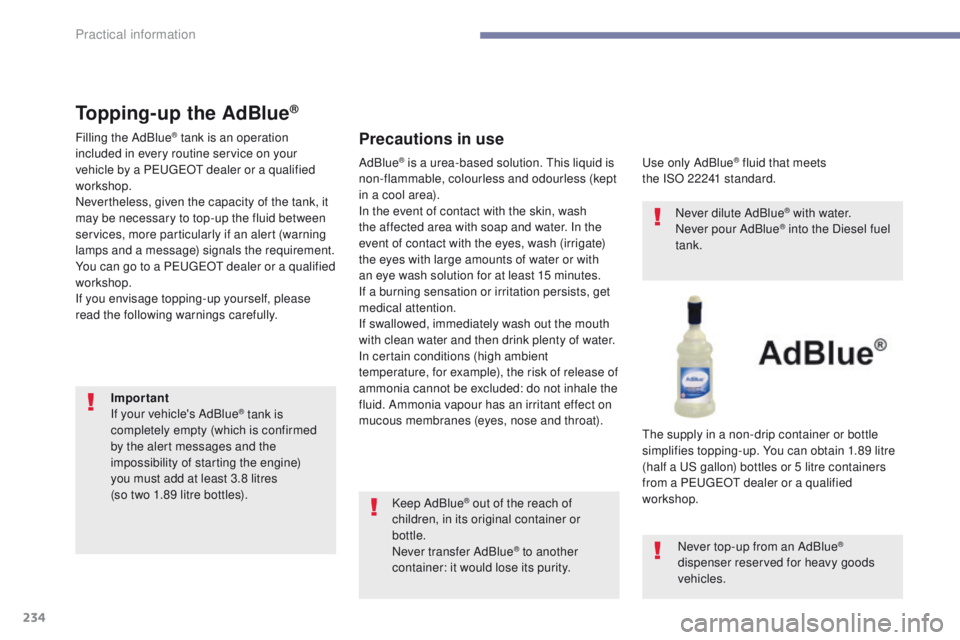
e supply in a non-drip container or bottle
simplifies topping-up. You can obtain 1.89 litre
(half a
u
S g
allon) bottles or 5 litre containers
from a P
e
uge
Ot
dealer or a qualified
workshop.
Never top-up from an AdBlue
®
dispenser reserved for heavy goods
vehicles.
AdBlue
® is a urea-based solution. th
is liquid is
non-flammable, colourless and odourless (kept
in a cool area).
In the event of contact with the skin, wash
the affected area with soap and water. In the
event of contact with the eyes, wash (irrigate)
the eyes with large amounts of water or with
an eye wash solution for at least 15 minutes.
If a burning sensation or irritation persists, get
medical attention.
If swallowed, immediately wash out the mouth
with clean water and then drink plenty of water.
In certain conditions (high ambient
temperature, for example), the risk of release of
ammonia cannot be excluded: do not inhale the
fluid. Ammonia vapour has an irritant effect on
mucous membranes (eyes, nose and throat).
Important
If your vehicle's AdBlue
® tank is
c
ompletely empty (which is confirmed
by the alert messages and the
impossibility of starting the engine)
you must add at least 3.8 litres
(so two 1.89 litre bottles).
Practical information
Page 240 of 392
238
308_en_Chap08_en-cas-de-panne_ed01-2016
Warning triangle (stowing)
Before leaving your vehicle to set up
and install the triangle, switch on the
hazard warning lamps and put on your
high visibility vest.
th
is safety equipment should be used in
addition to the hazard warning lamps.
Its presence in the vehicle is mandatory.
Placing the triangle in the
road
Refer to the manufacturer's instructions on
unfolding and installing supplied with the
triangle. F
P
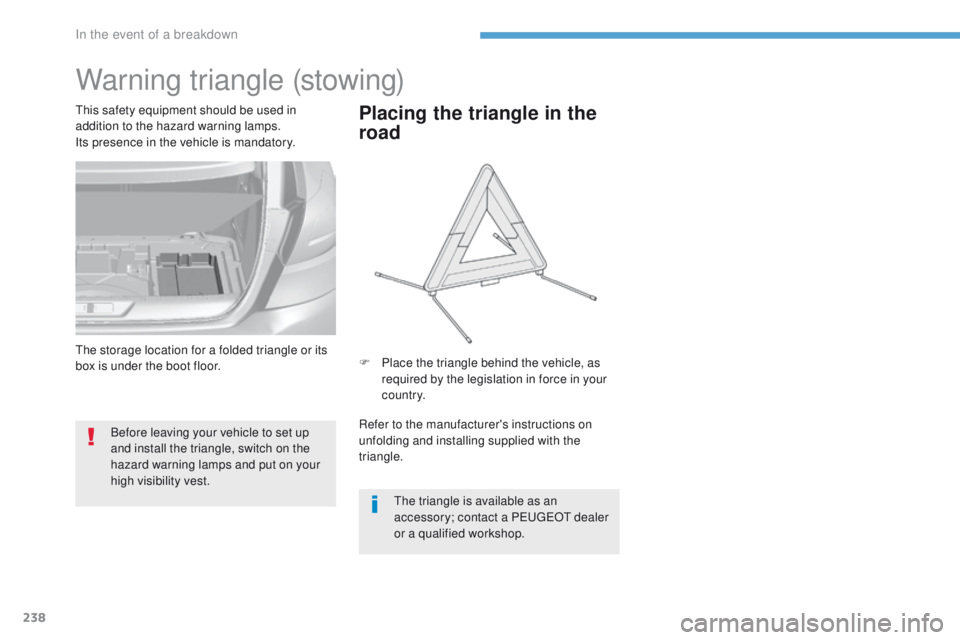
lace the triangle behind the vehicle, as
required by the legislation in force in your
c o unt r y.
th
e triangle is available as an
accessory; contact a P
e
uge
Ot
dealer
or a qualified workshop.
th
e storage location for a folded triangle or its
box is under the boot floor.
In the event of a breakdown
Page 250 of 392
248
308_en_Chap08_en-cas-de-panne_ed01-2016
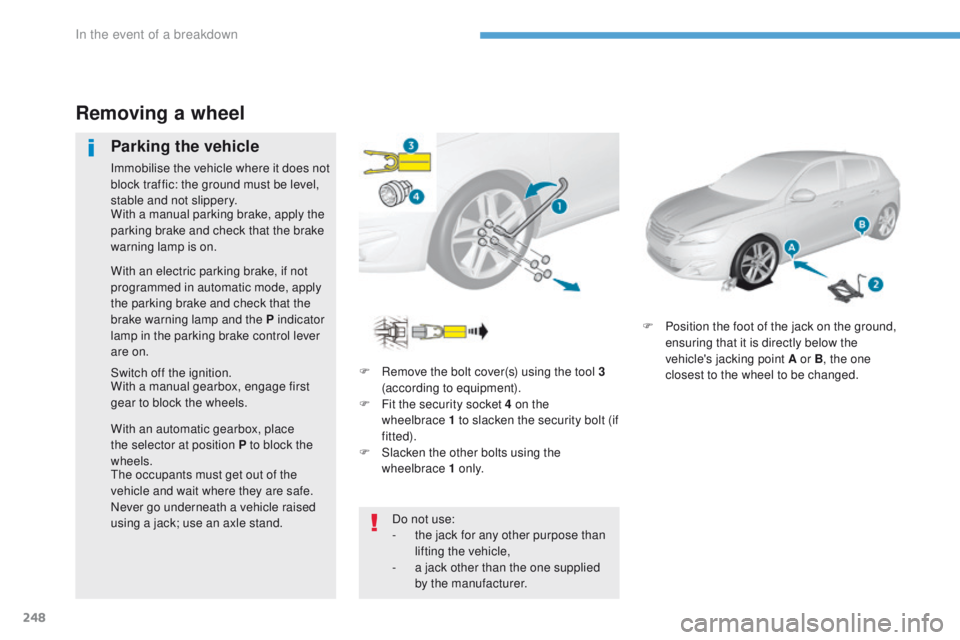
F Remove the bolt cover(s) using the tool 3
(according to equipment).
F
F
it the security socket 4 on the
wheelbrace
1 to slacken the security bolt (if
fitted).
F
S
lacken the other bolts using the
wheelbrace 1 o n l y. F
P
osition the foot of the jack on the ground,
ensuring that it is directly below the
vehicle's jacking point A or B , the one
closest to the wheel to be changed.
Removing a wheel
Parking the vehicle
Immobilise the vehicle where it does not
block traffic: the ground must be level,
stable and not slippery.
Switch off the ignition. With a manual parking brake, apply the
parking brake and check that the brake
warning lamp is on.
With an electric parking brake, if not
programmed in automatic mode, apply
the parking brake and check that the
brake warning lamp and the P indicator
lamp in the parking brake control lever
are on.
With a manual gearbox, engage first
gear to block the wheels.
With an automatic gearbox, place
the selector at position P to block the
wheels.
th
e occupants must get out of the
vehicle and wait where they are safe.
Never go underneath a vehicle raised
using a jack; use an axle stand. Do not use:
-
t
he jack for any other purpose than
lifting the vehicle,
-
a j
ack other than the one supplied
by the manufacturer.
In the event of a breakdown
Page 257 of 392
255
308_en_Chap08_en-cas-de-panne_ed01-2016
For reassembly, carry out these operations in
reverse order.
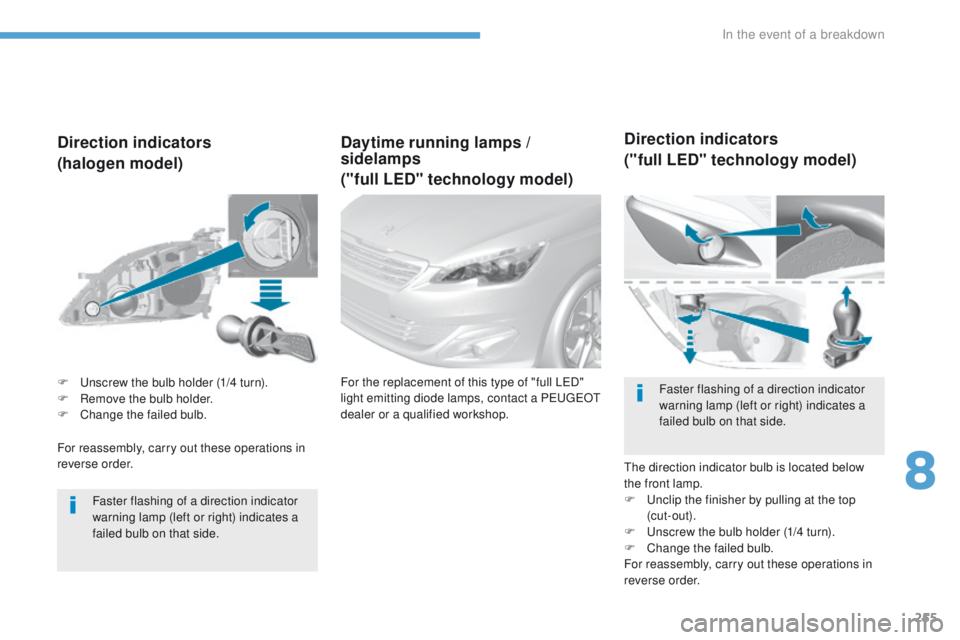
Direction indicators
(halogen model)
Faster flashing of a direction indicator
warning lamp (left or right) indicates a
failed bulb on that side.
Daytime running lamps /
sidelamps
("full LED" technology model)
For the replacement of this type of "full LeD "
light emitting diode lamps, contact a Pe ugeOt
dealer or a qualified workshop.
Direction indicators
("full LED" technology model)
the direction indicator bulb is located below
the front lamp.
F
u
n
clip the finisher by pulling at the top
(cut-out).
F
u
n
screw the bulb holder (1/4 turn).
F
C
hange the failed bulb.
For reassembly, carry out these operations in
reverse order. Faster flashing of a direction indicator
warning lamp (left or right) indicates a
failed bulb on that side.
F
u
n
screw the bulb holder (1/4 turn).
F
R
emove the bulb holder.
F
C
hange the failed bulb.
8
In the event of a breakdown
Page 274 of 392
272
308_en_Chap08_en-cas-de-panne_ed01-2016
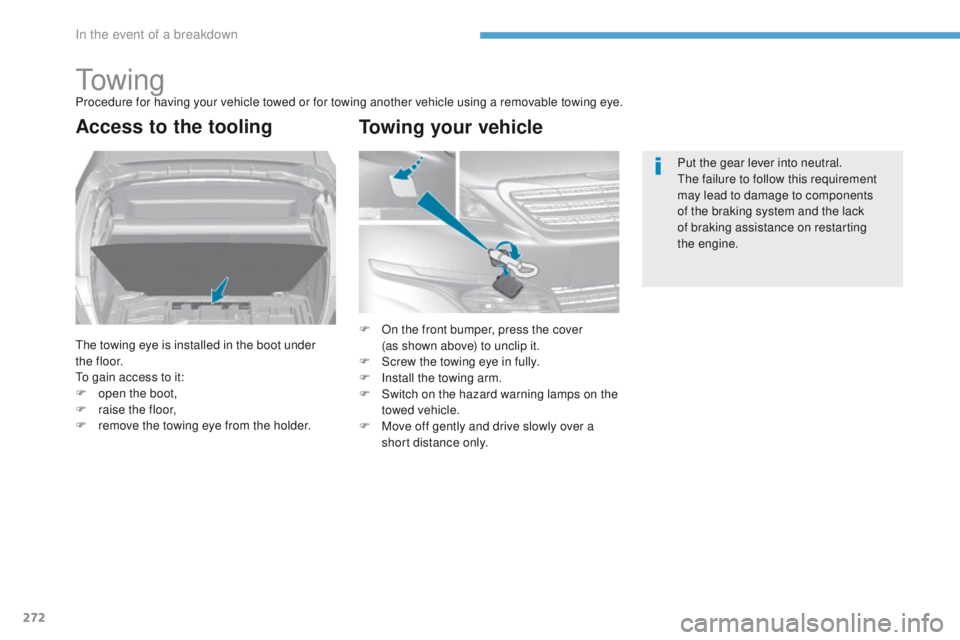
to w i n gProcedure for having your vehicle towed or for towing another vehicle using a removable towing eye.
Access to the tooling
the towing eye is installed in the boot under
t h e f l o o r.
to g
ain access to it:
F
o
pen the boot,
F
r
aise the floor,
F
r
emove the towing eye from the holder. Put the gear lever into neutral.
th
e failure to follow this requirement
may lead to damage to components
of the braking system and the lack
of braking assistance on restarting
the
engine.
F O n the front bumper, press the cover
(as shown above) to unclip it.
F
S
crew the towing eye in fully.
F
I
nstall the towing arm.
F
S
witch on the hazard warning lamps on the
towed vehicle.
F
M
ove off gently and drive slowly over a
short distance only.
Towing your vehicle
In the event of a breakdown
Page 275 of 392
273
308_en_Chap08_en-cas-de-panne_ed01-2016
General recommendations
Observe the legislation in force in your country.en
sure that the weight of the towing vehicle is higher than that of the towed vehicle.
th
e driver must remain at the wheel of the towed vehicle and must have a valid driving licence.
When towing a vehicle with all four wheels on the ground, always use an approved towing
arm; rope and straps are prohibited.
th
e towing vehicle must move off gently.
When towing a vehicle with the engine off, there is no longer any power assistance for
braking or steering.
In the following cases, you must always call on a professional recovery service:
-
v
ehicle broken down on a motor way or fast road,
-
f
our-wheel drive vehicle,
-
w
hen it is not possible to put the gearbox into neutral, unlock the steering, or release
the parking brake,
-
t
owing with only two wheels on the ground,
-
w
here there is no approved towing arm available...
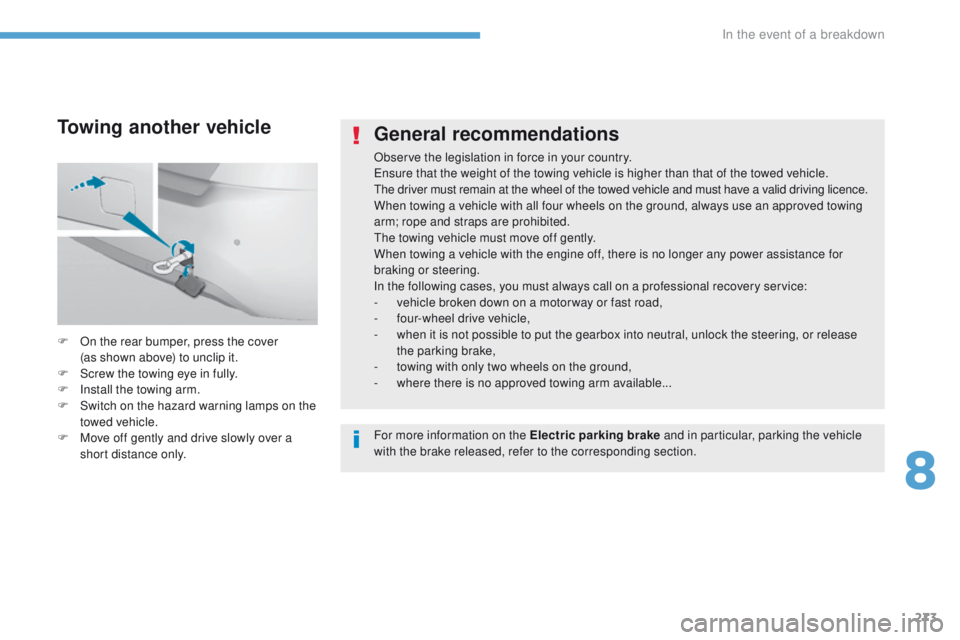
F
O
n the rear bumper, press the cover
(as
shown above) to unclip it.
F
S
crew the towing eye in fully.
F
I
nstall the towing arm.
F
S
witch on the hazard warning lamps on the
towed vehicle.
F
M
ove off gently and drive slowly over a
short distance only.
Towing another vehicle
For more information on the Electric parking brake and in particular, parking the vehicle
with the brake released, refer to the corresponding section.
8
In the event of a breakdown
Page 303 of 392
301
308_en_Chap10b_SMegplus_ed01-2016
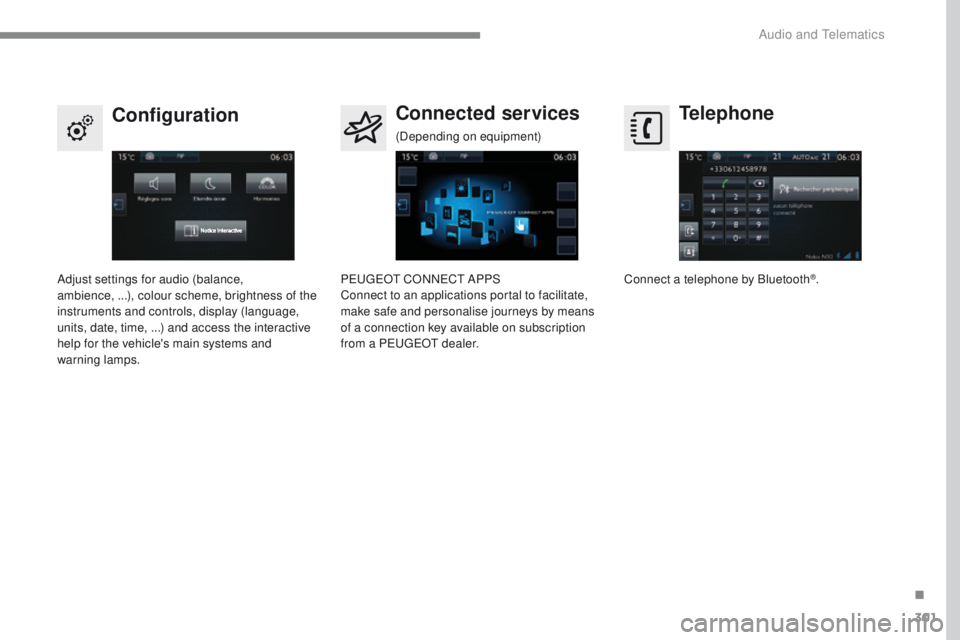
Telephone
Configuration Connected services
Connect a telephone by Bluetooth®.
Adjust settings for audio (balance,
ambience,
...), colour scheme, brightness of the
instruments and controls, display (language,
units, date, time, ...) and access the interactive
help for the vehicle's main systems and
warning lamps. Pe
ugeOt C
ONNeCt A
PPS
Connect to an applications portal to facilitate,
make safe and personalise journeys by means
of a connection key available on subscription
from a P
e
uge
Ot
dealer.
(Depending on equipment)
.
Audio and telematics
Page 330 of 392
328
308_en_Chap10b_SMegplus_ed01-2016
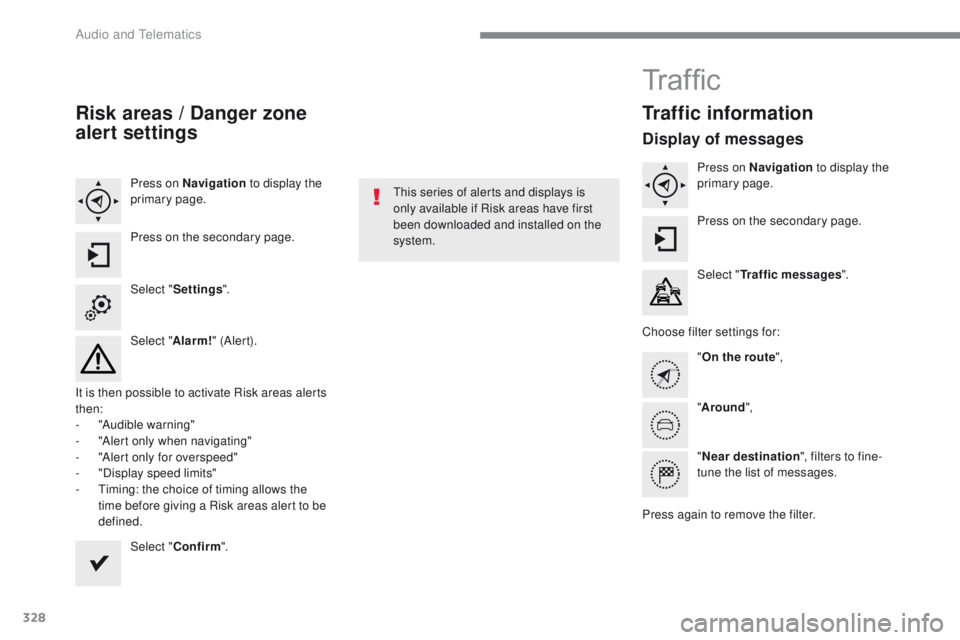
Risk areas / Danger zone
alert settings
Press on Navigation to display the
primary page.
Press on the secondary page.
Select " Settings ".
Select " Alarm!" (Aler t).
It is then possible to activate Risk areas alerts
then:
-
"
Audible warning"
-
"
Alert only when navigating"
-
"
Alert only for overspeed"
-
"
Display speed limits"
-
t
i
ming: the choice of timing allows the
time before giving a Risk areas alert to be
defined.
Select " Confirm ".th
is series of alerts and displays is
only available if Risk areas have first
been downloaded and installed on the
system.
Tr a f fi c
Traffic information
Display of messages
Press on Navigation to display the
primary page.
Press on the secondary page.
Select " Traffic messages ".
Choose filter settings for: "On the route ",
" Around ",
" Near destination ", filters to fine-
tune the list of messages.
Press again to remove the filter.
Audio and telematics
Page 333 of 392
331
308_en_Chap10b_SMegplus_ed01-2016
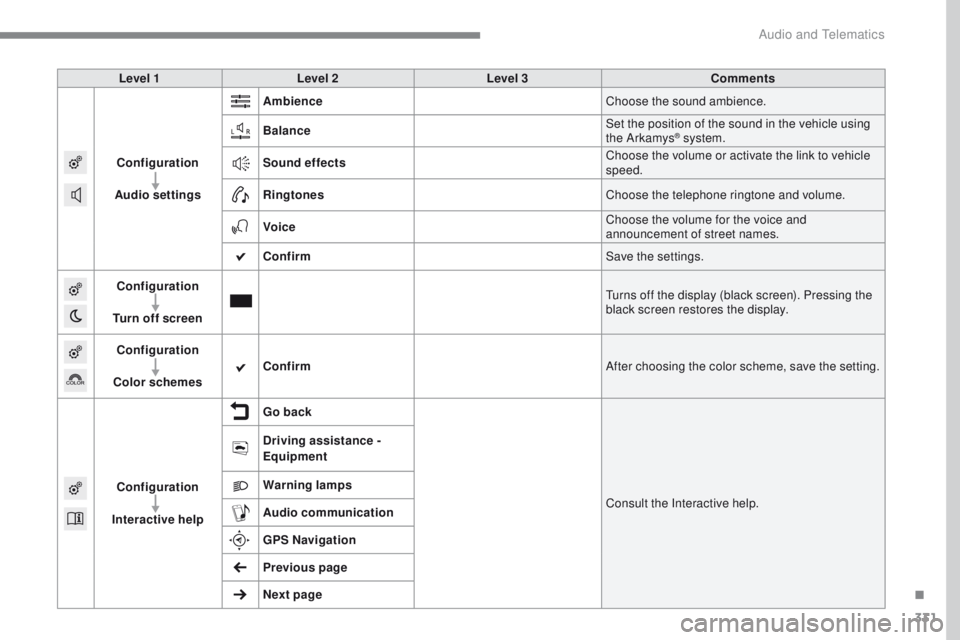
Level 1Level 2 Level 3 Comments
Configuration
Audio settings Ambience
Choose the sound ambience.
Balance Set the position of the sound in the vehicle using
the Arkamys
® system.
Sound effects Choose the volume or activate the link to vehicle
speed.
Ringtones Choose the telephone ringtone and volume.
Voice Choose the volume for the voice and
announcement of street names.
Confirm Save the settings.
Configuration
Turn off screen
tu
rns off the display (black screen). Pressing the
black screen restores the display.
Configuration
Color schemes Confirm
After choosing the color scheme, save the setting.
Configuration
Interactive help Go back
Consult the Interactive help.
Driving assistance
-
Equipment
Warning lamps
Audio communication
GPS Navigation
Previous page
Next page
.
Audio and telematics