fuel cap Peugeot 308 2017 Owner's Manual
[x] Cancel search | Manufacturer: PEUGEOT, Model Year: 2017, Model line: 308, Model: Peugeot 308 2017Pages: 392, PDF Size: 10.16 MB
Page 24 of 392
22
Engine
autodiagnosis
systemflashing.the
engine management system has
a fault. Risk of destruction of the catalytic converter.
Have it checked by a Pe
ugeOt dealer or a qualified
workshop.
fixed.
th
e emission control system has a
fault.
the warning lamp should go off when the engine is started.
If it does not go off, contact a Pe ugeOt dealer or qualified
workshop without delay.
Emergency
Collision
Braking System flashing.the
em ergency Collision Braking
System is active.th e system brakes briefly so as to reduce the speed
of collision with the vehicle ahead.
fixed,
accompanied by
a mesage and an
audible signal
the
e
m
ergency Collision Braking
System has a fault. Have it checked by a P
e
uge
Ot
dealer or a qualified
workshop.
fixed.
the emergency Collision Braking System
has been deactivated (via the menu).
Warning / indicator lamp State Cause Action / Observations
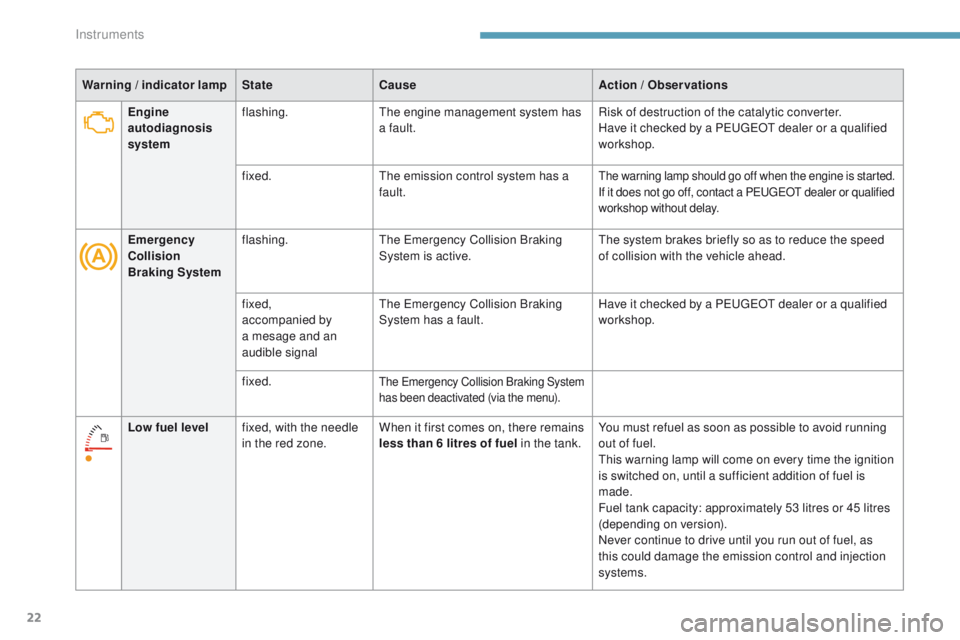
Low fuel level fixed, with the needle
in the red zone. When it first comes on, there remains
less than 6 litres of fuel
in the tank.You must refuel as soon as possible to avoid running
out of fuel.
th
is warning lamp will come on every time the ignition
is switched on, until a sufficient addition of fuel is
made.
Fuel tank capacity: approximately 53 litres or 45 litres
(depending on version).
Never continue to drive until you run out of fuel, as
this could damage the emission control and injection
systems.
Instruments
Page 52 of 392
50
308_en_Chap02_ouvertures_ed01-2016
System for the central locking or unlocking
of the vehicle using the door lock or from a
distance.
It is also used to open and close the fuel filler
cap, locate and start the vehicle, as well as
providing protection against theft.
Remote control key
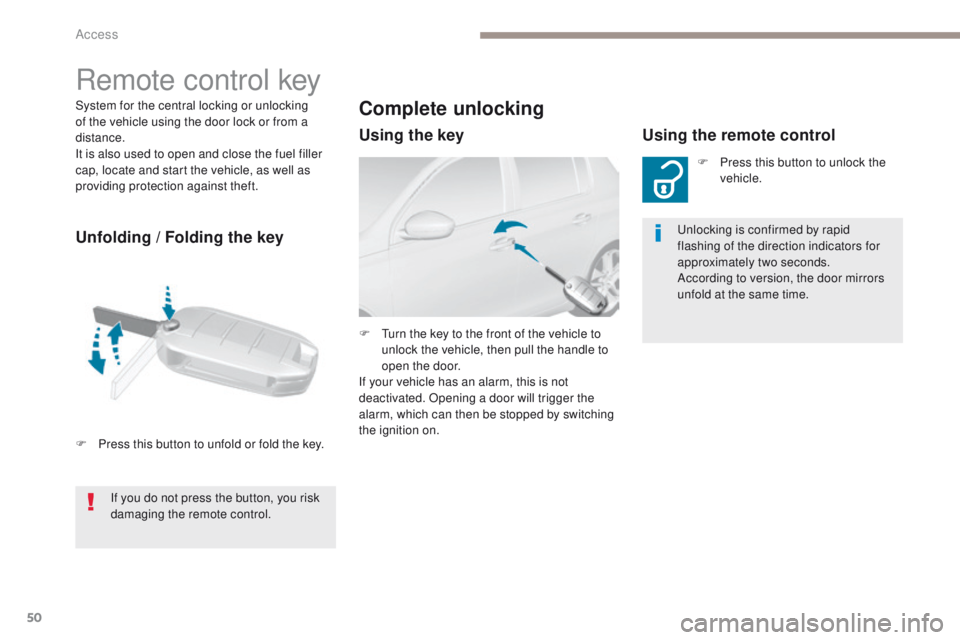
Unfolding / Folding the key
F Press this button to unfold or fold the key.
Complete unlocking
Using the keyUsing the remote control
F Press this button to unlock the
vehicle.
un
locking is confirmed by rapid
flashing of the direction indicators for
approximately two seconds.
According to version, the door mirrors
unfold at the same time.
F
t
u
rn the key to the front of the vehicle to
unlock the vehicle, then pull the handle to
open the door.
If your vehicle has an alarm, this is not
deactivated. Opening a door will trigger the
alarm, which can then be stopped by switching
the ignition on.
If you do not press the button, you risk
damaging the remote control.
Access
Page 215 of 392
213
308_en_Chap07_info-pratiques_ed01-2016
Fuel tank
Additions of fuel must be of at least 6 litres to
be registered by the fuel gauge.
Opening the filler cap may result in an inrush of
air. t
h
is vacuum is entirely normal and results
from the sealing of the fuel system.
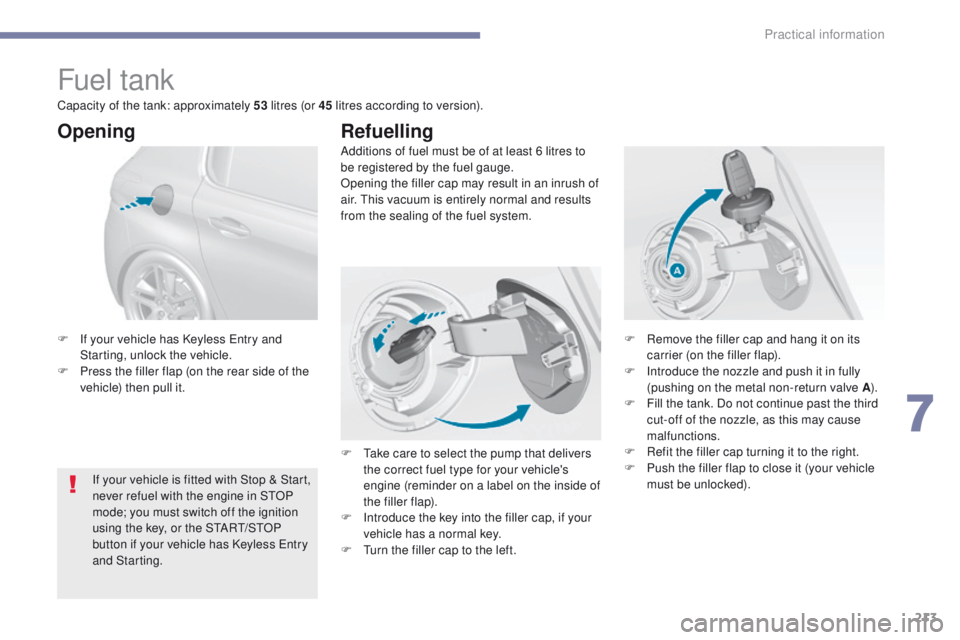
Opening
If your vehicle is fitted with Stop & Start,
never refuel with the engine in StO P
mode; you must switch off the ignition
using the key, or the S
tA
R
t/
S
tO
P
button if your vehicle has Keyless
e
n
try
and Starting.
F
I
f your vehicle has Keyless e
n
try and
Starting, unlock the vehicle.
F
P
ress the filler flap (on the rear side of the
vehicle) then pull it.
Refuelling
F Remove the filler cap and hang it on its carrier (on the filler flap).
F
I
ntroduce the nozzle and push it in fully
(pushing on the metal non-return valve A ).
F
F
ill the tank. Do not continue past the third
cut-off of the nozzle, as this may cause
malfunctions.
F
R
efit the filler cap turning it to the right.
F
P
ush the filler flap to close it (your vehicle
must be unlocked).
F
t
a
ke care to select the pump that delivers
the correct fuel type for your vehicle's
engine (reminder on a label on the inside of
the filler flap).
Capacity of the tank: approximately 53
litres (or 45 litres according to version).
F
I
ntroduce the key into the filler cap, if your
vehicle has a normal key.
F
t
u
rn the filler cap to the left.
7
Practical information
Page 216 of 392
214
308_en_Chap07_info-pratiques_ed01-2016
Low fuel level
When the low fuel level in the tank is
reached, this warning lamp comes on in
the instrument panel, accompanied by
an audible warning and a message.
Fuel supply cut-off
Your vehicle is equipped with a safety device
which cuts off the fuel supply in the event of a
collision. When it first comes on, less than 6 litres of fuel
remain in the tank.
You must refuel as soon as possible to avoid
running out.If you have put in the wrong fuel for
your vehicle, you must have have
the tank drained and refilled with
the correct fuel before you star t the
engine.
Your vehicle is fitted with a catalytic converter,
a device which helps to reduce the level of
harmful emissions in the exhaust gases.
For petrol engines, you must use unleaded
fuel only.
th
e filler neck is narrower, admitting petrol
nozzles only. It is still possible to use a fuel can to fill
the tank but this must be done slowly.
In order to ensure a good flow of fuel,
do not place the nozzle of the fuel can
in direct contact with the flap of the
misfuel prevention device.
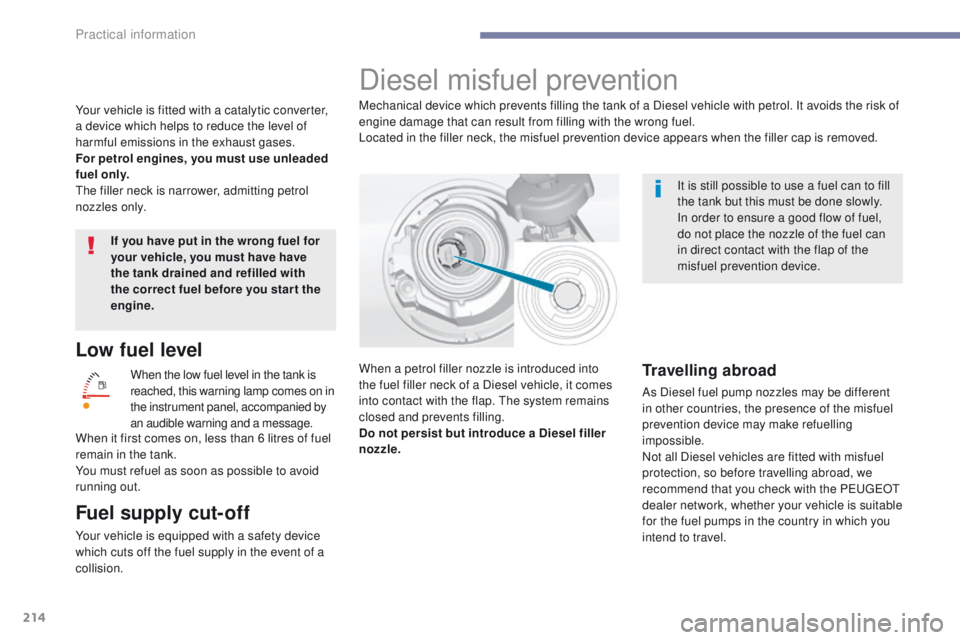
Diesel misfuel prevention
Mechanical device which prevents filling the tank of a Diesel vehicle with petrol. It avoids the risk of
engine damage that can result from filling with the wrong fuel.
Located in the filler neck, the misfuel prevention device appears when the filler cap is removed.
When a petrol filler nozzle is introduced into
the fuel filler neck of a Diesel vehicle, it comes
into contact with the flap.
t
h
e system remains
closed and prevents filling.
Do not persist but introduce a Diesel filler
nozzle.
Travelling abroad
As Diesel fuel pump nozzles may be different
in other countries, the presence of the misfuel
prevention device may make refuelling
impossible.
Not all Diesel vehicles are fitted with misfuel
protection, so before travelling abroad, we
recommend that you check with the P
e
uge
Ot
dealer network, whether your vehicle is suitable
for the fuel pumps in the country in which you
intend to travel.
Practical information
Page 235 of 392
233
308_en_Chap07_info-pratiques_ed01-2016
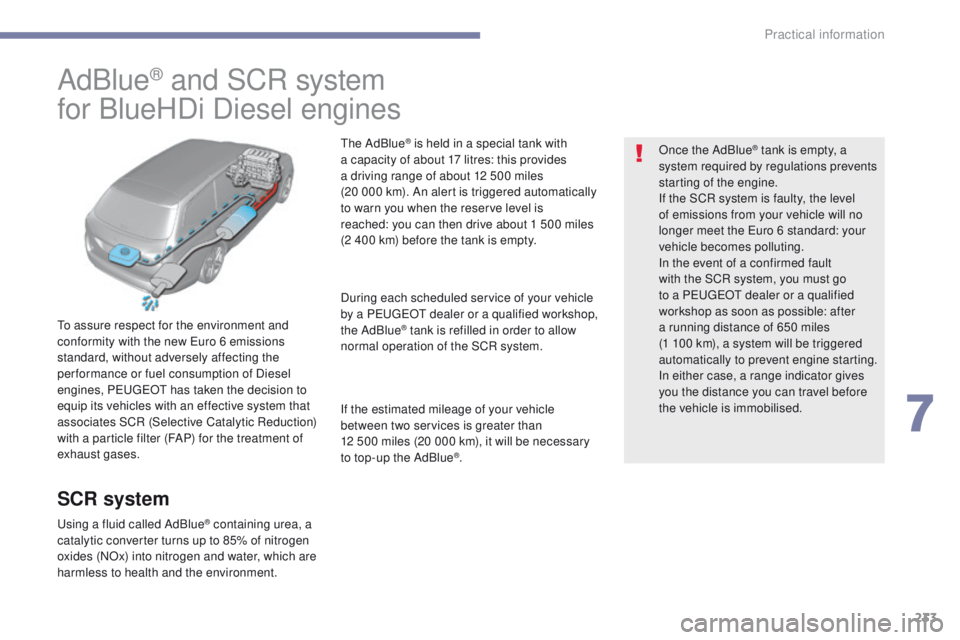
AdBlue® and SCR system
for BlueHDi Diesel engines
to assure respect for the environment and
conformity with the new
eu ro 6 emissions
standard, without adversely affecting the
per formance or fuel consumption of Diesel
engines, P
e
uge
Ot
has taken the decision to
equip its vehicles with an effective system that
associates SCR (Selective Catalytic Reduction)
with a particle filter (FAP) for the treatment of
exhaust gases.
SCR system
using a fluid called AdBlue® containing urea, a
catalytic converter turns up to 85% of nitrogen
oxides (NOx) into nitrogen and water, which are
harmless to health and the environment.
th
e AdBlue
® is held in a special tank with
a capacity of about 17 litres: this provides
a driving range of about 12 500 miles
(20
000
km). An alert is triggered automatically
to warn you when the reserve level is
reached: you can then drive about 1 500 miles
(2
400
km) before the tank is empty.
During each scheduled service of your vehicle
by a P
e
uge
Ot
dealer or a qualified workshop,
the AdBlue
® tank is refilled in order to allow
normal operation of the SCR system.
If the estimated mileage of your vehicle
between two services is greater than
12
500
miles (20 000 km), it will be necessary
to top-up the AdBlue
®. Once the AdBlue
® tank is empty, a
s
ystem required by regulations prevents
starting of the engine.
If the SCR
system is faulty, the level
of emissions from your vehicle will no
longer meet the
e
u
ro 6 standard: your
vehicle becomes polluting.
In the event of a confirmed fault
with the SCR system, you must go
to a P
e
uge
Ot
dealer or a qualified
workshop as soon as possible: after
a running distance of 650 miles
(1
100 km), a system will be triggered
automatically to prevent engine starting.
In either case, a range indicator gives
you the distance you can travel before
the vehicle is immobilised.
7
Practical information
Page 236 of 392
234
308_en_Chap07_info-pratiques_ed01-2016
Topping-up the AdBlue®
Filling the AdBlue® tank is an operation
included in every routine service on your
vehicle by a P
e
uge
Ot
dealer or a qualified
workshop.
Nevertheless, given the capacity of the tank, it
may be necessary to top-up the fluid between
services, more particularly if an alert (warning
lamps and a message) signals the requirement.
You can go to a P
e
uge
Ot
dealer or a qualified
workshop.
If you envisage topping-up yourself, please
read the following warnings carefully.Precautions in use
Keep AdBlue® out of the reach of
children, in its original container or
bottle.
Never transfer AdBlue
® to another
container: it would lose its purity.
us
e only AdBlue
® fluid that meets
the ISO 22241 standard.
Never dilute AdBlue
® with water.
Never pour AdBlue® into the Diesel fuel
tank.
th
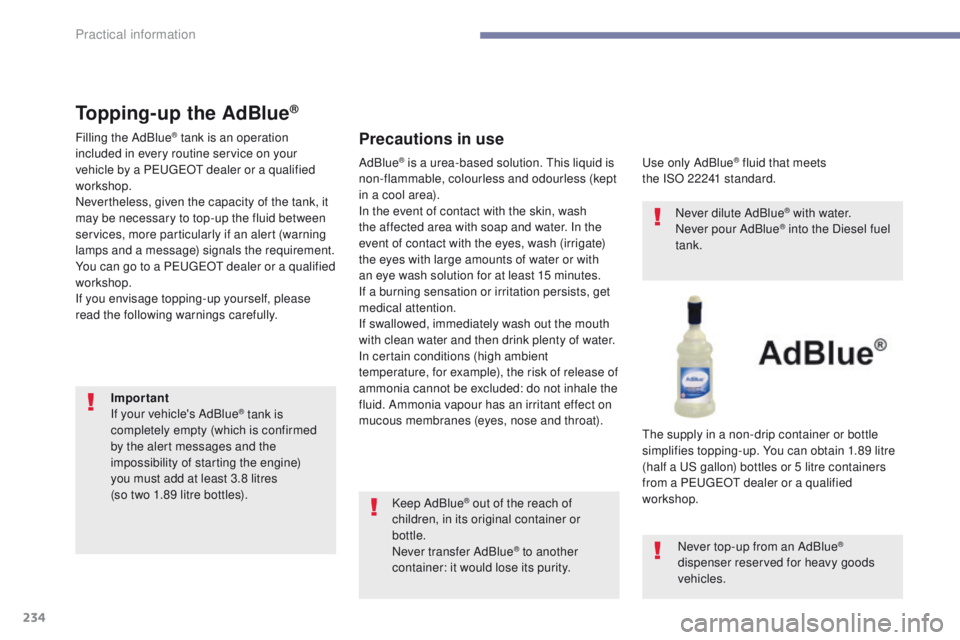
e supply in a non-drip container or bottle
simplifies topping-up. You can obtain 1.89 litre
(half a
u
S g
allon) bottles or 5 litre containers
from a P
e
uge
Ot
dealer or a qualified
workshop.
Never top-up from an AdBlue
®
dispenser reserved for heavy goods
vehicles.
AdBlue
® is a urea-based solution. th
is liquid is
non-flammable, colourless and odourless (kept
in a cool area).
In the event of contact with the skin, wash
the affected area with soap and water. In the
event of contact with the eyes, wash (irrigate)
the eyes with large amounts of water or with
an eye wash solution for at least 15 minutes.
If a burning sensation or irritation persists, get
medical attention.
If swallowed, immediately wash out the mouth
with clean water and then drink plenty of water.
In certain conditions (high ambient
temperature, for example), the risk of release of
ammonia cannot be excluded: do not inhale the
fluid. Ammonia vapour has an irritant effect on
mucous membranes (eyes, nose and throat).
Important
If your vehicle's AdBlue
® tank is
c
ompletely empty (which is confirmed
by the alert messages and the
impossibility of starting the engine)
you must add at least 3.8 litres
(so two 1.89 litre bottles).
Practical information
Page 277 of 392
275
308_en_Chap09_caracteristiques-techniques_ed01-2016
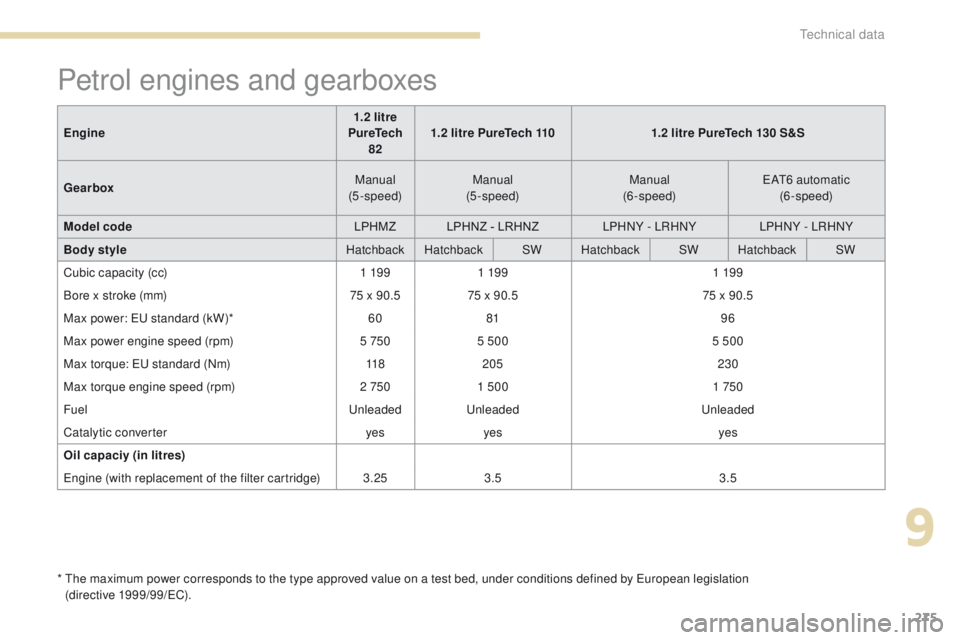
Petrol engines and gearboxes
* the maximum power corresponds to the type approved value on a test bed, under conditions defined by eu ropean legislation
(directive 1999/99/eC ).
Engine
1.2 litre
PureTech 82 1.2 litre PureTech 110
1.2 litre PureTech 130 S&S
Gearbox Manual
(5-speed) Manual
(5-speed) Manual
(6-speed)
eAt6
automatic
(6-speed)
Model code LPHMZLPHNZ - LRHNZ LPHNY - LRHNY LPHNY - LRHNY
Body style Hatchback HatchbackSWHatchback SWHatchback SW
Cubic capacity (cc) 1 19 91 19 9 1 19 9
Bore x stroke (mm) 75 x 90.575 x 90.5 75 x 90.5
Max power: eu standard (kW)*
6081 96
Max power engine speed (rpm) 5 7505 500 5 500
Max torque: eu standard (Nm)
118205 230
Max torque engine speed (rpm) 2 7501 500 1 750
Fuel
u
nleaded
u
nleaded
u
nleaded
Catalytic converter yesyes yes
Oil capaciy (in litres)
en
gine (with replacement of the filter cartridge)
3.253.5 3.5
9
technical data
Page 278 of 392
276
308_en_Chap09_caracteristiques-techniques_ed01-2016
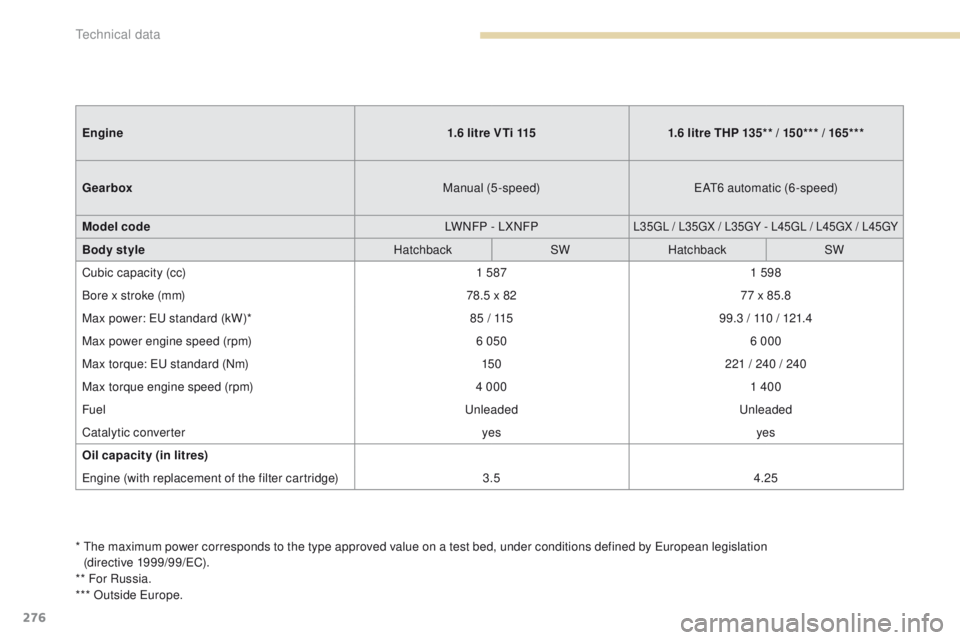
* the maximum power corresponds to the type approved value on a test bed, under conditions defined by eu ropean legislation
(directive 1999/99/eC ).
** For Russia.
*** Outside
e
u
rope.
Engine
1.6 litre VTi 1151.6 litre THP 135** / 150*** / 165***
Gearbox Manual (5-speed)
eAt6
automatic (6-speed)
Model code LWNFP - LXNFP
L35gL / L35gX / L35gY - L 45gL / L 45gX / L 45gY
Body style HatchbackSWHatchback SW
Cubic capacity (cc) 1 5871 598
Bore x stroke (mm) 78.5 x 8277 x 85.8
Max power:
eu standard (kW)* 85 / 11599.3 / 110 / 121.4
Max power engine speed (rpm) 6 0506 000
Max torque:
eu standard (Nm) 150221 / 240 / 240
Max torque engine speed (rpm) 4 0001 400
Fuel
u
nleaded
u
nleaded
Catalytic converter yesyes
Oil capacity (in litres)
en
gine (with replacement of the filter cartridge) 3.54.25
technical data
Page 279 of 392
277
308_en_Chap09_caracteristiques-techniques_ed01-2016
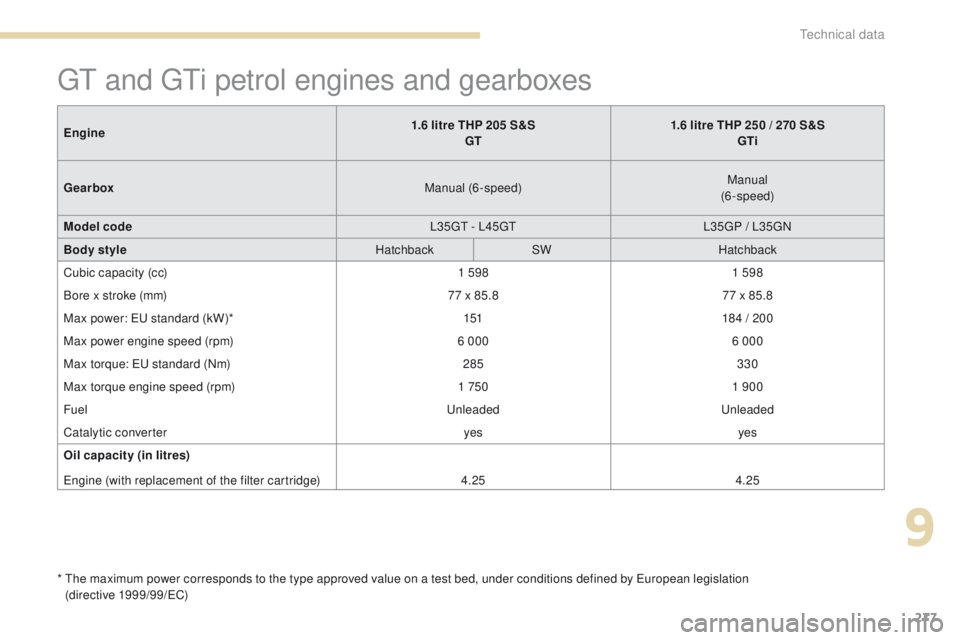
gt and gti petrol engines and gearboxes
* the maximum power corresponds to the type approved value on a test bed, under conditions defined by eu ropean legislation
(directive 1999/99/eC )
Engine
1.6 litre THP 205 S&S
GT 1.6 litre THP 250 / 270 S&S
GTi
Gearbox Manual (6-speed)Manual
(6-speed)
Model code L35
gt -
L45
gtL
35
gP / L
35
gN
B
ody style
HatchbackSW Hatchback
Cubic capacity (cc) 1 5981 598
Bore x stroke (mm) 77 x 85.877 x 85.8
Max power: eu standard (kW)*
151184 / 200
Max power engine speed (rpm) 6 0006 000
Max torque: eu standard (Nm)
285330
Max torque engine speed (rpm) 1 7501 900
Fuel
u
nleaded
u
nleaded
Catalytic converter yesyes
Oil capacity (in litres)
en
gine (with replacement of the filter cartridge)
4.254.25
9
technical data
Page 283 of 392
281
308_en_Chap09_caracteristiques-techniques_ed01-2016
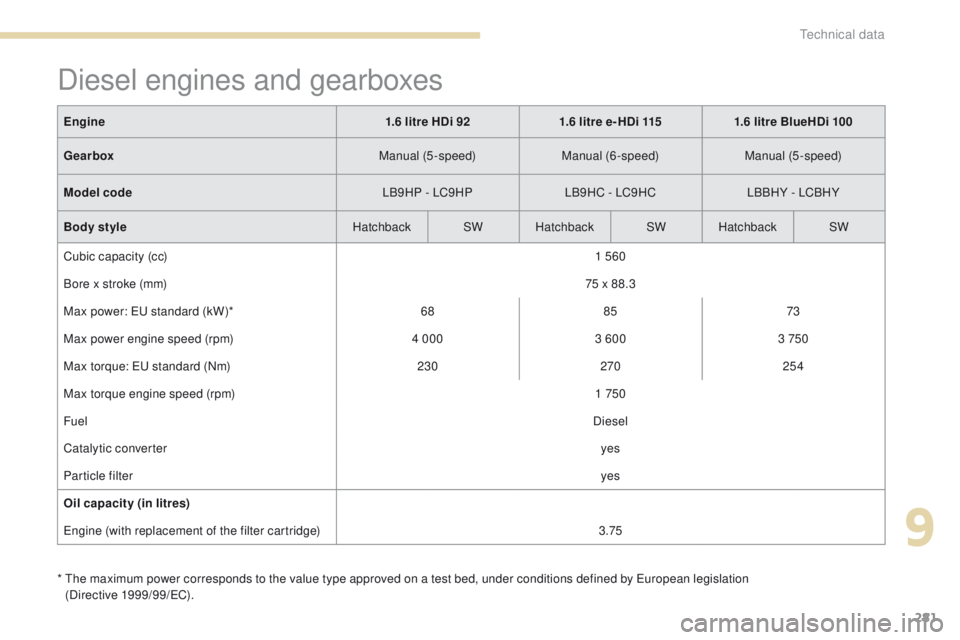
Diesel engines and gearboxes
* the maximum power corresponds to the value type approved on a test bed, under conditions defined by eu ropean legislation
(Directive 1999/99/eC ).
Engine
1.6 litre HDi 921.6 litre e- HDi 115 1.6 litre BlueHDi 100
Gearbox Manual (5-speed)Manual (6-speed) Manual (5-speed)
Model code LB9HP - LC9HPLB9HC - LC9HC LBBHY - LCBHY
Body style HatchbackSWHatchback SWHatchback SW
Cubic capacity (cc) 1 560
Bore x stroke (mm) 75 x 88.3
Max power: eu standard (kW)*
6885 73
Max power engine speed (rpm) 4 0003 600 3 750
Max torque: eu standard (Nm)
230270254
Max torque engine speed (rpm) 1 750
Fuel Diesel
Catalytic converter yes
Particle filter yes
Oil capacity (in litres)
en
gine (with replacement of the filter cartridge)
3.75
9
technical data