check engine PEUGEOT 308 2017 User Guide
[x] Cancel search | Manufacturer: PEUGEOT, Model Year: 2017, Model line: 308, Model: Peugeot 308 2017Pages: 566, PDF Size: 16.05 MB
Page 107 of 566
105
3008-2_en_Chap03_ergonomie-et-confort_ed01-2016
Stop & Start
The heating and air conditioning
systems only work when the engine is
running.
To maintain a comfortable temperature
in the passenger compartment, you can
temporarily deactivate the Stop & Start
system.
For more information on Stop & Star t,
refer to the corresponding section.
In order for these systems to be fully effective, follow the operation and maintenance
guidelines below:
F
T
o obtain an even air distribution, take care not to obstruct the exterior air intake grilles
located at the base of the windscreen, the nozzles, the vents and the air outlets, as well
as the air extractor located in the boot.
F
D
o not cover the sunshine sensor, located on the dashboard; this is used for regulation
of the air conditioning system.
F
O
perate the air conditioning system for at least 5 to 10 minutes, once or twice a month
to keep it in per fect working order.
F
E
nsure that the passenger compartment filter is in good condition and have the filter
elements replaced regularly.
W
e recommend the use of a combined passenger compartment filter. Thanks to
its special active additive, it contributes to the purification of the air breathed by the
occupants and the cleanliness of the passenger compartment (reduction of allergic
symptoms, bad odours and greasy deposits).
F
T
o ensure correct operation of the air conditioning system, you are also advised to have
it checked regularly as recommended in the warranty and maintenance record.
F
I
f the system does not produce cold air, switch it off and contact a PEUGEOT dealer or
a qualified workshop.
When towing the maximum load on a steep gradient in high temperatures, switching off the
air conditioning increases the available engine power and so improves the towing ability. The condensation created by the air
conditioning results in a discharge
of water under the vehicle which is
perfectly normal.
If after an extended stop in sunshine,
the interior temperature is very
high, first ventilate the passenger
compartment for a few moments.
Put the air flow control at a setting high
enough to quickly change the air in the
passenger compartment.
The air conditioning system does not
contain chlorine and does not present
any danger to the ozone layer.
Recommendations for ventilation and air conditioning
3
Ease of use and comfort
Page 125 of 566
123
3008-2_en_Chap03_ergonomie-et-confort_ed01-2016
Charging
F First ensure that the charging zone is clear of other articles.
F
P
lace a portable device in the middle of the
charging zone.
F
O
nce the portable device is detected, the
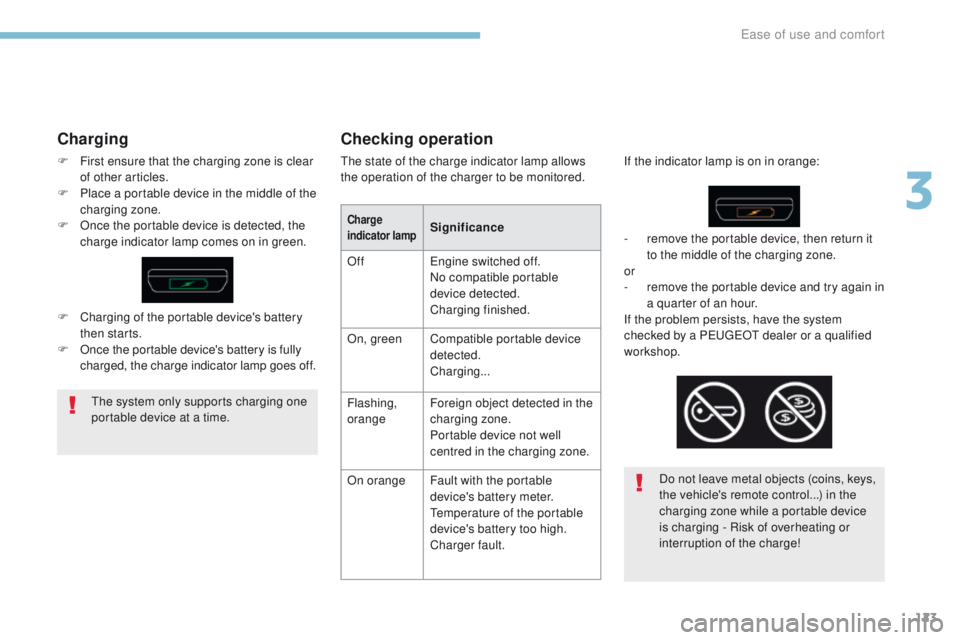
charge indicator lamp comes on in green. If the indicator lamp is on in orange:
Do not leave metal objects (coins, keys,
the vehicle's remote control...) in the
charging zone while a portable device
is charging - Risk of overheating or
interruption of the charge!
-
r
emove the portable device, then return it
to the middle of the charging zone.
or
-
r
emove the portable device and try again in
a quarter of an hour.
If the problem persists, have the system
checked by a PEUGEOT dealer or a qualified
workshop.
F
C
harging of the portable device's battery
then starts.
F
O
nce the portable device's battery is fully
charged, the charge indicator lamp goes off.
Checking operation
The state of the charge indicator lamp allows
the operation of the charger to be monitored.
The system only supports charging one
portable device at a time.
Charge
indicator lampSignificance
Off Engine switched off.
No compatible portable
device detected.
Charging finished.
On, green Compatible portable device
detected.
Charging...
Flashing,
orange Foreign object detected in the
charging zone.
Portable device not well
centred in the charging zone.
On orange Fault with the portable
device's battery meter.
Temperature of the portable
device's battery too high.
Charger fault.
3
Ease of use and comfort
Page 135 of 566
133
3008-2_en_Chap03_ergonomie-et-confort_ed01-2016
Rear fittings
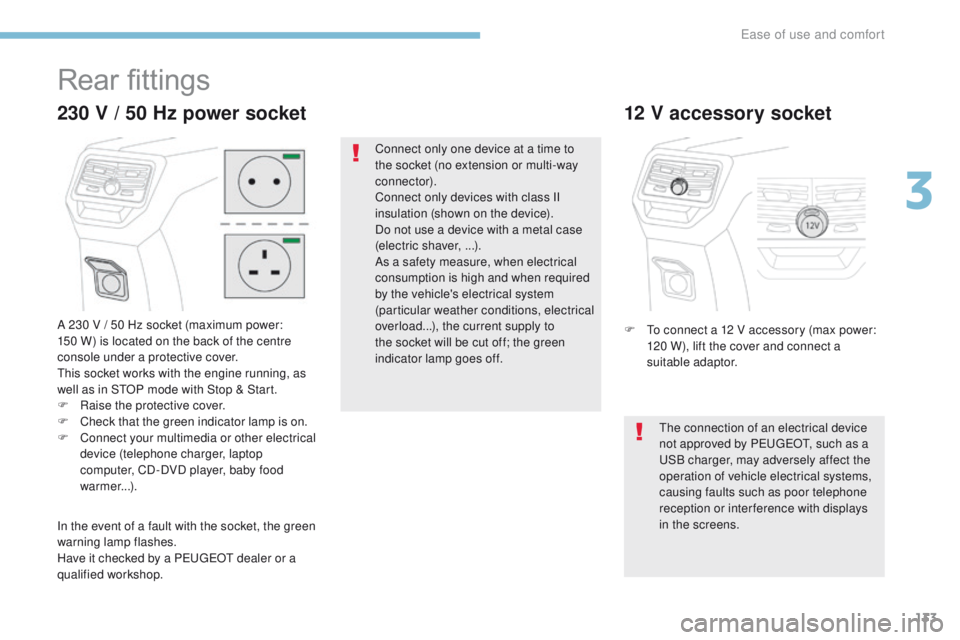
A 230 V / 50 Hz socket (maximum power:
150 W) is located on the back of the centre
console under a protective cover.
This socket works with the engine running, as
well as in STOP mode with Stop & Start.
F
Ra
ise the protective cover.
F
C
heck that the green indicator lamp is on.
F
C
onnect your multimedia or other electrical
device (telephone charger, laptop
computer, CD-DVD player, baby food
warmer...).
230 V / 50 Hz power socket
In the event of a fault with the socket, the green
warning lamp flashes.
Have it checked by a PEUGEOT dealer or a
qualified workshop. Connect only one device at a time to
the socket (no extension or multi-way
connector).
Connect only devices with class II
insulation (shown on the device).
Do not use a device with a metal case
(electric shaver, ...).
As a safety measure, when electrical
consumption is high and when required
by the vehicle's electrical system
(particular weather conditions, electrical
overload...), the current supply to
the socket will be cut off; the green
indicator lamp goes off.
F
T
o connect a 12 V accessory (max power:
120 W), lift the cover and connect a
suitable adaptor.
12 V accessory socket
The connection of an electrical device
not approved by PEUGEOT, such as a
USB charger, may adversely affect the
operation of vehicle electrical systems,
causing faults such as poor telephone
reception or inter ference with displays
in the screens.
3
Ease of use and comfort
Page 164 of 566
162
3008-2_en_Chap05_securite_ed01-2016
Anti-slip regulation (ASR) / Dynamic stability control (DSC)
Operation
These systems are activated automatically
every time the vehicle is started.
They come into operation in the event of a
problem of grip or trajectory.
Deactivation
In exceptional conditions (starting a vehicle
which is bogged down, stuck in snow, on soft
ground...), it may be advisable to deactivate the
ASR system, so that the wheels can turn freely
and regain grip.
Reactivate the system as soon as the level of
grip permits.Deactivation is done in the Driving
menu of the touch screen.
Reactivation
The ASR system is reactivated automatically
every time the ignition is switched back on or
from 30 mph (50 km/h).
Below 30 mph (50 km/h), you can reactivate it
manually:
Operating fault
This is indicated by flashing of this
warning lamp in the instrument panel.
Illumination of this warning lamp,
accompanied by the display of a
message and an audible signal,
indicates a fault with the system.
Contact a PEUGEOT dealer or a qualified
workshop to have the systems checked.
It is confirmed by the display of a message.
The ASR system no longer acts on the
operation of the engine or the brakes in the
event of an involuntary change of trajectory.
ASR / DSC
These systems offer increased safety
in normal driving, but they should not
encourage the driver to take extra risks
or drive at high speed.
It is in conditions of reduced grip
(rain, snow, black ice) that the risk of
loss of grip increases. It is therefore
important for your safety to keep these
systems activated in all conditions, and
particularly in difficult conditions.
The correct operation of these
systems depends on observation of
the manufacturer's recommendations
regarding as much the wheels (tyres
and rims), braking and electronic
components as the assembly and repair
procedures used by PEUGEOT dealers.
To benefit in full from the effectiveness
of these systems in wintry conditions,
the vehicle must be fitted with four snow
tyres, allowing the vehicle to retain
neutral behaviour on the road.
After an impact, have these systems
checked by a PEUGEOT dealer or a
qualified workshop. Reactivation is done in the Driving
menu of the touch screen.
It is confirmed by the display of a
message.
Safety
Page 165 of 566
163
3008-2_en_Chap05_securite_ed01-2016
Trailer stability assist
Operation
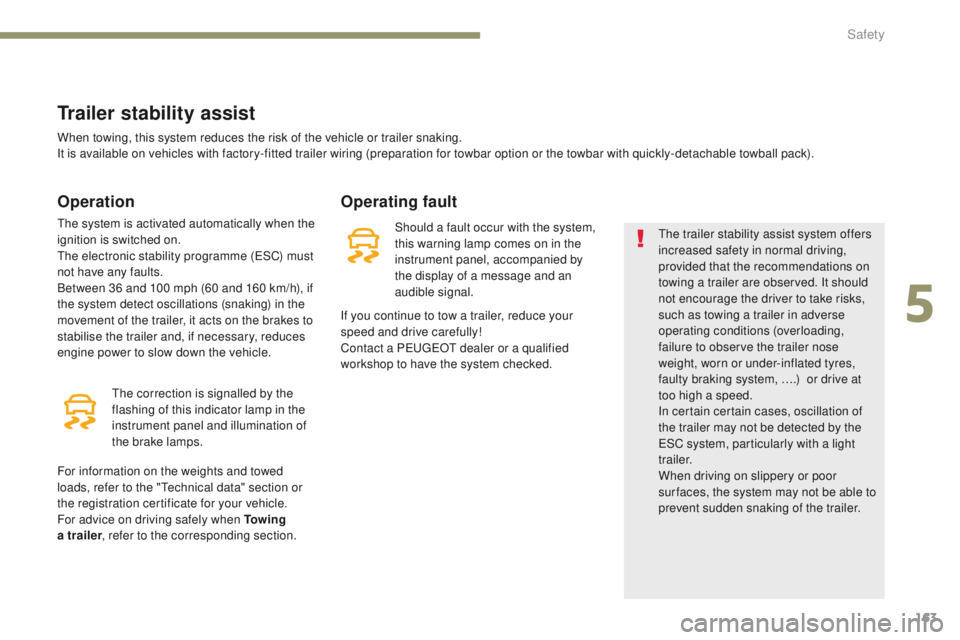
The system is activated automatically when the
ignition is switched on.
The electronic stability programme (ESC) must
not have any faults.
Between 36 and 100 mph (60 and 160 km/h), if
the system detect oscillations (snaking) in the
movement of the trailer, it acts on the brakes to
stabilise the trailer and, if necessary, reduces
engine power to slow down the vehicle.
For information on the weights and towed
loads, refer to the "Technical data" section or
the registration certificate for your vehicle.
For advice on driving safely when To w i n g
a trailer , refer to the corresponding section.
When towing, this system reduces the risk of the vehicle or trailer snaking.
It is available on vehicles with factory-fitted trailer wiring (preparation for towbar option or the towbar with quickly-detachable towball pack).
The correction is signalled by the
flashing of this indicator lamp in the
instrument panel and illumination of
the brake lamps.
Operating fault
Should a fault occur with the system,
this warning lamp comes on in the
instrument panel, accompanied by
the display of a message and an
audible signal.
If you continue to tow a trailer, reduce your
speed and drive carefully!
Contact a PEUGEOT dealer or a qualified
workshop
to have the system checked. The trailer stability assist system offers
increased safety in normal driving,
provided that the recommendations on
towing a trailer are observed. It should
not encourage the driver to take risks,
such as towing a trailer in adverse
operating conditions (overloading,
failure to observe the trailer nose
weight, worn or under-inflated tyres,
faulty braking system, ….)
or drive at
too high a speed.
In certain certain cases, oscillation of
the trailer may not be detected by the
ESC system, particularly with a light
t r a i l e r.
When driving on slippery or poor
sur faces, the system may not be able to
prevent sudden snaking of the trailer.
5
Safety
Page 169 of 566
167
3008-2_en_Chap05_securite_ed01-2016
For the system to operate, the slope
must be steeper than 5%.
The system can be used with the
gearbox in neutral.
Otherwise, engage a gear appropriate
for the speed of the vehicle, to avoid the
engine stalling.
With an automatic gearbox, the system
can be used with the selector at N, D
or R .
If the speed of the vehicle exceeds 18 mph
(30
km/h), regulation is automatically paused
and the indicator in the instrument panel
changes back to grey, but the indicator lamp in
the button still stays on.
Regulation resumes automatically as soon as
the speed of the vehicle drops below 18 mph
(30 km/h), provided that the conditions of
gradient and release of the pedals are met.
You can press the accelerator or brake pedal
at any time.
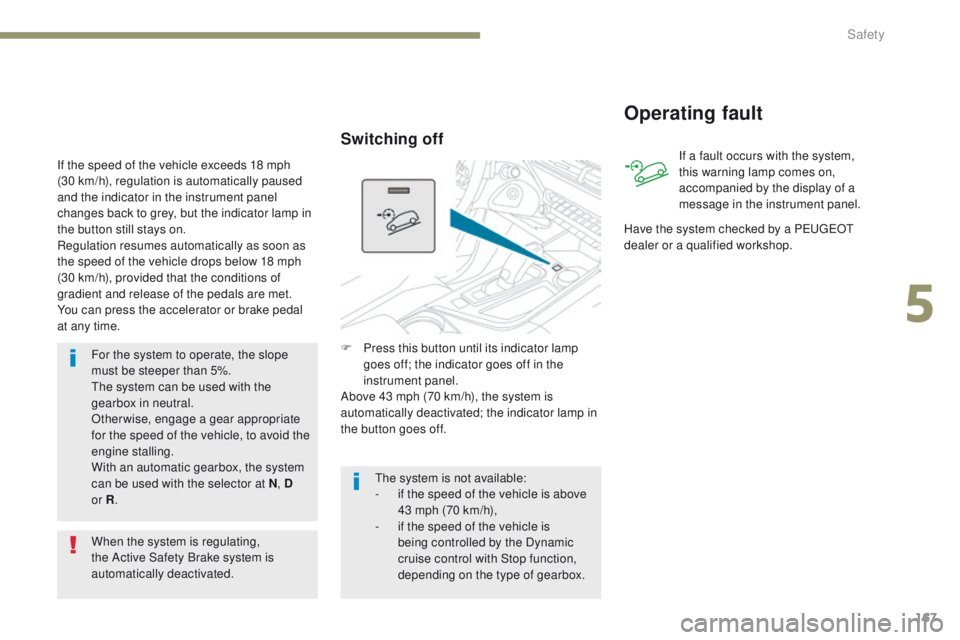
Operating fault
If a fault occurs with the system,
this warning lamp comes on,
accompanied by the display of a
message in the instrument panel.
Have the system checked by a PEUGEOT
dealer or a qualified workshop.Switching off
F Press this button until its indicator lamp goes off; the indicator goes off in the
instrument panel.
Above 43 mph (70 km/h), the system is
automatically deactivated; the indicator lamp in
the button goes off.
The system is not available:
-
i
f the speed of the vehicle is above
43 mph (70 km/h),
-
i
f the speed of the vehicle is
being controlled by the Dynamic
cruise control with Stop function,
depending on the type of gearbox.
When the system is regulating,
the Active Safety Brake system is
automatically deactivated.
5
Safety
Page 198 of 566
196
3008-2_en_Chap06_conduite_ed01-2016
When towing
Distribution of loads
F Distribute the load in the trailer so that the heaviest items are as close as possible to
the axle and the nose weight approaches
the maximum permitted without
exceeding
it.
Air density decreases with altitude, thus
reducing engine performance. Above
1
000 metres, the maximum towed load must
be reduced by 10
% for every 1 000 metres of
altitude.
Side wind
F Take into account the increased sensitivity to side wind.
For more information on Weights
, refer to the
corresponding section. F
I
f the warning lamp and the
STOP warning lamp come on,
stop the vehicle and switch off
the engine as soon as possible.
Braking
Towing a trailer increases the braking distance.
To avoid overheating of the brakes, the use of
engine braking is recommended.
Ty r e s
F Check the tyre pressures of the towing vehicle and of the trailer, observing the
recommended pressures.
Lighting
F Check the electrical lighting and signalling on the trailer and the headlamp beam
height of your vehicle.
For more information on Adjusting the
headlamp beam height , refer to the
corresponding section.
The rear parking sensors will be
deactivated automatically to avoid the
audible signal if a genuine PEUGEOT
towbar is used.
Cooling
Towing a trailer on a slope increases the
temperature of the coolant.
As the fan is electrically controlled, its cooling
capacity is not dependent on the engine speed.
F
T
o lower the engine speed, reduce your
speed.
The maximum towed load on a long incline
depends on the gradient and the ambient
temperature.
In all cases, keep a check on the coolant
temperature.
Driving
Page 206 of 566
204
3008-2_en_Chap06_conduite_ed01-2016
When towing, parking on a steep slope,
or if your vehicle is heavily laden,
turn the wheels towards the kerb and
engage a gear (with a manual gearbox)
or place the gear selector at position P
with an automatic gearbox.
For towing, you vehicle is approved for
parking on slopes of up to 12%.
Manual operation
Manual application
With the vehicle stationary: briefly pull the control lever.
If you push the control lever without
pressing the brake pedal, the parking
brake will not be released and a
message is displayed.
Manual release
With the ignition on or the engine running, to
release the parking brake:
F
p
ress the brake pedal,
F
w
hile maintaining pressure on the brake
pedal, briefly push the control lever.
The complete release of the parking brake
is confirmed by the brake indicator lamp and
the
P indicator lamp in the control lever going
off, accompanied by the display of the message
"Parking brake released".
Never leave a child alone inside the
vehicle with the ignition on, as they
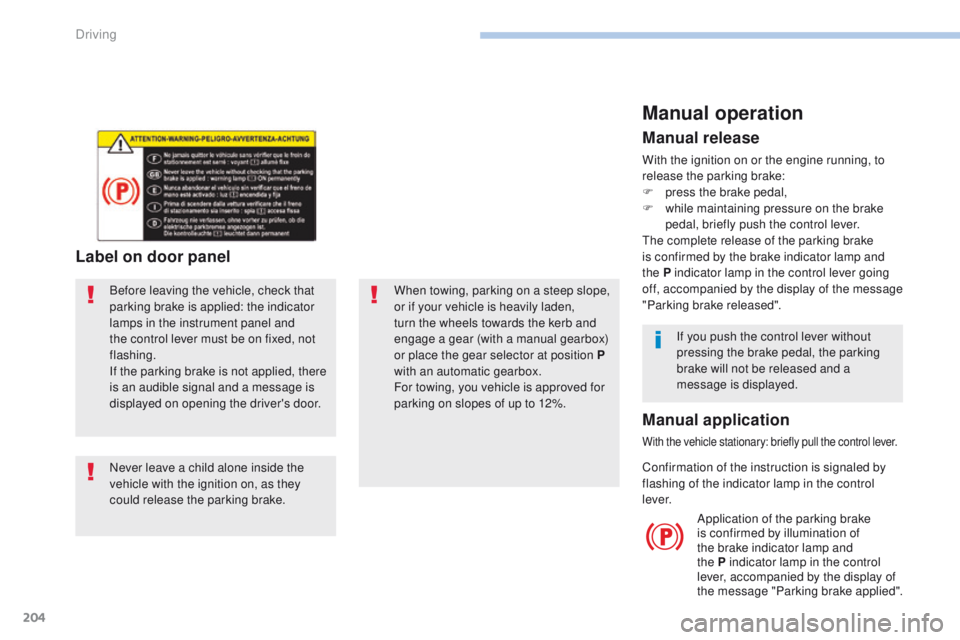
could release the parking brake. Before leaving the vehicle, check that
parking brake is applied: the indicator
lamps in the instrument panel and
the control lever must be on fixed, not
flashing.
If the parking brake is not applied, there
is an audible signal and a message is
displayed on opening the driver's door.
Label on door panel
Confirmation of the instruction is signaled by
flashing of the indicator lamp in the control
l eve r. Application of the parking brake
is confirmed by illumination of
the brake indicator lamp and
the
P indicator lamp in the control
lever, accompanied by the display of
the message "Parking brake applied".
Driving
Page 207 of 566
205
3008-2_en_Chap06_conduite_ed01-2016
Automatic operation
Automatic release
Ensure first that the engine is running and the
driver's door is properly closed.
The electric parking brake releases
automatically and progressively when the
vehicle is moving.
With a manual gearbox
F
F
ully depress the clutch pedal,
engage 1
st gear or reverse.
F
P
ress the accelerator pedal and release
the clutch pedal.
With an automatic gearbox
F
P
ress the brake pedal.
F
Sel
ect position D , M or R.
F
R
elease the brake pedal and press the
accelerator pedal.
With an automatic gearbox, if the brake
does not release automatically, check
that the front doors are correctly closed.
When stationary with the engine running, do not
depress the accelerator pedal unnecessarily,
you risk releasing the parking brake.
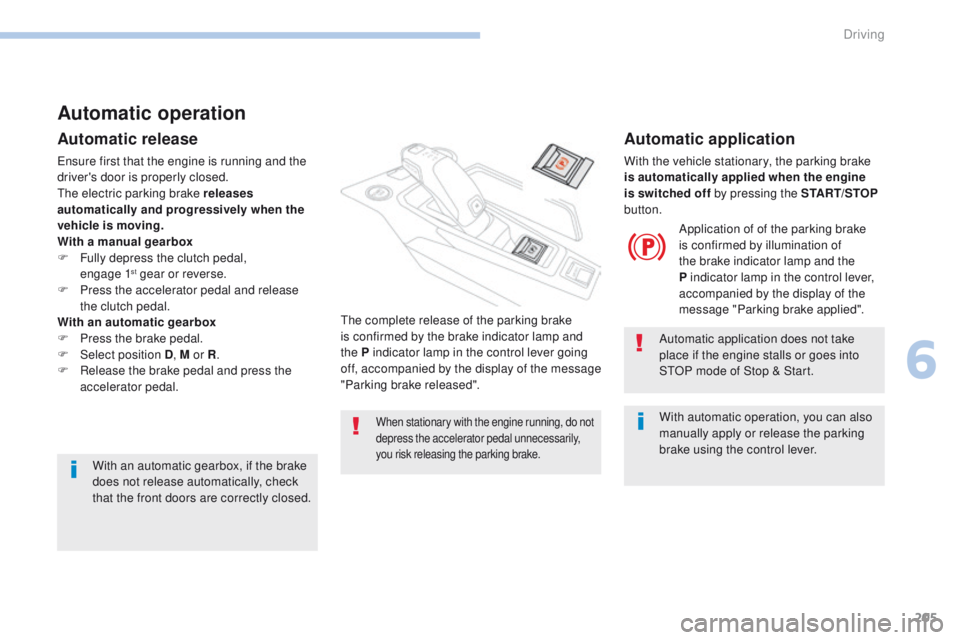
The complete release of the parking brake
is confirmed by the brake indicator lamp and
the P indicator lamp in the control lever going
off, accompanied by the display of the message
"Parking brake released".
Automatic application
With the vehicle stationary, the parking brake
is automatically applied when the engine
is switched off by pressing the START/STOP
button.
Application of of the parking brake
is confirmed by illumination of
the brake indicator lamp and the
P
indicator lamp in the control lever,
accompanied by the display of the
message "Parking brake applied".
Automatic application does not take
place if the engine stalls or goes into
STOP mode of Stop & Start.
With automatic operation, you can also
manually apply or release the parking
brake using the control lever.
6
Driving
Page 217 of 566
215
3008-2_en_Chap06_conduite_ed01-2016
In severe wintry conditions (temperature
below -23°C), it is recommended that
the engine be allowed to run for a few
minutes before moving off, to ensure
the correct operation and durability of
the engine and gearbox.
Stopping the vehicle
Whatever the state of the gearbox when the
ignition is switched off, P mode is engaged
automatically, with the exception of N, in which
case P
mode will be engaged after a delay of
5 seconds (allowing the change to free-wheel).
Check that P mode has been engaged and
that the electric parking brake was applied
automatically; if not, apply it manually.
Operating faults
Malfunction of the gearbox Malfunction of the selector
In the event of a minor fault
In the event of a serious fault
Stop as soon as it is safe to do so, away
from the traffic, and call a PEUGEOT
dealer or a qualified workshop.
When the ignition is switched off,
the gearbox goes into P mode
automatically.You are alerted by the illumination of
this warning lamp.
The corresponding indicator lamps
for the selector panel and the electric
parking brake control lever must
be on, as well as the ones in the
instrument panel.
This is signalled by the illumination of
this warning lamp, accompanied by the
display of a message and an audible
signal, when the ignition is switched on.
The gearbox goes into back-up mode: D mode
stays in third gear, the steering mounted control
paddles are inoperative, M mode is no longer
available. You may feel a pronounced jolt when
engaging reverse. This does not present any
risk for the gearbox.
Do not drive faster than 62 mph (100 km/h),
keeping to the speed limit.
Go to a PEUGEOT dealer or a qualified
workshop.
You are alerted by the illumination of this
warning lamp, accompanied by the display
of a message and an audible signal.
In certain cases, the selector lamps may not
come on, but the state of the gearbox is still
displayed in the instrument panel.
Drive cautiously and go to a PEUGEOT or a
qualified workshop.
6
Driving