towing PEUGEOT 308 2017 Owner's Guide
[x] Cancel search | Manufacturer: PEUGEOT, Model Year: 2017, Model line: 308, Model: Peugeot 308 2017Pages: 566, PDF Size: 16.05 MB
Page 553 of 566
13
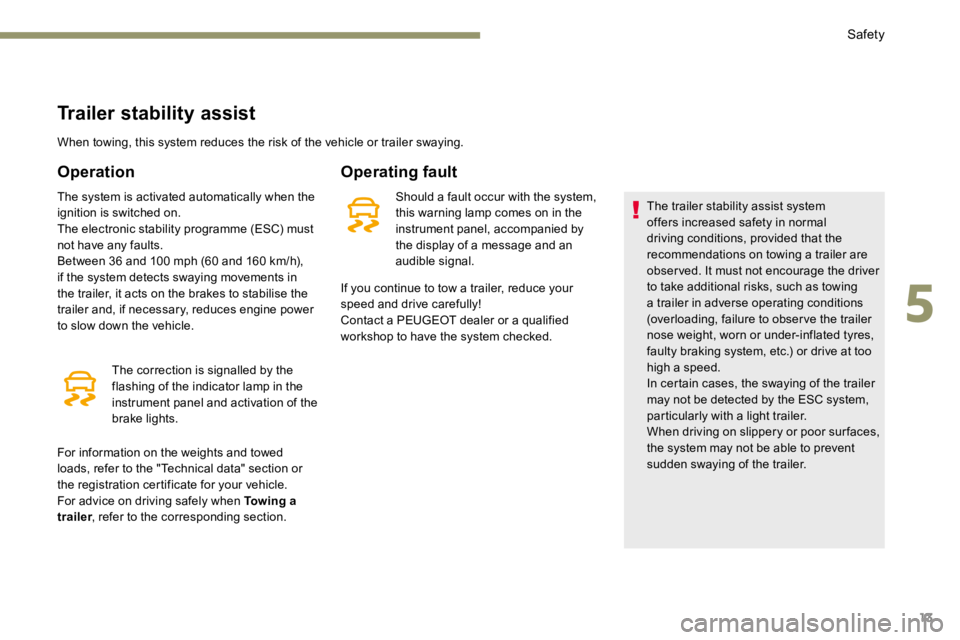
Trailer stability assist
When towing, this system reduces the risk of the vehicle or trailer swaying.
Operation
The system is activated automatically when the
ignition is switched on.
The electronic stability programme (ESC) must
not have any faults.
Between 36 and 100 mph (60 and 160 km/h),
if the system detects swaying movements in
the trailer, it acts on the brakes to stabilise the
trailer and, if necessary, reduces engine power
to slow down the vehicle.The correction is signalled by the
flashing of the indicator lamp in the
instrument panel and activation of the
brake lights.
Operating fault
Should a fault occur with the system,
this warning lamp comes on in the
instrument panel, accompanied by
the display of a message and an
audible signal. The trailer stability assist system
offers increased safety in normal
driving conditions, provided that the
recommendations on towing a trailer are
obser ved. It must not encourage the driver
to take additional risks, such as towing
a trailer in adverse operating conditions
(overloading, failure to obser ve the trailer
nose weight, worn or under-inflated tyres,
faulty braking system, etc.) or drive at too
high a speed.
In certain cases, the swaying of the trailer
may not be detected by the ESC system,
particularly with a light trailer.
When driving on slippery or poor sur faces,
the system may not be able to prevent
sudden swaying of the trailer.
If you continue to tow a trailer, reduce your
speed and drive carefully!
Contact a PEUGEOT dealer or a qualified
workshop to have the system checked.
For information on the weights and towed
loads, refer to the "Technical data" section or
the registration certificate for your vehicle.
For advice on driving safely when Towing a
trailer , refer to the corresponding section.
5
Safety
Page 555 of 566
15
Operating limits
In the following cases, deactivating the
system via the vehicle's configuration menu is
recommended:
- when towing a trailer,
- when carrying long objects on roof bars or
a roof rack,
- before using an automatic car wash, with
the engine running,
- before placing the vehicle on a rolling road
in a workshop,
- when the vehicle is being towed, with the
engine running,
- when a "space-saver" type spare wheel is
fitted (depending on version),
- following impact damage to the windscreen
close to the detection camera,
- if the front bumper has been damaged,
- if the brake lamps are not working. Because of limits in the operation of the
system, it is possible that warnings are
not given, are given too late or seem
unjustified.
Consequently, the driver must always
remain attentive and able to react at any
time to avoid an accident.
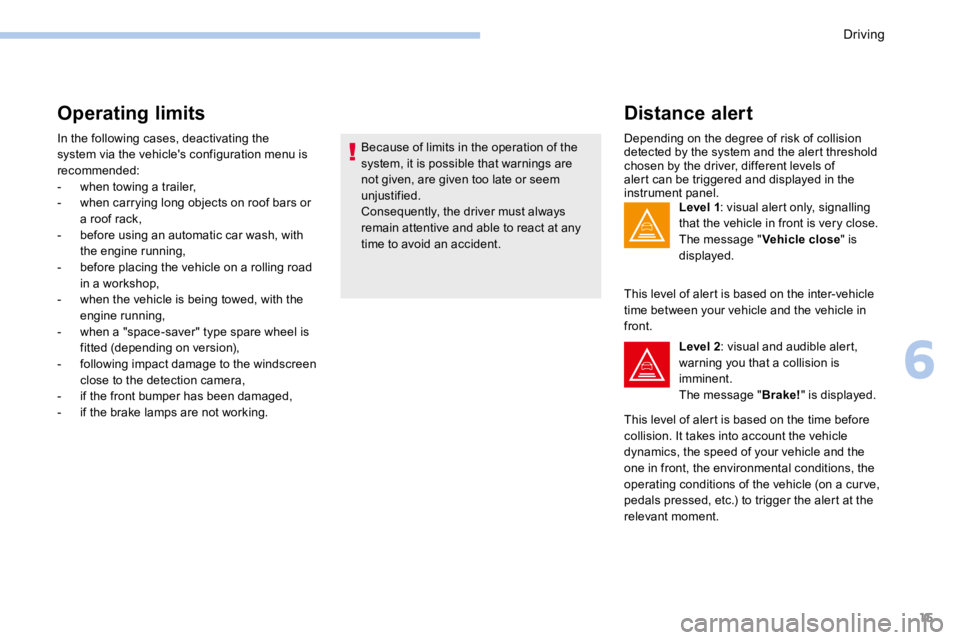
Distance alert
Depending on the degree of risk of collision
detected by the system and the alert threshold
chosen by the driver, different levels of
alert can be triggered and displayed in the
instrument panel.
Level 1: visual alert only, signalling
that the vehicle in front is very close.
The message " Vehicle close" is
displayed.
This level of alert is based on the inter-vehicle
time between your vehicle and the vehicle in
front. Level 2: visual and audible alert,
warning you that a collision is
imminent.
The message " Brake!" is displayed.
This level of alert is based on the time before
collision. It takes into account the vehicle
dynamics, the speed of your vehicle and the
one in front, the environmental conditions, the
operating conditions of the vehicle (on a cur ve,
pedals pressed, etc.) to trigger the alert at the
relevant moment.
6
Driving
Page 559 of 566
19
Characteristics of engines and towed loads
Engines
The engine characteristics are detailed on the
vehicle's registration certificate, and in the
sales documentation.
Weights and towed loads
When the ambient temperature is high,
leaving the engine running for 1 to
2 minutes after stopping the vehicle to
allow it to cool is recommended.
The weights and towed loads relating to your
vehicle are stated in the registration certificate,
and in the sales documentation.
These values are also shown on the
manufacturer's nameplate or label.
For more information, contact a PEUGEOT
dealer or a qualified workshop.
The GTW and towed load values indicated are
valid up to a maximum altitude of 1,000 metres.
The towed load value must be reduced by 10%
for each additional 1,000 metres of altitude.
The recommended nose weight corresponds
to the weight permitted on the towbar
(dismantlable with or without a tool).
GT W:
Gross train weight High ambient temperatures may result
in a reduction in the per formance of
the vehicle to protect the engine. If the
ambient temperature is above 37°C, limit
the towed load.
Towing with a towing vehicle which is only
slightly laden may negatively affect its
handling.
Towing a trailer increases the braking
distance.
With a towing vehicle, never exceed the
speed of 62 mph (100 km/h) (obser ve the
local legislation in force).
The maximum power corresponds to
the value type-approved on a test bed,
according to the conditions defined in
European legislation (Directive 1999/99/
EC).
For more information, contact a PEUGEOT
dealer or a qualified workshop.
9
Technical data