towing PEUGEOT 308 2017 User Guide
[x] Cancel search | Manufacturer: PEUGEOT, Model Year: 2017, Model line: 308, Model: Peugeot 308 2017Pages: 566, PDF Size: 16.05 MB
Page 206 of 566
204
3008-2_en_Chap06_conduite_ed01-2016
When towing, parking on a steep slope,
or if your vehicle is heavily laden,
turn the wheels towards the kerb and
engage a gear (with a manual gearbox)
or place the gear selector at position P
with an automatic gearbox.
For towing, you vehicle is approved for
parking on slopes of up to 12%.
Manual operation
Manual application
With the vehicle stationary: briefly pull the control lever.
If you push the control lever without
pressing the brake pedal, the parking
brake will not be released and a
message is displayed.
Manual release
With the ignition on or the engine running, to
release the parking brake:
F
p
ress the brake pedal,
F
w
hile maintaining pressure on the brake
pedal, briefly push the control lever.
The complete release of the parking brake
is confirmed by the brake indicator lamp and
the
P indicator lamp in the control lever going
off, accompanied by the display of the message
"Parking brake released".
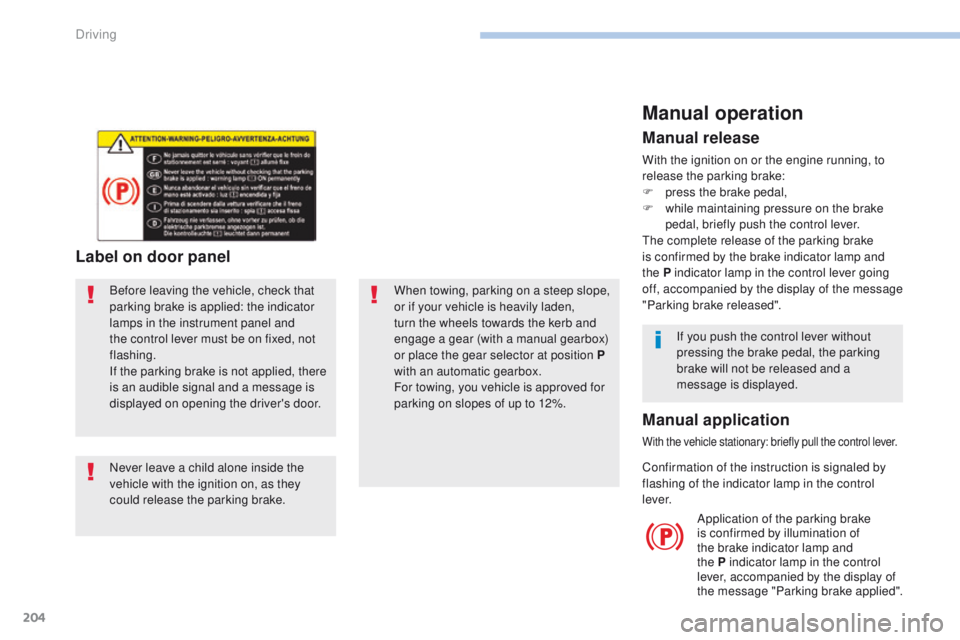
Never leave a child alone inside the
vehicle with the ignition on, as they
could release the parking brake. Before leaving the vehicle, check that
parking brake is applied: the indicator
lamps in the instrument panel and
the control lever must be on fixed, not
flashing.
If the parking brake is not applied, there
is an audible signal and a message is
displayed on opening the driver's door.
Label on door panel
Confirmation of the instruction is signaled by
flashing of the indicator lamp in the control
l eve r. Application of the parking brake
is confirmed by illumination of
the brake indicator lamp and
the
P indicator lamp in the control
lever, accompanied by the display of
the message "Parking brake applied".
Driving
Page 209 of 566
207
3008-2_en_Chap06_conduite_ed01-2016
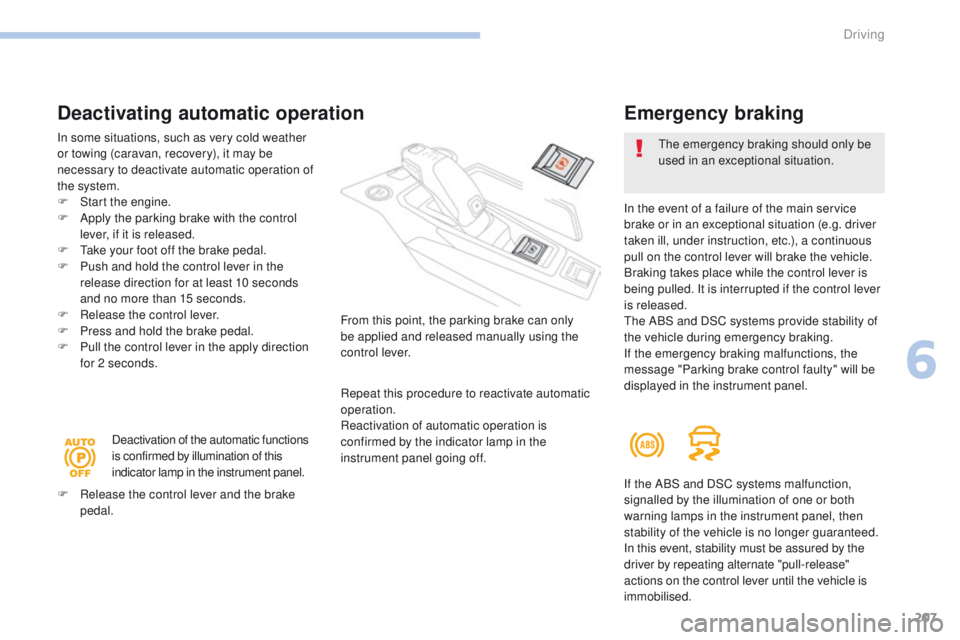
Deactivating automatic operation
In some situations, such as very cold weather
or towing (caravan, recovery), it may be
necessary to deactivate automatic operation of
the system.
F
S
tart the engine.
F
A
pply the parking brake with the control
lever, if it is released.
F
T
ake your foot off the brake pedal.
F
P
ush and hold the control lever in the
release direction for at least 10 seconds
and no more than 15 seconds.
F
R
elease the control lever.
F
P
ress and hold the brake pedal.
F
P
ull the control lever in the apply direction
for 2 seconds.
Deactivation of the automatic functions
is confirmed by illumination of this
indicator lamp in the instrument panel.
F
R
elease the control lever and the brake
pedal. From this point, the parking brake can only
be applied and released manually using the
control lever.
Repeat this procedure to reactivate automatic
operation.
Reactivation of automatic operation is
confirmed by the indicator lamp in the
instrument panel going off.
Emergency braking
The emergency braking should only be
used in an exceptional situation.
In the event of a failure of the main service
brake or in an exceptional situation (e.g. driver
taken ill, under instruction, etc.), a continuous
pull on the control lever will brake the vehicle.
Braking takes place while the control lever is
being pulled. It is interrupted if the control lever
is released.
The ABS and DSC systems provide stability of
the vehicle during emergency braking.
If the emergency braking malfunctions, the
message "Parking brake control faulty" will be
displayed in the instrument panel.
If the ABS and DSC systems malfunction,
signalled by the illumination of one or both
warning lamps in the instrument panel, then
stability of the vehicle is no longer guaranteed.
In this event, stability must be assured by the
driver by repeating alternate "pull-release"
actions on the control lever until the vehicle is
immobilised.
6
Driving
Page 213 of 566
211
3008-2_en_Chap06_conduite_ed01-2016
Automatic gearbox (EAT6)
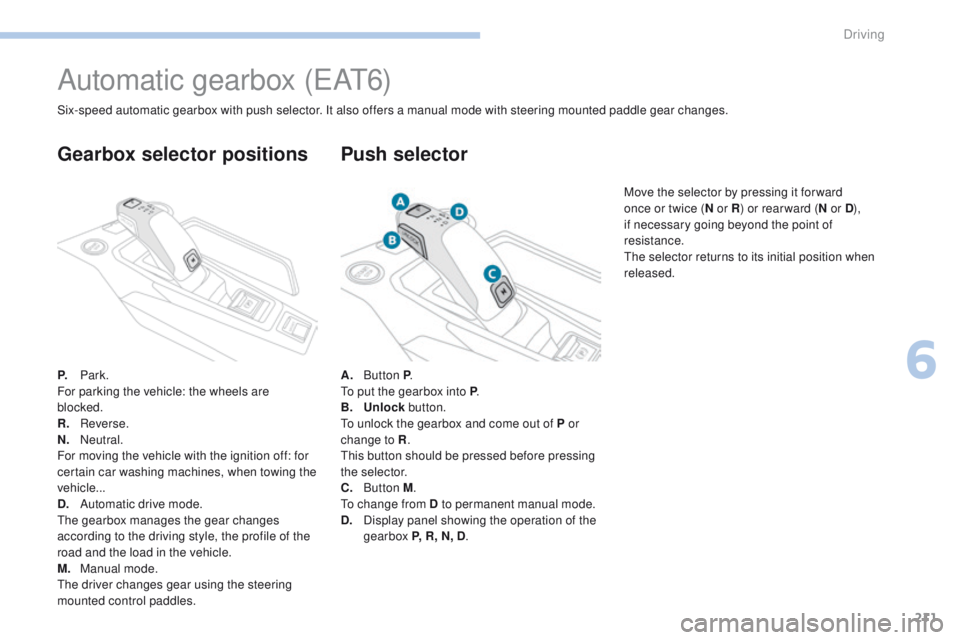
P. Park.
For parking the vehicle: the wheels are
blocked.
R.
R
everse.
N.
N
eutral.
For moving the vehicle with the ignition off: for
certain car washing machines, when towing the
vehicle...
D.
Aut
omatic drive mode.
The gearbox manages the gear changes
according to the driving style, the profile of the
road and the load in the vehicle.
M.
M
anual mode.
The driver changes gear using the steering
mounted control paddles.
Gearbox selector positions
A. Button P.
To put the gearbox into P .
B.
Un
lock button.
To unlock the gearbox and come out of P or
change to R .
This button should be pressed before pressing
the selector.
C.
Button M.
To change from D to permanent manual mode.
D.
D
isplay panel showing the operation of the
gearbox P, R, N, D .
Push selector
Six-speed automatic gearbox with push selector. It also offers a manual mode with steering mounted paddle gear changes.
Move the selector by pressing it for ward
once or twice (N or R) or rear ward ( N or
D),
if necessary going beyond the point of
resistance.
The selector returns to its initial position when
released.
6
Driving
Page 239 of 566
237
3008-2_en_Chap06_conduite_ed01-2016
Only use the cruise control if the traffic
conditions will allow you to drive for a
certain time at a steady speed and at a
safe distance from the vehicle ahead.
Do not activate the cruise control in
urban areas, in heavy traffic, on winding
or steep roads, on slippery or flooded
roads, or in conditions of poor visibility
(heavy rain, fog, falling snow...).
In some circumstances, it may not be
possible to maintain or reach the cruise
speed set: towing, vehicle heavily
loaded, steep climb.
The use of mats not approved by
PEUGEOT may inter fere with the
operation of the cruise control.
To avoid any risk of jamming of the
pedals:
-
e
nsure that the mat is positioned
c o r r e c t l y,
-
n
ever fit one mat on top of another.
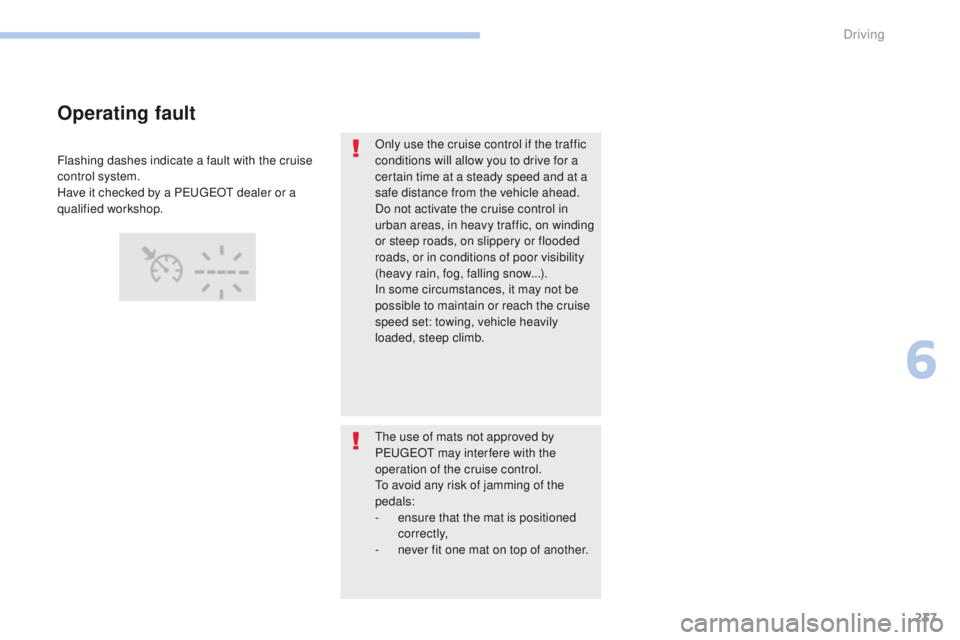
Operating fault
Flashing dashes indicate a fault with the cruise
control system.
Have it checked by a PEUGEOT dealer or a
qualified workshop.
6
Driving
Page 247 of 566
245
3008-2_en_Chap06_conduite_ed01-2016
Limits of operation
The system cannot exceed the limits of the
laws of physics.
It is recommended that the system be
deactivated when the "space-saver" spare
wheel is in use.
The system should not be activated when
towing a trailer.
In certain critical situations, the system will
encourage the driver to immediately take back
control:
-
i
f the vehicle in front slows down too much
or too suddenly, and the driver does not
brake,
-
i
f a vehicle comes between your vehicle
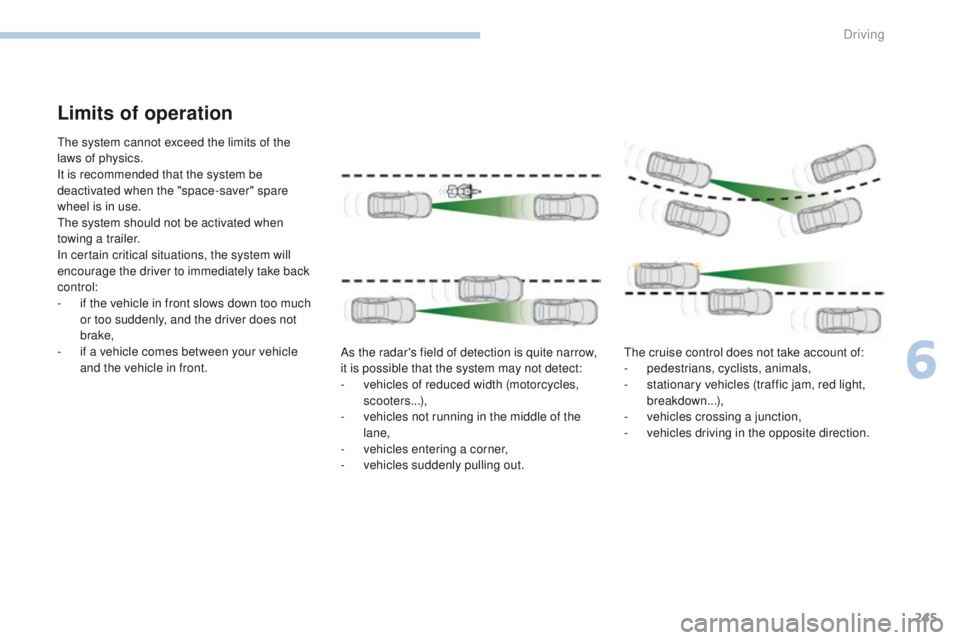
and the vehicle in front. As the radar's field of detection is quite narrow,
it is possible that the system may not detect:
-
v
ehicles of reduced width (motorcycles,
scooters...),
-
v
ehicles not running in the middle of the
lane,
-
v
ehicles entering a corner,
-
v
ehicles suddenly pulling out.The cruise control does not take account of:
-
p
edestrians, cyclists, animals,
-
s
tationary vehicles (traffic jam, red light,
breakdown...),
-
v
ehicles crossing a junction,
-
v
ehicles driving in the opposite direction.
6
Driving
Page 250 of 566
248
3008-2_en_Chap06_conduite_ed01-2016
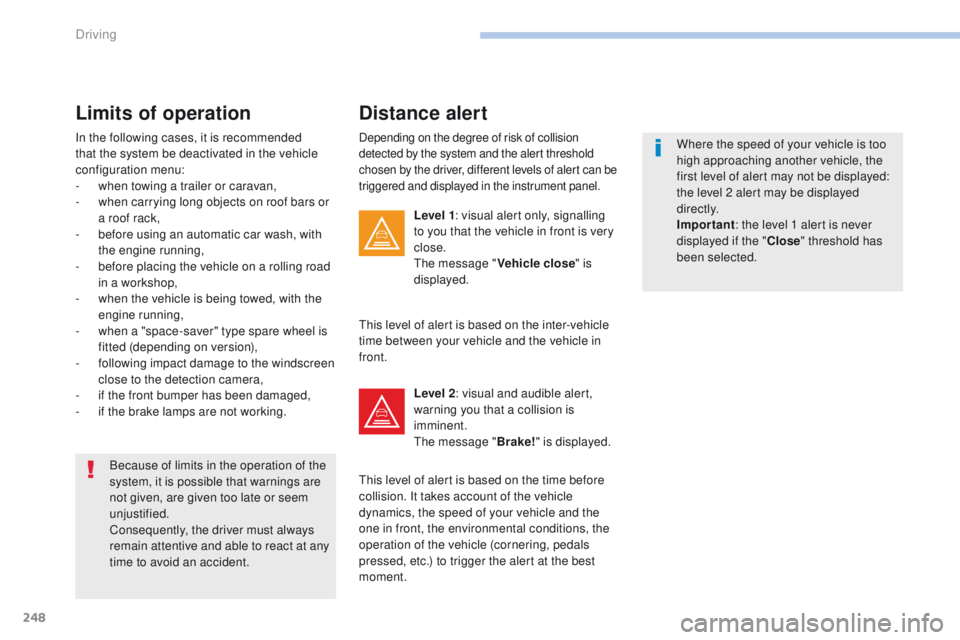
Depending on the degree of risk of collision
detected by the system and the alert threshold
chosen by the driver, different levels of alert can be
triggered and displayed in the instrument panel.
Because of limits in the operation of the
system, it is possible that warnings are
not given, are given too late or seem
unjustified.
Consequently, the driver must always
remain attentive and able to react at any
time to avoid an accident.
Distance alert
Level 1: visual alert only, signalling
to you that the vehicle in front is very
close.
The message " Vehicle close" is
displayed.
Limits of operation
In the following cases, it is recommended
that the system be deactivated in the vehicle
configuration menu:
-
w
hen towing a trailer or caravan,
-
w
hen carrying long objects on roof bars or
a roof rack,
-
b
efore using an automatic car wash, with
the engine running,
-
b
efore placing the vehicle on a rolling road
in a workshop,
-
w
hen the vehicle is being towed, with the
engine running,
-
w
hen a "space-saver" type spare wheel is
fitted (depending on version),
-
f
ollowing impact damage to the windscreen
close to the detection camera,
-
i
f the front bumper has been damaged,
-
i
f the brake lamps are not working. This level of alert is based on the inter-vehicle
time between your vehicle and the vehicle in
front.
Level 2: visual and audible alert,
warning you that a collision is
imminent.
The message " Brake!" is displayed.
This level of alert is based on the time before
collision. It takes account of the vehicle
dynamics, the speed of your vehicle and the
one in front, the environmental conditions, the
operation of the vehicle (cornering, pedals
pressed, etc.) to trigger the alert at the best
moment. Where the speed of your vehicle is too
high approaching another vehicle, the
first level of alert may not be displayed:
the level 2 alert may be displayed
di r e c t l y.
Important
: the level 1 alert is never
displayed if the " Close" threshold has
been selected.
Driving
Page 262 of 566
260
3008-2_en_Chap06_conduite_ed01-2016
Blind Spot Monitoring System
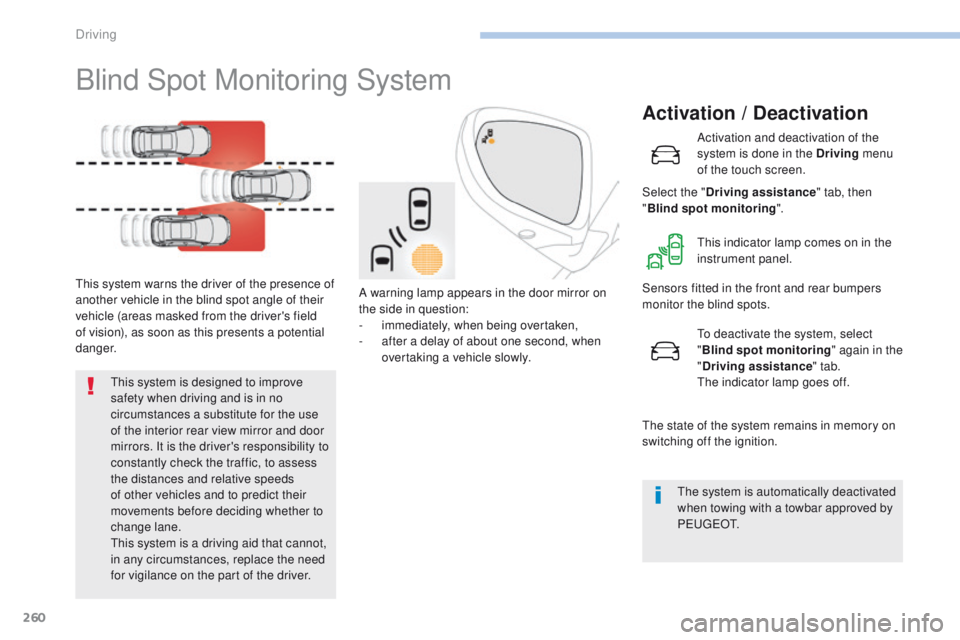
This system warns the driver of the presence of
another vehicle in the blind spot angle of their
vehicle (areas masked from the driver's field
of vision), as soon as this presents a potential
danger.
Activation / Deactivation
Activation and deactivation of the
system is done in the Driving menu
of the touch screen.
Select the " Driving assistance " tab, then
" Blind spot monitoring ".
A warning lamp appears in the door mirror on
the side in question:
-
i
mmediately, when being overtaken,
-
a
fter a delay of about one second, when
overtaking a vehicle slowly.
This system is designed to improve
safety when driving and is in no
circumstances a substitute for the use
of the interior rear view mirror and door
mirrors. It is the driver's responsibility to
constantly check the traffic, to assess
the distances and relative speeds
of other vehicles and to predict their
movements before deciding whether to
change lane.
This system is a driving aid that cannot,
in any circumstances, replace the need
for vigilance on the part of the driver. This indicator lamp comes on in the
instrument panel.
To deactivate the system, select
"
Blind spot monitoring " again in the
" Driving assistance " tab.
The indicator lamp goes off.
Sensors fitted in the front and rear bumpers
monitor the blind spots.
The state of the system remains in memory on
switching off the ignition.
The system is automatically deactivated
when towing with a towbar approved by
P E U G E O T.
Driving
Page 281 of 566
279
3008-2_en_Chap06_conduite_ed01-2016
The system is deactivated by pressing the control.The system is deactivated automatically:
- o n switching off the ignition,
-
i
f the engine stalls,
-
i
f no manoeuvre is started within 5 minutes
of selection of the type of manoeuvre,
-
a
fter a prolonged stop of the vehicle during
a manoeuvre,
-
i
f the road wheel anti-slip regulation (ASR)
is triggered,
-
i
f the speed of the vehicle exceeds the
stated limit,
-
w
hen the driver interrupts movement of the
steering wheel,
-
a
fter 4 manoeuvre cycles,
-
o
n opening the driver's door,
-
i
f one of the front wheels encounters an
obstacle.
The operation indicator lamp goes off in the
instrument panel and a message is displayed
accompanied by an audible signal.
The driver should then take back control of the
vehicle's steering.
Deactivation
The system is switched off automatically:
- w hen towing a trailer, connected
electrically,
-
i
f the driver's door is opened,
-
i
f the speed of the vehicle is above 42 mph
(70 km/h).
To switch the system of for a prolonged period,
contact a PEUGEOT dealer or a qualified
workshop.
Operating faults
In the event of a fault with the power
steering, this warning lamp flashes in
the instrument panel, accompanied
by a message.
Contact a PEUGEOT dealer or a qualified
workshop.
Switching off
If the lateral distance between your
vehicle and the space is too great, the
system may not be able to measure the
space.
Anything projecting beyond the envelope
of the vehicle (a ladder on the roof, for
example) is not taken into account by the
Park Assist system during a manoeuvre.
In bad weather or in winter, ensure that
the sensors are not covered by road
dirt, ice or snow.
In the event of a fault, have the system
checked by a PEUGEOT dealer or a
qualified workshop.
If the system is deactivated during a
manoeuvre, the drive should reactivate
it to repeat the measurement. In the event of a fault, this warning
lamp flashes for a few seconds,
accompanied by an audible signal.
If the fault occurs during the use
of the system, the warning lamp
goes
off. High pressure jet washing
When washing your vehicle, keep the lance at
least 30 cm away from the sensors.
6
Driving
Page 286 of 566
284
3008-2_en_Chap07_infos-pratiques_ed01-2016
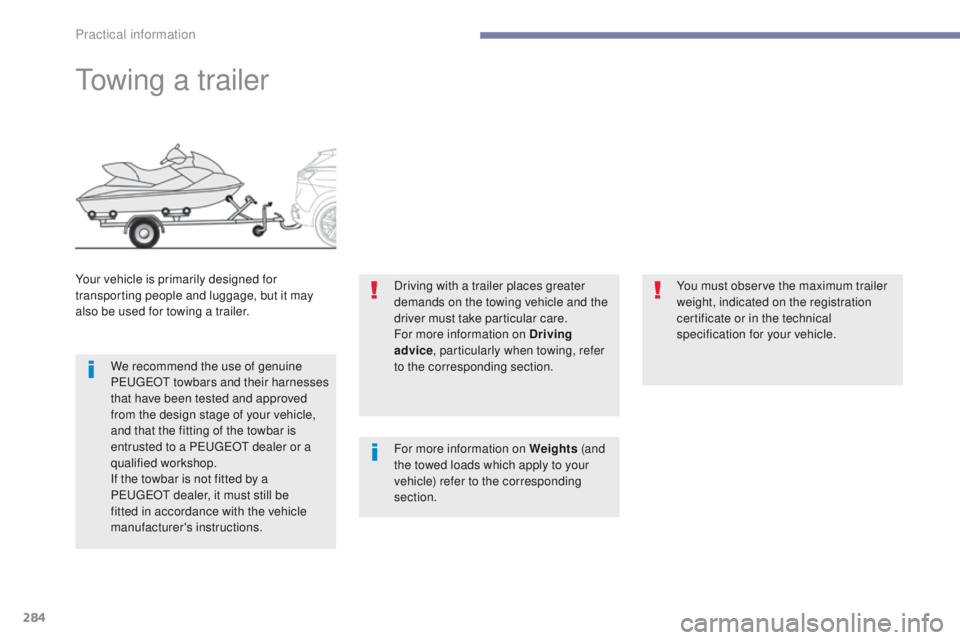
Towing a trailer
Your vehicle is primarily designed for
transporting people and luggage, but it may
also be used for towing a trailer.We recommend the use of genuine
PEUGEOT towbars and their harnesses
that have been tested and approved
from the design stage of your vehicle,
and that the fitting of the towbar is
entrusted to a PEUGEOT dealer or a
qualified workshop.
If the towbar is not fitted by a
PEUGEOT dealer, it must still be
fitted in accordance with the vehicle
manufacturer's instructions. Driving with a trailer places greater
demands on the towing vehicle and the
driver must take particular care.
For more information on Driving
advice
, particularly when towing, refer
to the corresponding section.
For more information on Weights (and
the towed loads which apply to your
vehicle) refer to the corresponding
section. You must observe the maximum trailer
weight, indicated on the registration
certificate or in the technical
specification for your vehicle.
Practical information
Page 287 of 566
285
3008-2_en_Chap07_infos-pratiques_ed01-2016
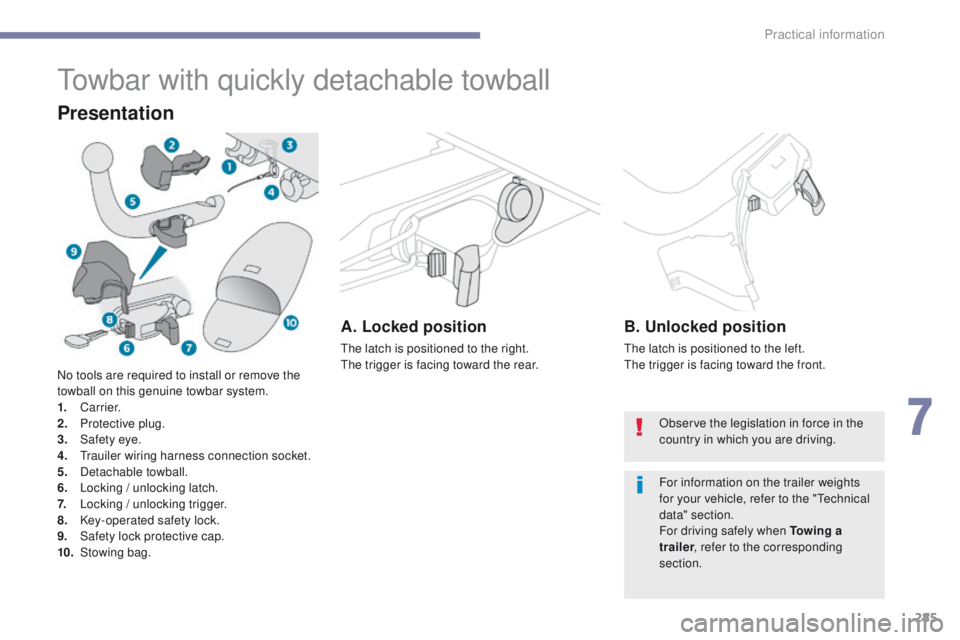
Towbar with quickly detachable towball
Presentation
A. Locked position
The latch is positioned to the right.
The trigger is facing toward the rear.
B. Unlocked position
The latch is positioned to the left.
The trigger is facing toward the front.Observe the legislation in force in the
country in which you are driving.
For information on the trailer weights
for your vehicle, refer to the "Technical
data" section.
For driving safely when Towing a
trailer, refer to the corresponding
section.
No tools are required to install or remove the
towball on this genuine towbar system.
1.
Carrier.
2.
P
rotective plug.
3.
S
afety eye.
4.
T
rauiler wiring harness connection socket.
5.
D
etachable towball.
6.
L
ocking / unlocking latch.
7.
L
ocking / unlocking trigger.
8.
K
ey-operated safety lock.
9.
S
afety lock protective cap.
10.
S
towing bag.
7
Practical information