engine PEUGEOT 308 2017 Workshop Manual
[x] Cancel search | Manufacturer: PEUGEOT, Model Year: 2017, Model line: 308, Model: Peugeot 308 2017Pages: 566, PDF Size: 16.05 MB
Page 142 of 566
140
3008-2_en_Chap03_ergonomie-et-confort_ed01-2016
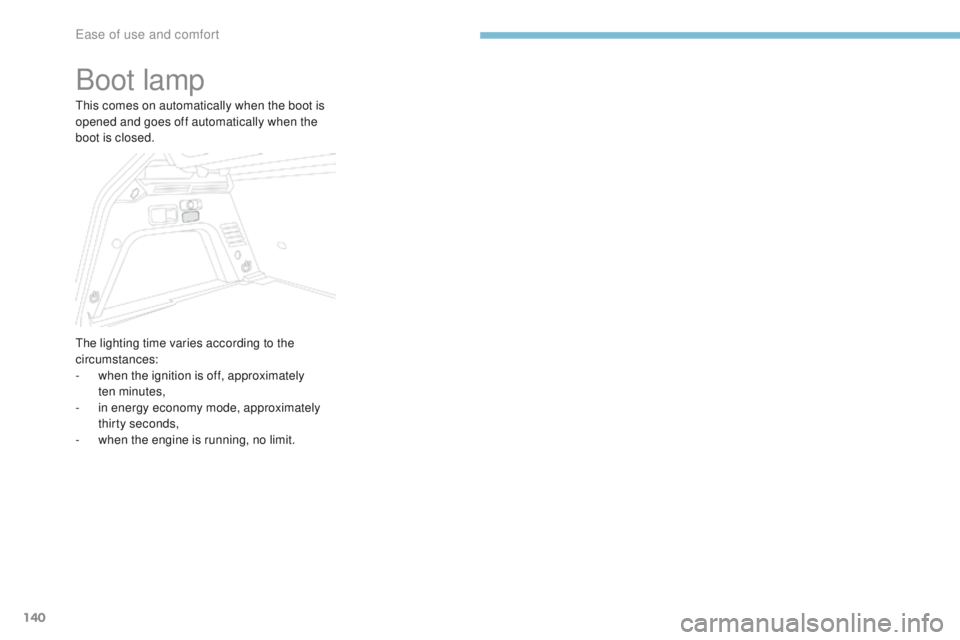
Boot lamp
This comes on automatically when the boot is
opened and goes off automatically when the
boot is closed.
The lighting time varies according to the
circumstances:
-
w
hen the ignition is off, approximately
ten
minutes,
-
i
n energy economy mode, approximately
thirty seconds,
-
w
hen the engine is running, no limit.
Ease of use and comfort
Page 143 of 566
141
3008-2_en_Chap04_eclairage-et-visibilite_ed01-2016
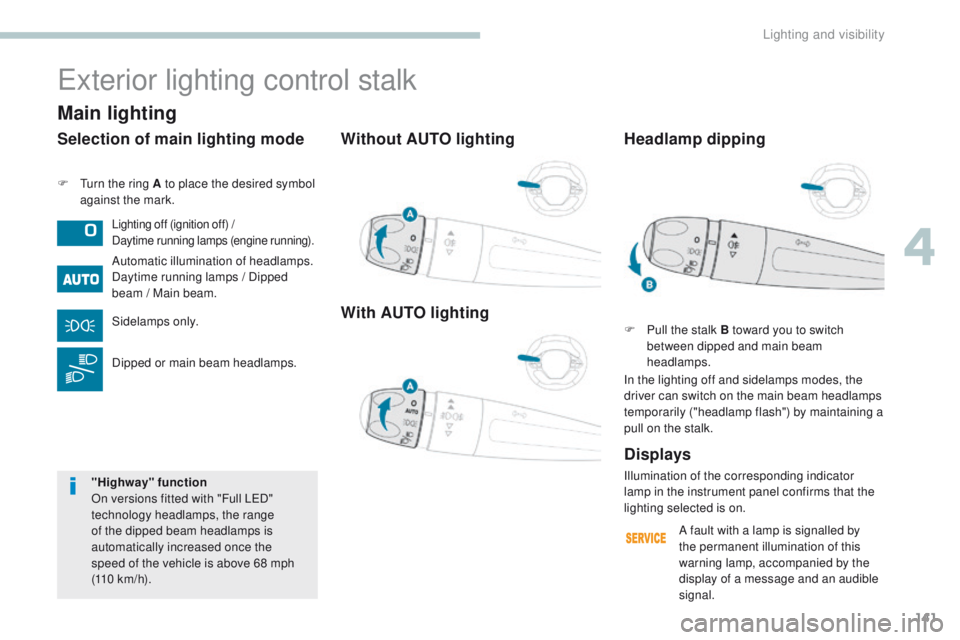
Without AUTO lighting
With AUTO lighting
F Turn the ring A to place the desired symbol against the mark.
Exterior lighting control stalk
Lighting off (ignition off) /
Daytime running lamps (engine running).
Automatic illumination of headlamps.
Daytime running lamps / Dipped
beam / Main beam.
Sidelamps only.
Dipped or main beam headlamps.
Displays
Selection of main lighting mode
Illumination of the corresponding indicator
lamp in the instrument panel confirms that the
lighting selected is on.
Headlamp dipping
F Pull the stalk B toward you to switch
between dipped and main beam
headlamps.
In the lighting off and sidelamps modes, the
driver can switch on the main beam headlamps
temporarily ("headlamp flash") by maintaining a
pull on the stalk.
Main lighting
"Highway" function
On versions fitted with "Full LED"
technology headlamps, the range
of the dipped beam headlamps is
automatically increased once the
speed of the vehicle is above 68 mph
(110
km/h). A fault with a lamp is signalled by
the permanent illumination of this
warning lamp, accompanied by the
display of a message and an audible
signal.
4
Lighting and visibility
Page 145 of 566
143
3008-2_en_Chap04_eclairage-et-visibilite_ed01-2016
Switching on the lighting
after switching off the
ignition
To reactivate the lighting control stalk,
turn the ring A to position "0" - lighting
off, then to the position of your choice.
When the driver's door is opened, a
temporary audible signal warns you that
the vehicle's lighting is on.
They switch off automatically after a
period which depends on the state of
charge of the battery (entry to energy
economy mode).
Daytime running lamps /
Sidelamps
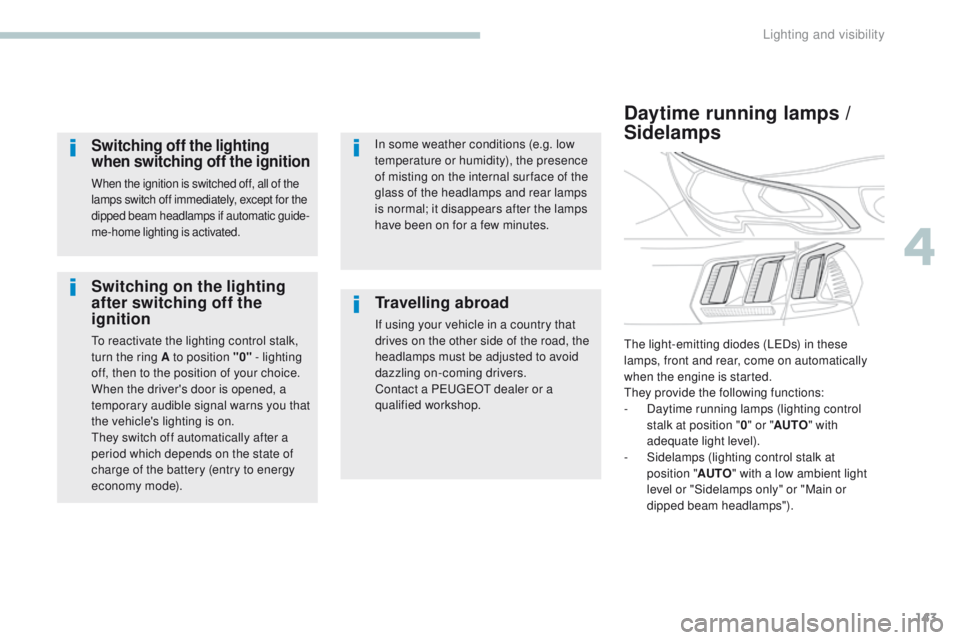
The light-emitting diodes (LEDs) in these
lamps, front and rear, come on automatically
when the engine is started.
They provide the following functions:
-
D
aytime running lamps (lighting control
stalk at position " 0" or " AUTO " with
adequate light level).
-
S
idelamps (lighting control stalk at
position
"AUTO " with a low ambient light
level or "Sidelamps only" or "Main or
dipped beam headlamps").
In some weather conditions (e.g. low
temperature or humidity), the presence
of misting on the internal sur face of the
glass of the headlamps and rear lamps
is normal; it disappears after the lamps
have been on for a few minutes.
Travelling abroad
If using your vehicle in a country that
drives on the other side of the road, the
headlamps must be adjusted to avoid
dazzling on-coming drivers.
Contact a PEUGEOT dealer or a
qualified workshop.
Switching off the lighting
when switching off the ignition
When the ignition is switched off, all of the
lamps switch off immediately, except for the
dipped beam headlamps if automatic guide-
me-home lighting is activated.
4
Lighting and visibility
Page 162 of 566
160
3008-2_en_Chap05_securite_ed01-2016
Electronic stability programme (ESC)
Definitions
Anti-lock braking system (ABS)
and electronic brake force
distribution (EBFD)
These systems improve the stability and
manoeuvrability of your vehicle when braking
and contribute towards improved control in
corners, in particular on poor or slippery road
surfaces.
The ABS prevents wheel lock in the event of
emergency braking.
The electronic brake force distribution system
manages the braking pressure wheel by wheel.
Emergency braking assistance
In an emergency, this system enables you to
reach the optimum braking pressure more
quickly and therefore reduce the stopping
distance.
It is triggered in relation to the speed at which
the brake pedal is pressed. This is felt by a
reduction in the resistance of the pedal and an
increase in the effectiveness of the braking.
Anti-slip regulation (ASR)
This system (also known as Traction Control)
optimises traction in order to avoid wheel
slip by acting on the brakes of the driving
wheels and on the engine. It also improves
the directional stability of the vehicle on
acceleration.
Dynamic stability control (DSC)
If there is a difference between the path
followed by the vehicle and that required by the
driver, this system monitors each wheel and
automatically acts on the brake of one or more
wheels and on the engine to return the vehicle
to the required path, within the limits of the laws
of physics.
A set of the following Electronic Stability systems:
-
a
nti-lock braking system (ABS) and electronic brake force distribution (EBFD),
-
em
ergency braking assistance,
-
w
heel anti-slip regulation (ASR) or traction control,
-
d
ynamic stability control (DSC).
-
t
railer stability assist (TSA).
Trailer stability assist (TSA)
This system allows control of the vehicle to be
retained when towing a trailer, so as to avoid
the risk of snaking.
It is available on vehicles with factory-fitted
trailer wiring (preparation for towbar option
or the towbar with quickly-detachable towball
pack).
Safety
Page 164 of 566
162
3008-2_en_Chap05_securite_ed01-2016
Anti-slip regulation (ASR) / Dynamic stability control (DSC)
Operation
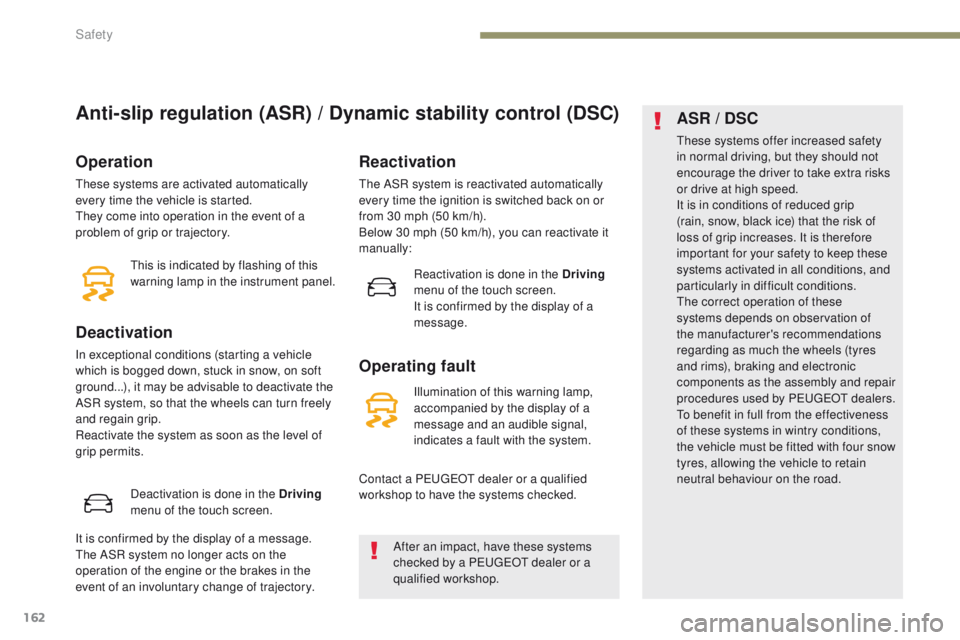
These systems are activated automatically
every time the vehicle is started.
They come into operation in the event of a
problem of grip or trajectory.
Deactivation
In exceptional conditions (starting a vehicle
which is bogged down, stuck in snow, on soft
ground...), it may be advisable to deactivate the
ASR system, so that the wheels can turn freely
and regain grip.
Reactivate the system as soon as the level of
grip permits.Deactivation is done in the Driving
menu of the touch screen.
Reactivation
The ASR system is reactivated automatically
every time the ignition is switched back on or
from 30 mph (50 km/h).
Below 30 mph (50 km/h), you can reactivate it
manually:
Operating fault
This is indicated by flashing of this
warning lamp in the instrument panel.
Illumination of this warning lamp,
accompanied by the display of a
message and an audible signal,
indicates a fault with the system.
Contact a PEUGEOT dealer or a qualified
workshop to have the systems checked.
It is confirmed by the display of a message.
The ASR system no longer acts on the
operation of the engine or the brakes in the
event of an involuntary change of trajectory.
ASR / DSC
These systems offer increased safety
in normal driving, but they should not
encourage the driver to take extra risks
or drive at high speed.
It is in conditions of reduced grip
(rain, snow, black ice) that the risk of
loss of grip increases. It is therefore
important for your safety to keep these
systems activated in all conditions, and
particularly in difficult conditions.
The correct operation of these
systems depends on observation of
the manufacturer's recommendations
regarding as much the wheels (tyres
and rims), braking and electronic
components as the assembly and repair
procedures used by PEUGEOT dealers.
To benefit in full from the effectiveness
of these systems in wintry conditions,
the vehicle must be fitted with four snow
tyres, allowing the vehicle to retain
neutral behaviour on the road.
After an impact, have these systems
checked by a PEUGEOT dealer or a
qualified workshop. Reactivation is done in the Driving
menu of the touch screen.
It is confirmed by the display of a
message.
Safety
Page 165 of 566
163
3008-2_en_Chap05_securite_ed01-2016
Trailer stability assist
Operation
The system is activated automatically when the
ignition is switched on.
The electronic stability programme (ESC) must
not have any faults.
Between 36 and 100 mph (60 and 160 km/h), if
the system detect oscillations (snaking) in the
movement of the trailer, it acts on the brakes to
stabilise the trailer and, if necessary, reduces
engine power to slow down the vehicle.
For information on the weights and towed
loads, refer to the "Technical data" section or
the registration certificate for your vehicle.
For advice on driving safely when To w i n g
a trailer , refer to the corresponding section.
When towing, this system reduces the risk of the vehicle or trailer snaking.
It is available on vehicles with factory-fitted trailer wiring (preparation for towbar option or the towbar with quickly-detachable towball pack).
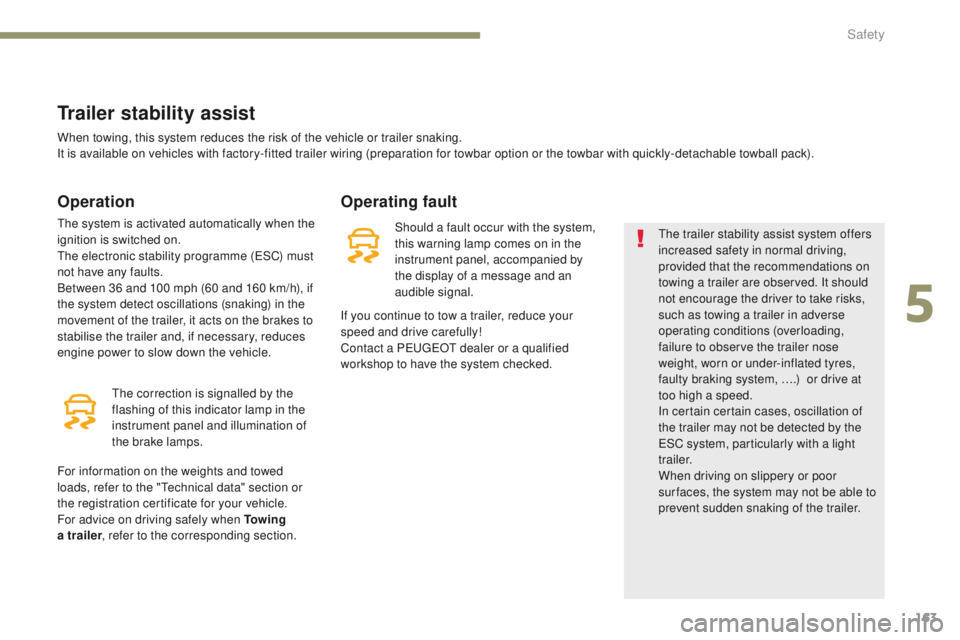
The correction is signalled by the
flashing of this indicator lamp in the
instrument panel and illumination of
the brake lamps.
Operating fault
Should a fault occur with the system,
this warning lamp comes on in the
instrument panel, accompanied by
the display of a message and an
audible signal.
If you continue to tow a trailer, reduce your
speed and drive carefully!
Contact a PEUGEOT dealer or a qualified
workshop
to have the system checked. The trailer stability assist system offers
increased safety in normal driving,
provided that the recommendations on
towing a trailer are observed. It should
not encourage the driver to take risks,
such as towing a trailer in adverse
operating conditions (overloading,
failure to observe the trailer nose
weight, worn or under-inflated tyres,
faulty braking system, ….)
or drive at
too high a speed.
In certain certain cases, oscillation of
the trailer may not be detected by the
ESC system, particularly with a light
t r a i l e r.
When driving on slippery or poor
sur faces, the system may not be able to
prevent sudden snaking of the trailer.
5
Safety
Page 166 of 566
164
3008-2_en_Chap05_securite_ed01-2016
Advanced Grip Control
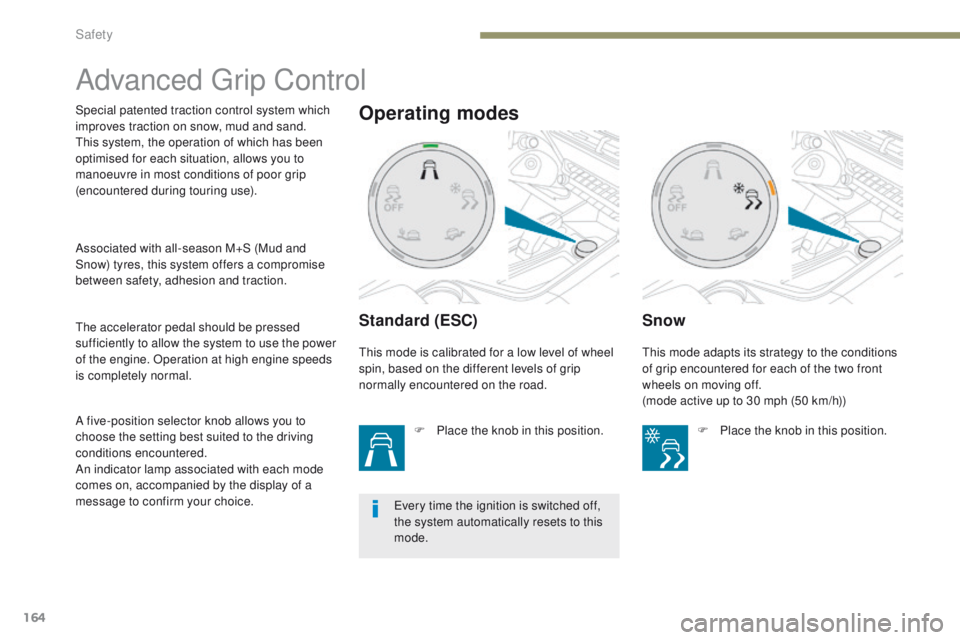
Standard (ESC)
F Place the knob in this position.
Snow
Special patented traction control system which
improves traction on snow, mud and sand.
This system, the operation of which has been
optimised for each situation, allows you to
manoeuvre in most conditions of poor grip
(encountered during touring use).This mode is calibrated for a low level of wheel
spin, based on the different levels of grip
normally encountered on the road.This mode adapts its strategy to the conditions
of grip encountered for each of the two front
wheels on moving off.
(mode active up to 30 mph (50 km/h))
F
P
lace the knob in this position.
The accelerator pedal should be pressed
sufficiently to allow the system to use the power
of the engine. Operation at high engine speeds
is completely normal.
Every time the ignition is switched off,
the system automatically resets to this
mode.
A five-position selector knob allows you to
choose the setting best suited to the driving
conditions encountered.
An indicator lamp associated with each mode
comes on, accompanied by the display of a
message to confirm your choice. Associated with all-season M+S (Mud and
Snow) tyres, this system offers a compromise
between safety, adhesion and traction.Operating modes
Safety
Page 168 of 566
166
3008-2_en_Chap05_securite_ed01-2016
Hill Assist Descent Control
System that provides assistance when
descending on loose or soft sur faces (gravel,
mud...) or a steep gradient.
This system reduces the risk of slip or loss
of control of the vehicle when descending,
whether going forward or in reverse.
During a descent, it assists the driver in
maintaining a constant speed, depending
on the gear engaged, while progressively
releasing the brakes.Operation
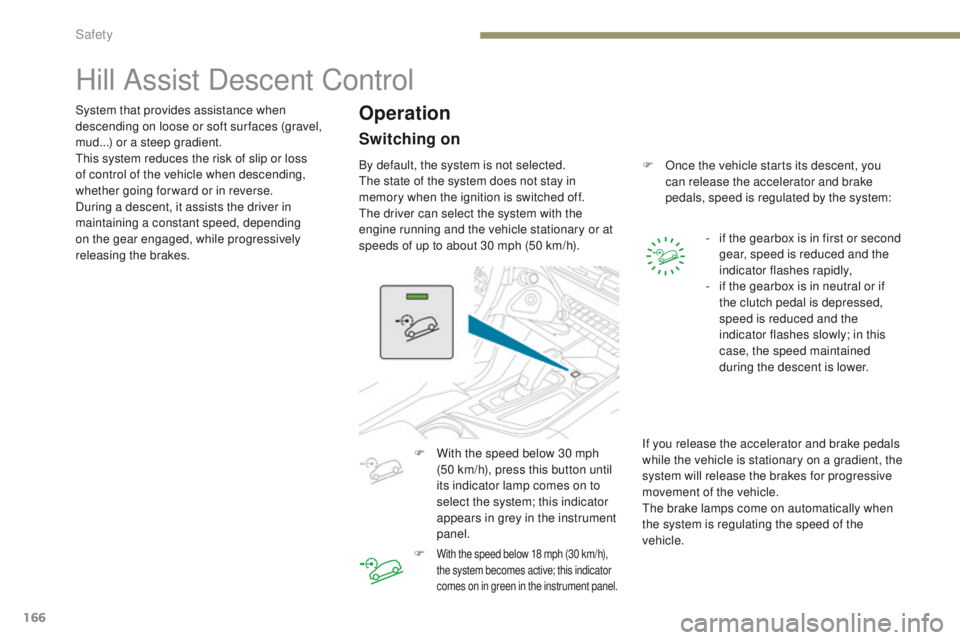
By default, the system is not selected.
The state of the system does not stay in
memory when the ignition is switched off.
The driver can select the system with the
engine running and the vehicle stationary or at
speeds of up to about 30 mph (50 km/h).F
O nce the vehicle starts its descent, you
can release the accelerator and brake
pedals, speed is regulated by the system:
-
i
f the gearbox is in first or second
gear, speed is reduced and the
indicator flashes rapidly,
-
i
f the gearbox is in neutral or if
the clutch pedal is depressed,
speed is reduced and the
indicator flashes slowly; in this
case, the speed maintained
during the descent is lower.
Switching on
F With the speed below 30 mph (50 km/h), press this button until
its indicator lamp comes on to
select the system; this indicator
appears in grey in the instrument
panel.
F
With the speed below 18 mph (30 km/h),
the system becomes active; this indicator
comes on in green in the instrument panel.
If you release the accelerator and brake pedals
while the vehicle is stationary on a gradient, the
system will release the brakes for progressive
movement of the vehicle.
The brake lamps come on automatically when
the system is regulating the speed of the
vehicle.
Safety
Page 169 of 566
167
3008-2_en_Chap05_securite_ed01-2016
For the system to operate, the slope
must be steeper than 5%.
The system can be used with the
gearbox in neutral.
Otherwise, engage a gear appropriate
for the speed of the vehicle, to avoid the
engine stalling.
With an automatic gearbox, the system
can be used with the selector at N, D
or R .
If the speed of the vehicle exceeds 18 mph
(30
km/h), regulation is automatically paused
and the indicator in the instrument panel
changes back to grey, but the indicator lamp in
the button still stays on.
Regulation resumes automatically as soon as
the speed of the vehicle drops below 18 mph
(30 km/h), provided that the conditions of
gradient and release of the pedals are met.
You can press the accelerator or brake pedal
at any time.
Operating fault
If a fault occurs with the system,
this warning lamp comes on,
accompanied by the display of a
message in the instrument panel.
Have the system checked by a PEUGEOT
dealer or a qualified workshop.Switching off
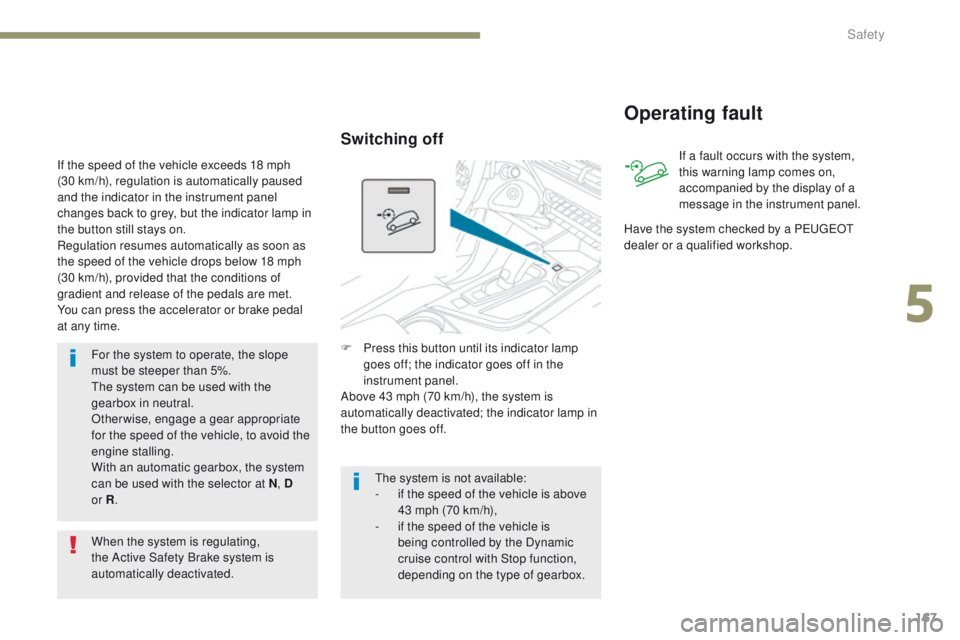
F Press this button until its indicator lamp goes off; the indicator goes off in the
instrument panel.
Above 43 mph (70 km/h), the system is
automatically deactivated; the indicator lamp in
the button goes off.
The system is not available:
-
i
f the speed of the vehicle is above
43 mph (70 km/h),
-
i
f the speed of the vehicle is
being controlled by the Dynamic
cruise control with Stop function,
depending on the type of gearbox.
When the system is regulating,
the Active Safety Brake system is
automatically deactivated.
5
Safety
Page 172 of 566
170
3008-2_en_Chap05_securite_ed01-2016
Fastening
F Pull the strap, then insert the tongue in the buckle.
F
C
heck that the seat belt is fastened
correctly by pulling the strap.
Unfastening
F Press the red button on the buckle.
F G uide the seat belt as it reels in. This warning lamp comes on in
the seat belt and passenger's front
airbag warning lamps display,
when one or more rear passengers
unfasten their seat belt.
Seat belt unfastened warning
lamp
Seat belt unfastened warning
lamps display
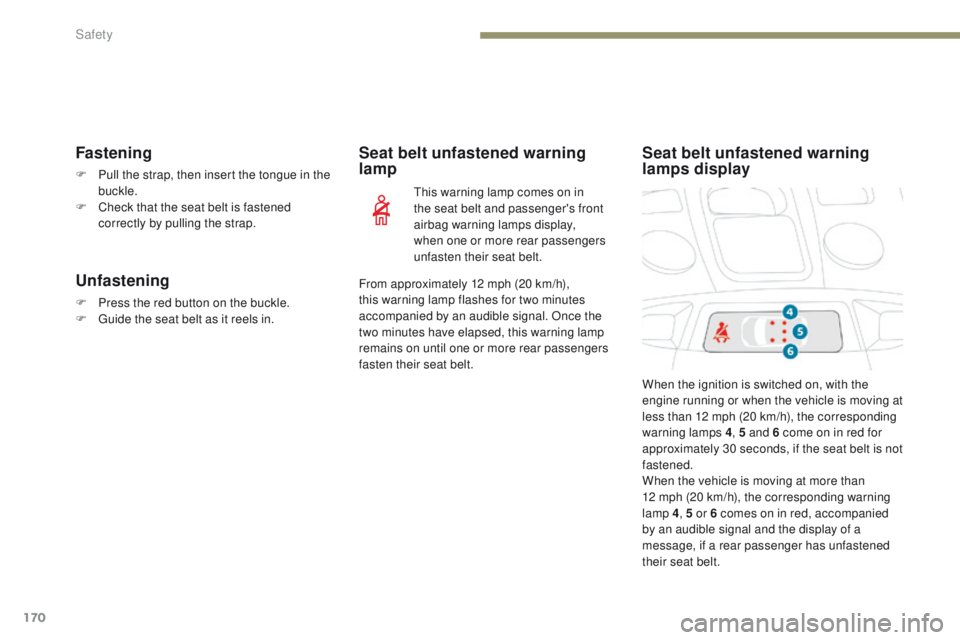
When the ignition is switched on, with the
engine running or when the vehicle is moving at
less than 12 mph (20 km/h), the corresponding
warning lamps 4
, 5 and 6 come on in red for
approximately 30 seconds, if the seat belt is not
fastened.
When the vehicle is moving at more than
12
mph (20 km/h), the corresponding warning
lamp 4 , 5 or 6 comes on in red, accompanied
by an audible signal and the display of a
message, if a rear passenger has unfastened
their seat belt.
From approximately 12 mph (20 km/h),
this warning lamp flashes for two minutes
accompanied by an audible signal. Once the
two minutes have elapsed, this warning lamp
remains on until one or more rear passengers
fasten their seat belt.
Safety