display PEUGEOT 308 2017 Repair Manual
[x] Cancel search | Manufacturer: PEUGEOT, Model Year: 2017, Model line: 308, Model: Peugeot 308 2017Pages: 566, PDF Size: 16.05 MB
Page 211 of 566
209
3008-2_en_Chap06_conduite_ed01-2016
SituationsConsequences
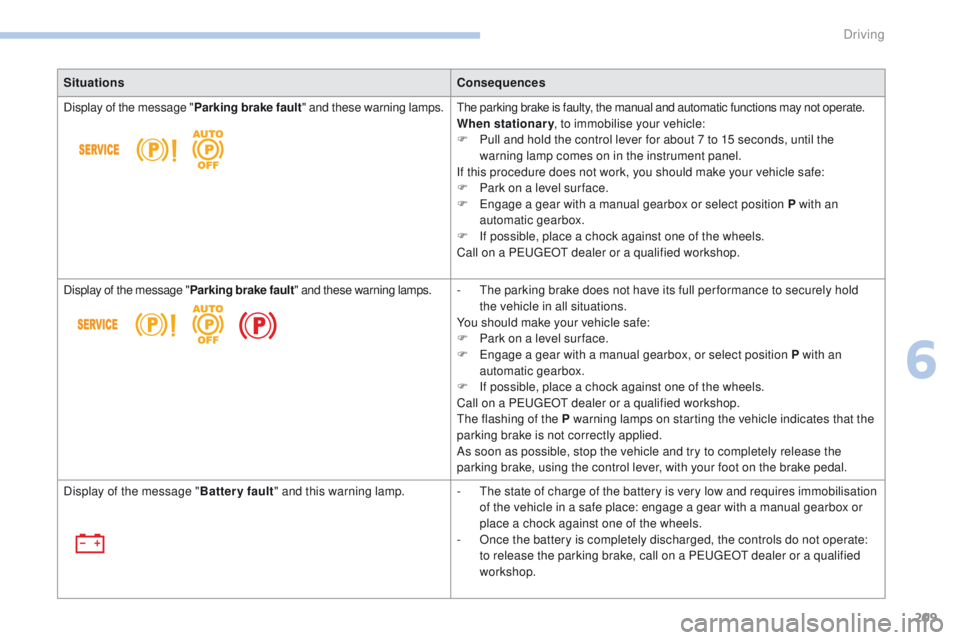
Display of the message " Parking brake fault" and these warning lamps. The parking brake is faulty, the manual and automatic functions may not operate.
When stationary, to immobilise your vehicle:
F
P
ull and hold the control lever for about 7 to 15 seconds, until the
warning lamp comes on in the instrument panel.
If this procedure does not work, you should make your vehicle safe:
F
P
ark on a level sur face.
F
E
ngage a gear with a manual gearbox or select position P with an
automatic gearbox.
F
I
f possible, place a chock against one of the wheels.
Call on a PEUGEOT dealer or a qualified workshop.
Display of the message " Parking brake fault" and these warning lamps. -
T
he parking brake does not have its full per formance to securely hold
the vehicle in all situations.
You should make your vehicle safe:
F
P
ark on a level sur face.
F
E
ngage a gear with a manual gearbox, or select position P with an
automatic gearbox.
F
I
f possible, place a chock against one of the wheels.
Call on a PEUGEOT dealer or a qualified workshop.
The flashing of the P warning lamps on starting the vehicle indicates that the
parking brake is not correctly applied.
As soon as possible, stop the vehicle and try to completely release the
parking brake, using the control lever, with your foot on the brake pedal.
Display of the message " Battery fault" and this warning lamp. -
T
he state of charge of the battery is very low and requires immobilisation
of the vehicle in a safe place: engage a gear with a manual gearbox or
place a chock against one of the wheels.
-
O
nce the battery is completely discharged, the controls do not operate:
to release the parking brake, call on a PEUGEOT dealer or a qualified
workshop.
6
Driving
Page 215 of 566
213
3008-2_en_Chap06_conduite_ed01-2016
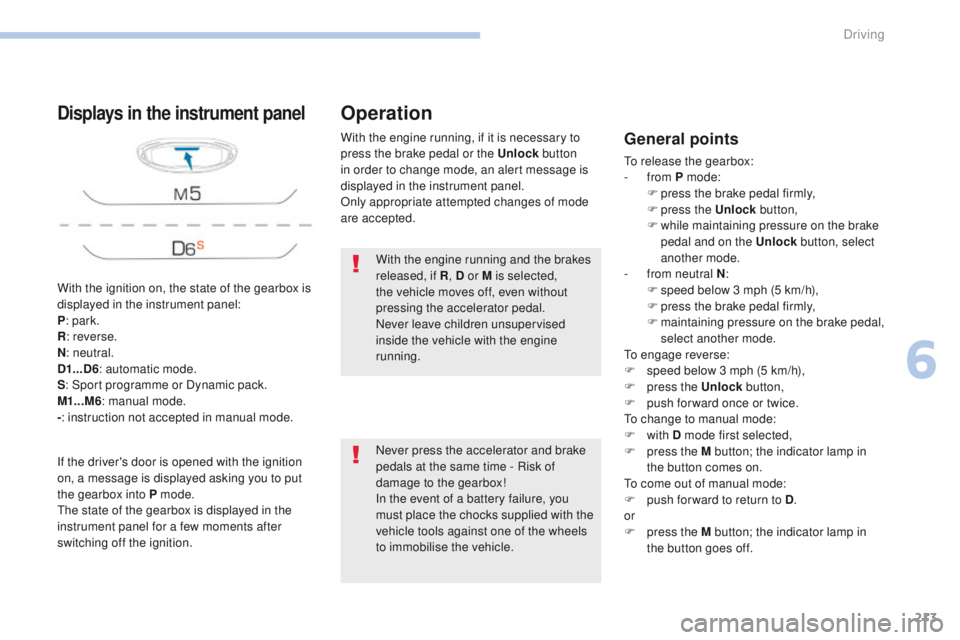
With the ignition on, the state of the gearbox is
displayed in the instrument panel:
P: park.
R : reverse.
N : neutral.
D1...D6 : automatic mode.
S : Sport programme or Dynamic pack.
M1...M6 : manual mode.
- : instruction not accepted in manual mode.
Displays in the instrument panel
If the driver's door is opened with the ignition
on, a message is displayed asking you to put
the gearbox into P mode.
The state of the gearbox is displayed in the
instrument panel for a few moments after
switching off the ignition. With the engine running, if it is necessary to
press the brake pedal or the Unlock
button
in order to change mode, an alert message is
displayed in the instrument panel.
Only appropriate attempted changes of mode
are accepted.
Operation
General points
To release the gearbox:
- from P mode:
F
p
ress the brake pedal firmly,
F
press the Unlock button,
F
w
hile maintaining pressure on the brake
pedal and on the Unlock button, select
another mode.
-
f
rom neutral N :
F
s
peed below 3 mph (5 km/h),
F
p
ress the brake pedal firmly,
F
m
aintaining pressure on the brake pedal,
select another mode.
To engage reverse:
F
s
peed below 3 mph (5 km/h),
F
p
ress the Unlock button,
F
p
ush forward once or twice.
To change to manual mode:
F
with D mode first selected,
F
p
ress the M button; the indicator lamp in
the button comes on.
To come out of manual mode:
F
p
ush for ward to return to D .
or
F
p
ress the M button; the indicator lamp in
the button goes off.
With the engine running and the brakes
released, if R
, D or M is selected,
the vehicle moves off, even without
pressing the accelerator pedal.
Never leave children unsupervised
inside the vehicle with the engine
running.
Never press the accelerator and brake
pedals at the same time - Risk of
damage to the gearbox!
In the event of a battery failure, you
must place the chocks supplied with the
vehicle tools against one of the wheels
to immobilise the vehicle.
6
Driving
Page 216 of 566
214
3008-2_en_Chap06_conduite_ed01-2016
The vehicle must be stationary to switch off the
ignition.
To put the vehicle into free-wheel with the
engine off:
F
v
ehicle stationary, engine running,
select
N,
F
s
witch off the engine,
F
s
witch the ignition on within five seconds,
F
w
ith your foot on the brake pedal, push the
selector for ward or rear ward and release to
confirm N and release the electric parking
brake manually,
F
s
witch off the ignition.
If you exceed the period of five seconds, the
gearbox goes into P mode; you must then start
the procedure again from the beginning.
Special aspects of automatic
mode
The gearbox selects the gear that offers
optimum per formance, taking account of the
ambient temperature, the profile of the road,
the load on the vehicle and the style of driving.
For maximum acceleration without touching
the selector, press the accelerator fully down
(kick-down). The gearbox changes down
automatically or holds the gear selected until
the maximum engine speed is reached.
When braking, the gearbox changes down
automatically to provide effective engine
braking.
The steering mounted controls allow the driver
to temporarily select a gear, if the road and
engine speed permit.
Special aspects of manual mode
The change from one gear to another takes
place only if the if the road speed and engine
speed permit.
If the engine speed is too high or too low, the
gear selected flashes for a few seconds, then
the gear actually engaged is displayed.
With N engaged, opening the driver's
door results in an audible signal.
Closing the driver's door stops the
signal.
Moving off
From P mode:
F
P ress the brake pedal firmly.
F
S
tart the engine.
F
M
aintaining pressure on the brake pedal,
press the Unlock button.
F
P
ush twice rear ward going beyond
the point of resistance to select the
automatic
D mode, or for ward to engage
reverse R .
From neutral N :
F
P
ress the brake pedal firmly.
F
S
tart the engine.
F
M
aintaining pressure on the brake
pedal, push rear ward to select the
automatic
D mode, or for ward, while
pressing the Unlock
button to engage
reverse R .
Then, from P or N :
F
R
elease the brake pedal.
F
A
ccelerate progressively to automatically
release the electric parking brake.
F
W
ith the parking brake released, the
vehicle then moves off.
Driving
Page 217 of 566
215
3008-2_en_Chap06_conduite_ed01-2016
In severe wintry conditions (temperature
below -23°C), it is recommended that
the engine be allowed to run for a few
minutes before moving off, to ensure
the correct operation and durability of
the engine and gearbox.
Stopping the vehicle
Whatever the state of the gearbox when the
ignition is switched off, P mode is engaged
automatically, with the exception of N, in which
case P
mode will be engaged after a delay of
5 seconds (allowing the change to free-wheel).
Check that P mode has been engaged and
that the electric parking brake was applied
automatically; if not, apply it manually.
Operating faults
Malfunction of the gearbox Malfunction of the selector
In the event of a minor fault
In the event of a serious fault
Stop as soon as it is safe to do so, away
from the traffic, and call a PEUGEOT
dealer or a qualified workshop.
When the ignition is switched off,
the gearbox goes into P mode
automatically.You are alerted by the illumination of
this warning lamp.
The corresponding indicator lamps
for the selector panel and the electric
parking brake control lever must
be on, as well as the ones in the
instrument panel.
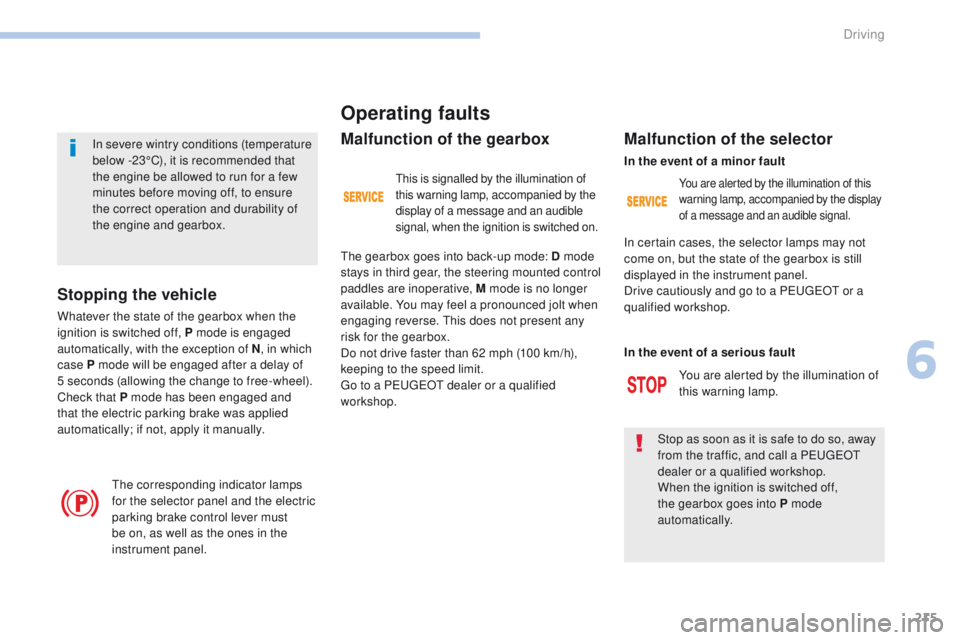
This is signalled by the illumination of
this warning lamp, accompanied by the
display of a message and an audible
signal, when the ignition is switched on.
The gearbox goes into back-up mode: D mode
stays in third gear, the steering mounted control
paddles are inoperative, M mode is no longer
available. You may feel a pronounced jolt when
engaging reverse. This does not present any
risk for the gearbox.
Do not drive faster than 62 mph (100 km/h),
keeping to the speed limit.
Go to a PEUGEOT dealer or a qualified
workshop.
You are alerted by the illumination of this
warning lamp, accompanied by the display
of a message and an audible signal.
In certain cases, the selector lamps may not
come on, but the state of the gearbox is still
displayed in the instrument panel.
Drive cautiously and go to a PEUGEOT or a
qualified workshop.
6
Driving
Page 219 of 566
SPORT
217
3008-2_en_Chap06_conduite_ed01-2016
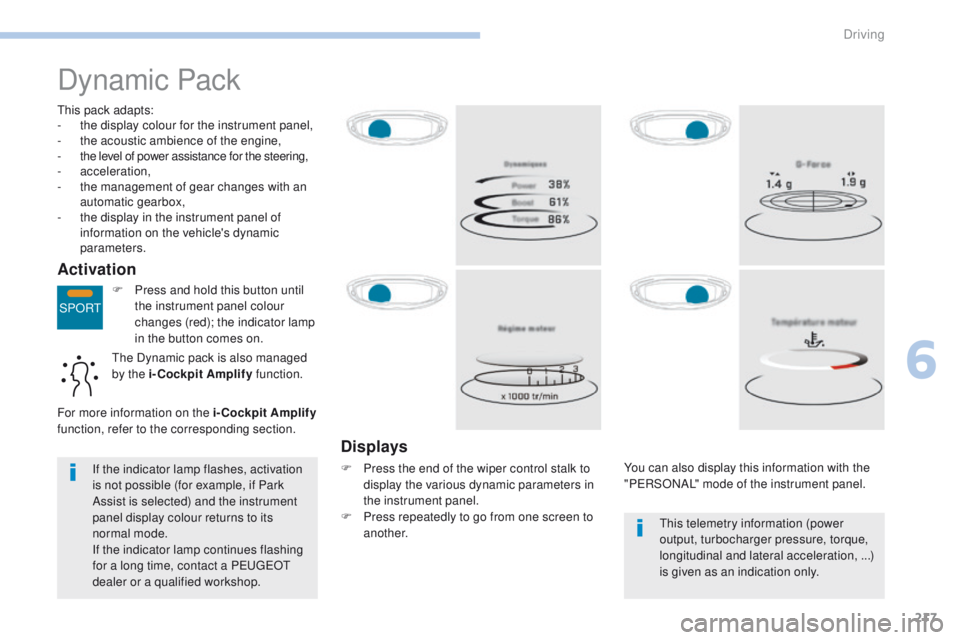
Dynamic Pack
This pack adapts:
- t he display colour for the instrument panel,
-
t
he acoustic ambience of the engine,
-
t
he level of power assistance for the steering,
-
acceleration,
-
t
he management of gear changes with an
automatic gearbox,
-
t
he display in the instrument panel of
information on the vehicle's dynamic
parameters.
Activation
F Press and hold this button until
the instrument panel colour
changes (red); the indicator lamp
in the button comes on.
Displays
F Press the end of the wiper control stalk to display the various dynamic parameters in
the instrument panel.
F
P
ress repeatedly to go from one screen to
another. You can also display this information with the
"PERSONAL" mode of the instrument panel.
If the indicator lamp flashes, activation
is not possible (for example, if Park
Assist is selected) and the instrument
panel display colour returns to its
normal mode.
If the indicator lamp continues flashing
for a long time, contact a PEUGEOT
dealer or a qualified workshop. This telemetry information (power
output, turbocharger pressure, torque,
longitudinal and lateral acceleration, ...)
is given as an indication only.
The Dynamic pack is also managed
by the i-Cockpit Amplify
function.
For more information on the i-Cockpit Amplify
function, refer to the corresponding section.
6
Driving
Page 220 of 566
218
3008-2_en_Chap06_conduite_ed01-2016
Gear shift indicator*
Depending on the driving situation and your
vehicle's equipment, the system may advise
you to skip one (or more) gear(s). You can
follow this instruction without engaging the
intermediate gears.
The gear engagement recommendations must
not be considered compulsory. In fact, the
configuration of the road, the amount of traffic
and safety remain determining factors when
choosing the best gear. Therefore, the driver
remains responsible for deciding whether or not
to follow the advice given by the system.
This function cannot be deactivated.-
Y
ou press the accelerator pedal.
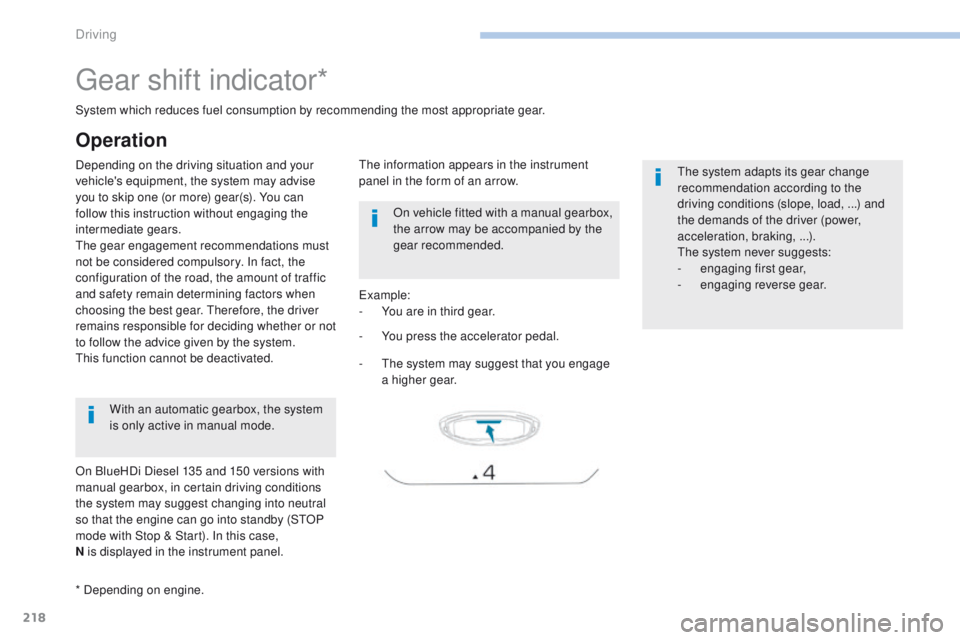
Example:
-
Y
ou are in third gear.
-
T
he system may suggest that you engage
a higher gear.
The information appears in the instrument
panel in the form of an arrow.
System which reduces fuel consumption by recommending the most appropriate gear.
With an automatic gearbox, the system
is only active in manual mode.
* Depending on engine. On vehicle fitted with a manual gearbox,
the arrow may be accompanied by the
gear recommended.
The system adapts its gear change
recommendation according to the
driving conditions (slope, load,
...) and
the demands of the driver (power,
acceleration, braking,
...).
The system never suggests:
-
e
ngaging first gear,
-
enga
ging reverse gear.
Operation
On BlueHDi Diesel 135 and 150 versions with
manual gearbox, in certain driving conditions
the system may suggest changing into neutral
so that the engine can go into standby (STOP
mode with Stop & Start). In this case,
N is displayed in the instrument panel.
Driving
Page 223 of 566
221
3008-2_en_Chap06_conduite_ed01-2016
Deactivation / Reactivation
In certain circumstances, such as the need
to maintain the temperature in the passenger
compartment, it may be useful to deactivate the
Stop & Start system.
The system can be deactivated at any time,
once the ignition is switched on.
If the engine is in STOP mode, it then restarts.
The Stop & Start system is reactivated
automatically every time the ignition is
switched
on.
Opening the bonnet
Before doing anything under the
bonnet, deactivate the Stop & Start
system to avoid the risk of injury
related to an automatic change to
S TA R T
m o d e .
Driving on flooded roads
Before driving through a flooded road,
it is strongly recommended that you
deactivate the Stop & Start system.
For more information on Driving
advice , particularly on flooded roads,
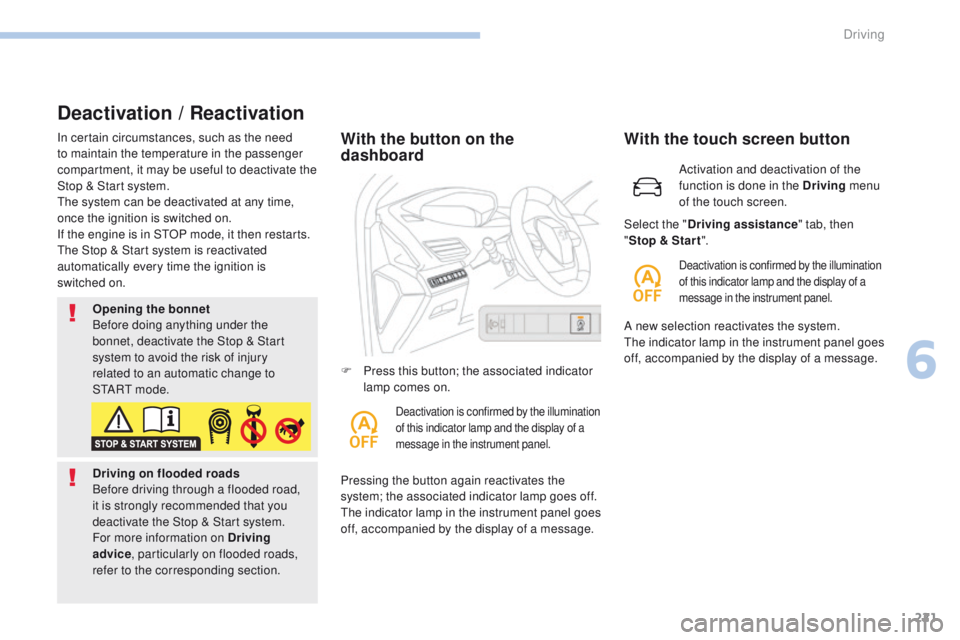
refer to the corresponding section.With the button on the
dashboard
Pressing the button again reactivates the
system; the associated indicator lamp goes off.
The indicator lamp in the instrument panel goes
off, accompanied by the display of a message. F
P
ress this button; the associated indicator
lamp comes on.
Deactivation is confirmed by the illumination
of this indicator lamp and the display of a
message in the instrument panel.
Activation and deactivation of the
function is done in the Driving menu
of the touch screen.
With the touch screen button
Deactivation is confirmed by the illumination
of this indicator lamp and the display of a
message in the instrument panel.
Select the " Driving assistance " tab, then
" Stop & Star t ".
A new selection reactivates the system.
The indicator lamp in the instrument panel goes
off, accompanied by the display of a message.
6
Driving
Page 224 of 566
222
3008-2_en_Chap06_conduite_ed01-2016
Operating fault
The Stop & Start system requires a
12 V battery of specific technology and
specification.
All work on this type of battery must be
carried out only by a PEUGEOT dealer
or a qualified workshop.
For more information on the
12 V batter y , refer to the corresponding
section. In the event of a fault with the system,
this warning lamp flashes for a few
moments in the instrument panel,
then remains on, accompanied by the
display of a message.
In the event of a fault in STOP mode,
the
vehicle may stall.
All of the instrument panel warning lamps
come
on.
It is then necessary to switch off the ignition
and start the engine again with the key or the
" START/STOP " button.
Have it checked by a PEUGEOT dealer or a
qualified workshop.
Driving
Page 226 of 566
224
3008-2_en_Chap06_conduite_ed01-2016
It is necessary to reinitialise the system every
time one or more tyre pressures are adjusted,
and after changing one or more wheels.
Reinitialisation
This is given by fixed illumination of
this warning lamp, accompanied by
an audible signal and, depending on
equipment, the display of a message.
Under-inflation alert
F Reduce speed immediately, avoid excessive steering movements and sudden
braking.
F
S
top the vehicle as soon as it is safe
to
do so. F
I
f you have a compressor, such as the one
in the temporary puncture repair kit, check
the pressures of the four tyres when cold.
F
I
f it is not possible to make this check
immediately, drive carefully at reduced
speed.
or
F
I
n the event of a puncture, use the
temporary puncture repair kit or the spare
wheel (depending on equipment).
The loss of pressure detected does not
always cause visible bulging of the tyre.
Do not satisfy yourself with just a visual
check. The alert is maintained until the system
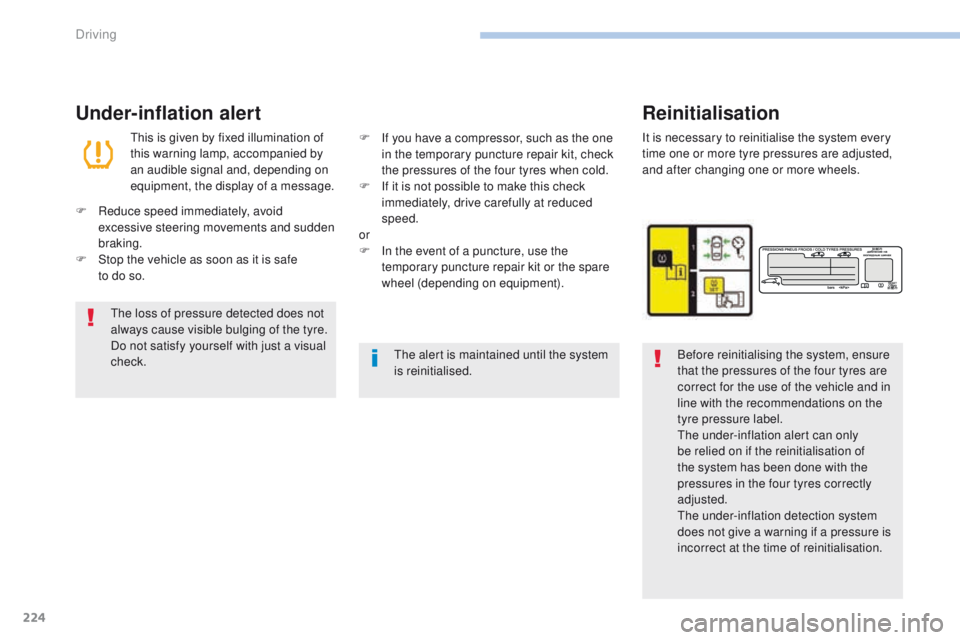
is reinitialised.Before reinitialising the system, ensure
that the pressures of the four tyres are
correct for the use of the vehicle and in
line with the recommendations on the
tyre pressure label.
The under-inflation alert can only
be relied on if the reinitialisation of
the system has been done with the
pressures in the four tyres correctly
adjusted.
The under-inflation detection system
does not give a warning if a pressure is
incorrect at the time of reinitialisation.
Driving
Page 227 of 566
225
3008-2_en_Chap06_conduite_ed01-2016
Touch screen
Monochrome screen C
Operating fault
The flashing and then fixed illumination of the
under-inflation warning lamp accompanied
by illumination of the Service warning lamp
indicates a fault with the system.
A message appears, accompanied by an
audible signal.
In this case, under-inflation monitoring of the
tyres is no longer assured.
Have the system checked by a PEUGEOT
dealer or a qualified workshop.
Before doing anything to the system,
the pressures of the four tyres must be
checked and the system reinitialised.
Reinitialisation of the function is
done in the "
Personalisation-
configuration " menu of the screen.
F
Sel
ect the " Define the vehicle
parameters " menu.
F
Sel
ect the " Driving assistance " menu.
F
Sel
ect the " Tyre inflation " menu.
F
Sel
ect the " Reinitialisation " function.
F
Sel
ect " Ye s" to confirm.
The reinitialisation is confirmed by an audible
signal. Reinitialisation of the function is done
in the Driving
menu of the touch
screen.
F
I
n the Driving menu, select the
" Settings "
tab.
F
I
n the page, select the " Under-inflation
reinitialisation " function.
F
Sel
ect " Ye s" to confirm.
The reinitialisation is confirmed by the display
of a message and an audible signal.
6
Driving