wheel PEUGEOT 308 2017 Repair Manual
[x] Cancel search | Manufacturer: PEUGEOT, Model Year: 2017, Model line: 308, Model: Peugeot 308 2017Pages: 566, PDF Size: 16.05 MB
Page 280 of 566
278
3008-2_en_Chap06_conduite_ed01-2016
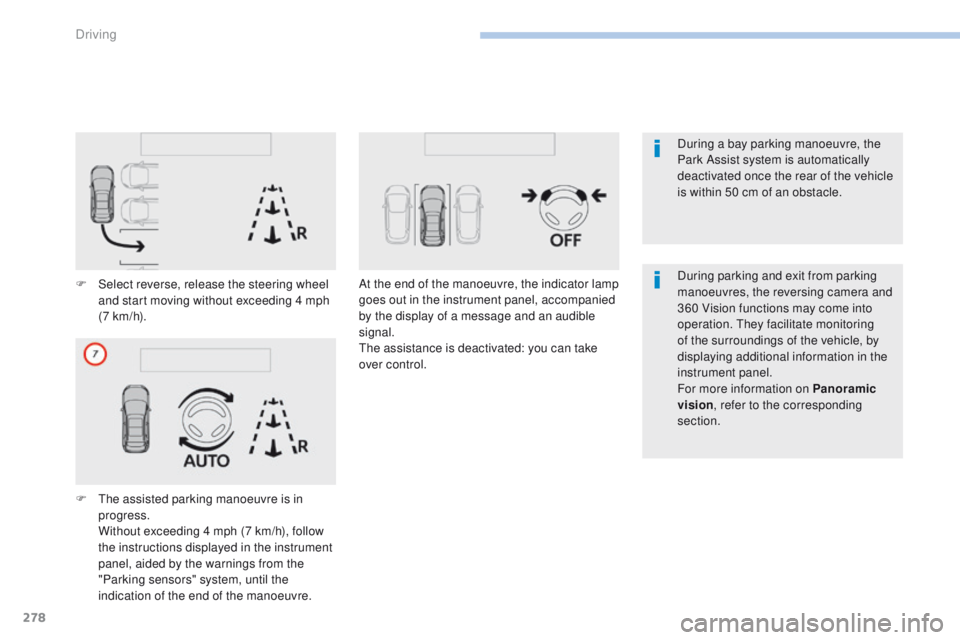
F Select reverse, release the steering wheel and start moving without exceeding 4 mph
(7 km/h).
F
T
he assisted parking manoeuvre is in
progress.
W
ithout exceeding 4 mph (7 km/h), follow
the instructions displayed in the instrument
panel, aided by the warnings from the
"Parking sensors" system, until the
indication of the end of the manoeuvre. At the end of the manoeuvre, the indicator lamp
goes out in the instrument panel, accompanied
by the display of a message and an audible
signal.
The assistance is deactivated: you can take
over control.
During parking and exit from parking
manoeuvres, the reversing camera and
360 Vision functions may come into
operation. They facilitate monitoring
of the surroundings of the vehicle, by
displaying additional information in the
instrument panel.
For more information on Panoramic
vision
, refer to the corresponding
section. During a bay parking manoeuvre, the
Park Assist system is automatically
deactivated once the rear of the vehicle
is within 50 cm of an obstacle.
Driving
Page 281 of 566
279
3008-2_en_Chap06_conduite_ed01-2016
The system is deactivated by pressing the control.The system is deactivated automatically:
- o n switching off the ignition,
-
i
f the engine stalls,
-
i
f no manoeuvre is started within 5 minutes
of selection of the type of manoeuvre,
-
a
fter a prolonged stop of the vehicle during
a manoeuvre,
-
i
f the road wheel anti-slip regulation (ASR)
is triggered,
-
i
f the speed of the vehicle exceeds the
stated limit,
-
w
hen the driver interrupts movement of the
steering wheel,
-
a
fter 4 manoeuvre cycles,
-
o
n opening the driver's door,
-
i
f one of the front wheels encounters an
obstacle.
The operation indicator lamp goes off in the
instrument panel and a message is displayed
accompanied by an audible signal.
The driver should then take back control of the
vehicle's steering.
Deactivation
The system is switched off automatically:
- w hen towing a trailer, connected
electrically,
-
i
f the driver's door is opened,
-
i
f the speed of the vehicle is above 42 mph
(70 km/h).
To switch the system of for a prolonged period,
contact a PEUGEOT dealer or a qualified
workshop.
Operating faults
In the event of a fault with the power
steering, this warning lamp flashes in
the instrument panel, accompanied
by a message.
Contact a PEUGEOT dealer or a qualified
workshop.
Switching off
If the lateral distance between your
vehicle and the space is too great, the
system may not be able to measure the
space.
Anything projecting beyond the envelope
of the vehicle (a ladder on the roof, for
example) is not taken into account by the
Park Assist system during a manoeuvre.
In bad weather or in winter, ensure that
the sensors are not covered by road
dirt, ice or snow.
In the event of a fault, have the system
checked by a PEUGEOT dealer or a
qualified workshop.
If the system is deactivated during a
manoeuvre, the drive should reactivate
it to repeat the measurement. In the event of a fault, this warning
lamp flashes for a few seconds,
accompanied by an audible signal.
If the fault occurs during the use
of the system, the warning lamp
goes
off. High pressure jet washing
When washing your vehicle, keep the lance at
least 30 cm away from the sensors.
6
Driving
Page 294 of 566
292
3008-2_en_Chap07_infos-pratiques_ed01-2016
Snow chains
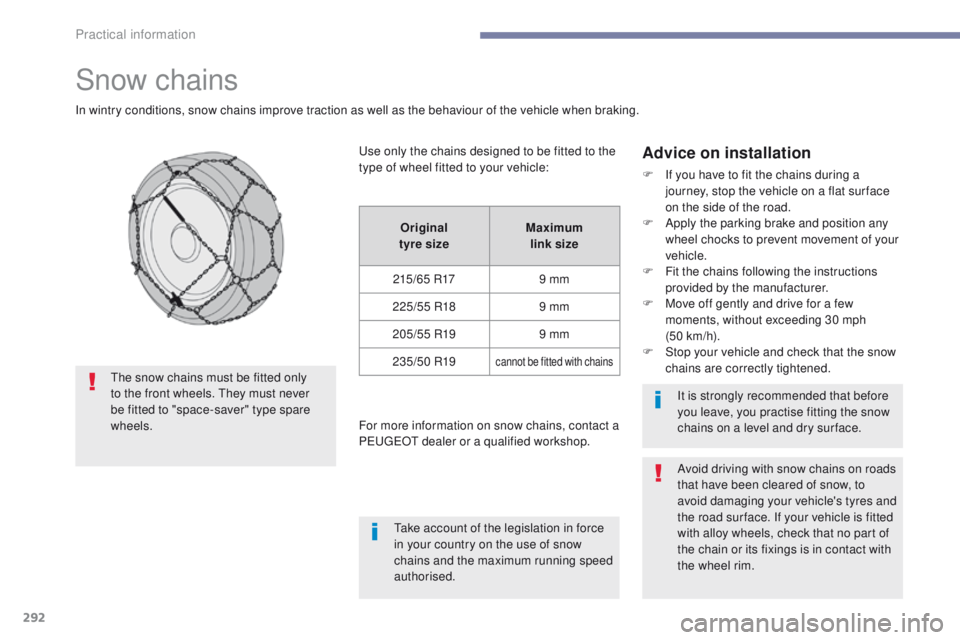
In wintry conditions, snow chains improve traction as well as the behaviour of the vehicle when braking.
Advice on installation
F If you have to fit the chains during a journey, stop the vehicle on a flat sur face
on the side of the road.
F
A
pply the parking brake and position any
wheel chocks to prevent movement of your
vehicle.
F
F
it the chains following the instructions
provided by the manufacturer.
F
M
ove off gently and drive for a few
moments, without exceeding 30 mph
(50
km/h).
F
S
top your vehicle and check that the snow
chains are correctly tightened.
Use only the chains designed to be fitted to the
type of wheel fitted to your vehicle:
For more information on snow chains, contact a
PEUGEOT dealer or a qualified workshop.
It is strongly recommended that before
you leave, you practise fitting the snow
chains on a level and dry sur face.
The snow chains must be fitted only
to the front wheels. They must never
be fitted to "space-saver" type spare
wheels.
Take account of the legislation in force
in your country on the use of snow
chains and the maximum running speed
authorised.Avoid driving with snow chains on roads
that have been cleared of snow, to
avoid damaging your vehicle's tyres and
the road sur face. If your vehicle is fitted
with alloy wheels, check that no part of
the chain or its fixings is in contact with
the wheel rim.
Original
tyre size Maximum
link size
215/65 R17 9 mm
225/55 R18 9 mm
205/55 R19 9 mm
235/50 R19
cannot be fitted with chains
Practical information
Page 311 of 566
309
3008-2_en_Chap08_en cas-de-panne_ed01-2016
Tool kit
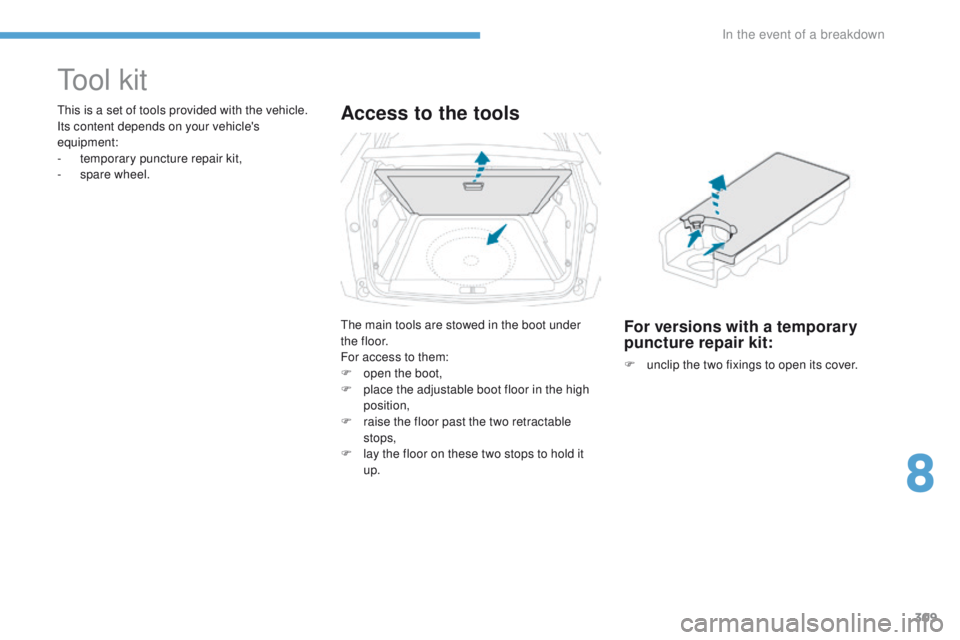
This is a set of tools provided with the vehicle.
Its content depends on your vehicle's
equipment:
-
t
emporary puncture repair kit,
-
spar
e wheel.Access to the tools
The main tools are stowed in the boot under
t h e f l o o r.
For access to them:
F
o
pen the boot,
F
p
lace the adjustable boot floor in the high
position,
F
r
aise the floor past the two retractable
stops,
F
l
ay the floor on these two stops to hold it
up.For versions with a temporary
puncture repair kit:
F unclip the two fixings to open its cover.
8
In the event of a breakdown
Page 312 of 566
310
3008-2_en_Chap08_en cas-de-panne_ed01-2016
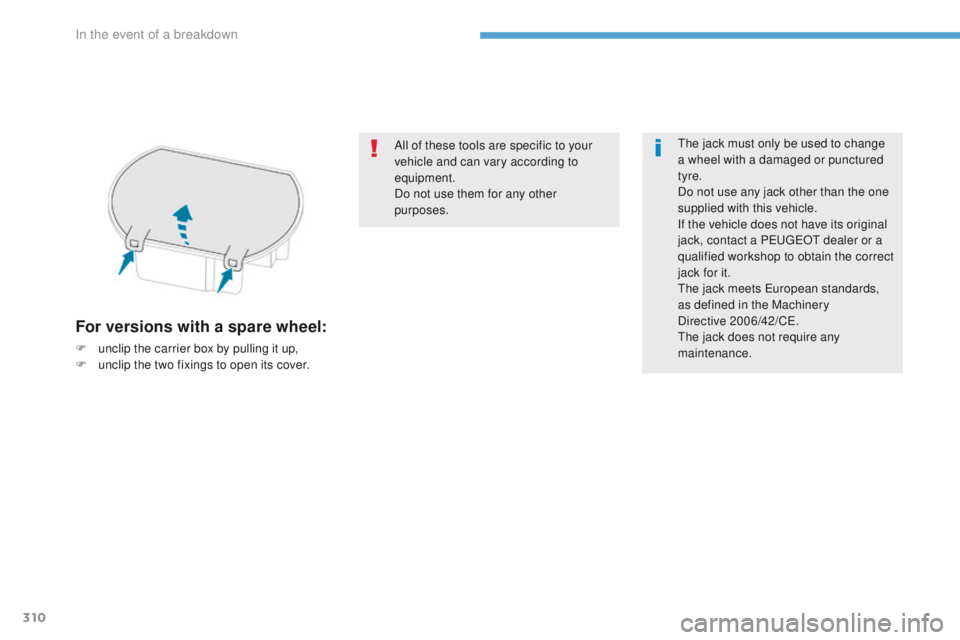
For versions with a spare wheel:
F unclip the carrier box by pulling it up,
F u nclip the two fixings to open its cover. All of these tools are specific to your
vehicle and can vary according to
equipment.
Do not use them for any other
purposes.
The jack must only be used to change
a wheel with a damaged or punctured
tyre.
Do not use any jack other than the one
supplied with this vehicle.
If the vehicle does not have its original
jack, contact a PEUGEOT dealer or a
qualified workshop to obtain the correct
jack for it.
The jack meets European standards,
as defined in the Machinery
Directive
2006/42/CE.
The jack does not require any
maintenance.
In the event of a breakdown
Page 313 of 566
311
3008-2_en_Chap08_en cas-de-panne_ed01-2016
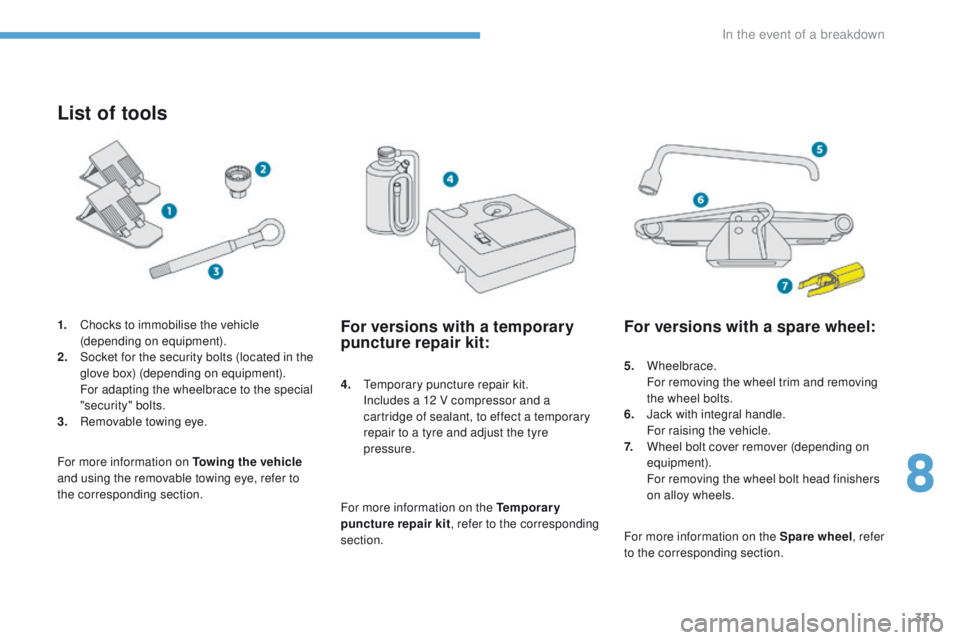
List of tools
4. Temporary puncture repair kit. Includes a 12 V compressor and a
cartridge of sealant, to effect a temporary
repair to a tyre and adjust the tyre
pressure.
For more information on Towing the vehicle
and using the removable towing eye, refer to
the corresponding section. 1.
C
hocks to immobilise the vehicle
(depending on equipment).
2.
S
ocket for the security bolts (located in the
glove box) (depending on equipment). F
or adapting the wheelbrace to the special
"security" bolts.
3.
R
emovable towing eye.
For versions with a temporary
puncture repair kit:
For more information on the Temporary
puncture repair kit , refer to the corresponding
section.
For versions with a spare wheel:
5. Wheelbrace. F
or removing the wheel trim and removing
the wheel bolts.
6.
J
ack with integral handle.
F
or raising the vehicle.
7.
W
heel bolt cover remover (depending on
equipment).
F
or removing the wheel bolt head finishers
on alloy wheels.
For more information on the Spare wheel , refer
to the corresponding section.
8
In the event of a breakdown
Page 314 of 566
312
3008-2_en_Chap08_en cas-de-panne_ed01-2016
Temporary puncture repair kit
Comprising a compressor and a sealant
cartridge, it allows the temporary repair of
a tyre so that you can drive to the nearest
garage.
It is designed to repair most punctures which
could affect the tyre, located on the tyre tread
or shoulder.Composition of the kit
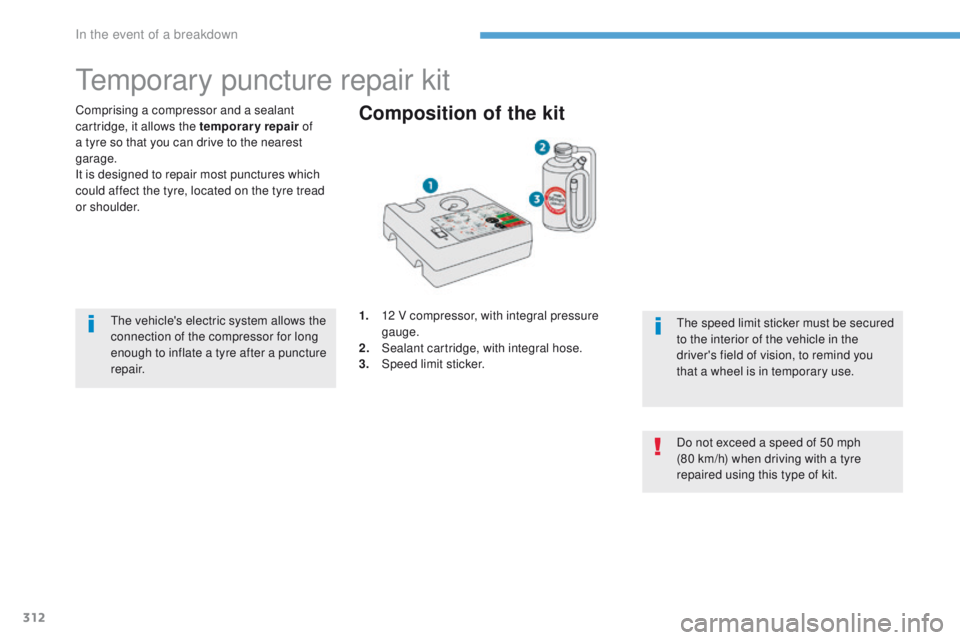
1. 12 V compressor, with integral pressure gauge.
2.
S
ealant cartridge, with integral hose.
3.
Spe
ed limit sticker. The speed limit sticker must be secured
to the interior of the vehicle in the
driver's field of vision, to remind you
that a wheel is in temporary use.
Do not exceed a speed of 50 mph
(80
km/h) when driving with a tyre
repaired using this type of kit.
The vehicle's electric system allows the
connection of the compressor for long
enough to inflate a tyre after a puncture
repair.
In the event of a breakdown
Page 319 of 566
317
3008-2_en_Chap08_en cas-de-panne_ed01-2016
Spare wheel
Access to the spare wheel
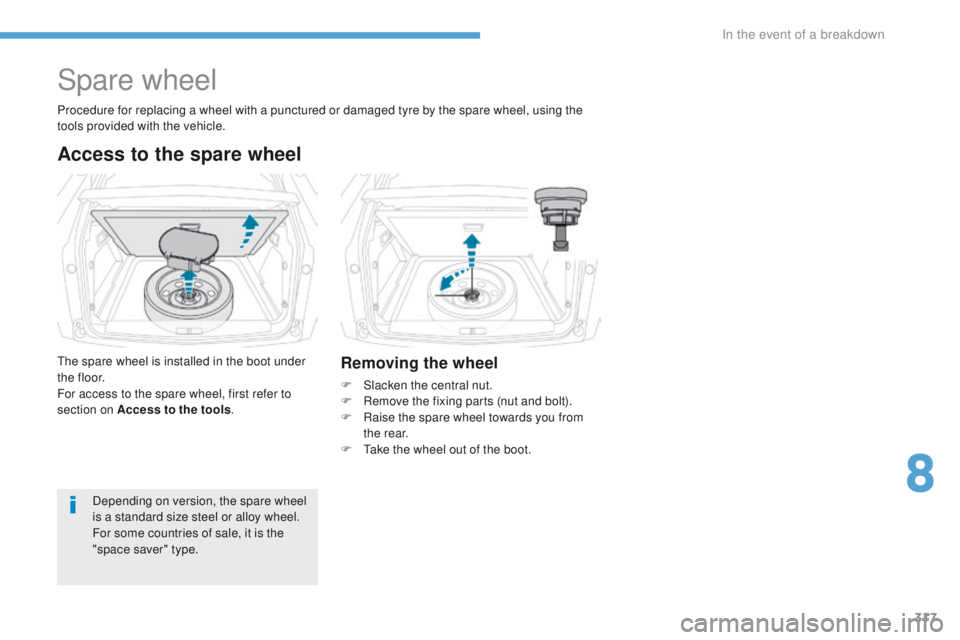
The spare wheel is installed in the boot under
t h e f l o o r.
For access to the spare wheel, first refer to
section on Access to the tools.
Depending on version, the spare wheel
is a standard size steel or alloy wheel.
For some countries of sale, it is the
"space saver" type.
Procedure for replacing a wheel with a punctured or damaged tyre by the spare wheel, using the
tools provided with the vehicle.Removing the wheel
F Slacken the central nut.
F
R emove the fixing parts (nut and bolt).
F
R
aise the spare wheel towards you from
the rear.
F
T
ake the wheel out of the boot.
8
In the event of a breakdown
Page 320 of 566
318
3008-2_en_Chap08_en cas-de-panne_ed01-2016
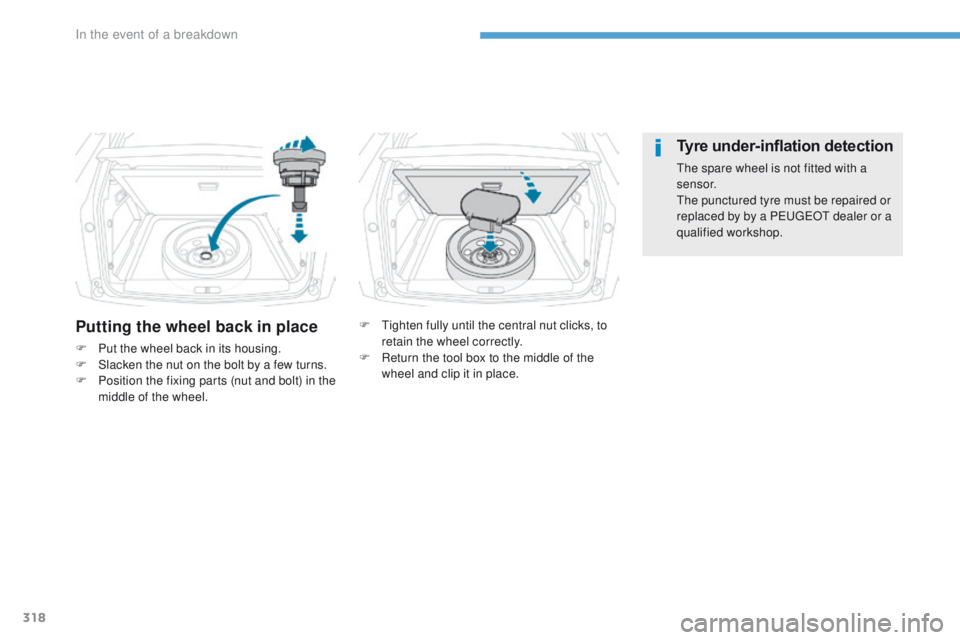
Putting the wheel back in place
F Put the wheel back in its housing.
F S lacken the nut on the bolt by a few turns.
F
P
osition the fixing parts (nut and bolt) in the
middle of the wheel.
Tyre under-inflation detection
The spare wheel is not fitted with a
sensor.
The punctured tyre must be repaired or
replaced by by a PEUGEOT dealer or a
qualified workshop.
F
T
ighten fully until the central nut clicks, to
retain the wheel correctly.
F
R
eturn the tool box to the middle of the
wheel and clip it in place.
In the event of a breakdown
Page 321 of 566
319
3008-2_en_Chap08_en cas-de-panne_ed01-2016
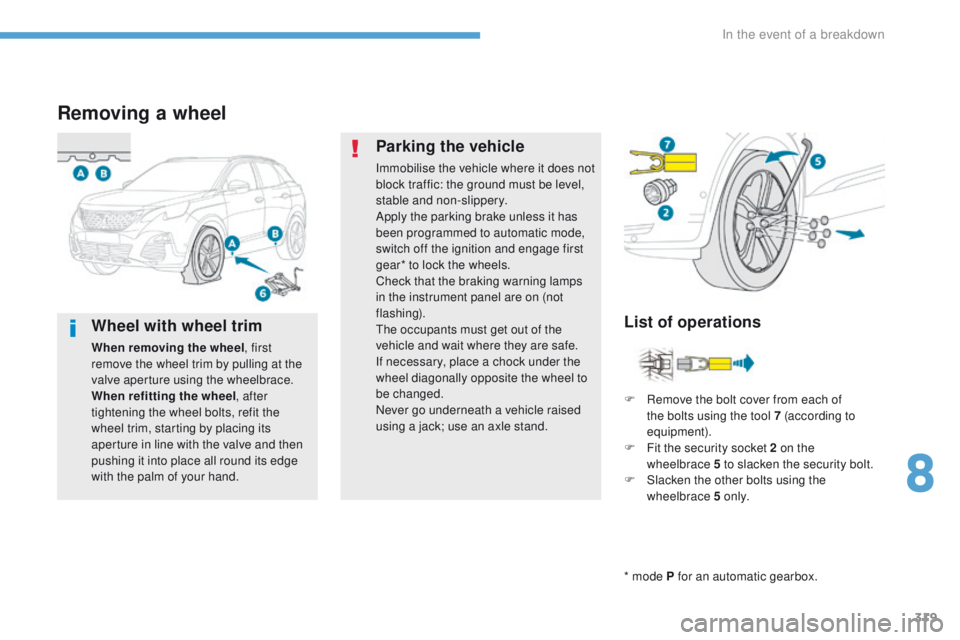
Removing a wheel
* mode P for an automatic gearbox.
List of operations
Parking the vehicle
Immobilise the vehicle where it does not
block traffic: the ground must be level,
stable and non-slippery.
Apply the parking brake unless it has
been programmed to automatic mode,
switch off the ignition and engage first
gear* to lock the wheels.
Check that the braking warning lamps
in the instrument panel are on (not
flashing).
The occupants must get out of the
vehicle and wait where they are safe.
If necessary, place a chock under the
wheel diagonally opposite the wheel to
be changed.
Never go underneath a vehicle raised
using a jack; use an axle stand.
F
R
emove the bolt cover from each of
the bolts using the tool 7 (according to
equipment).
F
F
it the security socket 2 on the
wheelbrace
5 to slacken the security bolt.
F
S
lacken the other bolts using the
wheelbrace 5 o n l y.
Wheel with wheel trim
When removing the wheel , first
remove the wheel trim by pulling at the
valve aperture using the wheelbrace.
When refitting the wheel , after
tightening the wheel bolts, refit the
wheel trim, starting by placing its
aperture in line with the valve and then
pushing it into place all round its edge
with the palm of your hand.
8
In the event of a breakdown