tow Peugeot 308 2018 Owner's Guide
[x] Cancel search | Manufacturer: PEUGEOT, Model Year: 2018, Model line: 308, Model: Peugeot 308 2018Pages: 324, PDF Size: 10.72 MB
Page 104 of 324
102
(e)To install a child seat at the rear, rear ward
or for ward facing, move the front seat
for ward, then straighten the backrest to
allow enough room for the child seat and
the child's legs.
(f )A child seat with a support leg must
never be installed on the centre rear
passenger seat.
Remove and stow the head restraint
before installing a child seat with backrest
on a passenger seat.
Refit the head restraint when the child
seat is removed.
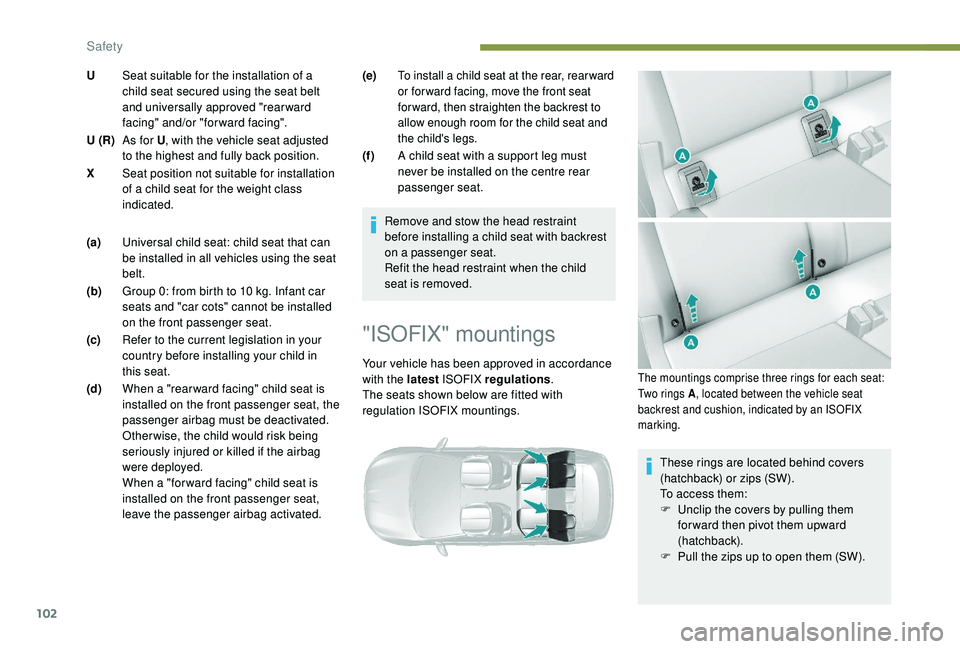
"ISOFIX" mountings
Your vehicle has been approved in accordance
with the latest ISOFIX regulations .
The seats shown below are fitted with
regulation ISOFIX mountings.
These rings are located behind covers
(hatchback) or zips (SW).
To access them:
F
U
nclip the covers by pulling them
forward then pivot them upward
(hatchback).
F
P
ull the zips up to open them (SW).
U
Seat suitable for the installation of a
child seat secured using the seat belt
and universally approved "rearward
facing" and/or "forward facing".
U (R) As for U , with the vehicle seat adjusted
to the highest and fully back position.
X Seat position not suitable for installation
of a child seat for the weight class
indicated.
(a) Universal child seat: child seat that can
be installed in all vehicles using the seat
belt.
(b) Group 0: from birth to 10
kg. Infant car
seats and "car cots" cannot be installed
on the front passenger seat.
(c) Refer to the current legislation in your
country before installing your child in
this seat.
(d) When a "rear ward facing" child seat is
installed on the front passenger seat, the
passenger airbag must be deactivated.
Otherwise, the child would risk being
seriously injured or killed if the airbag
were deployed.
When a "for ward facing" child seat is
installed on the front passenger seat,
leave the passenger airbag activated.The mountings comprise three rings for each seat:
Two rings A , located between the vehicle seat
backrest and cushion, indicated by an ISOFIX
marking.
Safety
Page 105 of 324
103
Do not use the luggage net rings
(hatchback) or stowing rings (SW), located
at the edges of the boot floor.
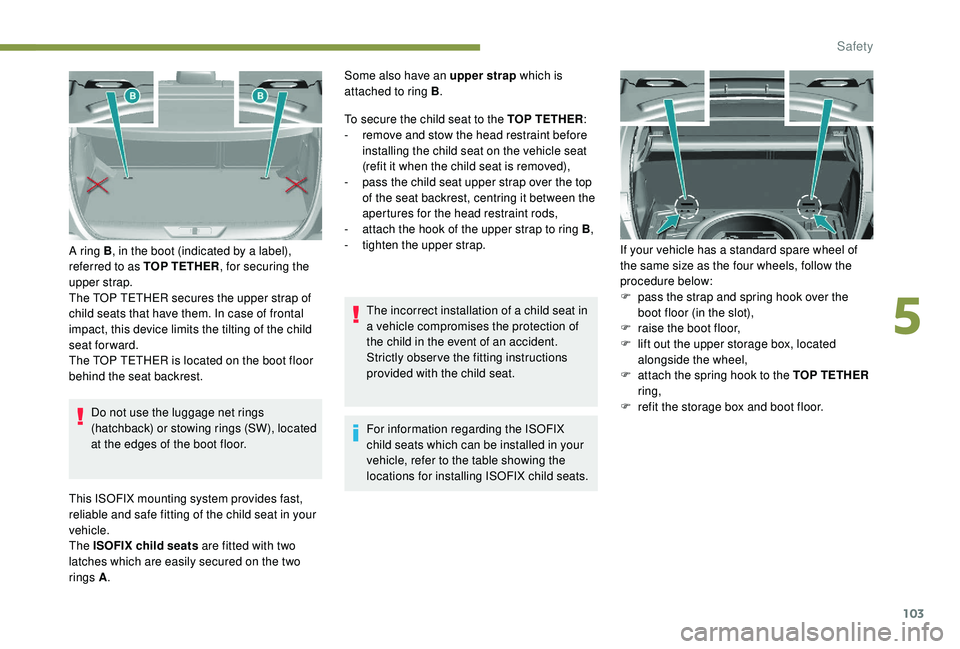
A ring B
, in the boot (indicated by a label),
referred to as TOP TETHER , for securing the
upper strap.
The TOP TETHER secures the upper strap of
child seats that have them. In case of frontal
impact, this device limits the tilting of the child
seat forward.
The TOP TETHER is located on the boot floor
behind the seat backrest.
This ISOFIX mounting system provides fast,
reliable and safe fitting of the child seat in your
vehicle.
The ISOFIX child seats are fitted with two
latches which are easily secured on the two
rings A . To secure the child seat to the TOP TETHER
:
-
r
emove and stow the head restraint before
installing the child seat on the vehicle seat
(refit it when the child seat is removed),
-
p
ass the child seat upper strap over the top
of the seat backrest, centring it between the
apertures for the head restraint rods,
-
a
ttach the hook of the upper strap to ring B
,
-
t
ighten the upper strap.
The incorrect installation of a child seat in
a vehicle compromises the protection of
the child in the event of an accident.
Strictly obser ve the fitting instructions
provided with the child seat.
For information regarding the ISOFIX
child seats which can be installed in your
vehicle, refer to the table showing the
locations for installing ISOFIX child seats. If your vehicle has a standard spare wheel of
the same size as the four wheels, follow the
procedure below:
F
p
ass the strap and spring hook over the
boot floor (in the slot),
F
r
aise the boot floor,
F
l
ift out the upper storage box, located
alongside the wheel,
F
a
ttach the spring hook to the TOP TETHER
ring,
F r efit the storage box and boot floor.
Some also have an upper strap
which is
attached to ring B .
5
Safety
Page 108 of 324
106
For more information on ISOFIX
mountings and child seats and the
upper strap in particular, refer to the
corresponding section.
Remove and stow the head restraint
before installing a child seat with backrest
on a passenger seat.
Refit the head restraint when the child
seat is removed.
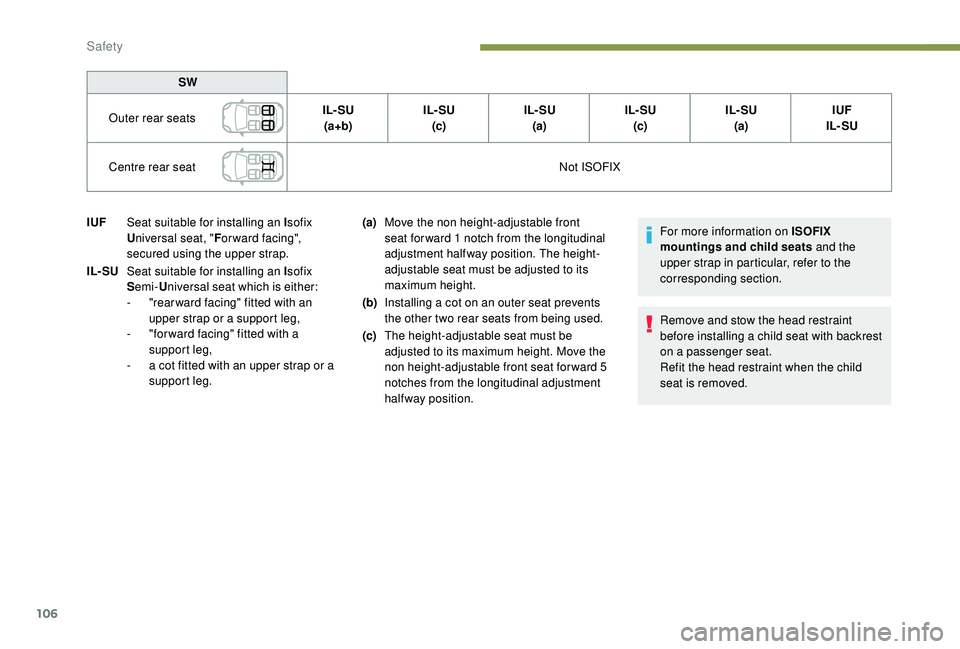
IUF
Seat suitable for installing an I sofix
U niversal seat, " For ward facing",
secured using the upper strap.
IL- SU Seat suitable for installing an I sofix
S emi- Universal seat which is either:
-
"
rear ward facing" fitted with an
upper strap or a support leg,
-
"
for ward facing" fitted with a
support leg,
-
a c
ot fitted with an upper strap or a
support leg. (a)
Move the non height-adjustable front
seat for ward 1 notch from the longitudinal
adjustment halfway position. The height-
adjustable seat must be adjusted to its
maximum height.
(b) Installing a cot on an outer seat prevents
the other two rear seats from being used.
(c) The height-adjustable seat must be
adjusted to its maximum height. Move the
non height-adjustable front seat for ward 5
notches from the longitudinal adjustment
halfway position.
SW
Outer rear seats IL- SU
(a+b) IL- SU
(c) IL- SU
(a) IL- SU
(c) IL- SU
(a) IUF
IL- SU
Centre rear seat Not ISOFIX
Safety
Page 111 of 324
109
Driving recommendations
Observe the driving regulations and remain
vigilant whatever the traffic conditions.
Pay close attention to the traffic and keep your
hands on the wheel so that you are ready to
react at any time to any eventuality.
As a safety measure, the driver should only
carry out any operations that require close
attention when the vehicle is stationary.
On a long journey, taking a break every two
hours is strongly recommended.
In difficult weather, drive smoothly, anticipate
the need to brake and increase the distance
from other vehicles.
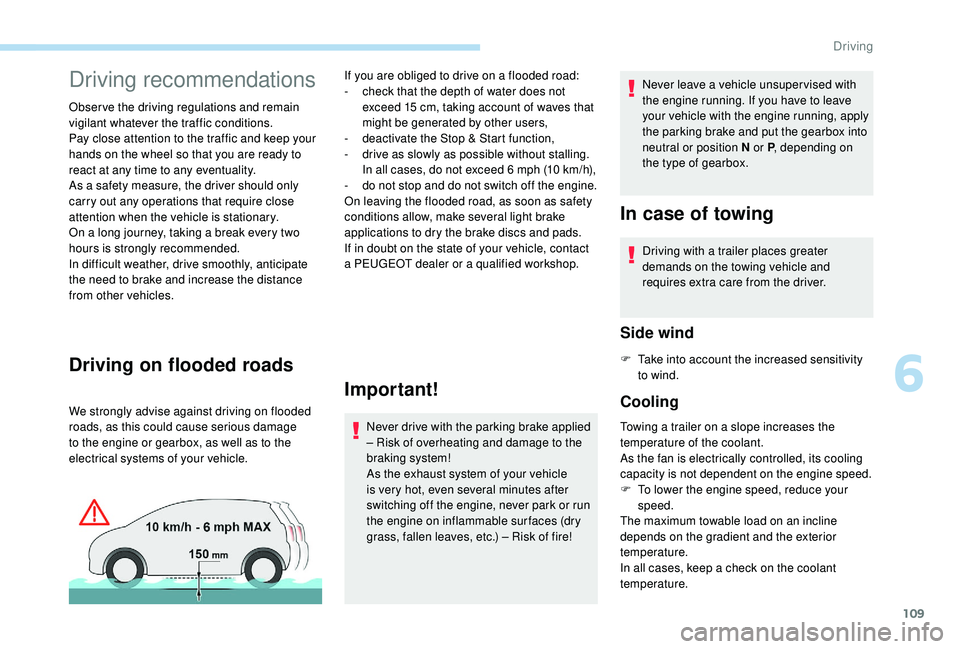
Driving on flooded roads
We strongly advise against driving on flooded
roads, as this could cause serious damage
to the engine or gearbox, as well as to the
electrical systems of your vehicle.
Important!
Never drive with the parking brake applied
– Risk of overheating and damage to the
braking system!
As the exhaust system of your vehicle
is very hot, even several minutes after
switching off the engine, never park or run
the engine on inflammable sur faces (dry
grass, fallen leaves, etc.) – Risk of fire!Never leave a vehicle unsuper vised with
the engine running. If you have to leave
your vehicle with the engine running, apply
the parking brake and put the gearbox into
neutral or position N or P
, depending on
the type of gearbox.
In case of towing
If you are obliged to drive on a flooded road:
- c heck that the depth of water does not
exceed 15
cm, taking account of waves that
might be generated by other users,
-
d
eactivate the Stop & Start function,
-
d
rive as slowly as possible without stalling.
In all cases, do not exceed 6
mph (10 km/h),
-
d
o not stop and do not switch off the engine.
On leaving the flooded road, as soon as safety
conditions allow, make several light brake
applications to dry the brake discs and pads.
If in doubt on the state of your vehicle, contact
a PEUGEOT dealer or a qualified workshop. Driving with a trailer places greater
demands on the towing vehicle and
requires extra care from the driver.
Side wind
F Take into account the increased sensitivity
to wind.
Cooling
Towing a trailer on a slope increases the
temperature of the coolant.
As the fan is electrically controlled, its cooling
capacity is not dependent on the engine speed.
F
T
o lower the engine speed, reduce your
speed.
The maximum towable load on an incline
depends on the gradient and the exterior
temperature.
In all cases, keep a check on the coolant
temperature.
6
Driving
Page 112 of 324
110
F If this warning lamp and the STOP warning lamp come on,
stop the vehicle and switch off
the engine as soon as possible.
New vehicle
Do not pull a trailer before having driven at least
approximately 620
miles (1,000
kilometres).
Braking
Towing a trailer increases the braking distance.
To avoid overheating of the brakes, the use of
engine braking is recommended.
Ty r e s
F Check the tyre pressures of the towing vehicle and of the trailer, observing the
recommended pressures.
Lighting
F Check the electrical lighting and signalling on the trailer and the headlamp beam height
of your vehicle.
For more information on Headlamp
adjustment , refer to the corresponding
section. Certain driving or manoeuvring aid
functions are automatically disabled if an
approved towing system is used.
Anti-theft protection
Electronic immobiliser
The key contains an electronic chip which has
a special code. When the ignition is switched
on, this code must be recognised in order for
starting to be possible.
This electronic engine immobiliser locks the
engine management system a few minutes
after the ignition is switched off, and prevents
the engine being started by anyone who does
not have the key.
In the event of a fault, you are informed
by illumination of this warning lamp, an
audible signal and a message in the
screen.
In this case, your vehicle will not start; contact
a PEUGEOT dealer as soon as possible.
Keep safely, away from your vehicle, the
label attached to the keys given to you
when you purchased your vehicle.
Starting/Switching off the
engine, remote control
key
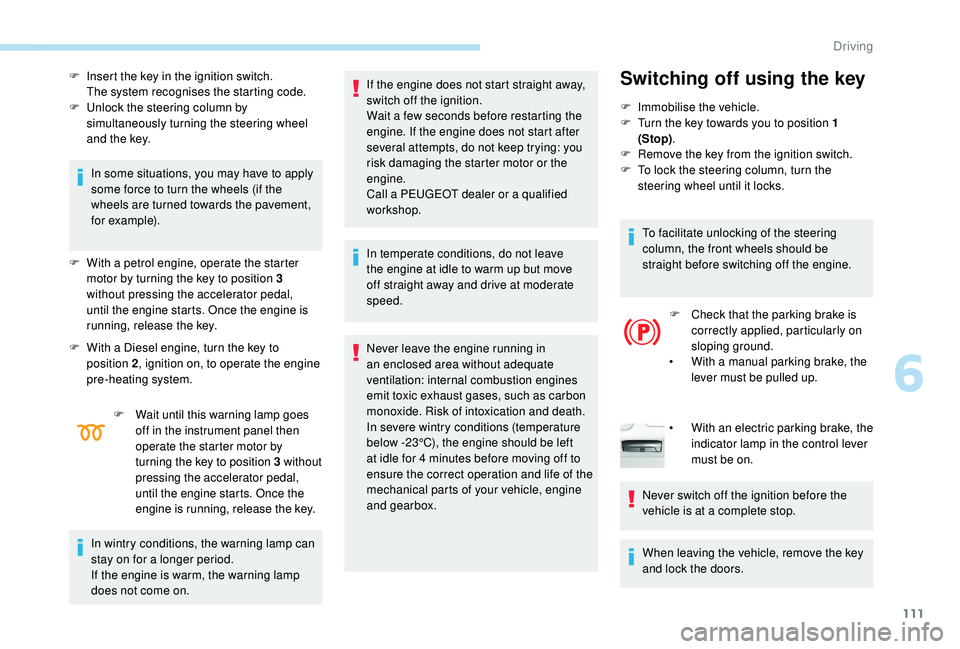
Place the gear lever into neutral.
Ignition switch
1.Stop position.
2. Ignition on position.
3. Starting position.
Starting with the key
The parking brake must be applied.
F
W
ith a manual gearbox, in neutral, fully
depress the clutch pedal.
F
W
ith an automatic gearbox, in mode P or N ,
fully depress the brake pedal.
Driving
Page 113 of 324
111
F Insert the key in the ignition switch.The system recognises the starting code.
F
U
nlock the steering column by
simultaneously turning the steering wheel
and the key.
In some situations, you may have to apply
some force to turn the wheels (if the
wheels are turned towards the pavement,
for example).
F
W
ith a petrol engine, operate the starter
motor by turning the key to position 3
without pressing the accelerator pedal,
until the engine starts. Once the engine is
running, release the key.
F
W
ith a Diesel engine, turn the key to
position 2 , ignition on, to operate the engine
pre-heating system.
F Wait until this warning lamp goes off in the instrument panel then
operate the starter motor by
turning the key to position 3 without
pressing the accelerator pedal,
until the engine starts. Once the
engine is running, release the key.
In wintry conditions, the warning lamp can
stay on for a longer period.
If the engine is warm, the warning lamp
does not come on. If the engine does not start straight away,
switch off the ignition.
Wait a few seconds before restarting the
engine. If the engine does not start after
several attempts, do not keep trying: you
risk damaging the starter motor or the
engine.
Call a PEUGEOT dealer or a qualified
workshop.
In temperate conditions, do not leave
the engine at idle to warm up but move
off straight away and drive at moderate
speed.
Never leave the engine running in
an enclosed area without adequate
ventilation: internal combustion engines
emit toxic exhaust gases, such as carbon
monoxide. Risk of intoxication and death.
In severe wintry conditions (temperature
below -23°C), the engine should be left
at idle for 4
minutes before moving off to
ensure the correct operation and life of the
mechanical parts of your vehicle, engine
and gearbox.
Switching off using the key
F Immobilise the vehicle.
F T urn the key towards you to position 1
(Stop) .
F
R
emove the key from the ignition switch.
F
T
o lock the steering column, turn the
steering wheel until it locks.
To facilitate unlocking of the steering
column, the front wheels should be
straight before switching off the engine.
F
C
heck that the parking brake is
correctly applied, particularly on
sloping ground.
•
W
ith a manual parking brake, the
lever must be pulled up.
•
W
ith an electric parking brake, the
indicator lamp in the control lever
must be on.
Never switch off the ignition before the
vehicle is at a complete stop.
When leaving the vehicle, remove the key
and lock the doors.
6
Driving
Page 117 of 324
115
When towing a trailer, parking on a steep
slope, or if your vehicle is heavily loaded,
turn the front wheels towards the kerb and
engage a gear.
When towing a trailer, your vehicle is
approved for parking on slopes of up to
12% .
The technology adopted for the electric
parking brake does not allow the fitment of
15-inch wheels.
Automatic release
Ensure first that the engine is running and the
driver's door is properly closed.
The electric parking brake releases
automatically and progressively when the
vehicle moves off.
With a manual gearbox : fully depress the
clutch pedal, engage first gear or reverse;
press the accelerator pedal and release the
clutch pedal.
With an automatic gearbox : select position D,
M or R then press the accelerator pedal. The complete release of the parking
brake is confirmed by the brake
indicator lamp and the P indicator
lamp in the control lever going off,
accompanied by the display of a
message.
When stationary with the engine running, do not
depress the accelerator pedal unnecessarily,
you risk releasing the parking brake.
Automatic application
With the vehicle stationary, the parking brake is
automatically applied when the ignition is
switched off
.
Application of the parking brake is
confirmed by illumination of the brake
indicator lamp and the P indicator
lamp in the control lever, accompanied
by the display of a message.
With the engine stalled or in STOP mode
of Stop & Start, automatic application
does not take place.
With automatic operation, you can also
manually apply or release the parking
brake at any time using the control lever.
Manual release
With the ignition on or the engine running, to
release the parking brake:
F
p
ress the brake pedal,
F
b
riefly push the control lever.
The complete release of the parking brake is
confirmed by the brake indicator lamp and the
P indicator lamp in the control lever going off,
accompanied by the display of a message and
an audible signal until the doors are closed.
If you push the control lever without
pressing the brake pedal, the parking
brake will not be released and a message
is displayed.
Manual application
With the vehicle stationary: briefly pull the
control lever.
Confirmation of the instruction is signalled by
flashing of the indicator lamp in the control
l eve r. Application of the parking brake is
confirmed by illumination of the brake
indicator lamp and the P indicator
lamp in the control lever, accompanied
by the display of a message.
6
Driving
Page 118 of 324
116
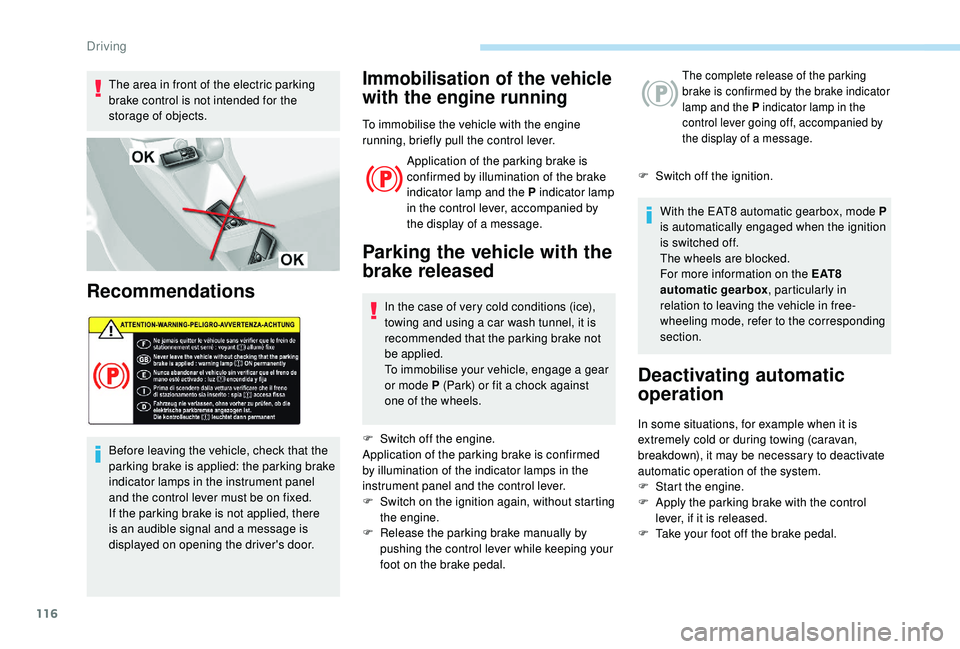
The area in front of the electric parking
brake control is not intended for the
storage of objects.
Recommendations
Before leaving the vehicle, check that the
parking brake is applied: the parking brake
indicator lamps in the instrument panel
and the control lever must be on fixed.
If the parking brake is not applied, there
is an audible signal and a message is
displayed on opening the driver's door.
Immobilisation of the vehicle
with the engine running
To immobilise the vehicle with the engine
running, briefly pull the control lever.Application of the parking brake is
confirmed by illumination of the brake
indicator lamp and the P indicator lamp
in the control lever, accompanied by
the display of a message.
Parking the vehicle with the
brake released
In the case of very cold conditions (ice),
towing and using a car wash tunnel, it is
recommended that the parking brake not
be applied.
To immobilise your vehicle, engage a gear
or mode P (Park) or fit a chock against
one of the wheels.
F
S
witch off the engine.
Application of the parking brake is confirmed
by illumination of the indicator lamps in the
instrument panel and the control lever.
F
S
witch on the ignition again, without starting
the engine.
F
R
elease the parking brake manually by
pushing the control lever while keeping your
foot on the brake pedal.
The complete release of the parking
brake is confirmed by the brake indicator
lamp and the P indicator lamp in the
control lever going off, accompanied by
the display of a message.
F Switch off the ignition.
With the EAT8 automatic gearbox, mode P
is automatically engaged when the ignition
is switched off.
The wheels are blocked.
For more information on the E AT 8
automatic gearbox , particularly in
relation to leaving the vehicle in free-
wheeling mode, refer to the corresponding
section.
Deactivating automatic
operation
In some situations, for example when it is
extremely cold or during towing (caravan,
breakdown), it may be necessary to deactivate
automatic operation of the system.
F
S
tart the engine.
F
A
pply the parking brake with the control
lever, if it is released.
F
T
ake your foot off the brake pedal.
Driving
Page 121 of 324
119
F Raise the ring under the knob and move the gear lever to the left, then for wards.
Only engage reverse gear when the vehicle
is stationary with the engine at idle.
As a safety precaution and to facilitate
starting the engine:
-
a
lways select neutral,
-
p
ress the clutch pedal.
EAT6 automatic gearbox
Six-speed automatic gearbox which offers a
choice between the comfort of fully automatic
operation, enhanced by sport and snow
programmes, or manual gear changing.
There are two driving modes:
-
a
utomatic operation for electronic
management of the gears by the gearbox,
•
w
ith the sport programme to give you a
more dynamic driving style,
•
o
r the snow programme to improve
driving in the event of poor grip.
-
man
ual operation for sequential changing
of the gears by the driver.
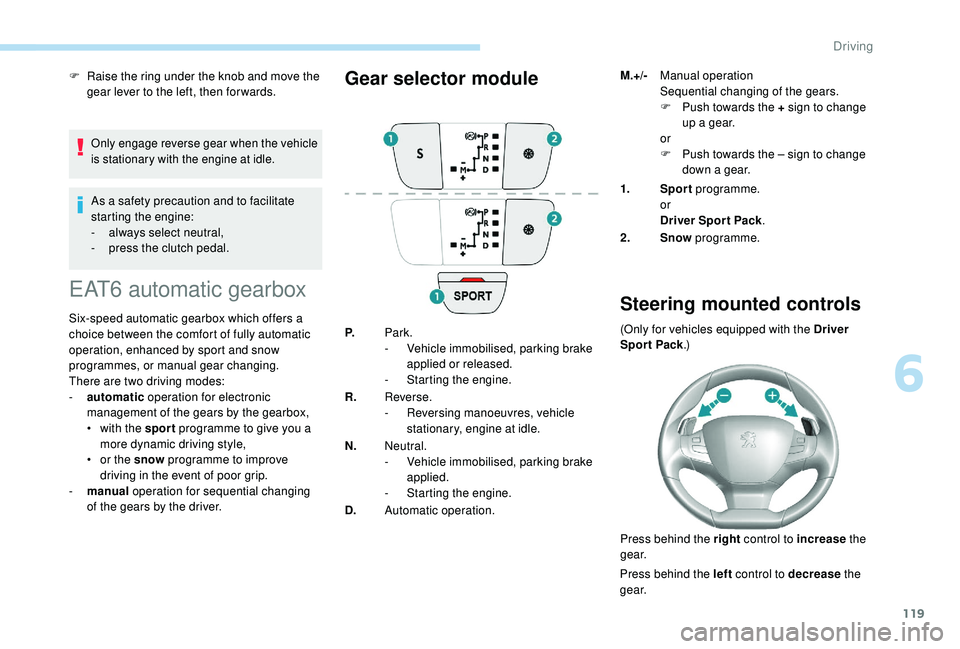
Gear selector module
P. Park.
-
V ehicle immobilised, parking brake
applied or released.
-
S
tarting the engine.
R. Reverse.
-
R
eversing manoeuvres, vehicle
stationary, engine at idle.
N. Neutral.
-
V
ehicle immobilised, parking brake
applied.
-
S
tarting the engine.
D. Automatic operation. 1.
Sport programme.
or
Driver Spor t Pack .
2. Snow programme.
Steering mounted controls
(Only for vehicles equipped with the Driver
Spor t Pack .)
Press behind the right control to increase the
g e a r.
Press behind the left control to decrease the
g e a r. M.+/-
Manual operation
Sequential changing of the gears.
F
P
ush towards the + sign to change
up a gear.
or
F
P
ush towards the – sign to change
down a gear.
6
Driving
Page 123 of 324
121
"Sport" and "Snow"
programmes
These two special programmes supplement
the automatic operation in specific conditions
of use.
"Sport"
F Press the "SPORT" button once
the engine has started.
" S " appears in the instrument panel.
The gearbox automatically favours a dynamic
style of driving.
On versions fitted with the Driver Sport Pack,
the " S" button is replaced by the " SPORT"
button.
"Snow"
F Press this button once the engine has started.
" T " appears in the instrument panel.
The gearbox adapts to driving on slippery
roads.
This programme improves starting and
handling when traction is poor.
Driver Sport Pack
This function favours a dynamic style of driving. F
P
ress the "
SPORT" button once
the engine has started.
" S " appears in the instrument panel.
For more information on the Driver Spor t
Pack , refer to the corresponding section.
Return to automatic operation
F At any time, press the button selected ( S or
" T ") again to quit the programme engaged
and return to auto-adaptive mode.
Manual operation
To reduce fuel consumption when at
a prolonged standstill with the engine
running (traffic jam, etc.), put the
selector in position N and apply the
parking brake.
F
Sel
ect position M for sequential changing
of the six gears.
F
P
ush towards the + sign to change up a
g e a r.
F
P
ush towards the – sign to change down a
g e a r. D disappears, and the gears
engaged appear in succession on
the instrument panel.
If the engine is under-revving or over-revving,
the gear selected flashes for a few seconds,
then the actual gear engaged is displayed.
It is possible to change from position D
(automatic) to position M (manual) at any time.
When the vehicle is stationary or moving
very slowly, the gearbox selects gear M1
automatically.
The sport and snow programmes are inactive
in manual operation.
Invalid value during manual
operation
This symbol is displayed if a gear is
not engaged correctly (gear selector
between two positions).
Stopping the vehicle
Before switching off the engine, you can
engage position P or N to place the gearbox in
neutral. Changing from one gear to another only
occurs if the vehicle speed and engine speed
conditions allow; other wise the gearbox will
operate temporarily in automatic mode.
6
Driving