tow Peugeot 308 2018 Service Manual
[x] Cancel search | Manufacturer: PEUGEOT, Model Year: 2018, Model line: 308, Model: Peugeot 308 2018Pages: 324, PDF Size: 10.72 MB
Page 168 of 324
166
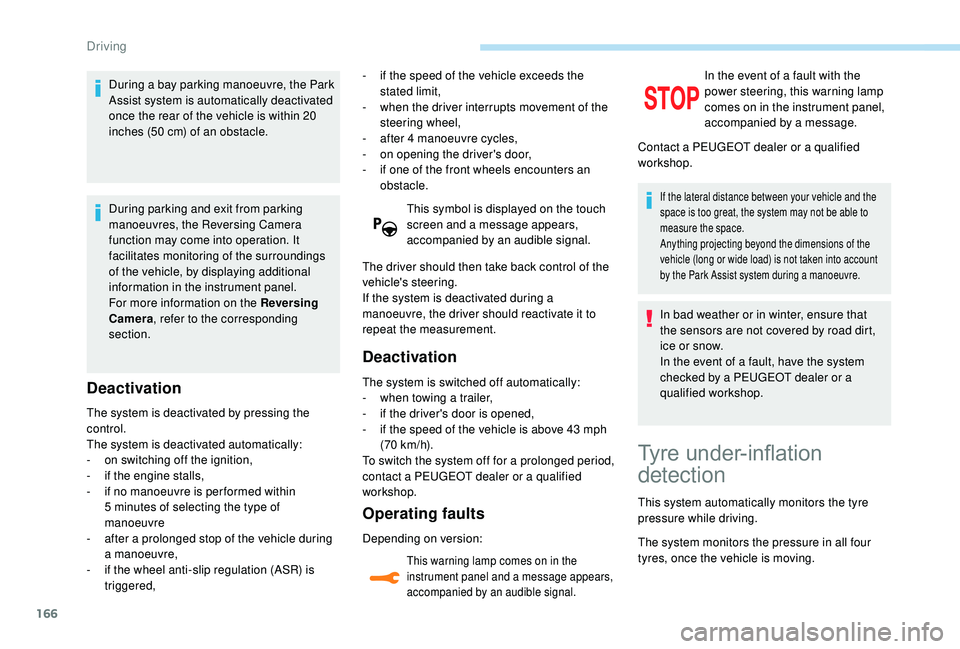
During a bay parking manoeuvre, the Park
Assist system is automatically deactivated
once the rear of the vehicle is within 20
inches (50 cm) of an obstacle.
During parking and exit from parking
manoeuvres, the Reversing Camera
function may come into operation. It
facilitates monitoring of the surroundings
of the vehicle, by displaying additional
information in the instrument panel.
For more information on the Reversing
Camera , refer to the corresponding
section.
Deactivation
The system is deactivated by pressing the
control.
The system is deactivated automatically:
-
o
n switching off the ignition,
-
i
f the engine stalls,
-
i
f no manoeuvre is per formed within
5
minutes of selecting the type of
manoeuvre
-
a
fter a prolonged stop of the vehicle during
a manoeuvre,
-
i
f the wheel anti-slip regulation (ASR) is
triggered, This symbol is displayed on the touch
screen and a message appears,
accompanied by an audible signal.
The driver should then take back control of the
vehicle's steering.
If the system is deactivated during a
manoeuvre, the driver should reactivate it to
repeat the measurement.
Deactivation
The system is switched off automatically:
- w hen towing a trailer,
-
i
f the driver's door is opened,
-
i
f the speed of the vehicle is above 43 mph
(70
km/h).
To switch the system off for a prolonged period,
contact a PEUGEOT dealer or a qualified
workshop.
Operating faults
Depending on version:
This warning lamp comes on in the
instrument panel and a message appears,
accompanied by an audible signal.
In the event of a fault with the
power steering, this warning lamp
comes on in the instrument panel,
accompanied by a message.
If the lateral distance between your vehicle and the
space is too great, the system may not be able to
measure the space.
Anything projecting beyond the dimensions of the
vehicle (long or wide load) is not taken into account
by the Park Assist system during a manoeuvre.
In bad weather or in winter, ensure that
the sensors are not covered by road dirt,
ice or snow.
In the event of a fault, have the system
checked by a PEUGEOT dealer or a
qualified workshop.
Contact a PEUGEOT dealer or a qualified
workshop.
Tyre under-inflation
detection
This system automatically monitors the tyre
pressure while driving.
The system monitors the pressure in all four
tyres, once the vehicle is moving.
-
i
f the speed of the vehicle exceeds the
stated limit,
-
w
hen the driver interrupts movement of the
steering wheel,
-
a
fter 4
manoeuvre cycles,
-
o
n opening the driver's door,
-
i
f one of the front wheels encounters an
obstacle.
Driving
Page 176 of 324
174
Removing
F Use a screwdriver as a lever to release each fixing clip.
Do not forget to remove the very cold
climate screen:
-
w
hen the external temperature is greater
than 10°C (example: in summer, etc.),
-
i
n the event of towing,
-
a
t speeds above 75 mph (120 km/h).
Towing device
Load distribution
F D istribute the load in the trailer so that the
heaviest items are as close as possible to
the axle and the nose weight approaches
the maximum permitted without
exceeding it.
Air density decreases with altitude, thus
reducing engine performance. The maximum
load which can be towed must be reduced by
10% per 1,000
metres of altitude. Use towing devices and their genuine
harnesses approved by PEUGEOT. It
is recommended that the installation be
per formed by a PEUGEOT dealer or a
qualified workshop.
If the towing device is not fitted by
a PEUGEOT dealer, it must still be
fitted in accordance with the vehicle
manufacturer's instructions.
Certain driving assistance or manoeuvring
assistance functions are automatically
disabled if an approved towing device is
used.
Obser ve the maximum authorised towable
weight, indicated on your vehicle's
registration certificate, the manufacturer's
label as well as in the Technical data
section of this guide.
Complying with the maximum
authorised nose weight (towball)
also includes the use of accessories
(bicycle carriers, tow boxes, etc.).
Obser ve the legislation in force in the
country in which you are driving.
GTi towing
Your vehicle cannot be fitted with a towing
device.
Towing device with towball
Before each use
Check that the towball is correctly fitted,
verifying the follow points:
Hatchback:
-
t
he green mark on the locking wheel
is in line with the green mark on the
towball,
-
t
he locking wheel is in contact with the
towball (position A ).
-
t
he safety lock is on and the key
removed; the locking wheel can no
longer be operated,
-
t
he towball must not be able to move in
its carrier; test by shaking it with your
hand.
SW:
-
t
he towball is correctly engaged
(position A ),
-
t
he safety lock is on and the key
removed; the trigger can no longer be
operated,
-
t
he towball must not be able to move in
its carrier; test by shaking it with your
hand.
If the towball is not locked, the trailer can
detach – accident risk!
Practical information
Page 177 of 324
175
During use
Never release the device with a trailer or
load carrier on the towball.
Never exceed the maximum authorised
weight for the vehicle – the Gross Train
Weight or GTW.
It is essential that the maximum
authorised load be complied with on the
towing device: if it is exceeded, this device
may detach from the vehicle, which is a
serious accident risk.
Check that the trailer lamps work
c o r r e c t l y.
Before setting off, check the adjustment of
the headlamp beam height.
For more information on Headlamp
adjustment, refer to the corresponding
section.
Following use
When travelling without a trailer or load
carrier, the towball must be removed and
the blanking plug inserted in the carrier.
This measure applies particularly where
the towball might obscure visibility of the
number plate or its lighting.Blanking plug
In the event of towing, it is essential to remove
the blanking plug if your vehicle has one.
To do this, contact a PEUGEOT dealer or a
qualified workshop.
The blanking plug is located behind the
lower air intake grille.
Towing device with
quickly detachable towball
(hatchback)
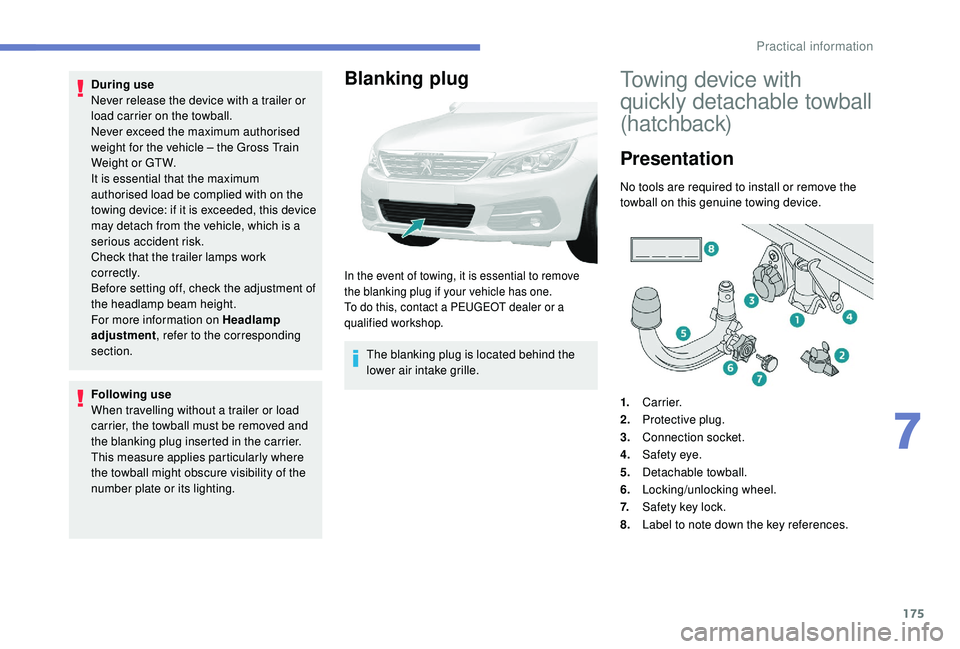
Presentation
No tools are required to install or remove the
towball on this genuine towing device.
1. Carrier.
2. Protective plug.
3. Connection socket.
4. Safety eye.
5. Detachable towball.
6. Locking/unlocking wheel.
7. Safety key lock.
8. Label to note down the key references.
7
Practical information
Page 178 of 324
176
Trailers with LED lamps are not
compatible with the wiring harness of this
device.
To know the Technical data , and, in
particular, the towable weights for your
vehicle, refer to the corresponding section.
To ensure complete safety while driving
with a To w b a r d e v i c e , refer to the
corresponding section.
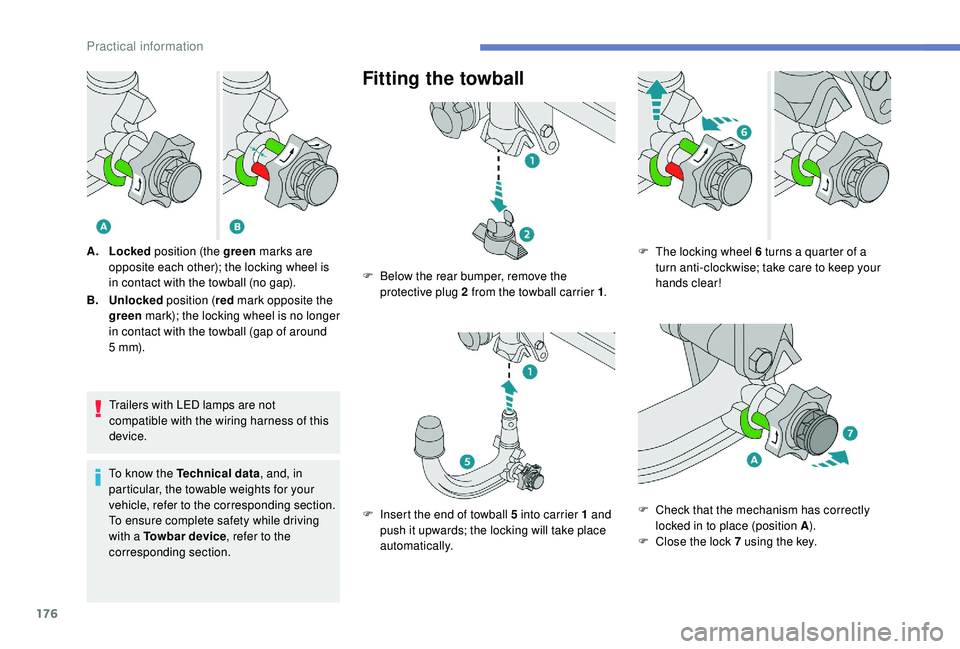
Fitting the towball
A. Locked position (the green marks are
opposite each other); the locking wheel is
in contact with the towball (no gap).
B. Unlocked position (red mark opposite the
green mark); the locking wheel is no longer
in contact with the towball (gap of around
5
m m). F
B
elow the rear bumper, remove the
protective plug 2 from the towball carrier 1 .
F
I
nsert the end of towball 5 into carrier 1 and
push it upwards; the locking will take place
automatically. F
T he locking wheel 6 turns a quarter of a
turn anti-clockwise; take care to keep your
hands clear!
F
C
heck that the mechanism has correctly
locked in to place (position A ).
F
C
lose the lock 7 using the key.
Practical information
Page 179 of 324
177
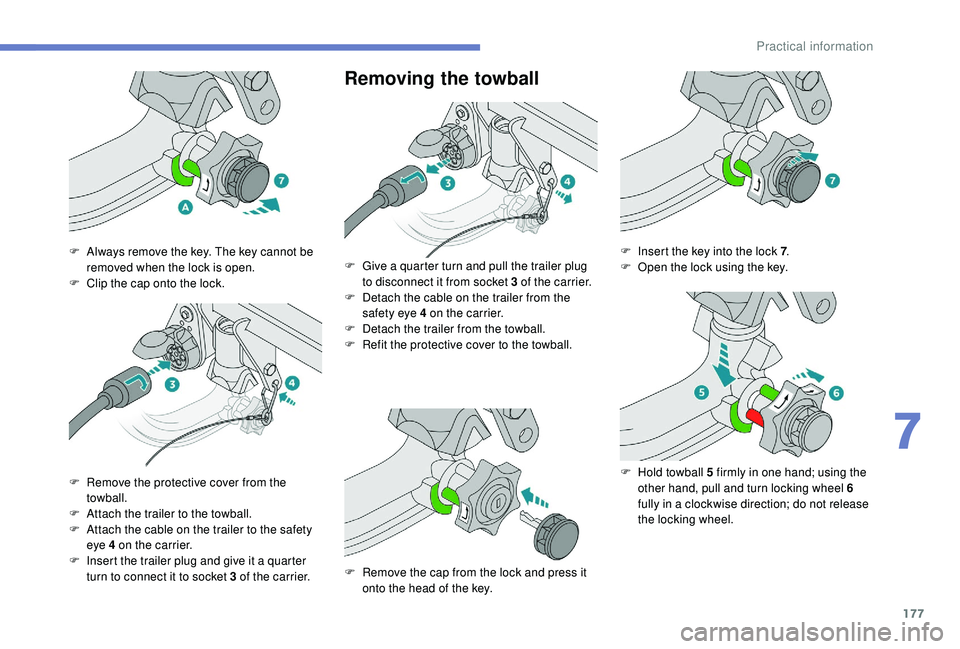
Removing the towball
F Always remove the key. The key cannot be removed when the lock is open.
F
C
lip the cap onto the lock.
F
R
emove the protective cover from the
towball.
F
A
ttach the trailer to the towball.
F
A
ttach the cable on the trailer to the safety
eye 4 on the carrier.
F
I
nsert the trailer plug and give it a quarter
turn to connect it to socket 3 of the carrier. F
G ive a quarter turn and pull the trailer plug
to disconnect it from socket 3 of the carrier.
F
D
etach the cable on the trailer from the
safety eye 4 on the carrier.
F
D
etach the trailer from the towball.
F
R
efit the protective cover to the towball.
F
R
emove the cap from the lock and press it
onto the head of the key. F
I nsert the key into the lock 7
.
F O pen the lock using the key.
F
H
old towball 5 firmly in one hand; using the
other hand, pull and turn locking wheel 6
fully in a clockwise direction; do not release
the locking wheel.
7
Practical information
Page 180 of 324
178
Maintenance
Correct operation is only possible if the towball
and its carrier are kept clean.
Before cleaning the vehicle with a high-
pressure jet wash, the towball must be removed
and the protective plug fitted to the carrier.Apply the label provided to a clearly visible
area, close to the carrier or in the boot.
Go to a PEUGEOT dealer or a qualified
workshop for any work on the towing
device system.
Towing device with
quickly detachable towball
(SW)
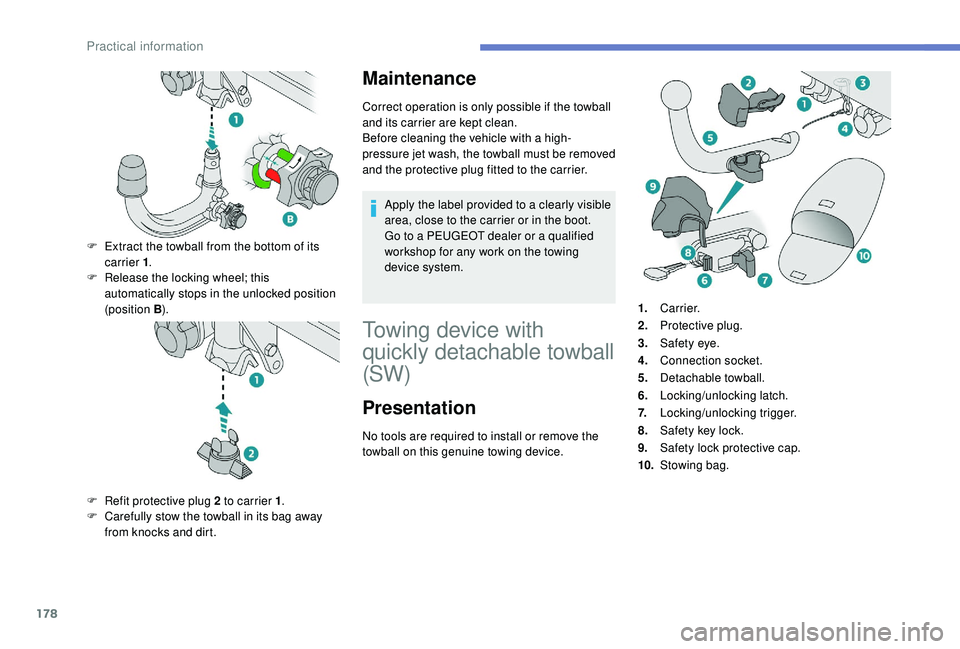
Presentation
F Extract the towball from the bottom of its carrier 1 .
F
R
elease the locking wheel; this
automatically stops in the unlocked position
(position B ).
F
R
efit protective plug 2 to carrier 1 .
F
C
arefully stow the towball in its bag away
from knocks and dirt. No tools are required to install or remove the
towball on this genuine towing device. 1.
Carrier.
2. Protective plug.
3. Safety eye.
4. Connection socket.
5. Detachable towball.
6. Locking/unlocking latch.
7. Locking/unlocking trigger.
8. Safety key lock.
9. Safety lock protective cap.
10. Stowing bag.
Practical information
Page 181 of 324
179
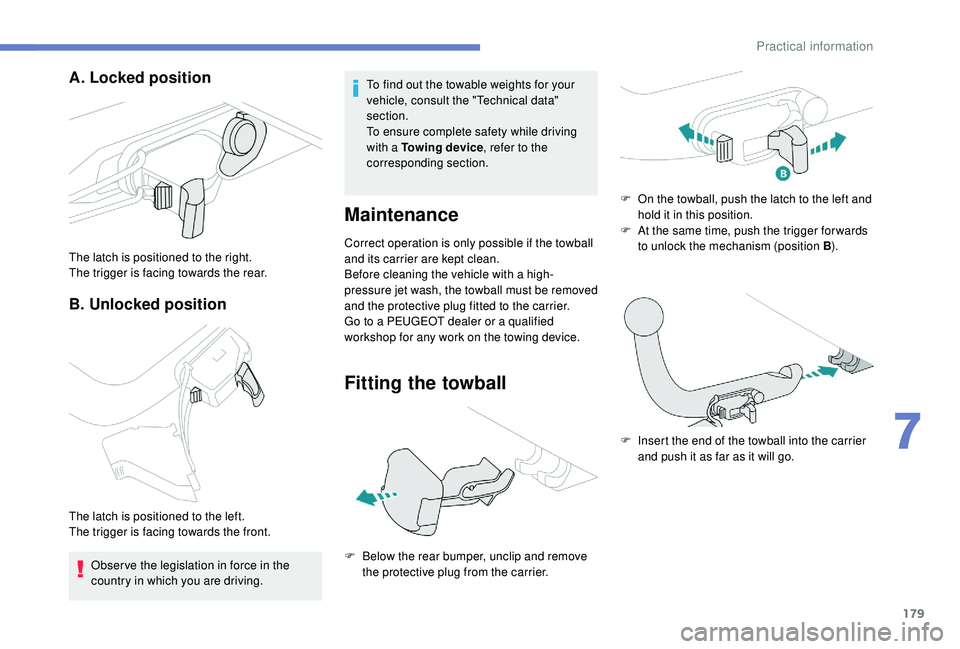
A. Locked position
B. Unlocked position
The latch is positioned to the right.
The trigger is facing towards the rear.
The latch is positioned to the left.
The trigger is facing towards the front. Obser ve the legislation in force in the
country in which you are driving. To find out the towable weights for your
vehicle, consult the "Technical data"
section.
To ensure complete safety while driving
with a Towing device
, refer to the
corresponding section.
Maintenance
Correct operation is only possible if the towball
and its carrier are kept clean.
Before cleaning the vehicle with a high-
pressure jet wash, the towball must be removed
and the protective plug fitted to the carrier.
Go to a PEUGEOT dealer or a qualified
workshop for any work on the towing device.
Fitting the towball
F Below the rear bumper, unclip and remove the protective plug from the carrier. F
O
n the towball, push the latch to the left and
hold it in this position.
F
A
t the same time, push the trigger for wards
to unlock the mechanism (position B ).
F
I
nsert the end of the towball into the carrier
and push it as far as it will go.
7
Practical information
Page 182 of 324
180
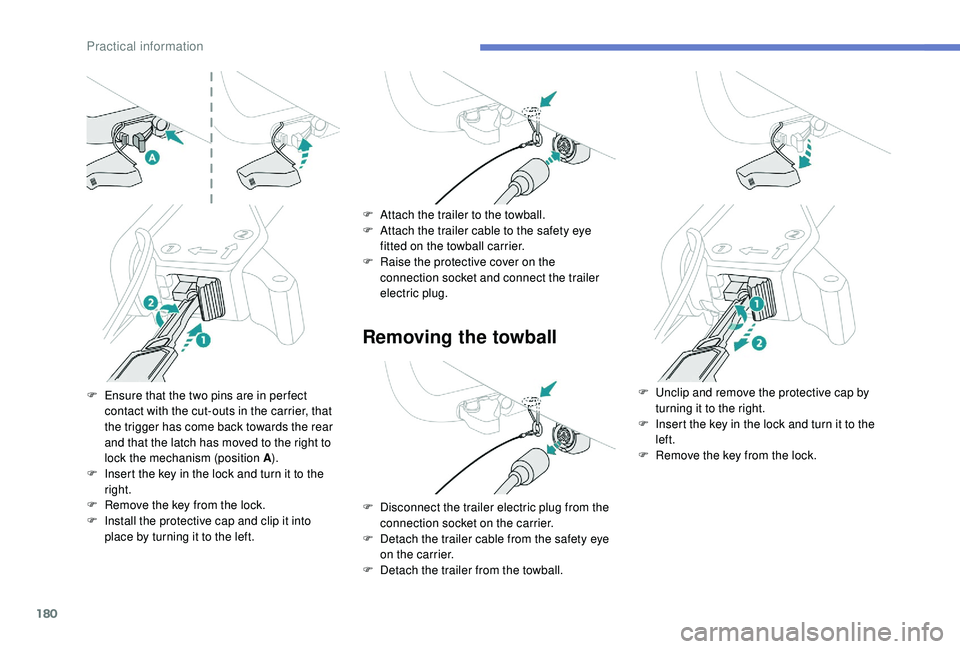
Removing the towball
F Ensure that the two pins are in per fect contact with the cut-outs in the carrier, that
the trigger has come back towards the rear
and that the latch has moved to the right to
lock the mechanism (position A ).
F
I
nsert the key in the lock and turn it to the
right.
F
R
emove the key from the lock.
F
I
nstall the protective cap and clip it into
place by turning it to the left. F
A
ttach the trailer to the towball.
F
A
ttach the trailer cable to the safety eye
fitted on the towball carrier.
F
R
aise the protective cover on the
connection socket and connect the trailer
electric plug.
F
D
isconnect the trailer electric plug from the
connection socket on the carrier.
F
D
etach the trailer cable from the safety eye
on the carrier.
F
D
etach the trailer from the towball.F
U nclip and remove the protective cap by
turning it to the right.
F
I
nsert the key in the lock and turn it to the
left.
F
R
emove the key from the lock.
Practical information
Page 183 of 324
181
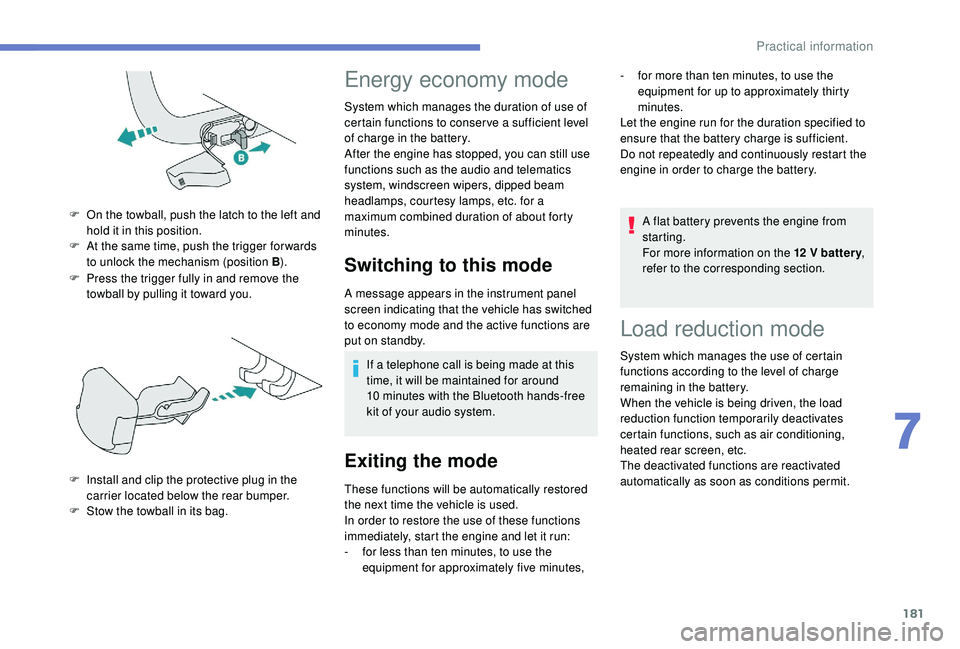
F Press the trigger fully in and remove the towball by pulling it toward you.
F
O
n the towball, push the latch to the left and
hold it in this position.
F
A
t the same time, push the trigger for wards
to unlock the mechanism (position B ).
F
I
nstall and clip the protective plug in the
carrier located below the rear bumper.
F
S
tow the towball in its bag.
Energy economy mode
System which manages the duration of use of
certain functions to conser ve a sufficient level
of charge in the battery.
After the engine has stopped, you can still use
functions such as the audio and telematics
system, windscreen wipers, dipped beam
headlamps,
courtesy lamps, etc. for a
maximum combined duration of about forty
minutes.
Switching to this mode
A message appears in the instrument panel
screen indicating that the vehicle has switched
to economy mode and the active functions are
put on standby.
If a telephone call is being made at this
time, it will be maintained for around
10
minutes with the Bluetooth hands-free
kit of your audio system.
Exiting the mode
These functions will be automatically restored
the next time the vehicle is used.
In order to restore the use of these functions
immediately, start the engine and let it run:
-
f
or less than ten minutes, to use the
equipment for approximately five minutes, A flat battery prevents the engine from
starting.
For more information on the 12
V batter y
,
refer to the corresponding section.
Load reduction mode
System which manages the use of certain
functions according to the level of charge
remaining in the battery.
When the vehicle is being driven, the load
reduction function temporarily deactivates
certain functions, such as air conditioning,
heated rear screen, etc.
The deactivated functions are reactivated
automatically as soon as conditions permit. -
f
or more than ten minutes, to use the
equipment for up to approximately thirty
minutes.
Let the engine run for the duration specified to
ensure that the battery charge is sufficient.
Do not repeatedly and continuously restart the
engine in order to charge the battery.
7
Practical information
Page 185 of 324
183
Bonnet
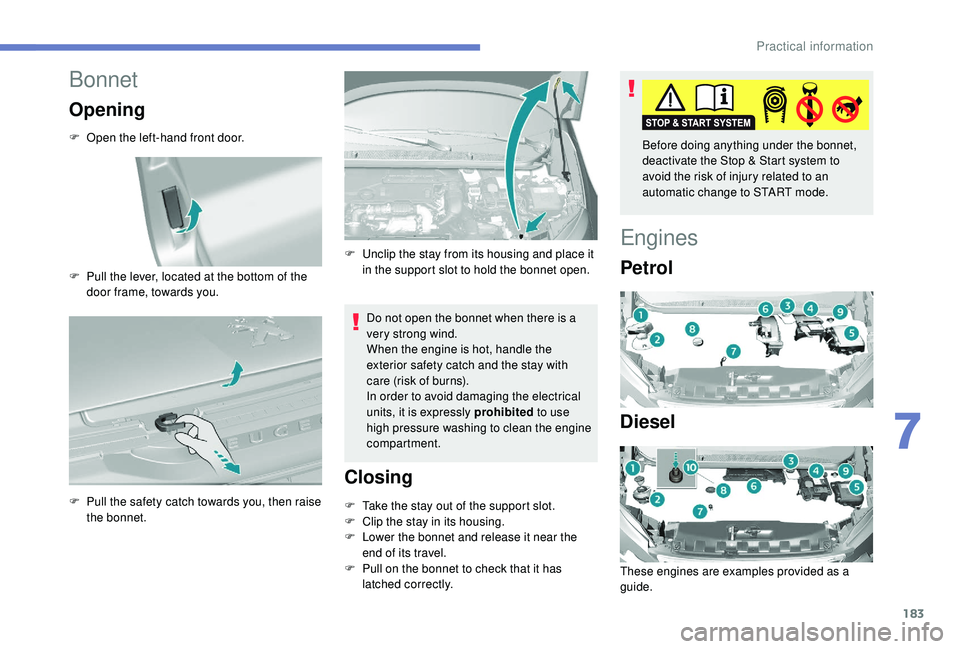
Opening
F Open the left-hand front door.
F
P
ull the lever, located at the bottom of the
door frame, towards you.
F
P
ull the safety catch towards you, then raise
the bonnet. Do not open the bonnet when there is a
very strong wind.
When the engine is hot, handle the
exterior safety catch and the stay with
care (risk of burns).
In order to avoid damaging the electrical
units, it is expressly prohibited
to use
high pressure washing to clean the engine
compartment.
Closing
F Take the stay out of the support slot.
F C lip the stay in its housing.
F
L
ower the bonnet and release it near the
end of its travel.
F
P
ull on the bonnet to check that it has
latched correctly.
Engines
Petrol
Diesel
These engines are examples provided as a
guide.
F
U
nclip the stay from its housing and place it
in the support slot to hold the bonnet open. Before doing anything under the bonnet,
deactivate the Stop & Start system to
avoid the risk of injury related to an
automatic change to START mode.
7
Practical information