check engine Peugeot 308 2018 Owner's Guide
[x] Cancel search | Manufacturer: PEUGEOT, Model Year: 2018, Model line: 308, Model: Peugeot 308 2018Pages: 324, PDF Size: 10.72 MB
Page 190 of 324
188
Brake disc/drum wear
For information on checking
brake disc/drum wear, contact a
PEUGEOT dealer or a qualified
workshop.
Electric parking brake
This system does not require any
specific check. However, in the
event of a problem, have the system
checked by a PEUGEOT dealer or a
qualified workshop.
For more information on the Electric
parking brake , refer to the corresponding
section.
Wheels and tyres
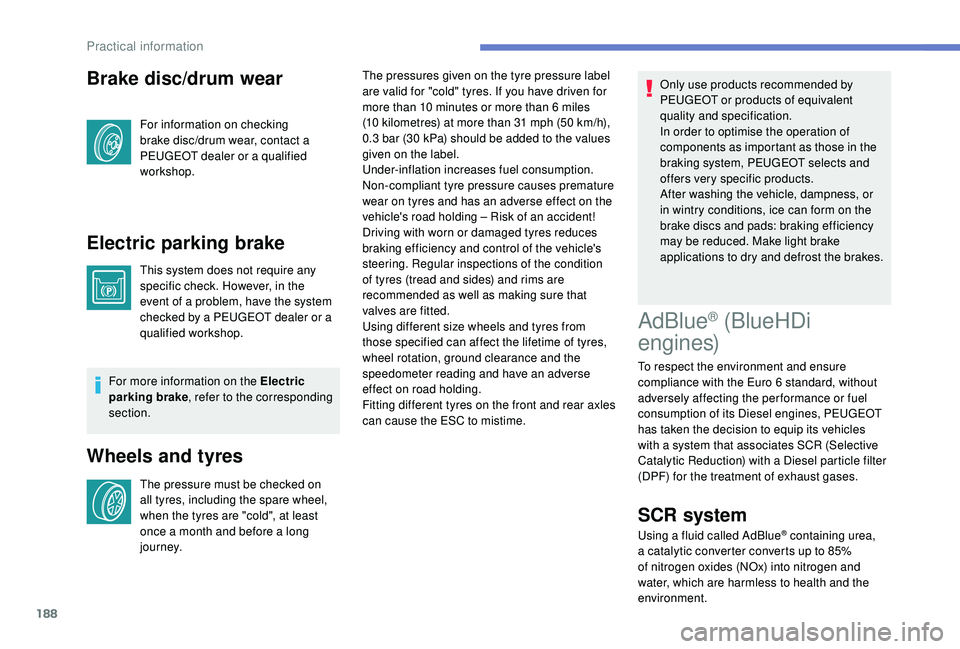
The pressure must be checked on
all tyres, including the spare wheel,
when the tyres are "cold", at least
once a month and before a long
j o u r n ey. The pressures given on the tyre pressure label
are valid for "cold" tyres. If you have driven for
more than 10
minutes or more than 6 miles
(10 kilometres) at more than 31 mph (50 km/h),
0.3 bar (30 kPa) should be added to the values
given on the label.
Under-inflation increases fuel consumption.
Non-compliant tyre pressure causes premature
wear on tyres and has an adverse effect on the
vehicle's road holding – Risk of an accident!
Driving with worn or damaged tyres reduces
braking efficiency and control of the vehicle's
steering. Regular inspections of the condition
of tyres (tread and sides) and rims are
recommended as well as making sure that
valves are fitted.
Using different size wheels and tyres from
those specified can affect the lifetime of tyres,
wheel rotation, ground clearance and the
speedometer reading and have an adverse
effect on road holding.
Fitting different tyres on the front and rear axles
can cause the ESC to mistime. Only use products recommended by
PEUGEOT or products of equivalent
quality and specification.
In order to optimise the operation of
components as important as those in the
braking system, PEUGEOT selects and
offers very specific products.
After washing the vehicle, dampness, or
in wintry conditions, ice can form on the
brake discs and pads: braking efficiency
may be reduced. Make light brake
applications to dry and defrost the brakes.
AdBlue® (BlueHDi
engines)
To respect the environment and ensure
compliance with the Euro 6 standard, without
adversely affecting the per formance or fuel
consumption of its Diesel engines, PEUGEOT
has taken the decision to equip its vehicles
with a system that associates SCR (Selective
Catalytic Reduction) with a Diesel particle filter
(DPF) for the treatment of exhaust gases.
SCR system
Using a fluid called AdBlue® containing urea,
a catalytic converter converts up to 85%
of nitrogen oxides (NOx) into nitrogen and
water, which are harmless to health and the
environment.
Practical information
Page 192 of 324
190
In the event of contact with the skin, wash the
affected area with soap and water. In the event
of contact with the eyes, wash (irrigate) the
eyes with large amounts of water or with an eye
wash solution for at least 15 minutes. If you feel
a persistent burning sensation or irritation, get
medical attention.
If swallowed, immediately wash out the mouth
with clean water and then drink plenty of water.
In certain conditions (at high temperature,
for example), the risk of release of ammonia
cannot be excluded: do not inhale the vapour.
Ammonia has an irritant effect on mucous
membranes (eyes, nose and throat).
Keep AdBlue
® in its original container and
out of the reach of children.
Procedure
Before starting the top up procedure, ensure
that the vehicle is parked on a flat and level
sur face.
In winter, check that the temperature of the
vehicle is above -11°C. If not, due to freezing,
the AdBlue
® cannot be poured into the tank.
Park your vehicle somewhere warmer for a few
hours before topping up. In the event of an AdBlue
® breakdown,
confirmed by the message "Add AdBlue:
Starting impossible", you must top up with
at least 5
litres.
Never pour AdBlue
® into the Diesel fuel
tank.
For the specifics associated with the
access configuration for the AdBlue
® tank
(via the boot or via the fuel filler flap), refer
to the descriptions given in detail further
on.
If any AdBlue
® is splashed, or if there are
any spillages on the side of the body, rinse
immediately with cold water or wipe with a
damp cloth.
If the fluid has crystallised, clean it off
using a sponge and hot water.
Important: in the event of a top-up after a
breakdown because of a lack of AdBlue,
you must wait around 5
minutes before
switching on the ignition, without opening
the driver’s door, locking the vehicle,
introducing the key into the ignition
switch, or introducing the key of the
K
eyless Entr y and Star ting system into
the passenger compartment.
Switch on the ignition, then wait for
10
seconds before starting the engine.
Practical information
Page 201 of 324
199
If after approximately seven minutes this
pressure is not reached, this indicates
that the tyre is not repairable; contact a
PEUGEOT dealer or a qualified workshop
for assistance.
F
R
emove the kit and screw the cap back on
the white pipe. Take care to avoid staining
your vehicle with traces of fluid. Keep the kit
to hand.
Take care, the sealant product is harmful
if swallowed and causes irritation to the
eyes.
Keep this product out of the reach of
children.2. Inflation
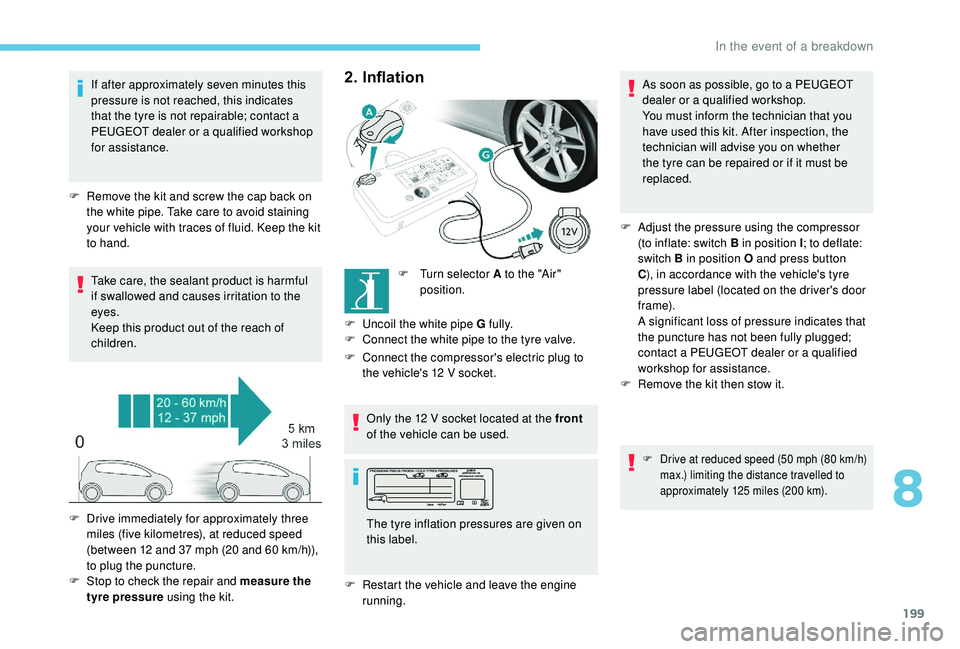
F Turn selector A to the "Air" position.
F
U
ncoil the white pipe G fully.
F
C
onnect the white pipe to the tyre valve.
F
C
onnect the compressor's electric plug to
the vehicle's 12
V socket.
Only the 12
V socket located at the front
of the vehicle can be used.
F
R
estart the vehicle and leave the engine
running.
F
D
rive immediately for approximately three
miles (five kilometres), at reduced speed
(between 12 and 37
mph (20 and 60
km/h)),
to plug the puncture.
F
S
top to check the repair and measure the
tyre pressure using the kit. The tyre inflation pressures are given on
this label. As soon as possible, go to a PEUGEOT
dealer or a qualified workshop.
You must inform the technician that you
have used this kit. After inspection, the
technician will advise you on whether
the tyre can be repaired or if it must be
replaced.
F
A
djust the pressure using the compressor
(to inflate: switch B in position I ; to deflate:
switch B in position O and press button
C ), in accordance with the vehicle's tyre
pressure label (located on the driver's door
f r a m e).
A significant loss of pressure indicates that
the puncture has not been fully plugged;
contact a PEUGEOT dealer or a qualified
workshop for assistance.
F
R
emove the kit then stow it.
F Drive at reduced speed (50 mph (80 km/h)
max.) limiting the distance travelled to
approximately 125
miles (200 km).
8
In the event of a breakdown
Page 202 of 324
200
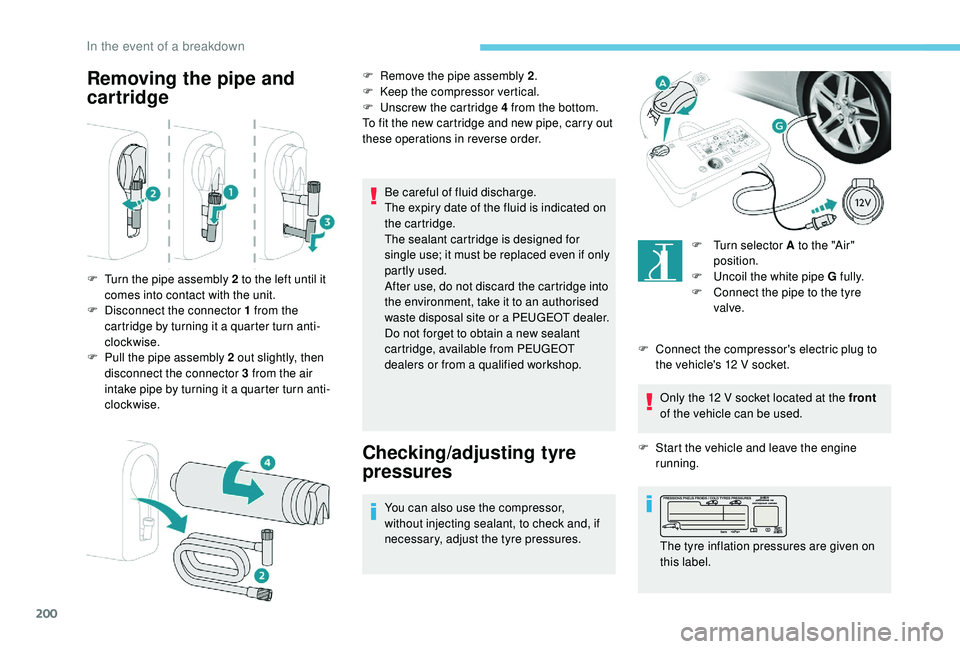
Removing the pipe and
cartridge
Be careful of fluid discharge.
The expiry date of the fluid is indicated on
the cartridge.
The sealant cartridge is designed for
single use; it must be replaced even if only
partly used.
After use, do not discard the cartridge into
the environment, take it to an authorised
waste disposal site or a PEUGEOT dealer.
Do not forget to obtain a new sealant
cartridge, available from PEUGEOT
dealers or from a qualified workshop.
Checking/adjusting tyre
pressures
You can also use the compressor,
without injecting sealant, to check and, if
necessary, adjust the tyre pressures.F
T
urn selector A to the "Air"
position.
F
U
ncoil the white pipe G fully.
F
C
onnect the pipe to the tyre
valve.
F
C
onnect the compressor's electric plug to
the vehicle's 12 V socket.
Only the 12 V socket located at the front
of the vehicle can be used.
F
S
tart the vehicle and leave the engine
running.
F
T
urn the pipe assembly 2 to the left until it
comes into contact with the unit.
F
D
isconnect the connector 1 from the
cartridge by turning it a quarter turn anti-
clockwise.
F
P
ull the pipe assembly 2 out slightly, then
disconnect the connector 3 from the air
intake pipe by turning it a quarter turn anti-
clockwise. F
R
emove the pipe assembly 2
.
F
K
eep the compressor vertical.
F
U
nscrew the cartridge 4 from the bottom.
To fit the new cartridge and new pipe, carry out
these operations in reverse order.
The tyre inflation pressures are given on
this label.
In the event of a breakdown
Page 217 of 324
215
12 V battery
Procedure for starting the engine using another
battery or charging a discharged battery.
General points
Lead-acid starter batteries
Batteries contain harmful substances
such as sulphuric acid and lead.
They must be disposed of in accordance
with regulations and must not, in any
circumstances, be discarded with
household waste.
Take used remote control batteries and
vehicle batteries to a special collection
point.
Protect your eyes and face before
handling the battery.
All operations on the battery must be
carried out in a well ventilated area and
away from naked flames and sources of
sparks, so as to avoid the risk of explosion
or fire.
Wash your hands afterwards. Versions equipped with Stop & Start are
fitted with a 12
V lead-acid battery of
specific technology and specification.
Its replacement should be carried out
only by a PEUGEOT dealer or a qualified
workshop.
Before doing any work
Immobilise the vehicle: apply the parking
brake, put the gearbox in neutral, then
switch off the ignition.
Check that all electrical equipment is
switched off.
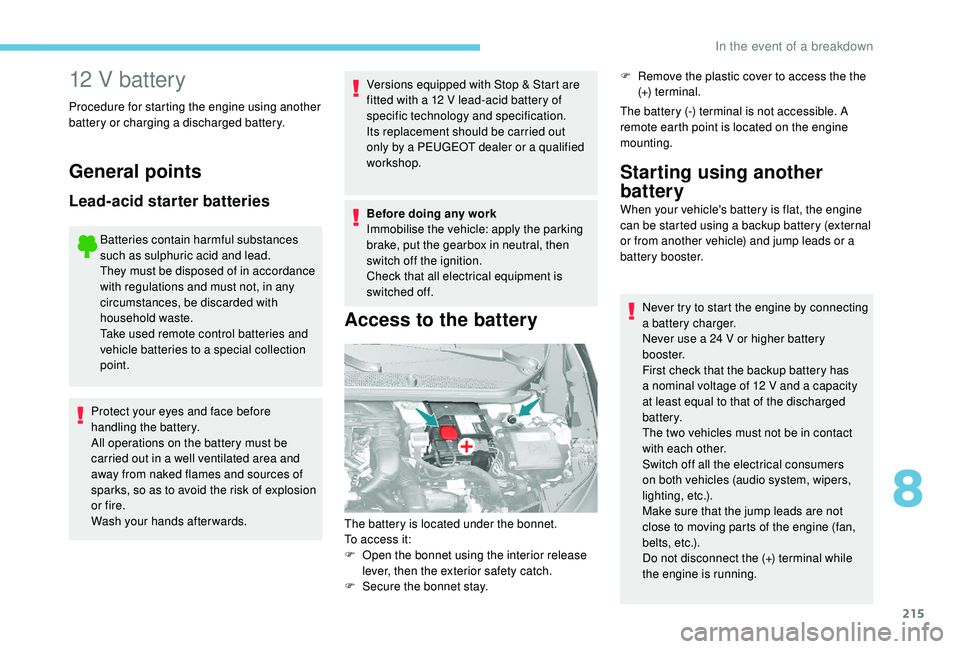
Access to the battery
F Remove the plastic cover to access the the (+) terminal.
The battery (-) terminal is not accessible. A
remote earth point is located on the engine
mounting.
The battery is located under the bonnet.
To access it:
F
O
pen the bonnet using the interior release
lever, then the exterior safety catch.
F
S
ecure the bonnet stay.
Starting using another
battery
When your vehicle's battery is flat, the engine
can be started using a backup battery (external
or from another vehicle) and jump leads or a
battery booster. Never try to start the engine by connecting
a battery charger.
Never use a 24
V or higher battery
b o o s t e r.
First check that the backup battery has
a nominal voltage of 12
V and a capacity
at least equal to that of the discharged
battery.
The two vehicles must not be in contact
with each other.
Switch off all the electrical consumers
on both vehicles (audio system, wipers,
lighting, etc.).
Make sure that the jump leads are not
close to moving parts of the engine (fan,
belts, etc.).
Do not disconnect the (+) terminal while
the engine is running.
8
In the event of a breakdown
Page 219 of 324
217
Never try to charge a frozen battery – risk
of explosion!
If the battery has frozen, have it checked
by a PEUGEOT dealer or by a qualified
workshop who will check that the internal
components have not been damaged and
that the container has not cracked, which
would mean a risk of toxic and corrosive
acid leaking.
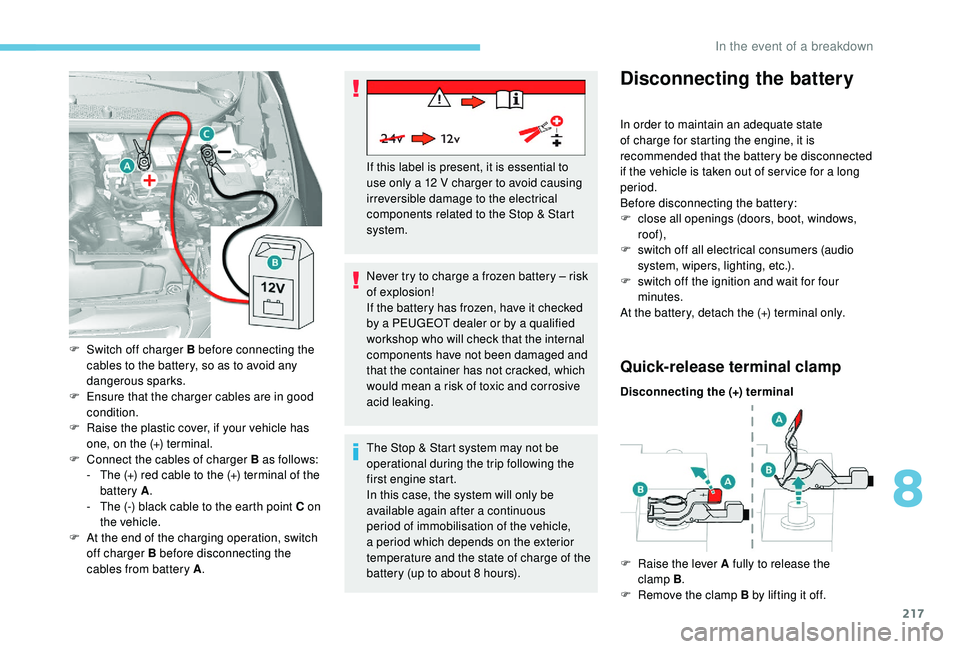
F
S
witch off charger B before connecting the
cables to the battery, so as to avoid any
dangerous sparks.
F
E
nsure that the charger cables are in good
condition.
F
R
aise the plastic cover, if your vehicle has
one, on the (+) terminal.
F
C
onnect the cables of charger B as follows:
-
T
he (+) red cable to the (+) terminal of the
battery A .
-
T
he (-) black cable to the earth point C on
the vehicle.
F
A
t the end of the charging operation, switch
off charger B before disconnecting the
cables from battery A . If this label is present, it is essential to
use only a 12
V charger to avoid causing
irreversible damage to the electrical
components related to the Stop & Start
system.
The Stop & Start system may not be
operational during the trip following the
first engine start.
In this case, the system will only be
available again after a continuous
period of immobilisation of the vehicle,
a period which depends on the exterior
temperature and the state of charge of the
battery (up to about 8
hours).
Disconnecting the battery
In order to maintain an adequate state
of charge for starting the engine, it is
recommended that the battery be disconnected
if the vehicle is taken out of ser vice for a long
period.
Before disconnecting the battery:
F
c
lose all openings (doors, boot, windows,
roof),
F
s
witch off all electrical consumers (audio
system, wipers, lighting, etc.).
F
s
witch off the ignition and wait for four
minutes.
At the battery, detach the (+) terminal only.
Quick-release terminal clamp
Disconnecting the (+) terminal
F
Ra
ise the lever A fully to release the
clamp B .
F
R
emove the clamp B by lifting it off.
8
In the event of a breakdown
Page 250 of 324
14
QUESTIONRESPONSESOLUTION
With the engine off, the audio system switches
off after a few minutes of use. When the engine is switched off, the audio
system operating time depends on the state of
charge of the battery.
The switch-off is normal: the audio system
switches to economy mode and switches off to
prevent discharging the vehicle's battery.Start the vehicle’s engine to increase the
battery charge.
The message "the audio system is overheated"
appears on the display. In order to protect the installation if the
surrounding temperature is too high, the audio
system switches to an automatic thermal
protection mode leading to a reduction of the
volume.Switch the audio system off for a few minutes
to allow the system to cool.
Radio
QUESTION
RESPONSESOLUTION
There is a difference in sound quality between
the different audio sources (radio, USB, etc.). To allow for optimal listening quality, the audio
settings (Volume, Bass, Treble, Ambience,
Loudness) can be tailored to different
sound sources, which can generate audible
differences when changing source (radio, USB,
e t c .) .Check that the audio settings (Volume, Bass,
Treble, Ambience, Loudness) are adapted
to the sources listened to. It is advisable
to set the audio functions (Bass, Treble,
Front-Rear Fader, Left-Right Balance) to the
middle position, select the musical ambience
"None" and set the loudness correction to the
"Inactive" position in radio mode.
The preset stations do not function (no sound,
87.5
MHz is displayed, etc.). An incorrect waveband is selected.
Press the BAND button to return to the
waveband (FM, FM2, DAB, AM) on which the
stations are preset.
Bluetooth® audio system
Page 274 of 324
22
Settings
QUESTIONRESPONSESOLUTION
When changing the setting of treble and bass,
the ambience setting is deselected.
When changing the ambience setting, the
treble and bass settings are reset. The selection of an ambience setting imposes
the settings for treble and bass and vice versa.
Modify the treble and bass or ambience
settings to obtain the desired musical
ambience.
When changing the balance setting,
distribution is deselected.
When changing the distribution setting, the
balance setting is deselected. The selection of a distribution setting imposes
the balance settings and vice versa.
Modify the balance setting or the distribution
setting to obtain the desired sound quality.
There is a difference in sound quality between
the different audio sources. To allow for optimal listening quality, the
audio settings can be tailored to different
sound sources, which can generate audible
differences when changing source.Check that the audio settings are adapted
to the sources listened to. Adjust the audio
functions to the middle position.
When the engine is off, the system switches off
after several minutes of use.
When the engine is switched off, the system's
operating time depends on the state of charge of
the battery.
The switch-off is normal: the system automatically
goes into energy economy mode and switches off
to maintain an adequate charge in the battery.Start the engine to increase the charge of the
battery.
PEUGEOT Connect Radio
Page 312 of 324
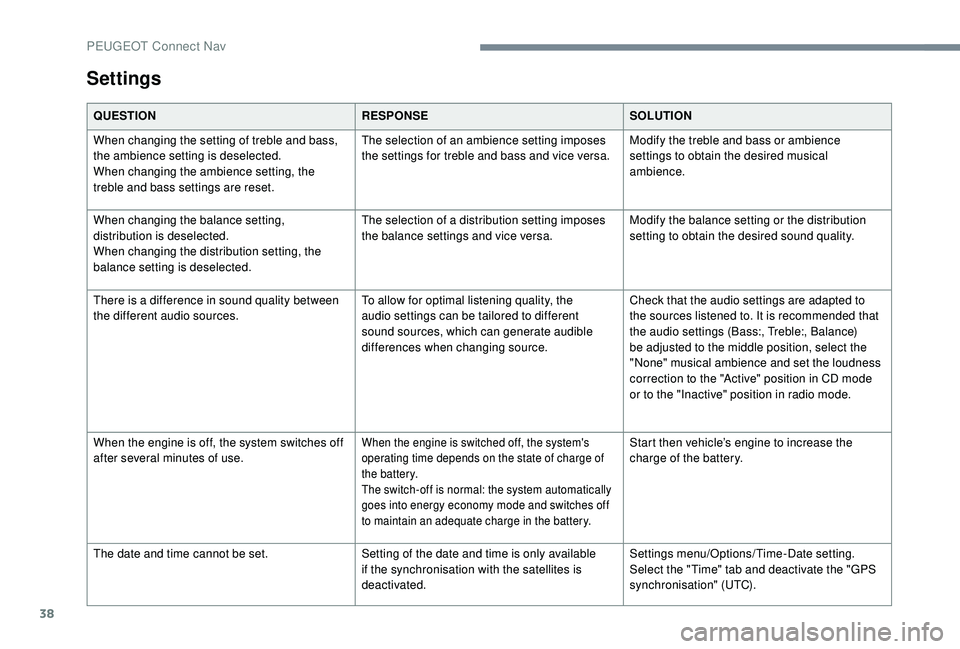
38
Settings
QUESTIONRESPONSESOLUTION
When changing the setting of treble and bass,
the ambience setting is deselected.
When changing the ambience setting, the
treble and bass settings are reset. The selection of an ambience setting imposes
the settings for treble and bass and vice versa.
Modify the treble and bass or ambience
settings to obtain the desired musical
ambience.
When changing the balance setting,
distribution is deselected.
When changing the distribution setting, the
balance setting is deselected. The selection of a distribution setting imposes
the balance settings and vice versa.
Modify the balance setting or the distribution
setting to obtain the desired sound quality.
There is a difference in sound quality between
the different audio sources. To allow for optimal listening quality, the
audio settings can be tailored to different
sound sources, which can generate audible
differences when changing source.Check that the audio settings are adapted to
the sources listened to. It is recommended that
the audio settings (Bass:, Treble:, Balance)
be adjusted to the middle position, select the
"None" musical ambience and set the loudness
correction to the "Active" position in CD mode
or to the "Inactive" position in radio mode.
When the engine is off, the system switches off
after several minutes of use.
When the engine is switched off, the system's
operating time depends on the state of charge of
the battery.
The switch-off is normal: the system automatically
goes into energy economy mode and switches off
to maintain an adequate charge in the battery.Start then vehicle’s engine to increase the
charge of the battery.
The date and time cannot be set. Setting of the date and time is only available
if the synchronisation with the satellites is
deactivated.Settings menu/Options/Time-Date setting.
Select the "Time" tab and deactivate the "GPS
synchronisation" (UTC).
PEUGEOT Connect Nav
Page 313 of 324
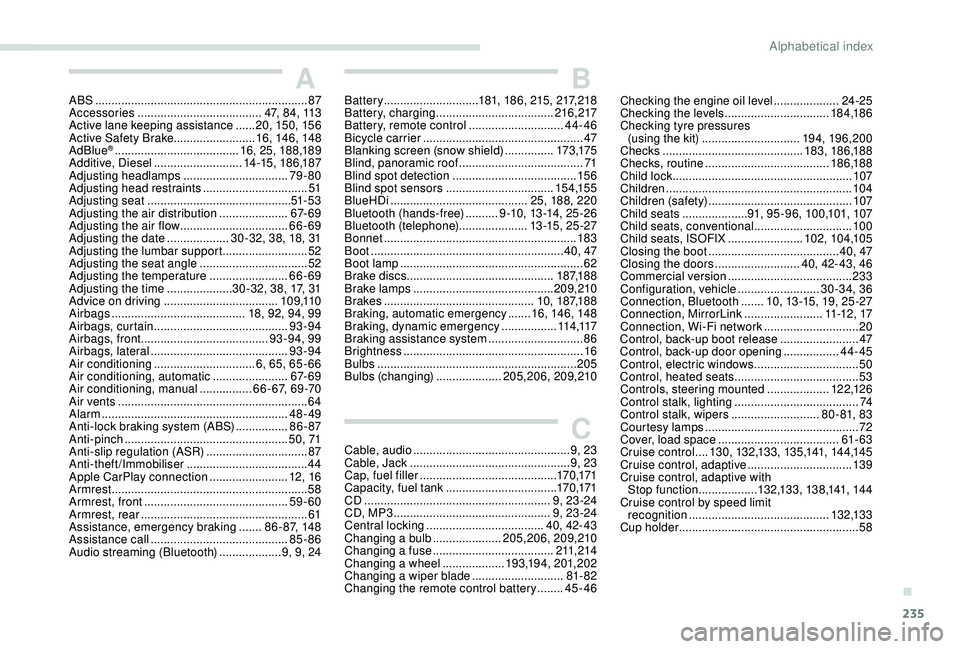
235
AABS .................................................................87
Accessories ...................................... 47, 84, 113
Active lane keeping assistance
......20, 15 0, 15 6
Active Safety Brake......................... 16, 14 6, 148
AdBlue
® ...................................... 1 6, 25, 188,189
Additive, Diesel ........................... 14 -15, 18 6,187
Adjusting headlamps
................................ 79-80
Adjusting head restraints
................................ 51
Adjusting seat
............................................ 51- 5 3
Adjusting the air distribution
.....................67- 6 9
Adjusting the air flow
................................. 6
6-69
Adjusting the date
................... 30 -32, 38, 18, 31
Adjusting the lumbar support
.......................... 52
A
djusting the seat angle
................................. 52
Adjusting the temperature
........................66-69
Adjusting the time
.................... 30 -32, 38, 17, 31
Advice on driving
................................... 109,110
Airbags
...............................
..........18, 92, 94, 99
Airbags, curtain
......................................... 93-94
Airbags, front ....................................... 93 -94, 99
Airbags, lateral
.......................................... 93-94
Air conditioning
............................... 6, 65, 65 - 66
Air conditioning, automatic
.......................67- 6 9
Air conditioning, manual
................ 6
6-67, 69-70
Air vents
.......................................................... 64
Alarm
......................................................... 48-49
Anti-lock braking system (ABS)
................86 - 87
Anti-pinch
.................................................. 5
0, 71
Anti-slip regulation (ASR)
............................... 87
Anti-theft/Immobiliser
..................................... 44
Apple CarPlay connection
........................12, 16
Armrest
................
............................................ 58
Armrest, front
............................................ 59-60
Armrest, rear
...............................
....................61
Assistance, emergency braking
.......86 - 87, 148
Assistance call
...............................
...........85-86
Audio streaming (Bluetooth)
...................9, 9, 24
BBattery ............................. 181, 18 6, 215, 217, 218
Battery, charging .................................... 216,217
Battery, remote control
.............................44-46
Bicycle carrier
...............................
..................47
Blanking screen (snow shield)
...............173 ,175
Blind, panoramic roof
...................................... 71
Blind spot detection
...................................... 15 6
Blind spot sensors
................................. 15 4,15 5
BlueHDi
.......................................... 25, 188, 220
Bluetooth (hands-free)
.......... 9
-10, 13 -14, 25 -2 6
Bluetooth (telephone)
..................... 1
3 -15, 25 -27
Bonnet
........................................................... 183
Boot
........................................................... 40, 47
Boot lamp
........................................................ 62
Brake discs
............................................. 187,188
Brake lamps
...............................
............209,210
Brakes
.............................................. 10, 187,188
Braking, automatic emergency
.......16, 14 6, 148
Braking, dynamic emergency
.................114 ,117
Braking assistance system
.............................86
Brightness
....................................................... 16
Bulbs
............................................................. 205
Bulbs (changing)
....................205,206, 209,210
CCable, audio ................................................ 9, 23
Cable, Jack ................................................. 9, 23
Cap, fuel filler
...............................
...........170,171
Capacity, fuel tank
.................................. 170,171
CD
......................................................... 9, 23 -24
CD, MP3
................................................ 9, 23 -24
Central locking
.................................... 4
0, 42- 43
Changing a bulb
..................... 20
5,206, 209,210
Changing a fuse
..................................... 21
1,214
Changing a wheel
................... 19
3,19 4, 201, 202
Changing a wiper blade
............................ 81
- 82
Changing the remote control battery
........45-46 Checking the engine oil level
....................
24-25
Checking the levels
................................
18 4,18 6
Checking tyre pressures (using the kit)
..............................
19 4, 19 6, 20 0
Checks
...........................................
183, 18 6,188
Checks, routine
......................................
18 6,188
Child lock
.......................................................
107
Children
.........................................................
104
Children (safety)
............................................
107
Child seats
.................... 9
1, 95 - 9 6, 10 0,101, 107
Child seats, conventional
..............................
10 0
Child seats, ISOFIX .......................
102, 104,105
Closing the boot
........................................
4
0, 47
Closing the doors
..........................
40, 42- 43, 46
Commercial version
......................................
233
Configuration, vehicle
......................... 3
0-34, 36
Connection, Bluetooth
....... 1
0, 13 -15, 19, 25 -27
Connection, MirrorLink
........................
11 -12 , 17
Connection, Wi-Fi network
.............................
20
Control, back-up boot release ........................
47
Control, back-up door opening .................
44-45
Control, electric windows
................................
50
Control, heated seats
......................................
53
Controls, steering mounted
...................
12 2,126
Control stalk, lighting
......................................
74
Control stalk, wipers
...........................
8
0 - 81, 8 3
Courtesy lamps ...............................................
72
Cover, load space .....................................
61- 63
Cruise control ....13 0, 132,13 3, 13 5,141, 14 4,14 5
Cruise control, adaptive
................................13 9
Cruise control, adaptive with Stop function
..................132,13 3, 13 8,141, 14 4
Cruise control by speed limit recognition
...............................
............132,13 3
Cup holder
.......................................................58
.
Alphabetical index