key Peugeot 308 2021 User Guide
[x] Cancel search | Manufacturer: PEUGEOT, Model Year: 2021, Model line: 308, Model: Peugeot 308 2021Pages: 244, PDF Size: 8.21 MB
Page 28 of 244
26
Access
For all work on the alarm system, contact a
PEUGEOT dealer or a qualified workshop.
Locking the vehicle with full
alarm system
Activation
► Switch off the engine and exit the vehicle.► Lock the vehicle using the remote
control.
or
► Lock the vehicle with the " Keyless Entry and
Starting" system.
The monitoring system is active: the indicator
lamp in the button flashes once per second and
the direction indicators come on for about 2
seconds.
After an instruction to lock the vehicle using
the remote control or the " Keyless Entry
and Starting" system, the exterior perimeter
monitoring is activated after 5 seconds, the
interior volumetric monitoring after 45 seconds.
If a door, boot, bonnet, etc. is not properly
closed, the vehicle is not locked but monitoring
will be activated after 45 seconds.
Deactivation
► Press this unlocking button on the
remote control.
or
* Only cases valid for GTi vehicles fitted with just the anti-tilt alarm.
when moving (speed above 6 mph (10 km/h)), a
message appears for a few seconds.
In the event of a fault or difficulties felt in
manoeuvring the tailgate when opening
or closing it, have it quickly checked by a
PEUGEOT dealer or a qualified workshop to
stop this issue getting worse and so as to not
cause the tailgate to drop, and serious
injuries.
Back-up control
System allowing the mechanical unlocking of the
boot in the event of a battery or central locking
system malfunction.
Unlocking
► Fold the rear seats down to gain access to
the lock from inside the boot.
►
Insert a small screwdriver into hole A
in the
lock to unlock the boot.
► Move the latch to the right.
Locking again after closing
If the fault persists after closing again, the boot
will remain locked.
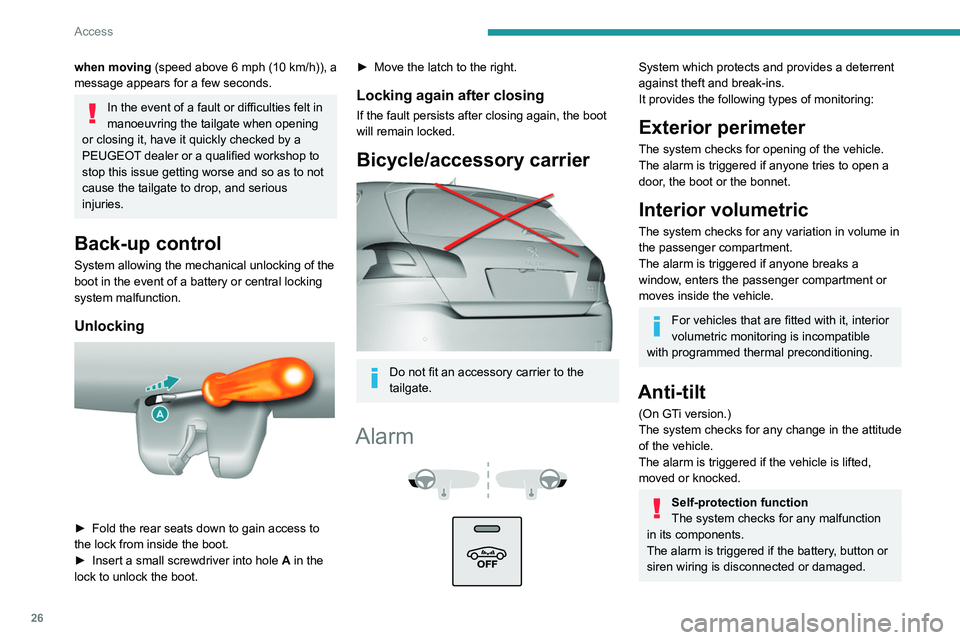
Bicycle/accessory carrier
Do not fit an accessory carrier to the
tailgate.
Alarm
System which protects and provides a deterrent
against theft and break-ins.
It provides the following types of monitoring:
Exterior perimeter
The system checks for opening of the vehicle.
The alarm is triggered if anyone tries to open a
door, the boot or the bonnet.
Interior volumetric
The system checks for any variation in volume in
the passenger compartment.
The alarm is triggered if anyone breaks a
window, enters the passenger compartment or
moves inside the vehicle.
For vehicles that are fitted with it, interior
volumetric monitoring is incompatible
with programmed thermal preconditioning.
Anti-tilt
(On GTi version.)
The system checks for any change in the attitude
of the vehicle.
The alarm is triggered if the vehicle is lifted,
moved or knocked.
Self-protection function
The system checks for any malfunction
in its components.
The alarm is triggered if the battery, button or
siren wiring is disconnected or damaged.
Page 29 of 244
27
Access
2For all work on the alarm system, contact a
PEUGEOT dealer or a qualified workshop.
Locking the vehicle with full
alarm system
Activation
► Switch off the engine and exit the vehicle.► Lock the vehicle using the remote
control.
or
►
Lock the vehicle with the "
Keyless Entry and
Starting" system.
The monitoring system is active: the indicator
lamp in the button flashes once per second and
the direction indicators come on for about 2
seconds.
After an instruction to lock the vehicle using
the remote control or the "
Keyless Entry
and Starting" system, the exterior perimeter
monitoring is activated after 5 seconds, the
interior volumetric monitoring after 45 seconds.
If a door
, boot, bonnet, etc. is not properly
closed, the vehicle is not locked but monitoring
will be activated after 45 seconds.
Deactivation
► Press this unlocking button on the
remote control.
or
* Only cases valid for GT i vehicles fitted with just the anti-tilt alarm.
► Unlock the vehicle with the " Keyless Entry
and Starting" system.
The monitoring system is deactivated: the
indicator lamp in the button goes off and the
direction indicators flash for about 2 seconds.
Where the vehicle locks itself again
automatically (occurs 30 seconds after
unlocking, if a door or the boot is not opened),
the monitoring system is not reactivated
automatically.
To reactivate it, the vehicle must be unlocked
and locked again, using the remote control
key or the "
Keyless Entry and Starting"
system.
Locking the vehicle
with exterior perimeter
monitoring only
Deactivate the interior volumetric monitoring
(and anti-tilt monitoring if fitted to your vehicle) to
avoid unwanted triggering of the alarm in cases
such as:
–
Passengers are inside the vehicle.
–
Leaving a window partially open.
–
W
ashing your vehicle.
–
Changing a wheel*.
–
Having your vehicle towed*.
–
T
ransport by ship or ferry*.
Deactivating the interior volumetric
and anti-tilt monitoring
► Switch off the ignition and within ten
seconds, press this button until the
indicator lamp comes on fixed.
►
Get out of the vehicle.
► Lock the vehicle immediately using the
remote control or the " Keyless Entry and
Starting" system.
The exterior perimeter monitoring alone is
activated: the indicator lamp in the button flashes
once per second.
T
o take effect, this deactivation must be carried
out each time the ignition is switched off.
Reactivating the interior volumetric
monitoring
The anti-tilt alarm is also reactivated, if your
vehicle has one.
► Deactivate exterior perimeter
monitoring by unlocking the vehicle using
the remote control or the "
Keyless Entry and
Starting" system.
The indicator lamp in the button goes off.
►
Reactivate the full alarm system by locking
the vehicle using the remote control or the "
Keyless Entry and Starting" system.
The indicator lamp in the button again flashes
once per second.
Page 30 of 244
28
Access
If the indicator lamp is on, the rear controls are
deactivated.
If the indicator lamp is off, the rear controls are
activated.
Reinitialising the electric
windows
Following reconnection of the battery, the safety
anti-pinch function must be reinitialised.
The anti-pinch function is disabled during the
following operations:
– bring the window down completely, then bring
it back up. It will go up by a few centimetres with
each press. Perform the operation again until the
window is fully closed,
– continue to pull the switch upwards for at least
one second after reaching the window closed
position.
Always remove the key when leaving the vehicle, even for a short time.
In the event of contact (pinching) during
operation of the windows, you must reverse
the movement of the window. To do this,
press the switch concerned.
When operating the passenger electric
window controls, the driver must ensure
that no one is preventing the closing of the
windows.
The driver must ensure that passengers use
the electric windows correctly.
Be aware of children when operating the
windows.
Triggering of the alarm
This is indicated by sounding of the siren and
flashing of the direction indicators for thirty
seconds.
The monitoring functions remain active until
the alarm has been triggered eleven times in
succession.
When the vehicle is unlocked using the
remote control or the " Keyless Entry and
Starting" system, rapid flashing of the indicator
lamp in the button informs you that the alarm
was triggered during your absence.
When the ignition is switched on, this flashing
stops immediately
.
Failure of the remote control
To deactivate the monitoring functions:
► Unlock the vehicle using the key (built into
the remote control) in the driver's door lock.
►
Open the door; this sets off the alarm.
►
Switch the ignition on; the alarm stops.
The
indicator lamp in the button
goes off.
Locking the vehicle without
activating the alarm
► Lock or deadlock the vehicle using the key
(built into the remote control) in the driver's door
lock.
Malfunction
When the ignition is switched on, fixed
illumination of the indicator lamp in the
button indicates a fault with the system.
Have the system checked by a PEUGEOT
dealer or a qualified workshop.
Electric windows
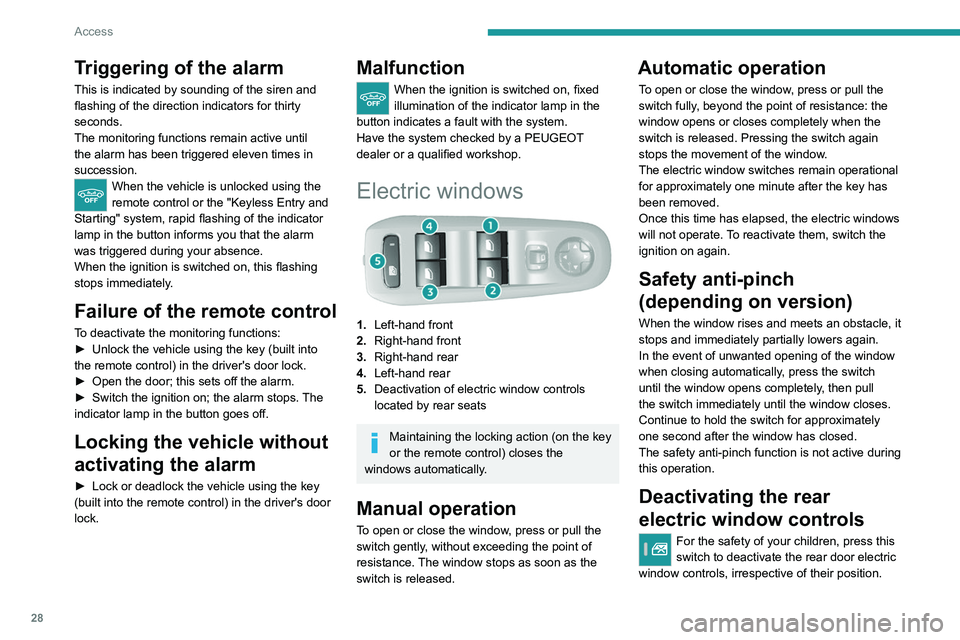
1. Left-hand front
2. Right-hand front
3. Right-hand rear
4. Left-hand rear
5. Deactivation of electric window controls
located by rear seats
Maintaining the locking action (on the key
or the remote control) closes the
windows automatically.
Manual operation
To open or close the window, press or pull the
switch gently, without exceeding the point of
resistance. The window stops as soon as the
switch is released.
Automatic operation
To open or close the window, press or pull the
switch fully, beyond the point of resistance: the
window opens or closes completely when the
switch is released. Pressing the switch again
stops the movement of the window.
The electric window switches remain operational
for approximately one minute after the key has
been removed.
Once this time has elapsed, the electric windows
will not operate. To reactivate them, switch the
ignition on again.
Safety anti-pinch
(depending on version)
When the window rises and meets an obstacle, it
stops and immediately partially lowers again.
In the event of unwanted opening of the window
when closing automatically, press the switch
until the window opens completely, then pull
the switch immediately until the window closes.
Continue to hold the switch for approximately
one second after the window has closed.
The safety anti-pinch function is not active during
this operation.
Deactivating the rear
electric window controls
For the safety of your children, press this
switch to deactivate the rear door electric
window controls, irrespective of their position.
Page 31 of 244
29
Access
2If the indicator lamp is on, the rear controls are
deactivated.
If the indicator lamp is off, the rear controls are
activated.
Reinitialising the electric
windows
Following reconnection of the battery, the safety
anti-pinch function must be reinitialised.
The anti-pinch function is disabled during the
following operations:
–
bring the window down completely
, then bring
it back up. It will go up by a few centimetres with
each press. Perform the operation again until the
window is fully closed,
–
continue to pull the switch upwards for at least
one second after reaching the window closed
position.
Always remove the key when leaving the vehicle, even for a short time.
In the event of contact (pinching) during
operation of the windows, you must reverse
the movement of the window. To do this,
press the switch concerned.
When operating the passenger electric
window controls, the driver must ensure
that no one is preventing the closing of the
windows.
The driver must ensure that passengers use
the electric windows correctly.
Be aware of children when operating the
windows.
Page 36 of 244
34
Ease of use and comfort
They can also be folded for parking in narrow
spaces.
Demisting - Defrosting
Demisting-defrosting of the door mirrors
operates with the engine running, by
switching on the heated rear screen.
For more information on Demisting and
defrosting the rear screen, refer to the
associated section.
Adjustment
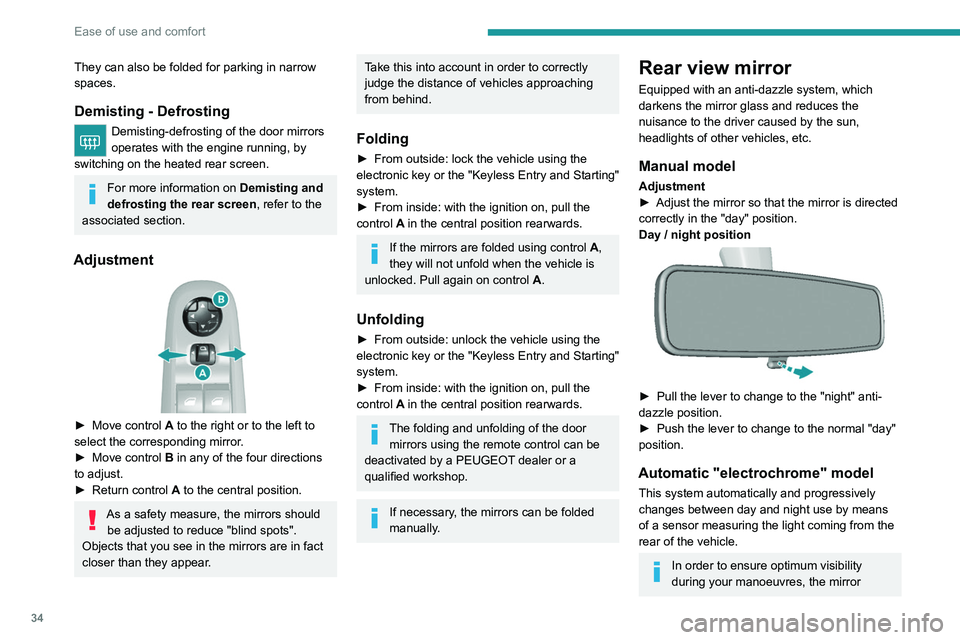
► Move control A to the right or to the left to
select the corresponding mirror.
►
Move control
B in any of the four directions
to adjust.
►
Return control A
to the central position.
As a safety measure, the mirrors should be adjusted to reduce "blind spots".
Objects that you see in the mirrors are in fact
closer than they appear.
Take this into account in order to correctly
judge the distance of vehicles approaching
from behind.
Folding
► From outside: lock the vehicle using the
electronic key or the " Keyless Entry and Starting"
system.
►
From inside: with the ignition on, pull the
control
A in the central position rearwards.
If the mirrors are folded using control A,
they will not unfold when the vehicle is
unlocked. Pull again on control A.
Unfolding
► From outside: unlock the vehicle using the
electronic key or the " Keyless Entry and Starting"
system.
►
From inside: with the ignition on, pull the
control
A in the central position rearwards.
The folding and unfolding of the door mirrors using the remote control can be
deactivated by a PEUGEOT dealer or a
qualified workshop.
If necessary, the mirrors can be folded
manually.
Rear view mirror
Equipped with an anti-dazzle system, which
darkens the mirror glass and reduces the
nuisance to the driver caused by the sun,
headlights of other vehicles, etc.
Manual model
Adjustment
► Adjust the mirror so that the mirror is directed
correctly in the "day" position.
Day / night position
► Pull the lever to change to the "night" anti-
dazzle position.
►
Push the lever to change to the normal "day"
position.
Automatic "electrochrome" model
This system automatically and progressively
changes between day and night use by means
of a sensor measuring the light coming from the
rear of the vehicle.
In order to ensure optimum visibility
during your manoeuvres, the mirror
Page 50 of 244
48
Ease of use and comfort
Closing
► Press the front of the control without going
beyond the point of resistance.
The blind stops when your release the control.
You can also press or pull the control beyond the point of resistance: the blind
opens or closes completely after you release
the control.
Operating the control again stops the
movement of the blind.
Anti-pinch
If the blind encounters an obstacle,
you should reverse the movement. Use the
control to do this.
Remember to always switch off the ignition
when leaving the vehicle, even for a short
time.
When operating the control, the driver should
ensure that there is nothing preventing
movement of the blind.
The driver must ensure that passengers use
the blind correctly.
Be aware of children when operating the
blind.
Courtesy lamps
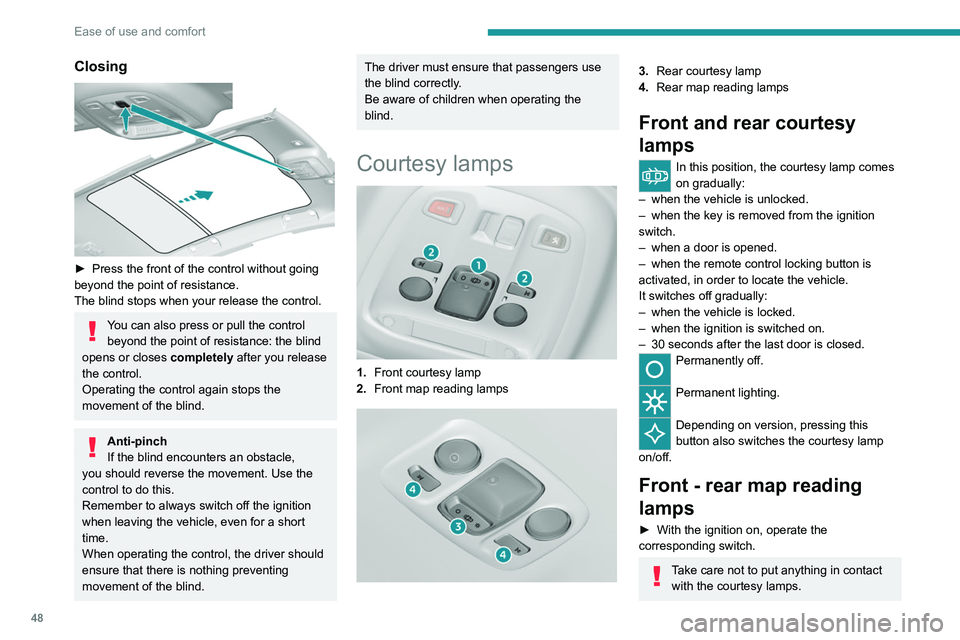
1. Front courtesy lamp
2. Front map reading lamps
3.Rear courtesy lamp
4. Rear map reading lamps
Front and rear courtesy
lamps
In this position, the courtesy lamp comes
on gradually:
–
when the vehicle is unlocked.
–
when the key is removed from the ignition
switch.
–
when a door is opened.
–
when the remote control locking button is
activated, in order to locate the vehicle.
It switches off gradually:
–
when the vehicle is locked.
–
when the ignition is switched on.
–
30 seconds after the last door is closed.
Permanently off.
Permanent lighting.
Depending on version, pressing this
button also switches the courtesy lamp
on/off.
Front - rear map reading
lamps
► With the ignition on, operate the
corresponding switch.
Take care not to put anything in contact with the courtesy lamps.
In "permanent lighting" mode, the lighting
time varies according to the
circumstances:
– when the ignition is off, approximately ten
minutes,
– in energy saving mode, approximately thirty
seconds,
– with the engine running, unlimited.
Footwell lighting
Switching on
Its operation is the same as the courtesy lamps.
The lamps come on when one of the doors is
opened.
Page 71 of 244
69
Safety
5It is recommended that children travel
on the rear seats of the vehicle:
–
‘rear facing’ up to the age of 3,
–
‘forward facing’ over the age of 3.
Make sure that the seat belt is correctly
positioned and tightened.
For child seats with a support leg, ensure that
the support leg is in firm and steady contact
with the floor.
Advice
An incorrectly installed child seat compromises the child's safety in the
event of an accident.
Ensure that there is no seat belt or seat belt
buckle under the child seat, as this could
destabilise it.
Remember to fasten the seat belts or the
harness of child seats, keeping the slack
relative to the child's body to a minimum,
even for short journeys.
When installing a child seat using the seat
belt, ensure that the seat belt is tightened
correctly on the child seat and that it secures
the child seat firmly on the seat of the vehicle.
If the passenger seat is adjustable, move it
forwards if necessary.
Remove the head restraint before
installing a child seat with a backrest on a
passenger seat.
Ensure that the head restraint is stored or
attached securely to prevent it from being
thrown around the vehicle in the event of
sharp braking. Refit the head restraint once
the child seat has been removed.
Installing a booster seat
The chest part of the seat belt must be
positioned on the child's shoulder without
touching the neck.
Ensure that the lap part of the seat belt
passes correctly over the child's thighs.
Use a booster seat with backrest, equipped
with a belt guide at shoulder level.
Additional protections
To prevent accidental opening of the
doors and rear windows, use the "Child lock".
Take care not to open the rear windows by
more than one third.
To protect young children from the rays of the
sun, fit side blinds on the rear windows.
As a safety precaution, do not leave:
–
a child alone and unattended in a vehicle,
–
a child or an animal in a vehicle which is
exposed to the sun, with the windows closed,
–
the keys within reach of children inside the
vehicle.
Child seat at the rear
"Forward facing" or "Rearward
facing"
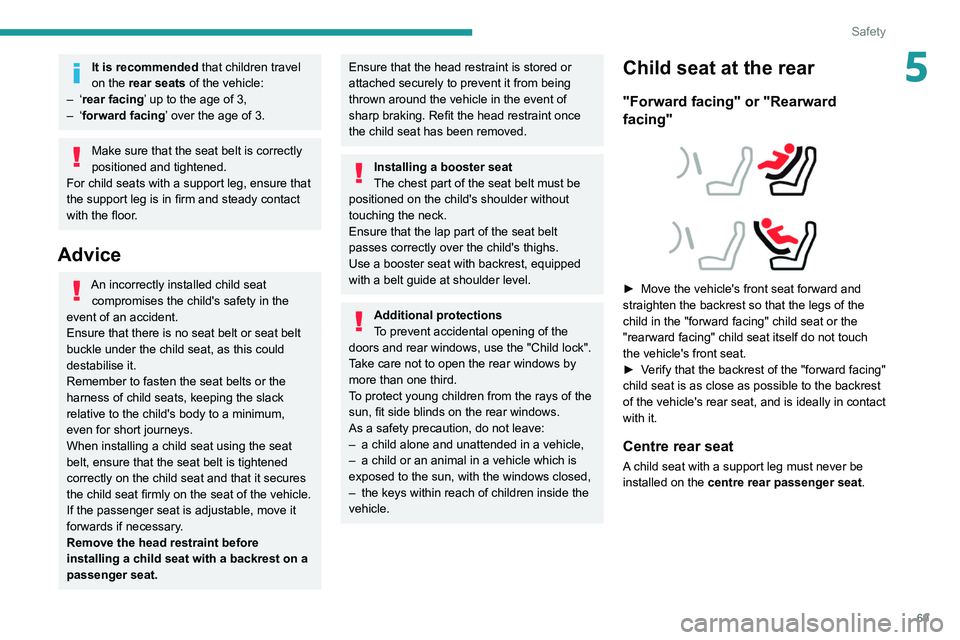
► Move the vehicle's front seat forward and
straighten the backrest so that the legs of the
child in the "forward facing" child seat or the
"rearward facing" child seat itself do not touch
the vehicle's front seat.
►
V
erify that the backrest of the "forward facing"
child seat is as close as possible to the backrest
of the vehicle's rear seat, and is ideally in contact
with it.
Centre rear seat
A child seat with a support leg must never be
installed on the centre rear passenger seat .
Page 72 of 244
70
Safety
Child seat at the front
► Adjust the front passenger seat to the
highest and fully back longitudinal position ,
with the backrest straightened.
"Forward facing"
You must leave the front passenger airbag active.
"Rearward facing"
The front passenger airbag must be deactivated before installing a rearward
facing child seat. Otherwise, the child risks
being seriously injured or killed if the
airbag deploys.
Warning label - Front passenger airbag
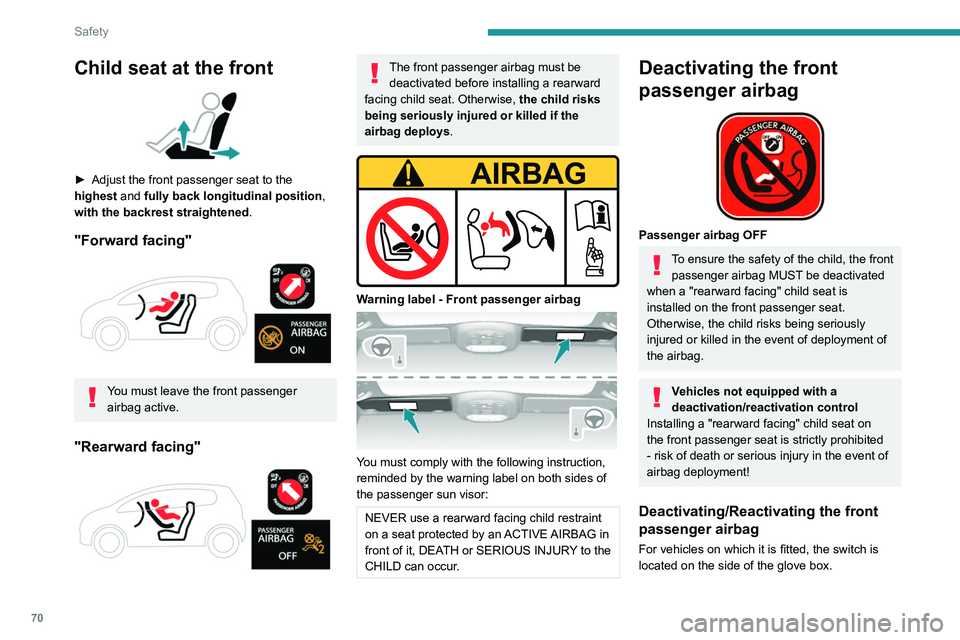
You must comply with the following instruction,
reminded by the warning label on both sides of
the passenger sun visor:
NEVER use a rearward facing child restraint
on a seat protected by an ACTIVE AIRBAG in
front of it, DEATH or SERIOUS INJURY to the
CHILD can occur.
Deactivating the front
passenger airbag
Passenger airbag OFF
To ensure the safety of the child, the front passenger airbag MUST be deactivated
when a "rearward facing" child seat is
installed on the front passenger seat.
Otherwise, the child risks being seriously
injured or killed in the event of deployment of
the
airbag.
Vehicles not equipped with a
deactivation/reactivation control
Installing a "rearward
facing" child seat on
the front passenger seat is strictly prohibited
- risk of death or serious injury in the event of
airbag deployment!
Deactivating/Reactivating the front
passenger airbag
For vehicles on which it is fitted, the switch is
located on the side of the glove box.
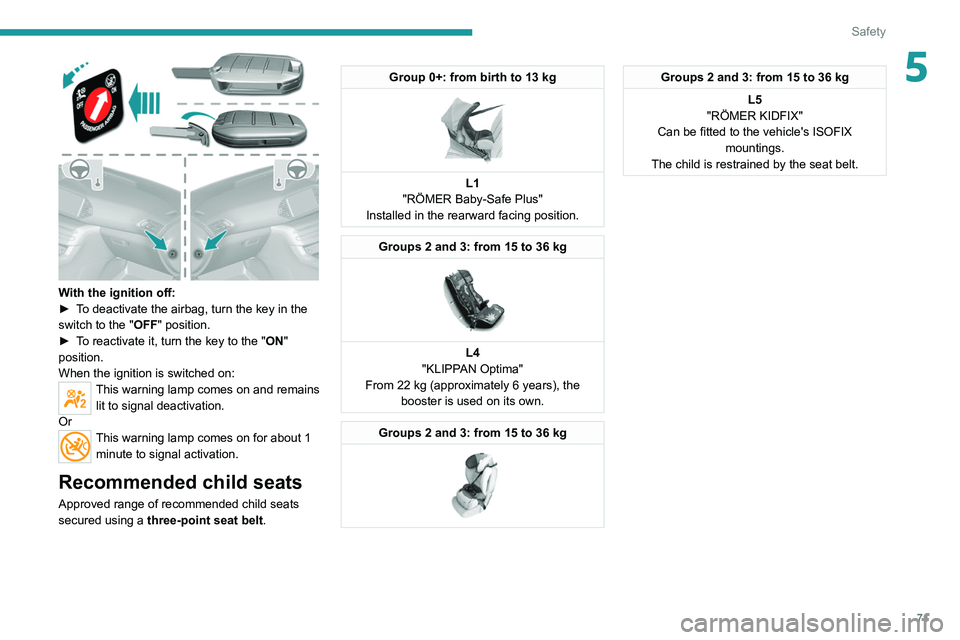
With the ignition off:
► To deactivate the airbag, turn the key in the
switch to the "OFF " position.
► To reactivate it, turn the key to the "ON"
position.
When the ignition is switched on:
This warning lamp comes on and remains lit to signal deactivation.
Or
This warning lamp comes on for about 1 minute to signal activation.
Recommended child seats
Approved range of recommended child seats
secured using a three-point seat belt.
Page 73 of 244
71
Safety
5
With the ignition off:
► T o deactivate the airbag, turn the key in the
switch to the "OFF " position.
►
T
o reactivate it, turn the key to the "ON"
position.
When the ignition is switched on:
This warning lamp comes on and remains lit to signal deactivation.
Or
This warning lamp comes on for about 1 minute to signal activation.
Recommended child seats
Approved range of recommended child seats
secured using a three-point seat belt.
Group 0+: from birth to 13 kg
L1
"RÖMER Baby-Safe Plus"
Installed in the rearward facing position.
Groups 2 and 3: from 15 to 36 kg
L4
"KLIPPAN Optima"
From 22 kg (approximately 6 years), the booster is used on its own.
Groups 2 and 3: from 15 to 36 kg
Groups 2 and 3: from 15 to 36 kg
L5
"RÖMER KIDFIX"
Can be fitted to the vehicle's ISOFIX mountings.
The child is restrained by the seat belt.
Page 80 of 244
78
Safety
Weight of the child/indicative age
Under 10 kg
(group
0)
Up to about 6
months old Under 10
kg
(group
0)
Under 13
kg
(group
0+)
Up to about 1 year old From 9 to 18
kg (group 1)
From about 1 to 3 years old
Type of ISOFIX child seat Carrycot "rearward facing" "rearward
facing""forward facing"
ISOFIX size category F G C D E C D A B B1
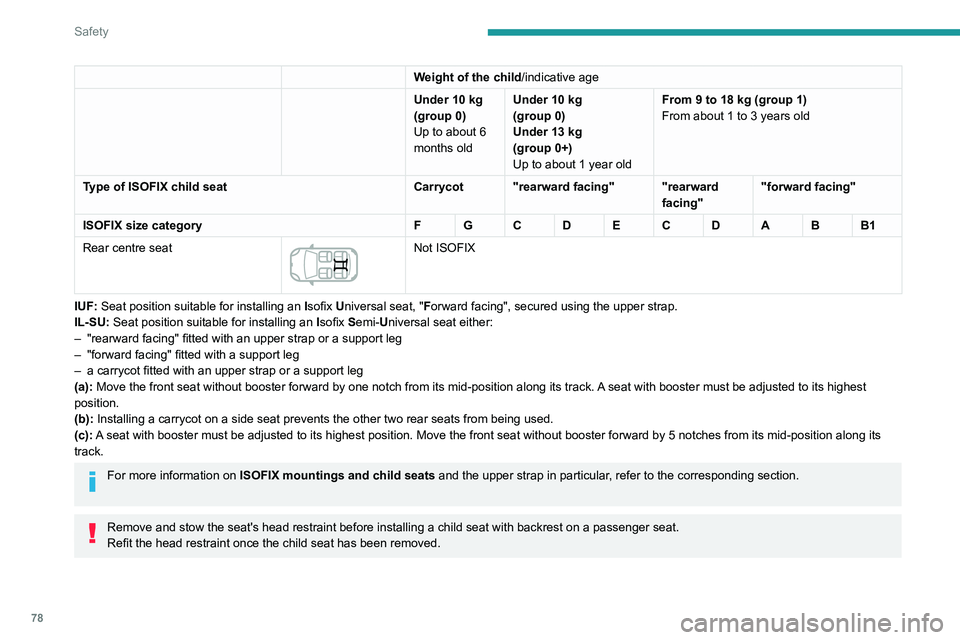
Rear centre seat
Not ISOFIX
IUF: Seat position suitable for installing an Isofix Universal seat, "Forward facing", secured using the upper strap.
IL-SU: Seat position suitable for installing an Isofix Semi-Universal seat either:
–
"rearward facing" fitted with an upper strap or a support leg
–
"forward facing" fitted with a support leg
–
a carrycot fitted with an upper strap or a support leg
(a):
Move the front seat without booster forward by one notch from its mid-p\
osition along its track. A seat with booster must be adjusted to its highest
position.
(b): Installing a carrycot on a side seat prevents the other two rear seats \
from being used.
(c): A seat with booster must be adjusted to its highest position. Move the fr\
ont seat without booster forward by 5 notches from its mid-position alon\
g its
track.
For more information on ISOFIX mountings and child seats and the upper strap in particular, refer to the corresponding section.
Remove and stow the seat's head restraint before installing a child seat\
with backrest on a passenger seat.
Refit the head restraint once the child seat has been removed.
Child lock
This mechanical system prevents opening of a
rear door using its interior control.
The control is located on the edge of each rear
door and locking is independent for each door.
Locking
► Using the built-in key, turn the control as far
as it will go: • to the left on the left-hand rear door,
• to the right on the right-hand rear door.
Unlocking
► Using the built-in key, turn the control as far
as it will go: • to the right on the left-hand rear door,
• to the left on the right-hand rear door.