ECU PEUGEOT 308 CC 2013 User Guide
[x] Cancel search | Manufacturer: PEUGEOT, Model Year: 2013, Model line: 308 CC, Model: PEUGEOT 308 CC 2013Pages: 268, PDF Size: 15.28 MB
Page 94 of 268
6
i
92
FITTINGS
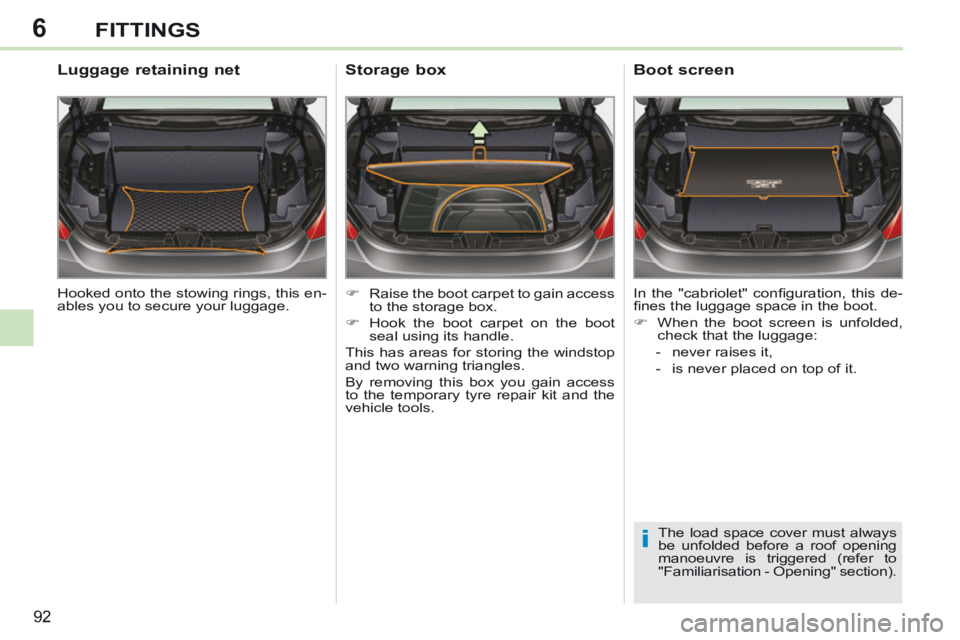
Hooked onto the stowing rings, this en-
ables you to secure your luggage.
Luggage retaining net
Raise the boot carpet to gain access to the storage box.
Hook the boot carpet on the boot seal using its handle.
This has areas for storing the windstop
and two warning triangles.
By removing this box you gain access
to the temporary tyre repair kit and the
vehicle tools.
Storage box Boot screen
In the "cabriolet" confi guration, this de-
fi nes the luggage space in the boot.
When the boot screen is unfolded,
check that the luggage:
- never raises it,
- is never placed on top of it.
The load space cover must always
be unfolded before a roof opening
manoeuvre is triggered (refer to
"Familiarisation - Opening" section).
Page 101 of 268
7
i
99
SAFETY
The driver must ensure that passen-
gers use the seat belts correctly and
that they are all restrained securely
before setting off.
Wherever you are seated in the ve-
hicle, always fasten your seat belt,
even for short journeys.
Do not interchange the seat belt buck-
les as they will not fulfi l their role fully.
The seat belts are fi tted with an inertia
reel permitting automatic adjustment
of the length of the strap to your size.
The seat belt is stowed automatically
when not in use.
Before and after use, ensure that the
seat belt is reeled in correctly.
The lower part of the strap must be
positioned as low as possible on the
pelvis.
The upper part must be positioned in
the hollow of the shoulder.
The inertia reels are fi tted with an au-
tomatic locking device which comes
into operation in the event of a collision,
emergency braking or if the vehicle rolls
over. You can release the device by
pulling fi rmly on the strap and releasing
it so that it reels in slightly. In order to be effective, a seat belt
must:
- be tightened as close to the body
as possible,
- be pulled in front of you with a smooth movement, checking that
it does not twist,
- be used to restrain only one person,
- not bear any trace of cuts or fraying,
- not be converted or modifi ed to avoid affecting its performance.
In accordance with current safety
regulations, for all repairs on your
vehicle, go to a qualifi ed workshop
with the skills and equipment needed,
which a PEUGEOT dealer is able to
provide.
Have your seat belts checked regu-
larly by a PEUGEOT dealer or a
qualifi ed workshop, particularly if the
straps show signs of damage.
Clean the seat belt straps with soapy
water or a textile cleaning product,
sold by PEUGEOT dealers.
After folding or moving a seat or rear
bench seat, ensure that the seat belt
is positioned and reeled in correctly. Recommendations for children
Use a suitable child seat if the pas-
senger is less than 12 years old or
shorter than one and a half metres.
Never use the same seat belt to se-
cure more than one person.
Never allow a child to travel on your
lap.
In the event of an impact
Depending on the nature and serious-
ness of the impact , the pretensioning
device may be deployed before and in-
dependently of the airbags. Deployment
of the pretensioners is accompanied by
a slight discharge of harmless smoke
and a noise, due to the activation of the
pyrotechnic cartridge incorporated in the
system.
In all cases, the airbag warning lamp
comes on.
Following an impact, have the seat
belts system checked, and if neces-
sary replaced, by a PEUGEOT dealer
or a qualifi ed workshop.
Page 111 of 268

7
109
SAFETY
LOCATIONS FOR CHILD SEATS SECURED USING THE SEAT BELT
In accordance with European regulations, this table indicates the option\
s for the installation of child seats secured using the
seat belt and universally approved (a) in relation to the weight of th\
e child and the seat in the vehicle.
(a) Universal child seat: child seat which can be installed in all veh\
icles using the seat belt.
(b) Group 0: from birth to 10 kg. Infant car seats and "car" cots cann\
ot be installed on the front passenger seat.
(c) Consult the legislation in force in your country before installing\
your child on this seat.
(d) To install a child seat, move the front seat forward, then put the seat b\
ack in the upright position to leave enough space for the child seat and the child's legs. The front seat can be moved further forward than the intermediate longitudinal position.
U : seat suitable for the installation of a child seat secured using the seat belt and universally approved "rearward facing" and/ or "forward facing".
U(R1) : same as to U , with the vehicle's seat adjusted to its middle longitudinal position. \
U(R2) : same as U , with the vehicle's seat adjusted to its highest position.
Seat
Weight of the child /indicative age
Less than 13 kg (groups 0 (b) and 0+)
Up to 1 year approx From 9 to 18 kg
(group 1)
From 1 to 3 years approx
From 15 to 25 kg
(group 2)
From 3 to 6 years approx
From 22 to 36 kg
(group 3)
From 6 to 10 years approx
Front passenger seat (c)
- fi x e d
- height adjustable U(R1)
U(R2) U(R1)
U(R2) U(R1)
U(R2) U(R1)
U(R2)
Outer rear
seats (d) U
U U U
Page 112 of 268
7
!
i
11 0
SAFETY
"ISOFIX" MOUNTINGS
Your vehicle has been approved to the
latest ISOFIX regulations .
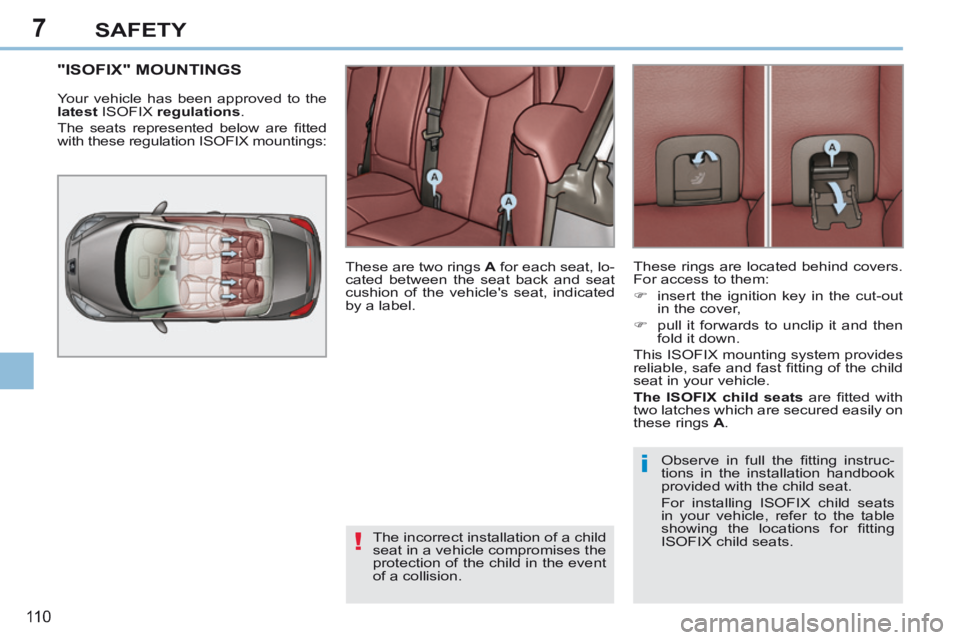
The seats represented below are fi tted
with these regulation ISOFIX mountings:
These are two rings A for each seat, lo-
cated between the seat back and seat
cushion of the vehicle's seat, indicated
by a label.
The incorrect installation of a child
seat in a vehicle compromises the
protection of the child in the event
of a collision. Observe in full the fi tting instruc-
tions in the installation handbook
provided with the child seat.
For installing ISOFIX child seats
in your vehicle, refer to the table
showing the locations for fi tting
ISOFIX child seats.
These rings are located behind covers.
For access to them:
insert the ignition key in the cut-out
in the cover,
pull it forwards to unclip it and then fold it down.
This ISOFIX mounting system provides
reliable, safe and fast fi tting of the child
seat in your vehicle.
The ISOFIX child seats are fi tted with
two latches which are secured easily on
these rings A .
Page 113 of 268
7
i
111
SAFETY
ISOFIX CHILD SEAT RECOMMENDED BY PEUGEOT AND APPROVED FOR YOUR VEHICLE
This child seat can also be used on seats which are not fi tted with ISOFIX mountings.
In this case, it is essential that it is secured to the vehicle's seat b\
y means of the seat belt.
Adjust the vehicle's front seat so that the child's feet do not touch th\
e seat back.
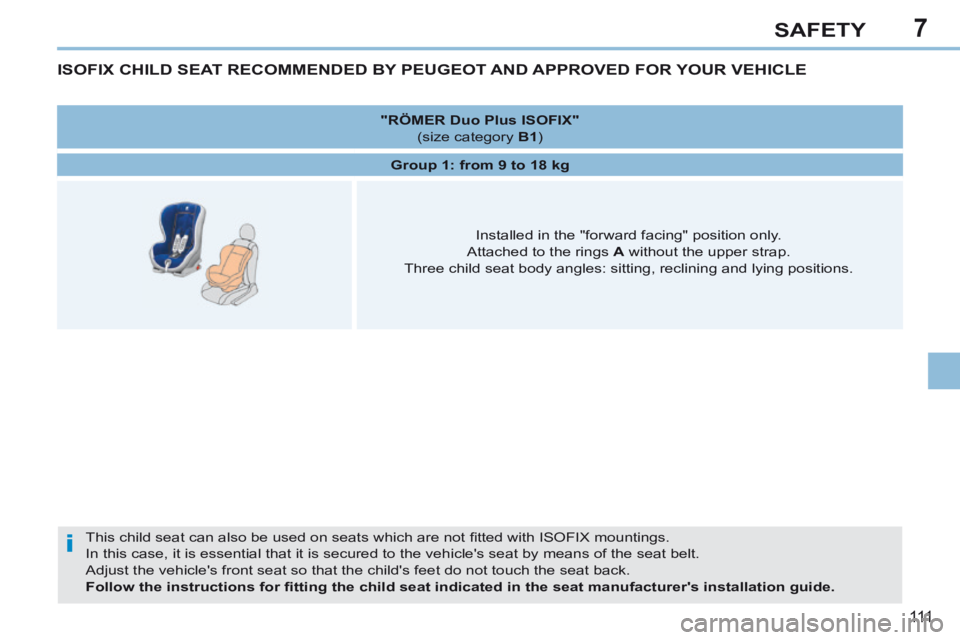
Follow the instructions for fi tting the child seat indicated in the seat manufacturer's installation guide. "RÖMER Duo Plus ISOFIX"
(size category B1 )
Group 1: from 9 to 18 kg
Installed in the "forward facing" position only.
Attached to the rings A without the upper strap.
Three child seat body angles: sitting, reclining and lying positions.
Page 115 of 268
7
!
11 3
SAFETY
ADVICE ON CHILD SEATS
The incorrect installation of a child
seat in a vehicle compromises the
child's protection in the event of an ac-
cident.
When installing a child seat using the
seat belt, ensure that the seat belt is
tightened correctly on the child seat
and that it secures the child seat fi rmly
on the vehicle's seat.
Remember to fasten the seat belts or
the child seat harnesses keeping the
slack in relation to the child's body to
a minimum , even for short journeys.
For optimum installation of the "for-
ward facing" child seat, ensure that
the back of the child seat is as close
as possible to the backrest of the vehi-
cle's seat, even in contact if possible. Children at the front
The legislation on carrying children on
a front passenger seat is specifi c to
each country. Refer to the legislation
in force in your country.
Deactivate the passenger airbag
when a "rearward facing" child seat is
installed on the front seat. Otherwise,
the child would risk being seriously
injured or killed if the airbag were to
infl ate.
As a safety precaution, do not leave:
- one or more children alone and
unsupervised in a vehicle,
- a child or an animal in a vehicle which is exposed to the sun, with
the windows closed,
- the keys within reach of children inside the vehicle.
Installation of a booster seat
The chest part of the seat belt must
be positioned on the child's shoulder
without touching the neck.
Ensure that the lap part of the seat
belt passes correctly over the child's
thighs.
PEUGEOT recommends the use of
a booster seat which has a back, fi t-
ted with a seat belt guide at shoulder
level.
Do not use the passenger's "AIRWAVE"
system if a child seat is installed on the
front seat.
Page 133 of 268
9
i
!
!
!
131
CHECKS
BONNET
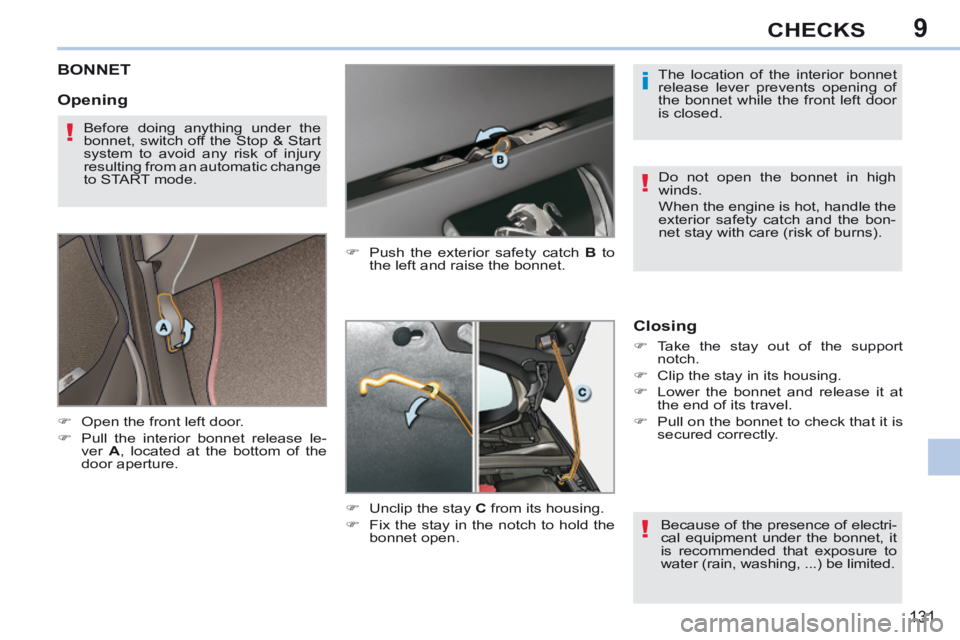
Open the front left door.
Pull the interior bonnet release le-ver A , located at the bottom of the
door aperture. Push the exterior safety catch
B to
the left and raise the bonnet.
Closing
Take the stay out of the support notch.
Clip the stay in its housing.
Lower the bonnet and release it at the end of its travel.
Pull on the bonnet to check that it is secured correctly.
Opening
The location of the interior bonnet
release lever prevents opening of
the bonnet while the front left door
is closed.
Do not open the bonnet in high
winds.
When the engine is hot, handle the
exterior safety catch and the bon-
net stay with care (risk of burns).
Before doing anything under the
bonnet, switch off the Stop & Start
system to avoid any risk of injury
resulting from an automatic change
to START mode.
Unclip the stay C from its housing.
Fix the stay in the notch to hold the bonnet open. Because of the presence of electri-
cal equipment under the bonnet, it
is recommended that exposure to
water (rain, washing, ...) be limited.
Page 147 of 268
10
i
145
PRACTICAL INFORMATION
CHANGING A WHEEL
Procedure for changing a faulty wheel
for the spare wheel using the tools pro-
vided with the vehicle.
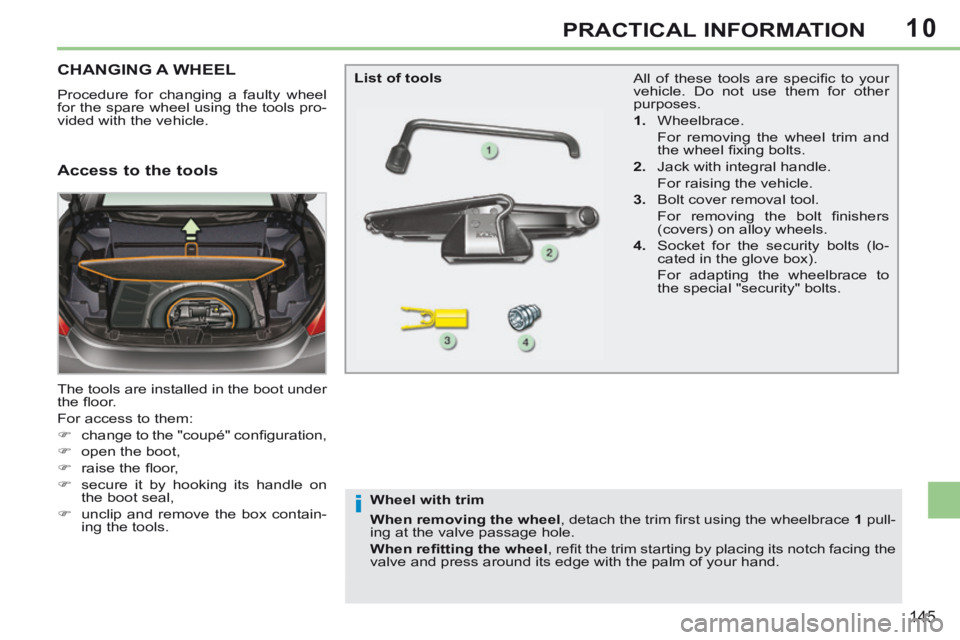
The tools are installed in the boot under
the fl oor.
For access to them:
change to the "coupé" confi guration,
open the boot,
raise the fl oor,
secure it by hooking its handle on the boot seal,
unclip and remove the box contain- ing the tools. All of these tools are specifi c to your
vehicle. Do not use them for other
purposes.
1. Wheelbrace.
For removing the wheel trim and
the wheel fi xing bolts.
2. Jack with integral handle.
For raising the vehicle.
3. Bolt cover removal tool.
For removing the bolt fi nishers (covers) on alloy wheels.
4. Socket for the security bolts (lo- cated in the glove box).
For adapting the wheelbrace to the special "security" bolts.
List of tools
Access to the tools
Wheel with trim
When removing the wheel , detach the trim fi rst using the wheelbrace
1 pull-
ing at the valve passage hole.
When refi tting the wheel , refi t the trim starting by placing its notch facing the
valve and press around its edge with the palm of your hand.
Page 148 of 268
10
i
i
146
PRACTICAL INFORMATION
Fitting the steel spare wheel
If your vehicle is fi tted with alloy
wheels, it is normal to notice, when
tightening the bolts on fi tting, that
the washers do not come into con-
tact with the steel spare wheel. The
wheel is secured by the conical
contact of each bolt.
Access to the spare wheel
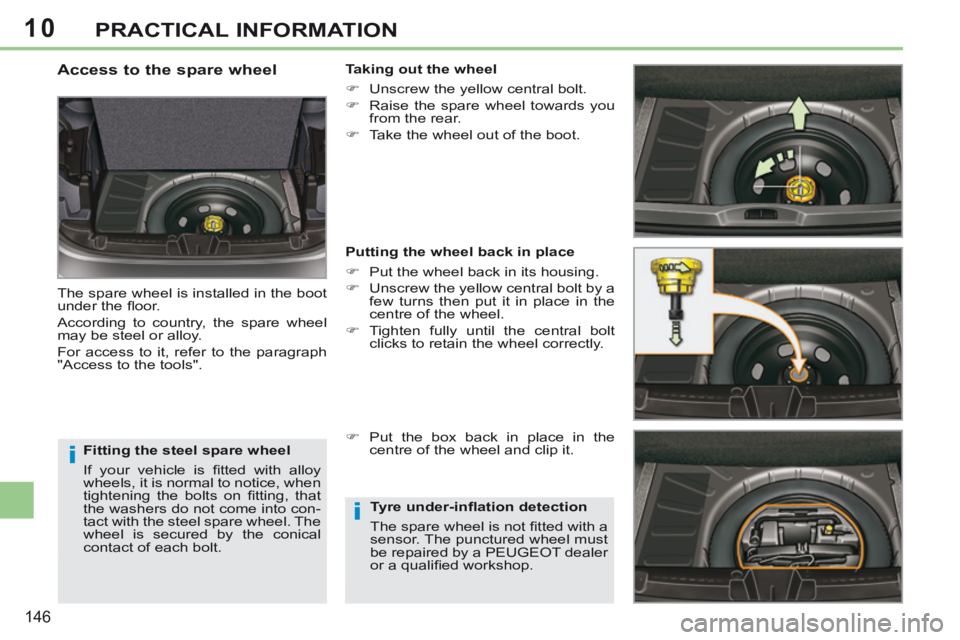
The spare wheel is installed in the boot
under the fl oor.
According to country, the spare wheel
may be steel or alloy.
For access to it, refer to the paragraph
"Access to the tools". Taking out the wheel
Unscrew the yellow central bolt.
Raise the spare wheel towards you
from the rear.
Take the wheel out of the boot.
Putting the wheel back in place
Put the wheel back in its housing.
Unscrew the yellow central bolt by a few turns then put it in place in the
centre of the wheel.
Tighten fully until the central bolt clicks to retain the wheel correctly.
Put the box back in place in the c entre of the wheel and clip it.
Tyre under-infl ation detection
The spare wheel is not fi tted with a
sensor. The punctured wheel must
be repaired by a PEUGEOT dealer
or a qualifi ed workshop.
Page 149 of 268
10
i
147
PRACTICAL INFORMATION
Parking the vehicle
Immobilise the vehicle where it
does not block traffi c: the ground
must be level, stable and non-
slippery ground.
Apply the parking brake, switch off
the ignition and engage fi rst gear *
to lock the wheels.
If necessary, place a chock under
the wheel diagonally opposite the
wheel to be changed.
It is imperative that you ensure that
the occupants get out of the ve-
hicle and wait where they are safe.
Never go underneath a vehicle
raised using a jack; use an axle
stand.
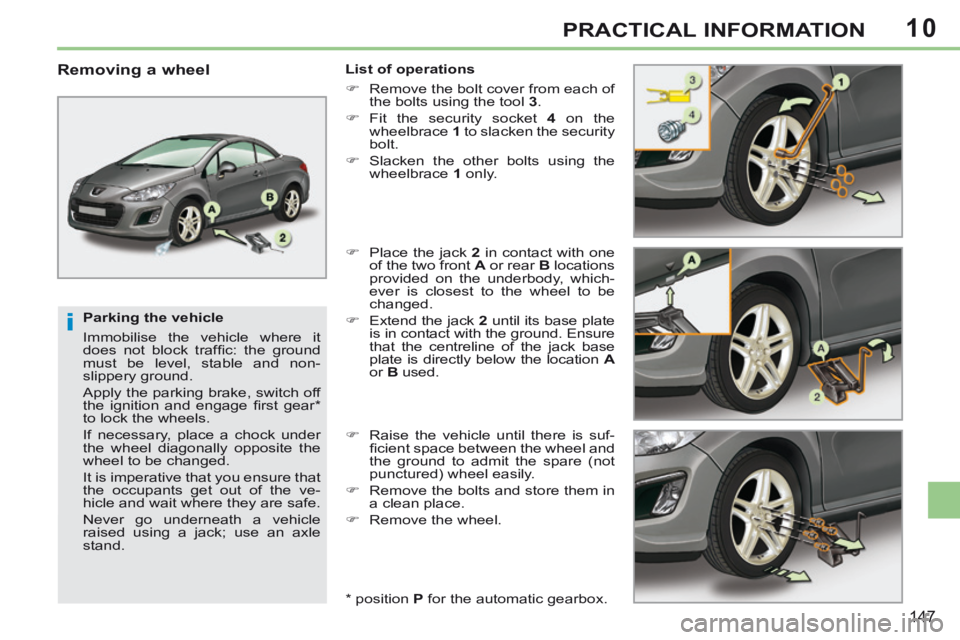
Removing a wheel List of operations
Remove the bolt cover from each of the bolts using the tool 3 .
Fit the security socket 4 on the
wheelbrace 1 to slacken the security
bolt.
Slacken the other bolts using the wheelbrace 1 only.
Place the jack 2 in contact with one
of the two front A or rear B locations
provided on the underbody, which-
ever is closest to the wheel to be
changed.
Extend the jack 2 until its base plate
is in contact with the ground. Ensure
that the centreline of the jack base
plate is directly below the location A
or B used.
Raise the vehicle until there is suf- fi cient space between the wheel and
the ground to admit the spare (not
punctured) wheel easily.
Remove the bolts and store them in a clean place.
Remove the wheel.
* position P for the automatic gearbox.