battery PEUGEOT 308 CC 2013 User Guide
[x] Cancel search | Manufacturer: PEUGEOT, Model Year: 2013, Model line: 308 CC, Model: PEUGEOT 308 CC 2013Pages: 268, PDF Size: 15.28 MB
Page 75 of 268
4
i
i
73
ACCESS
Unlocking and partially opening
the boot
BOOT
Boot anti-theft protection
The boot is designed to remain secure,
even in the "cabriolet" confi guration, if
the vehicle is locked.
So, when the vehicle is locked and the
roof is open, the boot cannot be un-
locked:
- by means of the interior door open-ing control,
- by pressing the manual central lock- ing control A , when the key is not in
the ignition switch.
Opening
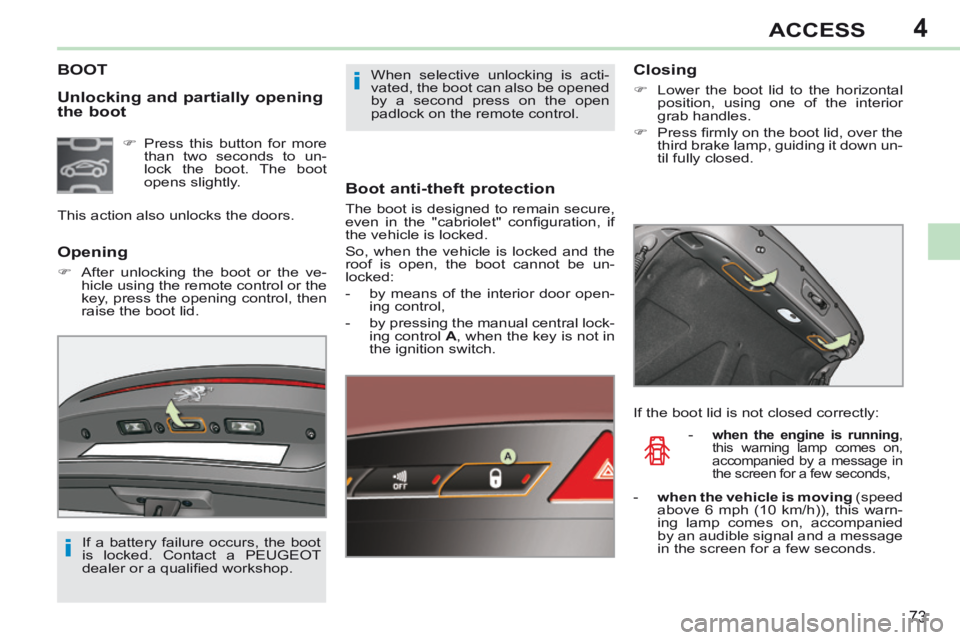
After unlocking the boot or the ve- hicle using the remote control or the
key, press the opening control, then
raise the boot lid. When selective unlocking is acti-
vated, the boot can also be opened
by a second press on the open
padlock on the remote control.
Press this button for more than two seconds to un-
lock the boot. The boot
opens slightly.
This action also unlocks the doors.
If a battery failure occurs, the boot
is locked. Contact a PEUGEOT
dealer or a qualifi ed workshop.
Closing
Lower the boot lid to the horizontal position, using one of the interior
grab handles.
Press fi rmly on the boot lid, over the third brake lamp, guiding it down un-
til fully closed.
If the boot lid is not closed correctly: -
when the engine is running ,
this warning lamp comes on,
accompanied by a message in
the screen for a few seconds,
- when the vehicle is moving (speed above 6 mph (10 km/h)), this warn-
ing lamp comes on, accompanied
by an audible signal and a message
in the screen for a few seconds.
Page 79 of 268
5
!i
i
77
VISIBILITY
Front and rear foglamps.
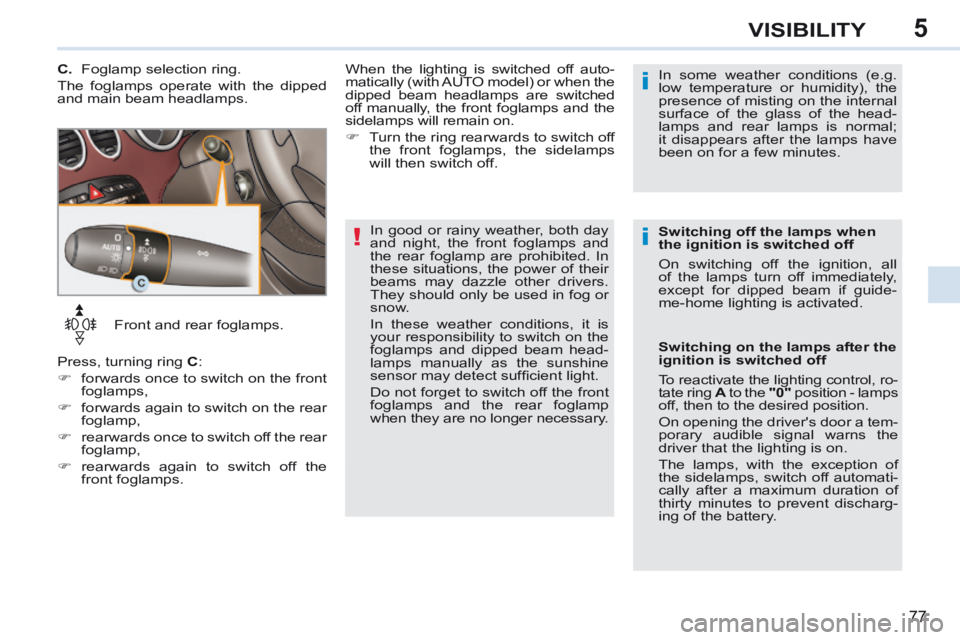
Press, turning ring C :
forwards once to switch on the front foglamps,
forwards again to switch on the rear foglamp,
rearwards once to switch off the rear foglamp,
rearwards again to switch off the front foglamps.
In good or rainy weather, both day
and night, the front foglamps and
the rear foglamp are prohibited. In
these situations, the power of their
beams may dazzle other drivers.
They should only be used in fog or
snow.
In these weather conditions, it is
your responsibility to switch on the
foglamps and dipped beam head-
lamps manually as the sunshine
sensor may detect suffi cient light.
Do not forget to switch off the front
foglamps and the rear foglamp
when they are no longer necessary.
Switching off the lamps when
the ignition is switched off
On switching off the ignition, all
of the lamps turn off immediately,
except for dipped beam if guide-
me-home lighting is activated.
C. Foglamp selection ring.
The foglamps operate with the dipped
and main beam headlamps.
In some weather conditions (e.g.
low temperature or humidity), the
presence of misting on the internal
surface of the glass of the head-
lamps and rear lamps is normal;
it disappears after the lamps have
been on for a few minutes.
Switching on the lamps after the
ignition is switched off
To reactivate the lighting control, ro-
tate ring A to the "0" position - lamps
off, then to the desired position.
On opening the driver's door a tem-
porary audible signal warns the
driver that the lighting is on.
The lamps, with the exception of
the sidelamps, switch off automati-
cally after a maximum duration of
thirty minutes to prevent discharg-
ing of the battery.
When the lighting is switched off auto-
matically (with AUTO model) or when the
dipped beam headlamps are switched
off manually, the front foglamps and the
sidelamps will remain on.
Turn the ring rearwards to switch off
the front foglamps, the sidelamps
will then switch off.
Page 120 of 268
8
PRND
!i
11 8
DRIVING
Return to automatic operation
At any time, press the button select-ed again to quit the programme en-
gaged and return to auto-adaptive
mode.
Manual operation
Select position M for sequential
changing of the six gears.
Push the lever towards the + sign to
change up a gear.
Pull the lever towards the - sign to
change down a gear.
It is only possible to change from one
gear to another if the vehicle speed and
engine speed permit; otherwise, the
gearbox will operate temporarily in au-
tomatic mode.
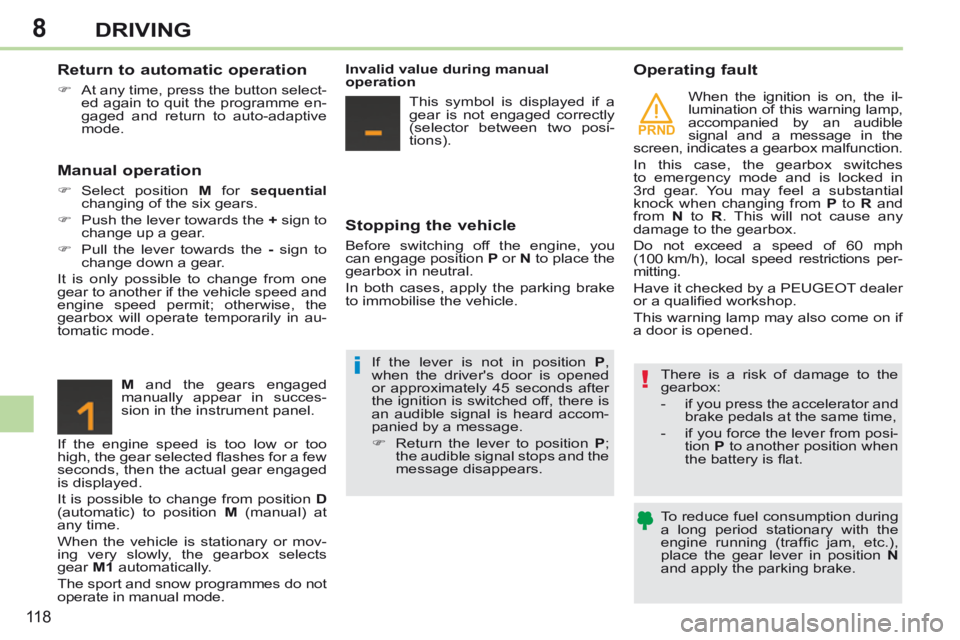
M and the gears engaged
manually appear in succes-
sion in the instrument panel.
If the engine speed is too low or too
high, the gear selected fl ashes for a few
seconds, then the actual gear engaged
is displayed.
It is possible to change from position D
(automatic) to position M (manual) at
any time.
When the vehicle is stationary or mov-
ing very slowly, the gearbox selects
gear M1 automatically.
The sport and snow programmes do not
operate in manual mode. Invalid value during manual
operation
This symbol is displayed if a
gear is not engaged correctly
(selector between two posi-
tions).
Stopping the vehicle
Before switching off the engine, you
can engage position P or N to place the
gearbox in neutral.
In both cases, apply the parking brake
to immobilise the vehicle.
Operating fault
There is a risk of damage to the
gearbox:
- if you press the accelerator and brake pedals at the same time,
- if you force the lever from posi- tion P to another position when
the battery is fl at.
To reduce fuel consumption during
a long period stationary with the
engine running (traffi c jam, etc.),
place the gear lever in position N
and apply the parking brake.
If the lever is not in position
P ,
when the driver's door is opened
or approximately 45 seconds after
the ignition is switched off, there is
an audible signal is heard accom-
panied by a message.
Return the lever to position P ;
the audible signal stops and the
message disappears. When the ignition is on, the il-
lumination of this warning lamp,
accompanied by an audible
signal and a message in the
screen, indicates a gearbox malfunction.
In this case, the gearbox switches
to emergency mode and is locked in
3rd gear. You may feel a substantial
knock when changing from P to R and
from N to R . This will not cause any
damage to the gearbox.
Do not exceed a speed of 60 mph
(100 km/h), local speed restrictions per-
mitting.
Have it checked by a PEUGEOT dealer
or a qualifi ed workshop.
This warning lamp may also come on if
a door is opened.
Page 121 of 268
8
!
i
i
11 9
DRIVING
STOP & START
The Stop & Start system puts the en-
gine temporarily into standby - STOP
mode - during stops in the traffi c (red
lights, traffi c jams, etc...). The engine
restarts automatically - START mode -
as soon as you want to move off. The
restart takes place instantly, quickly and
silently.
Perfect for urban use, the Stop & Start
system reduces fuel consumption, ex-
haust emissions and the noise level
when stationary.
Operation
Going into engine STOP mode The "ECO" warning lamp comes
on in the instrument panel and the
engine goes into standby:
- with a manual gearbox , at speeds below 12 mph (20 km/h), when you
put the gear lever into neutral, and
you release the clutch pedal.
If your vehicle is fi tted with it, a time counter calculates the
sum of the periods in STOP
mode during a journey. It
rests itself to zero every time
the ignition is switched on with the key. For your comfort when parking,
STOP mode is not available for a
few seconds after coming out of
reverse gear.
STOP mode does not affect the
functionality of the vehicle, such
as braking, power steering, for ex-
ample.
Never refuel with the engine in
STOP mode; you must switch off
the ignition with the key. Special cases: STOP mode
unavailable
STOP mode is not invoked when:
- the driver's door is open,
- the driver's seat belt is not fastened,
- the vehicle has not exceeded 6 mph
(10 km/h) since the last engine start
using the key,
- the engine is needed to maintain a comfortable temperature in the pas-
senger compartment,
- demisting is active,
- some special conditions (battery charge, engine temperature, brak-
ing assistance, ambient tempera-
ture...) where the engine is needed
to assure control of a system.
The "ECO" warning lamp fl ash-
es for a few seconds, then goes
off.
This operation is perfectly normal.
In STOP mode of Stop & Start, the
"AIRWAVE" system stops working.
Page 122 of 268
8
i
i
!
120
DRIVING
Going into engine START mode The "ECO" warning lamp goes
off and the engine starts:
- with a manual gearbox , when you fully depress the clutch pedal. Special cases: START invoked
automatically
For your safety and comfort, START
mode is invoked automatically when:
- you open the driver's door,
- you unfasten the driver's seat belt,
- the speed of the vehicle exceeds
15 mph (25 km/h) with a manual
gearbox,
- some special conditions (battery charge, engine temperature, brak-
ing assistance, ambient tempera-
ture...) where the engine is needed
to assure control of a system.
The "ECO" warning lamp fl ash-
es, then goes off.
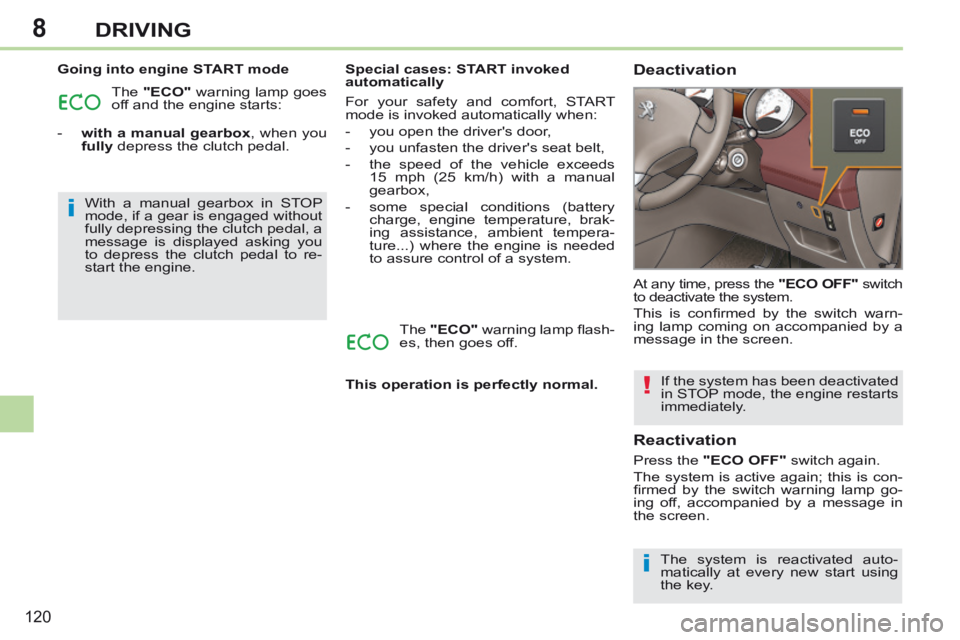
This operation is perfectly normal. Deactivation
If the system has been deactivated
in STOP mode, the engine restarts
immediately.
At any time, press the
"ECO OFF" switch
to deactivate the system.
This is confi rmed by the switch warn-
ing lamp coming on accompanied by a
message in the screen.
Reactivation
Press the "ECO OFF" switch again.
The system is active again; this is con-
fi rmed by the switch warning lamp go-
ing off, accompanied by a message in
the screen.
The system is reactivated auto-
matically at every new start using
the key.
With a manual gearbox in STOP
mode, if a gear is engaged without
fully depressing the clutch pedal, a
message is displayed asking you
to depress the clutch pedal to re-
start the engine.
Page 123 of 268
8
!
!
121
DRIVING
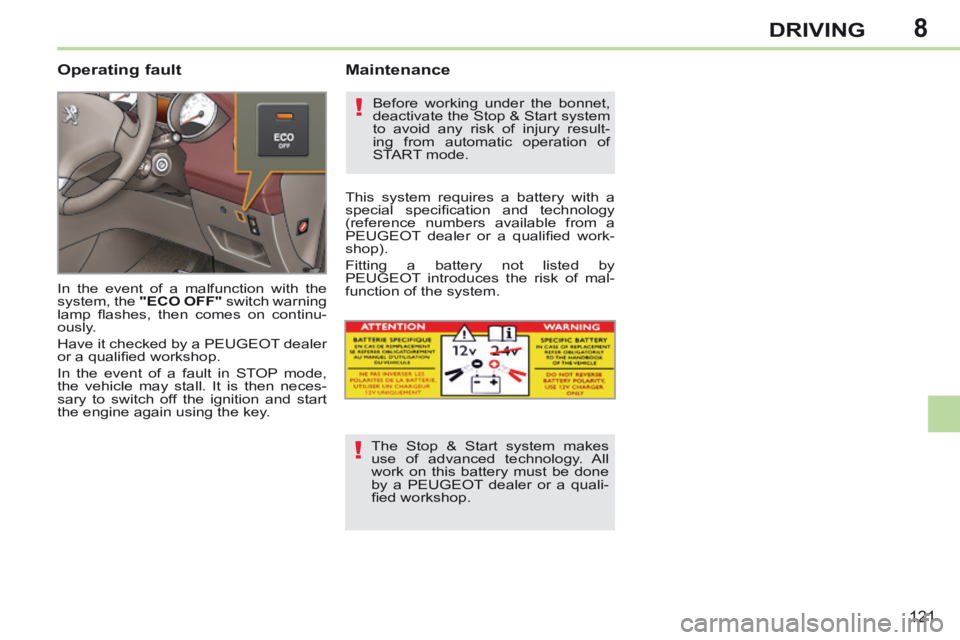
Operating fault
In the event of a malfunction with the
system, the "ECO OFF" switch warning
lamp fl ashes, then comes on continu-
ously.
Have it checked by a PEUGEOT dealer
or a qualifi ed workshop.
In the event of a fault in STOP mode,
the vehicle may stall. It is then neces-
sary to switch off the ignition and start
the engine again using the key.
Maintenance
Before working under the bonnet,
deactivate the Stop & Start system
to avoid any risk of injury result-
ing from automatic operation of
START mode.
This system requires a battery with a
special specifi cation and technology
(reference numbers available from a
PEUGEOT dealer or a qualifi ed work-
shop).
Fitting a battery not listed by
PEUGEOT introduces the risk of mal-
function of the system.
The Stop & Start system makes
use of advanced technology. All
work on this battery must be done
by a PEUGEOT dealer or a quali-
fi ed workshop.
Page 135 of 268
9
133
CHECKS
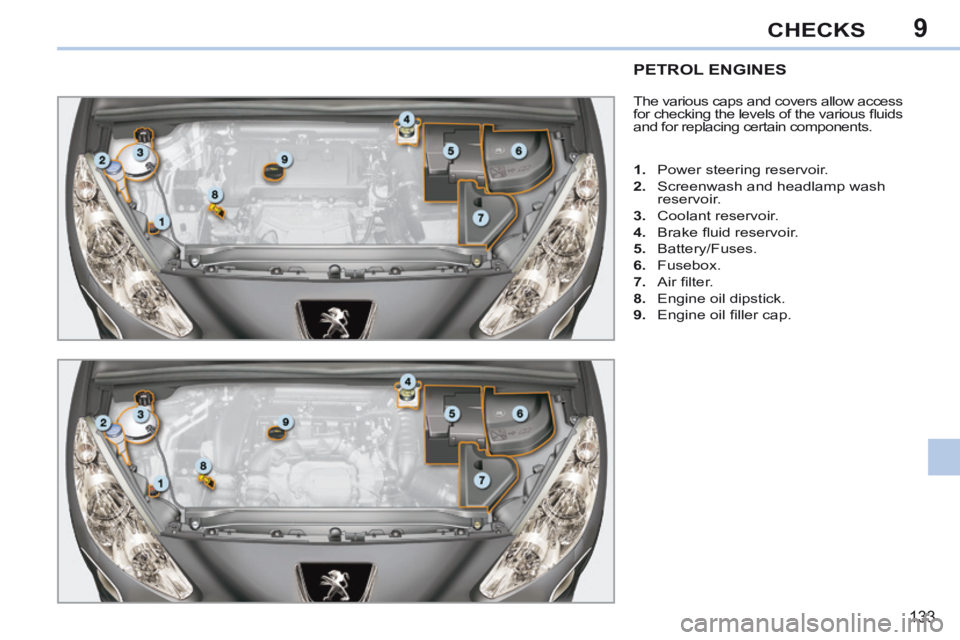
PETROL ENGINES
The various caps and covers allow access
for checking the levels of the various fl uids
and for replacing certain components.
1. Power steering reservoir.
2. Screenwash and headlamp wash reservoir.
3. Coolant reservoir.
4. Brake fl uid reservoir.
5. Battery/Fuses.
6. Fusebox.
7. Air fi lter.
8. Engine oil dipstick.
9. Engine oil fi ller cap.
Page 136 of 268
9
134
CHECKS
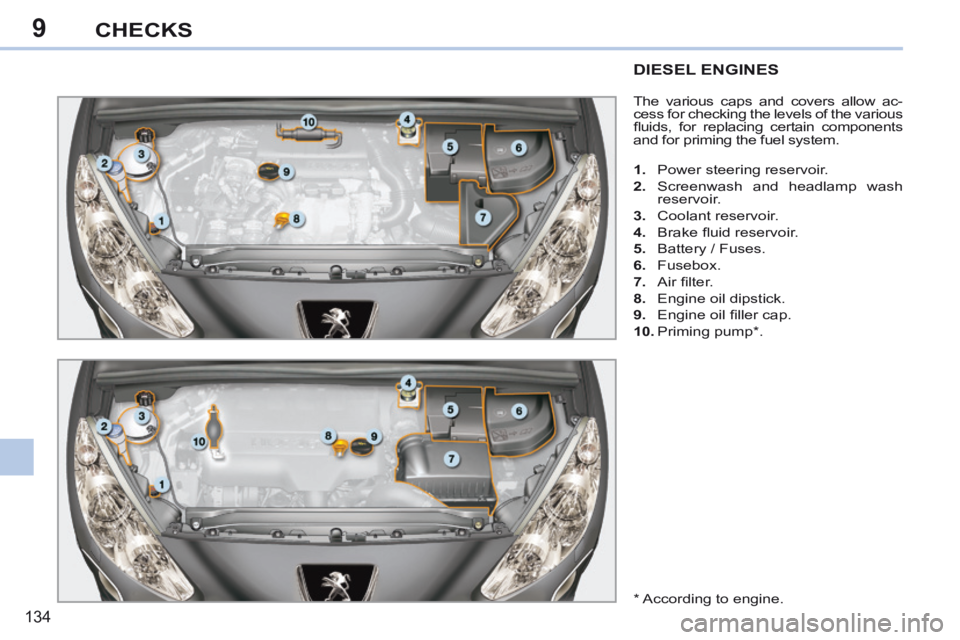
DIESEL ENGINES
The various caps and covers allow ac-
cess for checking the levels of the various
fl uids, for replacing certain components
and for priming the fuel system.
1. Power steering reservoir.
2. Screenwash and headlamp wash reservoir.
3. Coolant reservoir.
4. Brake fl uid reservoir.
5. Battery / Fuses.
6. Fusebox.
7. Air fi lter.
8. Engine oil dipstick.
9. Engine oil fi ller cap.
10. Priming pump * .
* According to engine.
Page 140 of 268
9
i
138
CHECKS
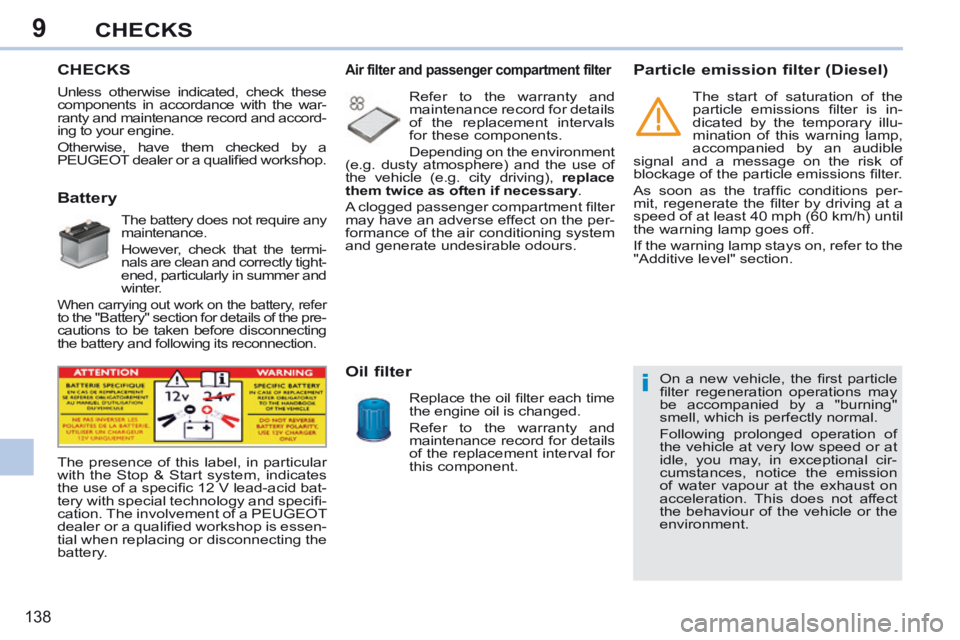
CHECKS
Battery
The battery does not require any
maintenance.
However, check that the termi-
nals are clean and correctly tight-
ened, particularly in summer and
winter.
When carrying out work on the battery, refer to the "Battery" section for details of the pre-
cautions to be taken before disconnecting
the battery and following its reconnection.
Air filter and passenger compartment filter
Refer to the warranty and
maintenance record for details
of the replacement intervals
for these components.
Depending on the environment
(e.g. dusty atmosphere) and the use of
the vehicle (e.g. city driving), replace
them twice as often if necessary .
A clogged passenger compartment fi lter
may have an adverse effect on the per-
formance of the air conditioning system
and generate undesirable odours.
Oil filter
Replace the oil fi lter each time
the engine oil is changed.
Refer to the warranty and
maintenance record for details
of the replacement interval for
this component.
The presence of this label, in particular
with the Stop & Start system, indicates
the use of a specifi c 12 V lead-acid bat-
tery with special technology and specifi -
cation. The involvement of a PEUGEOT
dealer or a qualifi ed workshop is essen-
tial when replacing or disconnecting the
battery.
Particle emission filter (Diesel)
On a new vehicle, the fi rst particle
fi lter regeneration operations may
be accompanied by a "burning"
smell, which is perfectly normal.
Following prolonged operation of
the vehicle at very low speed or at
idle, you may, in exceptional cir-
cumstances, notice the emission
of water vapour at the exhaust on
acceleration. This does not affect
the behaviour of the vehicle or the
environment. The start of saturation of the
particle emissions fi lter is in-
dicated by the temporary illu-
mination of this warning lamp,
accompanied by an audible
signal and a message on the risk of
blockage of the particle emissions fi lter.
As soon as the traffi c conditions per-
mit, regenerate the fi lter by driving at a
speed of at least 40 mph (60 km/h) until
the warning lamp goes off.
If the warning lamp stays on, refer to the
"Additive level" section.
Unless otherwise indicated, check these
components in accordance with the war-
ranty and maintenance record and accord-
ing to your engine.
Otherwise, have them checked by a
PEUGEOT dealer or a qualifi ed workshop.
Page 160 of 268
10
158
PRACTICAL INFORMATION
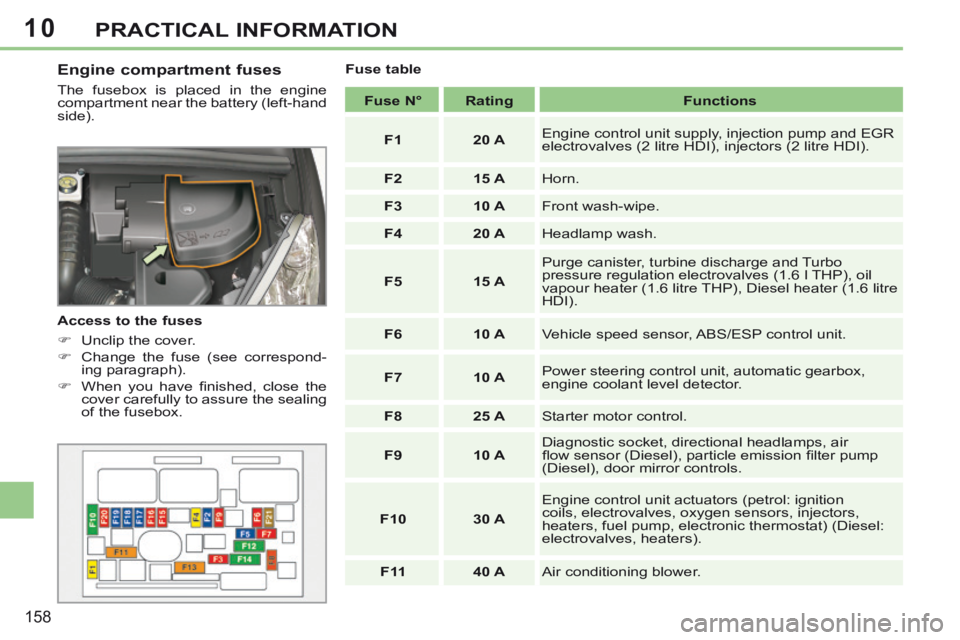
Engine compartment fuses
The fusebox is placed in the engine
compartment near the battery (left-hand
side).
Access to the fuses
Unclip the cover.
Change the fuse (see correspond-ing paragraph).
When you have fi nished, close the cover carefully to assure the sealing
of the fusebox. Fuse table
Fuse N° Rating Functions
F1 20 A Engine control unit supply, injection pump and EGR
electrovalves (2 litre HDI), injectors (2 litre HDI).
F2 15 A Horn.
F3 10 A Front wash-wipe.
F4 20 A Headlamp wash.
F5 15 A Purge canister, turbine discharge and Turbo
pressure regulation electrovalves (1.6 l THP), oil
vapour heater (1.6 litre THP), Diesel heater (1.6 litre
HDI).
F6 10 A Vehicle speed sensor, ABS/ESP control unit.
F7 10 A Power steering control unit, automatic gearbox,
engine coolant level detector.
F8 25 A Starter motor control.
F9 10 A Diagnostic socket, directional headlamps, air
fl ow sensor (Diesel), particle emission fi lter pump
(Diesel), door mirror controls.
F10 30 A Engine control unit actuators (petrol: ignition
coils, electrovalves, oxygen sensors, injectors,
heaters, fuel pump, electronic thermostat) (Diesel:
electrovalves, heaters).
F 11 40 A Air conditioning blower.