light Peugeot 308 CC 2014 Owner's Guide
[x] Cancel search | Manufacturer: PEUGEOT, Model Year: 2014, Model line: 308 CC, Model: Peugeot 308 CC 2014Pages: 268, PDF Size: 15.33 MB
Page 95 of 268
7
i
i
93
SAFETY
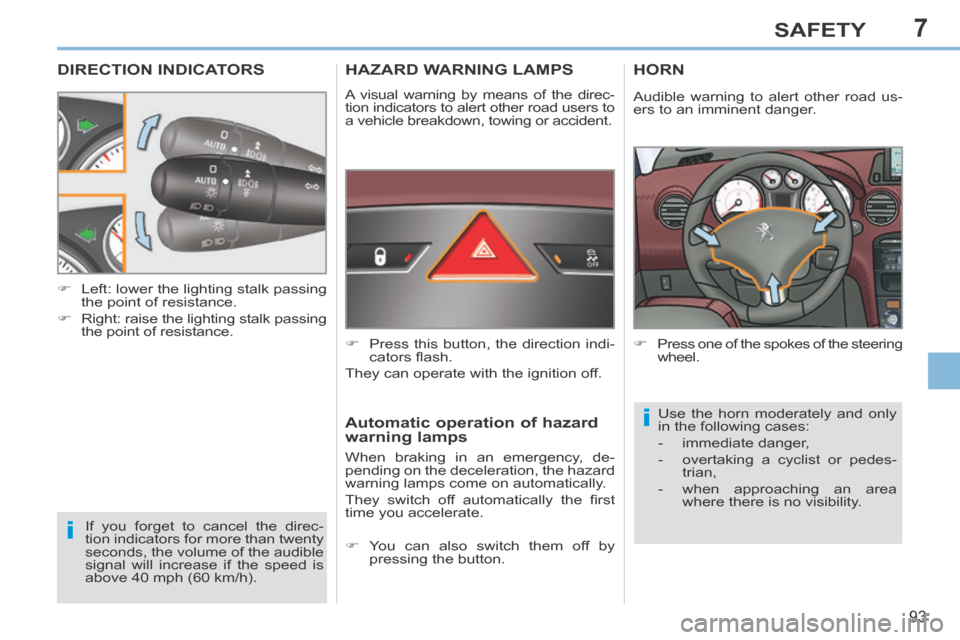
DIRECTION INDICATORS
If you forget to cancel the direc-
tion indicators for more than twenty
seconds, the volume of the audible
signal will increase if the speed is
above 40 mph (60 km/h).
Left: lower the lighting stalk passing
the point of resistance.
Right: raise the lighting stalk passing the point of resistance.
HAZARD WARNING LAMPS
A visual warning by means of the direc-
tion indicators to alert other road users to
a vehicle breakdown, towing or accident.
Press this button, the direction indi-cators fl ash.
They can operate with the ignition off.
Automatic operation of hazard
warning lamps
When braking in an emergency, de-
pending on the deceleration, the hazard
warning lamps come on automatically.
They switch off automatically the fi rst
time you accelerate.
You can also switch them off by pressing the button.
HORN
Press one of the spokes of the steering wheel.
Use the horn moderately and only
in the following cases:
- immediate danger,
- overtaking a cyclist or pedes- trian,
- when approaching an area where there is no visibility.
Audible warning to alert other road us-
ers to an imminent danger.
Page 96 of 268
7
!
i
!
94
SAFETY
BRAKING ASSISTANCE SYSTEMS
Group of supplementary systems which
help you to obtain optimum braking in
complete safety in emergency situations:
- anti-lock braking system (ABS),
- electronic brake force distribution (EBFD),
- emergency braking assistance (EBA).
Anti-lock braking system
and electronic brake force
distribution
Linked systems which improve the sta-
bility and manoeuvrability of your vehi-
cle when braking, in particular on poor
or slippery surfaces.
When braking in an emergency,
press very fi rmly without releasing
the pressure. When replacing wheels (tyres and
rims), ensure that they conform to
the manufacturer's recommenda-
tions.
Operating fault If this warning lamp comes on,
accompanied by an audible
signal and a message in the
screen, it indicates a malfunc-
tion of the anti-lock braking system
which could result in loss of control of
the vehicle when braking. If this warning lamp comes on,
together with the
STOP and
ABS warning lamps, accompa-
nied by an audible signal and
a message in the screen, it indicates a
malfunction of the electronic brake force
distribution which could result in loss of
control of the vehicle when braking.
Emergency braking assistance
System which, in an emergency, en-
ables you to obtain the optimum braking
pressure more quickly, thus reducing the
stopping distance.
Activation
The anti-lock braking system comes
into operation automatically when there
is a risk of wheel lock.
Normal operation of the ABS may make
itself felt by slight vibration of the brake
pedal.
Activation
It is triggered by the speed at which the
brake pedal is pressed.
The effect of this is a reduction in the
resistance of the pedal and an increase
in braking effi ciency. When braking in an emergency,
press fi rmly without releasing the
pressure.
You must stop as soon as it is safe
to do so.
In either case, contact a PEUGEOT
dealer or a qualifi ed workshop.
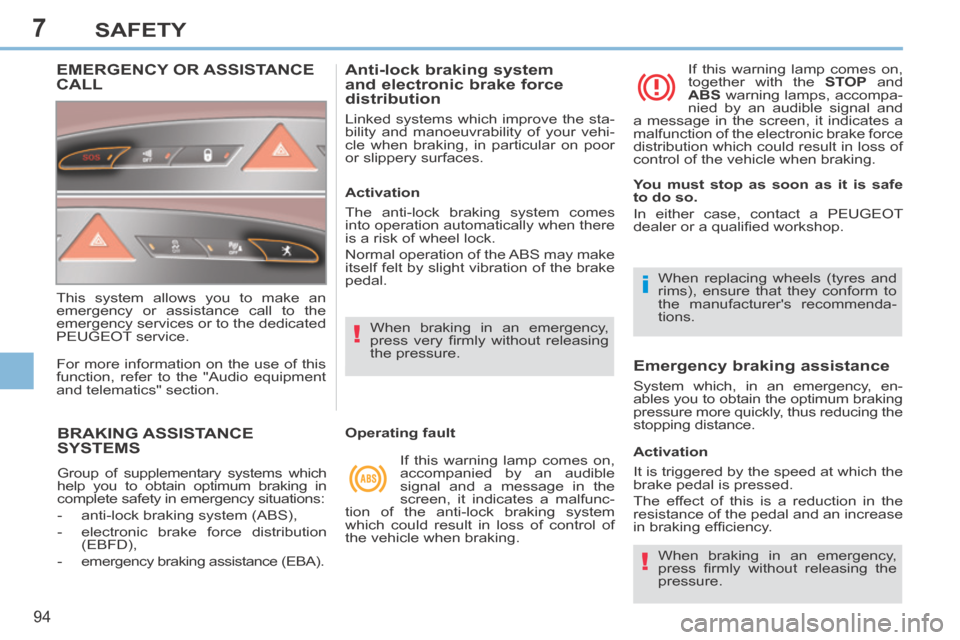
EMERGENCY OR ASSISTANCE CALL
This system allows you to make an
emergency or assistance call to the
emergency services or to the dedicated
PEUGEOT service.
For more information on the use of this
function, refer to the "Audio equipment
and telematics" section.
Page 101 of 268
7
i
99
SAFETY
The driver must ensure that passen-
gers use the seat belts correctly and
that they are all restrained securely
before setting off.
Wherever you are seated in the ve-
hicle, always fasten your seat belt,
even for short journeys.
Do not interchange the seat belt buck-
les as they will not fulfi l their role fully.
The seat belts are fi tted with an inertia
reel permitting automatic adjustment
of the length of the strap to your size.
The seat belt is stowed automatically
when not in use.
Before and after use, ensure that the
seat belt is reeled in correctly.
The lower part of the strap must be
positioned as low as possible on the
pelvis.
The upper part must be positioned in
the hollow of the shoulder.
The inertia reels are fi tted with an au-
tomatic locking device which comes
into operation in the event of a collision,
emergency braking or if the vehicle rolls
over. You can release the device by
pulling fi rmly on the strap and releasing
it so that it reels in slightly. In order to be effective, a seat belt
must:
- be tightened as close to the body
as possible,
- be pulled in front of you with a smooth movement, checking that
it does not twist,
- be used to restrain only one person,
- not bear any trace of cuts or fraying,
- not be converted or modifi ed to avoid affecting its performance.
In accordance with current safety
regulations, for all repairs on your
vehicle, go to a qualifi ed workshop
with the skills and equipment needed,
which a PEUGEOT dealer is able to
provide.
Have your seat belts checked regu-
larly by a PEUGEOT dealer or a
qualifi ed workshop, particularly if the
straps show signs of damage.
Clean the seat belt straps with soapy
water or a textile cleaning product,
sold by PEUGEOT dealers.
After folding or moving a seat or rear
bench seat, ensure that the seat belt
is positioned and reeled in correctly. Recommendations for children
Use a suitable child seat if the pas-
senger is less than 12 years old or
shorter than one and a half metres.
Never use the same seat belt to se-
cure more than one person.
Never allow a child to travel on your
lap.
In the event of an impact
Depending on the nature and serious-
ness of the impact , the pretensioning
device may be deployed before and in-
dependently of the airbags. Deployment
of the pretensioners is accompanied by
a slight discharge of harmless smoke
and a noise, due to the activation of the
pyrotechnic cartridge incorporated in the
system.
In all cases, the airbag warning lamp
comes on.
Following an impact, have the seat
belts system checked, and if neces-
sary replaced, by a PEUGEOT dealer
or a qualifi ed workshop.
Page 102 of 268
7
i
!
100
SAFETY
AIRBAGS
The airbags have been designed to
maximise the safety of the occupants in
the event of violent collisions. They sup-
plement the action of the force-limiting
seat belts.
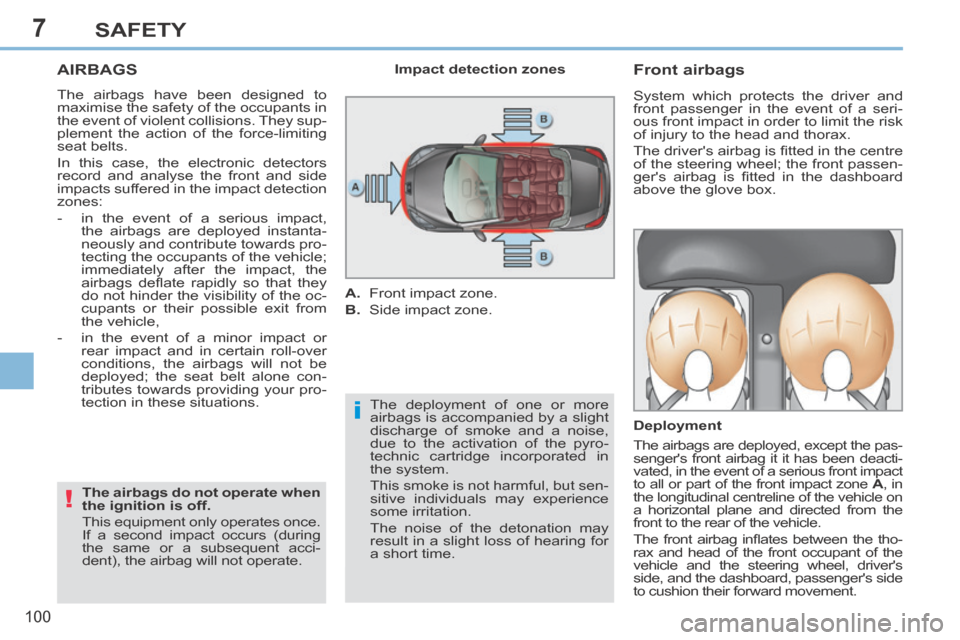
In this case, the electronic detectors
record and analyse the front and side
impacts suffered in the impact detection
zones:
- in the event of a serious impact, the airbags are deployed instanta-
neously and contribute towards pro-
tecting the occupants of the vehicle;
immediately after the impact, the
airbags defl ate rapidly so that they
do not hinder the visibility of the oc-
cupants or their possible exit from
the vehicle,
- in the event of a minor impact or rear impact and in certain roll-over
conditions, the airbags will not be
deployed; the seat belt alone con-
tributes towards providing your pro-
tection in these situations. The deployment of one or more
airbags is accompanied by a slight
discharge of smoke and a noise,
due to the activation of the pyro-
technic cartridge incorporated in
the system.
This smoke is not harmful, but sen-
sitive individuals may experience
some irritation.
The noise of the detonation may
result in a slight loss of hearing for
a short time.
Front airbags
Deployment
The airbags are deployed, except the pas-
senger's front airbag it it has been deacti-
vated, in the event of a serious front impact
to all or part of the front impact zone A , in
the longitudinal centreline of the vehicle on
a horizontal plane and directed from the
front to the rear of the vehicle.
The front airbag infl ates between the tho-
rax and head of the front occupant of the
vehicle and the steering wheel, driver's
side, and the dashboard, passenger's side
to cushion their forward movement.
Impact detection zones
A. Front impact zone.
B. Side impact zone.
The airbags do not operate when
the ignition is off.
This equipment only operates once.
If a second impact occurs (during
the same or a subsequent acci-
dent), the airbag will not operate. System which protects the driver and
front passenger in the event of a seri-
ous front impact in order to limit the risk
of injury to the head and thorax.
The driver's airbag is fi tted in the centre
of the steering wheel; the front passen-
ger's airbag is fi tted in the dashboard
above the glove box.
Page 104 of 268
7
i
102
SAFETY
Lateral airbags
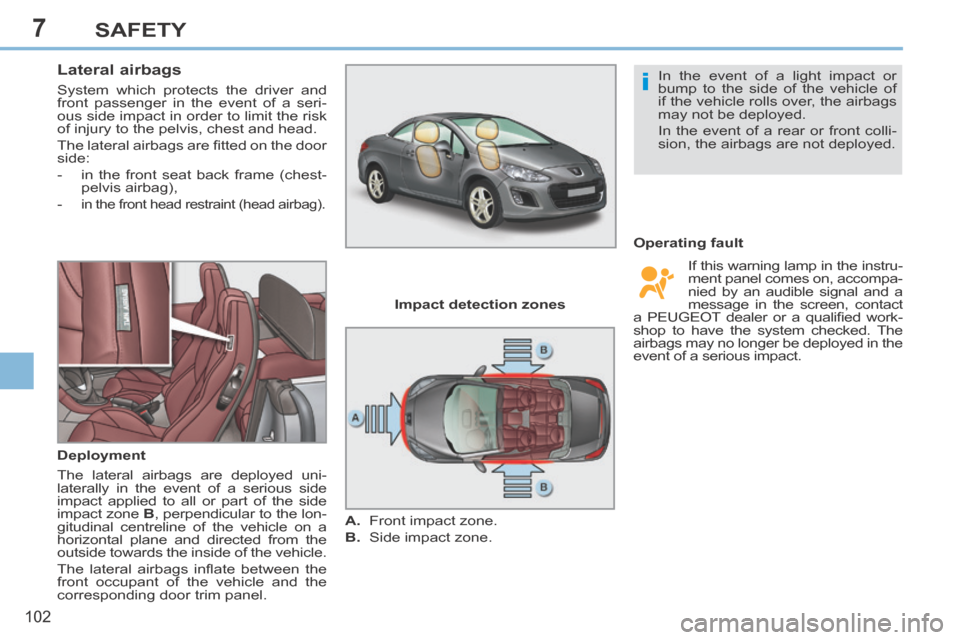
System which protects the driver and
front passenger in the event of a seri-
ous side impact in order to limit the risk
of injury to the pelvis, chest and head.
The lateral airbags are fi tted on the door
side:
- in the front seat back frame (chest-pelvis airbag),
-
in the front head restraint (head airbag).
Deployment
The lateral airbags are deployed uni-
laterally in the event of a serious side
impact applied to all or part of the side
impact zone B , perpendicular to the lon-
gitudinal centreline of the vehicle on a
horizontal plane and directed from the
outside towards the inside of the vehicle.
The lateral airbags infl ate between the
front occupant of the vehicle and the
corresponding door trim panel. Operating fault
Impact detection zones
A. Front impact zone.
B. Side impact zone. If this warning lamp in the instru-
ment panel comes on, accompa-
nied by an audible signal and a
message in the screen, contact
a PEUGEOT dealer or a qualifi ed work-
shop to have the system checked. The
airbags may no longer be deployed in the
event of a serious impact. In the event of a light impact or
bump to the side of the vehicle of
if the vehicle rolls over, the airbags
may not be deployed.
In the event of a rear or front colli-
sion, the airbags are not deployed.
Page 121 of 268
8
!
i
i
11 9
DRIVING
STOP & START
The Stop & Start system puts the en-
gine temporarily into standby - STOP
mode - during stops in the traffi c (red
lights, traffi c jams, etc...). The engine
restarts automatically - START mode -
as soon as you want to move off. The
restart takes place instantly, quickly and
silently.
Perfect for urban use, the Stop & Start
system reduces fuel consumption, ex-
haust emissions and the noise level
when stationary.
Operation
Going into engine STOP mode The "ECO" warning lamp comes
on in the instrument panel and the
engine goes into standby:
- with a manual gearbox , at speeds below 12 mph (20 km/h), when you
put the gear lever into neutral, and
you release the clutch pedal.
If your vehicle is fi tted with
it, a time counter calculates
the sum of the periods in
STOP mode during a jour-
ney. It rests itself to zero ev-
ery time the ignition is switched on with
the key. For your comfort when parking,
STOP mode is not available for a
few seconds after coming out of
reverse gear.
STOP mode does not affect the
functionality of the vehicle, such
as braking, power steering, for ex-
ample.
Never refuel with the engine in
STOP mode; you must switch off
the ignition with the key. Special cases: STOP mode
unavailable
STOP mode is not invoked when:
- the driver's door is open,
- the driver's seat belt is not fastened,
- the vehicle has not exceeded 6 mph
(10 km/h) since the last engine start
using the key,
- the engine is needed to maintain a comfortable temperature in the pas-
senger compartment,
- demisting is active,
- some special conditions (battery charge, engine temperature, brak-
ing assistance, ambient tempera-
ture...) where the engine is needed
to assure control of a system.
The "ECO" warning lamp fl ash-
es for a few seconds, then goes
off.
This operation is perfectly normal.
In STOP mode of Stop & Start, the
"AIRWAVE" system stops working.
Page 141 of 268
9
!
139
CHECKS
Only use products recommended
by PEUGEOT or products of equiv-
alent quality and specifi cation.
In order to optimise the operation
of units as important as those in the
braking system, PEUGEOT selects
and offers very specifi c products.
After washing the vehicle, damp-
ness, or in wintry conditions, ice
can form on the brake discs and
pads: braking effi ciency may be
reduced. Make light brake applica-
tions to dry and defrost the brakes. Brake disc wear Brake pads Parking brake
Brake wear depends on the
style of driving, particularly in
the case of vehicles used in
town, over short distances. It
may be necessary to have the
condition of the brakes checked, even
between vehicle services.
Unless there is a leak in the circuit, a
drop in the brake fl uid level indicates
that the brake pads are worn.
For information on checking
brake disc wear, contact a
PEUGEOT dealer or a quali-
fi ed workshop. If excessive travel or a loss of
effectiveness of this system
is noticed, the parking brake
must be checked, even be-
tween two services.
Checking this system must be done by
a PEUGEOT dealer or a qualifi ed work-
shop.
Manual gearbox
The gearbox does not re-
quire any maintenance (no oil
change).
Refer to the warranty and
maintenance record for the
details of the level checking
interval for this component.
Automatic gearbox
The gearbox does not re-
quire any maintenance (no oil
change).
Refer to the warranty and
maintenance record for details
of the level checking interval
for this component.
Page 158 of 268
10
156
PRACTICAL INFORMATION
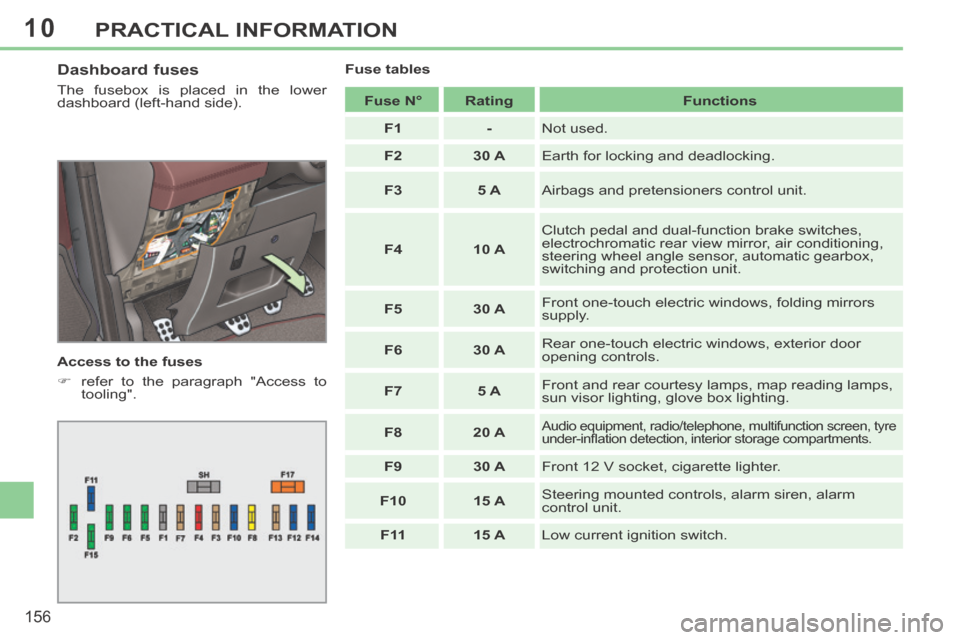
Dashboard fuses
The fusebox is placed in the lower
dashboard (left-hand side).
Access to the fuses
refer to the paragraph "Access to tooling". Fuse tables
Fuse N° Rating Functions
F1 - Not used.
F2 30 A Earth for locking and deadlocking.
F3 5 A Airbags and pretensioners control unit.
F4 10 A Clutch pedal and dual-function brake switches,
electrochromatic rear view mirror, air conditioning,
steering wheel angle sensor, automatic gearbox,
switching and protection unit.
F5 30 A Front one-touch electric windows, folding mirrors
supply.
F6 30 A Rear one-touch electric windows, exterior door
opening controls.
F7 5 A Front and rear courtesy lamps, map reading lamps,
sun visor lighting, glove box lighting.
F8 20 A
Audio equipment, radio/telephone, multifunction screen, tyre
under-infl ation detection, interior storage compartments.
F9 30 A Front 12 V socket, cigarette lighter.
F10 15 A Steering mounted controls, alarm siren, alarm
control unit.
F 11 15 A Low current ignition switch.
Page 169 of 268
10
i
i
167
PRACTICAL INFORMATION
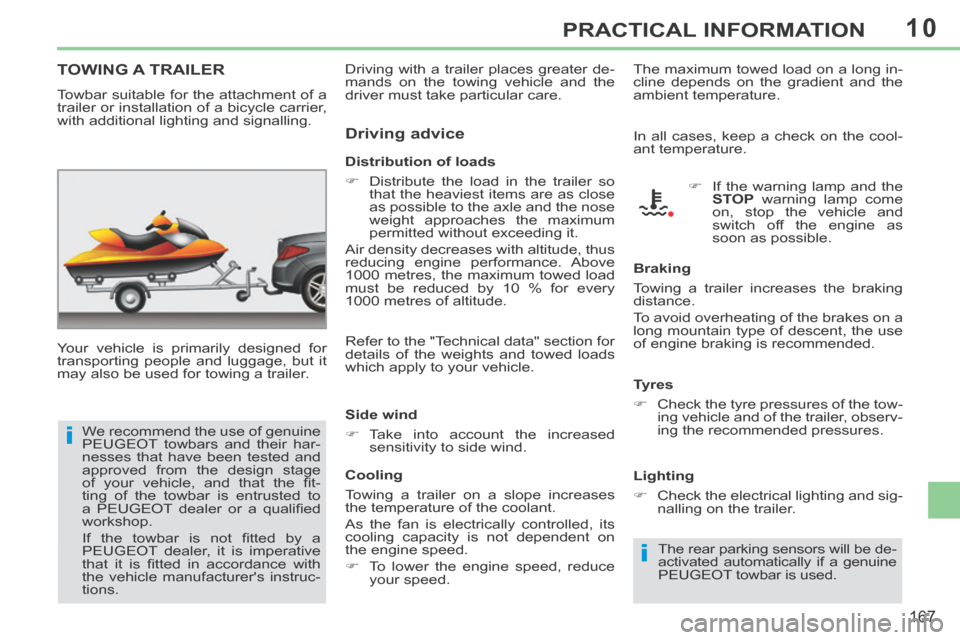
TOWING A TRAILER
Your vehicle is primarily designed for
transporting people and luggage, but it
may also be used for towing a trailer. Distribution of loads
Distribute the load in the trailer so
that the heaviest items are as close
as possible to the axle and the nose
weight approaches the maximum
permitted without exceeding it.
Air density decreases with altitude, thus
reducing engine performance. Above
1000 metres, the maximum towed load
must be reduced by 10 % for every
1000 metres of altitude.
Refer to the "Technical data" section for
details of the weights and towed loads
which apply to your vehicle.
Side wind
Take into account the increased sensitivity to side wind.
Towbar suitable for the attachment of a
trailer or installation of a bicycle carrier,
with additional lighting and signalling.
Driving advice
We recommend the use of genuine
PEUGEOT towbars and their har-
nesses that have been tested and
approved from the design stage
of your vehicle, and that the fi t-
ting of the towbar is entrusted to
a PEUGEOT dealer or a qualifi ed
workshop.
If the towbar is not fi tted by a
PEUGEOT dealer, it is imperative
that it is fi tted in accordance with
the vehicle manufacturer's instruc-
tions. Driving with a trailer places greater de-
mands on the towing vehicle and the
driver must take particular care.
In all cases, keep a check on the cool-
ant temperature.
Braking
Towing a trailer increases the braking
distance.
To avoid overheating of the brakes on a
long mountain type of descent, the use
of engine braking is recommended.
Tyres
Check the tyre pressures of the tow-ing vehicle and of the trailer, observ-
ing the recommended pressures.
Lighting
Check the electrical lighting and sig- nalling on the trailer.
The rear parking sensors will be de-
activated automatically if a genuine
PEUGEOT towbar is used.
If the warning lamp and the STOP warning lamp come
on, stop the vehicle and
switch off the engine as
soon as possible.
The maximum towed load on a long in-
cline depends on the gradient and the
ambient temperature.
Cooling
Towing a trailer on a slope increases
the temperature of the coolant.
As the fan is electrically controlled, its
cooling capacity is not dependent on
the engine speed.
To lower the engine speed, reduce your speed.
Page 173 of 268
11
171
TECHNICAL DATA
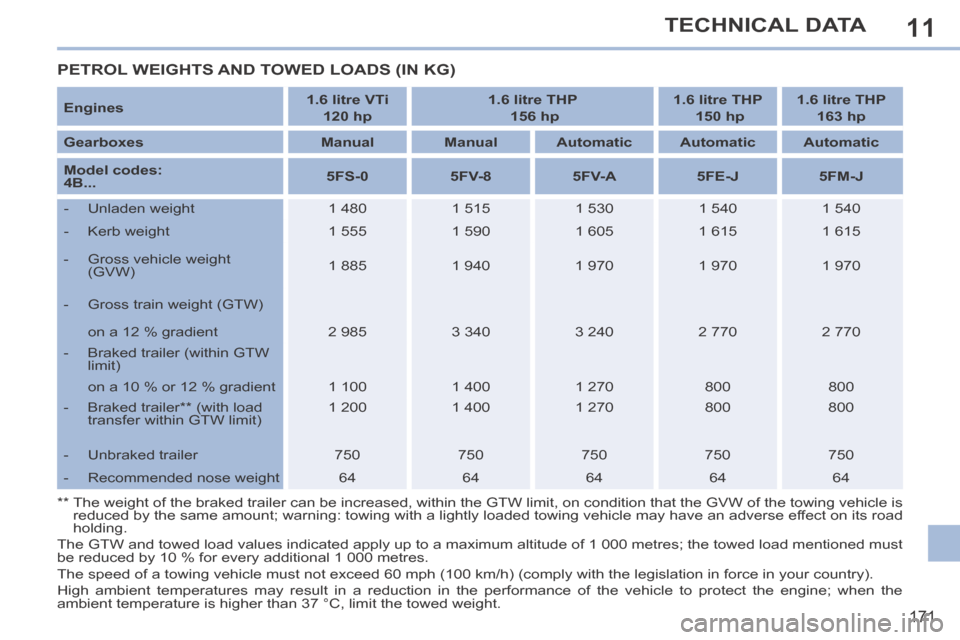
PETROL WEIGHTS AND TOWED LOADS (IN KG)
Engines 1.6 litre VTi
120 hp 1.6 litre THP
156 hp 1.6 litre THP
150 hp 1.6 litre THP
163 hp
Gearboxes Manual Manual Automatic Automatic Automatic
Model codes:
4B... 5FS-0
5FV-8 5FV-A 5FE-J 5FM-J
- Unladen weight 1 480 1 515 1 530 1 540 1 540
- Kerb weight 1 555 1 590 1 605 1 615 1 615
- Gross vehicle weight (GVW) 1 885
1 940 1 970 1 970 1 970
- Gross train weight (GTW)
on a 12 % gradient 2 985 3 340 3 240 2 770 2 770
- Braked trailer (within GTW limit)
on a 10 % or 12 % gradient 1 100 1 400 1 270 800 800
- Braked trailer ** (with load transfer within GTW limit) 1 200
1 400 1 270 800 800
- Unbraked trailer 750 750 750 750 750
- Recommended nose weight 64 64 64 64 64
** The weight of the braked trailer can be increased, within the GTW limit,\
on condition that the GVW of the towing vehicle is reduced by the same amount; warning: towing with a lightly loaded towing\
vehicle may have an adverse effect on its road
holding.
The GTW and towed load values indicated apply up to a maximum altitude o\
f 1 000 metres; the towed load mentioned must
be reduced by 10 % for every additional 1 000 metres.
The speed of a towing vehicle must not exceed 60 mph (100 km/h) (comp\
ly with the legislation in force in your country).
High ambient temperatures may result in a reduction in the performance of the vehicle to protect the engine; when the
a mbient temperature is higher than 37 °C, limit the towed weight.