warning Peugeot 308 CC 2014 Workshop Manual
[x] Cancel search | Manufacturer: PEUGEOT, Model Year: 2014, Model line: 308 CC, Model: Peugeot 308 CC 2014Pages: 268, PDF Size: 15.33 MB
Page 144 of 268
10
iii
142
PRACTICAL INFORMATION
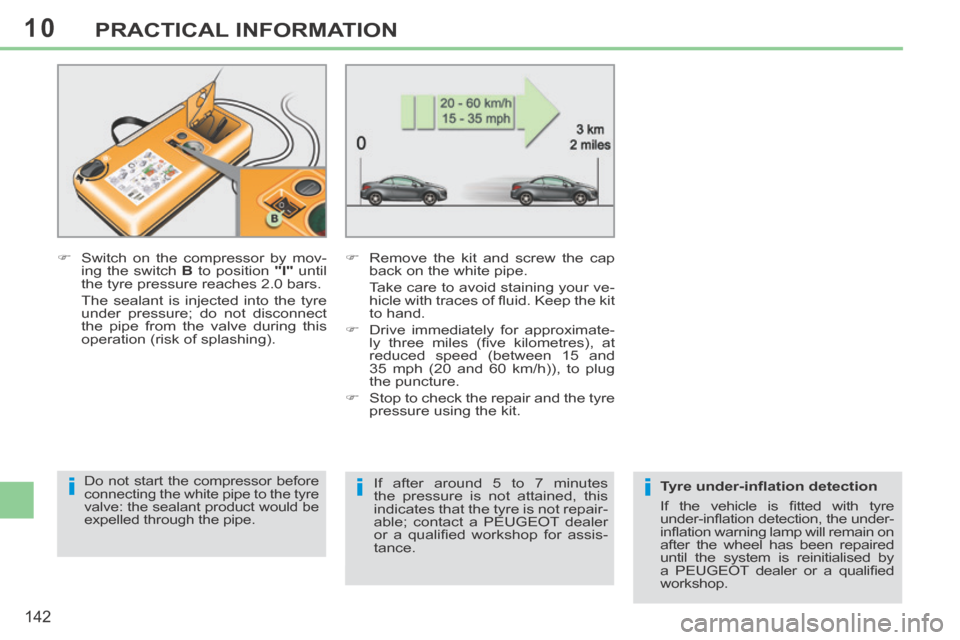
Switch on the compressor by mov-ing the switch B to position "I" until
the tyre pressure reaches 2.0 bars.
The sealant is injected into the tyre under pressure; do not disconnect
the pipe from the valve during this
operation (risk of splashing). Remove the kit and screw the cap
back on the white pipe.
Take care to avoid staining your ve- hicle with traces of fl uid. Keep the kit
to hand.
Drive immediately for approximate- ly three miles (fi ve kilometres), at
reduced speed (between 15 and
35 mph (20 and 60 km/h)), to plug
the puncture.
Stop to check the repair and the tyre pressure using the kit.
Do not start the compressor before
connecting the white pipe to the tyre
valve: the sealant product would be
expelled through the pipe. Tyre under-infl ation detection
If the vehicle is fi tted with tyre
under-infl ation detection, the under-
infl ation warning lamp will remain on
after the wheel has been repaired
until the system is reinitialised by
a PEUGEOT dealer or a qualifi ed
workshop.
If after around 5 to 7 minutes
the pressure is not attained, this
i ndicates that the tyre is not repair-
able; contact a PEUGEOT dealer
or a qualifi ed workshop for assis-
tance.
Page 159 of 268
10
157
PRACTICAL INFORMATION
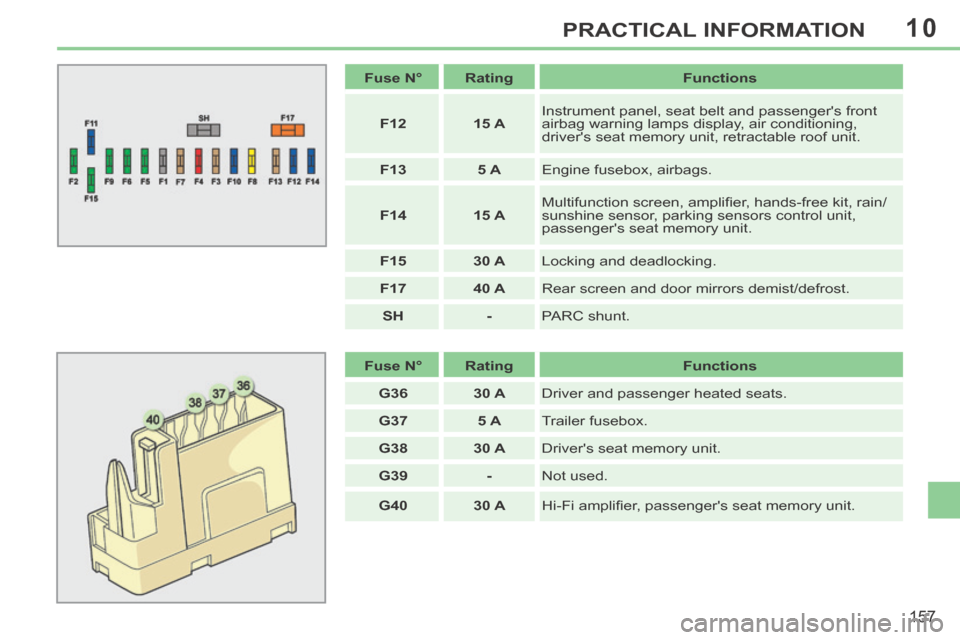
Fuse N° Rating Functions
F12 15 A Instrument panel, seat belt and passenger's front
airbag warning lamps display, air conditioning,
driver's seat memory unit, retractable roof unit.
F13 5 A Engine fusebox, airbags.
F14 15 A Multifunction screen, amplifi er, hands-free kit, rain/
sunshine sensor, parking sensors control unit,
passenger's seat memory unit.
F15 30 A Locking and deadlocking.
F17 40 A Rear screen and door mirrors demist/defrost.
SH - PARC shunt.
Fuse N° Rating Functions
G36 30 A Driver and passenger heated seats.
G37 5 A Trailer fusebox.
G38 30 A Driver's seat memory unit.
G39 - Not used.
G40 30 A Hi-Fi amplifi er, passenger's seat memory unit.
Page 165 of 268
10
i
i
!
!
i
163
PRACTICAL INFORMATION
With Stop & Start, the battery does
not have to be disconnected for
charging.
Charging the battery using
a battery charger
When your vehicle's battery is dis-
charged or when the vehicle is to be
out of use for a prolonged period, you
can charge the battery using a battery
charger.
Contact a PEUGEOT dealer or a quali-
fi ed workshop for the specifi cation of
chargers compatible with your battery.
Before disconnecting
Go to the battery.
Close the retractable roof.
Check that the doors and boot are closed but not locked.
Switch off the ignition and wait for at least four minutes.
If the vehicle is to not going to be used for
more than a month, it is recommended
that the battery be disconnected.
Charging
Disconnect the (+) terminal.
Follow the instructions for use pro-vided by the manufacturer of the
charger.
Connect the charger's red cable to the (+) terminal of the battery, then
the black cable to the (-) terminal.
Once the battery is fully charged, disconnect the charger cables in re-
verse order.
Charging should be carried out in
a well-ventilated area and away
from naked fl ames and sources of
sparks, so as to avoid any risk of
explosion and fi re.
Do not try to charge a frozen bat-
tery; fi rst thaw it out so as to avoid
the risk of explosion.
If the battery had frozen, before
charging, have it checked by a
PEUGEOT dealer or qualifi ed
workshop who will ensure that
the internal components have not
been damaged and that the casing
is not cracked, which would cause
a leak of toxic and corrosive acid.
Some functions are not available
if the battery is not suffi ciently
charged. Reinitialisation after
reconnection
After any reconnection of the battery,
switch on the ignition and wait at least
one minute before starting, to allow time
for the initialisation of the electronic sys-
tems.
By referring to the corresponding sec-
tions, you should set or initialise the fol-
lowing systems yourself:
- remote control,
- electric windows and automatic par- tial opening of door glasses,
- time and date,
- audio and navigation system set- tings.
Check that no alert message or
warning lamp comes on after
switching on the ignition.
However, if minor problems persist
after carrying out these operations,
contact a PEUGEOT dealer or a
qualifi ed workshop.
Page 168 of 268
10
i
166
PRACTICAL INFORMATION
Towing your vehicle
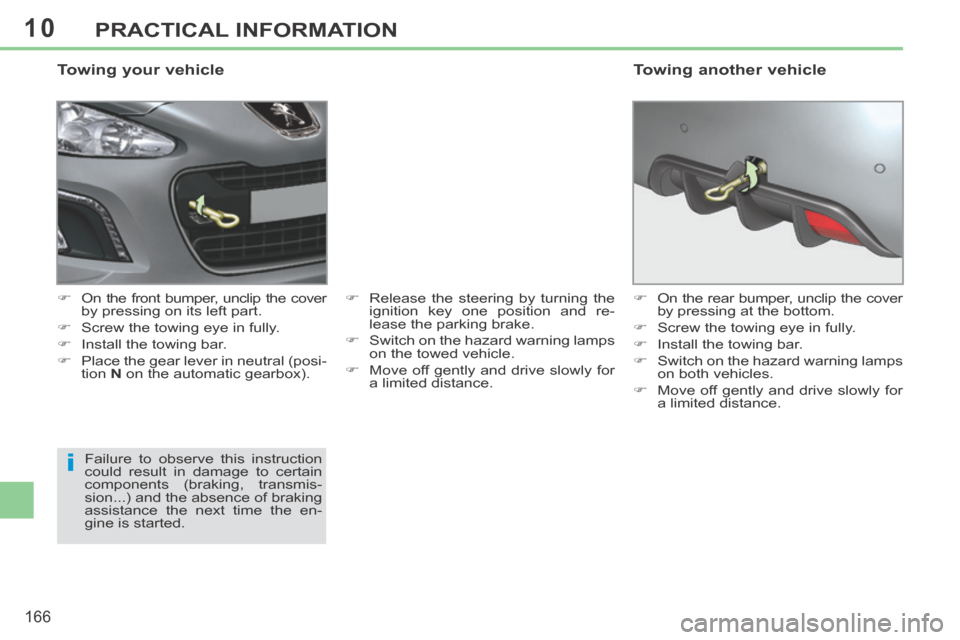
On the front bumper, unclip the cover by pressing on its left part.
Screw the towing eye in fully.
Install the towing bar.
Place the gear lever in neutral (posi- tion N on the automatic gearbox). Release the steering by turning the
ignition key one position and re-
lease the parking brake.
Switch on the hazard warning lamps on the towed vehicle.
Move off gently and drive slowly for a limited distance.
Failure to observe this instruction
could result in damage to certain
components (braking, transmis-
sion...) and the absence of braking
assistance the next time the en-
gine is started. On the rear bumper, unclip the cover
by pressing at the bottom.
Screw the towing eye in fully.
Install the towing bar.
Switch on the hazard warning lamps on both vehicles.
Move off gently and drive slowly for a limited distance.
Towing another vehicle
Page 169 of 268
10
i
i
167
PRACTICAL INFORMATION
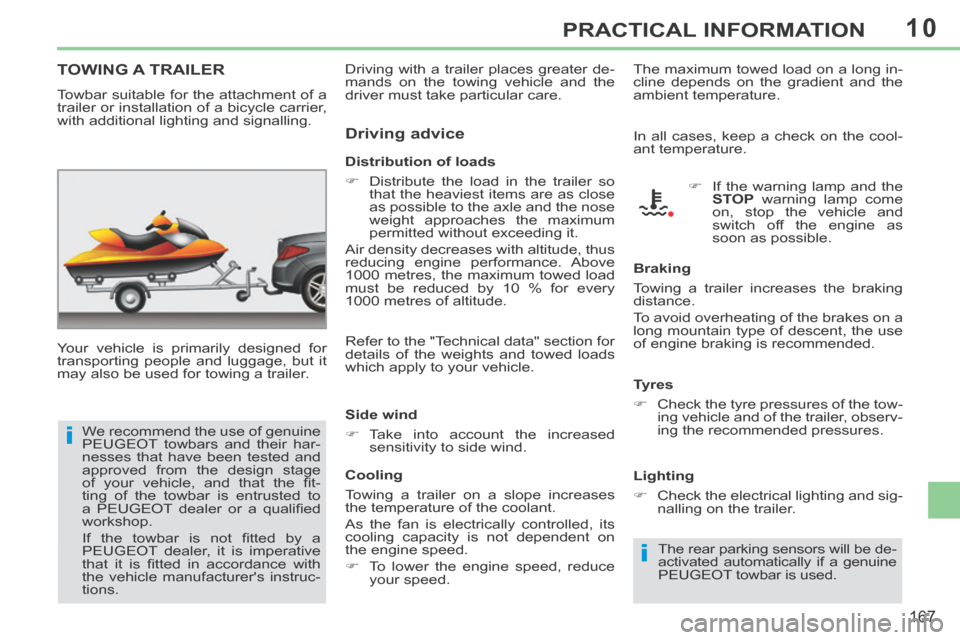
TOWING A TRAILER
Your vehicle is primarily designed for
transporting people and luggage, but it
may also be used for towing a trailer. Distribution of loads
Distribute the load in the trailer so
that the heaviest items are as close
as possible to the axle and the nose
weight approaches the maximum
permitted without exceeding it.
Air density decreases with altitude, thus
reducing engine performance. Above
1000 metres, the maximum towed load
must be reduced by 10 % for every
1000 metres of altitude.
Refer to the "Technical data" section for
details of the weights and towed loads
which apply to your vehicle.
Side wind
Take into account the increased sensitivity to side wind.
Towbar suitable for the attachment of a
trailer or installation of a bicycle carrier,
with additional lighting and signalling.
Driving advice
We recommend the use of genuine
PEUGEOT towbars and their har-
nesses that have been tested and
approved from the design stage
of your vehicle, and that the fi t-
ting of the towbar is entrusted to
a PEUGEOT dealer or a qualifi ed
workshop.
If the towbar is not fi tted by a
PEUGEOT dealer, it is imperative
that it is fi tted in accordance with
the vehicle manufacturer's instruc-
tions. Driving with a trailer places greater de-
mands on the towing vehicle and the
driver must take particular care.
In all cases, keep a check on the cool-
ant temperature.
Braking
Towing a trailer increases the braking
distance.
To avoid overheating of the brakes on a
long mountain type of descent, the use
of engine braking is recommended.
Tyres
Check the tyre pressures of the tow-ing vehicle and of the trailer, observ-
ing the recommended pressures.
Lighting
Check the electrical lighting and sig- nalling on the trailer.
The rear parking sensors will be de-
activated automatically if a genuine
PEUGEOT towbar is used.
If the warning lamp and the STOP warning lamp come
on, stop the vehicle and
switch off the engine as
soon as possible.
The maximum towed load on a long in-
cline depends on the gradient and the
ambient temperature.
Cooling
Towing a trailer on a slope increases
the temperature of the coolant.
As the fan is electrically controlled, its
cooling capacity is not dependent on
the engine speed.
To lower the engine speed, reduce your speed.
Page 170 of 268
10
i
!
168
PRACTICAL INFORMATION
VERY COLD CLIMATE SCREEN *
Removable protective screen which
prevents the accumulation of snow at
the radiator cooling fan.
Fitting
Offer up the very cold climate screen to the front of the lower section of
the front bumper.
Press around its edge to engage its fi xing clips one by one.
Do not forget to remove the very
cold climate screen when:
- the ambient temperature ex- ceeds 10 °C,
- towing,
- driving at speeds above 75 mph (120 km/h).
* According to country.
Removal
Use a screwdriver as a lever to release each fi xing clip in turn. "Comfort":
windstop, cover for windstop, reading
lamp, parking sensors...
"Transport solutions":
boot liner, towbar-mounted bicycle car-
rier, towbars, towbar wiring harnesses...
ACCESSORIES
A wide range of accessories and
genuine parts is available from the
PEUGEOT dealer network.
These accessories and parts have
been tested and approved for reliability
and safety.
They are all adapted to your vehicle and
benefi t from PEUGEOT's recommenda-
tion and warranty. "Styling":
alloy wheels, front spoiler, gear lever
knobs...
"Safety and security":
anti-theft alarm, security wheel bolts,
breathalyser, fi rst aid kit, warning tri-
angle, high visibility vest, stolen vehicle
tracking system, child booster cush-
ions, winter equipment...
** To avoid any risk of jamming of the
pedals:
- ensure that the mat is positioned and secured correctly,
- never fi t one mat on top of another.
"Protection":
mats ** , bumper protection strips, ve-
hicle protective cover...
When fi tting a towbar and its wir-
ing harness outside the PEUGEOT
dealer network, this fi tment must
be done following the vehicle man-
ufacturer's recommendations.
Page 173 of 268
11
171
TECHNICAL DATA
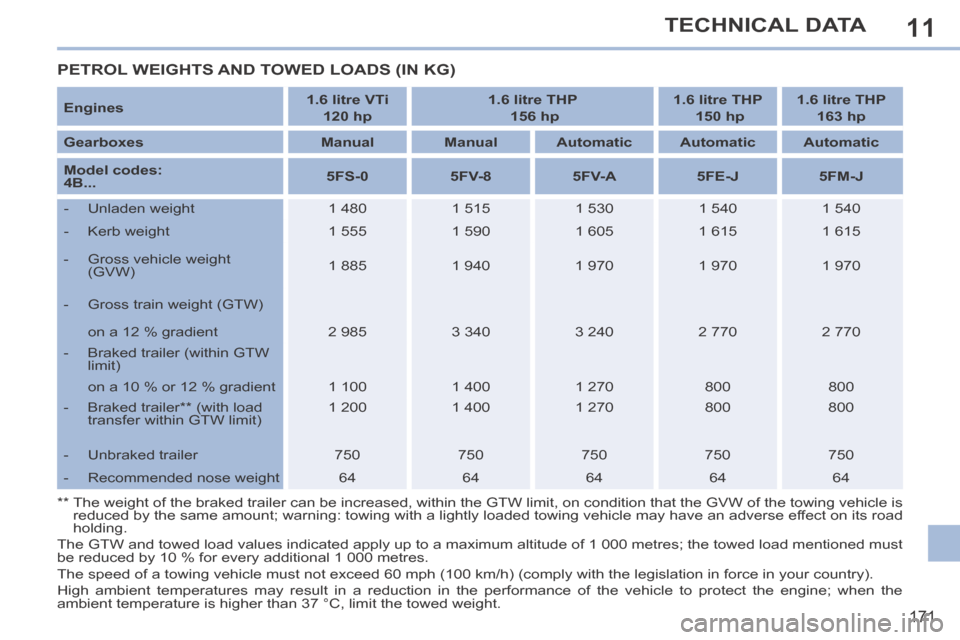
PETROL WEIGHTS AND TOWED LOADS (IN KG)
Engines 1.6 litre VTi
120 hp 1.6 litre THP
156 hp 1.6 litre THP
150 hp 1.6 litre THP
163 hp
Gearboxes Manual Manual Automatic Automatic Automatic
Model codes:
4B... 5FS-0
5FV-8 5FV-A 5FE-J 5FM-J
- Unladen weight 1 480 1 515 1 530 1 540 1 540
- Kerb weight 1 555 1 590 1 605 1 615 1 615
- Gross vehicle weight (GVW) 1 885
1 940 1 970 1 970 1 970
- Gross train weight (GTW)
on a 12 % gradient 2 985 3 340 3 240 2 770 2 770
- Braked trailer (within GTW limit)
on a 10 % or 12 % gradient 1 100 1 400 1 270 800 800
- Braked trailer ** (with load transfer within GTW limit) 1 200
1 400 1 270 800 800
- Unbraked trailer 750 750 750 750 750
- Recommended nose weight 64 64 64 64 64
** The weight of the braked trailer can be increased, within the GTW limit,\
on condition that the GVW of the towing vehicle is reduced by the same amount; warning: towing with a lightly loaded towing\
vehicle may have an adverse effect on its road
holding.
The GTW and towed load values indicated apply up to a maximum altitude o\
f 1 000 metres; the towed load mentioned must
be reduced by 10 % for every additional 1 000 metres.
The speed of a towing vehicle must not exceed 60 mph (100 km/h) (comp\
ly with the legislation in force in your country).
High ambient temperatures may result in a reduction in the performance of the vehicle to protect the engine; when the
a mbient temperature is higher than 37 °C, limit the towed weight.
Page 175 of 268
11
173
TECHNICAL DATA
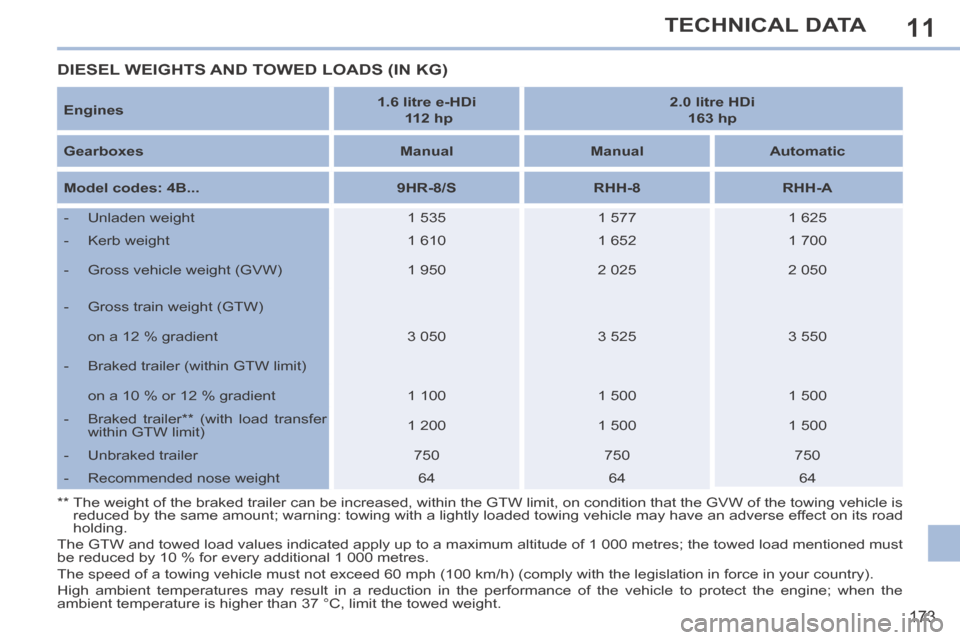
Engines 1.6 litre e-HDi
112 hp 2.0 litre HDi
163 hp
Gearboxes Manual Manual Automatic
Model codes: 4B... 9HR-8/S RHH-8 RHH-A
- Unladen weight 1 535 1 577 1 625
- Kerb weight 1 610 1 652 1 700
- Gross vehicle weight (GVW) 1 950 2 025 2 050
- Gross train weight (GTW)
on a 12 % gradient 3 050 3 525 3 550
- Braked trailer (within GTW limit)
on a 10 % or 12 % gradient 1 100 1 500 1 500
- Braked trailer ** (with load transfer within GTW limit) 1 200
1 500 1 500
- Unbraked trailer 750 750 750
- Recommended nose weight 64 64 64
The GTW and towed load values indicated apply up to a maximum altitude o\
f 1 000 metres; the towed load mentioned must
be reduced by 10 % for every additional 1 000 metres.
The speed of a towing vehicle must not exceed 60 mph (100 km/h) (comp\
ly with the legislation in force in your country).
High ambient temperatures may result in a reduction in the performance of the vehicle to protect the engine; when the
ambient temperature is higher than 37 °C, limit the towed weight.
DIESEL WEIGHTS AND TOWED LOADS (IN KG)
** The weight of the braked trailer can be increased, within the GTW limit,\
on condition that the GVW of the towing vehicle is reduced by the same amount; warning: towing with a lightly loaded towing\
vehicle may have an adverse effect on its road
holding.
Page 193 of 268
04
191
NAVIGATION - GUIDANCE
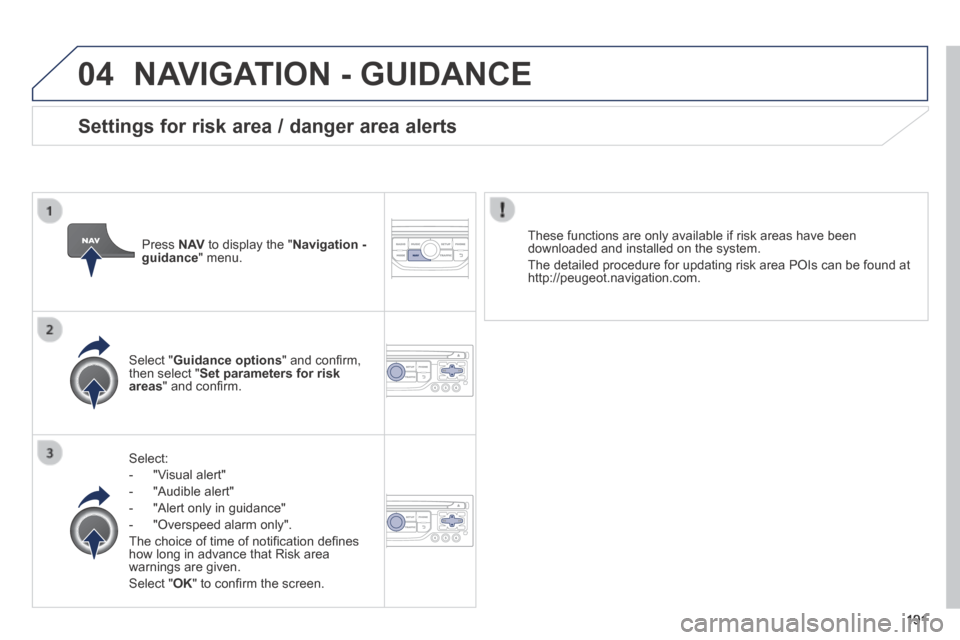
Select:
- "Visual alert"
- "Audible alert"
- "Alert only in guidance"
- "Overspeed alarm only".
The choice of time of notifi cation defi nes how long in advance that Risk area warnings are given.
Select " OK " to confi rm the screen.
Select " Guidance options " and confi rm, then select " Set parameters for risk areas " and confi rm.
These functions are only available if risk areas have been downloaded and installed on the system.
The detailed procedure for updating risk area POIs can be found at http://peugeot.navigation.com.
Press N AV to display the " Navigation - guidance " menu.
Settings for risk area / danger area alerts
Page 228 of 268

226
The following table groups together the answers to the most frequently a\
sked questions concerning your audio system.
FREQUENTLY ASKED QUESTIONS
QUESTIONANSWERSOLUTION
The route calculation is not successful. The guidance criteria may conflict with the current location (exclusion\
of toll roads on a toll motorway). Check the guidance criteria on the Navigation Menu, "Guidance options" "Define calculation criteria".
I am unable to enter my post code. The system only accepts post codes of up to 5 characters.
The POIs do not appear. The POIs have not been selected. Select the POIs in the list of POIs.
The risk areas audible warning does not work. The audible warning is not active. Activate audible warnings in the Guidance options menu, "Navigation - guidance", "Set parameters for risk areas".
The system does not suggest a detour around an incident on the route.
The guidance criteria do not take account of TMC messages. Select the "Traffic info" function in the list of guidance criteria.
I receive a Risk area alert which is not on my route. Other than guidance, the system announces all Risk areas positioned in a\
cone located in front of the vehicle. It may provide an alert for a Risk\
area located on nearby or parallel roads.
Zoom in on the map to view the exact position of the Risk area. Select "On the route" to no longer receive alerts other than guidance or to reduce the time for the announcement.