wheel PEUGEOT 308 CC DAG 2008 User Guide
[x] Cancel search | Manufacturer: PEUGEOT, Model Year: 2008, Model line: 308 CC DAG, Model: PEUGEOT 308 CC DAG 2008Pages: 221, PDF Size: 8.7 MB
Page 106 of 221
7
!
i
!
94
SAFETY
BRAKING ASSISTANCE SYSTEMS
Group of supplementary systems which
help you to obtain optimum braking in
complete safety in emergency situa-
tions:
- the anti-lock braking system (ABS),
- the electronic brake force distribu-tion (EBFD),
- the emergency braking assistance (EBA).
Anti-lock braking system
and electronic brake force
distribution
Linked systems which improve the sta-
bility and manoeuvrability of your vehi-
cle when braking, in particular on poor
or slippery surfaces.
When braking in an emergency,
press very fi rmly without releasing
the pressure. When replacing wheels (tyres and
rims), ensure that they conform to
the manufacturer's recommenda-
tions.
Operating fault
If this warning light comes on,
accompanied by an audible sig-
nal and a message on the mul-
ti-function display, it indicates a
malfunction of the anti-lock braking sys-
tem which could result in loss of control
of the vehicle when braking.
If this warning light comes on,
together with the STOP and
ABS warning lights, accompa-
nied by an audible signal and a
message on the multifunction display, it
indicates a malfunction of the electron-
ic brake force distribution which could
result in loss of control of the vehicle
when braking.
You MUST stop as soon as it is safe
to do so.
In both cases, contact a PEUGEOT
dealer. Emergency braking assistance
System which, in an emergency, ena-
bles you to obtain the optimum braking
pressure more quickly, thus reducing
the stopping distance.
Activation
The anti-lock braking system comes
into operation automatically when there
is a risk of wheel lock.
Normal operation of the ABS may make
itself felt by slight vibration of the brake
pedal. Activation
It is triggered by the speed at which the
brake pedal is pressed.
The effect of this is a reduction in the
resistance of the pedal and an increase
in braking effi ciency.
When braking in an emergency,
press fi rmly without releasing the
pressure.
Page 107 of 221

7
!
SAFETY
The ESP/ASR systems offer excep-
tional safety in normal driving, but
this should not encourage the driver
to take extra risks or drive at high
speed.
The correct functioning of these
systems depends on observation
of the manufacturer's recommen-
dations regarding the wheels (tyres
and rims), the braking components,
the electronic components and the
PEUGEOT assembly and opera-
tion procedures.
After an impact, have these systems
checked by a PEUGEOT dealer.
Disarming
In exceptional conditions (starting a
vehicle which is bogged down, stuck
in snow, on soft ground, ...), it may be
advisable to disarm the ASR and ESP
systems, so that the wheels can move
freely and regain grip.
Press the
"ESP OFF" button, located
in the centre of the fascia.
If this warning light comes on
on the instrument panel and
the indicator light on the button
comes on, this indicates that
the ASR and ESP systems are
disarmed.
Reactivation
These systems are reactivated automati-
cally each time the ignition is switched
back on or from 30 mph (50 km/h).
Press the "ESP OFF" button again
to reactivate them manually. Operating fault
If this warning light comes on,
accompanied by an audible sig-
nal and a message on the multi-
function display, this indicates a
malfunction of these systems.
Have the systems checked by a PEUGEOT
dealer.
TRAJECTORY CONTROL SYSTEMS
Activation
These systems are activated automati-
cally each time the vehicle is started.
Anti-skid regulation (ASR) and
electronic stability programme (ESP)
The anti-skid regulation optimises trac-
tion to prevent skidding of the wheels,
by acting on the brakes of the driving
wheels and on the engine.
The electronic stability programme acts
on the brake of one or more wheels and
on the engine to keep the vehicle on the
trajectory required by the driver.
They come into operation in the event
of a grip or trajectory problem.
This is indicated by fl ashing of
this warning light on the instru-
ment panel.
Page 112 of 221
7
i
!
100
SAFETY
AIR BAGS
The air bags have been designed to
maximise the safety of the occupants in
the event of violent collisions. They sup-
plement the action of the force-limiting
seat belts.
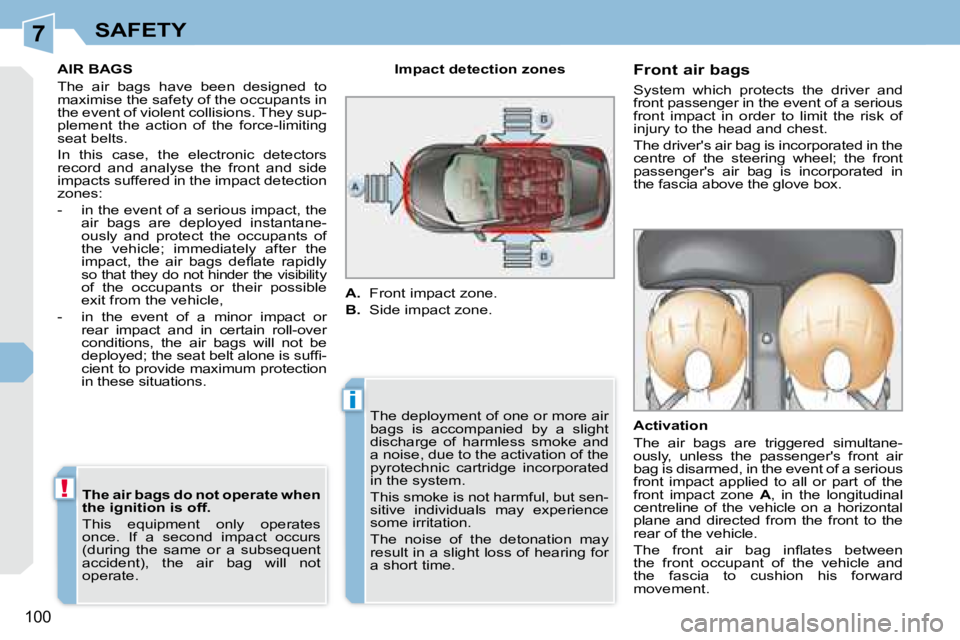
In this case, the electronic detectors
record and analyse the front and side
impacts suffered in the impact detection
zones:
- in the event of a serious impact, the air bags are deployed instantane-
ously and protect the occupants of
the vehicle; immediately after the
impact, the air bags defl ate rapidly
so that they do not hinder the visibility
of the occupants or their possible
exit from the vehicle,
- in the event of a minor impact or rear impact and in certain roll-over
conditions, the air bags will not be
deployed; the seat belt alone is suffi -
cient to provide maximum protection
in these situations.
The deployment of one or more air
bags is accompanied by a slight
discharge of harmless smoke and
a noise, due to the activation of the
pyrotechnic cartridge incorporated
in the system.
This smoke is not harmful, but sen-
sitive individuals may experience
some irritation.
The noise of the detonation may
result in a slight loss of hearing for
a short time. Front air bags
System which protects the driver and
front passenger in the event of a serious
front impact in order to limit the risk of
injury to the head and chest.
The driver's air bag is incorporated in the
centre of the steering wheel; the front
passenger's air bag is incorporated in
the fascia above the glove box.
Activation
The air bags are triggered simultane-
ously, unless the passenger's front air
bag is disarmed, in the event of a serious
front impact applied to all or part of the
front impact zone
A , in the longitudinal
centreline of the vehicle on a horizontal
plane and directed from the front to the
rear of the vehicle.
The front air bag infl ates between
the front occupant of the vehicle and
the fascia to cushion his forward
movement.
Impact detection zones
A. Front impact zone.
B. Side impact zone.
The air bags do not operate when
the ignition is off.
This equipment only operates
once. If a second impact occurs
(during the same or a subsequent
accident), the air bag will not
operate.
Page 115 of 221
7
!
103
SAFETY
For the air bags to be fully
effective, observe the following
safety rules:
Sit in a normal upright position.
Wear a correctly adjusted seat belt.
Do not leave anything between the
occupants and the air bags (a child,
pet, object...). This could hamper the
operation of the air bags or injure the
occupants.
After an accident or if the vehicle has
been stolen or broken into, have the
air bag systems checked.
All work on the air bag system is strict-
ly forbidden unless it is carried out by
qualifi ed personnel of the PEUGEOT
network.
Even if all of the precautions men-
tioned are observed, a risk of injury
or of minor burns to the head, chest
or arms when an air bag is triggered
cannot be ruled out. In fact, the bag
infl ates almost instantly (within a few
milliseconds) then defl ates within the
same time discharging the hot gas via
openings provided for this purpose. Front air bags
Do not drive holding the steering wheel by its spokes or resti
ng your hands on
the centre part of the wheel.
Passengers must not place their feet on the fascia.
Smoke as little as possible as deployment of the air bags can ca use burns or
the risk of injury from a cigarette or pipe.
Never remove or pierce the steering wheel or hit it violently.
Side air bags
Put approved covers only on the seats. These will not hinder i nfl ation of the side
air bags. Consult a PEUGEOT dealer.
Do not fi x or glue anything to the seat backs. This could ca use injury to the chest
or arms if the side air bag is triggered.
Do not fi x or glue anything to the front head restraints. This could cause injury
to the head if the side air bag is triggered.
Do not sit with the upper part of the body any nea rer to the door than necessary.
Page 124 of 221
8
!
i
!
111
DRIVING
When parking on a slope, direct
your wheels to chock them against
the pavement, pull the handbrake
and engage a gear.
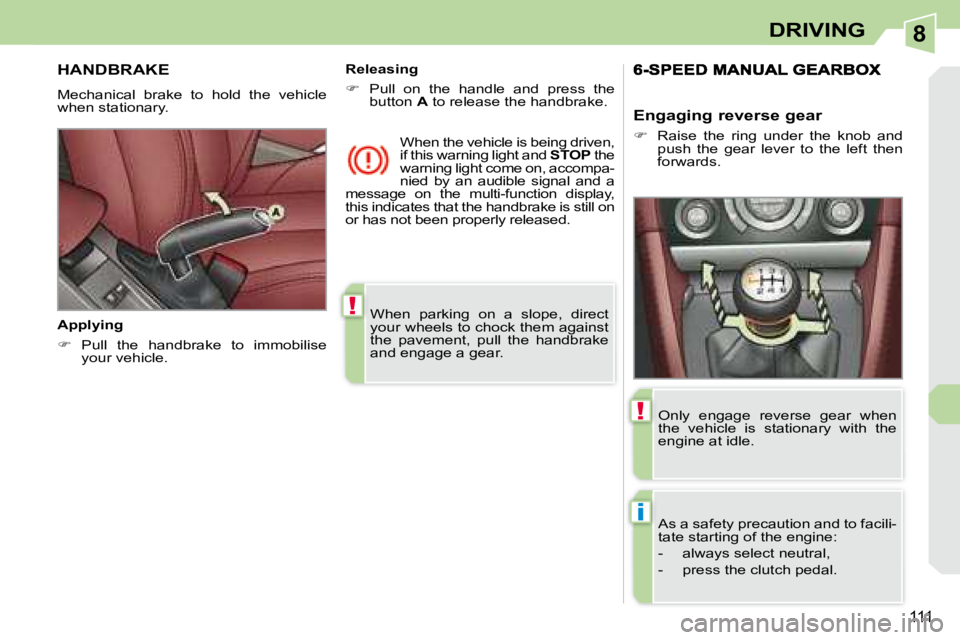
HANDBRAKE
Mechanical brake to hold the vehicle
when stationary.
Applying
Pull the handbrake to immobilise your vehicle. When the vehicle is being driven,
if this warning light and
STOP the
warning light come on, accompa-
nied by an audible signal and a
message on the multi-function display,
this indicates that the handbrake is still on
or has not been properly released.
Releasing
Pull on the handle and press the
button A to release the handbrake.
As a safety precaution and to facili-
tate starting of the engine:
- always select neutral,
- press the clutch pedal.
Only engage reverse gear when
the vehicle is stationary with the
engine at idle.
Engaging reverse gear
Raise the ring under the knob and
push the gear lever to the left then
forwards.
Page 128 of 221
8
i
115
DRIVING
SPEED LIMITER
System which prevents the vehicle from
exceeding the speed programmed by
the driver.
When the programmed speed limit is
reached, pressing the accelerator pedal
no longer has any effect.
The speed limiter is switched on
manually: it requires a programmed
speed of at least 20 mph (30 km/h).
The speed limiter is switched off by
manual operation of the control.
The programmed speed can be ex-
ceeded temporarily by pressing the
accelerator fi rmly.
To return to the programmed speed,
simply slow down to a speed below the
programmed speed.
The programmed speed remains in the
memory when the ignition is switched
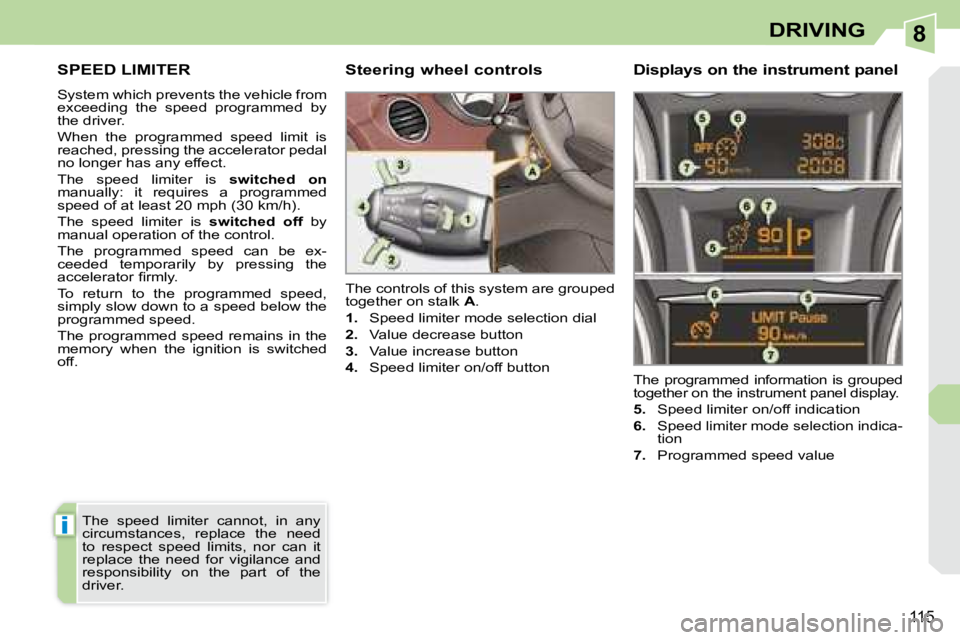
off. The controls of this system are grouped
together on stalk
A .
1. Speed limiter mode selection dial
2. Value decrease button
3. Value increase button
4. Speed limiter on/off button
The programmed information is grouped
together on the instrument panel display.
5. Speed limiter on/off indication
6.
Speed limiter mode selection indica-
tion
7. Programmed speed value
Steering wheel controls Displays on the instrument
panel
The speed limiter cannot, in any
circumstances, replace the need
to respect speed limits, nor can it
replace the need for vigilance and
responsibility on the part of the
driver.
Page 130 of 221
8
i
117
DRIVING
CRUISE CONTROL
System which automatically maintains
the speed of the vehicle at the value
programmed by the driver, without any
action on the accelerator pedal.
The cruise control is switched on
manually: it requires a minimum vehicle
speed of 25 mph (40 km/h) and the en-
gaging:
- of fourth gear on the manual gear- box,
- of second gear on the automatic gearbox, in sequential driving mode,
- of position D on the automatic gear-
box.
The cruise control is switched off
manually or by pressing the brake or
clutch pedal or on triggering of the ESP
system for safety reasons.
It is possible to exceed the programmed
speed temporarily by pressing the ac-
celerator pedal.
To return to the programmed speed,
simply release the accelerator pedal.
Switching off the ignition cancels any
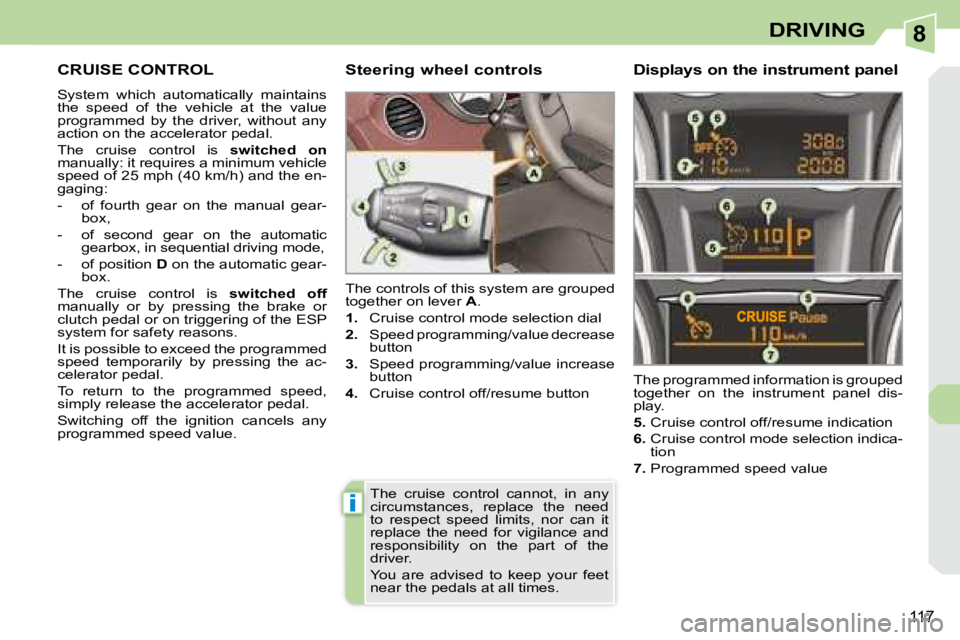
programmed speed value. The controls of this system are grouped
together on lever
A .
1. Cruise control mode selection dial
2. Speed programming/value decrease
button
3. Speed programming/value increase
button
4. Cruise control off/resume button The programmed information is grouped
together on the instrument panel dis-
play.
5. Cruise control off/resume indication
6. Cruise control mode selection indica-
tion
7. Programmed speed value
Steering wheel controls Displays on the instrument
panel
The cruise control cannot, in any
circumstances, replace the need
to respect speed limits, nor can it
replace the need for vigilance and
responsibility on the part of the
driver.
You are advised to keep your feet
near the pedals at all times.
Page 142 of 221
10
i
129
PRACTICAL INFORMATION
PUNCTURE REPAIR KIT Using the kit
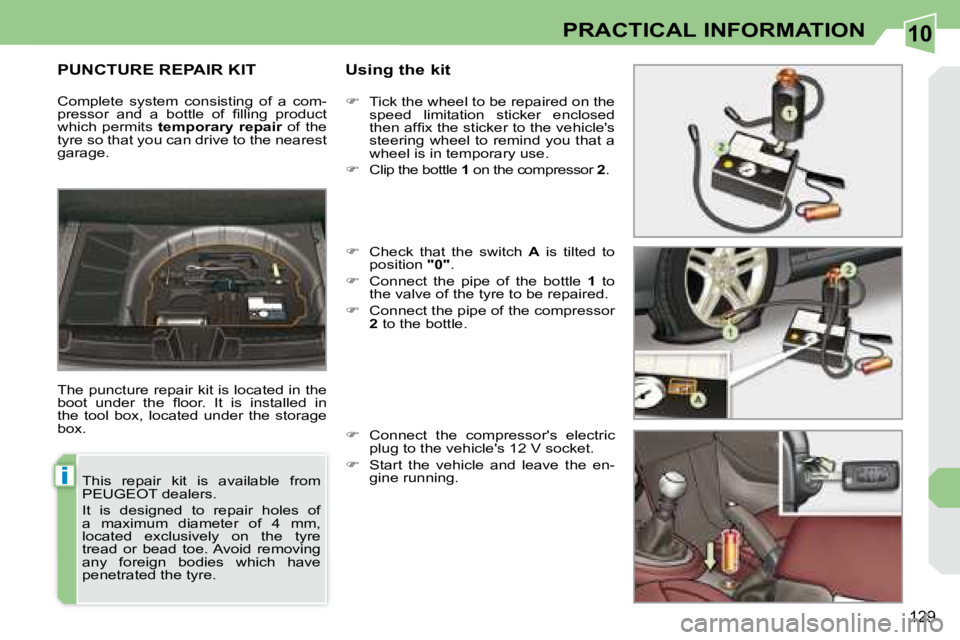
The puncture repair kit is located in the
boot under the fl oor. It is installed in
the tool box, located under the storage
box.
Tick the wheel to be repaired on the
speed limitation sticker enclosed
then affi x the sticker to the vehicle's
steering wheel to remind you that a
wheel is in temporary use.
Clip the bottle 1 on the compressor 2 .
Check that the switch A is tilted to
position "0" .
Connect the pipe of the bottle 1 to
the valve of the tyre to be repaired.
Connect the pipe of the compressor
2 to the bottle.
Connect the compressor's electric
plug to the vehicle's 12 V socket.
Start the vehicle and leave the en-
gine running.
Complete system consisting of a com-
pressor and a bottle of fi lling product
which permits
temporary repair of the
tyre so that you can drive to the nearest
garage.
This repair kit is available from
PEUGEOT dealers.
It is designed to repair holes of
a maximum diameter of 4 mm,
located exclusively on the tyre
tread or bead toe. Avoid removing
any foreign bodies which have
penetrated the tyre.
Page 144 of 221

10
!
i
131
PRACTICAL INFORMATION
Take care, the bottle of puncture
repair fl uid contains ethylene-glycol.
This product is harmful if swallowed
and causes irritation to the eyes.
Keep it out of reach of children.
The expiry date of the fl uid is indi-
cated on the base of the bottle.
The bottle is designed for a single
use; even if only partly used, it must
be replaced.
After use, do not discard the bottle
into the environment, take it to a
PEUGEOT dealer or to an organi-
sation responsible for its collec-
tion.
Do not forget to obtain a new bot-
tle of fi lling product, available from
PEUGEOT dealers.
Connect the compressor's electric
plug to the vehicle's 12 V socket
again.
Start the vehicle again and leave the
engine running.
Adjust the pressure using the com-
pressor (to infl ate: switch A in po-
sition "1" ; to defl ate: switch A in
position "0" and press button B ), in
accordance with the vehicle's tyre
pressure label (located on the door
aperture on the driver's side), then
remember to check that the leak
is fi lled correctly (no further loss of
pressure after several miles [kilome-
tres]).
Remove the compressor, then store
the whole kit.
Drive at reduced speed (50 mph
[80 km/h]).
Visit a PEUGEOT dealer as soon as
possible to have the tyre repaired or
replaced by a technician. If the vehicle is fi tted with tyre un-
der-infl ation detection, the tyre
under-infl ation warning light will re-
main on after the wheel has been
repaired until the system is reini-
tialised by a PEUGEOT dealer.
Page 145 of 221
10
i
132
PRACTICAL INFORMATION
CHANGING A WHEEL
Procedure for changing a faulty wheel
for the spare wheel using the tools pro-
vided with the vehicle.
The tools are installed in the boot under
the fl oor.
To gain access to them:
change to the "coupé" confi guration,
open the boot,
raise the fl oor,
secure it by hooking its handle on
the boot seal,
unclip and remove the box contain-
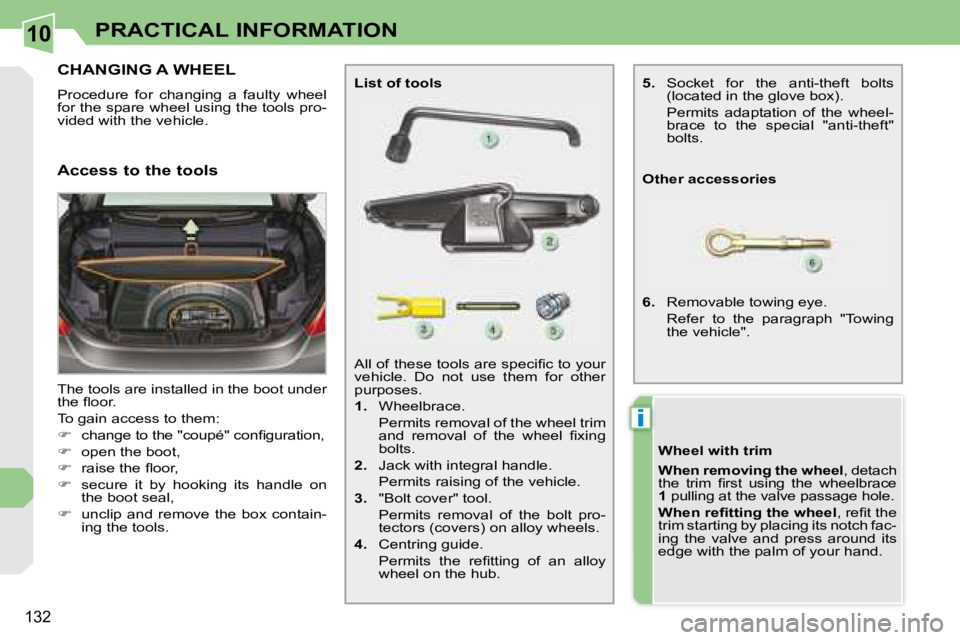
ing the tools. All of these tools are specifi c to your
vehicle. Do not use them for other
purposes.
1. Wheelbrace.
Permits removal of the wheel trim and removal of the wheel fi xing
bolts.
2. Jack with integral handle.
Permits raising of the vehicle.
3. "Bolt cover" tool.
Permits removal of the bolt pro- tectors (covers) on alloy wheels.
4. Centring guide.
Permits the refi tting of an alloy wheel on the hub.
List of tools
Other accessories
6. Removable towing eye.
Refer to the paragraph "Towing the vehicle".
Access to the tools
Wheel with trim
When removing the wheel , detach
the trim fi rst using the wheelbrace
1 pulling at the valve passage hole.
When refi tting the wheel , refi t the
trim starting by placing its notch fac-
ing the valve and press around its
edge with the palm of your hand.
5. Socket for the anti-theft bolts
(located in the glove box).
Permits adaptation of the wheel- brace to the special "anti-theft"
bolts.