ESP PEUGEOT 308 SW BL 2010 Owner's Guide
[x] Cancel search | Manufacturer: PEUGEOT, Model Year: 2010, Model line: 308 SW BL, Model: PEUGEOT 308 SW BL 2010Pages: 336, PDF Size: 21.2 MB
Page 119 of 336
!i
11 7
FITTINGS
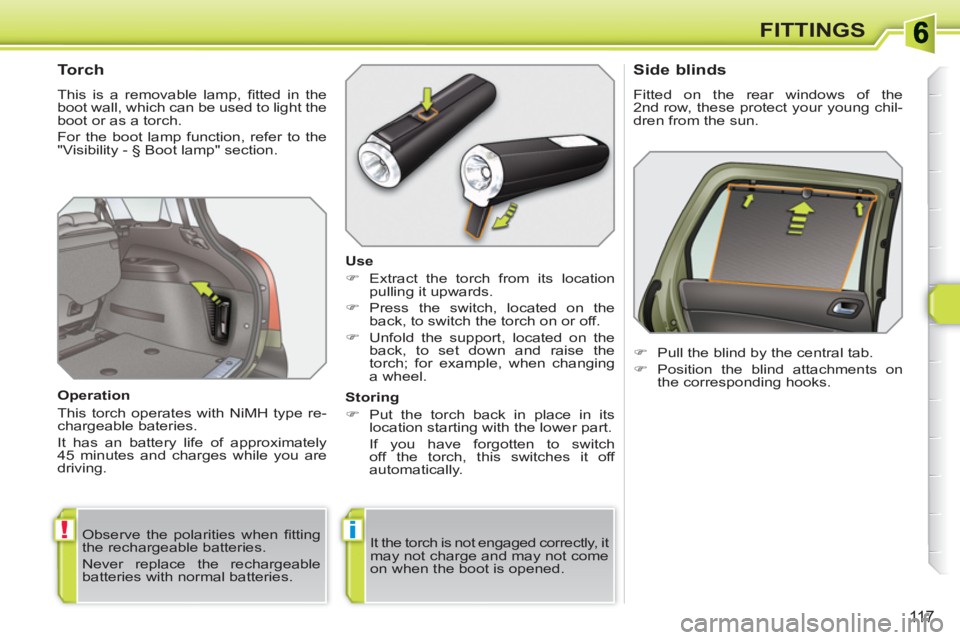
Torch
This is a removable lamp, fi tted in the
boot wall, which can be used to light the
boot or as a torch.
For the boot lamp function, refer to the
"Visibility - § Boot lamp" section.
Operation
This torch operates with NiMH type re-
chargeable bateries.
It has an battery life of approximately
45 minutes and charges while you are
driving.
Use
)
Extract the torch from its location
pulling it upwards.
)
Press the switch, located on the
back, to switch the torch on or off.
)
Unfold the support, located on the
back, to set down and raise the
torch; for example, when changing
a wheel.
Storing
)
Put the torch back in place in its
location starting with the lower part.
If you have forgotten to switch
off the torch, this switches it off
automatically.
Side blinds
Fitted on the rear windows of the
2nd row, these protect your young chil-
dren from the sun.
)
Pull the blind by the central tab.
)
Position the blind attachments on
the corresponding hooks.
Observe the polarities when fi tting
the rechargeable batteries.
Never replace the rechargeable
batteries with normal batteries. It the torch is not engaged correctly, it
may not charge and may not come
on when the boot is opened.
Page 131 of 336
!
i
i
i
129
SAFETY
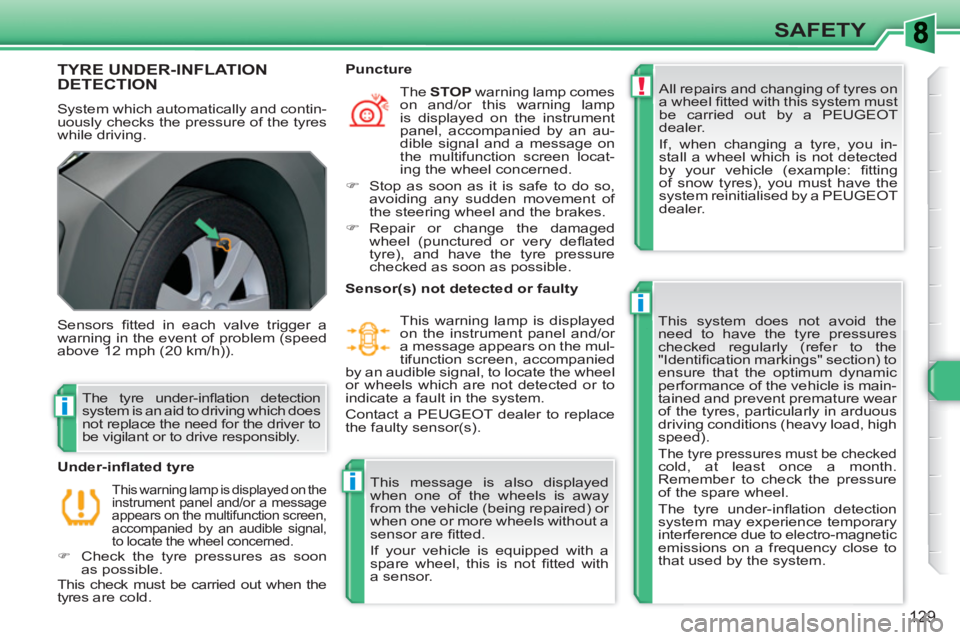
TYRE UNDER-INFLATIONDETECTION
System which automatically and contin-
uously checks the pressure of the tyres
while driving. All repairs and changing of tyres on
a wheel fi tted with this system must
be carried out by a PEUGEOT
dealer.
If, when changing a tyre, you in-
stall a wheel which is not detected
by your vehicle (example: fi tting
of snow tyres), you must have the
system reinitialised by a PEUGEOT
dealer.
This system does not avoid the
need to have the tyre pressures
checked regularly (refer to the
"Identifi cation markings" section) to
ensure that the optimum dynamic
performance of the vehicle is main-
tained and prevent premature wear
of the tyres, particularly in arduous
driving conditions (heavy load, high
speed).
The tyre pressures must be checked cold, at least once a month.
Remember to check the pressure
of the spare wheel.
The tyre under-infl ation detection
system may experience temporary
interference due to electro-magnetic
emissions on a frequency close to
that used by the system.
Sensors fi tted in each valve trigger a
warning in the event of problem (speed
above 12 mph (20 km/h)).
This warning lamp is displayed on the
instrument panel and/or a message
appears on the multifunction screen,
accompanied by an audible signal,
to locate the wheel concerned.
)
Check the tyre pressures as soon
as possible.
This check must be carried out when the
tyres are cold.
Under-infl ated tyre
The STOP
warning lamp comes
on and/or this warning lamp
is displayed on the instrument
panel, accompanied by an au-
dible signal and a message on
the multifunction screen locat-
ing the wheel concerned.
)
Stop as soon as it is safe to do so,
avoiding any sudden movement of
the steering wheel and the brakes.
)
Repair or change the damaged
wheel (punctured or very defl ated
tyre), and have the tyre pressure
checked as soon as possible.
Puncture
The tyre under-infl ation detection
system is an aid to driving which does
not replace the need for the driver to
be vigilant or to drive responsibly.
Sensor(s) not detected or faulty
This warning lamp is displayed
on the instrument panel and/or
a message appears on the mul-
tifunction screen, accompanied
by an audible signal, to locate the wheel
or wheels which are not detected or to
indicate a fault in the system.
Contact a PEUGEOT dealer to replace
the faulty sensor(s).
This message is also displayed
when one of the wheels is away
from the vehicle (being repaired) or
when one or more wheels without a
sensor are fi tted.
If your vehicle is equipped with a
spare wheel, this is not fi tted with
a sensor.
Page 133 of 336
!
SAFETY
The ESP/ASR systems offer ex-
ceptional safety in normal driving,
but this should not encourage the
driver to take extra risks or drive at
high speed.
The correct functioning of these
systems depends on observation
of the manufacturer's recommen-
dations regarding the wheels (tyres
and rims), the braking components,
the electronic components and the
repair and assembly procedures
used by PEUGEOT dealers.
After an impact, have these sys-
tems checked by a PEUGEOT
dealer.
Deactivation
In exceptional conditions (starting a ve-
hicle which is bogged down, stuck in
snow, on soft ground, ...), it may be ad-
visable to deactivate the ASR and ESP
systems, so that the wheels can move
freely and regain grip.
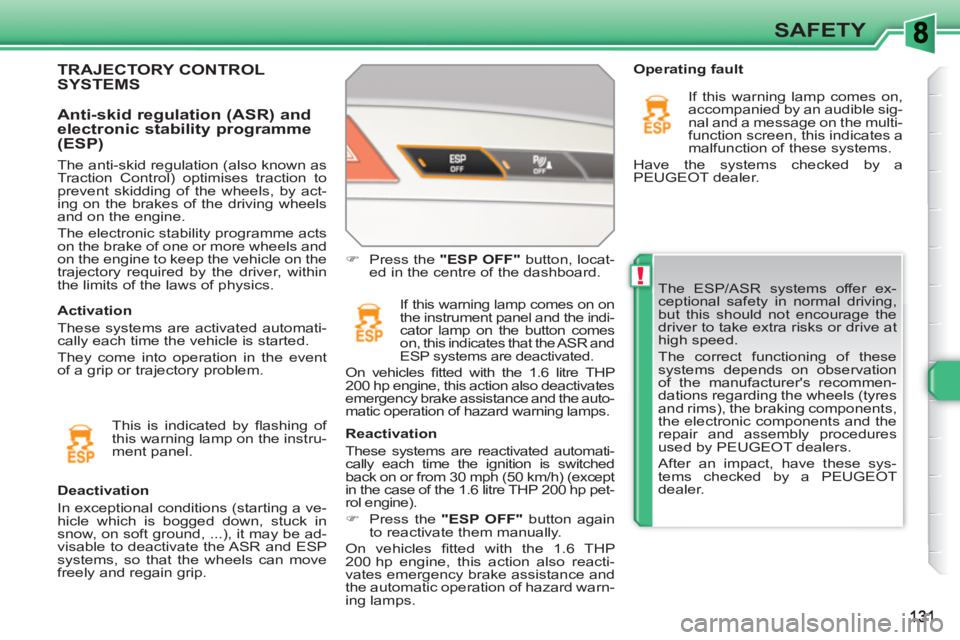
)
Press the "ESP OFF"
button, locat-
ed in the centre of the dashboard.
If this warning lamp comes on on
the instrument panel and the indi-
cator lamp on the button comes
on, this indicates that the ASR and
ESP systems are deactivated.
On vehicles fi tted with the 1.6 litre THP
200 hp engine, this action also deactivates
emergency brake assistance and the auto-
matic operation of hazard warning lamps.
Reactivation
These systems are reactivated automati-
cally each time the ignition is switched
back on or from 30 mph (50 km/h) (except
in the case of the 1.6 litre THP 200 hp pet-
rol engine).
)
Press the "ESP OFF"
button again
to reactivate them manually.
On vehicles fi tted with the 1.6 THP
200 hp engine, this action also reacti-
vates emergency brake assistance and
the automatic operation of hazard warn-
ing lamps.
Operating fault
If this warning lamp comes on,
accompanied by an audible sig-
nal and a message on the multi-
function screen, this indicates a
malfunction of these systems.
Have the systems checked by a
PEUGEOT dealer.
TRAJECTORY CONTROLSYSTEMS
Activation
These systems are activated automati-
cally each time the vehicle is started.
They come into operation in the event
of a grip or trajectory problem.
Anti-skid regulation (ASR) and
electronic stability programme
(ESP)
This is indicated by fl ashing of
this warning lamp on the instru-
ment panel.
The anti-skid regulation (also known as
Traction Control) optimises traction to
prevent skidding of the wheels, by act-
ing on the brakes of the driving wheels
and on the engine.
The electronic stability programme acts
on the brake of one or more wheels and
on the engine to keep the vehicle on the
trajectory required by the driver, within
the limits of the laws of physics.
Page 135 of 336
133
SAFETY
Seat belt not fastened/unfastened
warning lamp
When the ignition is switched
on, this warning lamp comes
on, either on the instrument
panel or on the seat belt and
passenger's front airbag warning lamps
display, if the driver and/or the front pas-
senger has not fastened their seat belt.
From approximately 12 mph (20 km/h)
this warning lamp fl ashes for two minutes
accompanied by an audible signal of in-
creasing volume. Once these two minutes
have elapsed, this warning lamp remains
on until the driver and/or the front passen-
ger fastens their seat belt.
*
According to version and/or country.
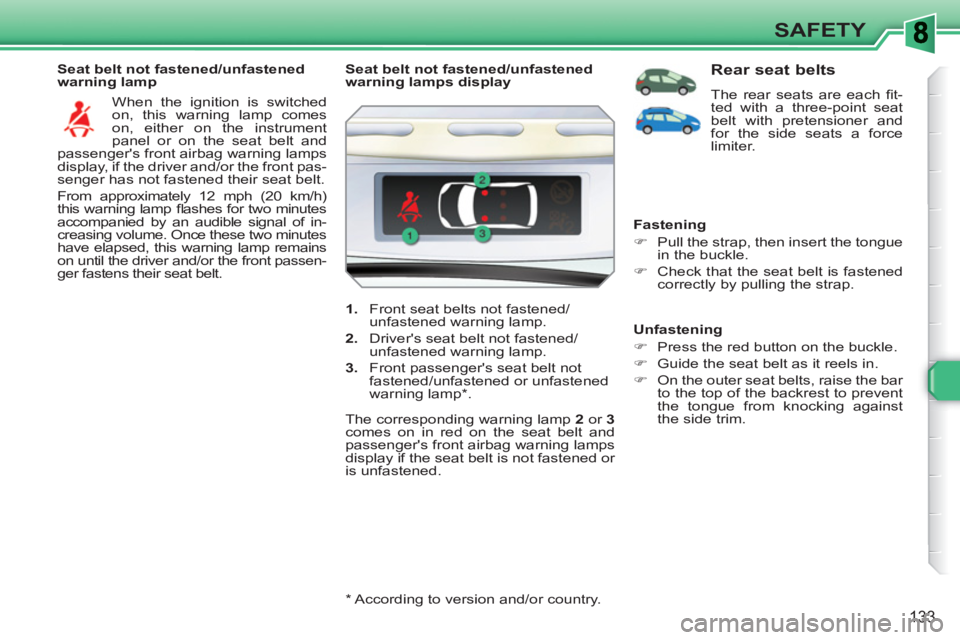
Seat belt not fastened/unfastened
warning lamps display
1.
Front seat belts not fastened/
unfastened warning lamp.
2.
Driver's seat belt not fastened/
unfastened warning lamp.
3.
Front passenger's seat belt not
fastened/unfastened or unfastened
warning lamp * .
The corresponding warning lamp 2
or 3
comes on in red on the seat belt and
passenger's front airbag warning lamps
display if the seat belt is not fastened or
is unfastened.
Rear seat belts
The rear seats are each fi t-
ted with a three-point seat
belt with pretensioner and
for the side seats a force
limiter.
Fastening
)
Pull the strap, then insert the tongue
in the buckle.
)
Check that the seat belt is fastened
correctly by pulling the strap.
Unfastening
)
Press the red button on the buckle.
)
Guide the seat belt as it reels in.
)
On the outer seat belts, raise the bar
to the top of the backrest to prevent
the tongue from knocking against
the side trim.
Page 136 of 336
134
SAFETY
Unfastening
)
Press the red button on the buckle.
)
Guide the seat belt as it reels in.
)
On the outer seat belts, raise the bar
to the top of the backrest to prevent
the tongue from knocking against
the side trim.
Seat belt unfastened warning lamp
This warning lamp comes on,
either on the instrument panel
or on the seat belt and pas-
senger's front airbag warning
lamps display, when one or more rear
passengers unfasten their seat belt.
From approximately 12 mph (20 km/h),
this warning lamp fl ashes for two minutes
accompanied by an audible signal of in-
creasing volume. Once these two minutes
have elapsed, this warning lamp remains
on until the one or more rear passengers
fasten their seat belt.
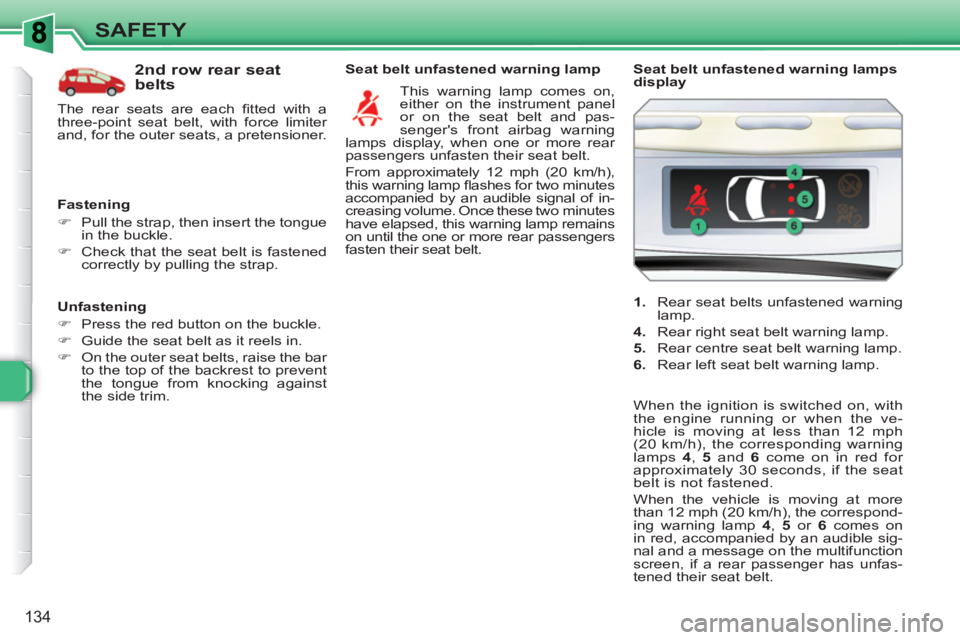
1.
Rear seat belts unfastened warning
lamp.
4.
Rear right seat belt warning lamp.
5.
Rear centre seat belt warning lamp.
6.
Rear left seat belt warning lamp.
Seat belt unfastened warning lamps
display
When the ignition is switched on, with
the engine running or when the ve-
hicle is moving at less than 12 mph
(20 km/h), the corresponding warning
lamps 4
, 5
and 6
come on in red for
approximately 30 seconds, if the seat
belt is not fastened.
When the vehicle is moving at more
than 12 mph (20 km/h), the correspond-
ing warning lamp 4
, 5
or 6
comes on
in red, accompanied by an audible sig-
nal and a message on the multifunction
screen, if a rear passenger has unfas-
tened their seat belt.
2nd row rear seat
belts
The rear seats are each fi tted with a
three-point seat belt, with force limiter
and, for the outer seats, a pretensioner.
Fastening
)
Pull the strap, then insert the tongue
in the buckle.
)
Check that the seat belt is fastened
correctly by pulling the strap.
Page 137 of 336
i
i
135
SAFETY
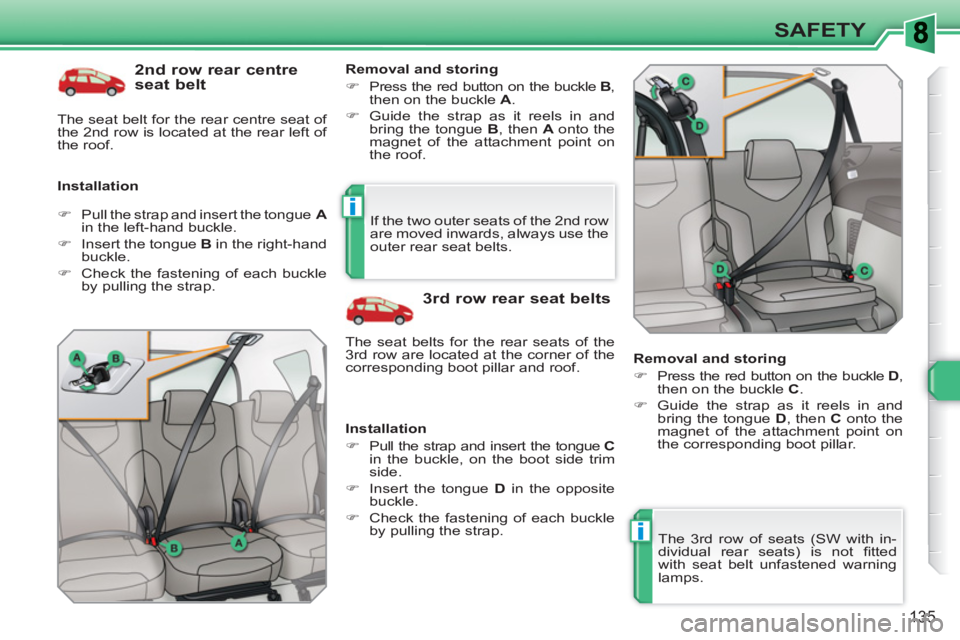
2nd row rear centre
seat belt
Installation
Removal and storing
)
Press the red button on the buckle B
,
then on the buckle A
.
)
Guide the strap as it reels in and
bring the tongue B
, then A
onto the
magnet of the attachment point on
the roof.
3rd row rear seat belts
Installation
)
Pull the strap and insert the tongue C
in the buckle, on the boot side trim
side.
)
Insert the tongue D
in the opposite
buckle.
)
Check the fastening of each buckle
by pulling the strap.
)
Pull the strap and insert the tongue A
in the left-hand buckle.
)
Insert the tongue B
in the right-hand
buckle.
)
Check the fastening of each buckle
by pulling the strap.
The seat belts for the rear seats of the
3rd row are located at the corner of the
corresponding boot pillar and roof. If the two outer seats of the 2nd row
are moved inwards, always use the
outer rear seat belts.
Removal and storing
)
Press the red button on the buckle D
,
then on the buckle C
.
)
Guide the strap as it reels in and
bring the tongue D
, then C
onto the
magnet of the attachment point on
the corresponding boot pillar.
The seat belt for the rear centre seat of
the 2nd row is located at the rear left of
the roof.
The 3rd row of seats (SW with in-
dividual rear seats) is not fi tted
with seat belt unfastened warning
lamps.
Page 141 of 336
!
139
SAFETY
Lateral airbags
System which protects the driver and
passengers (with the exception of the
rear centre passenger) in the event of a
serious side impact in order to limit the
risk of injury to the chest.
Each lateral airbag is incorporated:
- in the front, in the seat back frame,
on the door side,
- in the rear, in the side trim (except
SW models).
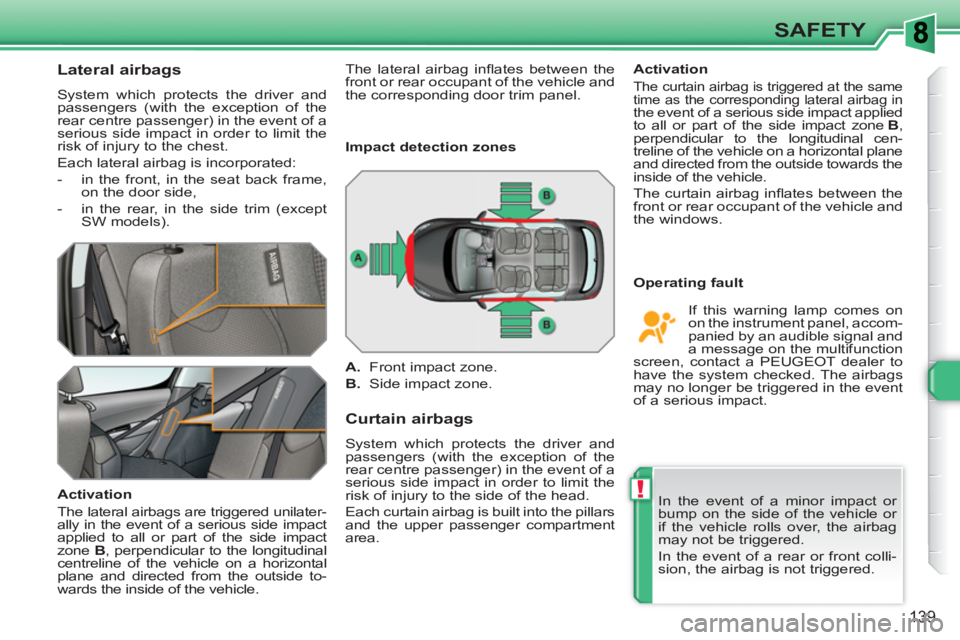
Activation
The lateral airbags are triggered unilater-
ally in the event of a serious side impact
applied to all or part of the side impact
zone B
, perpendicular to the longitudinal
centreline of the vehicle on a horizontal
plane and directed from the outside to-
wards the inside of the vehicle.
Curtain airbags
System which protects the driver and
passengers (with the exception of the
rear centre passenger) in the event of a
serious side impact in order to limit the
risk of injury to the side of the head.
Each curtain airbag is built into the pillars
and the upper passenger compartment
area.
Operating fault
Activation
The curtain airbag is triggered at the same
time as the corresponding lateral airbag in
the event of a serious side impact applied
to all or part of the side impact zone B
,
perpendicular to the longitudinal cen-
treline of the vehicle on a horizontal plane
and directed from the outside towards the
inside of the vehicle.
The curtain airbag infl ates between the
front or rear occupant of the vehicle and
the windows.
In the event of a minor impact or
bump on the side of the vehicle or
if the vehicle rolls over, the airbag
may not be triggered.
In the event of a rear or front colli-
sion, the airbag is not triggered.
Impact detection zones
A.
Front impact zone.
B.
Side impact zone.
If this warning lamp comes on
on the instrument panel, accom-
panied by an audible signal and
a message on the multifunction
screen, contact a PEUGEOT dealer to
have the system checked. The airbags
may no longer be triggered in the event
of a serious impact. The lateral airbag infl ates between the
front or rear occupant of the vehicle and
the corresponding door trim panel.
Page 144 of 336
i
142
DRIVING
GEAR SHIFT INDICATOR *
System which reduces fuel consumption
by advising the driver to change up on
vehicles fi tted with a manual gearbox.
Operation
The system intervenes only when driv-
ing economically.
Depending on the driving situation and
your vehicle's equipment, the system
may advise you to skip one or more
gears. You can follow this instruc-
tion without engaging the intermediate
gears.
The gear recommended should not
be considered compulsory. In fact, the
confi guration of the road, the amount
of traffi c and safety remain determining
factors when choosing the best gear.
Therefore, the driver remains responsi-
ble for deciding whether or not to follow
the advice given by the system.
This function cannot be deactivated.
*
According to engine.
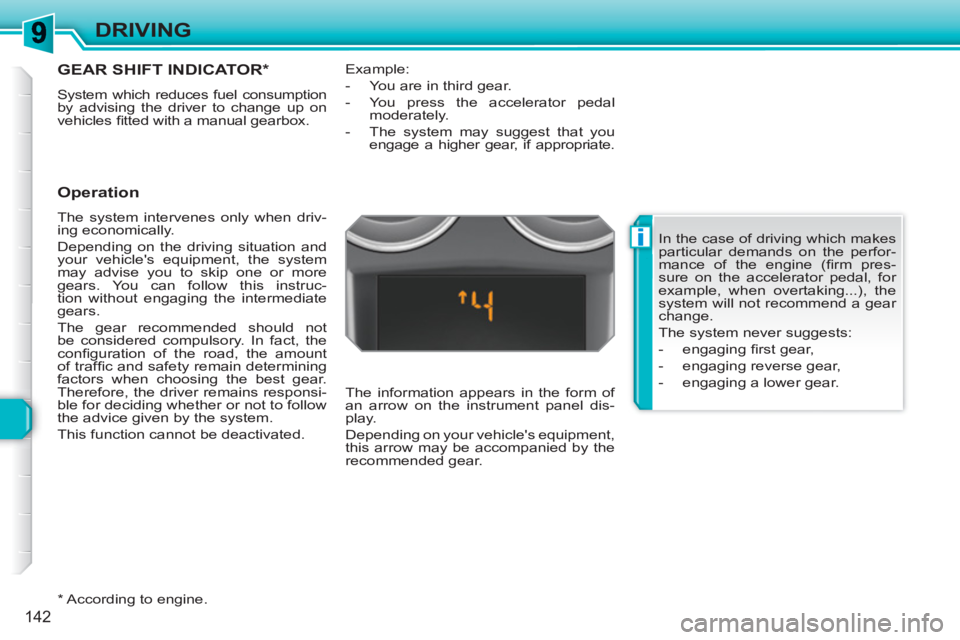
Example:
- You are in third gear.
- You press the accelerator pedal
moderately.
- The system may suggest that you
engage a higher gear, if appropriate.
The information appears in the form of
an arrow on the instrument panel dis-
play.
Depending on your vehicle's equipment,
this arrow may be accompanied by the
recommended gear.
In the case of driving which makes
particular demands on the perfor-
mance of the engine (fi rm pres-
sure on the accelerator pedal, for
example, when overtaking...), the
system will not recommend a gear
change.
The system never suggests:
- engaging fi rst gear,
- engaging reverse gear,
- engaging a lower gear.
Page 149 of 336
147
DRIVING
"PORSCHE TIPTRONICSYSTEM" AUTOMATICGEARBOX
Four or six speed automatic gearbox
which offers a choice between the com-
fort of fully automatic operation, en-
hanced by sport and snow programmes,
or manual gear changing.
Four driving modes are provided:
- automatic
operation for electronic
management of the gears by the
gearbox,
- sport
programme for a more
dynamic style of driving,
- snow
programme to improve driving
when traction is poor,
- manual
operation for sequential
changing of the gears by the driver.
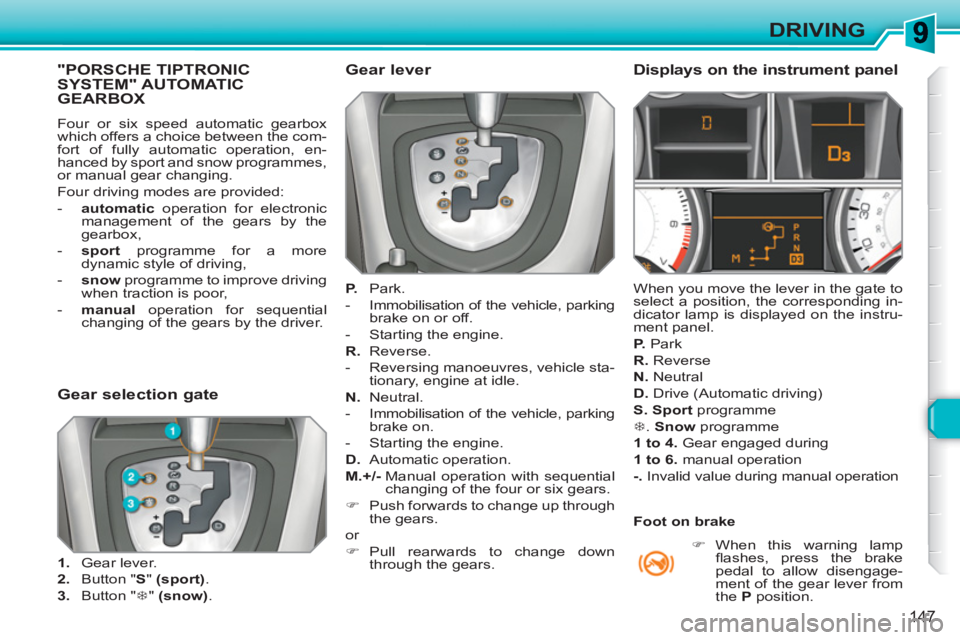
Gear lever
P.
Park.
- Immobilisation of the vehicle, parking
brake on or off.
- Starting the engine.
R.
Reverse.
- Reversing manoeuvres, vehicle sta-
tionary, engine at idle.
N.
Neutral.
- Immobilisation of the vehicle, parking
brake on.
- Starting the engine.
D.
Automatic operation.
M.+/-
Manual operation with sequential
changing of the four or six gears.
)
Push forwards to change up through
the gears.
or
)
Pull rearwards to change down
through the gears.
Displays on the instrument panel
When you move the lever in the gate to
select a position, the corresponding in-
dicator lamp is displayed on the instru-
ment panel.
P.
Park
R.
Reverse
N.
Neutral
D.
Drive (Automatic driving)
S.
Sport
programme
7
. Snow
programme
1 to 4.
Gear engaged during
1 to 6.
manual operation
-.
Invalid value during manual operation
)
When this warning lamp
fl ashes, press the brake
pedal to allow disengage-
ment of the gear lever from
the P
position.
Gear selection gate
1.
Gear lever.
2.
Button " S
" (sport)
.
3.
Button " 7
" (snow)
.
Foot on brake
Page 152 of 336
i
150
DRIVING
SPEED LIMITER
System which prevents the vehicle from
exceeding the speed programmed by
the driver.
When the programmed speed limit is
reached, pressing the accelerator pedal
no longer has any effect.
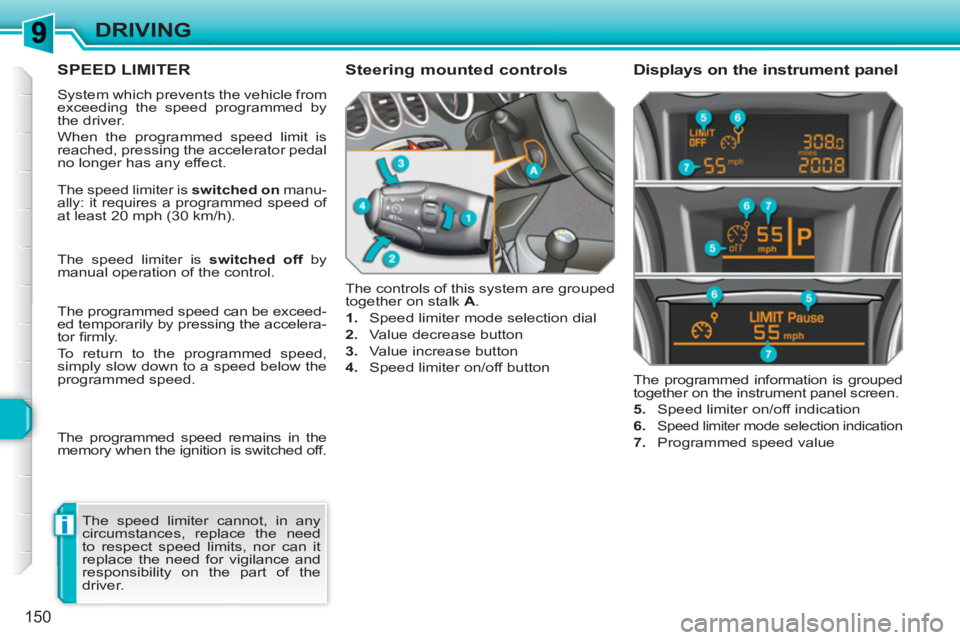
The controls of this system are grouped
together on stalk A
.
1.
Speed limiter mode selection dial
2.
Value decrease button
3.
Value increase button
4.
Speed limiter on/off button
The programmed information is grouped
together on the instrument panel screen.
5.
Speed limiter on/off indication
6.
Speed limiter mode selection indication
7.
Programmed speed value
Steering mounted controls
Displays on the instrument panel
The speed limiter cannot, in any
circumstances, replace the need
to respect speed limits, nor can it
replace the need for vigilance and
responsibility on the part of the
driver.
The speed limiter is switched on
manu-
ally: it requires a programmed speed of
at least 20 mph (30 km/h).
The speed limiter is switched off
by
manual operation of the control.
The programmed speed can be exceed-
ed temporarily by pressing the accelera-
tor fi rmly.
To return to the programmed speed,
simply slow down to a speed below the
programmed speed.
The programmed speed remains in the
memory when the ignition is switched off.