dashboard Peugeot 308 SW BL 2013 Owner's Manual
[x] Cancel search | Manufacturer: PEUGEOT, Model Year: 2013, Model line: 308 SW BL, Model: Peugeot 308 SW BL 2013Pages: 382, PDF Size: 17.75 MB
Page 37 of 382
1INSTRUMENTS and CONTROLS
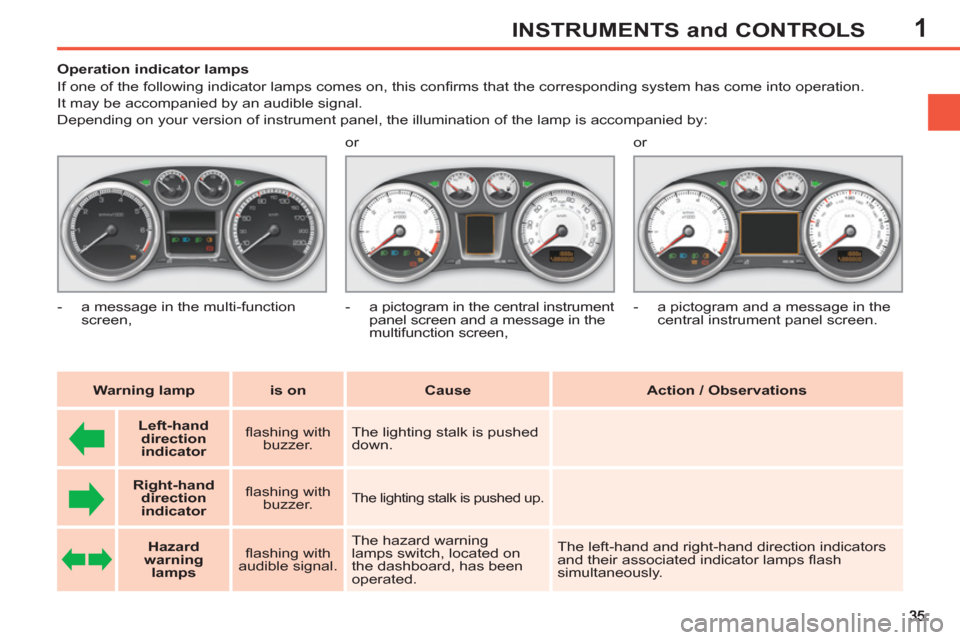
Operation indicator lamps
If one of the following indicator lamps comes on, this confi rms that the corresponding system has come into operation.
It may be accompanied by an audible signal.
Depending on your version of instrument panel, the illumination of the lamp is accompanied by:
Warning lamp
is on
Cause
Action / Observations
Left-hand
direction
indicato
r
fl ashing with
buzzer. The lighting stalk is pushed
down.
Right-hand
direction
indicator
fl ashing with
buzzer.
The lighting stalk is pushed up.
Hazard
warning
lamps
fl ashing with
audible signal. The hazard warning
lamps switch, located on
the dashboard, has been
operated. The left-hand and right-hand direction indicators
and their associated indicator lamps fl ash
simultaneously.
- a message in the multi-function
screen, or
- a pictogram in the central instrument
panel screen and a message in the
multifunction screen, or
- a pictogram and a message in the
central instrument panel screen.
Page 39 of 382
1
37
INSTRUMENTS and CONTROLS
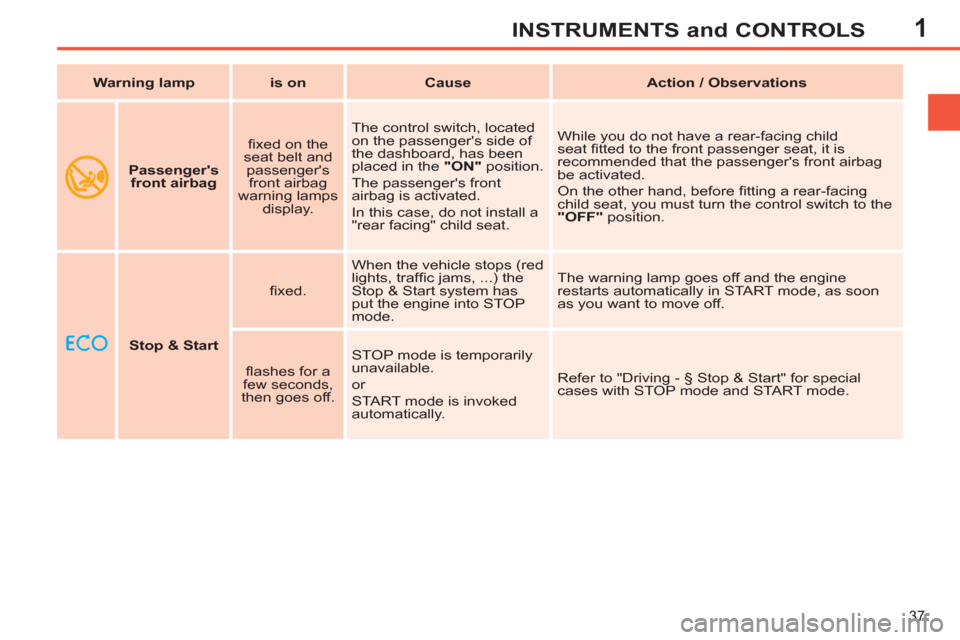
Stop & Start
fi xed. When the vehicle stops (red
lights, traffi c jams, ...) the
Stop & Start system has
put the engine into STOP
mode. The warning lamp goes off and the engine
restarts automatically in START mode, as soon
as you want to move off.
fl ashes for a
few seconds,
then goes off. STOP mode is temporarily
unavailable.
or
START mode is invoked
automatically. Refer to "Driving - § Stop & Start" for special
cases with STOP mode and START mode.
Warning lamp
is on
Cause
Action / Observations
Passenger's
front airbag
fi xed on the
seat belt and
passenger's
front airbag
warning lamps
display. The control switch, located
on the passenger's side of
the dashboard, has been
placed in the "ON"
position.
The passenger's front
airbag is activated.
In this case, do not install a
"rear facing" child seat. While you do not have a rear-facing child
seat fi tted to the front passenger seat, it is
recommended that the passenger's front airbag
be activated.
On the other hand, before fi tting a rear-facing
child seat, you must turn the control switch to the
"OFF"
position.
Page 40 of 382
1
38
INSTRUMENTS and CONTROLS
Warning lamp
is on
Cause
Action / Observations
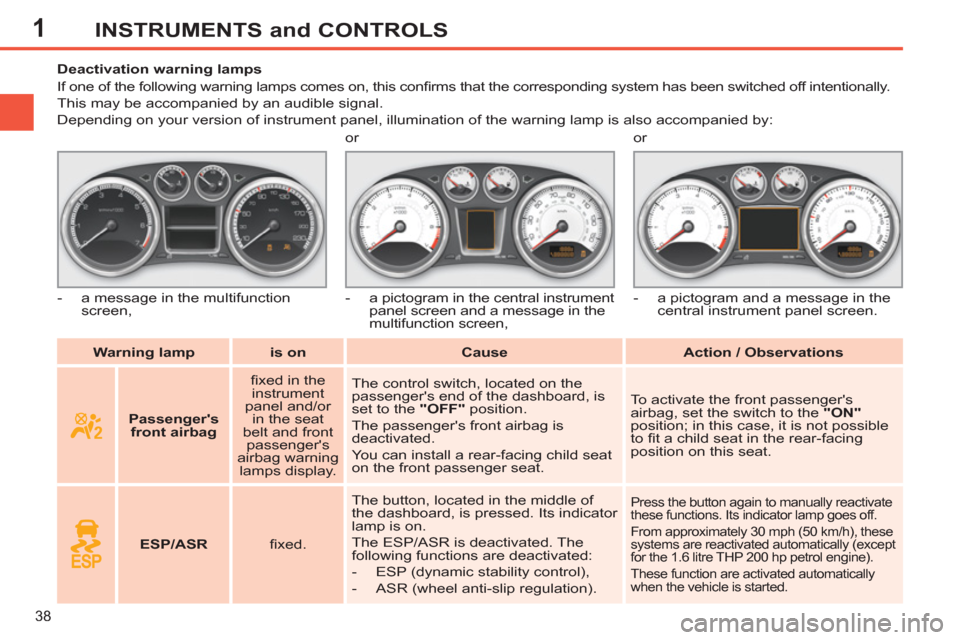
Deactivation warning lamps
If one of the following warning lamps comes on, this confi rms that the corresponding system has been switched off intentionally.
This may be accompanied by an audible signal.
Depending on your version of instrument panel, illumination of the warning lamp is also accompanied by:
Passenger's
front airbag
fi xed in the
instrument
panel and/or
in the seat
belt and front
passenger's
airbag warning
lamps display. The control switch, located on the
passenger's end of the dashboard, is
set to the "OFF"
position.
The passenger's front airbag is
deactivated.
You can install a rear-facing child seat
on the front passenger seat. To activate the front passenger's
airbag, set the switch to the "ON"
position; in this case, it is not possible
to fi t a child seat in the rear-facing
position on this seat.
ESP/ASR
fi xed. The button, located in the middle of
the dashboard, is pressed. Its indicator
lamp is on.
The ESP/ASR is deactivated. The
following functions are deactivated:
- ESP (dynamic stability control),
- ASR (wheel anti-slip regulation).
Press the button again to manually reactivate
these functions. Its indicator lamp goes off.
From approximately 30 mph (50 km/h), these
systems are reactivated automatically (except
for the 1.6 litre THP 200 hp petrol engine).
These function are activated automatically
when the vehicle is started.
- a message in the multifunction
screen, or
- a pictogram in the central instrument
panel screen and a message in the
multifunction screen, or
- a pictogram and a message in the
central instrument panel screen.
Page 64 of 382
3
62
COMFORT
If after an extended stop in sunshine,
the interior temperature is very high,
fi rst ventilate the passenger com-
partment for a few moments.
Put the air fl ow control at a setting
high enough to quickly change the
air in the passenger compartment.
The air conditioning system does
not contain chlorine and does not
present any danger to the ozone
layer. RECOMMENDATIONS FOR VENTILATION AND AIR CONDITIONING
In order for these systems to be fully effective, follow the operation and main-
tenance guidelines below:
)
To obtain an even air distribution, take care not to obstruct the exterior air
intake grilles located at the base of the windscreen, the nozzles, the vents
and the air outlets, as well as the air extractor located in the boot.
)
Do not cover the sunshine sensor, located on the dashboard; this is used
for regulation of the digital air conditioning system.
)
Operate the air conditioning system for at least 5 to 10 minutes, once or
twice a month to keep it in perfect working order.
)
Ensure that the passenger compartment fi lter is in good condition and
have the fi lter elements replaced regularly (refer to the "Checks" section).
We recommend the use of a combined passenger compartment fi lter.
Thanks to its special active additive, it contributes to the purifi cation of
the air breathed by the occupants and the cleanliness of the passenger
compartment (reduction of allergic symptoms, bad odours and greasy de-
posits).
)
To ensure correct operation of the air conditioning system, you are also
advised to have it checked regularly as recommended in the servicing
booklet.
)
If the system does not produce cold air, switch it off and contact a PEUGEOT
dealer or a qualifi ed workshop.
When towing the maximum load on a steep gradient in high temperatures,
switching off the air conditioning increases the available engine power and so
improves the towing ability.
The condensation created by the
air conditioning results in a dis-
charge of water under the vehicle
which is perfectly normal.
Stop & Start
The heating and air conditioning systems only work when the engine is run-
ning. To maintain a comfortable temperature in the passenger compartment,
you can temporarily deactivate the Stop & Start system (see "Driving").
Page 142 of 382
8
140
SAFETY
The ESP/ASR systems offer ex-
ceptional safety in normal driving,
but this should not encourage the
driver to take extra risks or drive at
high speed.
The correct functioning of these
systems depends on observation
of the manufacturer's recommen-
dations on:
- wheels (tyres and rims),
- braking components,
- electronic components,
- repair and assembly procedures.
After an impact, have these sys-
tems checked by a PEUGEOT
dealer or a qualifi ed workshop.
Deactivation
In exceptional conditions (starting a ve-
hicle which is bogged down, stuck in
snow, on soft ground, ...), it may be ad-
visable to deactivate the ASR and ESP
systems, so that the wheels can move
freely and regain grip.
)
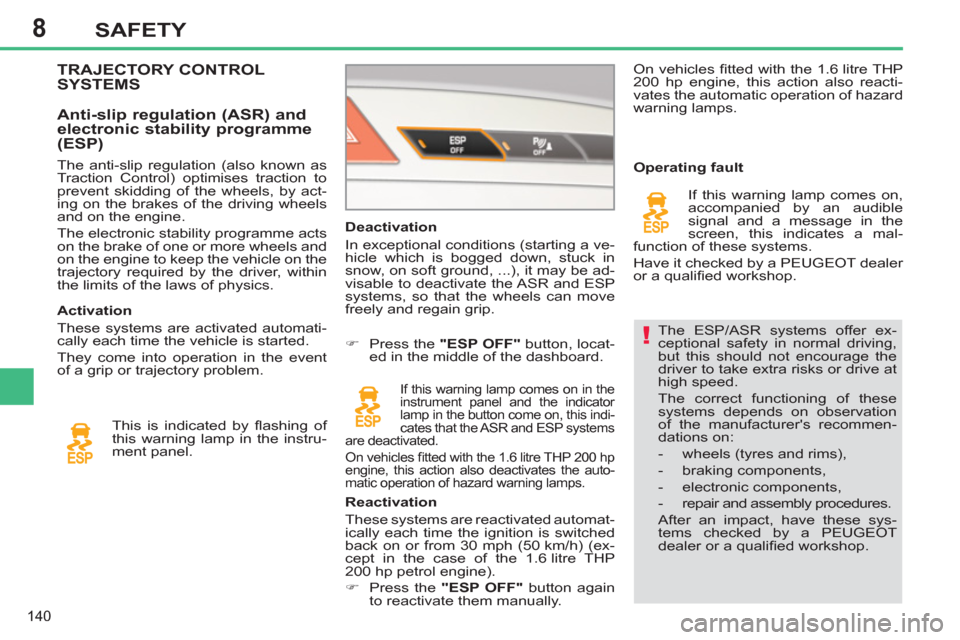
Press the "ESP OFF"
button, locat-
ed in the middle of the dashboard.
If this warning lamp comes on in the
instrument panel and the indicator
lamp in the button come on, this indi-
cates that the ASR and ESP systems
are deactivated.
On vehicles fi tted with the 1.6 litre THP 200 hp
engine, this action also deactivates the auto-
matic operation of hazard warning lamps.
Reactivation
These systems are reactivated automat-
ically each time the ignition is switched
back on or from 30 mph (50 km/h) (ex-
cept in the case of the 1.6 litre THP
200 hp petrol engine).
)
Press the "ESP OFF"
button again
to reactivate them manually.
Operating fault
If this warning lamp comes on,
accompanied by an audible
signal and a message in the
screen, this indicates a mal-
function of these systems.
Have it checked by a PEUGEOT dealer
or a qualifi ed workshop.
TRAJECTORY CONTROLSYSTEMS
Activation
These systems are activated automati-
cally each time the vehicle is started.
They come into operation in the event
of a grip or trajectory problem.
Anti-slip regulation (ASR) and
electronic stability programme
(ESP)
This is indicated by fl ashing of
this warning lamp in the instru-
ment panel.
The anti-slip regulation (also known as
Traction Control) optimises traction to
prevent skidding of the wheels, by act-
ing on the brakes of the driving wheels
and on the engine.
The electronic stability programme acts
on the brake of one or more wheels and
on the engine to keep the vehicle on the
trajectory required by the driver, within
the limits of the laws of physics. On vehicles fi tted with the 1.6 litre THP
200 hp engine, this action also reacti-
vates the automatic operation of hazard
warning lamps.
Page 148 of 382
8
146
SAFETY
AIRBAGS
Deployment of the airbag(s) is ac-
companied by a slight emission of
harmless smoke and a noise, due
to the activation of the pyrotechnic
cartridge incorporated in the sys-
tem.
This smoke is not harmful, but sen-
sitive individuals may experience
slight irritation.
The noise of the detonation may
result in a slight loss of hearing for
a short time.
Front airbags
System which protects the driver and
front passenger in the event of a seri-
ous front impact in order to limit the risk
of injury to the head and thorax.
The driver's airbag is fi tted in the centre
of the steering wheel; the front passen-
ger's airbag is fi tted in the dashboard
above the glove box.
Deployment
The airbags are deployed simultaneously,
unless the passenger's front airbag is deac-
tivated, in the event of a serious front impact
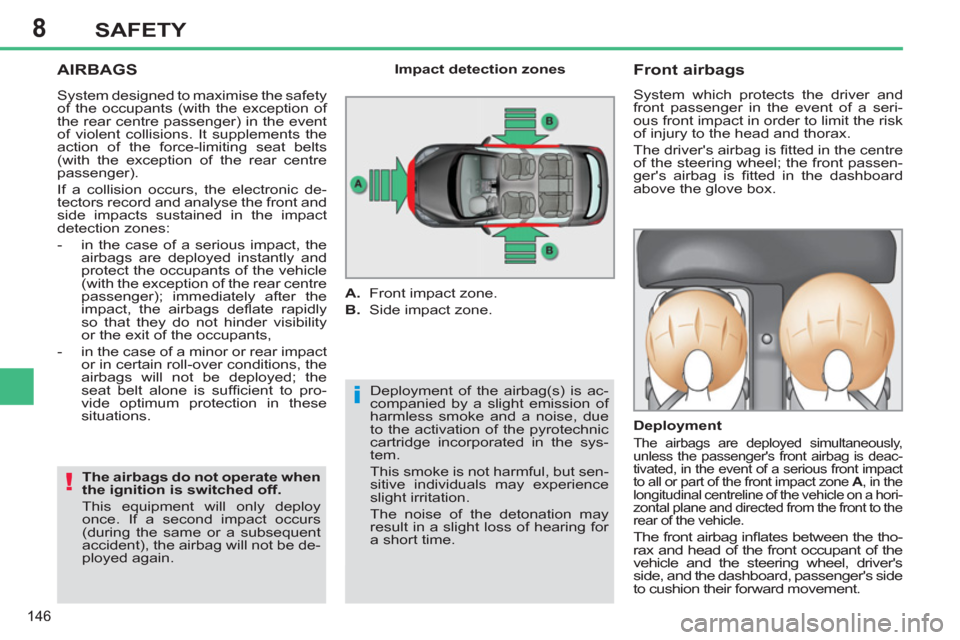
to all or part of the front impact zone A
, in the
longitudinal centreline of the vehicle on a hori-
zontal plane and directed from the front to the
rear of the vehicle.
The front airbag infl ates between the tho-
rax and head of the front occupant of the
vehicle and the steering wheel, driver's
side, and the dashboard, passenger's side
to cushion their forward movement.
Impact detection zones
A.
Front impact zone.
B.
Side impact zone.
The airbags do not operate when
the ignition is switched off.
This equipment will only deploy
once. If a second impact occurs
(during the same or a subsequent
accident), the airbag will not be de-
ployed again.
System designed to maximise the safety
of the occupants (with the exception of
the rear centre passenger) in the event
of violent collisions. It supplements the
action of the force-limiting seat belts
(with the exception of the rear centre
passenger).
If a collision occurs, the electronic de-
tectors record and analyse the front and
side impacts sustained in the impact
detection zones:
- in the case of a serious impact, the
airbags are deployed instantly and
protect the occupants of the vehicle
(with the exception of the rear centre
passenger); immediately after the
impact, the airbags defl ate rapidly
so that they do not hinder visibility
or the exit of the occupants,
- in the case of a minor or rear impact
or in certain roll-over conditions, the
airbags will not be deployed; the
seat belt alone is suffi cient to pro-
vide optimum protection in these
situations.
Page 149 of 382
8
147
SAFETY
If even one of the two airbag warn-
ing lamps comes on continuously,
do not install a child seat on the
front passenger seat.
Have the system checked by a
PEUGEOT dealer or a qualifi ed
workshop.
Operating fault
If this warning lamp comes on in
the instrument panel, accompa-
nied by an audible warning and
a message in the screen, con-
tact a PEUGEOT dealer or a qualifi ed
workshop to have the system checked.
The airbags may no longer be deployed
in the event of a serious impact.
Knee airbag *
System which protects the driver's
knees in the event of a serious front im-
pact.
This airbag is fi tted in the dashboard
below the steering column.
Deployment
It is deployed at the same time as the
front airbags.
Reactivation
When you remove the child seat, turn
the switch to the "ON"
position to re-
activate the airbag and so assure the
safety of your front passenger in the
event of an impact.
With the ignition on, this warn-
ing lamp comes on in the seat
belt and passenger's front airbag
warning lamps display for ap-
proximately one minute, if the passenger's
front airbag is activated. To assure the safety of your child,
the passenger's front airbag must
be deactivated when you install a
"rear facing" child seat on the front
passenger seat.
Otherwise, the child would risk be-
ing seriously injured or killed if the
airbag were deployed.
According to version, this warning
lamp comes on in the instrument
panel and/or in the seat belt and
passenger's front airbag warning
lamps display when the ignition is on and
until the airbag is reactivated. If this warning lamp fl ashes in
the instrument panel and/or in
the seat belt and passenger's
front airbag warning lamps dis-
play, contact a PEUGEOT dealer or a
qualifi ed workshop. The passenger's
front airbag may no longer be deployed
in the event of a serious impact.
Deactivation
Only the passenger's front airbag can
be deactivated:
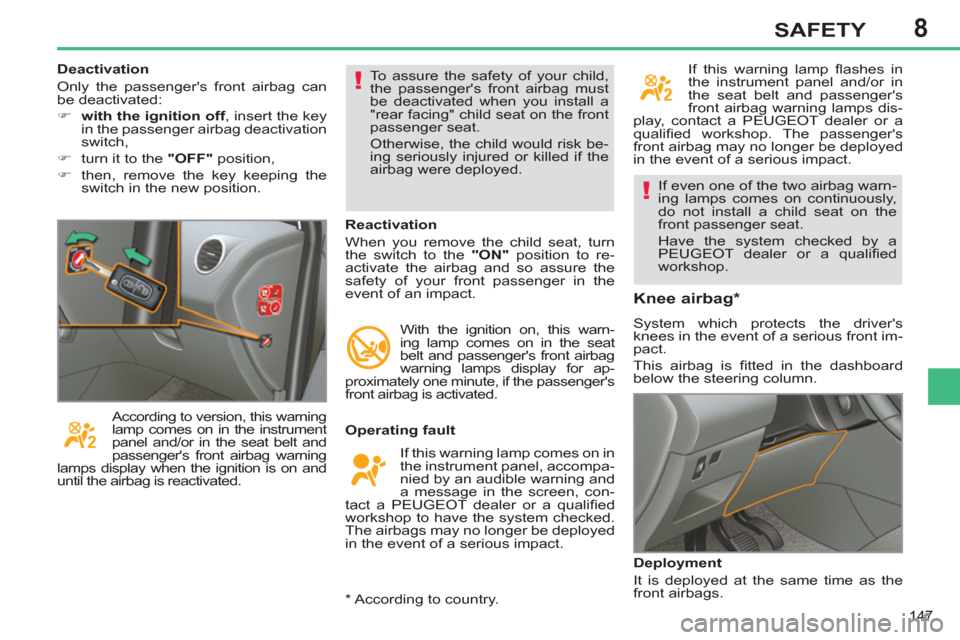
)
with the ignition off
, insert the key
in the passenger airbag deactivation
switch,
)
turn it to the "OFF"
position,
)
then, remove the key keeping the
switch in the new position.
*
According to country.
Page 151 of 382
8
149
SAFETY
For the airbags to be fully
effective, observe the following
safety rules:
Sit in a normal upright position.
Wear a correctly adjusted seat belt.
Do not leave anything between the
occupants and the airbags (a child,
pet, object...). This could hamper the
operation of the airbags or injure the
occupants.
*
According to country.
Knee airbag *
Do not sit with your knees any nearer to the steering wheel than necessary.
Lateral airbags
Use only approved covers on the seats, compatible with the deployment the
lateral airbags. For information on the range of seat covers suitable for your
vehicle, you can contact a PEUGEOT dealer (see "Practical information - § Ac-
cessories").
Do not fi x or attach anything to the seat backs (clothing...). This could cause
injury to the chest or arms if the lateral airbag is deployed.
Do not sit with the upper part of the body any nearer to the door than necessary.
Curtain airbags
Do not fi x or attach anything to the roof. This could cause injury to the head if
the curtain airbag is deployed.
If fi tted on your vehicle, do not remove the grab handles installed on the roof,
they play a part in securing the curtain airbags.
After an accident or if the vehicle has
been stolen or broken into, have the
airbag systems checked.
All work on the airbag system must
be carried out by a PEUGEOT dealer
or a qualifi ed workshop.
Even if all of the precautions men-
tioned are observed, a risk of injury
or of minor burns to the head, chest
or arms when an airbag is deployed
cannot be ruled out. The bag infl ates
almost instantly (within a few mil-
liseconds) then defl ates within the
same time discharging the hot gas
via openings provided for this pur-
pose.
Front airbags
Do not drive holding the steering wheel by its spokes or resting your hands on
the centre part of the wheel.
Passengers must not place their feet on the dashboard.
If possible, do not smoke as deployment of the airbags can cause burns or the
risk of injury from a cigarette or pipe.
Never remove or pierce the steering wheel or hit it violently.
Page 203 of 382
11
201
PRACTICAL INFORMATION
PEUGEOT will not accept responsi-bility for the cost incurred in repairing your vehicle or for rectifying mal-
functions resulting from the installa-
tion of accessories not supplied and
not recommended by PEUGEOT
and not installed in accordance with
its instructions, in particular when
the combined consumption of all of
the additional equipment connected
exceeds 10 milliamperes.
Installing electrical accessories
Your vehicle's electrical system is
designed to operate with standard
or optional equipment.
Before installing other electrical
equipment or accessories on your
vehicle, contact a PEUGEOT dealer
or a qualifi ed workshop.
CHANGING A FUSE
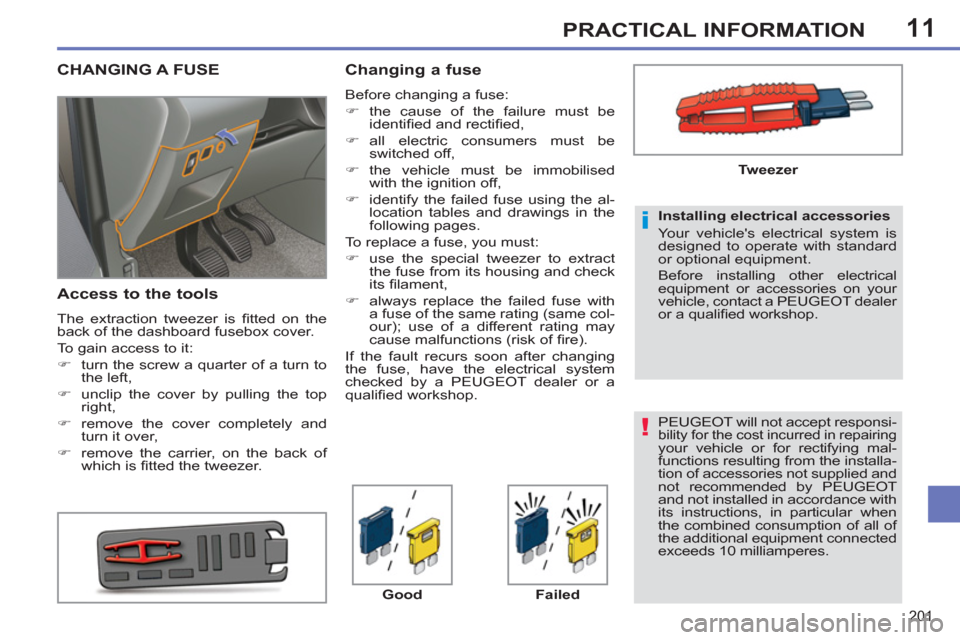
Access to the tools
The extraction tweezer is fi tted on the
back of the dashboard fusebox cover.
To gain access to it:
)
turn the screw a quarter of a turn to
the left,
)
unclip the cover by pulling the top
right,
)
remove the cover completely and
turn it over,
)
remove the carrier, on the back of
which is fi tted the tweezer.
Changing a fuse
Before changing a fuse:
)
the cause of the failure must be
identifi ed and rectifi ed,
)
all electric consumers must be
switched off,
)
the vehicle must be immobilised
with the ignition off,
)
identify the failed fuse using the al-
location tables and drawings in the
following pages.
To replace a fuse, you must:
)
use the special tweezer to extract
the fuse from its housing and check
its fi lament,
)
always replace the failed fuse with
a fuse of the same rating (same col-
our); use of a different rating may
cause malfunctions (risk of fi re).
If the fault recurs soon after changing
the fuse, have the electrical system
checked by a PEUGEOT dealer or a
qualifi ed workshop.
Good
Failed
Tweezer
Page 204 of 382
11
202
PRACTICAL INFORMATION
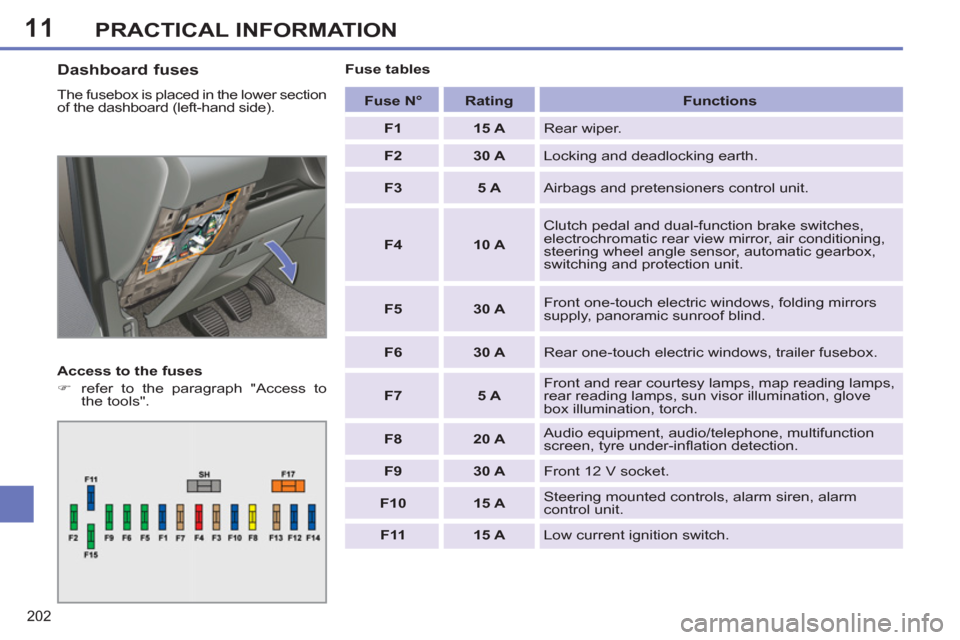
Dashboard fuses
The fusebox is placed in the lower section
of the dashboard (left-hand side).
Access to the fuses
)
refer to the paragraph "Access to
the tools".
Fuse tables
Fuse N°
Rating
Functions
F1
15 A
Rear wiper.
F2
30 A
Locking and deadlocking earth.
F3
5 A
Airbags and pretensioners control unit.
F4
10 A
Clutch pedal and dual-function brake switches,
electrochromatic rear view mirror, air conditioning,
steering wheel angle sensor, automatic gearbox,
switching and protection unit.
F5
30 A
Front one-touch electric windows, folding mirrors
supply, panoramic sunroof blind.
F6
30 A
Rear one-touch electric windows, trailer fusebox.
F7
5 A
Front and rear courtesy lamps, map reading lamps,
rear reading lamps, sun visor illumination, glove
box illumination, torch.
F8
20 A
Audio equipment, audio/telephone, multifunction
screen, tyre under-infl ation detection.
F9
30 A
Front 12 V socket.
F10
15 A
Steering mounted controls, alarm siren, alarm
control unit.
F11
15 A
Low current ignition switch.