fuse Peugeot 308 SW BL 2013 Owner's Manual
[x] Cancel search | Manufacturer: PEUGEOT, Model Year: 2013, Model line: 308 SW BL, Model: Peugeot 308 SW BL 2013Pages: 382, PDF Size: 17.75 MB
Page 5 of 382
3
CONTENTS
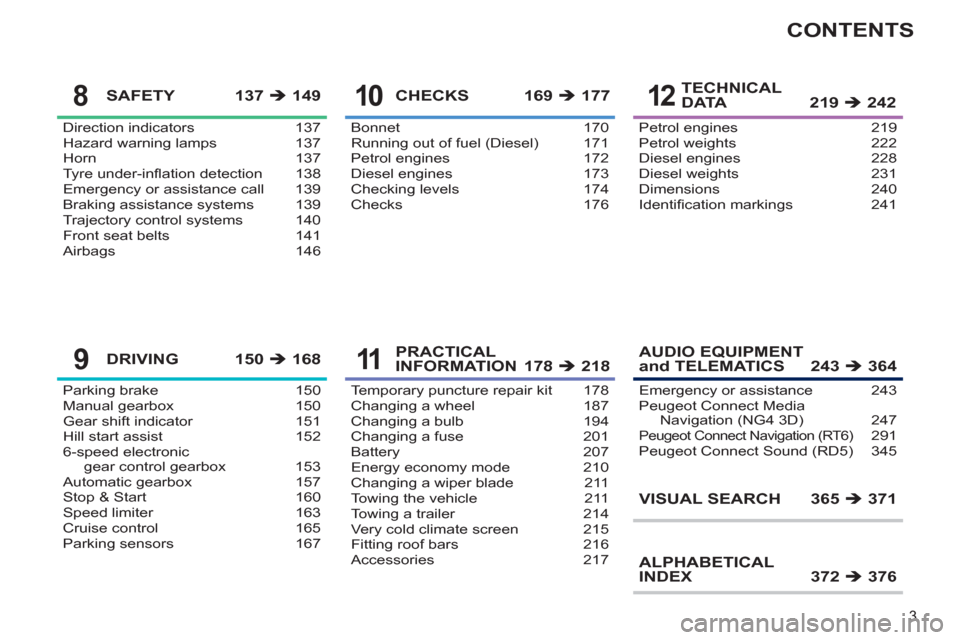
Direction indicators 137
Hazard warning lamps 137
Horn 137
Tyre under-infl ation detection 138
Emergency or assistance call 139
Braking assistance systems 139
Trajectory control systems 140
Front seat belts 141
Airbags 146
SAFETY 137 Î 149
Parking brake 150
Manual gearbox 150
Gear shift indicator 151
Hill start assist 152
6-speed electronic
gear control gearbox 153
Automatic gearbox 157
Stop & Start 160
Speed limiter 163
Cruise control 165
Parking sensors 167
DRIVING 150 Î 168
Bonnet 170
Running out of fuel (Diesel) 171
Petrol engines 172
Diesel engines 173
Checking levels 174
Checks 176
CHECKS 169 Î 177
Temporary puncture repair kit 178
Changing a wheel 187
Changing a bulb 194
Changing a fuse 201
Battery 207
Energy economy mode 210
Changing a wiper blade 211
Towing the vehicle 211
Towing a trailer 214
Very cold climate screen 215
Fitting roof bars 216
Accessories 217
PRACTICAL
INFORMATION 178 Î 218
Petrol engines 219
Petrol weights 222
Diesel engines 228
Diesel weights 231
Dimensions 240
Identifi cation markings 241
TECHNICAL
DATA 219 Î 242
AUDIO EQUIPMENT
and TELEMATICS 243 Î 364
VISUAL SEARCH 365 Î 371
ALPHABETICAL
INDEX 372 Î 376
Emergency or assistance 243
Peugeot Connect Media
Navigation (NG4 3D) 247
Peugeot Connect Navigation (RT6) 291
Peugeot Connect Sound (RD5) 345
8
9
10
11
12
Page 11 of 382
9
FAMILIARISATION
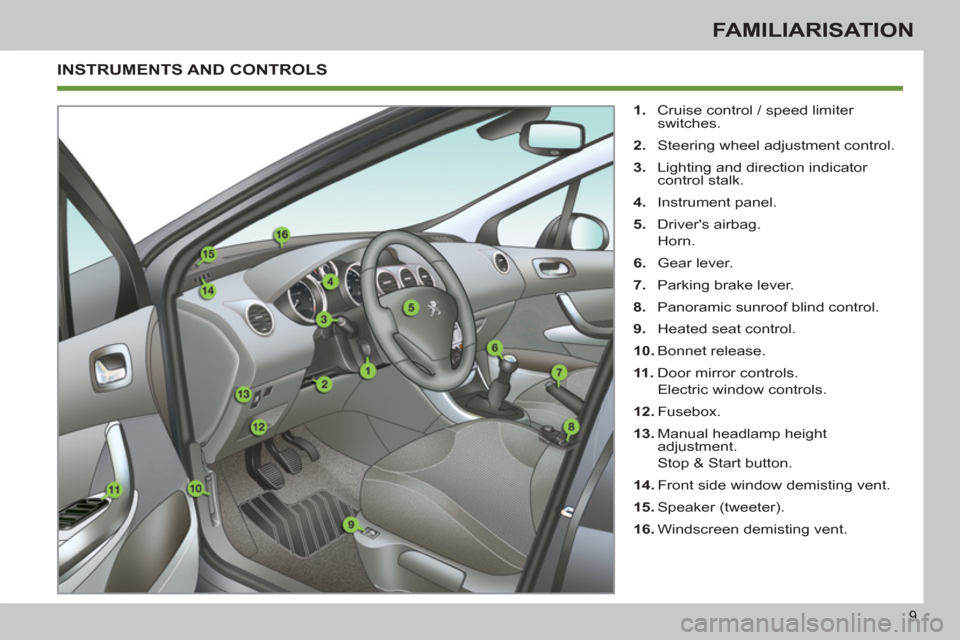
INSTRUMENTS AND CONTROLS
1.
Cruise control / speed limiter
switches.
2.
Steering wheel adjustment control.
3.
Lighting and direction indicator
control stalk.
4.
Instrument panel.
5.
Driver's airbag.
Horn.
6.
Gear lever.
7.
Parking brake lever.
8.
Panoramic sunroof blind control.
9.
Heated seat control.
10.
Bonnet release.
11 .
Door mirror controls.
Electric window controls.
12.
Fusebox.
13.
Manual headlamp height
adjustment.
Stop & Start button.
14.
Front side window demisting vent.
15.
Speaker (tweeter).
16.
Windscreen demisting vent.
Page 63 of 382
3
61
COMFORT
VENTILATION
Air treatment
The incoming air follows various routes
depending on the controls selected by
the driver:
- direct arrival in the passenger compart-
ment (air intake),
- passage through a heating circuit
(heating),
- passage through a cooling circuit
(air conditioning).
The temperature control enables you to
obtain the level of comfort required by
mixing the air of the various circuits. The air distribution control enables you to
diffuse the air in the passenger compart-
ment combining several air vents.
The air fl ow control enables you to increase
or reduce the speed of the ventilation blower.
Air intake
The air circulating in the passenger com-
partment is fi ltered and originates either
from the outside via the grille located at
the base of the windscreen or from the
inside in air recirculation mode.
Control panel
The controls of this system are grouped
together on control panel A
on the centre
console. Depending on the model, the
functions offered are:
- level of comfort required,
- air fl ow,
- air distribution,
- demisting and defrosting,
- manual or digital air conditioning
controls.
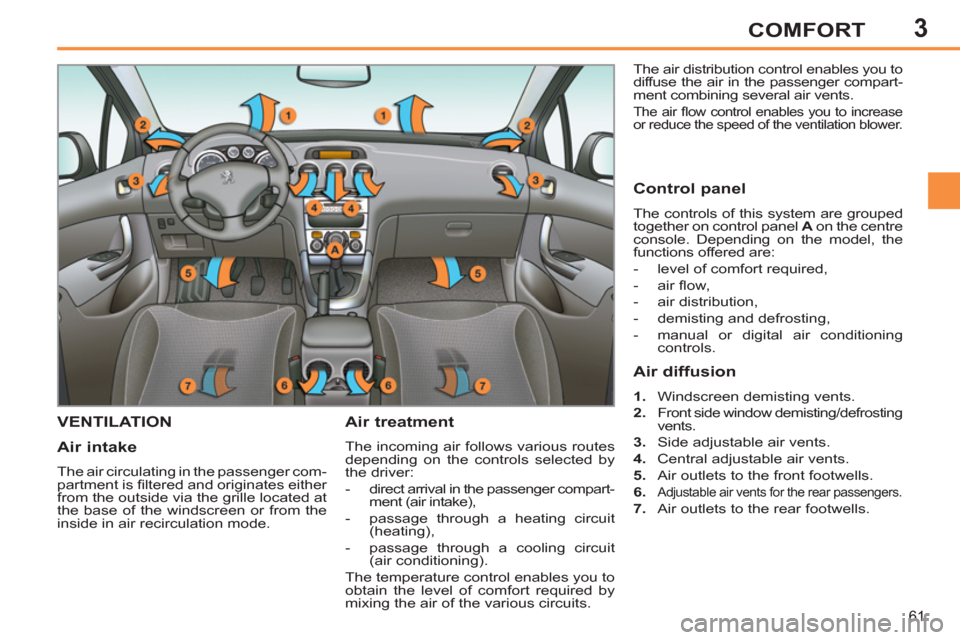
Air diffusion
1.
Windscreen demisting vents.
2.
Front side window demisting/defrosting
vents.
3.
Side adjustable air vents.
4.
Central adjustable air vents.
5.
Air outlets to the front footwells.
6.
Adjustable air vents for the rear passengers.
7.
Air outlets to the rear footwells.
Page 174 of 382
10
172
CHECKS
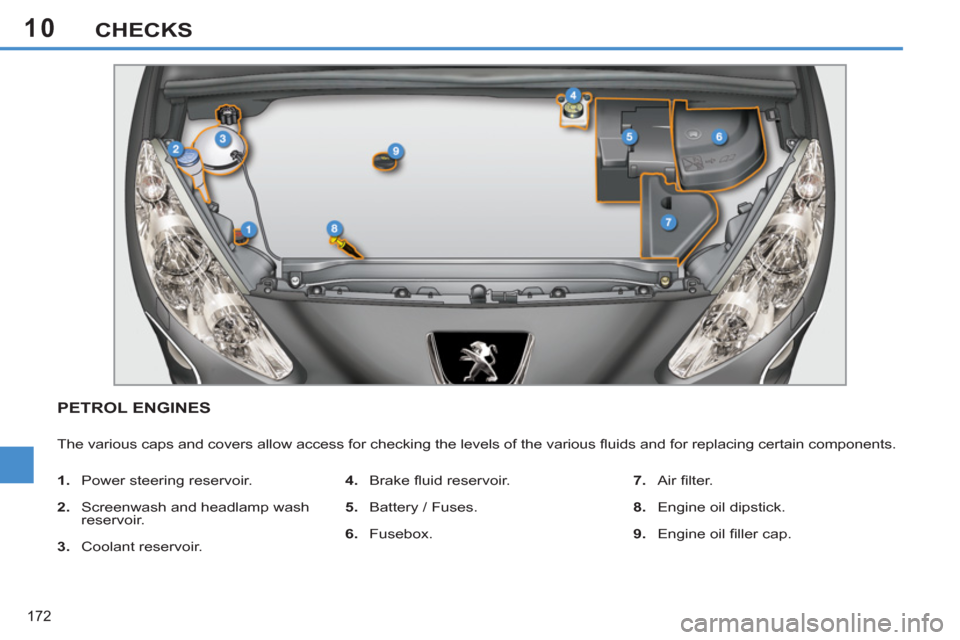
PETROL ENGINES
The various caps and covers allow access for checking the levels of the various fl uids and for replacing certain components.
1.
Power steering reservoir.
2.
Screenwash and headlamp wash
reservoir.
3.
Coolant reservoir.
4.
Brake fl uid reservoir.
5.
Battery / Fuses.
6.
Fusebox.
7.
Air fi lter.
8.
Engine oil dipstick.
9.
Engine oil fi ller cap.
Page 175 of 382
10
173
CHECKS
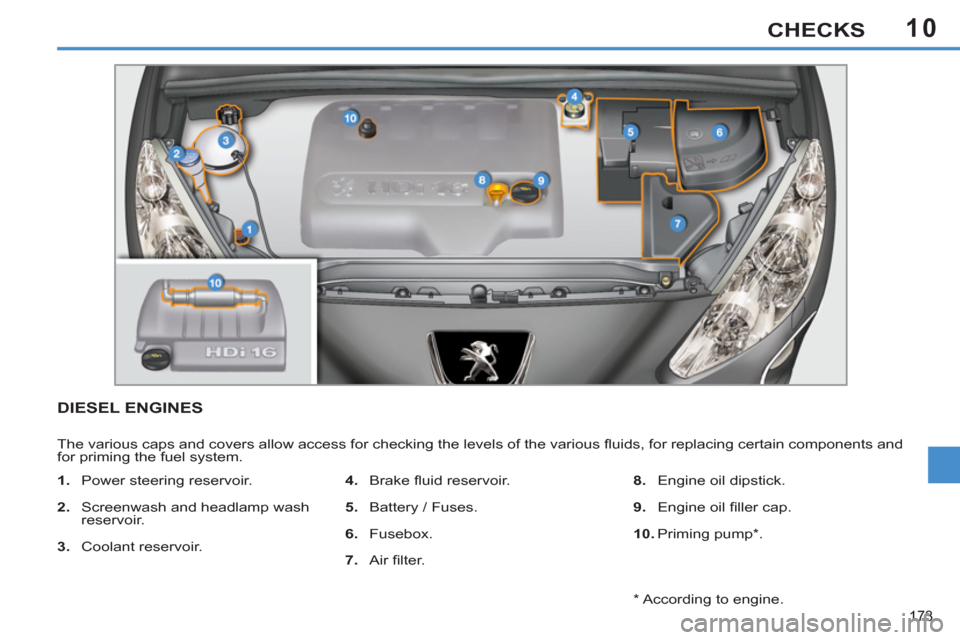
DIESEL ENGINES
The various caps and covers allow access for checking the levels of the various fl uids, for replacing certain components and
for priming the fuel system.
1.
Power steering reservoir.
2.
Screenwash and headlamp wash
reservoir.
3.
Coolant reservoir.
4.
Brake fl uid reservoir.
5.
Battery / Fuses.
6.
Fusebox.
7.
Air fi lter.
8.
Engine oil dipstick.
9.
Engine oil fi ller cap.
10.
Priming pump * .
*
According to engine.
Page 203 of 382
11
201
PRACTICAL INFORMATION
PEUGEOT will not accept responsi-bility for the cost incurred in repairing your vehicle or for rectifying mal-
functions resulting from the installa-
tion of accessories not supplied and
not recommended by PEUGEOT
and not installed in accordance with
its instructions, in particular when
the combined consumption of all of
the additional equipment connected
exceeds 10 milliamperes.
Installing electrical accessories
Your vehicle's electrical system is
designed to operate with standard
or optional equipment.
Before installing other electrical
equipment or accessories on your
vehicle, contact a PEUGEOT dealer
or a qualifi ed workshop.
CHANGING A FUSE
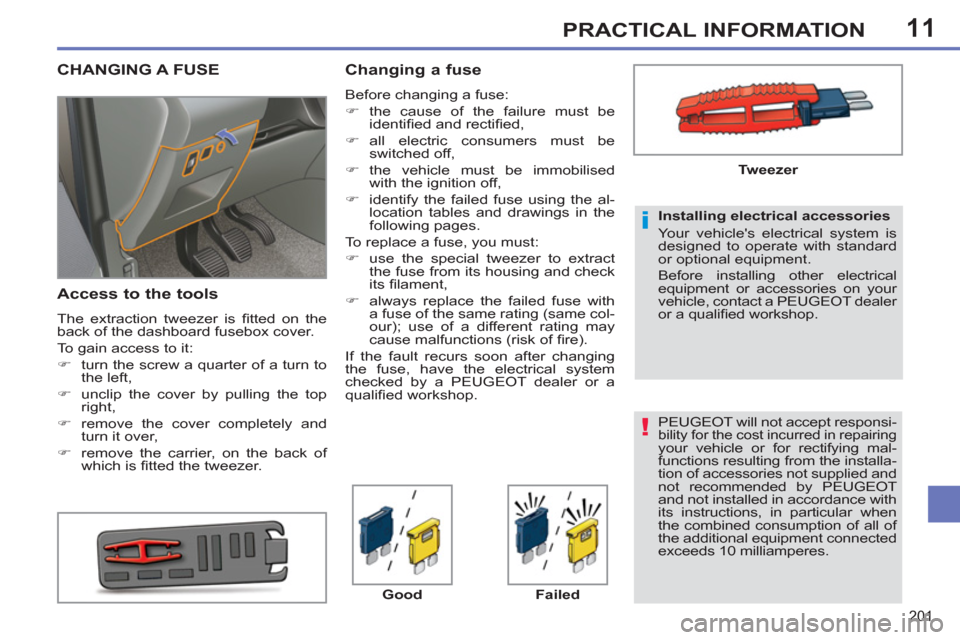
Access to the tools
The extraction tweezer is fi tted on the
back of the dashboard fusebox cover.
To gain access to it:
)
turn the screw a quarter of a turn to
the left,
)
unclip the cover by pulling the top
right,
)
remove the cover completely and
turn it over,
)
remove the carrier, on the back of
which is fi tted the tweezer.
Changing a fuse
Before changing a fuse:
)
the cause of the failure must be
identifi ed and rectifi ed,
)
all electric consumers must be
switched off,
)
the vehicle must be immobilised
with the ignition off,
)
identify the failed fuse using the al-
location tables and drawings in the
following pages.
To replace a fuse, you must:
)
use the special tweezer to extract
the fuse from its housing and check
its fi lament,
)
always replace the failed fuse with
a fuse of the same rating (same col-
our); use of a different rating may
cause malfunctions (risk of fi re).
If the fault recurs soon after changing
the fuse, have the electrical system
checked by a PEUGEOT dealer or a
qualifi ed workshop.
Good
Failed
Tweezer
Page 204 of 382
11
202
PRACTICAL INFORMATION
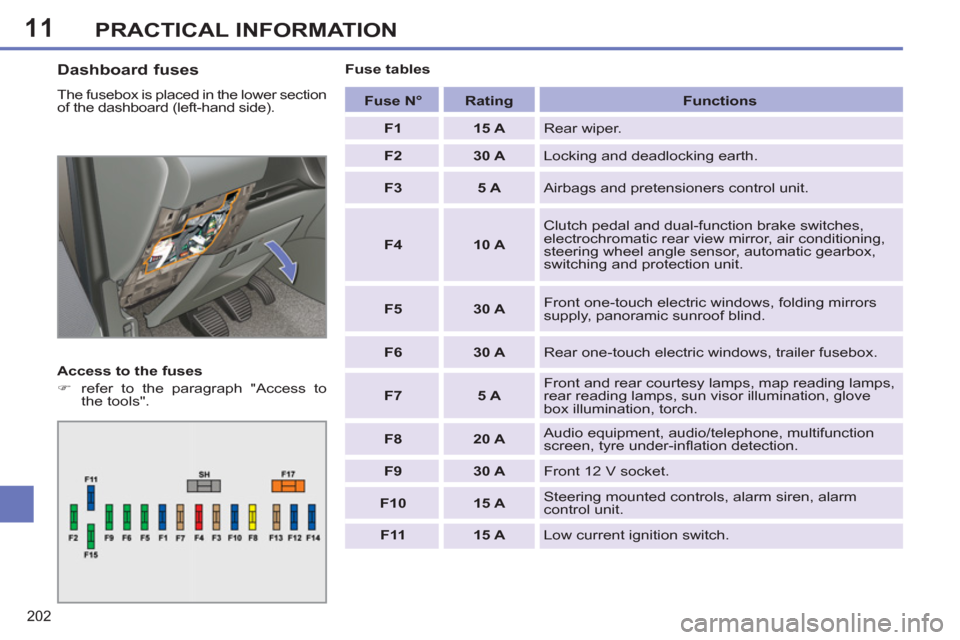
Dashboard fuses
The fusebox is placed in the lower section
of the dashboard (left-hand side).
Access to the fuses
)
refer to the paragraph "Access to
the tools".
Fuse tables
Fuse N°
Rating
Functions
F1
15 A
Rear wiper.
F2
30 A
Locking and deadlocking earth.
F3
5 A
Airbags and pretensioners control unit.
F4
10 A
Clutch pedal and dual-function brake switches,
electrochromatic rear view mirror, air conditioning,
steering wheel angle sensor, automatic gearbox,
switching and protection unit.
F5
30 A
Front one-touch electric windows, folding mirrors
supply, panoramic sunroof blind.
F6
30 A
Rear one-touch electric windows, trailer fusebox.
F7
5 A
Front and rear courtesy lamps, map reading lamps,
rear reading lamps, sun visor illumination, glove
box illumination, torch.
F8
20 A
Audio equipment, audio/telephone, multifunction
screen, tyre under-infl ation detection.
F9
30 A
Front 12 V socket.
F10
15 A
Steering mounted controls, alarm siren, alarm
control unit.
F11
15 A
Low current ignition switch.
Page 205 of 382
11
203
PRACTICAL INFORMATION
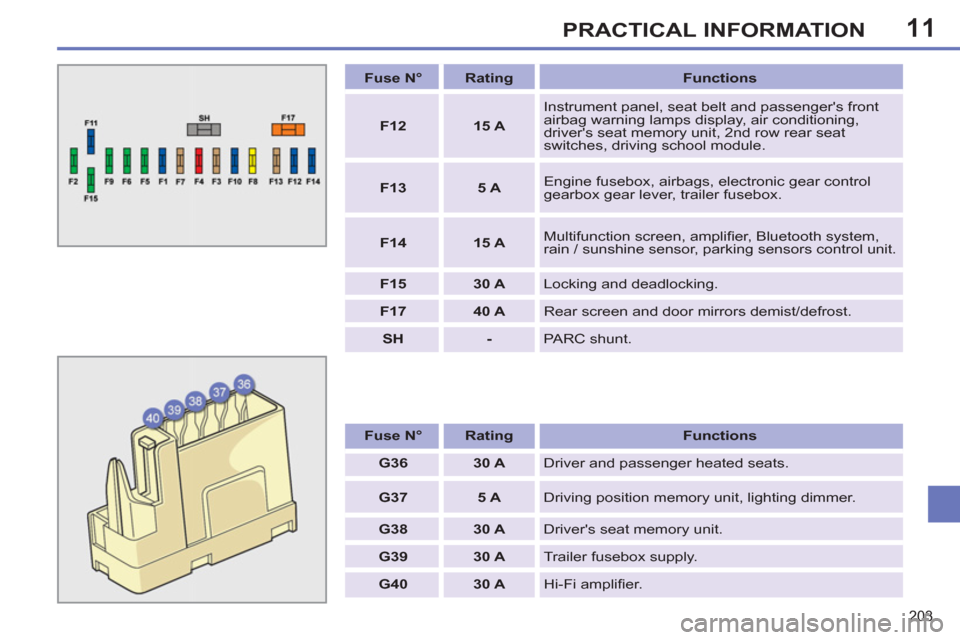
Fuse N°
Rating
Functions
F12
15 A
Instrument panel, seat belt and passenger's front
airbag warning lamps display, air conditioning,
driver's seat memory unit, 2nd row rear seat
switches, driving school module.
F13
5 A
Engine fusebox, airbags, electronic gear control
gearbox gear lever, trailer fusebox.
F14
15 A
Multifunction screen, amplifi er, Bluetooth system,
rain / sunshine sensor, parking sensors control unit.
F15
30 A
Locking and deadlocking.
F17
40 A
Rear screen and door mirrors demist/defrost.
SH
-
PARC shunt.
Fuse N°
Rating
Functions
G36
30 A
Driver and passenger heated seats.
G37
5 A
Driving position memory unit, lighting dimmer.
G38
30 A
Driver's seat memory unit.
G39
30 A
Trailer fusebox supply.
G40
30 A
Hi-Fi amplifi er.
Page 206 of 382
11
204
PRACTICAL INFORMATION
Engine compartment fuses
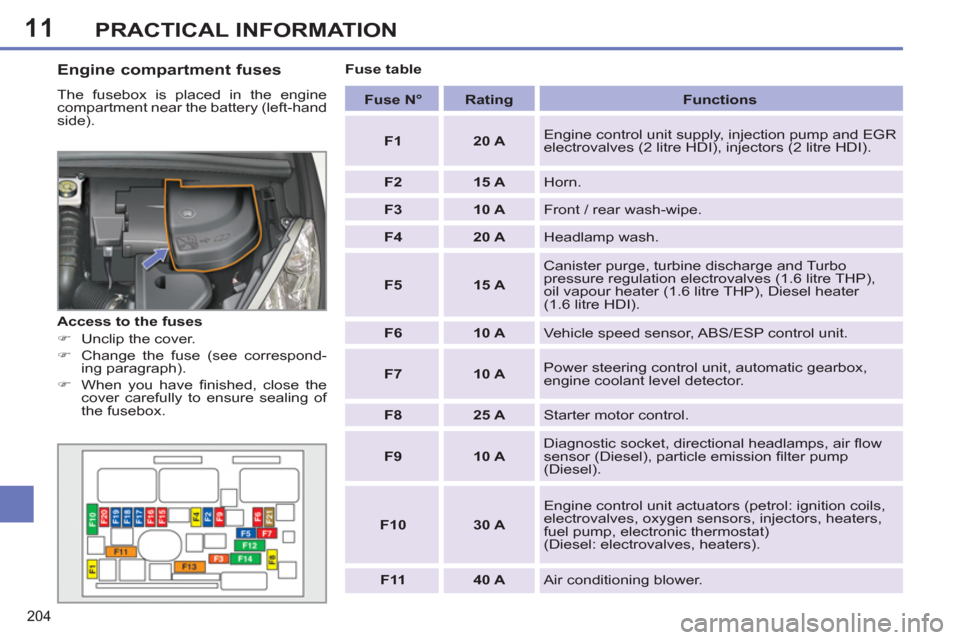
The fusebox is placed in the engine
compartment near the battery (left-hand
side).
Fuse N°
Rating
Functions
F1
20 A
Engine control unit supply, injection pump and EGR
electrovalves (2 litre HDI), injectors (2 litre HDI).
F2
15 A
Horn.
F3
10 A
Front / rear wash-wipe.
F4
20 A
Headlamp wash.
F5
15 A
Canister purge, turbine discharge and Turbo
pressure regulation electrovalves (1.6 litre THP),
oil vapour heater (1.6 litre THP), Diesel heater
(1.6 litre HDI).
F6
10 A
Vehicle speed sensor, ABS/ESP control unit.
F7
10 A
Power steering control unit, automatic gearbox,
engine coolant level detector.
F8
25 A
Starter motor control.
F9
10 A
Diagnostic socket, directional headlamps, air fl ow
sensor (Diesel), particle emission fi lter pump
(Diesel).
F10
30 A
Engine control unit actuators (petrol: ignition coils,
electrovalves, oxygen sensors, injectors, heaters,
fuel pump, electronic thermostat)
(Diesel: electrovalves, heaters).
F11
40 A
Air conditioning blower.
Access to the fuses
)
Unclip the cover.
)
Change the fuse (see correspond-
ing paragraph).
)
When you have fi nished, close the
cover carefully to ensure sealing of
the fusebox.
Fuse table
Page 207 of 382
11
205
PRACTICAL INFORMATION
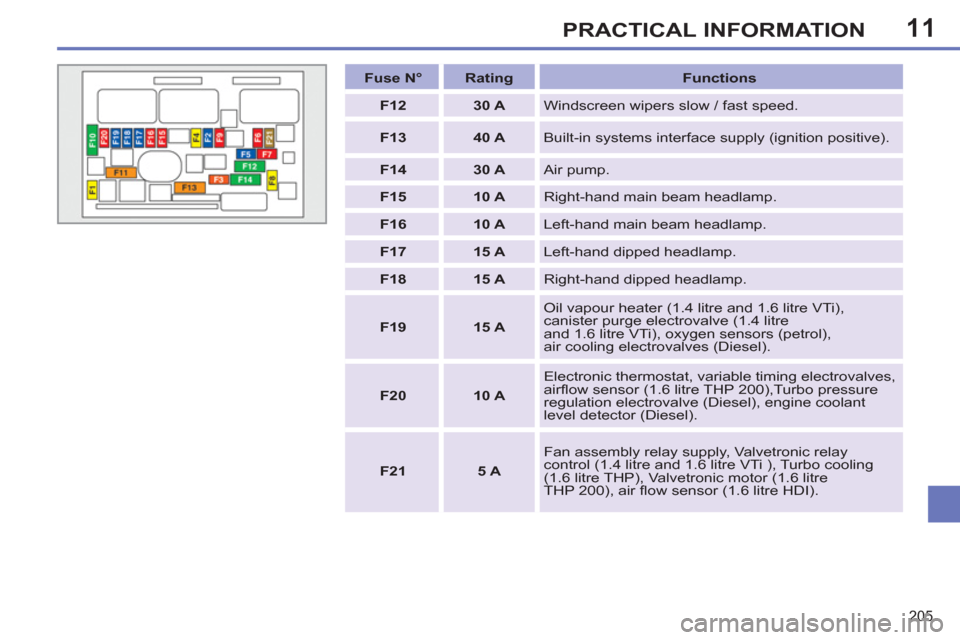
Fuse N°
Rating
Functions
F12
30 A
Windscreen wipers slow / fast speed.
F13
40 A
Built-in systems interface supply (ignition positive).
F14
30 A
Air pump.
F15
10 A
Right-hand main beam headlamp.
F16
10 A
Left-hand main beam headlamp.
F17
15 A
Left-hand dipped headlamp.
F18
15 A
Right-hand dipped headlamp.
F19
15 A
Oil vapour heater (1.4 litre and 1.6 litre VTi),
canister purge electrovalve (1.4 litre
and 1.6 litre VTi), oxygen sensors (petrol),
air cooling electrovalves (Diesel).
F20
10 A
Electronic thermostat, variable timing electrovalves,
airfl ow sensor (1.6 litre THP 200),Turbo pressure
regulation electrovalve (Diesel), engine coolant
level detector (Diesel).
F21
5 A
Fan assembly relay supply, Valvetronic relay
control (1.4 litre and 1.6 litre VTi ), Turbo cooling
(1.6 litre THP), Valvetronic motor (1.6 litre
THP 200), air fl ow sensor (1.6 litre HDI).