bonnet PEUGEOT 4008 2014.5 User Guide
[x] Cancel search | Manufacturer: PEUGEOT, Model Year: 2014.5, Model line: 4008, Model: PEUGEOT 4008 2014.5Pages: 389, PDF Size: 15.75 MB
Page 209 of 389
207
Bonnet
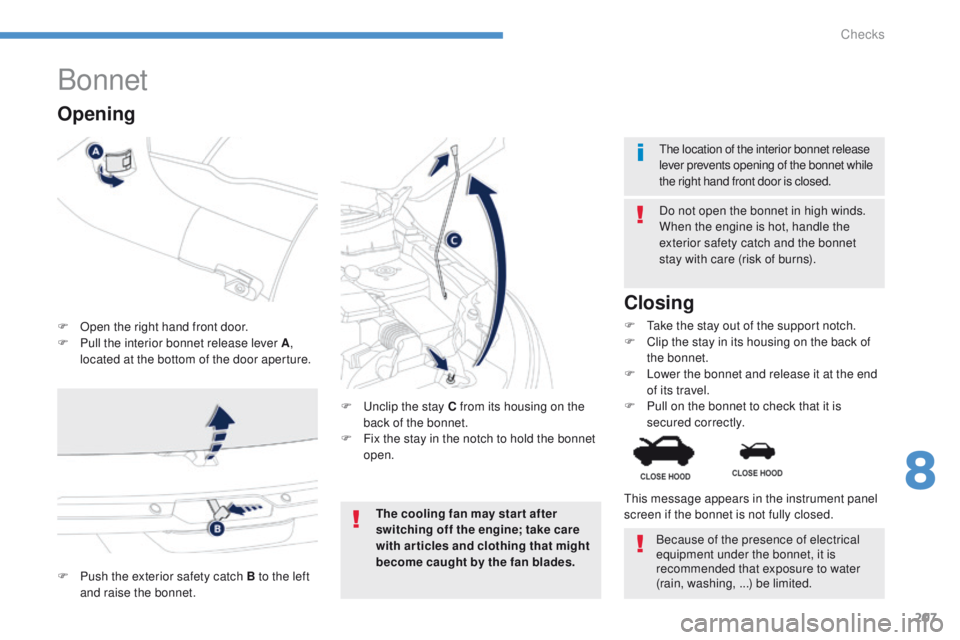
F Open the right hand front door.
F P ull the interior bonnet release lever A ,
located at the bottom of the door aperture. Do not open the bonnet in high winds.
When the engine is hot, handle the
exterior safety catch and the bonnet
stay with care (risk of burns).
F u
n
clip the stay C from its housing on the
back of the bonnet.
F
F
ix the stay in the notch to hold the bonnet
open.
Closing
F take the stay out of the support notch.
F C lip the stay in its housing on the back of
the bonnet.
F
L
ower the bonnet and release it at the end
of its travel.
F
P
ull on the bonnet to check that it is
secured correctly.
th
e location of the interior bonnet release
lever prevents opening of the bonnet while
the right hand front door is closed.
Opening
F Push the exterior safety catch B to the left and raise the bonnet.
th
is message appears in the instrument panel
screen if the bonnet is not fully closed.
The cooling fan may star t after
switching off the engine; take care
with articles and clothing that might
become caught by the fan blades. Because of the presence of electrical
equipment under the bonnet, it is
recommended that exposure to water
(rain, washing, ...) be limited.
8
Checks
Page 214 of 389
212
Running out of fuel (Diesel)
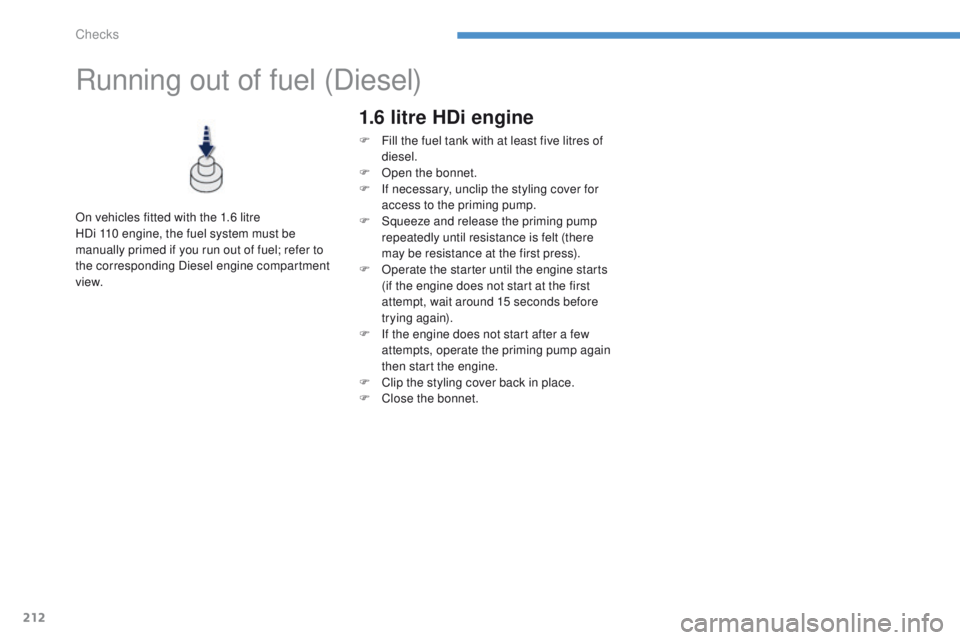
On vehicles fitted with the 1.6 litre
HDi 110 engine, the fuel system must be
manually primed if you run out of fuel; refer to
the corresponding Diesel engine compartment
view.
1.6 litre HDi engine
F Fill the fuel tank with at least five litres of diesel.
F
O
pen the bonnet.
F
I
f necessary, unclip the styling cover for
access to the priming pump.
F
S
queeze and release the priming pump
repeatedly until resistance is felt (there
may be resistance at the first press).
F
O
perate the starter until the engine starts
(if the engine does not start at the first
attempt, wait around 15 seconds before
trying again).
F
I
f the engine does not start after a few
attempts, operate the priming pump again
then start the engine.
F
C
lip the styling cover back in place.
F
C
lose the bonnet.
Checks
Page 215 of 389
213
Checking levels
take care when working under the bonnet, as certain areas of the engine may be extremely hot (risk of burns) and the cooling fan could start at
any time (even with the ignition off).
Oil level
the check of the the level is done
out with the dipstick, located under
the bonnet. Refer to the description
of your engine compartment for the
position of the dipstick.Engine oil change
Refer to the warranty and maintenance record
for details of the interval for this operation.
In order to maintain the reliability of the engine
and emission control system, never use
additives in the engine oil.
Oil specification
the oil must be the correct grade for your
engine and conform to the manufacturer's
recommendations.
Check all of these levels regularly, in line with the warranty and maintenance record.
t
o
p them up if necessary, unless other wise indicated.
If a level drops significantly, have the corresponding system checked by a P
e
uge
Ot
dealer or a qualified workshop.
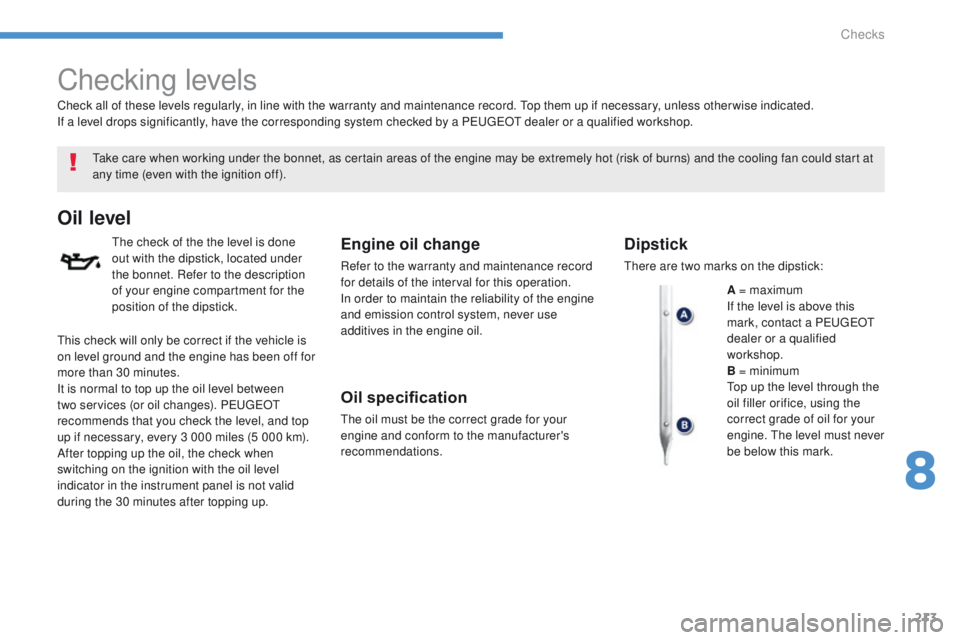
Dipstick
there are two marks on the dipstick:
A = maximum
If the level is above this
mark, contact a P
e
uge
Ot
dealer or a qualified
workshop.
B = minimum
to
p up the level through the
oil filler orifice, using the
correct grade of oil for your
engine.
t
h
e level must never
be below this mark.
th
is check will only be correct if the vehicle is
on level ground and the engine has been off for
more than 30 minutes.
It is normal to top up the oil level between
two services (or oil changes). P
e
uge
Ot
recommends that you check the level, and top
up if necessary, every 3 000 miles (5 000 km).
After topping up the oil, the check when
switching on the ignition with the oil level
indicator in the instrument panel is not valid
during the 30 minutes after topping up.
8
Checks
Page 217 of 389
215
Avoid prolonged contact of used oil or
fluids with the skin.
Most of these fluids are harmful to
health or indeed very corrosive.
Do not discard used oil or fluids into
sewers or onto the ground.
ta
ke used oil to a P
e
uge
Ot
dealer or
a qualified workshop (France) or to an
authorised waste disposal site.
Used products
To p p i n g u p
the reservoir must be topped up without delay
by a Pe ugeOt dealer or a qualified workshop.
Additive level
(1.6 HDi 110 Diesel versions
with particle filter)
the additive reservoir low level is indicated by
the display of this message.
Fluid specification
For optimum cleaning, this fluid must not be
topped up with or replaced with plain water.
Screenwash and headlamp
wash fluid
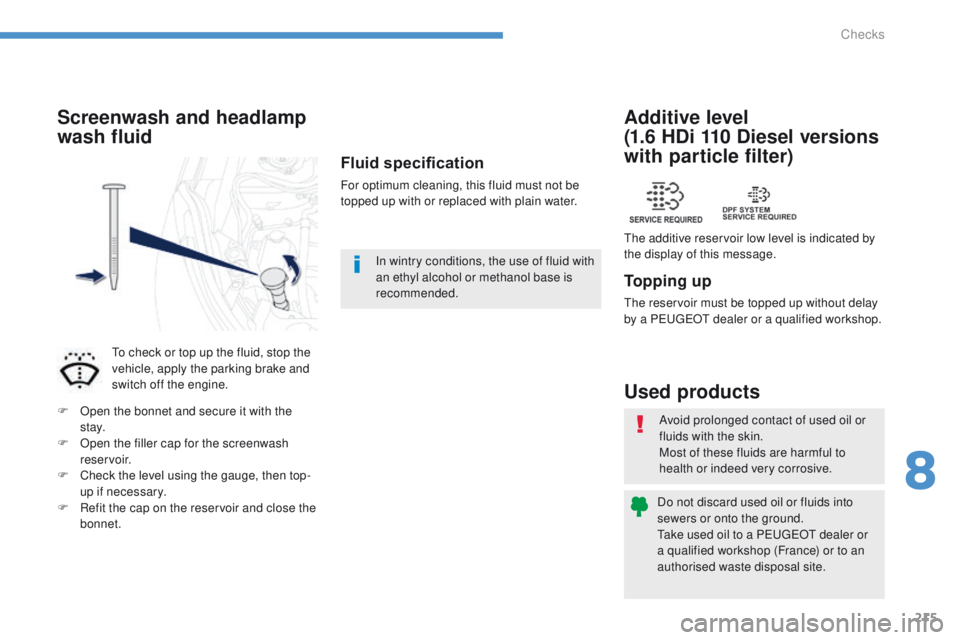
to check or top up the fluid, stop the
vehicle, apply the parking brake and
switch off the engine.
F
O
pen the bonnet and secure it with the
st ay.
F
O
pen the filler cap for the screenwash
reservoir.
F
C
heck the level using the gauge, then top-
up if necessary.
F
R
efit the cap on the reservoir and close the
bonnet. In wintry conditions, the use of fluid with
an ethyl alcohol or methanol base is
recommended.
8
Checks
Page 237 of 389
235
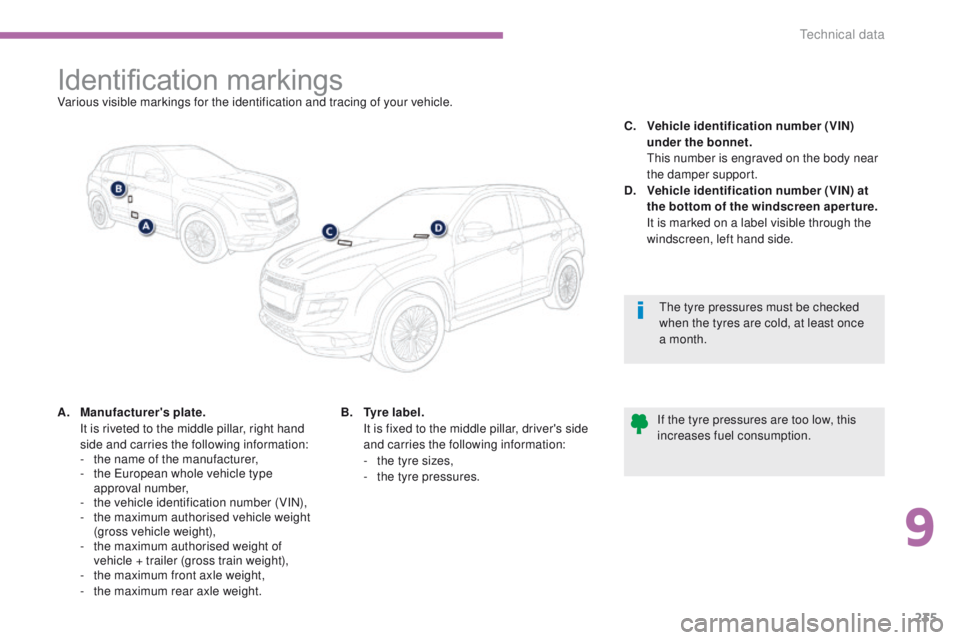
Identification markingsVarious visible markings for the identification and tracing of your vehicle.
A.
M
anufacturer's plate.
I
t is riveted to the middle pillar, right hand
side and carries the following information:
-
t
he name of the manufacturer,
-
t
he e
u
ropean whole vehicle type
approval number,
-
t
he vehicle identification number (VIN),
-
t
he maximum authorised vehicle weight
(gross vehicle weight),
-
t
he maximum authorised weight of
vehicle + trailer (gross train weight),
-
t
he maximum front axle weight,
-
t
he maximum rear axle weight.
th
e tyre pressures must be checked
when the tyres are cold, at least once
a month.
If the tyre pressures are too low, this
increases fuel consumption.
B.
T
yre label.
I
t is fixed to the middle pillar, driver's side
and carries the following information:
-
t
he tyre sizes,
-
t
he tyre pressures.C.
V
ehicle identification number (VIN)
under the bonnet.
t
h
is number is engraved on the body near
the damper support.
D.
V
ehicle identification number (VIN) at
the bottom of the windscreen aper ture.
I
t is marked on a label visible through the
windscreen, left hand side.
9
technical data
Page 337 of 389
335
ABS and eBFD systems ...............................142
Accessories .................................................. 204
Accessory socket, 12V
......................90, 92, 93
Access to bulbs
............................................. 183
Active stability control (ASC)
.......................................................... 14 4
Adjusting headlamps
.................................... 13 3
Adjusting head restraints
................................73
Adjusting seat belt height
............................. 14
6
Adjusting the steering wheel
..........................79
Airbag, knee
.......................................... 152, 15 4
Airbags
.......................................................... 150
Airbags, curtain
..................................... 15
3, 15 4
Airbags, front ......................................... 150, 15 4
Airbags, lateral
...................................... 152, 15 4
Air conditioning
......................................... 10, 81
Air conditioning, automatic
.......................81, 8 4
Air conditioning, manual
...........................81, 82
Air filter
.......................................................... 216
Air flow
..............................
..............................80
Air intake
................................................... 83, 86
Air vents
.......................................................... 80
Alarm
............................................................... 65
Anti-lock braking system (ABS)
....................142
Anti-theft
................................................. 61, 102
Apple
® player ............... 2 78, 279, 280, 304, 306
Armrest, front ...................................... 74, 90, 93
Armrest, rear
................................................... 76
A
SC
........
....................................................... 14 4
Ashtray, portable
....................................... 90, 92
Audible warning
............................................ 141
Audio-CD
..............................
.......276, 303, 323
Audio file formats
.......................................... 2
76
Audio streaming (Bluetooth)
..............................
............330, 331
Audio systems
............................... 249, 289, 311
Audio-telematics
........................................... 249
Automatic illumination of headlamps
...................................... 128, 13 0Automatic operation of hazard warning
lamps
..............................
............................
141
Automatic rain sensitive windscreen wipers
........................................
13 6
Automatic switching off of lighting ................
13 0
Auxiliary sockets
............................ 9
4, 278 -281,
304-308, 328-329
A
D
CD MP3 ........................................ 2 76, 303, 325
Central locking .......................................... 52-59
Changing a bulb
..................................... 182-187
Changing a fuse
..................................... 18 8 -19 3
Changing a wheel
.................................. 175 -178
Changing a wiper blade
................................197
Changing the remote control battery
..............60
Changing the time
.............................. 44, 46, 49
Checking levels
...................................... 21
3 -215
Checking the engine oil level
........................213
Checks
...............
.................................... 2 07-218
Children
...............................
...149, 151, 155 -170
Child lock
...............................
........................170
Child seats
................... 1
55, 156, 160 -162, 169
Child seats, ISOFIX
...................................... 16
6
Cigarette lighter ............................................... 92
Closing the boot
.............................................. 63
Closing the doors
............................................ 62
Colour screen
....................... 2
50, 253, 290, 293
Connectors, audio
........................... 9
4, 278 -281,
304-305, 328-329
Controls for air conditioning
......................82, 84
Coolant
...............................
.............................35
Coolant level
................................................. 214
Courtesy lamp, front
..................................... 13 8
Courtesy lamp, rear
...................................... 13 9
Cruise control
................................................ 12
0
Cup holder
...............................
........................90
CV
t g
earbox
......................................... 10 5 , 217
Daytime running lamps
.........................13 0, 18 4
Deactivating ASC
.......................................... 14 4
Deactivating the passenger airbag
...............150
Battery
................................................... 19 4, 216
Battery, charging
........................................... 19 6
Battery, remote control
............................. 6
0, 61
Bluetooth (telephone)
.................................. 237, 288, 308
Bluetooth telephone with voice recognition
........................................... 2 37-24 8
Bonnet
........................................................... 207
Bonnet stay
................................................... 207
Boot
................................................................. 63
Boot lamp
...................................................... 140
Bottle holder
.................................................... 90
Brake discs
.................................................... 2
18
Brake lamps
.................................................. 18 6
Brake pads
.................................................... 218
Braking assistance system
........................... 14
2
Bulbs (changing, type)
........................... 18
2-187
Capacity, fuel tank
..............................
.......... 210
CD changer
...............................
.................... 325
B
C
.
Alphabetical index
Page 339 of 389
337
Keeping children safe .............1 49, 151, 155 -170
Key ............................................................ 52- 61
Key, electronic
........................................... 56 - 61
Key in ignition warning
....................................98
Keyless
e
n
try and Starting .................5 6 - 61, 9 9
Key with remote control
....................52- 55, 102
Labels, identification
..................................... 23
5
Lamps, front
.................................................. 182
Lamps, rear
................................................... 18 6
Lamps, warning and indicator
...................13 -18
L
e
D
daytime running lamps
.........................18 4
Level, brake fluid
........................................... 2
14
Level, headlamp wash
..................................215
Levels and checks
................208, 209, 213-218
Lighting bulbs (replacement)
................. 18
2-187
Lighting control stalk
..................................... 127
Lighting dimmer
..............................
................51
Lighting, guide-me home
..............................131
Lighting, interior
............................................ 140
Lighting on reminder
..................................... 129
Loading
........................................................... 10
Long objects, transporting
.............................. 76
L
ow fuel level ................................................ 210
Luggage retaining strap
..................................96
Main beam
............................................ 182, 18 4
Maintenance
................................................... 10
K
L
M
Map (colour screen) ......................................26 6
Map reading lamps ....................................... 13 8
Markings, identification
.................................235
Mat
.................................................................. 91
Menu
.................................................... 253, 294
Mirror, rear view
.............................................. 79
Mirrors, door .................................................... 77
Mountings for ISOFIX seats
.........................16 4, 165, 168
MP3 CD
........................................ 276, 303, 325
Navigation
............................................. 254-267
Navigation data
............................................. 265
Number plate lamps
.............................. 18
6, 187
Oil filter
...............
........................................... 216
Oil level .......................................................... 213
Opening the bonnet
...................................... 2
07
Opening the boot
..............................
..52, 56, 63
Opening the doors
.............................. 5
2, 56, 62
Opening the fuel filler flap
.............................2
10
Operation indicator lamps
.........................13 -18
N
O
Radio ............................................ 275, 300, 301
Range ........................................................ 32, 35
RCA sockets
.......................... 94, 278, 304, 328
RDS
............................................................... 302
Rear foglamp ................................. 129, 186, 187
Rear screen (demisting)
..................................89
Recharging the battery
................................. 19
4
Recirculation / exterior air intake
....................84
Regeneration of the particle emissions filter
............................................ 217
Remote control
.......................................... 5
2- 61
Removing a wheel
........................................ 17 7
Removing the mat
........................................... 91
Repair kit, puncture
....................................... 171
Replacing bulbs
..................................... 182-187
Replacing fuses
..............................
.......18 8 -19 3
Replacing the air filter
...................................216
Replacing the oil filter
................................... 2
16
R
P
Pair telephone ......................................2 88, 308
Panoramic glass sunroof ................................70
Parcel shelf, rear
............................................. 97
P
arking brake
........................................ 102, 218
Parking sensors, front
...................................125
Parking sensors, rear ............................123, 124
Particle filter
.......................................... 215, 217
Passenger compartment filter
......................216
Player, CD MP3
............................ 276, 303, 325
Port,
u
S
B
............................... 9
4, 278, 304, 328
Priming the fuel system
................................212
Protecting children
.................149, 151, 155 -170
Puncture
................................................ 171, 175
.
Alphabetical index
Page 367 of 389
111
4
Driving
4008-add_en_Chap04_conduite_ed01-2015
Stop & Start (Auto Stop & Go) system
Operation
Going into engine STOP mode
The "AS &G" warning lamp comes on in the instrument panel or the instrument panel screen and the engine goes into standby after a few seconds:
- with a manual gearbox , with the vehicle stationary and your foot on the brake, when you put the gear lever into neutral and release the clutch pedal.
Never refuel with the engine in STOP mode; you must switch off the ignition with the key or the START/STOP button.
When the engine is stopped automatically, the operation of certain vehicle systems, such as for example, braking, power steering... are modified. Ta k e c a r e.
Special cases: STOP mode not available
STOP mode is not invoked when: - the driver's seat belt is not fastened, - the driver's door is open, - the bonnet is open, - the minimum time period of 30 seconds since starting the engine has not elapsed, - the vehicle has not exceeded 3 mph (5 km/h) since the last engine start, - the vehicle has restarted less than 10 seconds ago, - the engine is needed to maintain a comfortable temperature in the passenger compartment, - demisting is active, - some special conditions (battery charge, engine temperature, braking assistance, ambient temperature...) where the engine is needed to assure control of a system.
- the "AS &G" warning lamp is flashing in the instrument panel.
This operation is perfectly normal.
The Stop & Start (Auto Stop & Go) system puts the engine temporarily into standby during stops in the traffic (red lights, traffic jams, or other...). The engine restarts automatically as soon as you want to move off. The restart takes place instantly, quickly and silently. Per fect for urban use, the Stop & Start (Auto Stop & Go) function reduces fuel consumption and exhaust emissions as well as the noise level when stationary.
If you move the gear lever, the "AS &G"warning lamp flashes, accompanied by an audible signal. The alert stops as soon as the gear lever is returned to the neutral position.
Page 368 of 389
112
Driving
4008-add_en_Chap04_conduite_ed01-2015
Going into engine START mode
The "AS &G" warning lamp goes off and the engine starts automatically:
- with a manual gearbox , when you fullydepress the clutch pedal.
For safety reasons or to ensure smooth operation, START mode is invoked automatically when:
Special cases: START invoked automatically
- the speed of the vehicle exceeds 2 mph (3 km/h) , - you open the driver's door, - you unfasten the driver's seatbelt, - some special conditions (battery charge, engine temperature, braking assistance, ambient temperature...) where the engine is needed to assure control of a system.
If the system has been deactivated in STOP mode, the engine will not start.
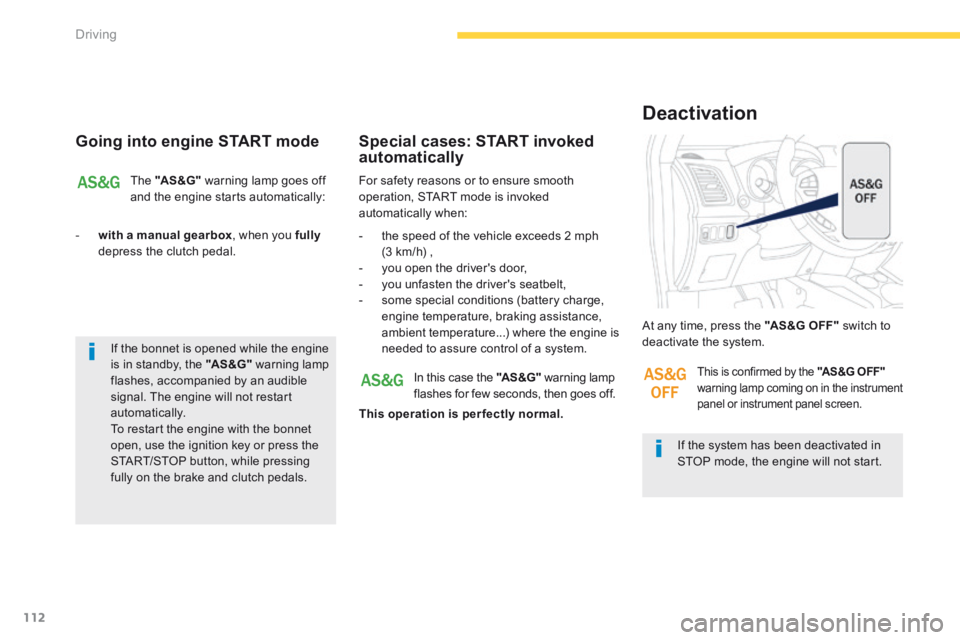
At any time, press the "AS &G O FF " switch to deactivate the system.
Deactivation
In this case the "AS &G" warning lamp flashes for few seconds, then goes off.
This operation is perfectly normal.
This is confirmed by the "AS &G O FF " warning lamp coming on in the instrument panel or instrument panel screen.
If the bonnet is opened while the engine is in standby, the "AS &G" warning lamp flashes, accompanied by an audible signal. The engine will not restart automatically. To restart the engine with the bonnet
open, use the ignition key or press the START/STOP button, while pressing fully on the brake and clutch pedals.
Page 373 of 389
215
8
Checks
4008-add_en_Chap08_verifications_ed01-2015
Avoid prolonged contact of used oil or
fluids with the skin. Most of these fluids are harmful to health or indeed very corrosive.
Do not discard used oil or fluids into sewers or onto the ground. Take used oil to a PEUGEOT dealer or a qualified workshop (France) or to an authorised waste disposal site.
Used products
Topping up
The reservoir must be topped up without delay by a PEUGEOT dealer or a qualified workshop.
Additive level
(1.6 HDi 110 Diesel versions
with particle filter)
The additive reservoir low level is indicated by the display of this message.
Fluid specifi cation
For optimum cleaning, this fluid must not be topped up with or replaced with plain water.
Screenwash and headlamp
wash fluid
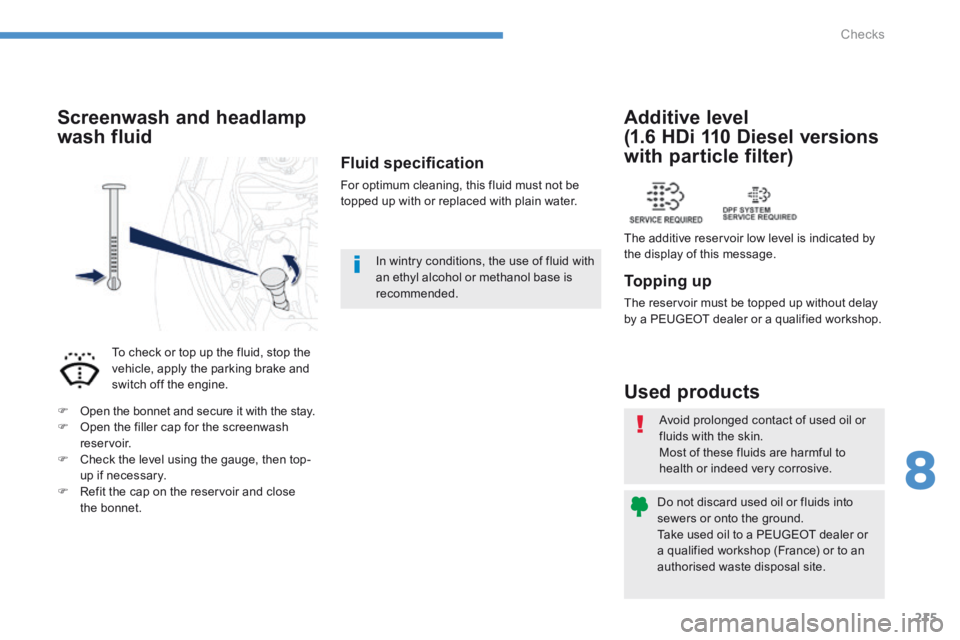
To check or top up the fluid, stop the vehicle, apply the parking brake and switch off the engine.
Open the bonnet and secure it with the stay. Open the filler cap for the screenwash reservoir. Check the level using the gauge, then top-up if necessary. Refit the cap on the reservoir and close the bonnet.
In wintry conditions, the use of fluid with an ethyl alcohol or methanol base is recommended.