check engine PEUGEOT 4008 2014.5 User Guide
[x] Cancel search | Manufacturer: PEUGEOT, Model Year: 2014.5, Model line: 4008, Model: PEUGEOT 4008 2014.5Pages: 389, PDF Size: 15.75 MB
Page 95 of 389
93
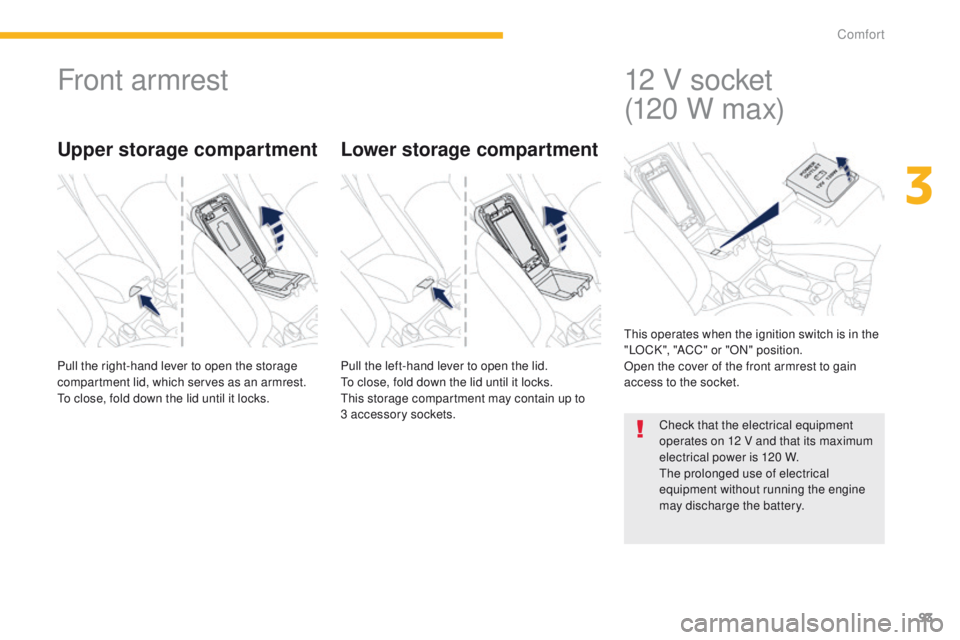
Front armrest
Pull the right-hand lever to open the storage
compartment lid, which serves as an armrest.
to c
lose, fold down the lid until it locks. Pull the left-hand lever to open the lid.to c
lose, fold down the lid until it locks.
th
is storage compartment may contain up to
3
accessory sockets.
th
is operates when the ignition switch is in the
"LOCK", "ACC" or "ON" position.
Open the cover of the front armrest to gain
access to the socket.
Upper storage compartment Lower storage compartment
Check that the electrical equipment
operates on 12 V and that its maximum
electrical power is 120 W.
th
e prolonged use of electrical
equipment without running the engine
may discharge the battery.
12 V socket
(120 W max)
3
Comfort
Page 111 of 389
109
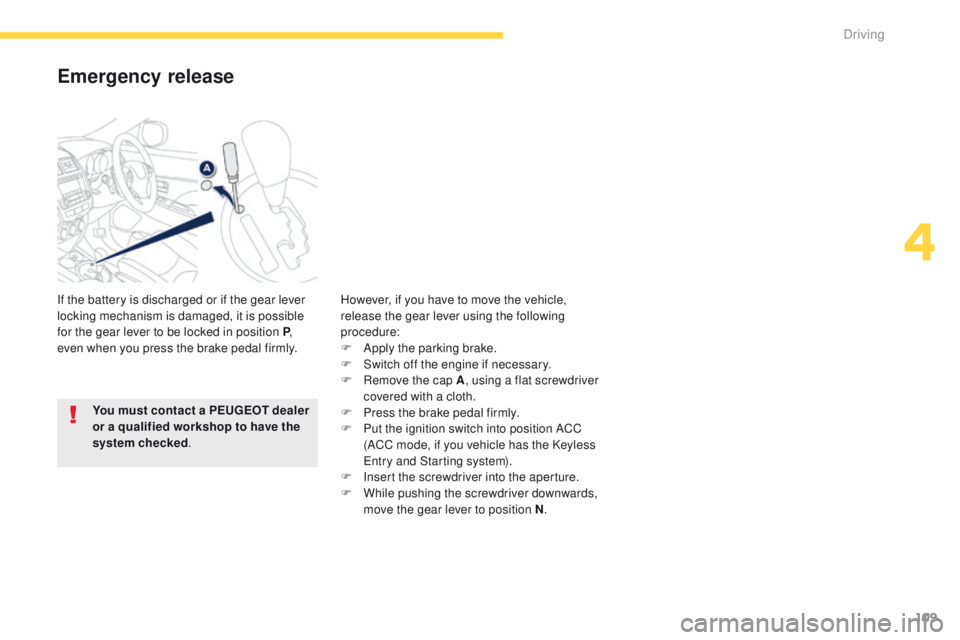
Emergency release
If the battery is discharged or if the gear lever
locking mechanism is damaged, it is possible
for the gear lever to be locked in position P,
even when you press the brake pedal firmly. However, if you have to move the vehicle,
release the gear lever using the following
procedure:
F
A
pply the parking brake.
F
S
witch off the engine if necessary.
F
R
emove the cap A, using a flat screwdriver
covered with a cloth.
F
P
ress the brake pedal firmly.
F
P
ut the ignition switch into position ACC
(ACC mode, if you vehicle has the Keyless
en
try and Starting system).
F
I
nsert the screwdriver into the aperture.
F
W
hile pushing the screwdriver downwards,
move the gear lever to position N .
You must contact a PEUGEOT dealer
or a qualified workshop to have the
system checked
.
4
Driving
Page 112 of 389
110
Hill start assist
System which keeps your vehicle immobilised
temporarily (approximately 2 seconds) when
starting on a gradient, the time it takes to
move your foot from the brake pedal to the
accelerator pedal.
th
is function is only active when:
-
t
he vehicle is completely stationary, with
your foot on the brake pedal,
-
w
hen certain conditions of gradient are
met,
-
w
ith the driver’s door closed.
th
e hill start assist function cannot be
deactivated.
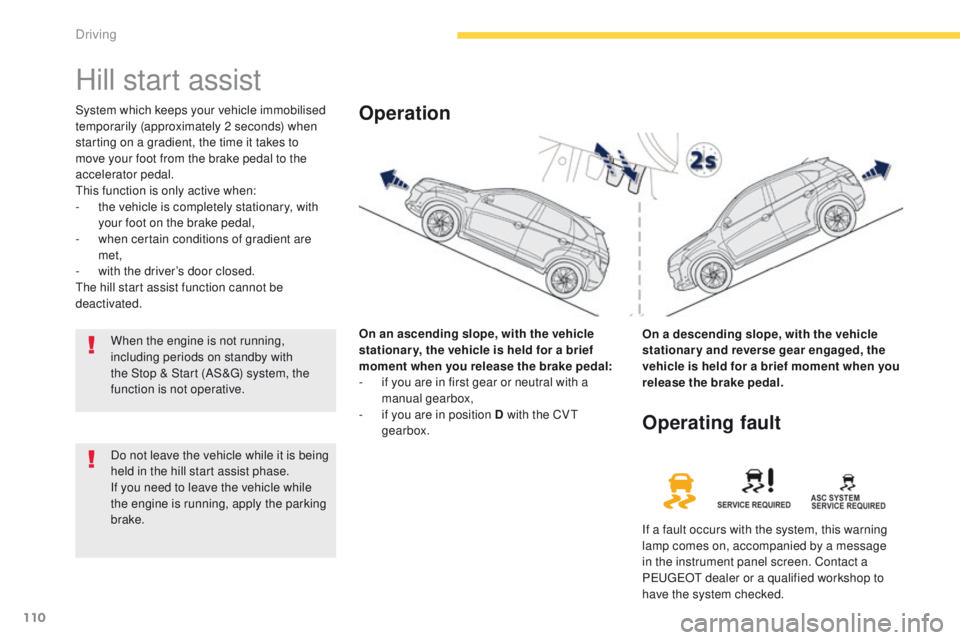
On an ascending slope, with the vehicle
stationar y, the vehicle is held for a brief
moment when you release the brake pedal:
-
i
f you are in first gear or neutral with a
manual gearbox,
-
i
f you are in position D with the CV
t
gearbox.Operation
On a descending slope, with the vehicle
stationary and reverse gear engaged, the
vehicle is held for a brief moment when you
release the brake pedal.
Do not leave the vehicle while it is being
held in the hill start assist phase.
If you need to leave the vehicle while
the engine is running, apply the parking
brake.
Operating fault
If a fault occurs with the system, this warning
lamp comes on, accompanied by a message
in the instrument panel screen. Contact a
P
e
uge
Ot
dealer or a qualified workshop to
have the system checked.
When the engine is not running,
including periods on standby with
the Stop & Start (AS&
g) s
ystem, the
function is not operative.
Driving
Page 115 of 389
113
the system is reactivated automatically
at every new start using the key or the
St
A
R
t/
S t
O
P button.
Reactivation
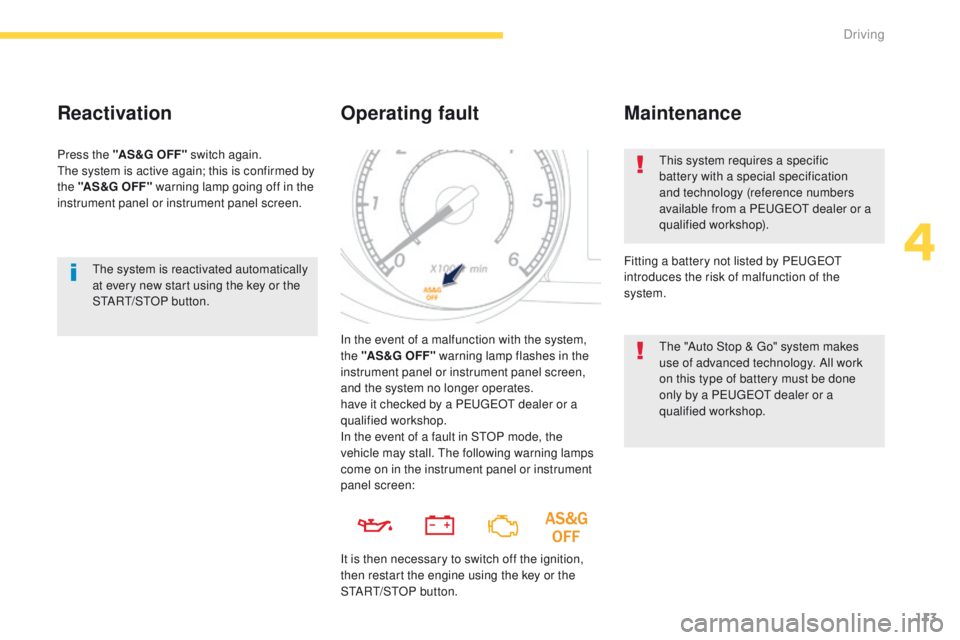
Press the "AS &G O FF " switch again.th
e system is active again; this is confirmed by
the "AS &G O FF " warning lamp going off in the
instrument panel or instrument panel screen.
Operating fault
In the event of a malfunction with the system,
the "AS &G O FF " warning lamp flashes in the
instrument panel or instrument panel screen,
and the system no longer operates.
have it checked by a P
e
uge
Ot
dealer or a
qualified workshop.
th
is system requires a specific
battery with a special specification
and technology (reference numbers
available from a P
e
uge
Ot
dealer or a
qualified workshop).
Fitting a battery not listed by P
e
uge
Ot
introduces the risk of malfunction of the
system.
Maintenance
the "Auto Stop & go" s ystem makes
use of advanced technology. All work
on this type of battery must be done
only by a P
e
uge
Ot
dealer or a
qualified workshop.
In the event of a fault in S
tO
P mode, the
vehicle may stall.
t
h
e following warning lamps
come on in the instrument panel or instrument
panel screen:
It is then necessary to switch off the ignition,
then restart the engine using the key or the
S
t
A
R
t/
S
t
O
P button.
4
Driving
Page 190 of 389
188
Changing a fuse
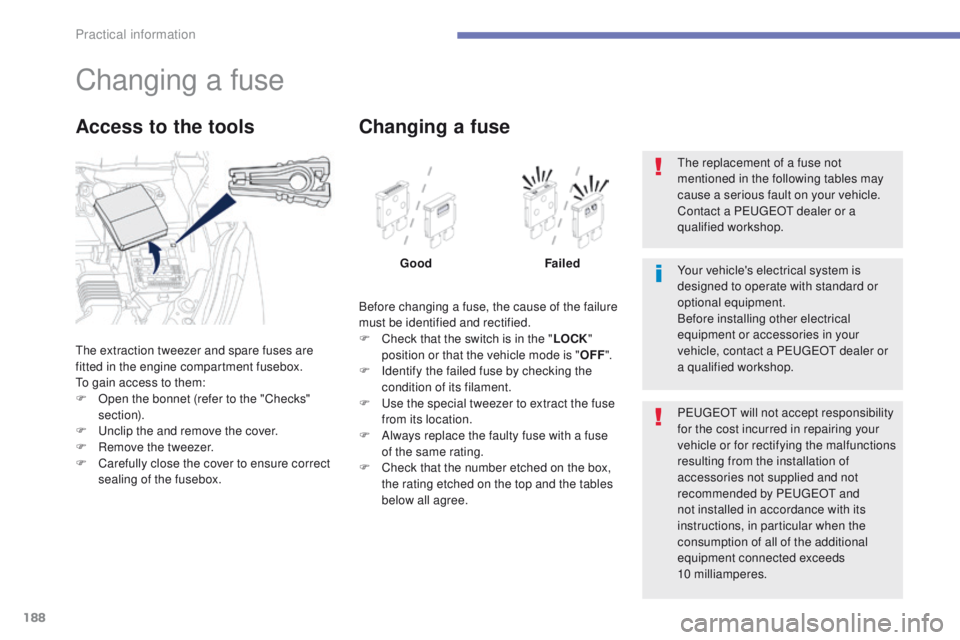
the extraction tweezer and spare fuses are
fitted in the engine compartment fusebox.
to g
ain access to them:
F
O
pen the bonnet (refer to the "Checks"
section).
F
u
n
clip the and remove the cover.
F
R
emove the tweezer.
F
C
arefully close the cover to ensure correct
sealing of the fusebox.
Access to the tools
Before changing a fuse, the cause of the failure
must be identified and rectified.
F
C
heck that the switch is in the " LOCK"
position or that the vehicle mode is " OFF".
F
I
dentify the failed fuse by checking the
condition of its filament.
F
u
s
e the special tweezer to extract the fuse
from its location.
F
A
lways replace the faulty fuse with a fuse
of the same rating.
F
C
heck that the number etched on the box,
the rating etched on the top and the tables
below all agree.
Changing a fuse
Good Failed
P
e
uge
Ot
will not accept responsibility
for the cost incurred in repairing your
vehicle or for rectifying the malfunctions
resulting from the installation of
accessories not supplied and not
recommended by P
e
uge
Ot
and
not installed in accordance with its
instructions, in particular when the
consumption of all of the additional
equipment connected exceeds
10
milliamperes.
Your vehicle's electrical system is
designed to operate with standard or
optional equipment.
Before installing other electrical
equipment or accessories in your
vehicle, contact a P
e
uge
Ot
dealer or
a qualified workshop.
th
e replacement of a fuse not
mentioned in the following tables may
cause a serious fault on your vehicle.
Contact a P
e
uge
Ot
dealer or a
qualified workshop.
Practical information
Page 197 of 389
195
Check the electrolyte level and top up if
necessary (see "Checking levels").
Starting using another
battery
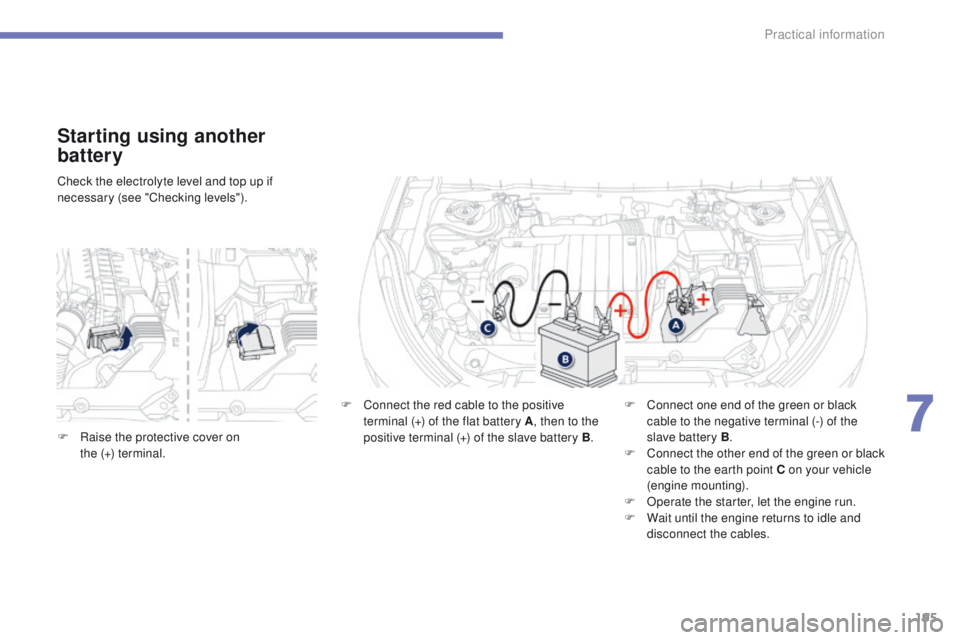
F Connect the red cable to the positive terminal (+) of the flat battery A , then to the
positive terminal (+) of the slave battery B. F
C onnect one end of the green or black
cable to the negative terminal (-) of the
slave battery B .
F
C
onnect the other end of the green or black
cable to the earth point C on your vehicle
(engine mounting).
F
O
perate the starter, let the engine run.
F
W
ait until the engine returns to idle and
disconnect the cables.
F
R
aise the protective cover on
the
(+)
terminal.
7
Practical information
Page 199 of 389
197
Removing a front or rear
wiper blade
F Raise the corresponding wiper arm.
F R emove the wiper blade, sliding it towards
the outside.
Changing a wiper
blade
Fitting a front or rear wiper
blade
F At the front, check the size of the wiper blade as the shorter blade is fitted on the
right-hand side of the vehicle.
F
P
ut the corresponding new wiper blade in
place and fix it.
F
F
old down the wiper arm carefully.
Automatic power cut-off to accessories
After the engine has stopped, when the
ignition switch is in the "ACC" position
(or the vehicle in "ACC" mode) you
can still use functions such as the audio
equipment, windscreen wipers, dipped beam
headlamps,
courtesy lamps, etc. for about
thirty
minutes.Cutting off
Once the thirty minutes have expired, the
power supply to the accessories will be
automatically cut off.
Restoring power
the power supply will be restored the next time
the ignition is switched on.
7
Practical information
Page 204 of 389
202
Driving advice
Distribution of loads
F Distribute the load in the trailer so that the heaviest items are as close as possible to
the axle and the nose weight approaches
the maximum permitted without
exceeding
it.
Air density decreases with altitude, thus
reducing engine performance. Above
1
000 metres, the maximum towing load must
be reduced by 10
% of the gt
W a
nd so on for
every 1
000 metres of altitude.
Refer to the "
te
chnical Data" section for details
of the weights and towing loads which apply to
your vehicle.
Side wind
F take into account the increased sensitivity to side wind.
Cooling
towing a trailer on a slope increases the
temperature of the coolant.
As the fan is electrically controlled, its cooling
capacity is not dependent on the engine speed.
F
t
o l
ower the engine speed, reduce your
speed.
th
e maximum towing load on a long slope
depends on the gradient and the outside
temperature.
In all cases, pay attention to the coolant
temperature.
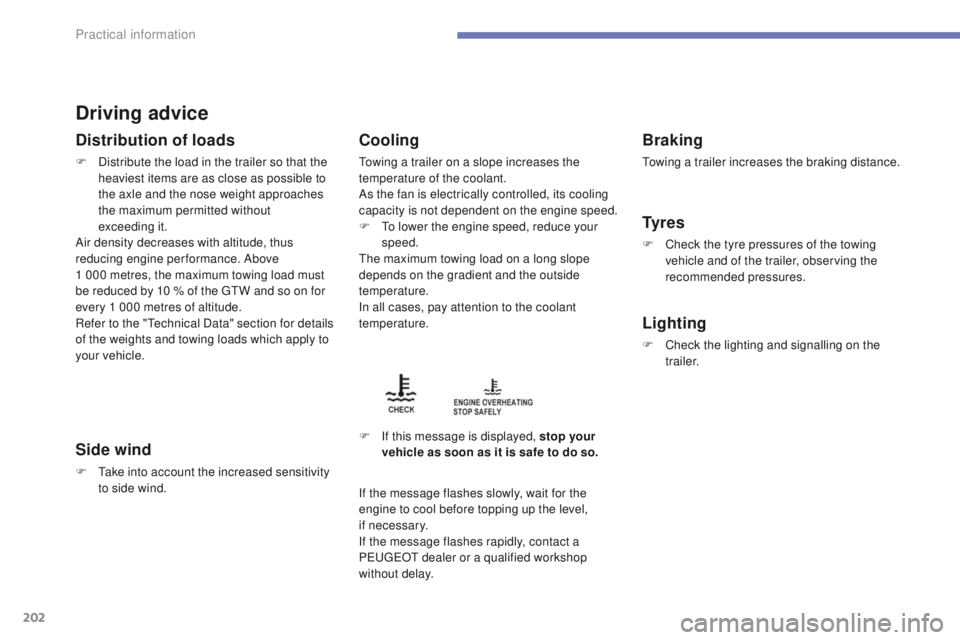
F
I
f this message is displayed, stop your
vehicle as soon as it is safe to do so.
Braking
towing a trailer increases the braking distance.
Ty r e s
F Check the tyre pressures of the towing vehicle and of the trailer, observing the
recommended pressures.
Lighting
F Check the lighting and signalling on the t r a i l e r.
If the message flashes slowly, wait for the
engine to cool before topping up the level,
if
necessary.
If the message flashes rapidly, contact a
P
e
uge
Ot
dealer or a qualified workshop
without delay.
Practical information
Page 208 of 389
206
PeugeOt & t O tA L,
A PARtNeRSHIP tO DeL IVe R
Be
tte R
P
e
RFORMANC
e
!
Innovation, the key to success
the tOtAL Research and Development and
Pe
ugeOt teams work together to develop high
quality lubricants that meet the requirements
of P
e
uge
Ot
vehicles. For you, this is the
assurance that the performance of your engine
is optimised while also ensuring its durability.
th
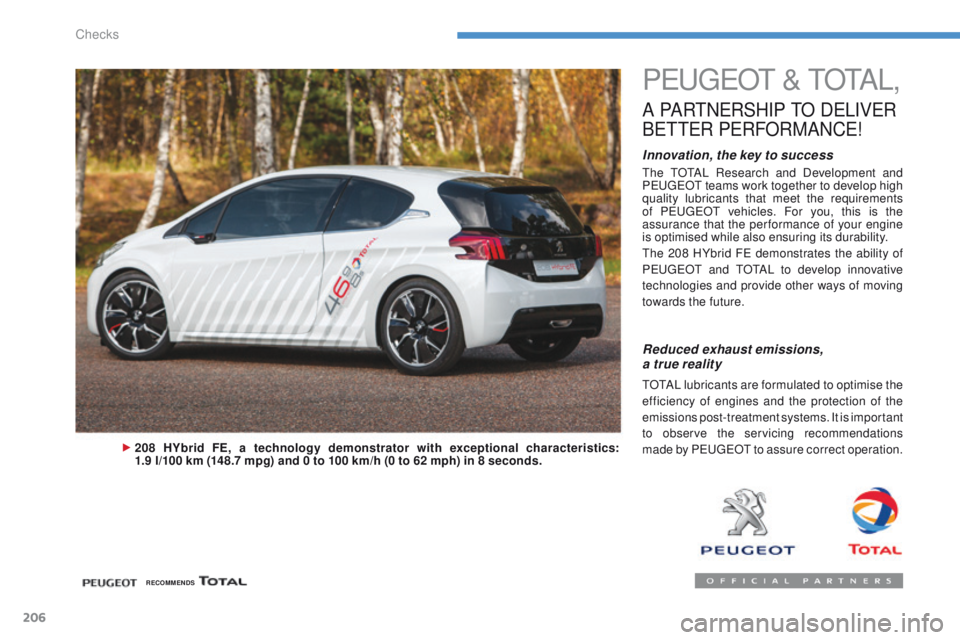
e 208 HYbrid F
e
demonstrates the ability of
P
e
uge
Ot
and
tOtA
L to develop innovative
technologies and provide other ways of moving
towards the future.
208 HYbrid FE, a technology demonstrator with exceptional characteristics:
1.9 l/100 km (148.7 mpg) and 0 to 100 km/h (0 to 62 mph) in 8 seconds.
Reduced exhaust emissions,
a true reality
tOtAL lubricants are formulated to optimise the
efficiency of engines and the protection of the
emissions post-treatment systems. It is important
to observe the servicing recommendations
made by P
e
uge
Ot
to assure correct operation.
RECOMMENDS
Checks
Page 209 of 389
207
Bonnet
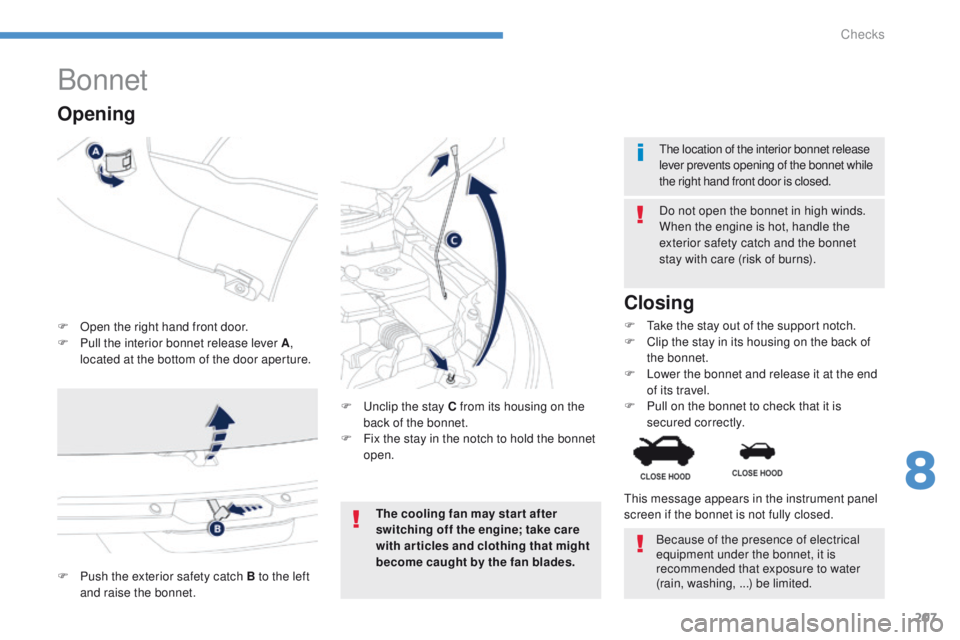
F Open the right hand front door.
F P ull the interior bonnet release lever A ,
located at the bottom of the door aperture. Do not open the bonnet in high winds.
When the engine is hot, handle the
exterior safety catch and the bonnet
stay with care (risk of burns).
F u
n
clip the stay C from its housing on the
back of the bonnet.
F
F
ix the stay in the notch to hold the bonnet
open.
Closing
F take the stay out of the support notch.
F C lip the stay in its housing on the back of
the bonnet.
F
L
ower the bonnet and release it at the end
of its travel.
F
P
ull on the bonnet to check that it is
secured correctly.
th
e location of the interior bonnet release
lever prevents opening of the bonnet while
the right hand front door is closed.
Opening
F Push the exterior safety catch B to the left and raise the bonnet.
th
is message appears in the instrument panel
screen if the bonnet is not fully closed.
The cooling fan may star t after
switching off the engine; take care
with articles and clothing that might
become caught by the fan blades. Because of the presence of electrical
equipment under the bonnet, it is
recommended that exposure to water
(rain, washing, ...) be limited.
8
Checks