brake light PEUGEOT 4008 2014.5 Owners Manual
[x] Cancel search | Manufacturer: PEUGEOT, Model Year: 2014.5, Model line: 4008, Model: PEUGEOT 4008 2014.5Pages: 389, PDF Size: 15.75 MB
Page 4 of 389
Instrument panel 12
Warning and indicator lamps
1
3
Instrument panel screen
1
9
tr
ip computer
3
2
Distance recorder
3
2
tr
ip distance recorder
3
2
Service indicator
3
3
Adjusting vehicle settings
3
7
Audio- CD system screen
4
4
Audio- CD system touch screen
4
6
Audio-
te
lematic system touch
screen
48
Lighting dimmer
5
1
MonitoringOver view
Remote control key 5
2
"Keyless e
n
try and Starting"
system
5
6
Doors
62
Boot
6
3
Alarm
65
el
ectric windows
6
8
Panoramic sunroof
7
0
Access
Front seats 7 1
Rear seats
7
5
Mirrors
77
Steering wheel adjustment
7
9
Ventilation
80
Manual heating / air conditioning
8
2
Automatic air conditioning
8
4
Rear screen demist - defrost
8
9
Interior fittings
9
0
Boot fittings
9
6
Comfort
Starting - stopping the engine with the key 98
Starting - stopping the engine with
the Keyless
e
n
try and Starting system
9
9
Parking brake
1
02
Manual gearbox
1
03
ge
ar shift indicator
1
04
CV
t
gearbox
1
05
Hill start assist
1
10
Stop & Start (Auto Stop &
g
o
) function
1
11
Under-inflation detection
1
14
Four wheel drive system
1
18
Cruise control
1
20
Parking sensors
1
23
Reversing camera
1
26
Driving
Lighting controls 1 27
Daytime running lamps
1
30
Automatic illumination of headlamps
1
30
Manual guide-me-home lighting
1
31
Welcome lighting
1
32
Headlamp adjustment
1
33
Wiper controls
1
34
Automatic rain sensitive wipers
1
36
Courtesy lamps
1
38
Boot lamp
1
40
Panoramic roof lighting
1
40
Visibility
e
co-driving
Contents
Page 6 of 389
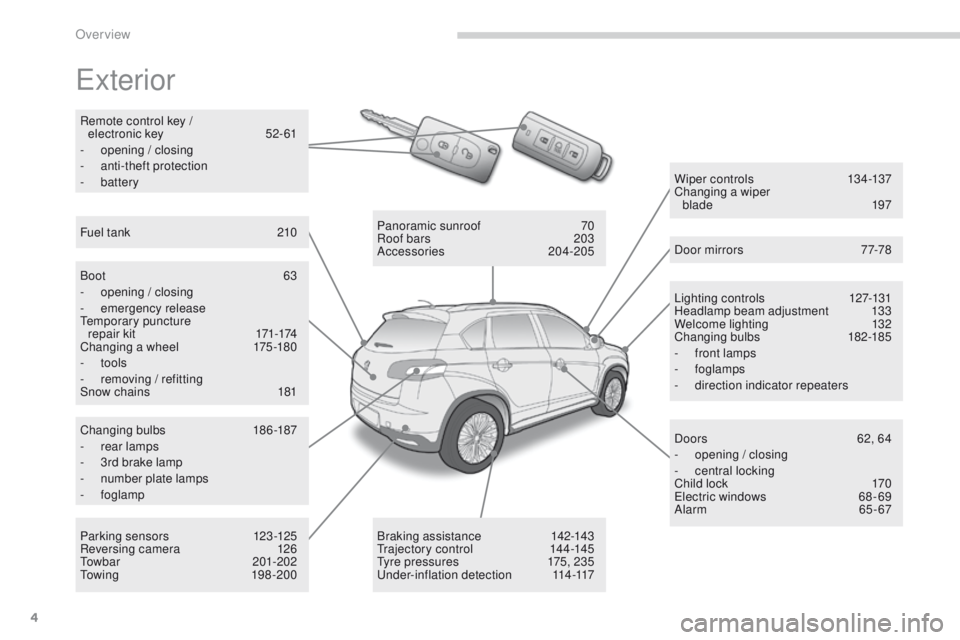
4
exterior
Lighting controls 127-131
Headlamp beam adjustment 1 33
Welcome lighting
1
32
Changing bulbs
1
82-185
-
f
ront lamps
-
foglamps
-
d
irection indicator repeaters
W iper c ontrols
13
4 -137
Changing a wiper blade
197
Door mirrors
7
7-78
Doors
6
2, 64
-
ope
ning / closing
-
c
entral locking
Child lock
1
70
el
ectric windows
6
8 - 69
Alarm
65-67
Panoramic sunroof
7
0
Roof bars
2
03
Accessories
20
4-205
Braking assistance
1
42-143
tra
jectory control
1
44-145
ty
re pressures
1
75, 235
un
der-inflation detection
1
14-117
Boot
63
- ope
ning / closing
- em
ergency release
te
mporary puncture
repair kit
1
71-174
Changing a wheel
1
75-180
-
tools
-
r
emoving / refitting
Snow chains
1
81
Changing bulbs
1
86-187
-
r
ear lamps
-
3
rd brake lamp
-
n
umber plate lamps
-
foglamp
Parking sensors
1
23-125
Reversing camera
1
26
to
wbar
20
1-202
to
w i n g
19 8 - 2 0 0
Fuel tank
2
10
Remote control key /
electronic key
5
2-61
-
ope
ning / closing
-
a
nti-theft protection
-
battery
Over view
Page 12 of 389
10
eco-drivingeco-driving is a range of everyday practices that allow the motorist to optimise their fuel consumption and CO2 emissions.
Optimise the use of your gearbox
With a manual gearbox, move off gently and change up without waiting.
During acceleration change up early.
With an automatic or electronic gearbox, give preference to automatic
mode and avoid pressing the accelerator pedal heavily or suddenly.
th
e gear shift indicator invites you to change up: as soon as the
indication to change up is displayed in the instrument panel, follow it
straight away.
With an electronic or automatic gearbox, this indicator appears only in
manual mode.
Drive smoothly
Maintain a safe distance between vehicles, use engine braking rather
than the brake pedal, and press the accelerator progressively. th ese
practices contribute towards a reduction in fuel consumption and CO
2
emissions and also helps reduce the background traffic noise.
Control the use of your electrical
equipment
Before moving off, if the passenger compartment is too warm, ventilate it
by opening the windows and air vents before using the air conditioning.
Above 30 mph (50 km/h), close the windows and leave the air vents
open.
Remember to make use of equipment that can help keep the
temperature in the passenger compartment down (sunroof and window
blinds...).
Switch off the air conditioning, unless it has automatic regulation, as
soon as the desired temperature is attained.
Switch off the demisting and defrosting controls, if not automatic.
Switch off the heated seat as soon as possible.
Switch off the headlamps and front foglamps when the level of light
does not require their use.
Avoid running the engine before moving off, particularly in winter; your
vehicle will warm up much faster while driving.
As a passenger, if you avoid connecting your multimedia devices
(film, music, video game...), you will contribute towards limiting the
consumption of electrical energy, and so of fuel.
Disconnect your portable devices before leaving the vehicle.
If your vehicle has cruise control, make use of the system at speeds
above 25 mph (40 km/h) when the traffic is flowing well.
eco-driving
Page 100 of 389
98
Starting - stopping the engine with the key
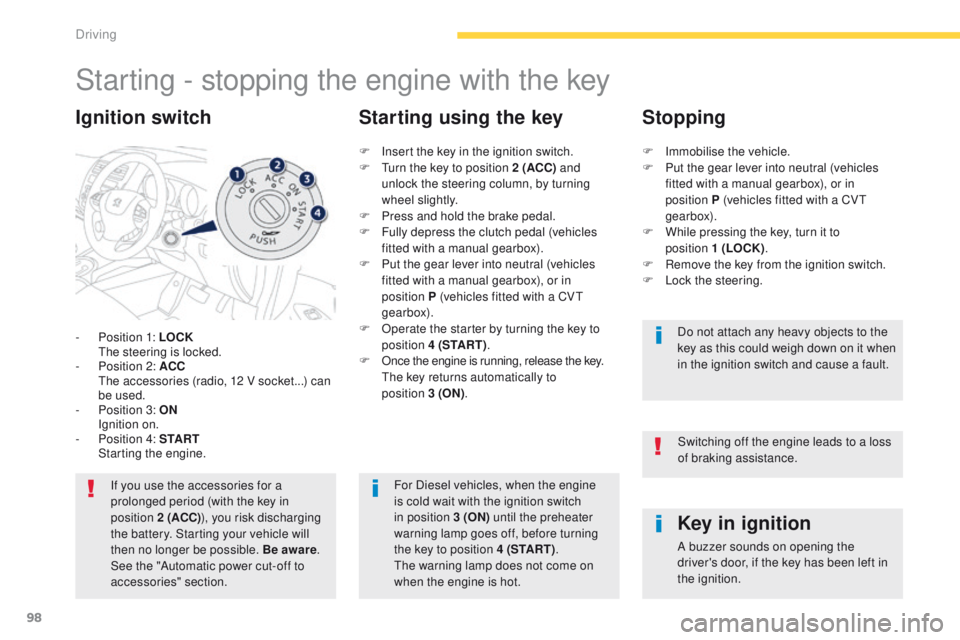
- Position 1: LOCK the steering is locked.
-
P
osition 2: ACC
t
h
e accessories (radio, 12 V socket...) can
be used.
-
P
osition 3: ON
I
gnition on.
-
P
osition 4: S TA R T
S
tarting the engine.
Ignition switch
If you use the accessories for a
prolonged period (with the key in
position 2 (ACC) ), you risk discharging
the battery. Starting your vehicle will
then no longer be possible. Be aware .
See the "Automatic power cut-off to
accessories" section.
Key in ignition
A buzzer sounds on opening the
driver's door, if the key has been left in
the ignition.
F
I
nsert the key in the ignition switch.
F
t
u
rn the key to position 2 (ACC)
and
unlock
the steering column, by turning
wheel slightly.
F
P
ress and hold the brake pedal.
F
F
ully depress the clutch pedal (vehicles
fitted with a manual gearbox).
F
P
ut the gear lever into neutral (vehicles
fitted with a manual gearbox), or in
position
P (vehicles fitted with a CV
t
gearbox).
F
O
perate the starter by turning the key to
position 4 (S TA R T ) .
F
O
nce the engine is running, release the key.
t
h
e key returns automatically to
position
3
(ON)
.
Starting using the key Stopping
F Immobilise the vehicle.
F
P ut the gear lever into neutral (vehicles
fitted with a manual gearbox), or in
position
P (vehicles fitted with a CV
t
gearbox).
F
W
hile pressing the key, turn it to
position
1 (LOCK).
F
R
emove the key from the ignition switch.
F
L
ock the steering.Do not attach any heavy objects to the
key as this could weigh down on it when
in the ignition switch and cause a fault.
For Diesel vehicles, when the engine
is cold wait with the ignition switch
in position 3 (ON) until the preheater
warning lamp goes off, before turning
the key to position 4 (S TA R T ) .
th
e warning lamp does not come on
when the engine is hot. Switching off the engine leads to a loss
of braking assistance.
Driving
Page 113 of 389
111
Stop & Start (Auto Stop & go) function
Operation
Going into engine STOP mode
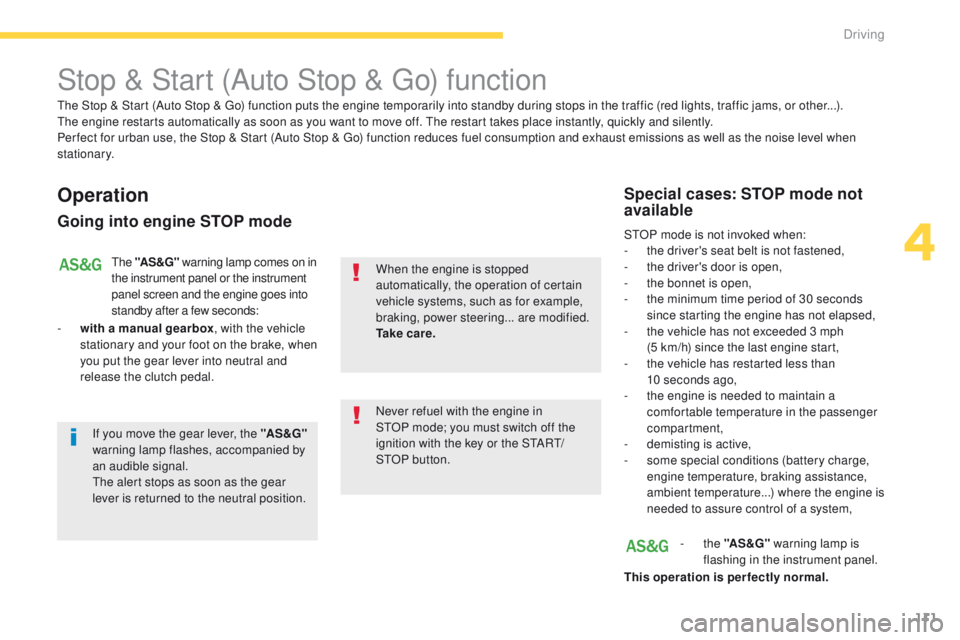
the "AS &G" warning lamp comes on in
the instrument panel or the instrument
panel screen and the engine goes into
standby after a few seconds:
-
w
ith a manual gearbox , with the vehicle
stationary and your foot on the brake, when
you put the gear lever into neutral and
release the clutch pedal.
Never refuel with the engine in
S
tO
P mode; you must switch off the
ignition with the key or the S
tA
R
t/
St
OP
button.
When the engine is stopped
automatically, the operation of certain
vehicle systems, such as for example,
braking, power steering... are modified.
Ta k e c a r e
.
Special cases: STOP mode not
available
StOP mode is not invoked when:
-
t he driver's seat belt is not fastened,
-
t
he driver's door is open,
-
t
he bonnet is open,
-
t
he minimum time period of 30 seconds
since starting the engine has not elapsed,
-
t
he vehicle has not exceeded 3 mph
(5
km/h) since the last engine start,
-
t
he vehicle has restarted less than
10
seconds ago,
-
t
he engine is needed to maintain a
comfortable temperature in the passenger
compartment,
-
d
emisting is active,
-
s
ome special conditions (battery charge,
engine temperature, braking assistance,
ambient temperature...) where the engine is
needed to assure control of a system,
-
the "AS &G" warning lamp is
flashing in the instrument panel.
This operation is perfectly normal.
th
e Stop & Start (Auto Stop &
g
o
) function puts the engine temporarily into standby during stops in the traffic (red lights, traffic jams, or other...).
th
e engine restarts automatically as soon as you want to move off.
t
h
e restart takes place instantly, quickly and silently.
Per fect for urban use, the Stop & Start (Auto Stop &
g
o
) function reduces fuel consumption and exhaust emissions as well as the noise level when
stationary.
If you move the gear lever, the "AS &G"
warning lamp flashes, accompanied by
an audible signal.
th
e alert stops as soon as the gear
lever is returned to the neutral position.
4
Driving
Page 144 of 389
142
group of supplementary systems which help
you to obtain optimum braking in complete
safety in emergency situations:
-
a
nti-lock braking system (ABS),
-
e
lectronic brake force distribution (
eB
FD).
Braking assistance systems
Anti-lock braking system
and electronic brake force
distribution
Linked systems which improve the stability and
manoeuvrability of your vehicle when braking,
in particular on poor or slippery sur faces.
Activation
the anti-lock braking system is active if the
vehicle speed is higher than 6 mph (10 km/h).
It is deactivated when the vehicle speed falls
below 3
mph (5 km/h).
th
e anti-lock braking system comes into
operation automatically when there is a risk of
wheel lock.
Normal operation of the ABS may make itself
felt by slight vibration of the brake pedal.
Operating fault
When the vehicle is stationary
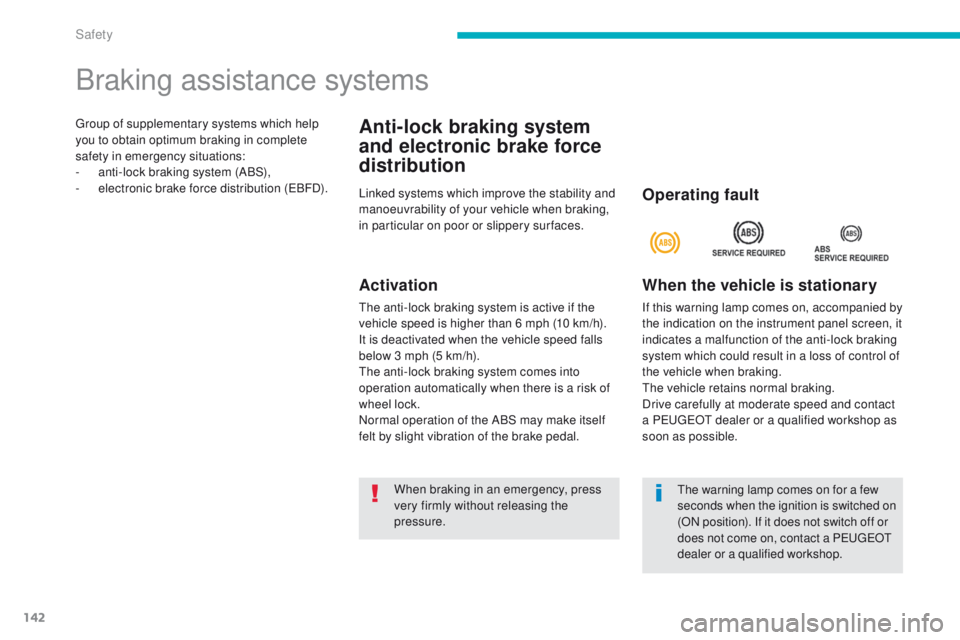
If this warning lamp comes on, accompanied by
the indication on the instrument panel screen, it
indicates a malfunction of the anti-lock braking
system which could result in a loss of control of
the vehicle when braking.
th
e vehicle retains normal braking.
Drive carefully at moderate speed and contact
a P
e
uge
Ot
dealer or a qualified workshop as
soon as possible.
When braking in an emergency, press
very firmly without releasing the
pressure.
th
e warning lamp comes on for a few
seconds when the ignition is switched on
(ON position). If it does not switch off or
does not come on, contact a P
e
uge
Ot
d
ealer or a qualified workshop.
Safety
Page 189 of 389
187
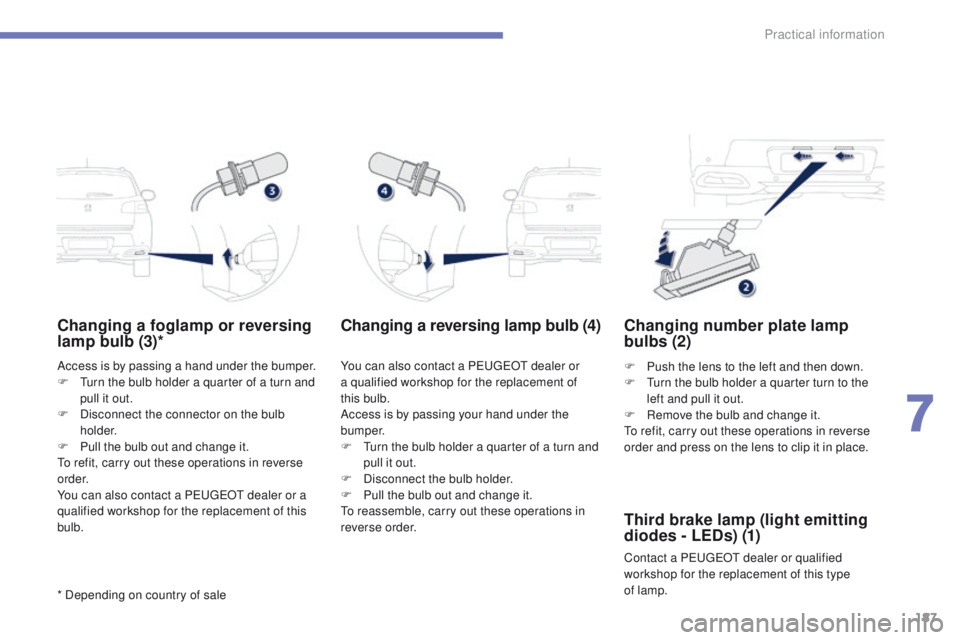
Changing a foglamp or reversing
lamp bulb (3)*
Access is by passing a hand under the bumper.
F tu rn the bulb holder a quarter of a turn and
pull it out.
F
D
isconnect the connector on the bulb
h o l d e r.
F
P
ull the bulb out and change it.
to r
efit, carry out these operations in reverse
o r d e r.
You can also contact a P
e
uge
Ot
dealer or a
qualified workshop for the replacement of this
bulb.
Changing a reversing lamp bulb (4)
You can also contact a Pe ugeOt dealer or
a qualified workshop for the replacement of
this
bulb.
Access is by passing your hand under the
b u m p e r.
F
t
u
rn the bulb holder a quarter of a turn and
pull it out.
F
D
isconnect the bulb holder.
F
P
ull the bulb out and change it.
to r
eassemble, carry out these operations in
reverse order.
Changing number plate lamp
bulbs (2)
F Push the lens to the left and then down.
F tu rn the bulb holder a quarter turn to the
left and pull it out.
F
R
emove the bulb and change it.
to r
efit, carry out these operations in reverse
order and press on the lens to clip it in place.
Third brake lamp (light emitting
diodes - LEDs) (1)
Contact a Pe ugeOt dealer or qualified
workshop for the replacement of this type
of
lamp.
* Depending on country of sale
7
Practical information
Page 191 of 389
189
Dashboard fuses
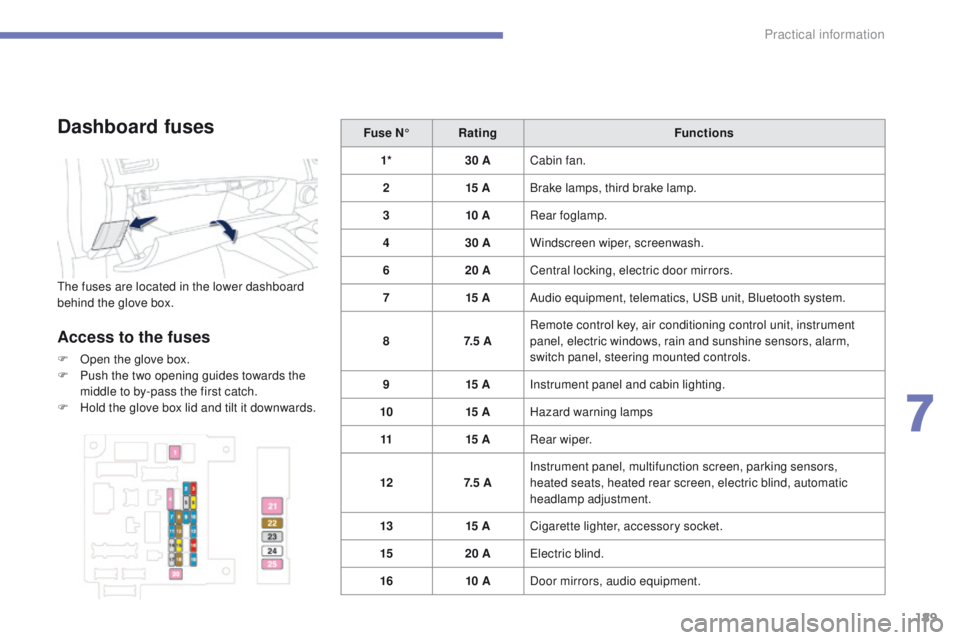
the fuses are located in the lower dashboard
behind the glove box.
Access to the fuses
F Open the glove box.
F P ush the two opening guides towards the
middle to by-pass the first catch.
F
H
old the glove box lid and tilt it downwards. Fuse N°
Rating Functions
1* 30 ACabin fan.
2 15 ABrake lamps, third brake lamp.
3 10 ARear foglamp.
4 30 AWindscreen wiper, screenwash.
6 20 ACentral locking, electric door mirrors.
7 15 AAudio equipment, telematics, u
S
B unit, Bluetooth system.
8 7. 5 ARemote control key, air conditioning control unit, instrument
panel, electric windows, rain and sunshine sensors, alarm,
switch panel, steering mounted controls.
9 15 AInstrument panel and cabin lighting.
10 15 AHazard warning lamps
11 15 ARear wiper.
12 7. 5 AInstrument panel, multifunction screen, parking sensors,
heated seats, heated rear screen, electric blind, automatic
headlamp adjustment.
13 15 ACigarette lighter, accessory socket.
15 20 A
ele
ctric blind.
16 10 ADoor mirrors, audio equipment.
7
Practical information
Page 220 of 389
218
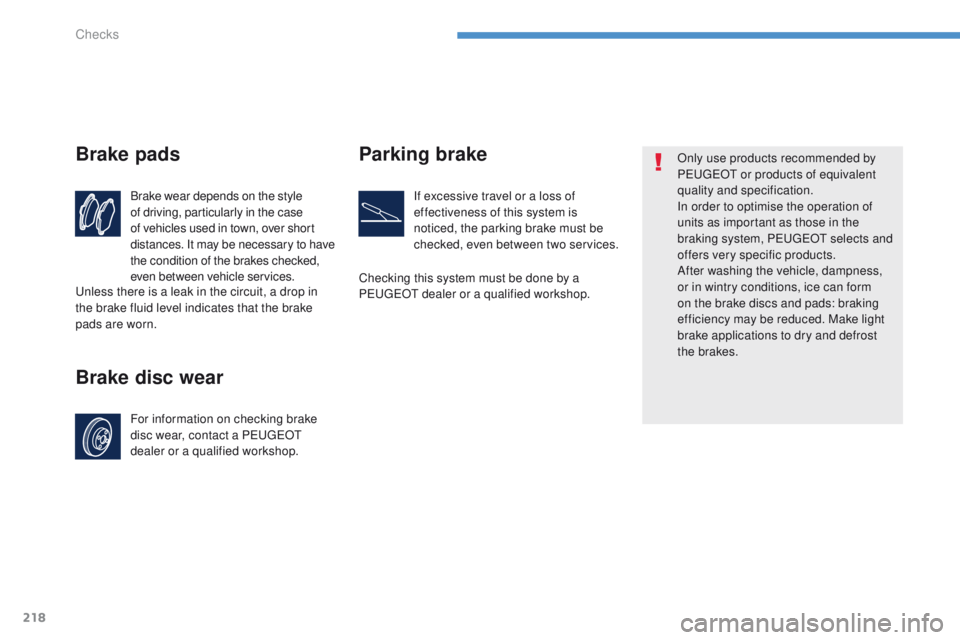
Brake wear depends on the style
of driving, particularly in the case
of vehicles used in town, over short
distances. It may be necessary to have
the condition of the brakes checked,
even between vehicle services.
Brake pads
For information on checking brake
disc wear, contact a PeugeOt
dealer or a qualified workshop.
Brake disc wear Parking brake
If excessive travel or a loss of
effectiveness of this system is
noticed, the parking brake must be
checked, even between two services.
Only use products recommended by
P
e
uge
Ot
or products of equivalent
quality and specification.
In order to optimise the operation of
units as important as those in the
braking system, P
e
uge
Ot
selects and
offers very specific products.
After washing the vehicle, dampness,
or in wintry conditions, ice can form
on the brake discs and pads: braking
efficiency may be reduced. Make light
brake applications to dry and defrost
the brakes.
Checking this system must be done by a
P
e
uge
Ot
dealer or a qualified workshop.
un
less there is a leak in the circuit, a drop in
the brake fluid level indicates that the brake
pads are worn.
Checks
Page 222 of 389
220
Petrol weights and towed loads (kg)
the values for maximum towed weights type
approved according to the sales zone (see the
tables on the following pages).
th
e exact values are given in your vehicle's
registration document as well as on the
manufacturer's plate.
th
ey are also mentioned in sales brochures.
For more details, contact a P
e
uge
Ot
dealer
or a qualified workshop.th e kerb weight is equal to the unladen
weight + driver (75 kg).th e gtW a nd towed load values indicated are
valid up to a maximum altitude of 1 000 metres;
the towed load mentioned must be reduced
by 10 % for each additional 1 000 metres of
altitude.
th
e speed of a towing vehicle must not exceed
60 mph (100 km/h) (comply with the legislation
in force in your country).
High ambient temperatures may result in a
reduction in the per formance of the vehicle to
protect the engine; if the ambient temperature
is above 37 °C, limit the towed load.
th
e weight of the braked trailer can be
increased, within the
gt
W l
imit, if the
gV
W of the towing vehicle is reduced
by an equal amount. Please note that
towing using a lightly loaded towing
vehicle may have an adverse effect
on its road holding.
technical data