wheel PEUGEOT 4008 2015 User Guide
[x] Cancel search | Manufacturer: PEUGEOT, Model Year: 2015, Model line: 4008, Model: PEUGEOT 4008 2015Pages: 389, PDF Size: 15.89 MB
Page 29 of 389
27
4008_en_Chap01_controle-de-marche_ed01-2014
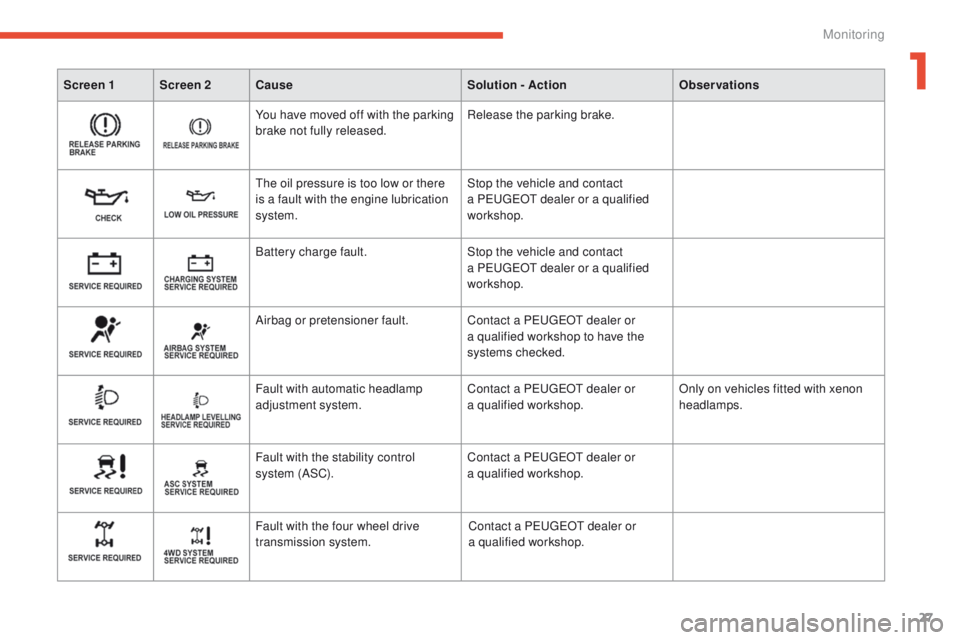
Screen 1 Screen 2Cause Solution - ActionObservations
You have moved off with the parking
brake not fully released.Release the parking brake.
th
e oil pressure is too low or there
is a fault with the engine lubrication
system. Stop the vehicle and contact
a P
e
uge
Ot
dealer or a qualified
workshop.
Battery charge fault. Stop the vehicle and contact
a P
e
uge
Ot
dealer or a qualified
workshop.
Airbag or pretensioner fault. Contact a P
e
uge
Ot
dealer or
a qualified workshop to have the
systems checked.
Fault with automatic headlamp
adjustment system. Contact a P
e
uge
Ot
dealer or
a qualified workshop. Only on vehicles fitted with xenon
headlamps.
Fault with the stability control
system (ASC). Contact a P
e
uge
Ot
dealer or
a qualified workshop.
Fault with the four wheel drive
transmission system. Contact a P
e
uge
Ot
dealer or
a qualified workshop.
1
Monitoring
Page 30 of 389
28
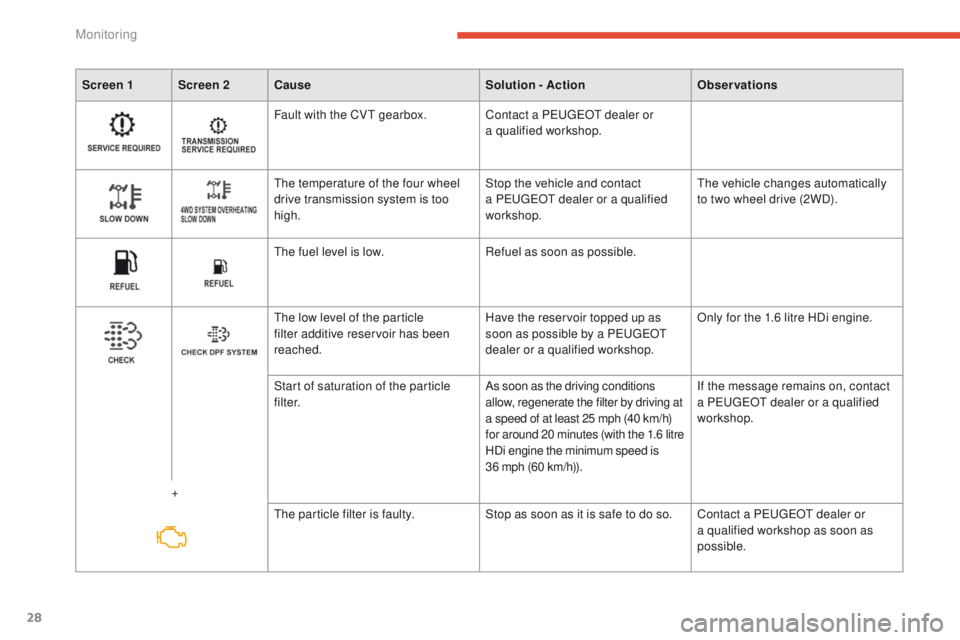
Screen 1 Screen 2Cause Solution - ActionObservations
Fault with the CVt gearbox. Contact a Pe ugeOt dealer or
a qualified workshop.
th
e temperature of the four wheel
drive transmission system is too
high. Stop the vehicle and contact
a P
e
uge
Ot
dealer or a qualified
workshop.
th
e vehicle changes automatically
to two wheel drive (2WD).
th
e fuel level is low. Refuel as soon as possible.
th
e low level of the particle
filter additive reservoir has been
reached. Have the reservoir topped up as
soon as possible by a P
e
uge
Ot
dealer or a qualified workshop. Only for the 1.6 litre HDi engine.
+ Start of saturation of the particle
f i l t e r.
As soon as the driving conditions
allow, regenerate the filter by driving at
a speed of at least 25 mph (40 km/h)
for around 20 minutes (with the 1.6 litre
HDi engine the minimum speed is
36 mph (60 km/h)). If the message remains on, contact
a P
e
uge
Ot
dealer or a qualified
workshop.
th
e particle filter is faulty. Stop as soon as it is safe to do so. Contact a P
e
uge
Ot
dealer or
a qualified workshop as soon as
possible.
Monitoring
Page 32 of 389
30
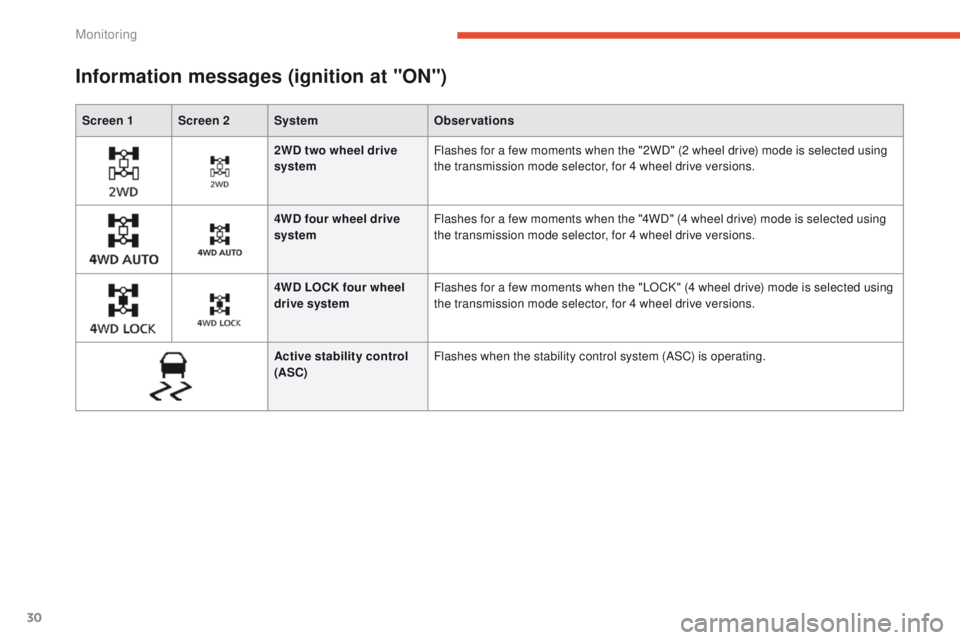
Screen 1 Screen 2SystemObservations
Information messages (ignition at "ON")
2WD two wheel drive
systemFlashes for a few moments when the "2WD" (2 wheel drive) mode is selected using
the transmission mode selector, for 4 wheel drive versions.
4WD four wheel drive
system Flashes for a few moments when the "4WD" (4 wheel drive) mode is selected using
the transmission mode selector, for 4 wheel drive versions.
4WD LOCK four wheel
drive system Flashes for a few moments when the "LOCK" (4 wheel drive) mode is selected using
the transmission mode selector, for 4 wheel drive versions.
Active stability control
(ASC) Flashes when the stability control system (ASC) is operating.
Monitoring
Page 44 of 389
42
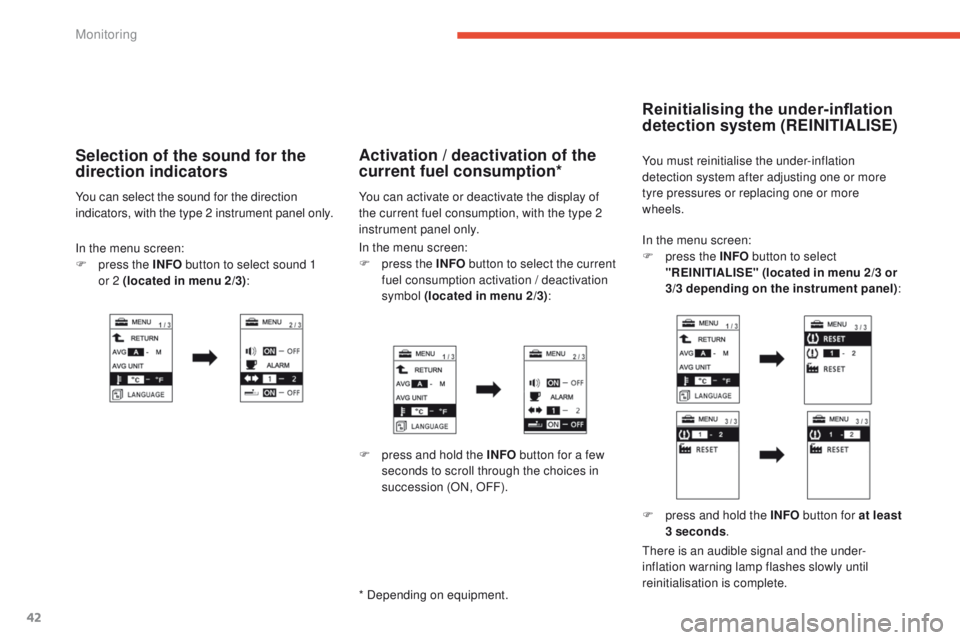
In the menu screen:
F p ress the INFO button to select
"REINITIALISE" (located in menu 2/3 or
3/3 depending on the instrument panel) :
Reinitialising the under-inflation
detection system (REINITIALISE)
You must reinitialise the under-inflation
detection system after adjusting one or more
tyre pressures or replacing one or more
wheels.
F
p
ress and hold the INFO button for at least
3 seconds .
ther
e is an audible signal and the under-
inflation warning lamp flashes slowly until
reinitialisation is complete.
In the menu screen:
F
p
ress the INFO button to select the current
fuel consumption activation / deactivation
symbol (located in menu 2/3) :Activation / deactivation of the
current fuel consumption*
You can activate or deactivate the display of
the current fuel consumption, with the type 2
instrument panel only.
F
p
ress and hold the INFO button for a few
seconds to scroll through the choices in
succession (ON, OFF).
* Depending on equipment.
In the menu screen:
F p ress the INFO button to select sound 1
or
2 (located in menu 2/3) :
Selection of the sound for the
direction indicators
You can select the sound for the direction
indicators, with the type 2 instrument panel only.
Monitoring
Page 81 of 389
79
4008_en_Chap03_confort_ed01-2014
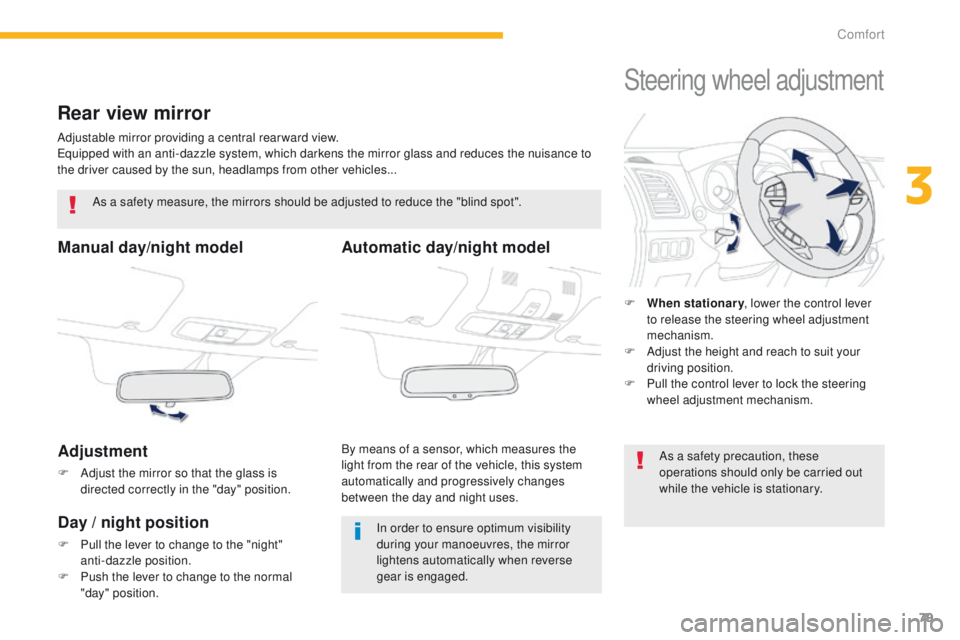
Rear view mirror
Adjustable mirror providing a central rearward view.equipped with an anti-dazzle system, which darkens the mirror glass and reduces the nuisance to
the driver caused by the sun, headlamps from other vehicles...
Manual day/night model
Adjustment
F Adjust the mirror so that the glass is directed correctly in the "day" position.As a safety measure, the mirrors should be adjusted to reduce the "blind spot".
In order to ensure optimum visibility
during your manoeuvres, the mirror
lightens automatically when reverse
gear is engaged.
Day / night position
F Pull the lever to change to the "night" anti-dazzle position.
F
P
ush the lever to change to the normal
"day" position.
Automatic day/night model
By means of a sensor, which measures the
light from the rear of the vehicle, this system
automatically and progressively changes
between the day and night uses.
Steering wheel adjustment
F When stationary , lower the control lever
to release the steering wheel adjustment
mechanism.
F
A
djust the height and reach to suit your
driving position.
F
P
ull the control lever to lock the steering
wheel adjustment mechanism.
As a safety precaution, these
operations should only be carried out
while the vehicle is stationary.
3
Comfort
Page 100 of 389
98
4008_en_Chap04_conduite_ed01-2014
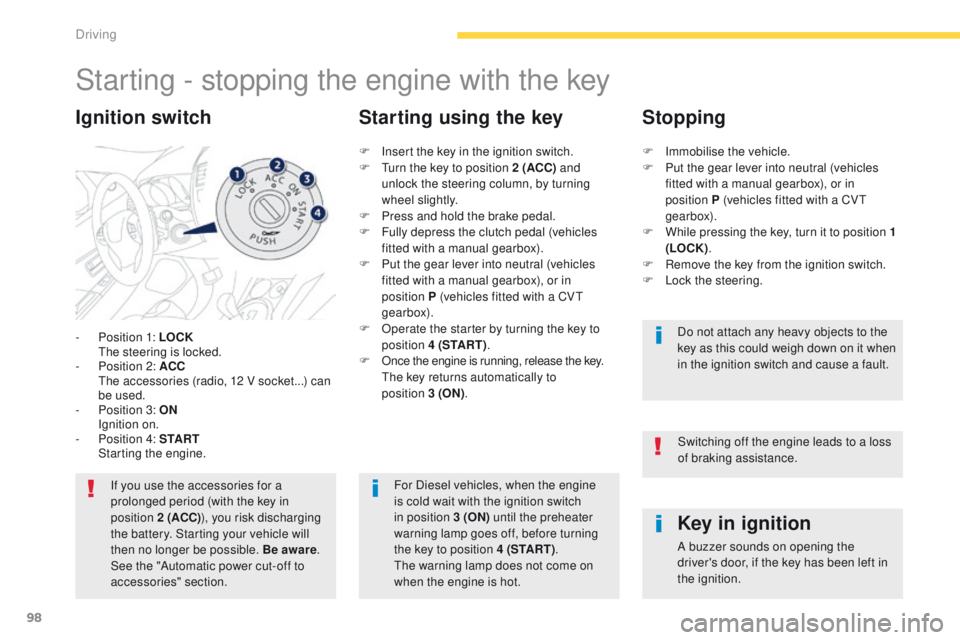
Starting - stopping the engine with the key
- Position 1: LOCK the steering is locked.
-
P
osition 2: ACC
t
h
e accessories (radio, 12 V socket...) can
be used.
-
P
osition 3: ON
I
gnition on.
-
P
osition 4: S TA R T
S
tarting the engine.
Ignition switch
If you use the accessories for a
prolonged period (with the key in
position 2 (ACC) ), you risk discharging
the battery. Starting your vehicle will
then no longer be possible. Be aware .
See the "Automatic power cut-off to
accessories" section.
Key in ignition
A buzzer sounds on opening the
driver's door, if the key has been left in
the ignition.
F
I
nsert the key in the ignition switch.
F
t
u
rn the key to position 2 (ACC)
and
unlock
the steering column, by turning
wheel slightly.
F
P
ress and hold the brake pedal.
F
F
ully depress the clutch pedal (vehicles
fitted with a manual gearbox).
F
P
ut the gear lever into neutral (vehicles
fitted with a manual gearbox), or in
position
P (vehicles fitted with a CV
t
gearbox).
F
O
perate the starter by turning the key to
position 4 (S TA R T ) .
F
O
nce the engine is running, release the key.
t
h
e key returns automatically to
position
3
(ON)
.
Starting using the key Stopping
F Immobilise the vehicle.
F
P ut the gear lever into neutral (vehicles
fitted with a manual gearbox), or in
position
P (vehicles fitted with a CV
t
gearbox).
F
W
hile pressing the key, turn it to position 1
(LOCK) .
F
R
emove the key from the ignition switch.
F
L
ock the steering.Do not attach any heavy objects to the
key as this could weigh down on it when
in the ignition switch and cause a fault.
For Diesel vehicles, when the engine
is cold wait with the ignition switch
in position 3 (ON) until the preheater
warning lamp goes off, before turning
the key to position 4 (S TA R T ) .
th
e warning lamp does not come on
when the engine is hot. Switching off the engine leads to a loss
of braking assistance.
Driving
Page 102 of 389
100
4008_en_Chap04_conduite_ed01-2014
For Diesel vehicles, when
the engine is cold starting
does not take place until the
pre-heater warning lamp has
gone of f.
If one of the starting conditions is not
met, a reminder message appears in
the instrument panel screen. In some
circumstances, it is necessary to
turn the steering wheel slightly while
pressing the "
START/STOP " button
to assist unlocking of the steering;
a message warns you when this is
needed.
th
e presence of the electronic key
in the defined zone is essential. For
reasons of safety, do not leave this area
when the engine is running.
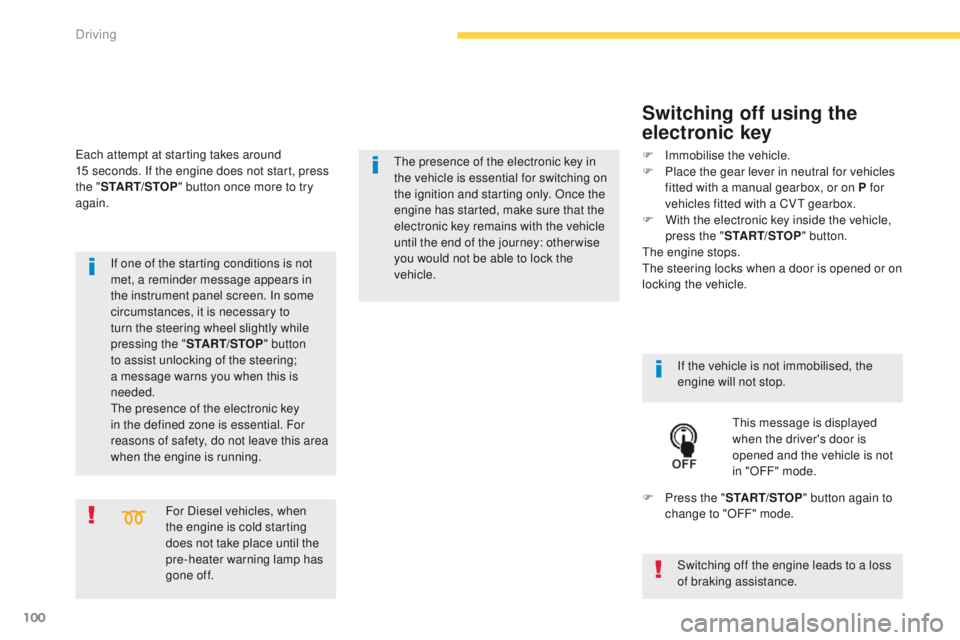
Switching off using the
electronic key
If the vehicle is not immobilised, the
engine will not stop.
th
is message is displayed
when the driver's door is
opened and the vehicle is not
in "OFF" mode.
F
P
ress the " START/STOP " button again to
change to "OFF" mode.
F
Imm
obilise the vehicle.
F
P
lace the gear lever in neutral for vehicles
fitted with a manual gearbox, or on P for
vehicles fitted with a CV
t
gearbox.
F
W
ith the electronic key inside the vehicle,
press the " START/STOP " button.
the
engine stops.
th
e steering locks when a door is opened or on
locking the vehicle.
ea
ch attempt at starting takes around
15 seconds. If the engine does not start, press
the " START/STOP " button once more to try
again.
the presence of the electronic key in
the vehicle is essential for switching on
the ignition and starting only. Once the
engine has started,
make sure that the
electronic key remains with the vehicle
until the end of the journey: otherwise
you would not be able to lock the
vehicle.
Switching off the engine leads to a loss
of braking assistance.
Driving
Page 104 of 389
102
4008_en_Chap04_conduite_ed01-2014
Anti-theft protection
Electronic engine immobiliser
the keys contain an electronic chip which has
a secret code. When the ignition is switched
on, this code must be recognised in order for
starting to be possible.
th
is electronic engine immobiliser locks the
engine management system a few minutes
after the ignition is switched off and prevents
starting of the engine by anyone who does not
have the key.
In the event of a malfunction, you are informed
by a message in the instrument panel screen.
In this case, your vehicle does not start; contact
a P
e
uge
Ot
dealer as soon as possible.
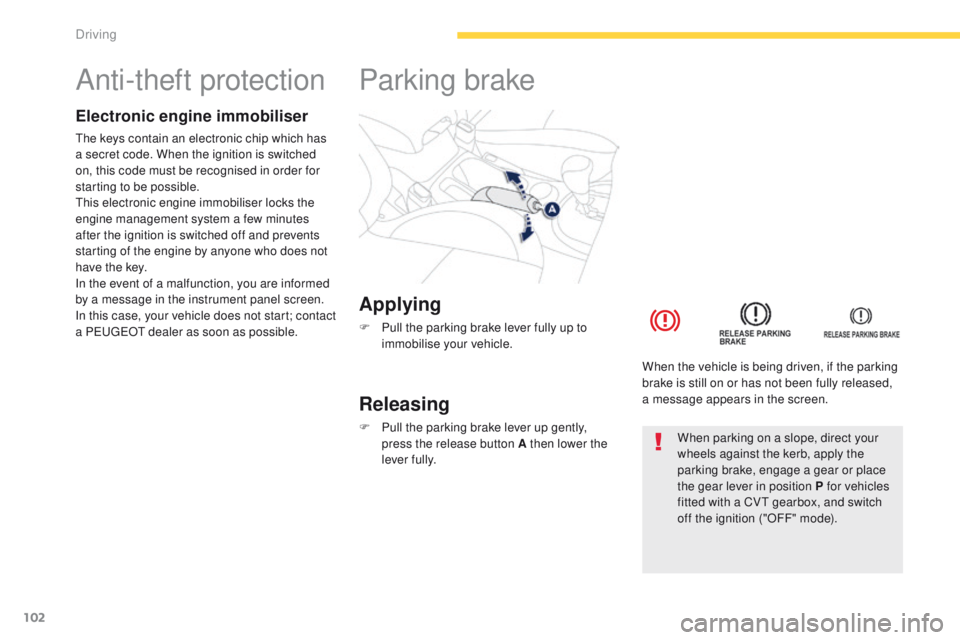
Applying
F Pull the parking brake lever fully up to immobilise your vehicle.
Parking brake
Releasing
F Pull the parking brake lever up gently, press the release button A then lower the
lever fully. When the vehicle is being driven, if the parking
brake is still on or has not been fully released,
a message appears in the screen.When parking on a slope, direct your
wheels against the kerb, apply the
parking brake, engage a gear or place
the gear lever in position P for vehicles
fitted with a CV
t
gearbox, and switch
off the ignition ("OFF" mode).
Driving
Page 116 of 389
114
4008_en_Chap04_conduite_ed01-2014
the tyre under-inflation detection
system is an aid to driving which does
not replace the need for vigilance on
the part of the driver.
Under-inflation detection
System which continuously and automatically checks the pressures of the four tyres after switching on the ignition.
A pressure sensor is located in the valve of each tyre (except the spare wheel).
th
e system triggers an alert if a drop in pressure is detected in one or more tyres, compared to the reference pressure registered in the system. t
h
is
reference pressure must be reinitialised every time the tyre pressures are adjusted or a wheel changed.
th
e system operates on condition that sensor identifiers have first been memorised in the system by a P
e
uge
Ot
dealer or a qualified workshop.
You can memorise two sets of tyres (for example: wheels with "standard" tyres and wheels with "winter" tyres).
Driving with under-inflated tyres
increases fuel consumption.
th
is system does not avoid the need
to check the tyre pressures regularly
(including the spare wheel) and before
a long journey.
Driving with under-inflated tyres
adversely affects road holding,
extends braking distances and causes
premature tyre wear, particularly under
arduous conditions (vehicle loaded,
high speed, long journey).
th
e tyre pressures for your vehicle can
be found on the tyre pressure label
(see the "Identification markings"
section).
th
e tyre pressures must be checked
when the tyres cold (vehicle stopped
for 1 hour or after driving for less then
6 miles (10 km) at moderate speed).
Other wise, add 0.3 bar to the values
indicated on the label.
Driving
Page 117 of 389
115
4008_en_Chap04_conduite_ed01-2014
Under-inflation alert
the alert is given by the fixed
illumination of this warning lamp and
the display of a message.
F
R
educe speed, avoid sudden steering
movements or harsh brake applications.
F
S
top as soon as it is safe to do so.
th
e loss of pressure detected does not
always lead to visible deformation of the
tyre. Do not rely on just a visual check.
th
e alert is maintained until the
reference pressure is reinitialised after
the inflation, repair or replacement of
the tyres concerned. In the event of
the repair or replacement of tyres, the
sensor identifiers must be registered in
the system by a P
e
uge
Ot
dealer or a
qualified workshop.
th
e spare wheel does not have
a sensor, so there is no need to
reinitialise the the system for running
with the spare wheel fitted.
F
I f you have a compressor (the one in the
temporary puncture repair kit for example),
check the four tyre pressures when cold.
I
f it is not possible to check the tyre
pressures at the time, drive carefully at
reduced speed.
or
F
I
n the event of a puncture, use the
temporary puncture repair kit or the spare
wheel (according to equipment).
Reinitialising the reference
pressure
Before reinitialising the system, ensure
that the pressures in the four tyres are
suitable for the conditions of use of the
vehicle and as specified on the tyre
pressure label.
th
e under-inflation detection system
cannot warn of an incorrect pressure at
the time of reinitialisation.
th
e system must be reinitialised after any
adjustment of tyre pressures and after
changing one or more wheels.
4
Driving