key PEUGEOT 4008 2015 Owner's Guide
[x] Cancel search | Manufacturer: PEUGEOT, Model Year: 2015, Model line: 4008, Model: PEUGEOT 4008 2015Pages: 389, PDF Size: 15.89 MB
Page 111 of 389
109
4008_en_Chap04_conduite_ed01-2014
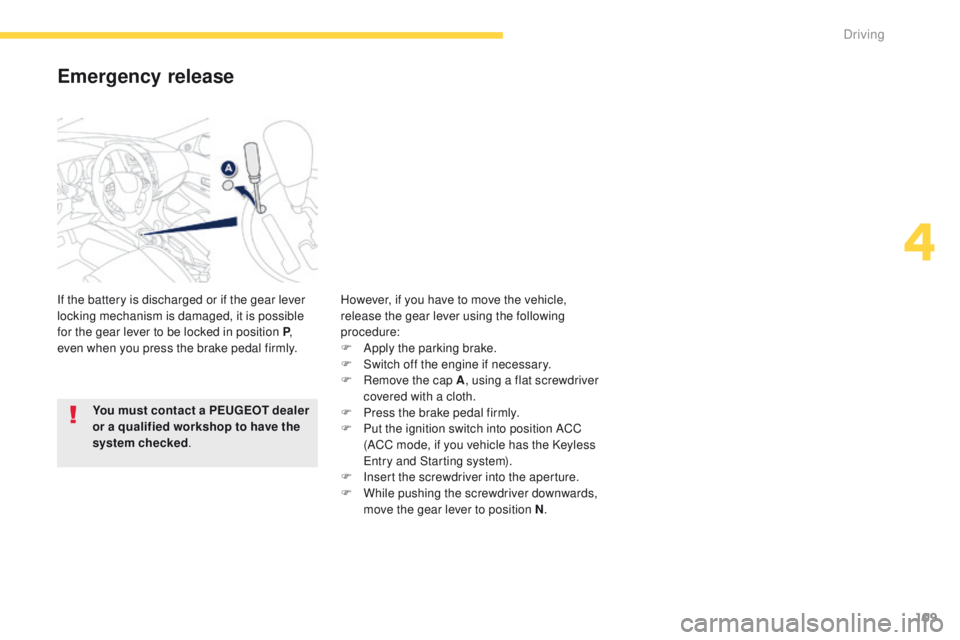
Emergency release
If the battery is discharged or if the gear lever
locking mechanism is damaged, it is possible
for the gear lever to be locked in position P,
even when you press the brake pedal firmly. However, if you have to move the vehicle,
release the gear lever using the following
procedure:
F
A
pply the parking brake.
F
S
witch off the engine if necessary.
F
R
emove the cap A, using a flat screwdriver
covered with a cloth.
F
P
ress the brake pedal firmly.
F
P
ut the ignition switch into position ACC
(ACC mode, if you vehicle has the Keyless
en
try and Starting system).
F
I
nsert the screwdriver into the aperture.
F
W
hile pushing the screwdriver downwards,
move the gear lever to position N .
You must contact a PEUGEOT dealer
or a qualified workshop to have the
system checked
.
4
Driving
Page 113 of 389
111
4008_en_Chap04_conduite_ed01-2014
Stop & Start (Auto Stop & go) function
Operation
Going into engine STOP mode
the "AS &G" warning lamp comes on in
the instrument panel or the instrument
panel screen and the engine goes into
standby after a few seconds:
-
w
ith a manual gearbox , with the vehicle
stationary and your foot on the brake, when
you put the gear lever into neutral and
release the clutch pedal.
Never refuel with the engine in
S
tO
P mode; you must switch off the
ignition with the key or the S
tA
R
t/
St
OP
button.
When the engine is stopped
automatically, the operation of certain
vehicle systems, such as for example,
braking, power steering... are modified.
Ta k e c a r e
.
Special cases: STOP mode not
available
StOP mode is not invoked when:
-
t he driver's seat belt is not fastened,
-
t
he driver's door is open,
-
t
he bonnet is open,
-
t
he minimum time period of 30 seconds
since starting the engine has not elapsed,
-
t
he vehicle has not exceeded 3 mph
(5
km/h) since the last engine start,
-
t
he vehicle has restarted less than
10
seconds ago,
-
t
he engine is needed to maintain a
comfortable temperature in the passenger
compartment,
-
d
emisting is active,
-
s
ome special conditions (battery charge,
engine temperature, braking assistance,
ambient temperature...) where the engine is
needed to assure control of a system,
-
the "AS &G" warning lamp is
flashing in the instrument panel.
This operation is perfectly normal.
th
e Stop & Start (Auto Stop &
g
o
) function puts the engine temporarily into standby during stops in the traffic (red lights, traffic jams, or other...).
th
e engine restarts automatically as soon as you want to move off.
t
h
e restart takes place instantly, quickly and silently.
Per fect for urban use, the Stop & Start (Auto Stop &
g
o
) function reduces fuel consumption and exhaust emissions as well as the noise level when
stationary.
If you move the gear lever, the "AS &G"
warning lamp flashes, accompanied by
an audible signal.
th
e alert stops as soon as the gear
lever is returned to the neutral position.
4
Driving
Page 114 of 389
112
4008_en_Chap04_conduite_ed01-2014
Going into engine START mode
the "AS &G" warning lamp goes off
and the engine starts automatically:
-
w
ith a manual gearbox , when you fully
depress the clutch pedal. For safety reasons or to ensure smooth
operation, StA
Rt mo de is invoked
automatically when:
Special cases: START invoked
automatically
- the speed of the vehicle exceeds 2 mph (3 km/h),
-
y
ou open the driver's door,
-
y
ou unfasten the driver's seatbelt,
-
s
ome special conditions (battery charge,
engine temperature, braking assistance,
ambient temperature...) where the engine is
needed to assure control of a system.
If the system has been deactivated in
S
tO
P mode, the engine will not start.
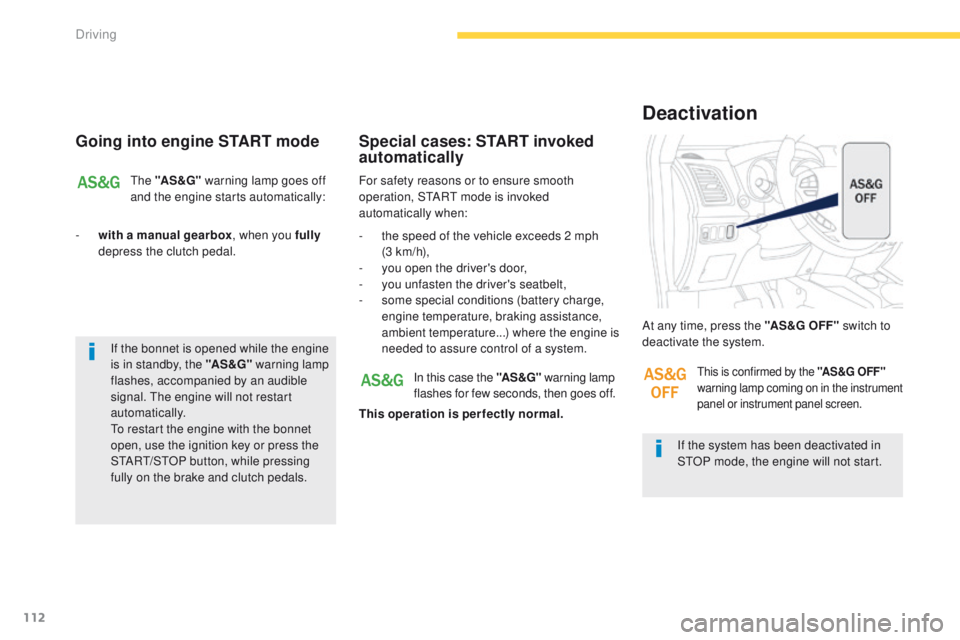
At any time, press the "AS &G O FF "
switch to
deactivate the system.
Deactivation
In this case the "AS &G" warning lamp
flashes for few seconds, then goes off.
This operation is perfectly normal.this is confirmed by the "AS &G O FF "
warning lamp coming on in the instrument
panel or instrument panel screen.
If the bonnet is opened while the engine
is in standby, the "AS &G" warning lamp
flashes, accompanied by an audible
signal.
t
h
e engine will not restart
automatically.
to r
estart the engine with the bonnet
open, use the ignition key or press the
S
tA
R
t/
S
tO
P button, while pressing
fully on the brake and clutch pedals.
Driving
Page 115 of 389
113
4008_en_Chap04_conduite_ed01-2014
the system is reactivated automatically
at every new start using the key or the
St
A
R
t/
S t
O
P button.
Reactivation
Press the "AS &G O FF " switch again.th
e system is active again; this is confirmed by
the "AS &G O FF " warning lamp going off in the
instrument panel or instrument panel screen.
Operating fault
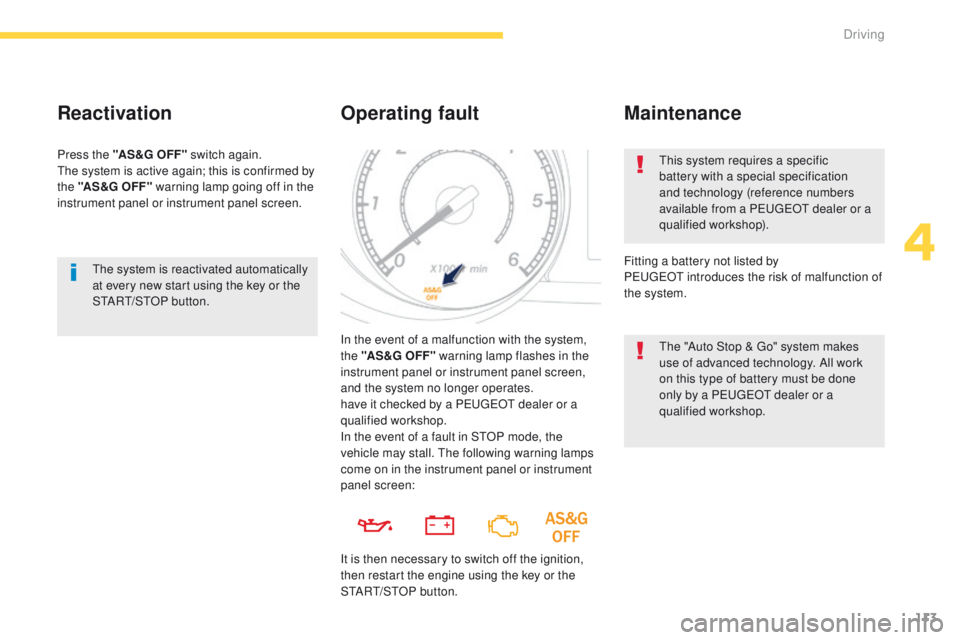
In the event of a malfunction with the system,
the "AS &G O FF " warning lamp flashes in the
instrument panel or instrument panel screen,
and the system no longer operates.
have it checked by a P
e
uge
Ot
dealer or a
qualified workshop.
th
is system requires a specific
battery with a special specification
and technology (reference numbers
available from a P
e
uge
Ot
dealer or a
qualified workshop).
Fitting a battery not listed by
P
e
uge
Ot
introduces the risk of malfunction of
the system.
Maintenance
the "Auto Stop & go" s ystem makes
use of advanced technology. All work
on this type of battery must be done
only by a P
e
uge
Ot
dealer or a
qualified workshop.
In the event of a fault in S
tO
P mode, the
vehicle may stall.
t
h
e following warning lamps
come on in the instrument panel or instrument
panel screen:
It is then necessary to switch off the ignition,
then restart the engine using the key or the
S
t
A
R
t/
S
t
O
P button.
4
Driving
Page 132 of 389
130
4008_en_Chap05_visibilite_ed01-2014
In foggy weather or in snow, the
sunshine sensor may detect sufficient
light. t
h
e lighting will not come on
automatically.
Do not cover the sunshine sensor, the
associated functions will no longer be
controlled.
Automatic switching off
When the lighting control stalk is at "dipped or
main beam headlamps", if the ignition switch
is at "LOCK" or "ACC" or if the key has been
removed from the ignition switch, the lamps
switch off automatically when the driver's
door is opened .
Daytime running lamps
Daytime lighting which comes on automatically
when the engine is started making the vehicle
more visible to other users.
th
is function is assured by special lamps.
th
e lighting control stalk must be placed in
position "0" or "AUTO" (d ay m o d e).
Automatic illumination of headlamps
the sidelamps and the dipped beam headlamps
come on automatically, without any action on the
part of the driver, if a low level of exterior light is
detected or if the wipers are switched on.
When the light returns to a sufficient level or the
wipers are switched off, the lighting is switched off
automatically.
th
e sensor is located at the base of the windscreen.
Contact a P
e
uge
Ot
dealer or a qualified workshop
to adjust the sensitivity of the sensor.
Visibility
Page 133 of 389
131
4008_en_Chap05_visibilite_ed01-2014
Switching off
the manual guide-me-home lighting switches
off immediately if you.
-
f
lash the headlamps again,
-
p
lace the lighting control stalk in another
position,
-
s
witch the ignition on (or select "ON" mode
for vehicle with the "Keyless
e
n
try and
Starting" system).
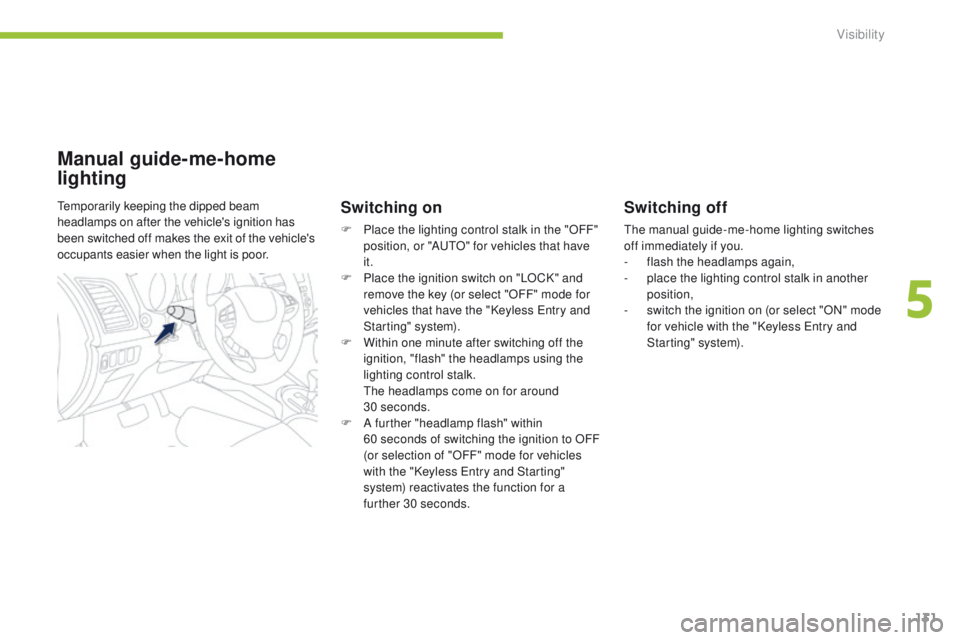
Manual guide-me-home
lighting
Switching on
F Place the lighting control stalk in the "OFF" position, or "Au tO " for vehicles that have
it.
F
P
lace the ignition switch on "LOCK" and
remove the key (or select "OFF" mode for
vehicles that have the "Keyless
e
n
try and
Starting" system).
F
W
ithin one minute after switching off the
ignition, "flash" the headlamps using the
lighting control stalk.
t
h
e headlamps come on for around
30
seconds.
F
A
further "headlamp flash" within
60
seconds of switching the ignition to OFF
(or selection of "OFF" mode for vehicles
with the "Keyless
e
n
try and Starting"
system) reactivates the function for a
further 30 seconds.
tem
porarily keeping the dipped beam
headlamps on after the vehicle's ignition has
been switched off makes the exit of the vehicle's
occupants easier when the light is poor.
5
Visibility
Page 134 of 389
132
4008_en_Chap05_visibilite_ed01-2014
exterior welcome lightingRemote switching on of the lighting makes your approach to the vehicle easier in poor light.
It comes on when the vehicle is unlocked remotely.
Switching on
F Place the lighting control in position "OFF" or "Au tO ".
F
P
ress the open padlock on the
remote control or the electronic
key.
t
h
e sidelamps come on for about
30 seconds. For vehicles fitted
with automatic illumination of
headlamps, the welcome lighting
only comes on under conditions
of low ambient light.
Switching off
the welcome lighting goes off immediately if:
- y ou press the open padlock on the remote
control,
-
y
ou place the lighting control in another
position,
-
y
ou switch on the ignition (or select "ON"
mode for vehicles fitted with the "Keyless
en
try and Starting" system).
Visibility
Page 153 of 389
151
4008_en_Chap06_securite_ed01-2014
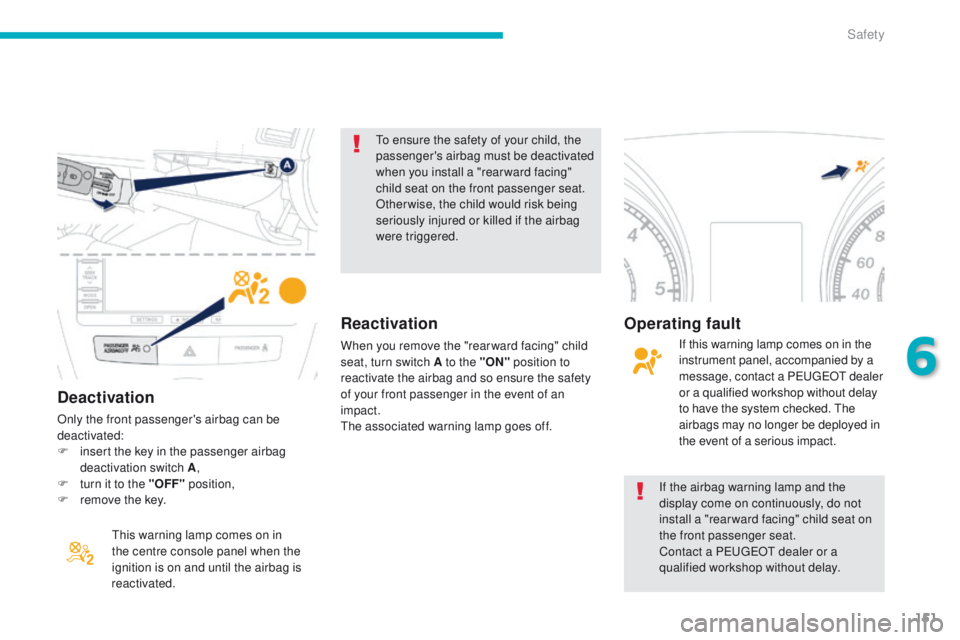
Deactivation
Only the front passenger's airbag can be
deactivated:
F
i
nsert the key in the passenger airbag
deactivation switch A ,
F
t
urn it to the "OFF" position,
F
r
emove the key.
th
is warning lamp comes on in
the centre console panel when the
ignition is on and until the airbag is
reactivated.
to e
nsure the safety of your child, the
passenger's airbag must be deactivated
when you install a "rear ward facing"
child seat on the front passenger seat.
Otherwise, the child would risk being
seriously injured or killed if the airbag
were triggered.
If the airbag warning lamp and the
display come on continuously, do not
install a "rear ward facing" child seat on
the front passenger seat.
Contact a P
e
uge
Ot
dealer or a
qualified workshop without delay.
Reactivation
When you remove the "rear ward facing" child
seat, turn switch A to the "ON" position to
reactivate the airbag and so ensure the safety
of your front passenger in the event of an
impact.
th
e associated warning lamp goes off.
Operating fault
If this warning lamp comes on in the
instrument panel, accompanied by a
message, contact a P
e
uge
Ot
dealer
or a qualified workshop without delay
to have the system checked.
t
h
e
airbags may no longer be deployed in
the event of a serious impact.
6
Safety
Page 156 of 389
154
4008_en_Chap06_securite_ed01-2014
Sit in a normal upright position.
Wear a correctly adjusted seat belt.
Do not leave anything between the
occupants and the airbags (a child, pet,
object...). t
h
is could hamper the operation of
the airbags or injure the occupants.
After an accident or if the vehicle has been
stolen or broken into, have the airbag
systems checked.
All work on the airbag system must be
carried out by a P
e
uge
Ot
dealer or a
qualified workshop.
ev
en if all of the precautions mentioned
are observed, a risk of injury or of minor
burns to the head, chest or arms when an
airbag is deployed cannot be ruled out.
t
h
e
bag inflates almost instantly (within a few
milliseconds) then deflates within the same
time discharging the hot gas via openings
provided for this purpose.
Knee airbag*
Do not sit with your knees any nearer to the
steering wheel than necessary.
Front airbags
Do not drive holding the steering wheel by its
spokes or resting your hands on the centre
part of the wheel.
Passengers must not place their feet on the
dashboard.
Do not smoke as deployment of the airbags
can cause burns or the risk of injury from a
cigarette or pipe.
Never remove or pierce the steering wheel or
hit it violently.
Do not fit or attach anything to the steering
wheel or dashboard, this could cause
injuries with deployment of the airbags.
For the airbags to be fully effective, observe the following safety rules:
Lateral airbags
use only approved covers on the seats,
compatible with the deployment the lateral
airbags. For information on the range of seat
covers suitable for your vehicle, you can
contact a P
e
uge
Ot
dealer.
Refer to the "Accessories" section.
Do not fix or attach anything to the seat
backs (clothing...).
t
h
is could cause injury
to the chest or arms if the lateral airbag is
deployed.
Do not sit with the upper part of the body any
nearer to the door than necessary.
* According to country.
Curtain airbags
Do not fix or attach anything to the roof. th is
could cause injury to the head if the curtain
airbag is deployed.
If fitted on your vehicle, do not remove the
grab handles installed on the roof, they play
a part in securing the curtain airbags.
Avoid attaching a heavy object to the key as
it could become a dangerous projectile if the
airbag were deployed.
Safety
Page 171 of 389
169
4008_en_Chap06_securite_ed01-2014
the incorrect installation of a child seat in a
vehicle compromises the child's protection in
the event of an accident.
Remember to fasten the seat belts or the
child seat harnesses keeping the slack in
relation to the child's body to a minimum,
even for short journeys.
For optimum installation of the forward
facing child seat, ensure that the back of the
child seat is in contact with the back of the
vehicle's seat and that the head restraint
does not cause any discomfort.
If the head restraint has to be removed,
ensure that it is stored or attached securely
to prevent it from being thrown around the
vehicle in the event of sharp braking.
Advice on child seats
Installing a booster cushion
the chest part of the seat belt must be
positioned on the child's shoulder without
touching the neck.
en
sure that the lap part of the seat belt
passes correctly over the child's thighs.
P
e
uge
Ot
recommends the use of a booster
seat which has a back, fitted with a seat belt
guide at shoulder level.
As a safety precaution, do not leave:
-
o
ne or more children alone and
unsupervised in a vehicle,
-
a c
hild or an animal in a vehicle which
is exposed to the sun, with the windows
closed,
-
t
he keys within reach of children inside
the vehicle.
Children at the front
the legislation on carrying a child on the
front passenger seat is specific to each
country. Refer to the legislation in force in
your country.
Deactivate the passenger's airbag when a
rear ward facing child seat is installed on the
front seat. Otherwise, the child would risk
being seriously injured or killed if the airbag
were to inflate.
to p
revent accidental opening of the doors,
use the Child lock.
ta
ke care not to open the rear windows by
more than one third.
to p
rotect young children from the rays of
the sun, fit side blinds on the rear windows.
6
Safety