change wheel PEUGEOT 4008 2017 Owners Manual
[x] Cancel search | Manufacturer: PEUGEOT, Model Year: 2017, Model line: 4008, Model: PEUGEOT 4008 2017Pages: 368, PDF Size: 12.22 MB
Page 13 of 368
11
4008_en_Chap00c_eco-conduite_ed01-2016
Limit the causes of excess consumption
Spread loads throughout the vehicle; place the heaviest items in the
bottom of the boot, as close as possible to the rear seats.
Limit the loads carried in the vehicle and reduce wind resistance
(roof bars, roof rack, bicycle carrier, trailer, etc.). u
s
e a roof box in
preference.
Remove roof bars and roof racks after use.
At the end of winter, remove snow tyres and refit your summer tyres.
Observe the recommendations on
maintenance
Check the tyre pressures regularly, when cold, referring to the label in
the door aperture, on the driver's side.
Carry out this check in particular:
-
b
efore a long journey,
-
a
t each change of season,
-
a
fter a long period out of use.
Do not forget the spare wheel and the tyres on any trailer or caravan.
Have your vehicle serviced regularly (engine oil, oil filter, air filter,
passenger compartment filter, etc.) and observe the schedule of
operations recommended in the manufacturer's service schedule.
When refuelling, do not continue after the third cut-off of the nozzle to
avoid any over flow.
At the wheel of your new vehicle, it is only after the first 1 800 miles
(3
000 kilometres) that you will see the fuel consumption settle down to
a consistent average.
.
eco-driving
Page 30 of 368
28
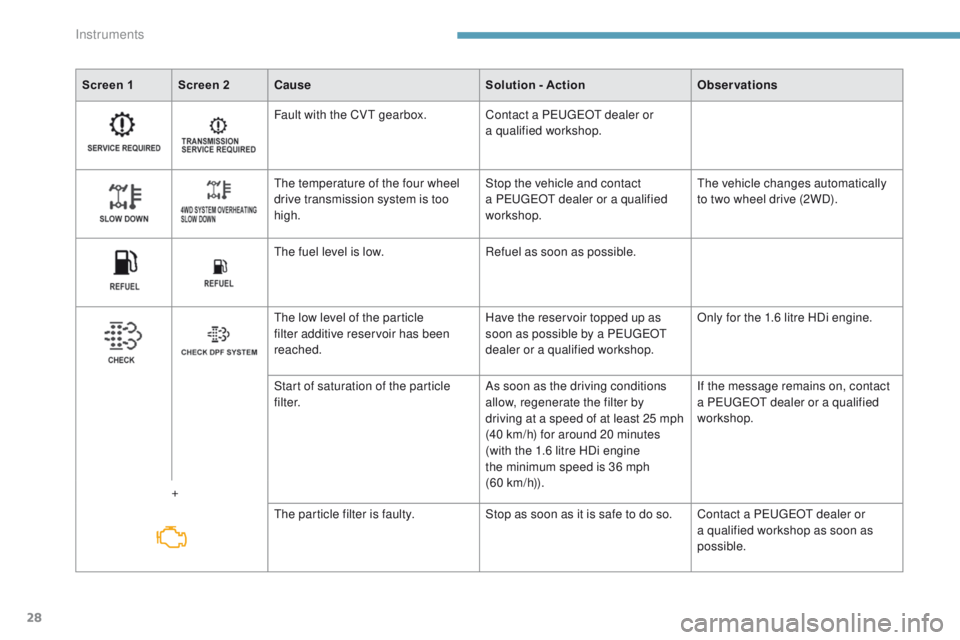
Screen 1 Screen 2Cause Solution - ActionObservations
Fault with the CV
t
gearbox. Contact a P
e
uge
Ot
dealer or
a qualified workshop.
th
e temperature of the four wheel
drive transmission system is too
high. Stop the vehicle and contact
a P
e
uge
Ot
dealer or a qualified
workshop.
th
e vehicle changes automatically
to two wheel drive (2WD).
th
e fuel level is low.Refuel as soon as possible.
th
e low level of the particle
filter additive reservoir has been
reached. Have the reservoir topped up as
soon as possible by a P
e
uge
Ot
dealer or a qualified workshop. Only for the 1.6 litre HDi engine.
+ Start of saturation of the particle
f i l t e r.
As soon as the driving conditions
allow, regenerate the filter by
driving
at a speed of at least 25 mph
(40 km/h) for around 20 minutes
(with the 1.6 litre HDi engine
the
minimum speed is 36 mph
(60 km/h)). If the message remains on, contact
a P
e
uge
Ot
dealer or a qualified
workshop.
th
e particle filter is faulty.Stop as soon as it is safe to do so. Contact a P
e
uge
Ot
dealer or
a qualified workshop as soon as
possible.
Instruments
Page 80 of 368
78
4008_en_Chap03_Ergonomie-et-confort_ed01-2016
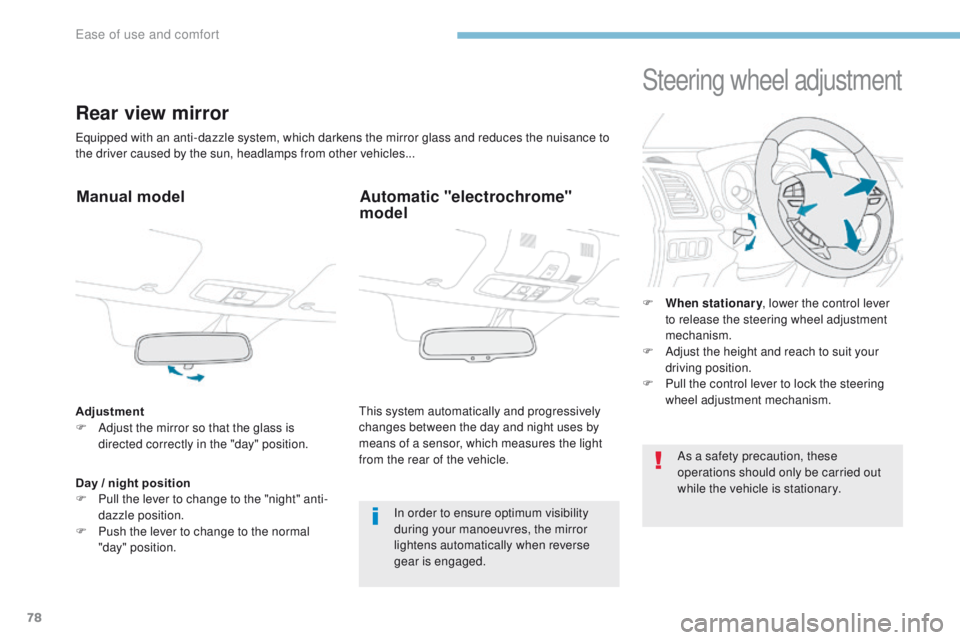
Rear view mirror
equipped with an anti-dazzle system, which darkens the mirror glass and reduces the nuisance to
the driver caused by the sun, headlamps from other vehicles...
Manual model
Adjustment
F A djust the mirror so that the glass is
directed correctly in the "day" position.
In order to ensure optimum visibility
during your manoeuvres, the mirror
lightens automatically when reverse
gear is engaged.
Day / night position
F
P
ull the lever to change to the "night" anti-
dazzle position.
F
P
ush the lever to change to the normal
"day" position.
Automatic "electrochrome"
model
this system automatically and progressively
changes between the day and night uses by
means of a sensor, which measures the light
from the rear of the vehicle.
Steering wheel adjustment
F When stationary , lower the control lever
to release the steering wheel adjustment
mechanism.
F
A
djust the height and reach to suit your
driving position.
F
P
ull the control lever to lock the steering
wheel adjustment mechanism.
As a safety precaution, these
operations should only be carried out
while the vehicle is stationary.
Ease of use and comfort
Page 102 of 368
100
4008_en_Chap04_conduite_ed01-2016
For Diesel vehicles, when
the engine is cold, starting
does not take place until the
pre-heater warning lamp has
gone of f.
If one of the starting conditions is not
met, a reminder message appears in
the instrument panel screen. In some
circumstances, it is necessary to
turn the steering wheel slightly while
pressing the "
START/STOP " button
to assist unlocking of the steering;
a message warns you when this is
needed.
th
e presence of the electronic key in
the defined zone is essential. For safety
reasons, do not leave this area when
the engine is running.
Switching off using the
electronic key
If the vehicle is not immobilised, the
engine will not switch off.
th
is message is displayed
when the driver's door is
opened and the vehicle is not
in "OFF" mode.
F
P
ress the " START/STOP " button again to
change to "OFF" mode.
F
Imm
obilise the vehicle.
F
P
lace the gear lever in neutral for vehicles
fitted with a manual gearbox, or on P for
vehicles fitted with a CV
t
gearbox.
F
W
ith the electronic key inside the vehicle,
press the " START/STOP " button.
the
engine switches off.
th
e steering locks when a door is opened or on
locking the vehicle.
ea
ch attempt at starting takes around
15
seconds. If the engine does not start, press
the " START/STOP " button once more to try
again.
the presence of the electronic key
in the vehicle is essential only for
switching on the ignition and for starting
the engine. Once the engine has
started, make sure that the electronic
key remains with the vehicle until the
end of the journey: otherwise you would
not be able to lock the vehicle.
Switching off the engine leads to a loss
of braking assistance.
Driving
Page 116 of 368
114
4008_en_Chap04_conduite_ed01-2016
the tyre under-inflation detection
system is an aid to driving which does
not replace the need for vigilance on
the part of the driver.
Under-inflation detection
System which continuously and automatically checks the pressures of the four tyres after switching on the ignition.
A pressure sensor is located in the valve of each tyre (except the spare wheel).
th
e system triggers an alert if a drop in pressure is detected in one or more tyres, compared to the reference pressure registered in the system. t
h
is
reference pressure must be reinitialised every time the tyre pressures are adjusted or a wheel changed.
th
e system operates on condition that the sensor identifiers have first been memorised in the system by a P
e
uge
Ot
dealer or a qualified workshop.
You can memorise two sets of tyres (e.g. wheels with "standard" tyres and wheels with "winter" tyres).
Driving with under-inflated tyres
increases fuel consumption.
th
is system does not avoid the need
to check the tyre pressures regularly
(including the spare wheel) and before
a long journey.
Driving with under-inflated tyres
adversely affects road holding,
extends braking distances and causes
premature tyre wear, particularly under
arduous conditions (vehicle loaded,
high speed, long journey).
th
e tyre pressures for your vehicle can
be found on the tyre pressure label.
For more information on Identification
markings , refer to the corresponding
section.
th
e tyre pressures must be checked
when the tyres are cold (vehicle
stopped for 1 hour or after driving for
less then 6 miles (10 km) at moderate
speed). Other wise, add 0.3 bar to the
values indicated on the label.
Driving
Page 120 of 368
118
4008_en_Chap04_conduite_ed01-2016
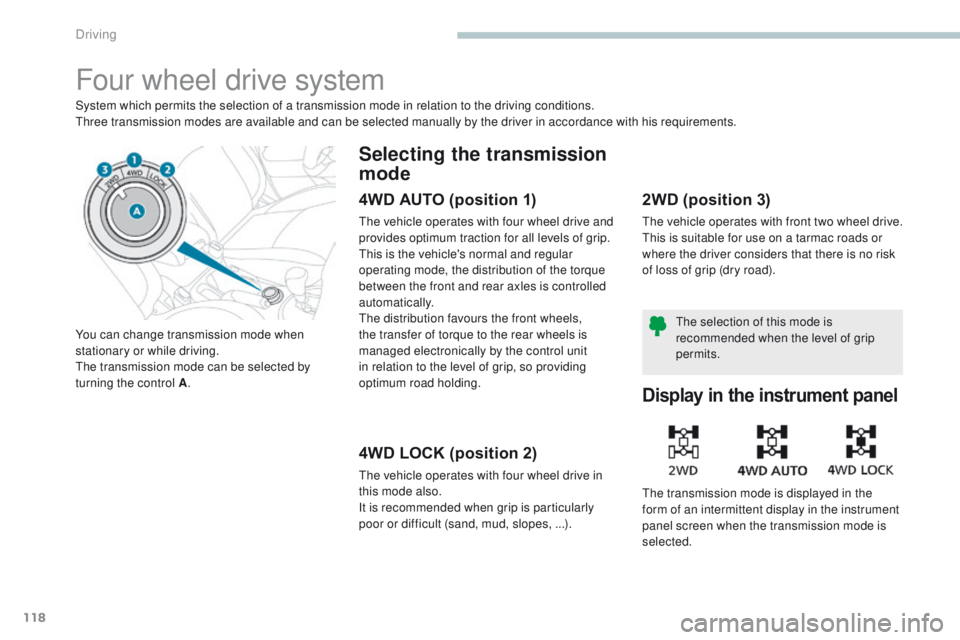
Four wheel drive system
System which permits the selection of a transmission mode in relation to the driving conditions.three transmission modes are available and can be selected manually by the driver in accordance with his requirements.
You can change transmission mode when
stationary or while driving.
th
e transmission mode can be selected by
turning the control A .
Selecting the transmission
mode
4WD AUTO (position 1)
the vehicle operates with four wheel drive and
provides optimum traction for all levels of grip.
th
is is the vehicle's normal and regular
operating mode, the distribution of the torque
between the front and rear axles is controlled
automatically.
th
e distribution favours the front wheels,
the transfer of torque to the rear wheels is
managed electronically by the control unit
in relation to the level of grip, so providing
optimum road holding.
4WD LOCK (position 2)
the vehicle operates with four wheel drive in
this mode also.
It is recommended when grip is particularly
poor or difficult (sand, mud, slopes, ...).
2WD (position 3)
the vehicle operates with front two wheel drive.th is is suitable for use on a tarmac roads or
where the driver considers that there is no risk
of loss of grip (dry road).
Display in the instrument panel
the transmission mode is displayed in the
form of an intermittent display in the instrument
panel screen when the transmission mode is
selected.
th
e selection of this mode is
recommended when the level of grip
permits.
Driving
Page 197 of 368
195
4008_en_Chap08_en-cas-de panne_ed01-2016
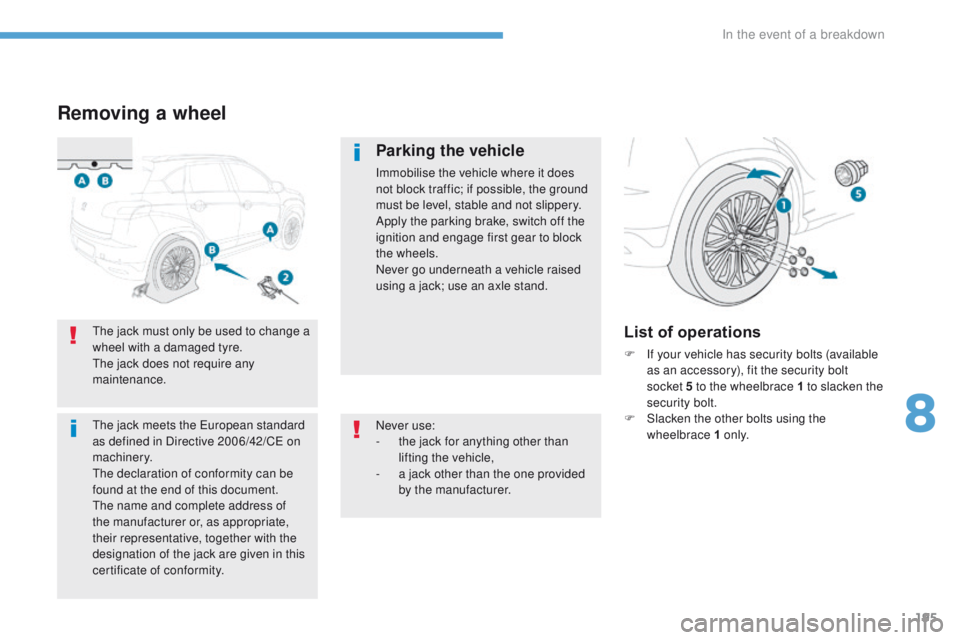
Removing a wheel
Parking the vehicle
Immobilise the vehicle where it does
not block traffic; if possible, the ground
must be level, stable and not slippery.
Apply the parking brake, switch off the
ignition and engage first gear to block
the wheels.
Never go underneath a vehicle raised
using a jack; use an axle stand.
List of operations
F If your vehicle has security bolts (available
as an accessory), fit the security bolt
socket 5 to the wheelbrace 1 to slacken the
security bolt.
F
S
lacken the other bolts using the
wheelbrace 1 o n l y.
Never use:
-
t
he jack for anything other than
lifting the vehicle,
-
a j
ack other than the one provided
by the manufacturer.
th
e jack must only be used to change a
wheel with a damaged tyre.th
e jack does not require any
maintenance.
th
e jack meets the
e
u
ropean standard
as defined in Directive 2006/42/C
e
on
machinery.
th
e declaration of conformity can be
found at the end of this document.
th
e name and complete address of
the manufacturer or, as appropriate,
their representative, together with the
designation of the jack are given in this
certificate of conformity.
8
In the event of a breakdown
Page 198 of 368
196
4008_en_Chap08_en-cas-de panne_ed01-2016
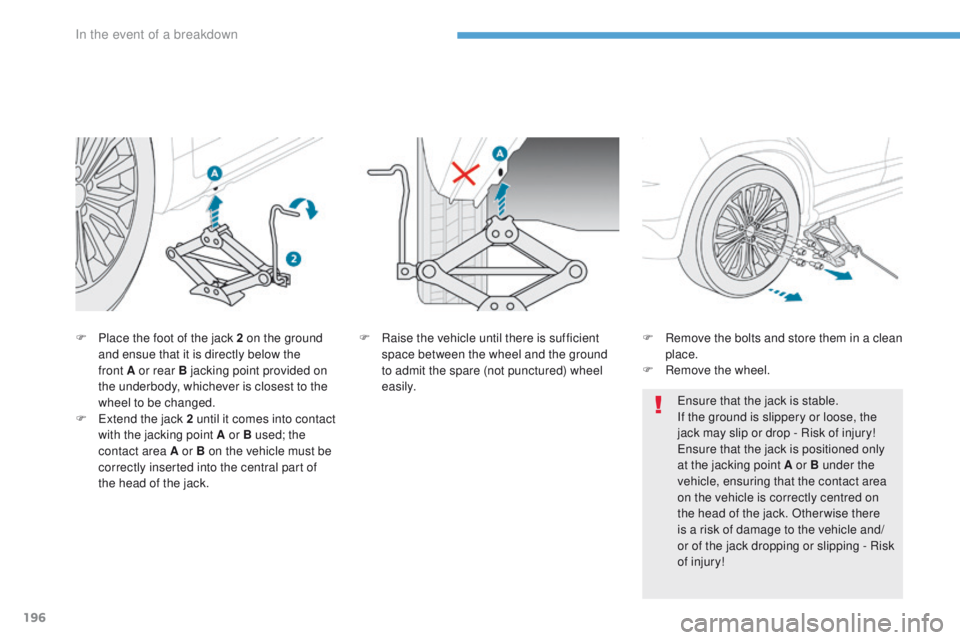
F Place the foot of the jack 2 on the ground
and ensue that it is directly below the
front
A or rear B jacking point provided on
the underbody, whichever is closest to the
wheel to be changed.
F
e
x
tend the jack 2 until it comes into contact
with the jacking point A or B used; the
contact area A or B on the vehicle must be
correctly inserted into the central part of
the head of the jack. F
Ra ise the vehicle until there is sufficient
space between the wheel and the ground
to admit the spare (not punctured) wheel
easily.
en
sure that the jack is stable.
If the ground is slippery or loose, the
jack may slip or drop - Risk of injury!
en
sure that the jack is positioned only
at the jacking point A or B under the
vehicle, ensuring that the contact area
on the vehicle is correctly centred on
the head of the jack. Otherwise there
is a risk of damage to the vehicle and/
or of the jack dropping or slipping - Risk
of injury!
F
R emove the bolts and store them in a clean
place.
F
R
emove the wheel.
In the event of a breakdown
Page 277 of 368
05
275
4008_EN_CHAP10B_MITSU6_ED01-2016
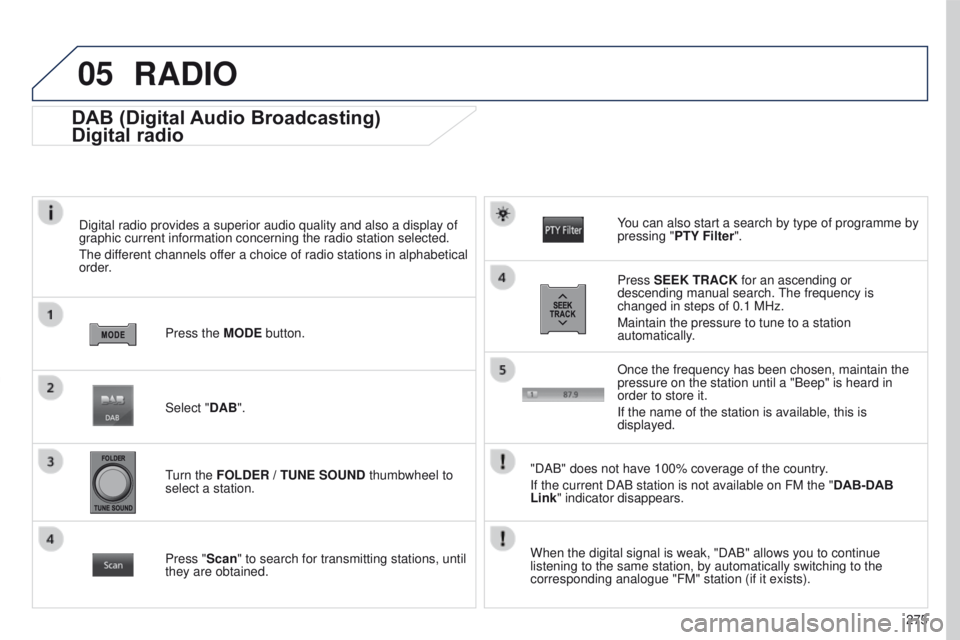
DAB (Digital Audio Broadcasting)
Digital radio
Digital radio provides a superior audio quality and also a display of
graphic current information concerning the radio station selected.
t
he different channels offer a choice of radio stations in alphabetical
order.
"DAB" does not have 100% coverage of the country.
If the current DAB station is not available on FM the "DAB-DAB
Link" indicator disappears.
Press the MODE button.
Press SEEK TRACK for an ascending or
descending
manual search.
t
he frequency is
changed in steps of 0.1 MHz.
Maintain the pressure to tune to a station
automatically.
Press "Scan" to search for transmitting stations, until
they are obtained. You can also start a search by type of programme by
pressing "
PTY Filter".
Once the frequency has been chosen, maintain the
pressure on the station until a "Beep" is heard in
order to store it.
If the name of the station is available, this is
displayed.
turn the
FOLDER / TUNE SOUND thumbwheel to
select a station. Select "DAB".
When the digital signal is weak, "DAB" allows you to continue
listening to the same station, by automatically switching to the
corresponding analogue "FM" station (if it exists).
RADIO
Page 327 of 368
04
325
4008_en_Chap10d_Mitsu4_ed01-2016
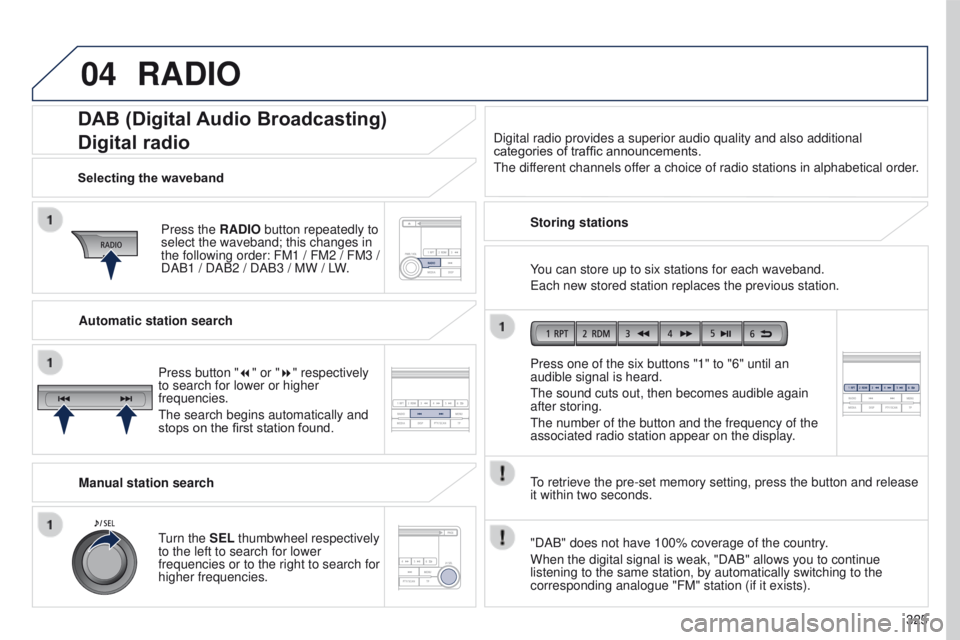
DAB (Digital Audio Broadcasting)
Digital radio
Press the RADIO button repeatedly to
select the waveband; this changes in
the following order: FM1 / FM2 / FM3 /
DAB1 / DAB2 / DAB3 / MW / LW.
Selecting the waveband
Digital radio provides a superior audio quality and also additional
categories of traffic announcements.
t
he different channels offer a choice of radio stations in alphabetical order.
Automatic station search
Manual station search
turn the
SEL thumbwheel respectively
to the left to search for lower
frequencies or to the right to search for
higher frequencies. Press button "7" or "8" respectively
to search for lower or higher
frequencies.
t
he search begins automatically and
stops on the first station found. Press one of the six buttons "1" to "6" until an
audible signal is heard.
t
he sound cuts out, then becomes audible again
after storing.
t
he number of the button and the frequency of the
associated radio station appear on the display. Storing stations
to retrieve the pre-set memory setting, press the button and release
it within two seconds. Y
ou can store up to six stations for each waveband.
e
ach new stored station replaces the previous station.
"DAB" does not have 100% coverage of the country.
When the digital signal is weak, "DAB" allows you to continue
listening to the same station, by automatically switching to the
corresponding analogue "FM" station (if it exists).
RADIO