cooling PEUGEOT 4C 2015 User Guide
[x] Cancel search | Manufacturer: PEUGEOT, Model Year: 2015, Model line: , Model:Pages: 348, PDF Size: 3.76 MB
Page 273 of 348
(antifreeze) solution. The use of lower quality water
will reduce the amount of corrosion protection in the
engine cooling system.
Please note that it is the owner’s responsibility to main-
tain the proper level of protection against freezing ac-
cording to the temperatures occurring in the area where
the vehicle is operated.
NOTE:
•Some vehicles require special tools to add coolant
properly. Failure to fill these systems properly could
lead to severe internal engine damage. If any coolant is
needed to be added to the system please contact your
local authorized dealer.•Mixing engine coolant (antifreeze) types is not recom-
mended and can result in cooling system damage. If
HOAT and OAT coolant are mixed in an emergency,
have a authorized dealer drain, flush, and refill with
OAT coolant (conforming to MS.90032) as soon as
possible.
Cooling System Pressure Cap
The cap must be fully tightened to prevent loss of engine
coolant (antifreeze) and to ensure that engine coolant
(antifreeze) will return to the radiator from the coolant
recovery tank.
The cap should be inspected and cleaned if there is any
accumulation of foreign material on the sealing surfaces.
7
MAINTAINING YOUR VEHICLE 271
Page 274 of 348
WARNING!
•Do not open hot engine cooling system. Never add
engine coolant (antifreeze) when the engine is
overheated. Do not loosen or remove the cap to cool
an overheated engine. Heat causes pressure to
build up in the cooling system. To prevent scalding
or injury, do not remove the pressure cap while the
system is hot or under pressure.
•Do not use a pressure cap other than the one
specified for your vehicle. Personal injury or en-
gine damage may result.
Disposal Of Used Engine Coolant
Used ethylene glycol-based engine coolant (antifreeze) is
a regulated substance requiring proper disposal. Check
with your local authorities to determine the disposal
rules for your community. To prevent ingestion by ani-
mals or children, do not store ethylene glycol-basedengine coolant in open containers or allow it to remain in
puddles on the ground. If ingested by a child or pet, seek
emergency assistance immediately. Clean up any ground
spills immediately.
Coolant Level
The coolant expansion bottle provides a quick visual
method for determining that the coolant level is ad-
equate. With the engine off and cold, the level of the
engine coolant (antifreeze) in the bottle should be be-
tween the “MIN” and “MAX” marks.
As long as the engine operating temperature is satisfac-
tory, the coolant bottle need only be checked once a
month.
When additional engine coolant (antifreeze) is needed to
maintain the proper level, it should be added to the
coolant bottle. Do not overfill.
272 MAINTAINING YOUR VEHICLE
Page 275 of 348
Points To Remember
NOTE:When the vehicle is stopped after a few miles/
kilometers of operation, you may observe vapor coming
from the front of the engine compartment. This is nor-
mally a result of moisture from rain, snow, or high
humidity accumulating on the radiator and being vapor-
ized when the thermostat opens, allowing hot engine
coolant (antifreeze) to enter the radiator.
If an examination of your engine compartment shows no
evidence of radiator or hose leaks, the vehicle may be
safely driven. The vapor will soon dissipate.
•Do not overfill the coolant expansion bottle.
•Check the coolant freeze point in the radiator and in
the coolant expansion bottle. If engine coolant (anti-
freeze) needs to be added, the contents of the coolant
expansion bottle must also be protected against freez-
ing.•If frequent engine coolant (antifreeze) additions are
required, the cooling system should be pressure tested
for leaks.
•Maintain engine coolant (antifreeze) concentration at a
minimum of 50% OAT coolant (conforming to MS-
90032) and distilled water for proper corrosion protec-
tion of your engine which contains aluminum compo-
nents.
•Keep the front of the radiator clean. If your vehicle is
equipped with air conditioning, keep the front of the
condenser clean.
•Do not change the thermostat for Summer or Winter
operation. If replacement is ever necessary, install
ONLY the correct type thermostat. Other designs may
result in unsatisfactory engine coolant (antifreeze)
performance, poor gas mileage, and increased emis-
sions.
7
MAINTAINING YOUR VEHICLE 273
Page 308 of 348
4. Install luggage compartment roof light by inserting it
in its correct position, first on one side and then
pressing on the other side until it clicks into place.
FLUID CAPACITIES
U.S. Metric
Fuel (Approximate)
1.750 Turbo Engine 10.5 Gallons 40 Liters
Reserve Fuel 1.1 Gallons 4 Liters
Engine Oil with Filter
1.750 Turbo Engine 6.1 Quarts 5.8 Liters
Cooling System
1.750 Turbo Engine (MOPAR®
Antifreeze/Engine Coolant 10
Year/150,000 Mile Formula).11.2 Quarts 10.6 Liters
306 MAINTAINING YOUR VEHICLE
Page 317 of 348
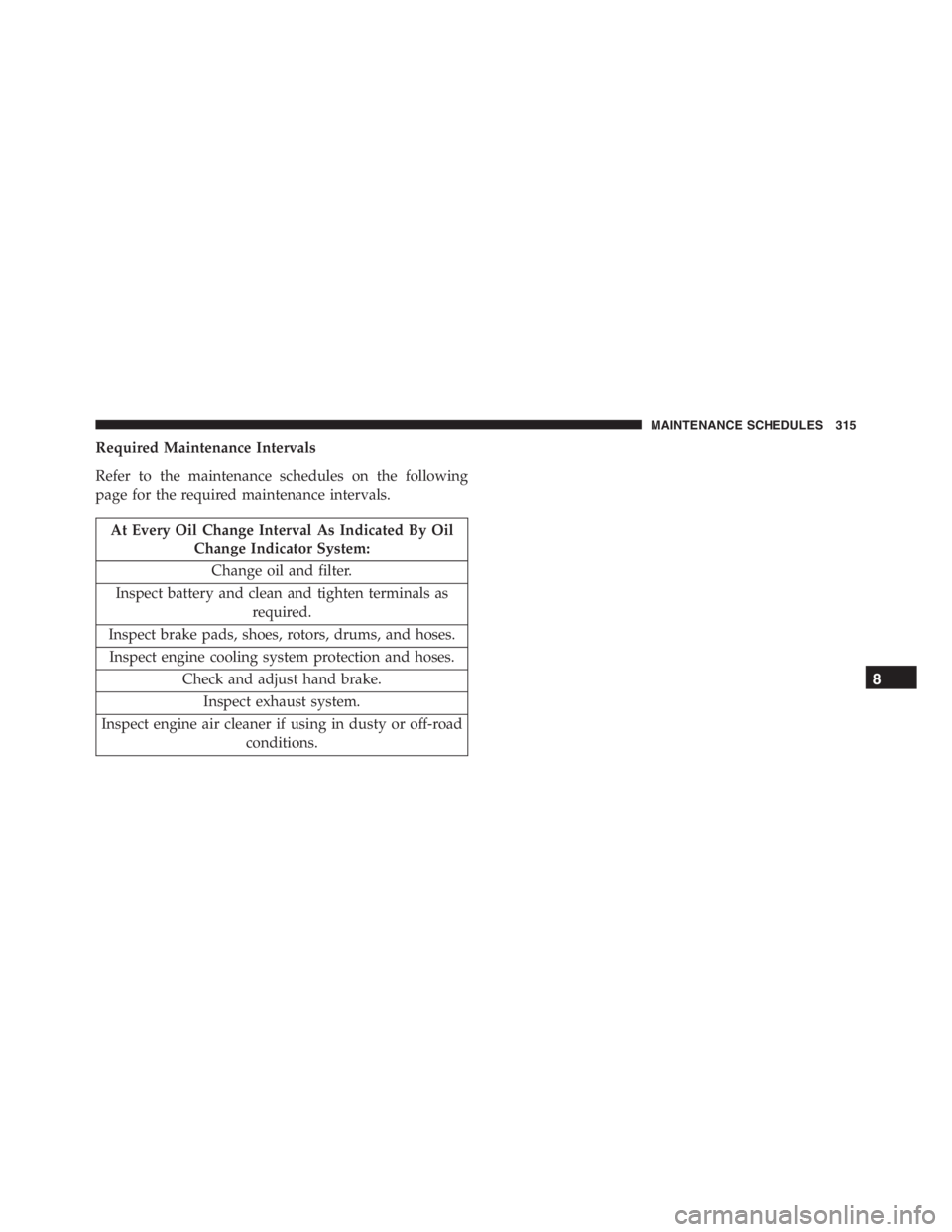
Required Maintenance Intervals
Refer to the maintenance schedules on the following
page for the required maintenance intervals.
At Every Oil Change Interval As Indicated By Oil
Change Indicator System:
Change oil and filter.
Inspect battery and clean and tighten terminals as
required.
Inspect brake pads, shoes, rotors, drums, and hoses.
Inspect engine cooling system protection and hoses.
Check and adjust hand brake.
Inspect exhaust system.
Inspect engine air cleaner if using in dusty or off-road
conditions.
8
MAINTENANCE SCHEDULES 315
Page 335 of 348
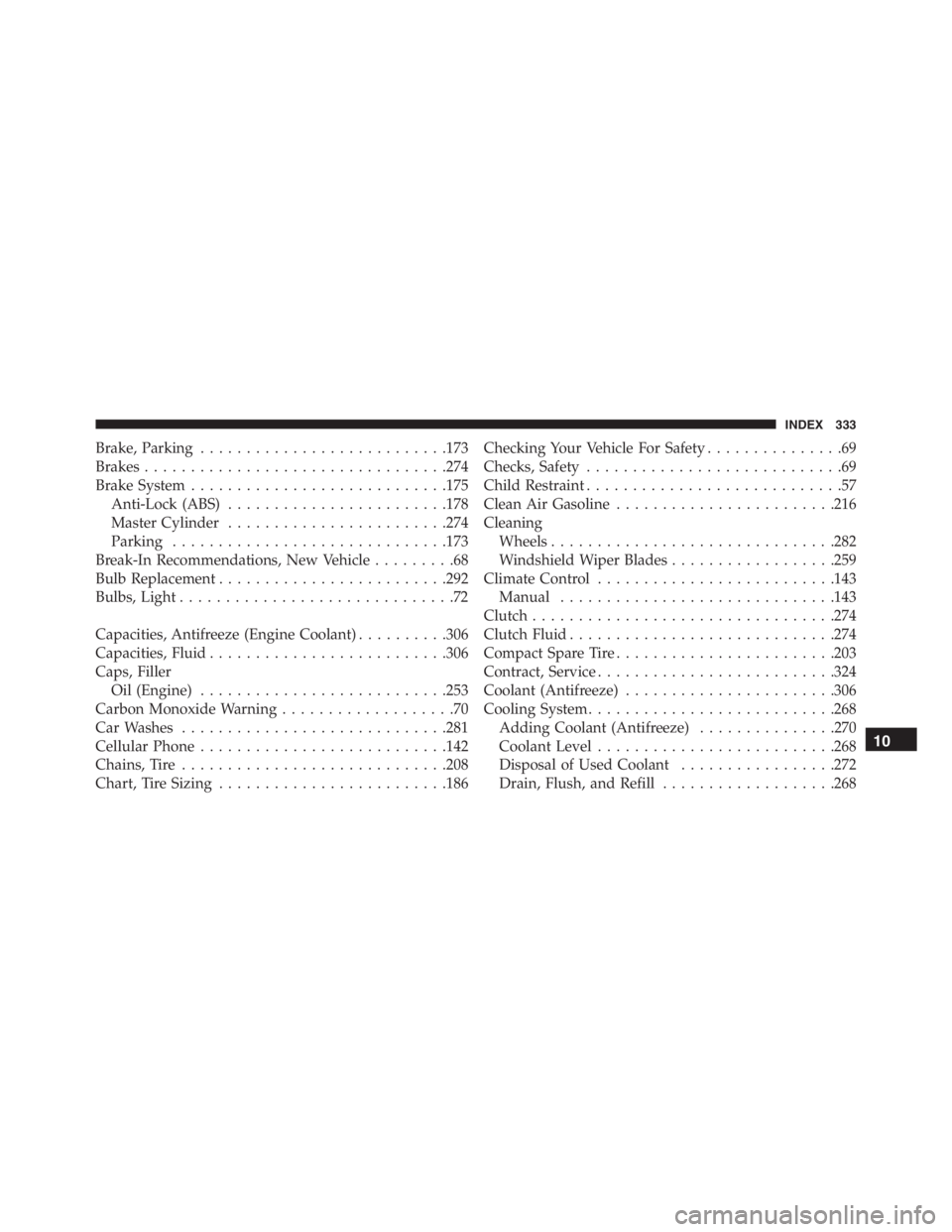
Brake, Parking...........................173
Brakes.................................274
Brake System............................175
Anti-Lock (ABS)........................178
Master Cylinder........................274
Parking..............................173
Break-In Recommendations, New Vehicle.........68
Bulb Replacement.........................292
Bulbs, Light..............................72
Capacities, Antifreeze (Engine Coolant)..........306
Capacities, Fluid..........................306
Caps, Filler
Oil (Engine)...........................253
Carbon Monoxide Warning...................70
Car Washes.............................281
Cellular Phone...........................142
Chains, Tire.............................208
Chart, Tire Sizing.........................186Checking Your Vehicle For Safety...............69
Checks, Safety............................69
Child Restraint............................57
Clean Air Gasoline........................216
Cleaning
Wheels...............................282
Windshield Wiper Blades..................259
Climate Control..........................143
Manual..............................143
Clutch.................................274
Clutch Fluid.............................274
Compact Spare Tire........................203
Contract, Service..........................324
Coolant (Antifreeze).......................306
Cooling System...........................268
Adding Coolant (Antifreeze)...............270
Coolant Level..........................268
Disposal of Used Coolant.................272
Drain, Flush, and Refill...................268
10
INDEX 333
Page 337 of 348
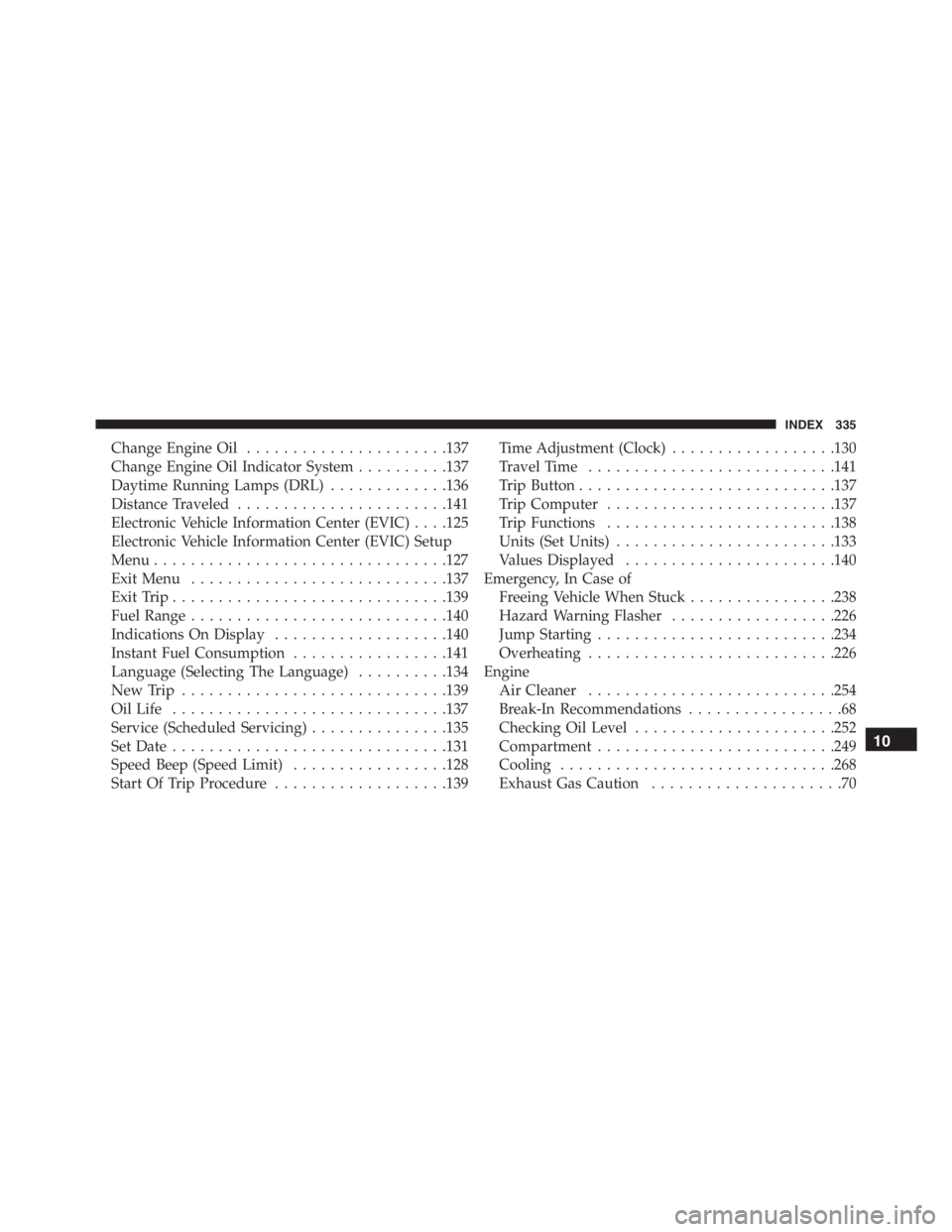
Change Engine Oil......................137
Change Engine Oil Indicator System..........137
Daytime Running Lamps (DRL).............136
Distance Traveled.......................141
Electronic Vehicle Information Center (EVIC). . . .125
Electronic Vehicle Information Center (EVIC) Setup
Menu................................127
Exit Menu............................137
Exit Trip..............................139
Fuel Range............................140
Indications On Display...................140
Instant Fuel Consumption.................141
Language (Selecting The Language)..........134
NewTrip .............................139
Oil Life..............................137
Service (Scheduled Servicing)...............135
Set Date..............................131
Speed Beep (Speed Limit).................128
Start Of Trip Procedure...................139Time Adjustment (Clock)..................130
Travel Time...........................141
Trip Button............................137
Trip Computer.........................137
Trip Functions.........................138
Units (Set Units)........................133
Values Displayed.......................140
Emergency, In Case of
Freeing Vehicle When Stuck................238
Hazard Warning Flasher..................226
Jump Starting..........................234
Overheating...........................226
Engine
Air Cleaner...........................254
Break-In Recommendations.................68
Checking Oil Level......................252
Compartment..........................249
Cooling..............................268
Exhaust Gas Caution.....................70
10
INDEX 335