instrument panel PEUGEOT 4C 2015 Repair Manual
[x] Cancel search | Manufacturer: PEUGEOT, Model Year: 2015, Model line: , Model:Pages: 348, PDF Size: 3.76 MB
Page 183 of 348
WARNING!(Continued)
•Vehicle modifications, or failure to properly main-
tain your vehicle, may change the handling charac-
teristics of your vehicle, and may negatively affect
the performance of the ESC system. Changes to the
steering system, suspension, braking system, tire
type and size or wheel size may adversely affect
ESC performance. Improperly inflated and un-
evenly worn tires may also degrade ESC perfor-
mance. Any vehicle modification or poor vehicle
maintenance that reduces the effectiveness of the
ESC system can increase the risk of loss of vehicle
control, vehicle rollover, personal injury and death.
This is an integral part of the ESC system and automati-
cally operates in the event of one or both drive wheels
slipping, loss of grip on wet roads (hydroplaning) and
acceleration on slippery, snowy or icy roads, etc.Depending on the slipping conditions, two different
control systems are activated:
•If the slipping involves both drive wheels, the ASR
system intervenes, reducing the power transmitted by
the engine.
•If the slipping only involves one of the drive wheels, it
also intervenes automatically, braking the wheel that is
slipping.
System Intervention
This is indicated by the flashing of the warning light on
the instrument panel, to inform the driver that the car is
in critical stability and grip conditions.
5
STARTING AND OPERATING 181
Page 241 of 348
that will maintain the rocking motion, without spinning
the wheels or racing the engine.
CAUTION!
Racing the engine or spinning the wheels may lead to
transmission overheating and failure. Allow the en-
gine to idle with the transmission in NEUTRAL for at
least one minute after every five rocking-motion
cycles. This will minimize overheating and reduce
the risk of transmission failure during prolonged
efforts to free a stuck vehicle.NOTE:To turn the ESC off, move the selector from the
Normal position to the Dynamic position and hold it for
a few moments. The Race configuration will be set when
the graph of the longitudinal and transversal G accelera-
tions is shown in the instrument panel. At this time the
ESC has been turned off. Once the vehicle has been freed,
The selector may be moved back to the desired mode.
CAUTION!
•When “rocking” a stuck vehicle by shifting be-
tween DRIVE and REVERSE, do not spin the
wheels faster than 15 mph (24 km/h), or drivetrain
damage may result.
•Revving the engine or spinning the wheels too fast
may lead to transmission overheating and failure.
It can also damage the tires. Do not spin the wheels
above 30 mph (48 km/h) while in gear (no trans-
mission shifting occurring).6
WHAT TO DO IN EMERGENCIES 239
Page 242 of 348
WARNING!
Fast spinning tires can be dangerous. Forces gener-
ated by excessive wheel speeds may cause damage, or
even failure, of the axle and tires. A tire could
explode and injure someone. Do not spin your vehi-
cle’s wheels faster than 30 mph (48 km/h) or for
longer than 30 seconds continuously without stop-
ping when you are stuck and do not let anyone near
a spinning wheel, no matter what the speed.
ENHANCED ACCIDENT RESPONSE SYSTEM
In the event of an impact, if the communication network
remains intact, and the power remains intact, depending
on the nature of the event the ORC will determine
whether to have the Enhanced Accident Response Sys-
tem perform the following functions:
•Cut off fuel to the engine.•Flash hazard lights as long as the battery has power or
until the ignition key is turned off.
•Turn on the interior lights, which remain on as long as
the battery has power or until the ignition key is
removed.
•Unlock the doors automatically.
After the event occurs, when the system is active, in
addition to the message Fuel Cutoff See Handbook, a
specific soft telltale is displayed.
Carefully check the vehicle for fuel leaks in the engine
compartment and on the ground near the engine com-
partment and fuel tank before resetting the system and
starting the engine.
System Reset Procedure
Depending on the nature of the event the left and right
turn signal lights, located in the instrument panel cluster,
240 WHAT TO DO IN EMERGENCIES
Page 255 of 348
CAUTION!
Do not overfill the engine with oil. Overfilling the
engine with oil will cause oil aeration, which can
lead to loss of oil pressure and an increase in oil
temperature. This loss of oil pressure and increased
oil temperature could damage your engine.
Change Engine Oil
The oil change indicator system will remind you that it is
time to take your vehicle in for scheduled maintenance.
Refer to the “Maintenance Schedule” for further informa-
tion.
NOTE:The actual interval for changing the oil and
replacing the engine oil filter depends on the vehicle
usage conditions and is signalled by the warning light or
message (if present) on the instrument panel or every 12
months.
Engine Oil Selection
For best performance and maximum protection for tur-
bocharged engines under all types of operating condi-
tions, the manufacturer recommends synthetic engine
oils that are API Certified and meet the requirements of
Chrysler Material Standard MS-12991.
Engine Oil Viscosity — 1.750 Turbo Engine (SAE
Grade)
SAE 5W-40 full synthetic engine oil is recommended for
all operating temperatures. This engine oil improves low
temperature starting and vehicle fuel economy.
Lubricants which do not have both the engine oil certi-
fication mark and the correct SAE viscosity grade num-
ber should not be used.
The engine oil filler cap also shows the recommended
engine oil viscosity for your engine. For information on
7
MAINTAINING YOUR VEHICLE 253
Page 287 of 348
To minimize the possibility of scratching the lenses and
reducing light output, avoid wiping with a dry cloth. To
remove road dirt, wash with a mild soap solution fol-
lowed by rinsing.
Do not use abrasive cleaning components, solvents, steel
wool or other aggressive material to clean the lenses.
Glass Surfaces
All glass surfaces should be cleaned on a regular basis
with MOPAR®, or any commercial household-type glass
cleaner. Never use an abrasive type cleaner. Use caution
when cleaning the inside rear window equipped. Do not
use scrapers or other sharp instrument that may scratch
the elements.
Labels can be peeled off after soaking with warm water
(If Equipped), keep all objects a safe distance from the
windows.When cleaning the rear view mirror, spray cleaner on the
towel or rag that you are using. Do not spray cleaner
directly on the mirror.
Instrument Panel Cover
The instrument panel cover has a low glare surface which
minimizes reflections on the windshield. Do not use
protectants or other products which may cause undesir-
able reflections. Use soap and warm water to restore the
low glare surface.
Instrument Panel Bezels
CAUTION!
When installing hanging air fresheners in your ve-
hicle, read the installation instructions carefully.
Some air fresheners will damage the finish of
painted or decorated parts if allowed to directly
contact any surface.
7
MAINTAINING YOUR VEHICLE 285
Page 293 of 348
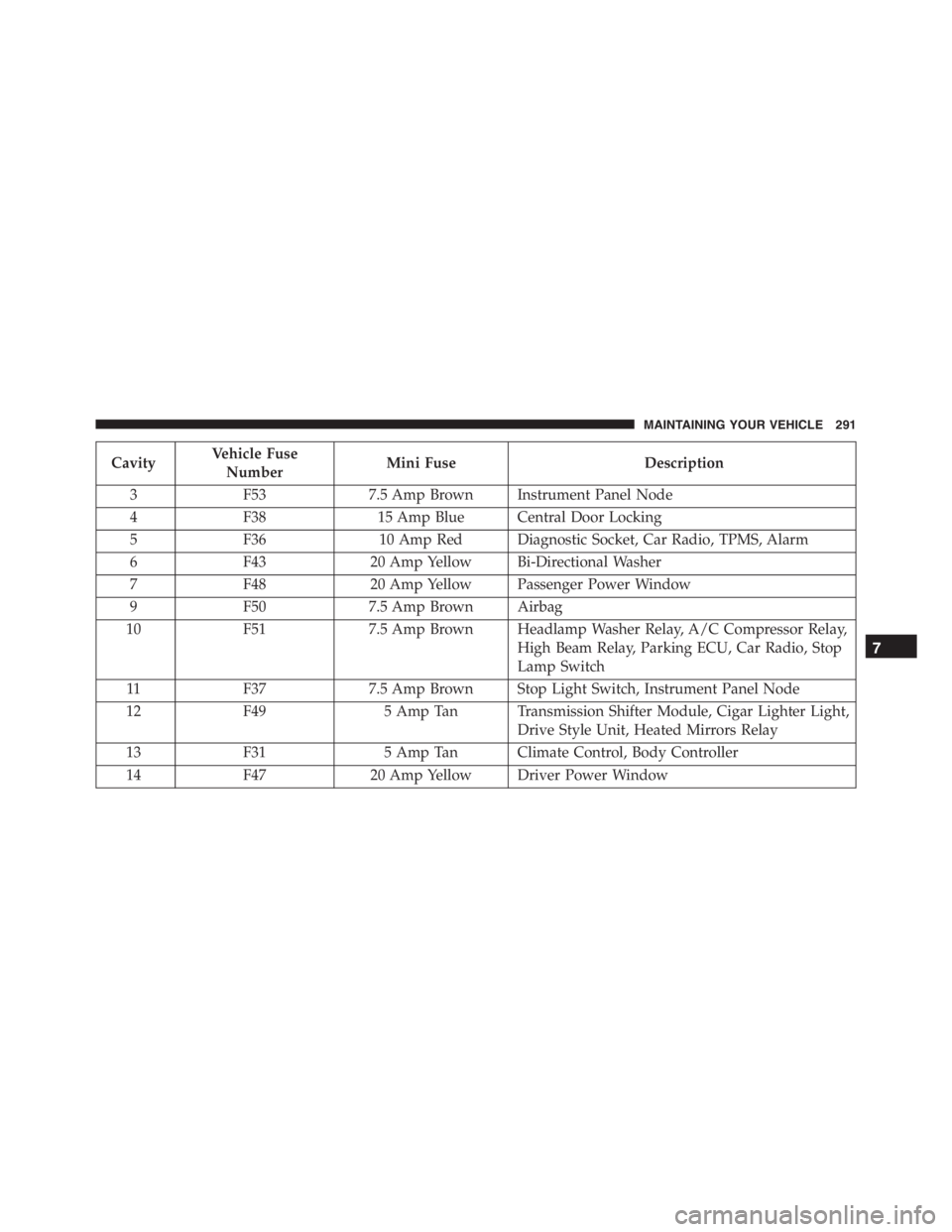
CavityVehicle Fuse
NumberMini Fuse Description
3 F53 7.5 Amp Brown Instrument Panel Node
4 F38 15 Amp Blue Central Door Locking
5 F36 10 Amp Red Diagnostic Socket, Car Radio, TPMS, Alarm
6 F43 20 Amp Yellow Bi-Directional Washer
7 F48 20 Amp Yellow Passenger Power Window
9 F50 7.5 Amp Brown Airbag
10 F51 7.5 Amp Brown Headlamp Washer Relay, A/C Compressor Relay,
High Beam Relay, Parking ECU, Car Radio, Stop
Lamp Switch
11 F37 7.5 Amp Brown Stop Light Switch, Instrument Panel Node
12 F49 5 Amp Tan Transmission Shifter Module, Cigar Lighter Light,
Drive Style Unit, Heated Mirrors Relay
13 F31 5 Amp Tan Climate Control, Body Controller
14 F47 20 Amp Yellow Driver Power Window
7
MAINTAINING YOUR VEHICLE 291
Page 314 of 348
MAINTENANCE SCHEDULE
Your vehicle is equipped with an automatic oil change
indicator system. The oil change indicator system will
remind you that it is time to take your vehicle in for
scheduled maintenance.
Based on engine operation conditions, the oil change
indicator message will illuminate in the instrument clus-
ter. This means that an engine oil and engine oil filter
change is required for your vehicle. Operating conditions
such as frequent short-trips, trailer tow, extremely hot or
cold ambient temperatures, and E85 fuel usage will
influence when the “Change Oil” or “Oil Change Re-
quired” message is displayed. Severe Operating Condi-
tions can cause the change oil message to illuminate as
early as 3,500 miles (5,600 km) since last reset. Have your
vehicle serviced as soon as possible, within the next 500
miles (805 km).The Wrench Warning Light may appear in the cluster as
a service reminder when vehicle maintenance is required,
according to the scheduled maintenance mileage. The
maintenance schedule intervals are set by the manufac-
turer. Failure to have them carried out may void your
New Vehicle Warranty.
NOTE:The actual interval for changing the oil and
replacing the engine oil filter depends on the vehicle
usage conditions and is signalled by the warning light or
message (if present) on the instrument panel or every 12
months.
Severe Duty All Models
In addition, if your vehicle is used under demanding
conditions, including:
•On the track
•On dusty roads
312 MAINTENANCE SCHEDULES
Page 318 of 348
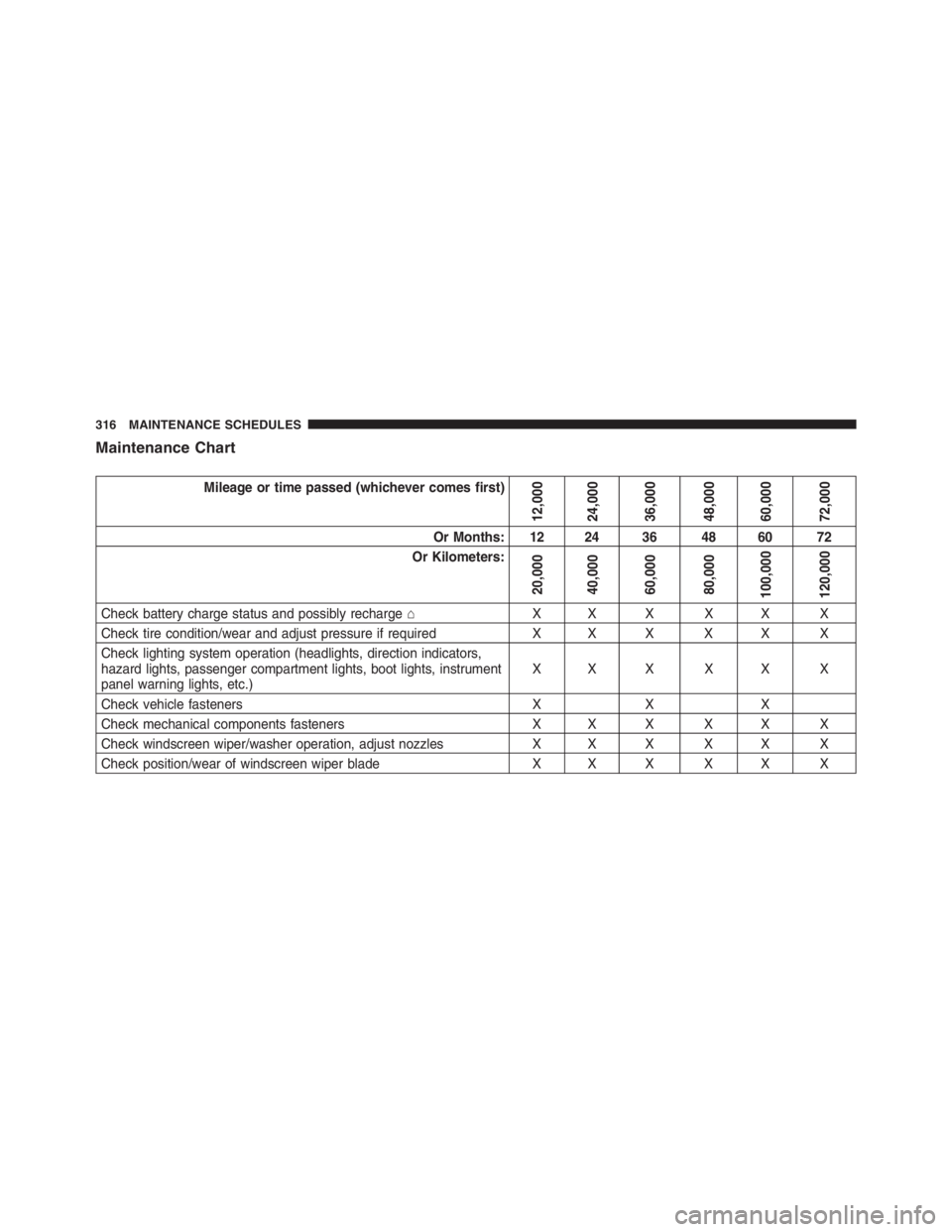
Maintenance Chart
Mileage or time passed (whichever comes first)
12,000
24,000
36,000
48,000
60,000
72,000
Or Months: 12 24 36 48 60 72
Or Kilometers:
20,000
40,000
60,000
80,000
100,000
120,000
Check battery charge status and possibly recharge⌂XX X X X X
Check tire condition/wear and adjust pressure if required X X X X X X
Check lighting system operation (headlights, direction indicators,
hazard lights, passenger compartment lights, boot lights, instrument
panel warning lights, etc.)XX X X X X
Check vehicle fasteners X X X
Check mechanical components fasteners X X X X X X
Check windscreen wiper/washer operation, adjust nozzles X X X X X X
Check position/wear of windscreen wiper blade X X X X X X
316 MAINTENANCE SCHEDULES
Page 322 of 348
(**) The actual interval for changing the oil and replacing
the engine oil filter depends on the vehicle usage condi-
tions and is signalled by the warning light or message (if
present) on the instrument panel or every 12 months.
(***) If the vehicle is operated in a dusty or dirty
environment the engine air filter has to be changed every
6,500 miles (10,000 km).WARNING!
•You can be badly injured working on or around a
motor vehicle. Do only service work for which you
have the knowledge and the right equipment. If
you have any doubt about your ability to perform a
service job, take your vehicle to a competent me-
chanic.
•Failure to properly inspect and maintain your ve-
hicle could result in a component malfunction and
effect vehicle handling and performance. This
could cause an accident.
320 MAINTENANCE SCHEDULES
Page 339 of 348
Octane Rating..........................215
Requirements..........................215
Tank Capacity..........................306
Fueling................................219
Fuses..................................287
Gasoline, Clean Air........................216
Gasoline (Fuel)...........................215
Gasoline, Reformulated.....................216
General Information.......................142
General Maintenance.......................251
Glass Cleaning...........................285
Hazard
Driving Through Flowing, Rising, or Shallow Stand-
ing Water.............................170
Hazard Warning Flasher....................226
Headlights...............................86
Cleaning.............................284Passing...............................87
Head Restraints...........................81
Heated Mirrors............................78
Heater.................................143
Holder, Cup.............................104
Ignition.................................11
Key..................................11
Ignition Key Removal.......................11
Illuminated Entry..........................19
Immobilizer (Sentry Key)....................13
Infant Restraint...........................57
Inside Rearview Mirror......................76
Instrument Cluster........................112
Instrument Cluster......................111
Instrument Panel and Controls................110
Instrument Panel Cover.....................285
Instrument Panel Lens Cleaning...............286
Interior Appearance Care....................284
10
INDEX 337