battery PEUGEOT 5008 2010 User Guide
[x] Cancel search | Manufacturer: PEUGEOT, Model Year: 2010, Model line: 5008, Model: PEUGEOT 5008 2010Pages: 331, PDF Size: 23.41 MB
Page 107 of 331
98
Different lighting times are
available:
- when the ignition is off, approxi- mately ten minutes,
- in energy economy mode, approxi- mately thirty seconds,
- when the engine is running, no limit.
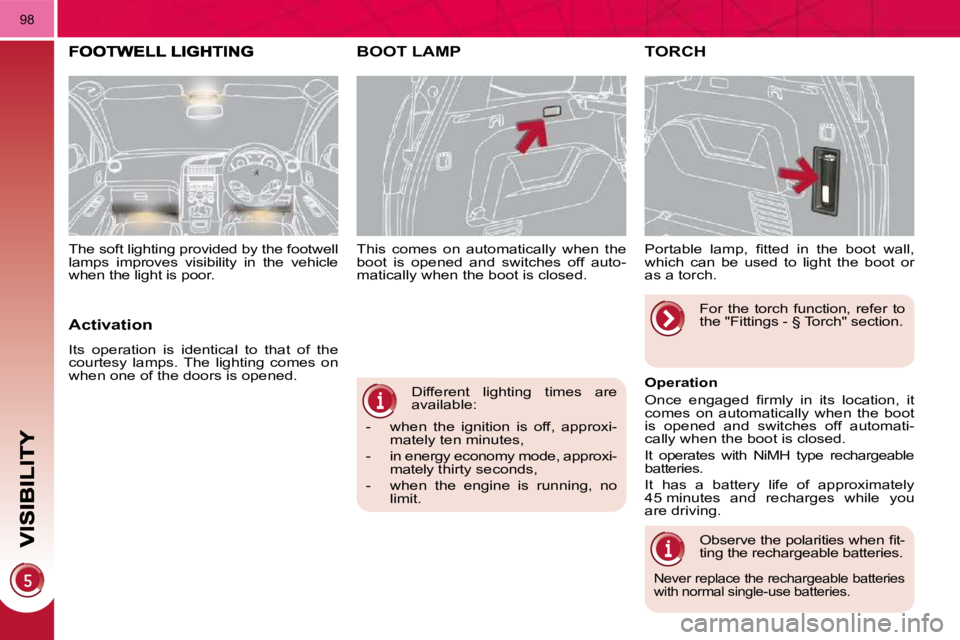
This comes on automatically when the
boot is opened and switches off auto-
matically when the boot is closed.
BOOT LAMP TORCH
Portable lamp, fi tted in the boot wall,
which can be used to light the boot or
as a torch.
Operation
Once engaged fi rmly in its location, it
comes on automatically when the boot
is opened and switches off automati-
cally when the boot is closed.
It operates with NiMH type rechargeable
batteries.
It has a battery life of approximately
45 minutes and recharges while you
are driving.
Observe the polarities when fi t-
ting the rechargeable batteries.
Never replace the rechargeable batteries
with normal single-use batteries.
For the torch function, refer to
the "Fittings - § Torch" section.
Activation
Its operation is identical to that of the
courtesy lamps. The lighting comes on
when one of the doors is opened.
The soft lighting provided by the footwell
lamps improves visibility in the vehicle
when the light is poor.
Page 108 of 331
FITTINGS
112
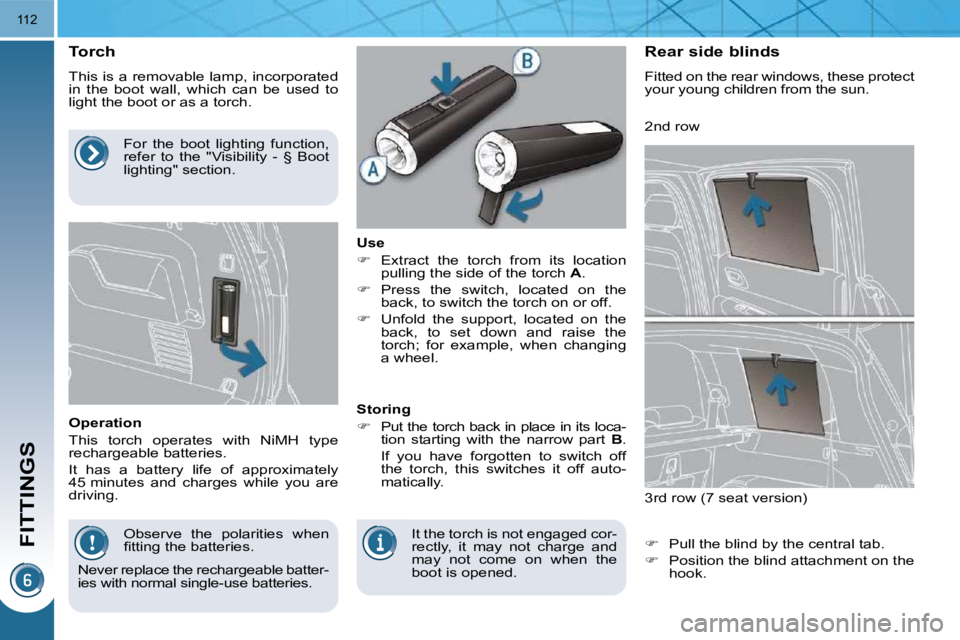
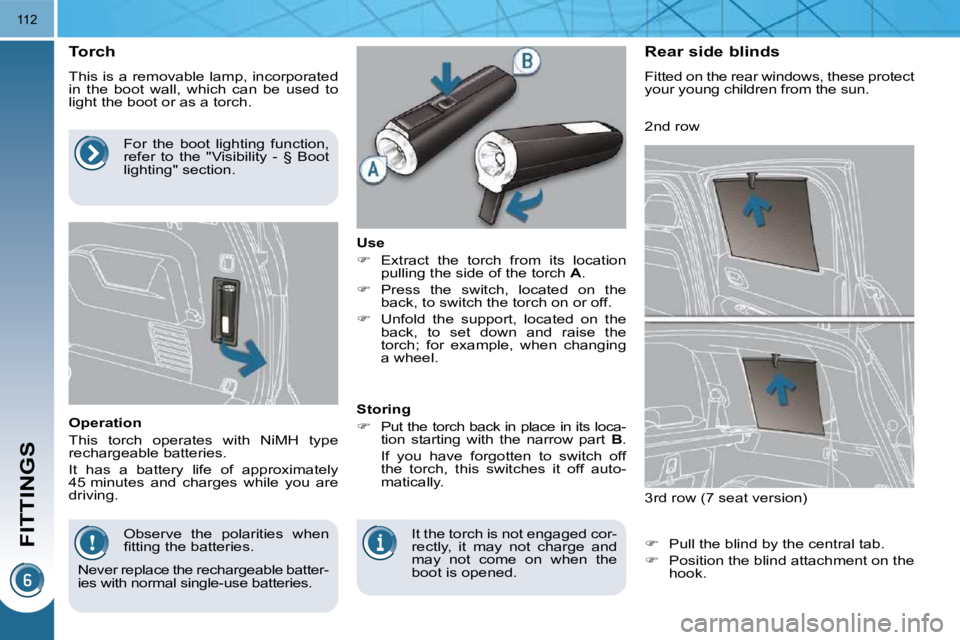
Torch
This is a removable lamp, incorporated
in the boot wall, which can be used to
light the boot or as a torch.
Operation
This torch operates with NiMH type
rechargeable batteries.
It has a battery life of approximately
45 minutes and charges while you are
driving. Use
Extract the torch from its location
pulling the side of the torch A .
Press the switch, located on the
back, to switch the torch on or off.
Unfold the support, located on the
back, to set down and raise the
torch; for example, when changing
a wheel.
Storing
Put the torch back in place in its loca-
tion starting with the narrow part B .
If you have forgotten to switch off the torch, this switches it off auto-
matically. Rear side blinds
Fitted on the rear windows, these protect
your young children from the sun.
Pull the blind by the central tab.
Position the blind attachment on the
hook.
Observe the polarities when
fi tting the batteries.
Never replace the rechargeable batter-
ies with normal single-use batteries. It the torch is not engaged cor-
rectly, it may not charge and
may not come on when the
boot is opened.
For the boot lighting function,
refer to the "Visibility - § Boot
lighting" section.
3 rd row (7 seat version)
2 nd row
Page 128 of 331
FITTINGS
112
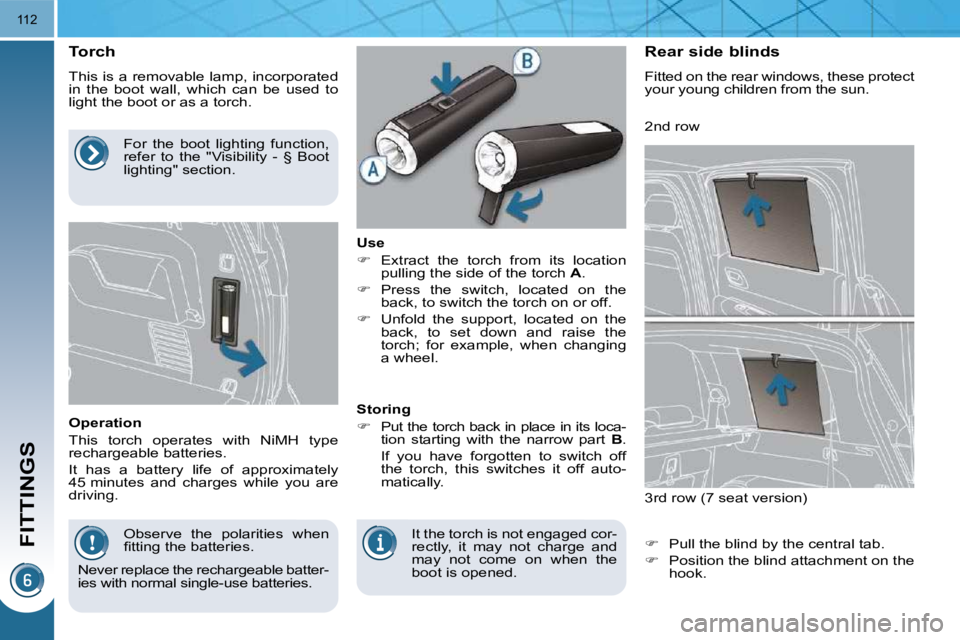
Torch
This is a removable lamp, incorporated
in the boot wall, which can be used to
light the boot or as a torch.
Operation
This torch operates with NiMH type
rechargeable batteries.
It has a battery life of approximately
45 minutes and charges while you are
driving. Use
Extract the torch from its location
pulling the side of the torch A .
Press the switch, located on the
back, to switch the torch on or off.
Unfold the support, located on the
back, to set down and raise the
torch; for example, when changing
a wheel.
Storing
Put the torch back in place in its loca-
tion starting with the narrow part B .
If you have forgotten to switch off the torch, this switches it off auto-
matically. Rear side blinds
Fitted on the rear windows, these protect
your young children from the sun.
Pull the blind by the central tab.
Position the blind attachment on the
hook.
Observe the polarities when
fi tting the batteries.
Never replace the rechargeable batter-
ies with normal single-use batteries. It the torch is not engaged cor-
rectly, it may not charge and
may not come on when the
boot is opened.
For the boot lighting function,
refer to the "Visibility - § Boot
lighting" section.
3 rd row (7 seat version)
2 nd row
Page 134 of 331
FITTINGS
112
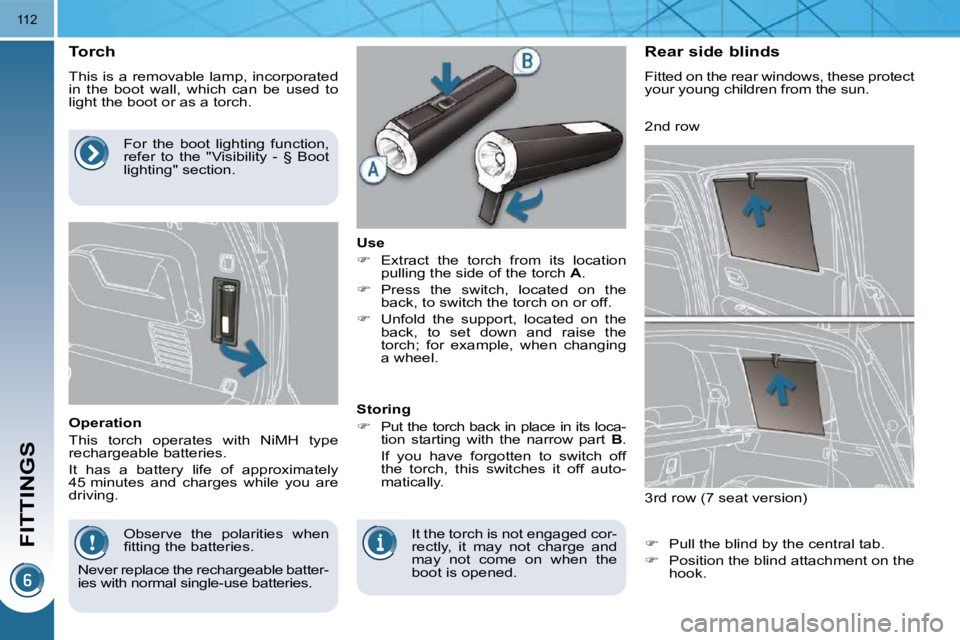
Torch
This is a removable lamp, incorporated
in the boot wall, which can be used to
light the boot or as a torch.
Operation
This torch operates with NiMH type
rechargeable batteries.
It has a battery life of approximately
45 minutes and charges while you are
driving. Use
Extract the torch from its location
pulling the side of the torch A .
Press the switch, located on the
back, to switch the torch on or off.
Unfold the support, located on the
back, to set down and raise the
torch; for example, when changing
a wheel.
Storing
Put the torch back in place in its loca-
tion starting with the narrow part B .
If you have forgotten to switch off the torch, this switches it off auto-
matically. Rear side blinds
Fitted on the rear windows, these protect
your young children from the sun.
Pull the blind by the central tab.
Position the blind attachment on the
hook.
Observe the polarities when
fi tting the batteries.
Never replace the rechargeable batter-
ies with normal single-use batteries. It the torch is not engaged cor-
rectly, it may not charge and
may not come on when the
boot is opened.
For the boot lighting function,
refer to the "Visibility - § Boot
lighting" section.
3 rd row (7 seat version)
2 nd row
Page 138 of 331
FITTINGS
112
Torch
This is a removable lamp, incorporated
in the boot wall, which can be used to
light the boot or as a torch.
Operation
This torch operates with NiMH type
rechargeable batteries.
It has a battery life of approximately
45 minutes and charges while you are
driving. Use
Extract the torch from its location
pulling the side of the torch A .
Press the switch, located on the
back, to switch the torch on or off.
Unfold the support, located on the
back, to set down and raise the
torch; for example, when changing
a wheel.
Storing
Put the torch back in place in its loca-
tion starting with the narrow part B .
If you have forgotten to switch off the torch, this switches it off auto-
matically. Rear side blinds
Fitted on the rear windows, these protect
your young children from the sun.
Pull the blind by the central tab.
Position the blind attachment on the
hook.
Observe the polarities when
fi tting the batteries.
Never replace the rechargeable batter-
ies with normal single-use batteries. It the torch is not engaged cor-
rectly, it may not charge and
may not come on when the
boot is opened.
For the boot lighting function,
refer to the "Visibility - § Boot
lighting" section.
3 rd row (7 seat version)
2 nd row
Page 167 of 331
138
Particular situations Emergency braking
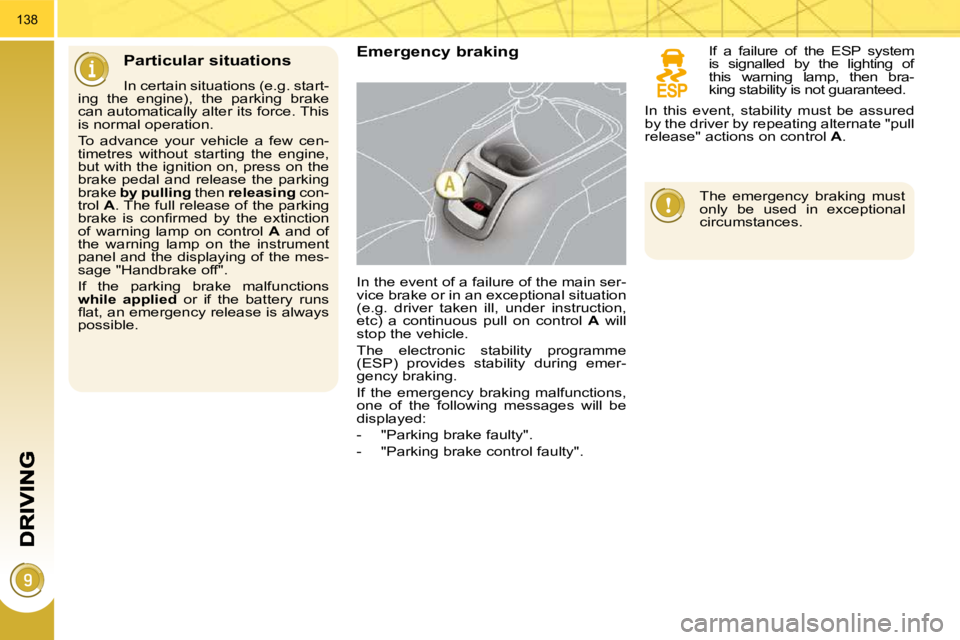
In the event of a failure of the main ser-
vice brake or in an exceptional situation
(e.g. driver taken ill, under instruction,
etc) a continuous pull on control A will
stop the vehicle.
The electronic stability programme
(ESP) provides stability during emer-
gency braking.
If the emergency braking malfunctions,
one of the following messages will be
displayed:
- "Parking brake faulty".
- "Parking brake control faulty".
In certain situations (e.g. start-
ing the engine), the parking brake
can automatically alter its force. This
is normal operation.
To advance your vehicle a few cen-
timetres without starting the engine,
but with the ignition on, press on the
brake pedal and release the parking
brake by pulling then releasing con-
trol A . The full release of the parking
brake is confi rmed by the extinction
of warning lamp on control A and of
the warning lamp on the instrument
panel and the displaying of the mes-
sage "Handbrake off".
If the parking brake malfunctions
while applied or if the battery runs
fl at, an emergency release is always
possible. If a failure of the ESP system
is signalled by the lighting of
this warning lamp, then bra-
king stability is not guaranteed.
In this event, stability must be assured
by the driver by repeating alternate "pull
release" actions on control A .
The emergency braking must
only be used in exceptional
circumstances.
Page 168 of 331
139
Emergency release
For safety reasons, after this
manoeuvre it is essential to
contact a PEUGEOT dealer
urgently to replace the protective
cover.
Following an emergency unlocking,
immobilisation of the vehicle is no
longer guaranteed once the manual
emergency release has been de-
ployed and the manual control does
not allow the re-application of your
parking brake.
Take no action, either on control A , or
stopping starting the engine while the
release device is engaged.
Take care not to allow moisture or
dust in the proximity of the protective
cover.
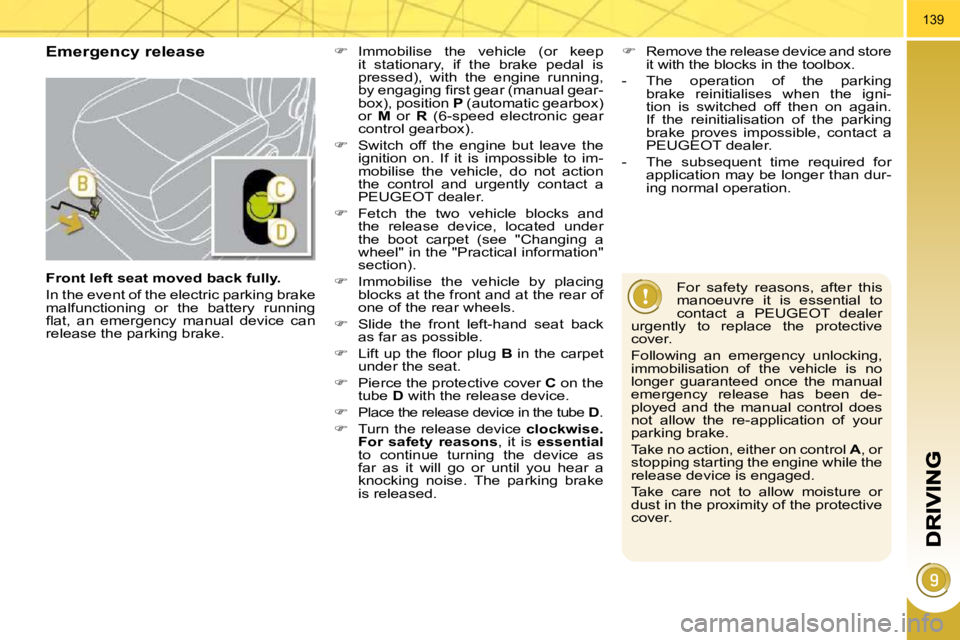
Immobilise the vehicle (or keep
it stationary, if the brake pedal is
pressed), with the engine running,
by engaging fi rst gear (manual gear-
box), position P (automatic gearbox)
or M or R (6-speed electronic gear
control gearbox).
Switch off the engine but leave the
ignition on. If it is impossible to im-
mobilise the vehicle, do not action
the control and urgently contact a
PEUGEOT dealer.
Fetch the two vehicle blocks and
the release device, located under
the boot carpet (see "Changing a
wheel" in the "Practical information"
section).
Immobilise the vehicle by placing
blocks at the front and at the rear of
one of the rear wheels.
Slide the front left-hand seat back
as far as possible.
Lift up the fl oor plug B in the carpet
under the seat.
Pierce the protective cover C on the
tube D with the release device.
Place the release device in the tube D .
Turn the release device clockwise.
For safety reasons , it is essential
to continue turning the device as
far as it will go or until you hear a
knocking noise. The parking brake
is released.
Remove the release device and store
it with the blocks in the toolbox.
- The operation of the parking brake reinitialises when the igni-
tion is switched off then on again.
If the reinitialisation of the parking
brake proves impossible, contact a
PEUGEOT dealer.
- The subsequent time required for application may be longer than dur-
ing normal operation.
Front left seat moved back fully.
In the event of the electric parking brake
malfunctioning or the battery running
fl at, an emergency manual device can
release the parking brake.
Page 171 of 331
142
Situations
Consequences
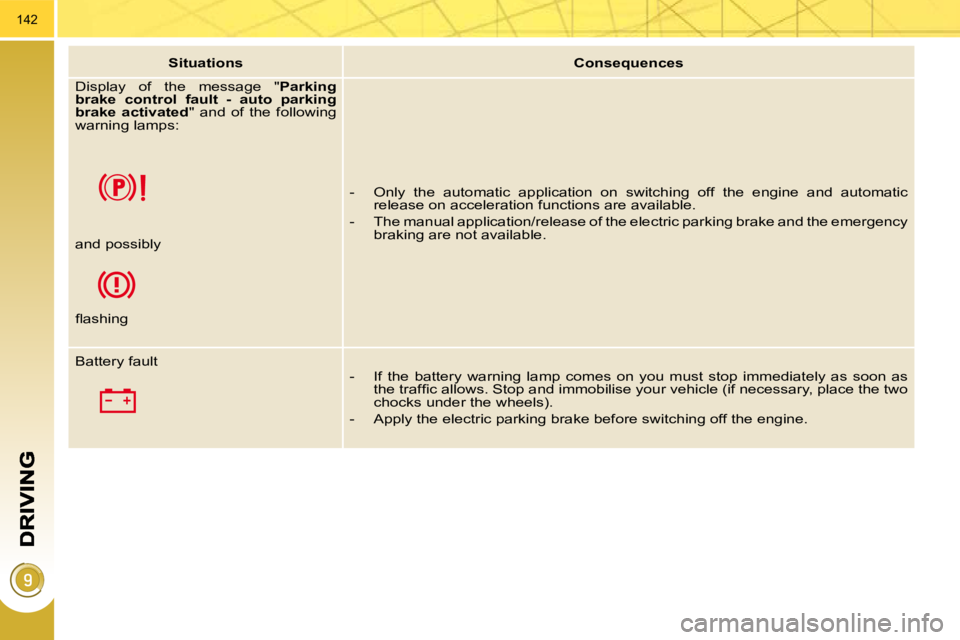
Display of the message " Parking
brake control fault - auto parking
brake activated " and of the following
warning lamps:
- Only the automatic application on switching off the engine and automatic
release on acceleration functions are available.
- The manual application/release of the electric parking b rake and the emergency
braking are not available.
and possibly
fl ashing
Battery fault
- If the battery warning lamp comes on you must stop immediat ely as soon as
the traffi c allows. Stop and immobilise your vehicle (if necessary, place the two
chocks under the wheels).
- Apply the electric parking brake before switching off the e ngine.
Page 172 of 331
138
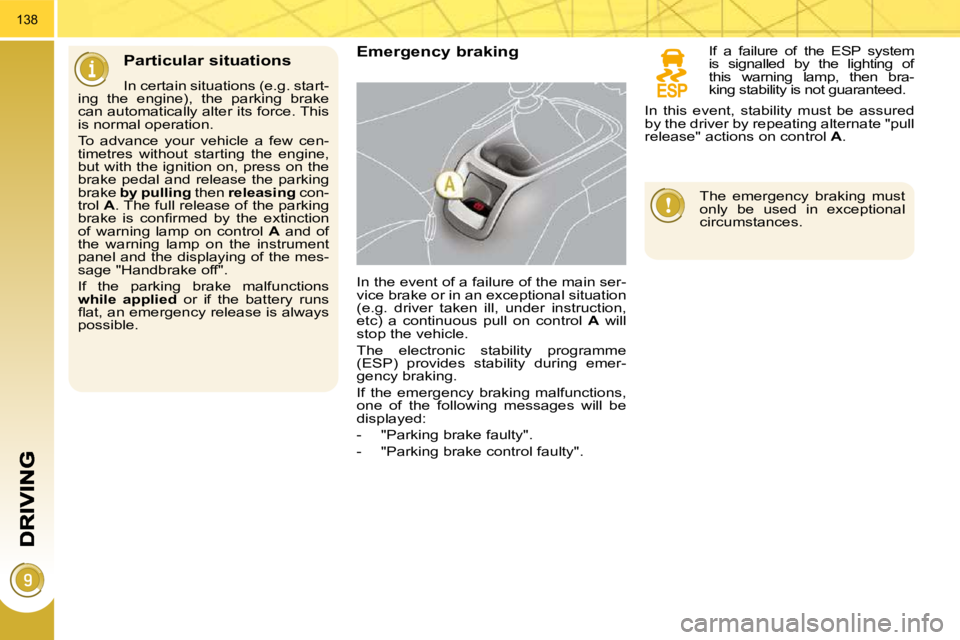
Particular situations Emergency braking
In the event of a failure of the main ser-
vice brake or in an exceptional situation
(e.g. driver taken ill, under instruction,
etc) a continuous pull on control A will
stop the vehicle.
The electronic stability programme
(ESP) provides stability during emer-
gency braking.
If the emergency braking malfunctions,
one of the following messages will be
displayed:
- "Parking brake faulty".
- "Parking brake control faulty".
In certain situations (e.g. start-
ing the engine), the parking brake
can automatically alter its force. This
is normal operation.
To advance your vehicle a few cen-
timetres without starting the engine,
but with the ignition on, press on the
brake pedal and release the parking
brake by pulling then releasing con-
trol A . The full release of the parking
brake is confi rmed by the extinction
of warning lamp on control A and of
the warning lamp on the instrument
panel and the displaying of the mes-
sage "Handbrake off".
If the parking brake malfunctions
while applied or if the battery runs
fl at, an emergency release is always
possible. If a failure of the ESP system
is signalled by the lighting of
this warning lamp, then bra-
king stability is not guaranteed.
In this event, stability must be assured
by the driver by repeating alternate "pull
release" actions on control A .
The emergency braking must
only be used in exceptional
circumstances.
Page 173 of 331
139
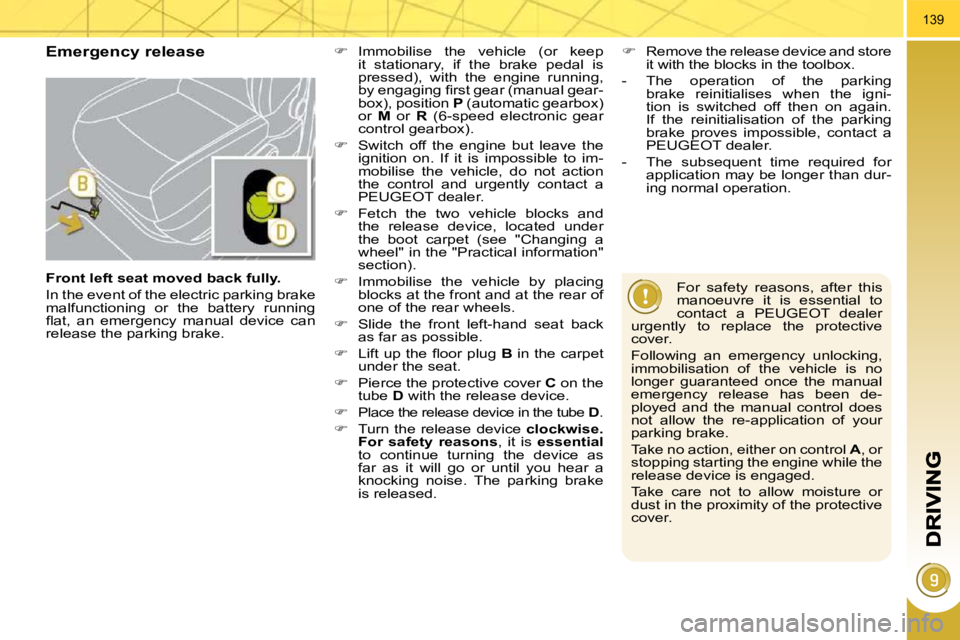
Emergency release
For safety reasons, after this
manoeuvre it is essential to
contact a PEUGEOT dealer
urgently to replace the protective
cover.
Following an emergency unlocking,
immobilisation of the vehicle is no
longer guaranteed once the manual
emergency release has been de-
ployed and the manual control does
not allow the re-application of your
parking brake.
Take no action, either on control A , or
stopping starting the engine while the
release device is engaged.
Take care not to allow moisture or
dust in the proximity of the protective
cover.
Immobilise the vehicle (or keep
it stationary, if the brake pedal is
pressed), with the engine running,
by engaging fi rst gear (manual gear-
box), position P (automatic gearbox)
or M or R (6-speed electronic gear
control gearbox).
Switch off the engine but leave the
ignition on. If it is impossible to im-
mobilise the vehicle, do not action
the control and urgently contact a
PEUGEOT dealer.
Fetch the two vehicle blocks and
the release device, located under
the boot carpet (see "Changing a
wheel" in the "Practical information"
section).
Immobilise the vehicle by placing
blocks at the front and at the rear of
one of the rear wheels.
Slide the front left-hand seat back
as far as possible.
Lift up the fl oor plug B in the carpet
under the seat.
Pierce the protective cover C on the
tube D with the release device.
Place the release device in the tube D .
Turn the release device clockwise.
For safety reasons , it is essential
to continue turning the device as
far as it will go or until you hear a
knocking noise. The parking brake
is released.
Remove the release device and store
it with the blocks in the toolbox.
- The operation of the parking brake reinitialises when the igni-
tion is switched off then on again.
If the reinitialisation of the parking
brake proves impossible, contact a
PEUGEOT dealer.
- The subsequent time required for application may be longer than dur-
ing normal operation.
Front left seat moved back fully.
In the event of the electric parking brake
malfunctioning or the battery running
fl at, an emergency manual device can
release the parking brake.