towing PEUGEOT 5008 2011 User Guide
[x] Cancel search | Manufacturer: PEUGEOT, Model Year: 2011, Model line: 5008, Model: PEUGEOT 5008 2011Pages: 340, PDF Size: 16.4 MB
Page 144 of 340
D
R
I
142
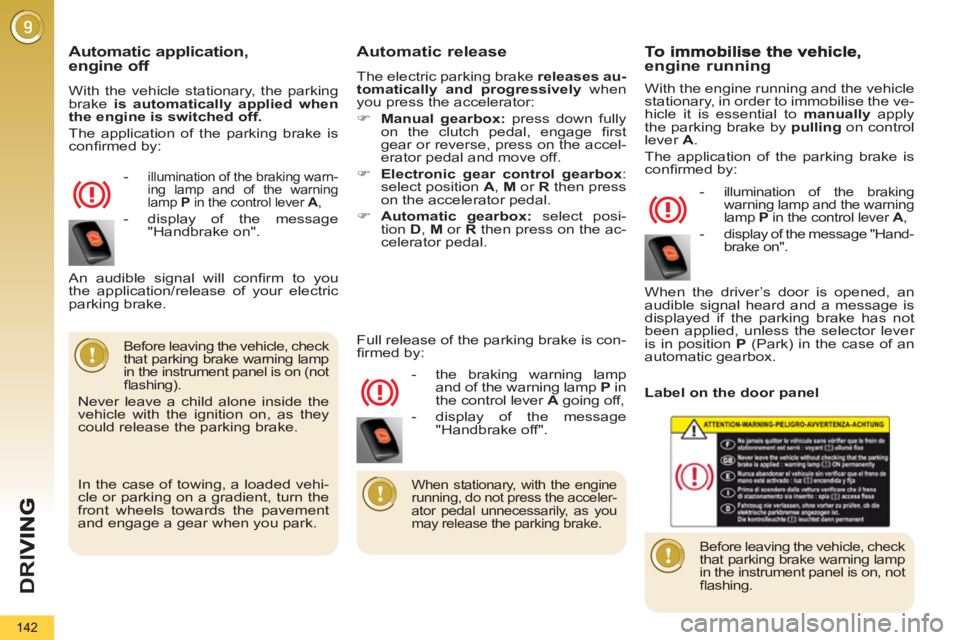
Automatic application,engine off
With the vehicle stationary, the parking
brake is automatically applied when
the engine is switched off.
The application of the parking brake is
confi rmed by:
-
illumination of the braking warn-
ing lamp and of the warning
lamp P
in the control lever A
,
- display of the message
"Handbrake on".
Automatic release
The electric parking brake releases au-
tomatically and progressively
when
you press the accelerator:
)
Manual gearbox:
press down fully
on the clutch pedal, engage fi rst
gear or reverse, press on the accel-
erator pedal and move off.
)
Electronic gear control gearbox
:
select position A
, M
or R
then press
on the accelerator pedal.
)
Automatic gearbox:
select posi-
tion D
, M
or R
then press on the ac-
celerator pedal.
Before leaving the vehicle, check
that parking brake warning lamp
in the instrument panel is on (not
fl ashing).
Never leave a child alone inside the
vehicle with the ignition on, as they
could release the parking brake.
- the braking warning lamp
and of the warning lamp P
in
the control lever A
going off,
- display of the message
"Handbrake off". An audible signal will confi rm to you
the application/release of your electric
parking brake.
Full release of the parking brake is con-
fi rmed by:
engine running
With the engine running and the vehicle
stationary, in order to immobilise the ve-
hicle it is essential to manually
apply
the parking brake by pulling
on control
lever A
.
The application of the parking brake is
confi rmed by:
-
illumination of the braking
warning lamp and the warning
lamp P
in the control lever A
,
- display of the message "Hand-
brake on".
When the driver’s door is opened, an
audible signal heard and a message is
displayed if the parking brake has not
been applied, unless the selector lever
is in position P
(Park) in the case of an
automatic gearbox.
Before leaving the vehicle, check
that parking brake warning lamp
in the instrument panel is on, not
fl ashing.
When stationary, with the engine
running, do not press the acceler-
ator pedal unnecessarily, as you
may release the parking brake.
In the case of towing, a loaded vehi-
cle or parking on a gradient, turn the
front wheels towards the pavement
and engage a gear when you park.
Label on the door panel
Page 181 of 340
PRACTICAL INFORMATION
179
TEMPORARY PUNCTURE REPAIR KIT
Complete system consisting of a com-
pressor and a sealant cartridge which
permits temporary repair
of a tyre so
that you can drive to the nearest garage.
It is designed to repair most punctures
which could affect the tyre, located on
the tyre tread or shoulder.
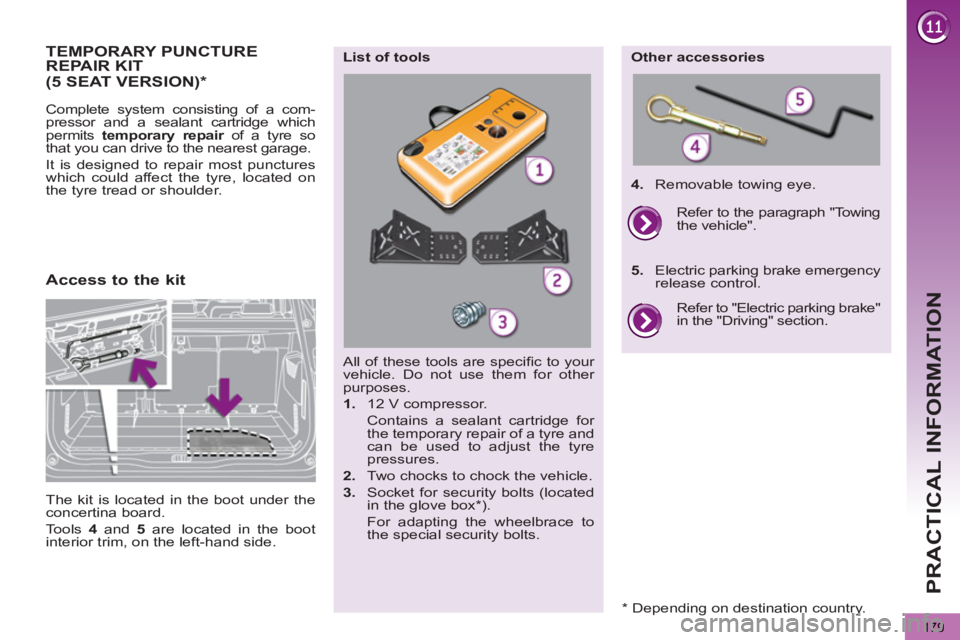
All of these tools are specifi c to your
vehicle. Do not use them for other
purposes.
1.
12 V compressor.
Contains a sealant cartridge for
the temporary repair of a tyre and
can be used to adjust the tyre
pressures.
2.
Two chocks to chock the vehicle.
3.
Socket for security bolts (located
in the glove box*)
.
For adapting the wheelbrace to
the special security bolts.
List of tools
Other accessories
4.
Removable towing eye.
Refer to "Electric parking brake"
in the "Driving" section.
Refer to the paragraph "Towing
the vehicle".
5.
Electric parking brake emergency
release control.
Access to the kit
(5 SEAT VERSION)
*
The kit is located in the boot under the
concertina board.
Tools 4
and 5
are located in the boot
interior trim, on the left-hand side.
*
Depending on destination country.
Page 191 of 340
PRACTICAL INFORMATION
189
Other accessories
Wheel with trim
When removing the wheel
,
detach the trim fi rst using the
wheelbrace 1
pulling at the valve
passage hole.
When refi tting the wheel
, refi t the
trim starting by placing its notch facing
the valve and press around its edge
with the palm of your hand.
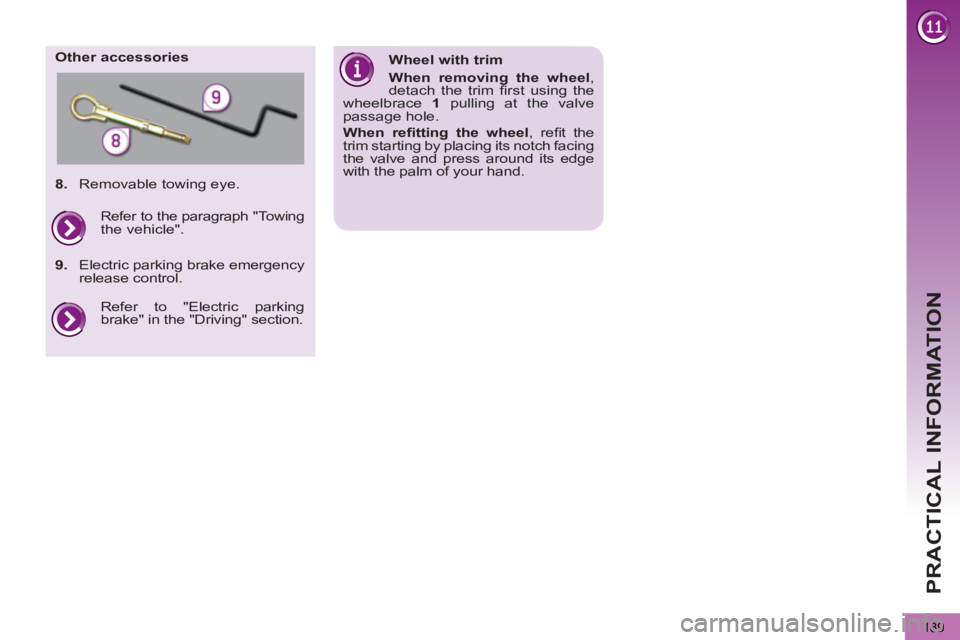
8.
Removable towing eye.
Refer to "Electric parking
brake" in the "Driving" section.
Refer to the paragraph "Towing
the vehicle".
9.
Electric parking brake emergency
release control.
Page 211 of 340
PRACTICAL INFORMATION
209
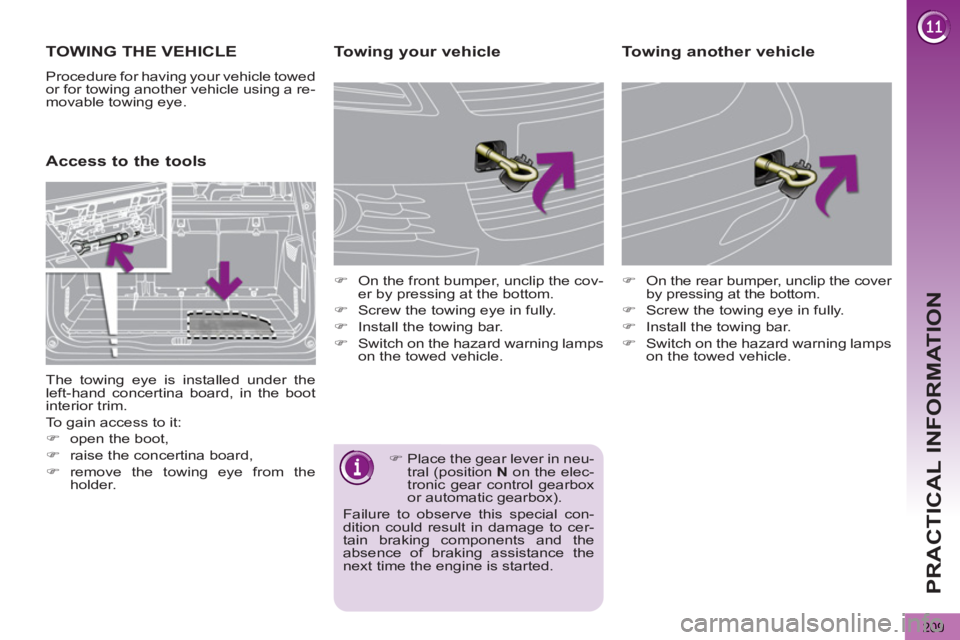
TOWING THE VEHICLE
Procedure for having your vehicle towed
or for towing another vehicle using a re-
movable towing eye.
Access to the tools
Towing your vehicle
)
On the front bumper, unclip the cov-
er by pressing at the bottom.
)
Screw the towing eye in fully.
)
Install the towing bar.
)
Switch on the hazard warning lamps
on the towed vehicle.
)
On the rear bumper, unclip the cover
by pressing at the bottom.
)
Screw the towing eye in fully.
)
Install the towing bar.
)
Switch on the hazard warning lamps
on the towed vehicle.
Towing another vehicle
The towing eye is installed under the
left-hand concertina board, in the boot
interior trim.
To gain access to it:
)
open the boot,
)
raise the concertina board,
)
remove the towing eye from the
holder.
)
Place the gear lever in neu-
tral (position N
on the elec-
tronic gear control gearbox
or automatic gearbox).
Failure to observe this special con-
dition could result in damage to cer-
tain braking components and the
absence of braking assistance the
next time the engine is started.
Page 212 of 340
PRACTICAL INFORMATION
210
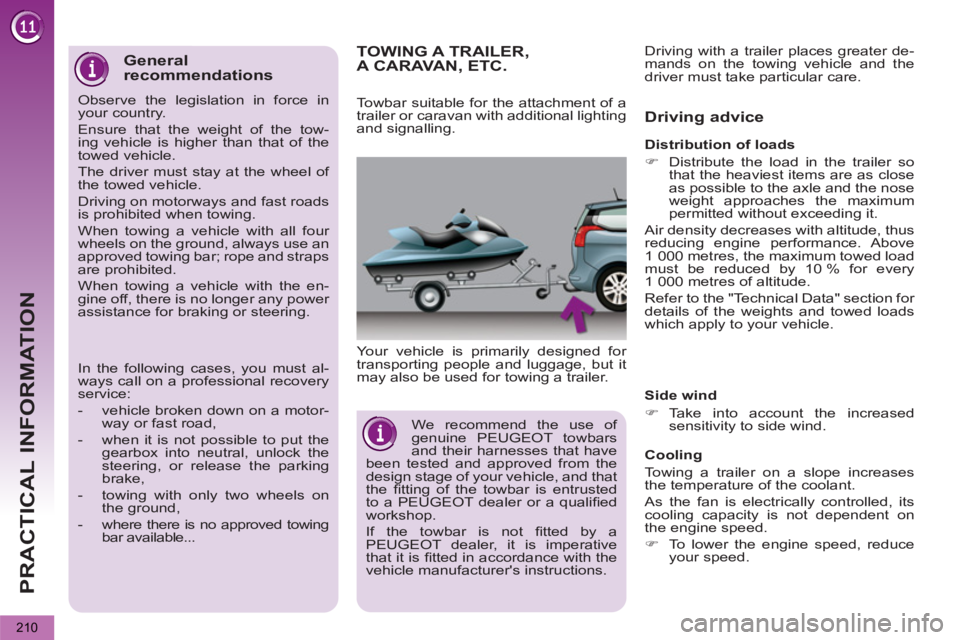
TOWING A TRAILER, A CARAVAN, ETC.
Your vehicle is primarily designed for
transporting people and luggage, but it
may also be used for towing a trailer.
Driving advice
Side wind
)
Take into account the increased
sensitivity to side wind.
Cooling
Towing a trailer on a slope increases
the temperature of the coolant.
As the fan is electrically controlled, its
cooling capacity is not dependent on
the engine speed.
)
To lower the engine speed, reduce
your speed.
Towbar suitable for the attachment of a
trailer or caravan with additional lighting
and signalling.
Distribution of loads
)
Distribute the load in the trailer so
that the heaviest items are as close
as possible to the axle and the nose
weight approaches the maximum
permitted without exceeding it.
Air density decreases with altitude, thus
reducing engine performance. Above
1 000 metres, the maximum towed load
must be reduced by 10 % for every
1 000 metres of altitude.
Refer to the "Technical Data" section for
details of the weights and towed loads
which apply to your vehicle. Driving with a trailer places greater de-
mands on the towing vehicle and the
driver must take particular care.
We recommend the use of
genuine PEUGEOT towbars
and their harnesses that have
been tested and approved from the
design stage of your vehicle, and that
the fi tting of the towbar is entrusted
to a PEUGEOT dealer or a qualifi ed
workshop.
If the towbar is not fi tted by a
PEUGEOT dealer, it is imperative
that it is fi tted in accordance with the
vehicle manufacturer's instructions.
General
recommendations
Observe the legislation in force in
your country.
Ensure that the weight of the tow-
ing vehicle is higher than that of the
towed vehicle.
The driver must stay at the wheel of
the towed vehicle.
Driving on motorways and fast roads
is prohibited when towing.
When towing a vehicle with all four
wheels on the ground, always use an
approved towing bar; rope and straps
are prohibited.
When towing a vehicle with the en-
gine off, there is no longer any power
assistance for braking or steering.
In the following cases, you must al-
ways call on a professional recovery
service:
- vehicle broken down on a motor-
way or fast road,
- when it is not possible to put the
gearbox into neutral, unlock the
steering, or release the parking
brake,
- towing with only two wheels on
the ground,
- where there is no approved towing
bar available...
Page 213 of 340
PRACTICAL INFORMATION
211
The maximum towed load on a long in-
cline depends on the gradient and the
ambient temperature.
In all cases, keep a check on the cool-
ant temperature.
Braking
Towing a trailer increases the braking
distance.
To avoid overheating of the brakes on a
long mountain type of descent, the use
of engine braking is recommended.
Tyres
)
Check the tyre pressures of the tow-
ing vehicle and of the trailer, observ-
ing the recommended pressures.
Lighting
)
Check the electrical lighting and sig-
nalling on the trailer.
The rear parking sensors will
be deactivated automatically if
a genuine PEUGEOT towbar
is used.
)
If the warning lamp and the
STOP
warning lamp come
on, stop the vehicle and
switch off the engine as
soon as possible.
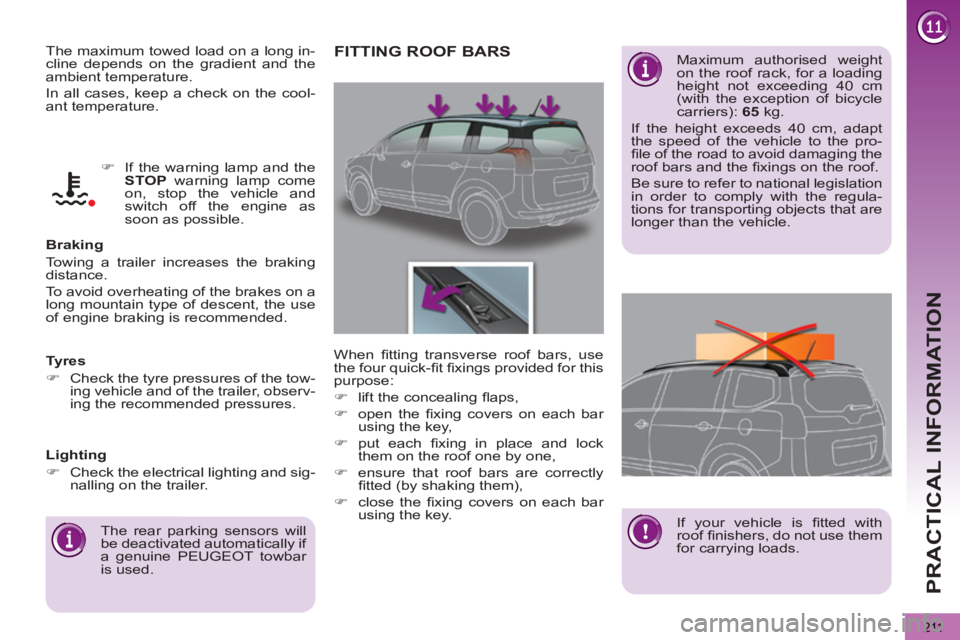
FITTING ROOF BARS
Maximum authorised weight
on the roof rack, for a loading
height not exceeding 40 cm
(with the exception of bicycle
carriers): 65
kg.
If the height exceeds 40 cm, adapt
the speed of the vehicle to the pro-
fi le of the road to avoid damaging the
roof bars and the fi xings on the roof.
Be sure to refer to national legislation
in order to comply with the regula-
tions for transporting objects that are
longer than the vehicle.
When fi tting transverse roof bars, use
the four quick-fi t fi xings provided for this
purpose:
)
lift the concealing fl aps,
)
open the fi xing covers on each bar
using the key,
)
put each fi xing in place and lock
them on the roof one by one,
)
ensure that roof bars are correctly
fi tted (by shaking them),
)
close the fi xing covers on each bar
using the key.
If your vehicle is fi tted with
roof fi nishers, do not use them
for carrying loads.
Page 214 of 340
PRACTICAL INFORMATION
212
Removal
Do not forget to remove the
very cold climate screen:
- when the ambient temperature
exceeds 10 °C,
- when towing,
-
at speeds above 75 mph (120 km/h).
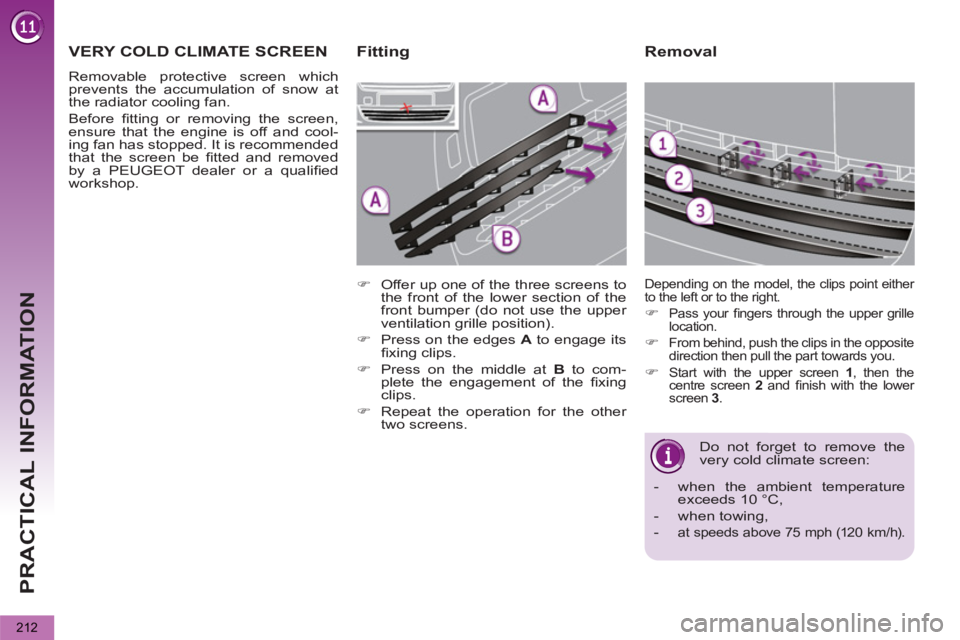
Depending on the model, the clips point either
to the left or to the right.
)
Pass your fi ngers through the upper grille
location.
)
From behind, push the clips in the opposite
direction then pull the part towards you.
)
Start with the upper screen 1
, then the
centre screen 2
and fi nish with the lower
screen 3
.
VERY COLD CLIMATE SCREEN
Removable protective screen which
prevents the accumulation of snow at
the radiator cooling fan.
Before fi tting or removing the screen,
ensure that the engine is off and cool-
ing fan has stopped. It is recommended
that the screen be fi tted and removed
by a PEUGEOT dealer or a qualifi ed
workshop.
)
Offer up one of the three screens to
the front of the lower section of the
front bumper (do not use the upper
ventilation grille position).
)
Press on the edges A
to engage its
fi xing clips.
)
Press on the middle at B
to com-
plete the engagement of the fi xing
clips.
)
Repeat the operation for the other
two screens.
Fitting
Page 217 of 340
TECHNICAL DATA
*
The kerb weight is equal to the unladen weight + driver (75 kg).
**
The weight of the braked trailer can be increased, within the GTW limit, if the GVW of the towing vehicle is reduced by an
equal amount; warning, towing using a lightly loaded towing vehicle may have an adverse effect on its road holding.
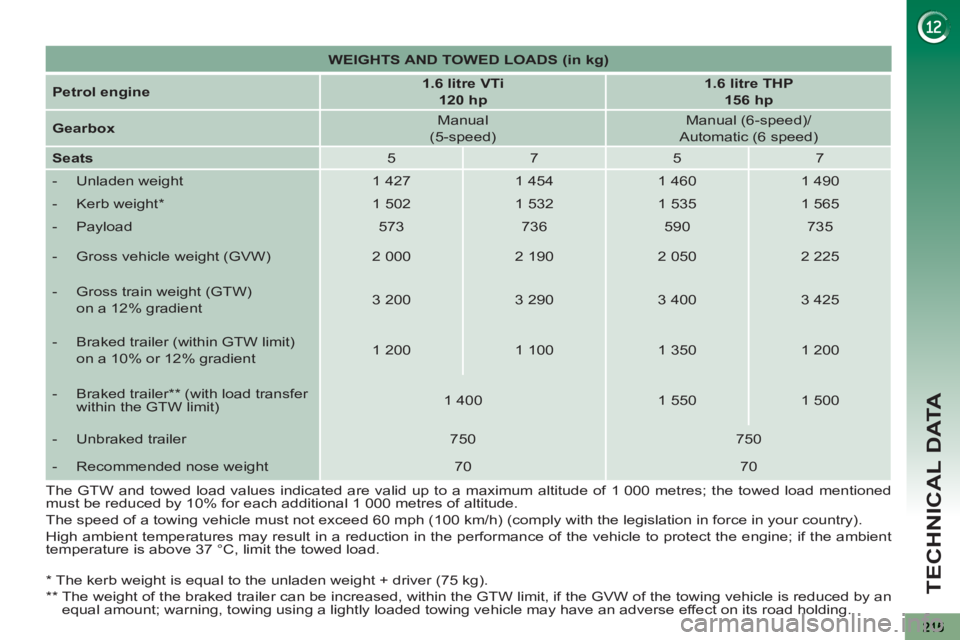
WEIGHTS AND TOWED LOADS (in kg)
Petrol engine
1.6 litre VTi
120 hp
1.6 litre THP
156 hp
Gearbox
Manual
(5-speed)
Manual (6-speed)/
Automatic (6 speed)
Seats
5
7
5
7
- Unladen weight
1 427
1 454
1 460
1 490
- Kerb weight *
1 502
1 532
1 535
1 565
- Payload
573
736
590
735
- Gross vehicle weight (GVW)
2 000
2 190
2 050
2 225
- Gross train weight (GTW)
on a 12% gradient
3 200
3 290
3 400
3 425
- Braked trailer (within GTW limit)
on a 10% or 12% gradient
1 200
1 100
1 350
1 200
- Braked trailer ** (with load transfer
within the GTW limit)
1 400
1 550
1 500
- Unbraked trailer
750
750
- Recommended nose weight
70
70
The GTW and towed load values indicated are valid up to a maximum altitude of 1 000 metres; the towed load mentioned
must be reduced by 10% for each additional 1 000 metres of altitude.
The speed of a towing vehicle must not exceed 60 mph (100 km/h) (comply with the legislation in force in your country).
High ambient temperatures may result in a reduction in the performance of the vehicle to protect the engine; if the ambient
temperature is above 37 °C, limit the towed load.
Page 219 of 340
TECHNICAL DATA
217
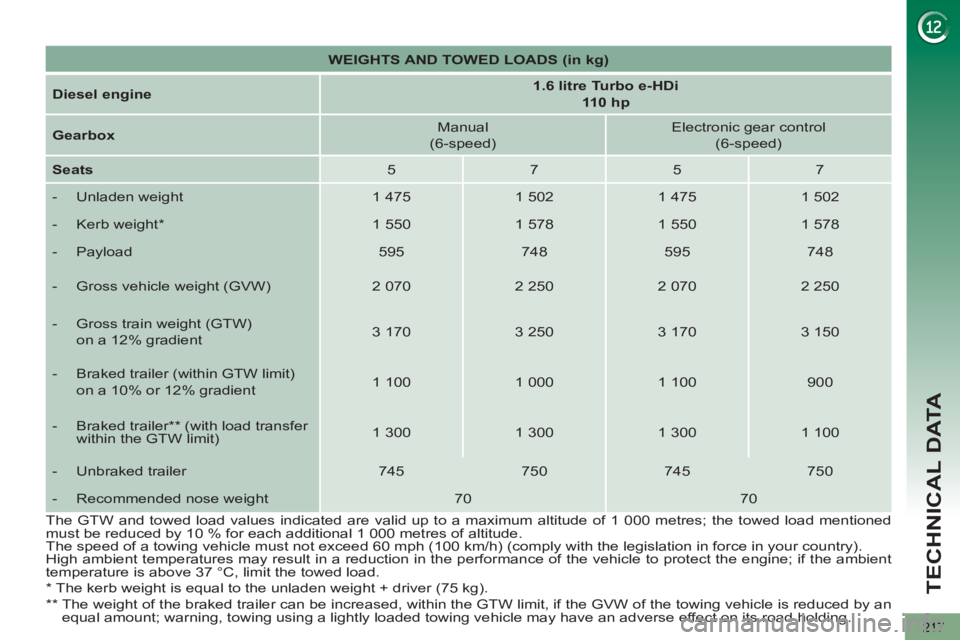
WEIGHTS AND TOWED LOADS (in kg)
Diesel engine
1.6 litre Turbo e-HDi
110 hp
Gearbox
Manual
(6-speed)
Electronic gear control
(6-speed)
Seats
5
7
5
7
- Unladen weight
1 475
1 502
1 475
1 502
- Kerb weight *
1 550
1 578
1 550
1 578
- Payload
595
748
595
748
- Gross vehicle weight (GVW)
2 070
2 250
2 070
2 250
- Gross train weight (GTW)
on a 12% gradient
3 170
3 250
3 170
3 150
- Braked trailer (within GTW limit)
on a 10% or 12% gradient
1 100
1 000
1 100
900
- Braked trailer ** (with load transfer
within the GTW limit)
1 300
1 300
1 300
1 100
- Unbraked trailer
745
750
745
750
- Recommended nose weight
70
70
* The kerb weight is equal to the unladen weight + driver (75 kg).
**
The weight of the braked trailer can be increased, within the GTW limit, if the GVW of the towing vehicle is reduced by an
equal amount; warning, towing using a lightly loaded towing vehicle may have an adverse effect on its road holding. The GTW and towed load values indicated are valid up to a maximum altitude of 1 000 metres; the towed load mentioned
must be reduced by 10 % for each additional 1 000 metres of altitude.
The speed of a towing vehicle must not exceed 60 mph (100 km/h) (comply with the legislation in force in your country).
High ambient temperatures may result in a reduction in the performance of the vehicle to protect the engine; if the ambient
temperature is above 37 °C, limit the towed load.
Page 220 of 340
TECHNICAL DATA
218
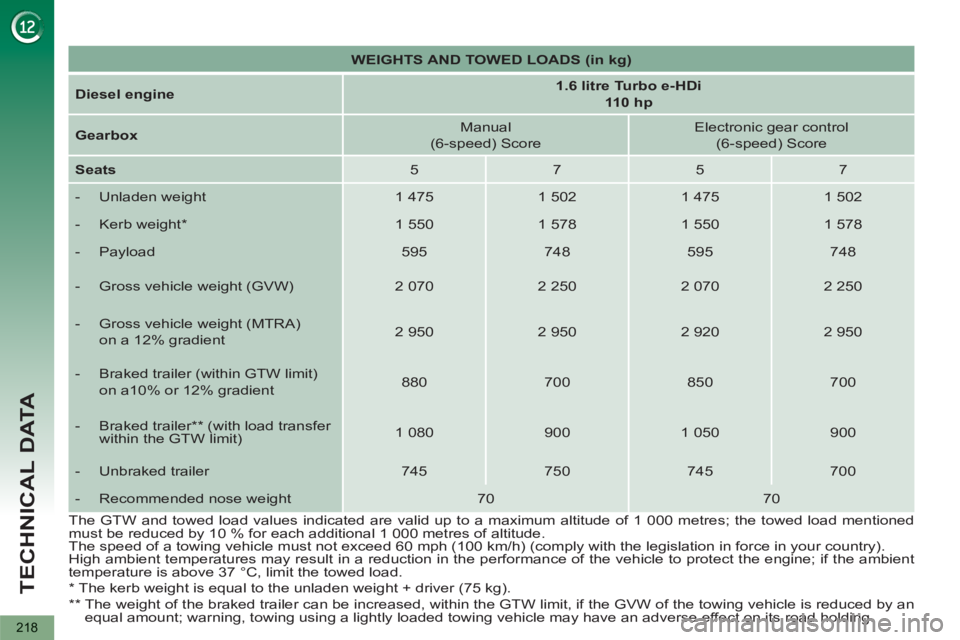
WEIGHTS AND TOWED LOADS (in kg)
Diesel engine
1.6 litre Turbo e-HDi
110 hp
Gearbox
Manual
(6-speed) Score
Electronic gear control
(6-speed) Score
Seats
5
7
5
7
- Unladen weight
1 475
1 502
1 475
1 502
- Kerb weight *
1 550
1 578
1 550
1 578
- Payload
595
748
595
748
- Gross vehicle weight (GVW)
2 070
2 250
2 070
2 250
- Gross vehicle weight (MTRA)
on a 12% gradient
2 950
2 950
2 920
2 950
- Braked trailer (within GTW limit)
on a10% or 12% gradient
880
700
850
700
- Braked trailer ** (with load transfer
within the GTW limit)
1 080
900
1 050
900
- Unbraked trailer
745
750
745
700
- Recommended nose weight
70
70
* The kerb weight is equal to the unladen weight + driver (75 kg).
**
The weight of the braked trailer can be increased, within the GTW limit, if the GVW of the towing vehicle is reduced by an
equal amount; warning, towing using a lightly loaded towing vehicle may have an adverse effect on its road holding. The GTW and towed load values indicated are valid up to a maximum altitude of 1 000 metres; the towed load mentioned
must be reduced by 10 % for each additional 1 000 metres of altitude.
The speed of a towing vehicle must not exceed 60 mph (100 km/h) (comply with the legislation in force in your country).
High ambient temperatures may result in a reduction in the performance of the vehicle to protect the engine; if the ambient
temperature is above 37 °C, limit the towed load.