weight PEUGEOT 5008 2013 Owners Manual
[x] Cancel search | Manufacturer: PEUGEOT, Model Year: 2013, Model line: 5008, Model: PEUGEOT 5008 2013Pages: 364, PDF Size: 16.24 MB
Page 5 of 364
CONTENTS
ALPHABETICAL
INDEX349-353
DRIVING 141-171
CHECKS 172-180
PRACTICAL
INFORMATION 181-216
TECHNICAL DATA 217-226
AUDIO EQUIPMENTand TELEMATICS 227-348
Electric parking brake...................141Hill start assist..............................146Head-up display...........................149Distance alert ...............................151Speed limiter................................r153Cruise control...............................155Manual gearbox ............................157Gear shift indicator.......................r1576-speed electronic gear control gearbox......................................158Automatic gearbox.......................162Stop & Start ..................................165Parking sensors ............................168Parking space sensors.................170
Bonnet ..........................................173Running out of fuel (Diesel)..........174Petrol engines ..............................175Diesel engines..............................176Checking levels............................177Checks..........................................179
Temporary puncture repair kit......181Changing a wheel.........................190Changing a bulb...........................196Changing a fuse ...........................20112 V battery ..................................208Energy economy mode.................211Changing a wiper blade................211Towing the vehicle ........................212Towing a trailer.............................r213Fitting roof bars............................214Very cold climate screen..............215Accessories..................................216
Petrol engines..............................217Petrol weights...............................218Diesel engines ..............................219Diesel weights ..............................220Dimensions ...................................224Identification markings..................225
Emergency or assistance.............227Peugeot Connect Media Navigation (NG4 3D)....................................231Peugeot Connect Navigation(RT6) ..........................................275Peugeot Connect Sound (RD5)...329
VISUAL
SEARCH354-360
Page 41 of 364
39
IN
S
Following this operation, if you
wish to disconnect the battery,
lock the vehicle and wait at
least fi ve minutes for the zero reset
to be taken into account.
Service indicator zero reset
After each service, the service indicator
must be reset to zero.
The procedure for resetting to zero is as
follows:
)
switch off the ignition,
)
press and hold the trip distance re-
corder zero reset button,
)
switch on the ignition; the distance re-
corder display begins a countdown,
)
when the display indicates "=0"
,
release the button; the spanner dis-
appears.
The distance remaining may
be weighted by the time fac-
tor, depending on the driving
conditions.
Therefore, the spanner may also
come on if you have exceeded the
two year service interval.
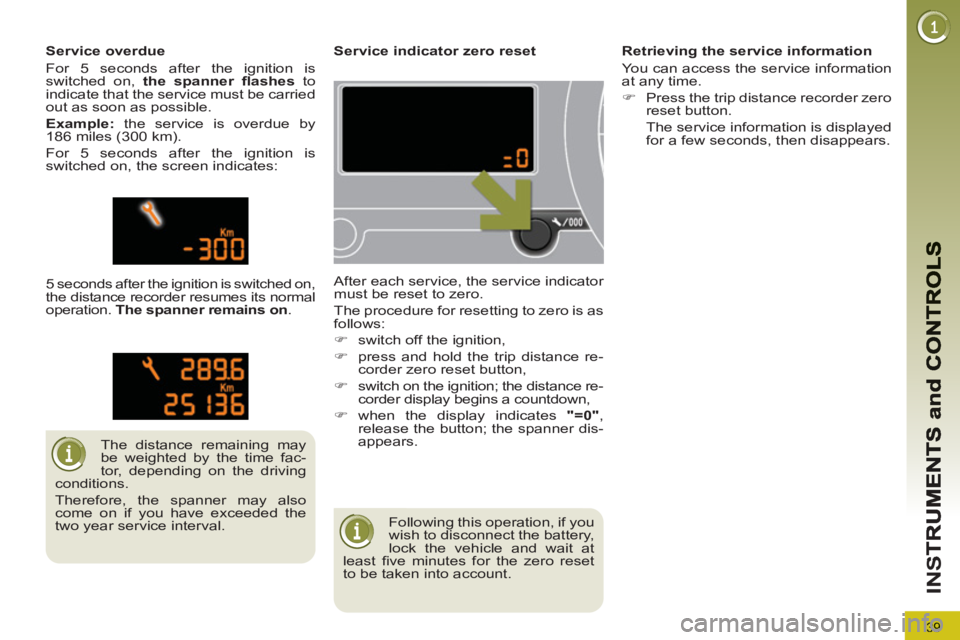
Service overdue
For 5 seconds after the ignition is
switched on, the spanner fl ashes
to
indicate that the service must be carried
out as soon as possible.
Example:
the service is overdue by
186 miles (300 km).
For 5 seconds after the ignition is
switched on, the screen indicates:
5 seconds after the ignition is switched on,
the distance recorder resumes its normal
operation. The spanner remains on
.
Retrieving the service information
You can access the service information
at any time.
)
Press the trip distance recorder zero
reset button.
The service information is displayed
for a few seconds, then disappears.
Page 68 of 364
CO
66
Table position, front passenger
seat
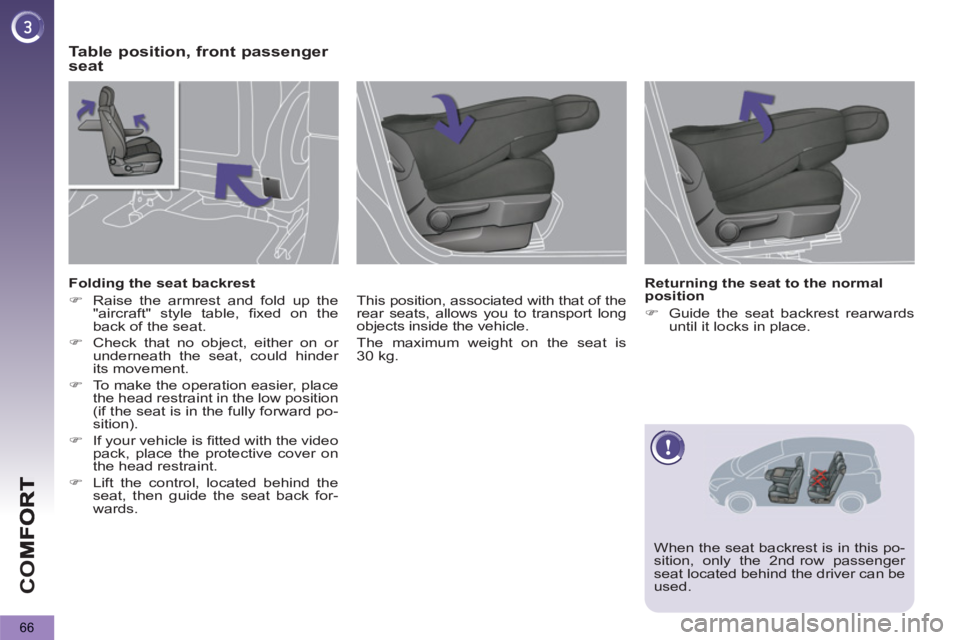
This position, associated with that of the
rear seats, allows you to transport long
objects inside the vehicle.
The maximum weight on the seat is
30 kg.
Folding the seat backrest
)
Raise the armrest and fold up the
"aircraft" style table, fi xed on the
back of the seat.
)
Check that no object, either on or
underneath the seat, could hinder
its movement.
)
To make the operation easier, place
the head restraint in the low position
(if the seat is in the fully forward po-
sition).
)
If your vehicle is fi tted with the video
pack, place the protective cover on
the head restraint.
)
Lift the control, located behind the
seat, then guide the seat back for-
wards.
Returning the seat to the normal
position
)
Guide the seat backrest rearwards
until it locks in place.
When the seat backrest is in this po-
sition, only the 2 nd
row passenger
seat located behind the driver can be
used.
Page 117 of 364
CHILD SAFETY
115
PEUGEOT recommends
that
children should travel in the outer
rear seats
of your vehicle:
-
"rearwards-facing"
up to the age
of 2,
- "forwards-facing"
over the age
of 2.
TO CHILD SEATS
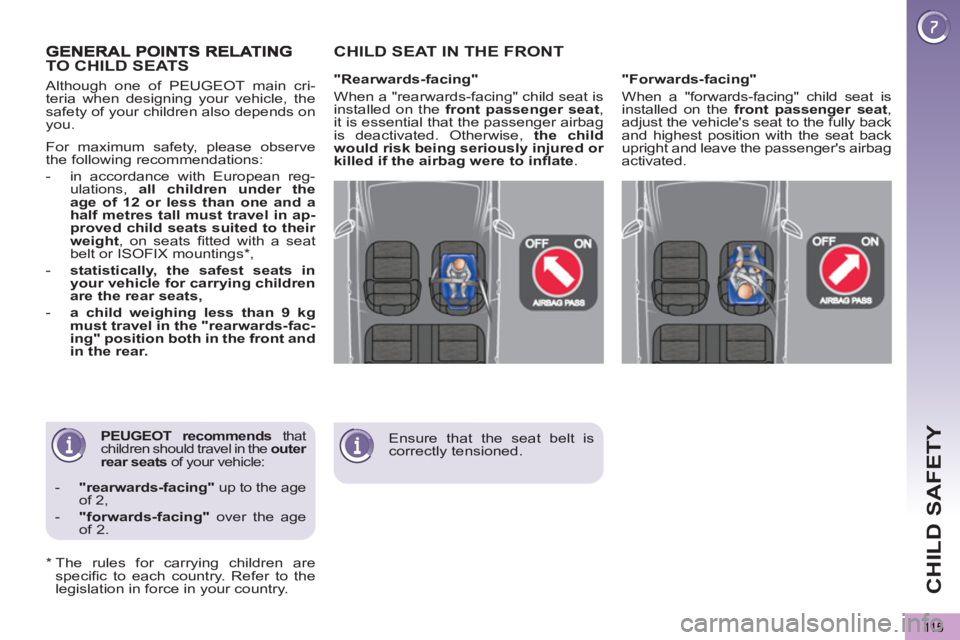
"Forwards-facing"
When a "forwards-facing" child seat is
installed on the front passenger seat
,
adjust the vehicle's seat to the fully back
and highest position with the seat back
upright and leave the passenger's airbag
activated.
"Rearwards-facing"
When a "rearwards-facing" child seat is
installed on the front passenger seat
,
it is essential that the passenger airbag
is deactivated. Otherwise, the child
would risk being seriously injured or
killed if the airbag were to infl ate
.
CHILD SEAT IN THE FRONT
Although one of PEUGEOT main cri-
teria when designing your vehicle, the
safety of your children also depends on
you.
For maximum safety, please observe
the following recommendations:
- in accordance with European reg-
ulations, all children under the
age of 12 or less than one and a
half metres tall must travel in ap-
proved child seats suited to their
weight
, on seats fi tted with a seat
belt or ISOFIX mountings * ,
- statistically, the safest seats in
your vehicle for carrying children
are the rear seats,
- a child weighing less than 9 kg
must travel in the "rearwards-fac-
ing" position both in the front and
in the rear.
*
The rules for carrying children are
specifi c to each country. Refer to the
legislation in force in your country.
Ensure that the seat belt is
correctly tensioned.
Page 123 of 364
CHILD SAFETY
121
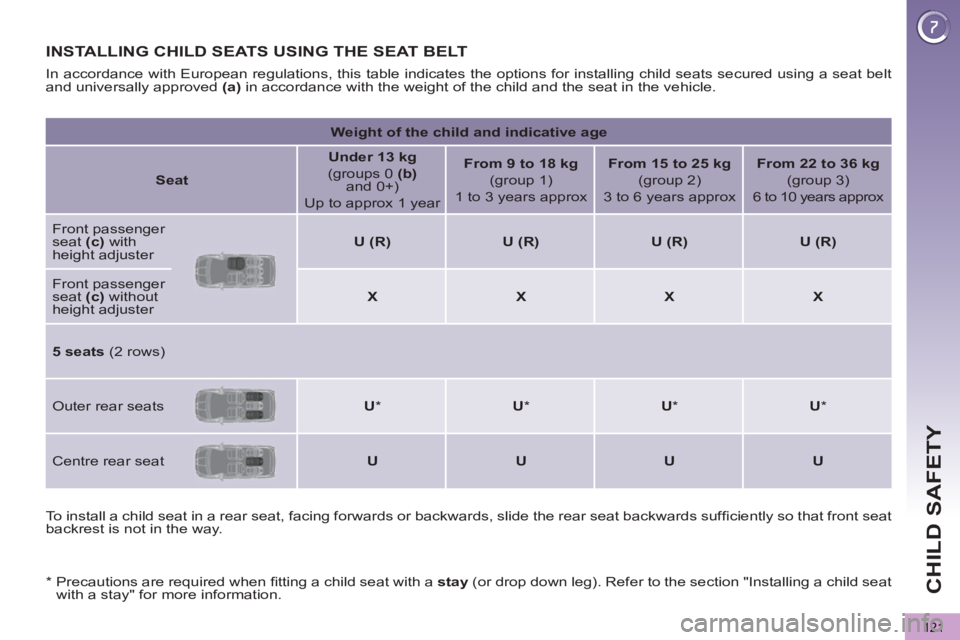
INSTALLING CHILD SEATS USING THE SEAT BELT
To install a child seat in a rear seat, facing forwards or backwards, slide the rear seat backwards suffi ciently so that front seat
backrest is not in the way.
In accordance with European regulations, this table indicates the options for installing child seats secured using a seat belt
and universally approved (a)
in accordance with the weight of the child and the seat in the vehicle.
Weight of the child and indicative age
Seat
Under 13 kg
(groups 0 ( b )
and 0+)
Up to approx 1 year
From 9 to 18 kg
(group 1)
1 to 3 years approx
From 15 to 25 kg
(group 2)
3 to 6 years approx
From 22 to 36 kg
(group 3)
6 to 10 years approx
Front passenger
seat ( c ) with
height adjuster
U (R)
U (R)
U (R)
U (R)
Front passenger
seat (c)
without
height adjuster
X
X
X
X
5 seats
(2 rows)
Outer rear seats
U
*
U
*
U
*
U
*
Centre rear seat
U
U
U
U
*
Precautions are required when fi tting a child seat with a stay
(or drop down leg). Refer to the section "Installing a child seat
with a stay" for more information.
Page 124 of 364
CHILD SAFETY
122
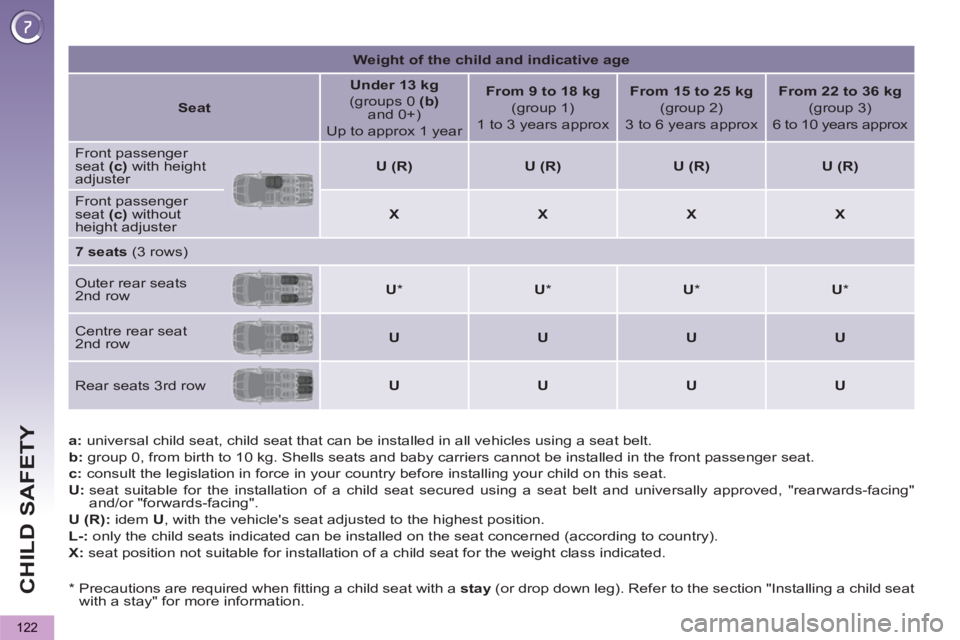
a:
universal child seat, child seat that can be installed in all vehicles using a seat belt.
b:
group 0, from birth to 10 kg. Shells seats and baby carriers cannot be installed in the front passenger seat.
c:
consult the legislation in force in your country before installing your child on this seat.
U:
seat suitable for the installation of a child seat secured using a seat belt and universally approved, "rearwards-facing"
and/or "forwards-facing".
U (R):
idem U
, with the vehicle's seat adjusted to the highest position.
L-:
only the child seats indicated can be installed on the seat concerned (according to country).
X:
seat position not suitable for installation of a child seat for the weight class indicated.
Weight of the child and indicative age
Seat
Under 13 kg
(groups 0 (b)
and 0+)
Up to approx 1 year
From 9 to 18 kg
(group 1)
1 to 3 years approx
From 15 to 25 kg
(group 2)
3 to 6 years approx
From 22 to 36 kg
(group 3)
6 to 10 years approx
Front passenger
seat (c)
with height
adjuster
U (R)
U (R)
U (R)
U (R)
Front passenger
seat (c)
without
height adjuster
X
X
X
X
7 seats
(3 rows)
Outer rear seats
2nd
row
U
*
U
*
U
*
U
*
Centre rear seat
2nd row
U
U
U
U
Rear seats 3rd row
U
U
U
U
* Precautions are required when fi tting a child seat with a stay
(or drop down leg). Refer to the section "Installing a child seat
with a stay" for more information.
Page 128 of 364
./..
CHILD SAFETY
126
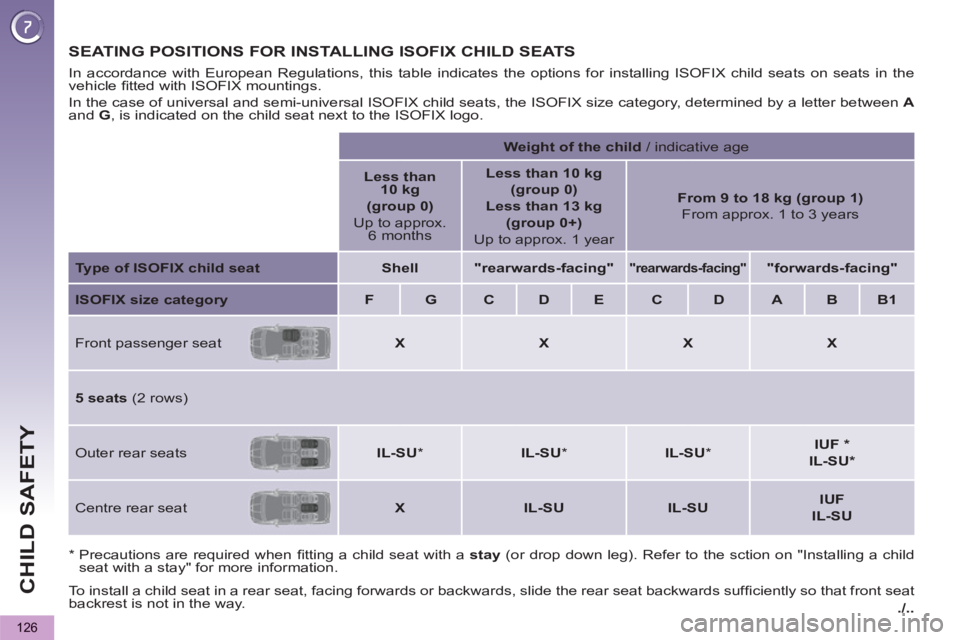
SEATING POSITIONS FOR INSTALLING ISOFIX CHILD SEATS
To install a child seat in a rear seat, facing forwards or backwards, slide the rear seat backwards suffi ciently so that front seat
backrest is not in the way.
In accordance with European Regulations, this table indicates the options for installing ISOFIX child seats on seats in the
vehicle fi tted with ISOFIX mountings.
In the case of universal and semi-universal ISOFIX child seats, the ISOFIX size category, determined by a letter between A
and G
, is indicated on the child seat next to the ISOFIX logo.
*
Precautions are required when fi tting a child seat with a stay
(or drop down leg). Refer to the sction on "Installing a child
seat with a stay" for more information.
Weight of the child
/ indicative age
Less than
10 kg
(group 0)
Up to approx.
6 months
Less than 10 kg
(group 0)
Less than 13 kg
(group 0+)
Up to approx. 1 year
From 9 to 18 kg (group 1)
From approx. 1 to 3 years
Type of ISOFIX child seat
Shell
"rearwards-facing"
"rearwards-facing"
"forwards-facing"
ISOFIX size category
F
G
C
D
E
C
D
A
B
B1
Front passenger seat
X
X
X
X
5 seats
(2 rows)
Outer rear seats
IL-SU
*
IL-SU
*
IL-SU
*
IUF
*
IL-SU *
Centre rear seat
X
IL-SU
IL-SU
IUF
IL-SU
Page 129 of 364
CHILD SAFETY
127
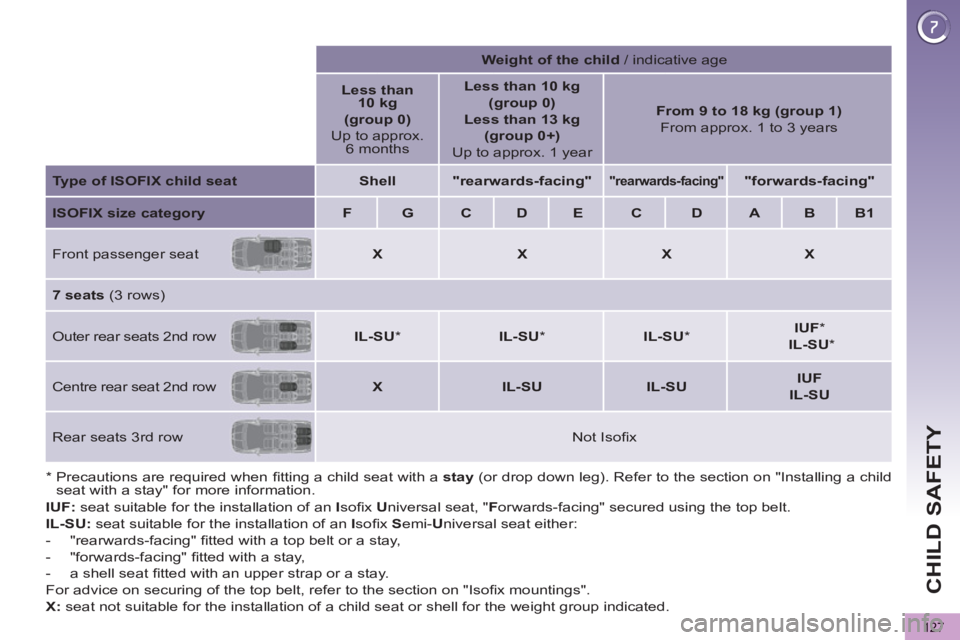
IUF:
seat suitable for the installation of an I
sofi x U
niversal seat, " F
orwards-facing" secured using the top belt.
IL-SU:
seat suitable for the installation of an I
sofi x S
emi- U
niversal seat either:
- "rearwards-facing" fi tted with a top belt or a stay,
- "forwards-facing" fi tted with a stay,
- a shell seat fi tted with an upper strap or a stay.
For advice on securing of the top belt, refer to the section on "Isofi x mountings".
X:
seat not suitable for the installation of a child seat or shell for the weight group indicated.
Weight of the child
/ indicative age
Less than
10 kg
(group 0)
Up to approx.
6 months
Less than 10 kg
(group 0)
Less than 13 kg
(group 0+)
Up to approx. 1 year
From 9 to 18 kg (group 1)
From approx. 1 to 3 years
Type of ISOFIX child seat
Shell
"rearwards-facing"
"rearwards-facing"
"forwards-facing"
ISOFIX size category
F
G
C
D
E
C
D
A
B
B1
Front passenger seat
X
X
X
X
7 seats
(3 rows)
Outer rear seats 2nd row
IL-SU
*
IL-SU
*
IL-SU
*
IUF
*
IL-SU
*
Centre rear seat 2nd row
X
IL-SU
IL-SU
IUF
IL-SU
Rear seats 3rd row
Not Isofi x
*
Precautions are required when fi tting a child seat with a stay
(or drop down leg). Refer to the section on "Installing a child
seat with a stay" for more information.
Page 215 of 364
PRACTICAL INFORMATION
213
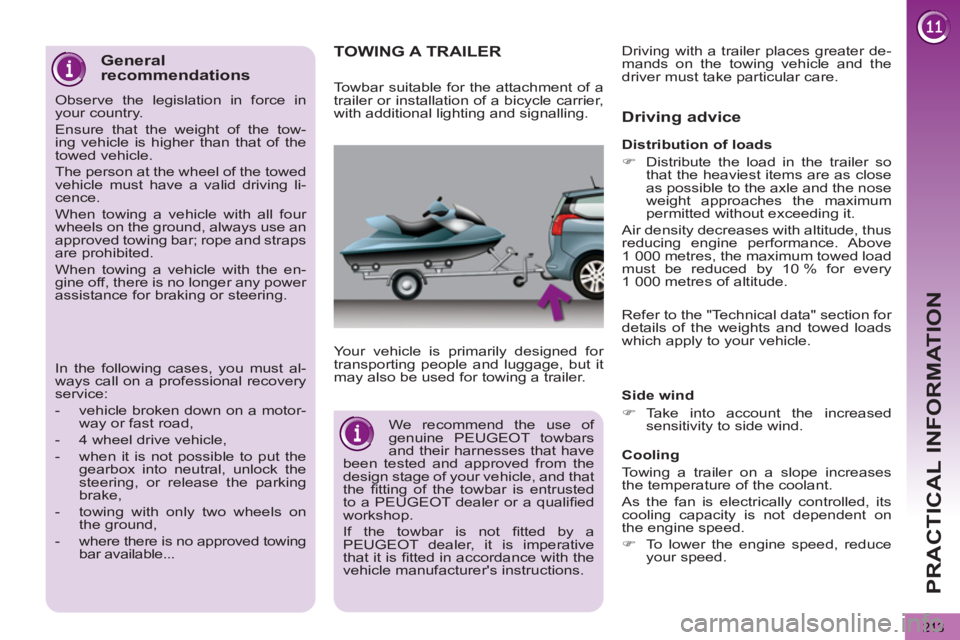
TOWING A TRAILER
Your vehicle is primarily designed for
transporting people and luggage, but it
may also be used for towing a trailer.
Driving advice
Side wind
)
Take into account the increased
sensitivity to side wind.
Cooling
Towing a trailer on a slope increases
the temperature of the coolant.
As the fan is electrically controlled, its
cooling capacity is not dependent on
the engine speed.
)
To lower the engine speed, reduce
your speed.
Towbar suitable for the attachment of a
trailer or installation of a bicycle carrier,
with additional lighting and signalling.
Distribution of loads
)
Distribute the load in the trailer so
that the heaviest items are as close
as possible to the axle and the nose
weight approaches the maximum
permitted without exceeding it.
Air density decreases with altitude, thus
reducing engine performance. Above
1 000 metres, the maximum towed load
must be reduced by 10 % for every
1 000 metres of altitude.
Driving with a trailer places greater de-
mands on the towing vehicle and the
driver must take particular care.
We recommend the use of
genuine PEUGEOT towbars
and their harnesses that have
been tested and approved from the
design stage of your vehicle, and that
the fi tting of the towbar is entrusted
to a PEUGEOT dealer or a qualifi ed
workshop.
If the towbar is not fi tted by a
PEUGEOT dealer, it is imperative
that it is fi tted in accordance with the
vehicle manufacturer's instructions.
General
recommendations
Observe the legislation in force in
your country.
Ensure that the weight of the tow-
ing vehicle is higher than that of the
towed vehicle.
The person at the wheel of the towed
vehicle must have a valid driving li-
cence.
When towing a vehicle with all four
wheels on the ground, always use an
approved towing bar; rope and straps
are prohibited.
When towing a vehicle with the en-
gine off, there is no longer any power
assistance for braking or steering.
In the following cases, you must al-
ways call on a professional recovery
service:
- vehicle broken down on a motor-
way or fast road,
- 4 wheel drive vehicle,
- when it is not possible to put the
gearbox into neutral, unlock the
steering, or release the parking
brake,
- towing with only two wheels on
the ground,
- where there is no approved towing
bar available...
Refer to the "Technical data" section for
details of the weights and towed loads
which apply to your vehicle.
Page 216 of 364
PRACTICAL INFORMATION
214
The maximum towed load on a long in-
cline depends on the gradient and the
ambient temperature.
In all cases, keep a check on the cool-
ant temperature.
Braking
Towing a trailer increases the braking
distance.
To avoid overheating of the brakes on a
long mountain type of descent, the use
of engine braking is recommended.
Tyres
)
Check the tyre pressures of the tow-
ing vehicle and of the trailer, observ-
ing the recommended pressures.
Lighting
)
Check the electrical lighting and sig-
nalling on the trailer.
The rear parking sensors will
be deactivated automatically if
a genuine PEUGEOT towbar
is used.
)
If the warning lamp and the
STOP
warning lamp come
on, stop the vehicle and
switch off the engine as
soon as possible.
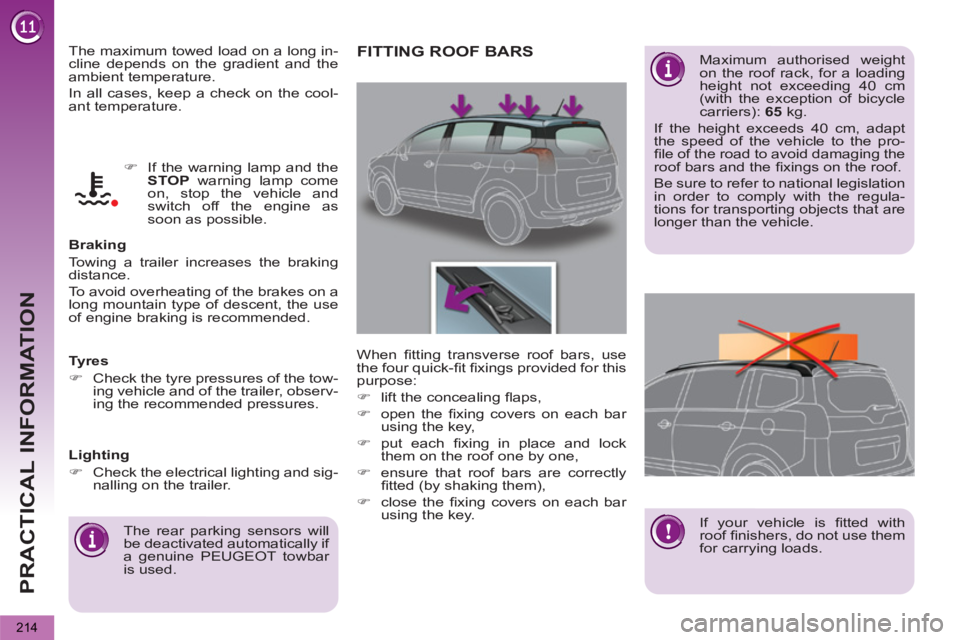
FITTING ROOF BARS
Maximum authorised weight
on the roof rack, for a loading
height not exceeding 40 cm
(with the exception of bicycle
carriers): 65
kg.
If the height exceeds 40 cm, adapt
the speed of the vehicle to the pro-
fi le of the road to avoid damaging the
roof bars and the fi xings on the roof.
Be sure to refer to national legislation
in order to comply with the regula-
tions for transporting objects that are
longer than the vehicle.
When fi tting transverse roof bars, use
the four quick-fi t fi xings provided for this
purpose:
)
lift the concealing fl aps,
)
open the fi xing covers on each bar
using the key,
)
put each fi xing in place and lock
them on the roof one by one,
)
ensure that roof bars are correctly
fi tted (by shaking them),
)
close the fi xing covers on each bar
using the key.
If your vehicle is fi tted with
roof fi nishers, do not use them
for carrying loads.