weight PEUGEOT 5008 2017 Owners Manual
[x] Cancel search | Manufacturer: PEUGEOT, Model Year: 2017, Model line: 5008, Model: PEUGEOT 5008 2017Pages: 404, PDF Size: 15.31 MB
Page 146 of 404
144
ASR / DSC
These systems offer increased safety
in normal driving, but they should not
encourage the driver to take extra risks or
drive at high speed.
It is in conditions of reduced grip (rain,
snow, black ice) that the risk of loss of grip
increases. It is therefore important for your
safety to keep these systems activated in
all conditions, and particularly in difficult
conditions.
The correct operation of these
systems depends on obser vation of
the manufacturer's recommendations
regarding as much the wheels (tyres and
rims), braking and electronic components
as the assembly and repair procedures
used by PEUGEOT dealers.
The use of snow tyres is recommended,
in order to be able to benefit from the
efficiency of these systems in winter
conditions.
In this case, it is essential to equip the
four wheels with tyres approved for your
vehicle.Trailer stability assist
When towing, this system reduces the risk of
the vehicle or trailer swaying.
Operation
The system is activated automatically when the
ignition is switched on.
The electronic stability programme (ESC) must
not have any faults.
Between 40 and 100 mph (60 and 160 km/h), if
the system detects oscillations (snaking) in the
movement of the trailer, it acts on the brakes to
stabilise the trailer and, if necessary, reduces
engine power to slow down the vehicle.
For information on the weights and towed
loads, refer to the "Technical data" section or
the registration certificate for your vehicle.
For advice on driving safely when Towing a
trailer , refer to the corresponding section.
Malfunction
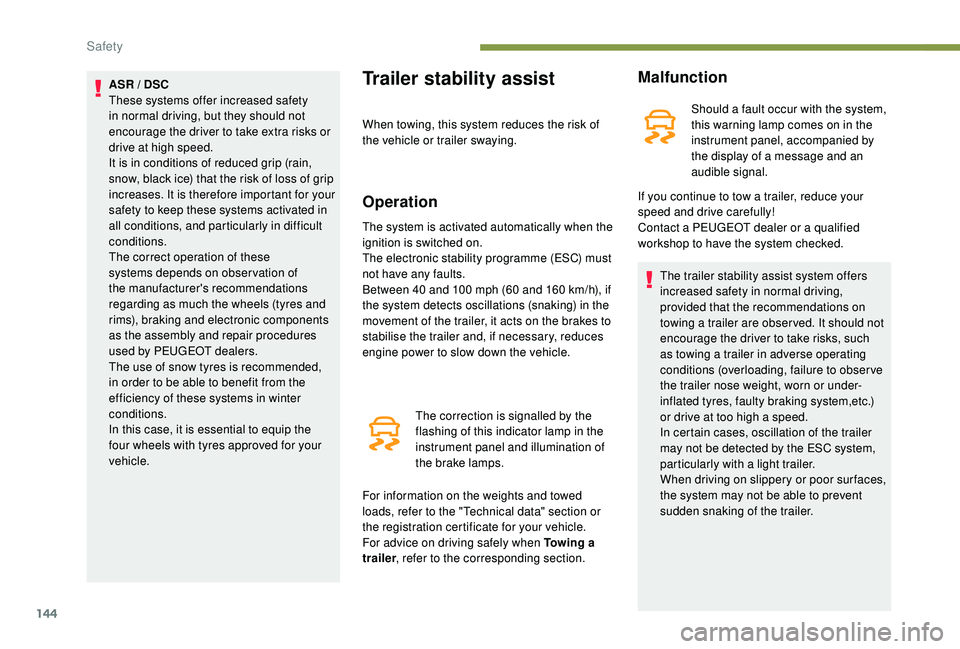
Should a fault occur with the system,
this warning lamp comes on in the
instrument panel, accompanied by
the display of a message and an
audible signal.
If you continue to tow a trailer, reduce your
speed and drive carefully!
Contact a PEUGEOT dealer or a qualified
workshop to have the system checked.
The trailer stability assist system offers
increased safety in normal driving,
provided that the recommendations on
towing a trailer are obser ved. It should not
encourage the driver to take risks, such
as towing a trailer in adverse operating
conditions (overloading, failure to obser ve
the trailer nose weight, worn or under-
inflated tyres, faulty braking system,etc.)
or drive at too high a speed.
In certain cases, oscillation of the trailer
may not be detected by the ESC system,
particularly with a light trailer.
When driving on slippery or poor sur faces,
the system may not be able to prevent
sudden snaking of the trailer.
The correction is signalled by the
flashing of this indicator lamp in the
instrument panel and illumination of
the brake lamps.
Safety
Page 159 of 404
157
General points relating to
child seats
* The legislation on carrying children is specific to each country. Consult the
legislation in force in your country.
Although one of the main criteria of PEUGEOT
when designing your vehicle, the safety of your
children also depends on you.
For maximum safety, please obser ve the
following recommendations:
-
I
n accordance with European regulations,
all children under the age of 12 or less
than one and a half metres tall must
travel in an approved child seat suited to
their weight and installed on a vehicle seat
fitted with a seat belt or ISOFIX mountings*.
-
S
tatistically, the safest seats in your
vehicle for carr ying children are the rear
seats.
-
A c
hild weighing less than 9 kg must
travel in the rear ward facing position
both in the front and in the rear. PEUGEOT recommends
that children
should travel on the rear seats of your
vehicle:
- "
rearward facing " up to the age of 3,
- "
forward facing " over the age of 3.
Child seat at the front
Refer to the current legislation in your country
before installing your child on this seat.
Rearward facing
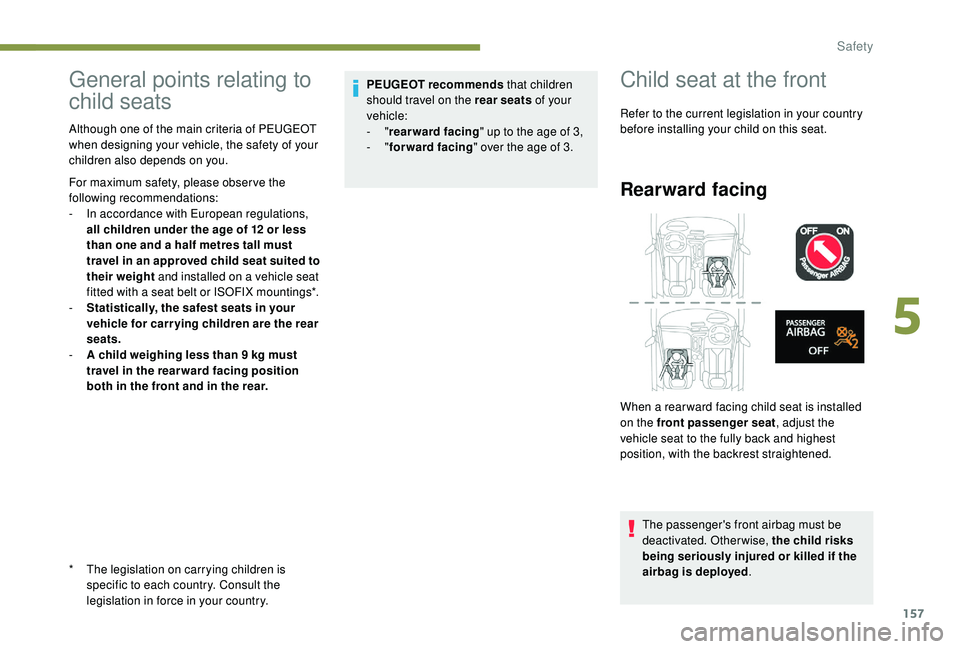
When a rear ward facing child seat is installed
on the front passenger seat , adjust the
vehicle seat to the fully back and highest
position, with the backrest straightened.
The passenger's front airbag must be
deactivated. Otherwise, the child risks
being seriously injured or killed if the
airbag is deployed .
5
Safety
Page 166 of 404
164
Locations for child seats secured using the seat belt
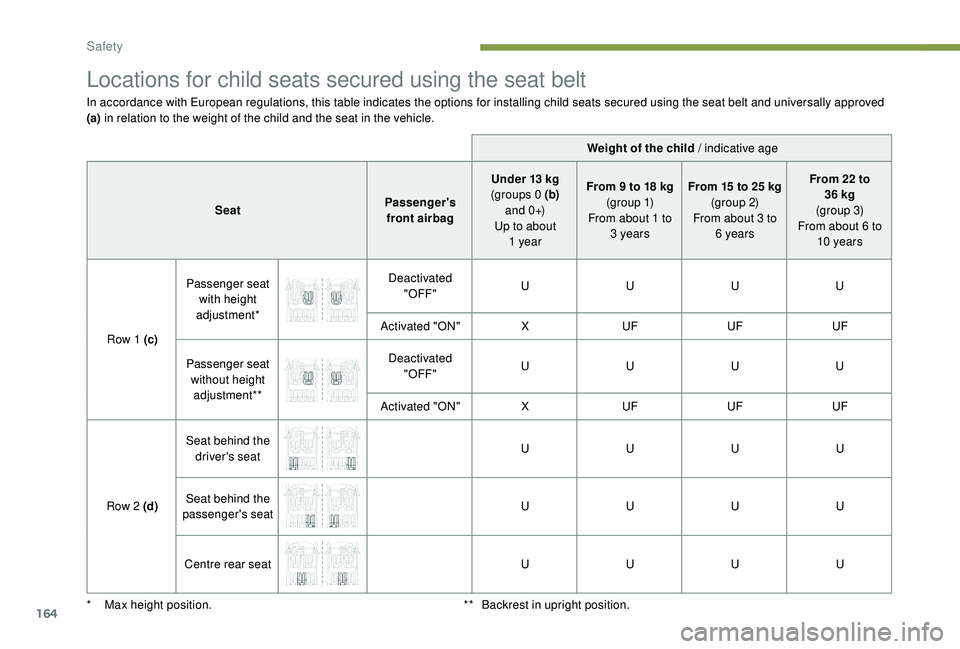
In accordance with European regulations, this table indicates the options for installing child seats secured using the seat belt and universally approved
(a) in relation to the weight of the child and the seat in the vehicle.
Weight of the child / indicative age
Seat Passenger's
front airbag Under 13
kg
(groups 0
(b)
a n d 0 +)
Up to about 1
yearFrom 9
to 18 kg
(g r o u p 1)
From about 1
to
3
yearsFrom 15
to 25 kg
(group 2)
From about 3
to
6
yearsFrom 22
to
36
kg
(group 3)
From about 6
to
10
years
Row 1
(c)Passenger seat
with height
adjustment* Deactivated
"OFF" U
UUU
Activated "ON" XUF UFUF
Passenger seat without height adjustment** Deactivated
"OFF" U
UUU
Activated "ON" XUF UFUF
Row 2
(d)Seat behind the
driver's seat U
UUU
Seat behind the
passenger's seat U
UUU
Centre rear seat UUUU
*
M
ax height position. **
B
ackrest in upright position.
Safety
Page 167 of 404
165
Weight of the child / indicative age
Seat Passenger's
front airbag Under 13
kg
(groups 0
(b)
a n d 0 +)
Up to about 1
year From 9
to 18 kg
(g r o u p 1)
From about 1
to
3
years From 15
to
25
kg
(group 2)
From about 3
to
6
yearsFrom 22
to
36
kg
(group 3)
From about 6
to
10
years
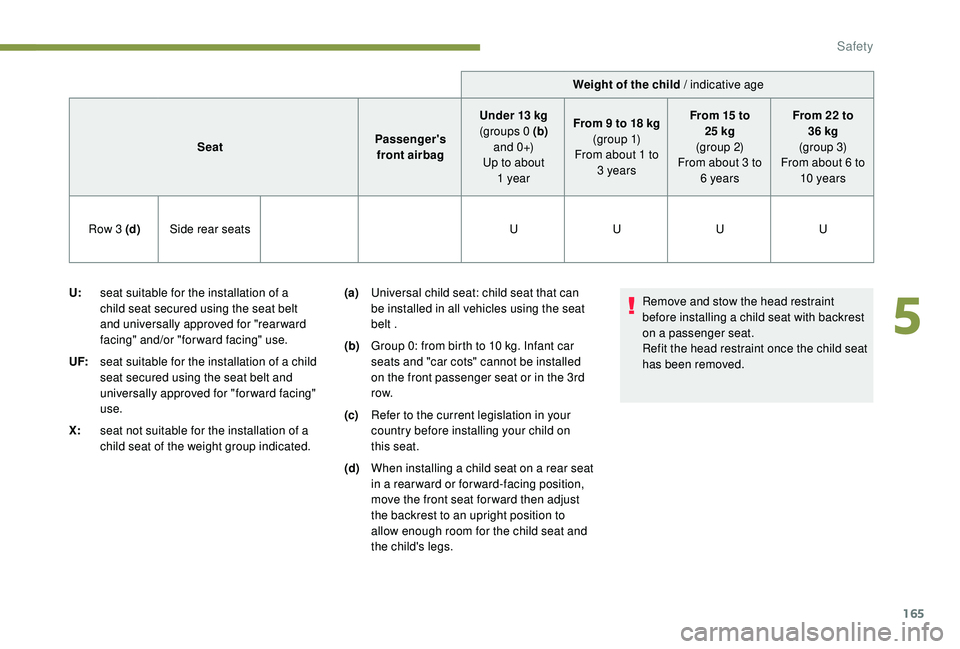
Row 3
(d) Side rear seats UUUU
U: seat suitable for the installation of a
child seat secured using the seat belt
and universally approved for "rearward
facing" and/or "forward facing" use.
UF: seat suitable for the installation of a child
seat secured using the seat belt and
universally approved for "forward facing"
use.
X: seat not suitable for the installation of a
child seat of the weight group indicated. (a)
Universal child seat: child seat that can
be installed in all vehicles using the seat
belt .
(b) Group 0: from birth to 10
kg. Infant car
seats and "car cots" cannot be installed
on the front passenger seat or in the 3rd
row.
(c) Refer to the current legislation in your
country before installing your child on
this seat.
(d) When installing a child seat on a rear seat
in a rearward or forward-facing position,
move the front seat for ward then adjust
the backrest to an upright position to
allow enough room for the child seat and
the child's legs. Remove and stow the head restraint
before installing a child seat with backrest
on a passenger seat.
Refit the head restraint once the child seat
has been removed.
5
Safety
Page 170 of 404
168
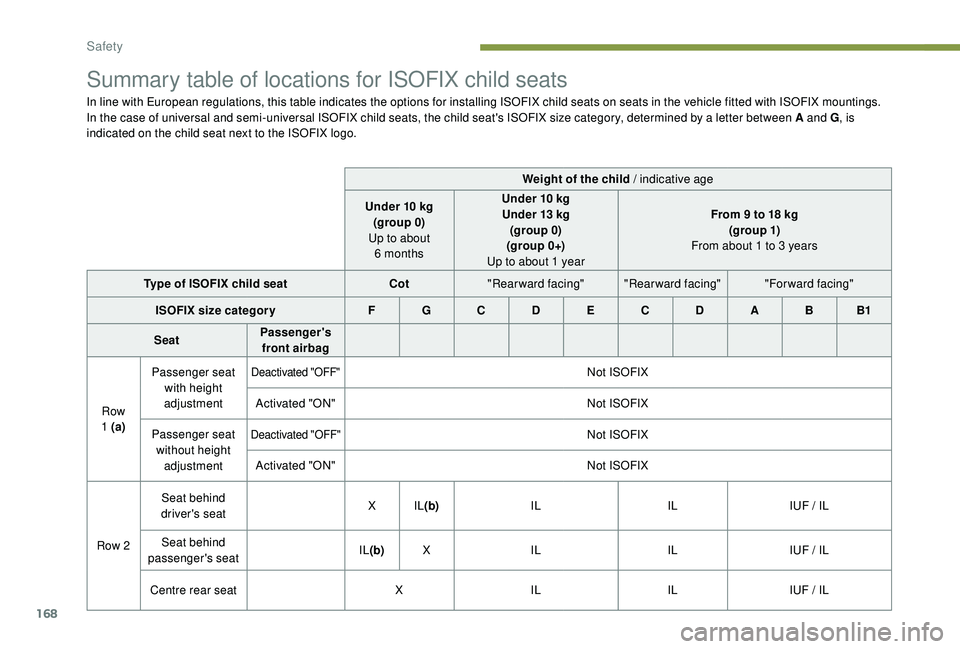
Summary table of locations for ISOFIX child seats
In line with European regulations, this table indicates the options for installing ISOFIX child seats on seats in the vehicle fitted with ISOFIX mountings.
In the case of universal and semi-universal ISOFIX child seats, the child seat's ISOFIX size category, determined by a letter between A and G, is
indicated on the child seat next to the ISOFIX logo.
Weight of the child / indicative age
Under 10
kg
(group 0)
Up to about 6
monthsUnder 10
kg
Under 13
kg
(group 0)
(group 0+)
Up to about 1
yearFrom 9
to 18 kg
(g ro up 1)
From about 1
to 3 years
Type of ISOFIX child seat Cot"Rearward facing" "Rearward facing" "Forward facing"
ISOFIX size categor y F G C D E C D A B B1
Seat Passenger's
front airbag
Row
1
(a) Passenger seat
with height
adjustment
Deactivated "OFF"Not ISOFIX
Activated "ON" Not ISOFIX
Passenger seat without height adjustment
Deactivated "OFF"Not ISOFIX
Activated "ON" Not ISOFIX
Row 2 Seat behind
driver's seat X
IL(b) IL ILIUF / IL
Seat behind
passenger's seat IL
(b) X IL ILIUF / IL
Centre rear seat XIL ILIUF / IL
Safety
Page 171 of 404
169
Weight of the child/ indicative age
Under 10
kg
(group 0)
Up to about 6
months Under 10
kg
Under 13
kg
(group 0)
(group 0+)
Up to about 1
year From 9
to 18 kg
(g ro up 1)
From about 1
to 3 years
Type of ISOFIX child seat Cot"Rearward facing" "Rearward facing" "Forward facing"
ISOFIX size categor y F G C D E C D A B B1
Seat Passenger's
front airbag
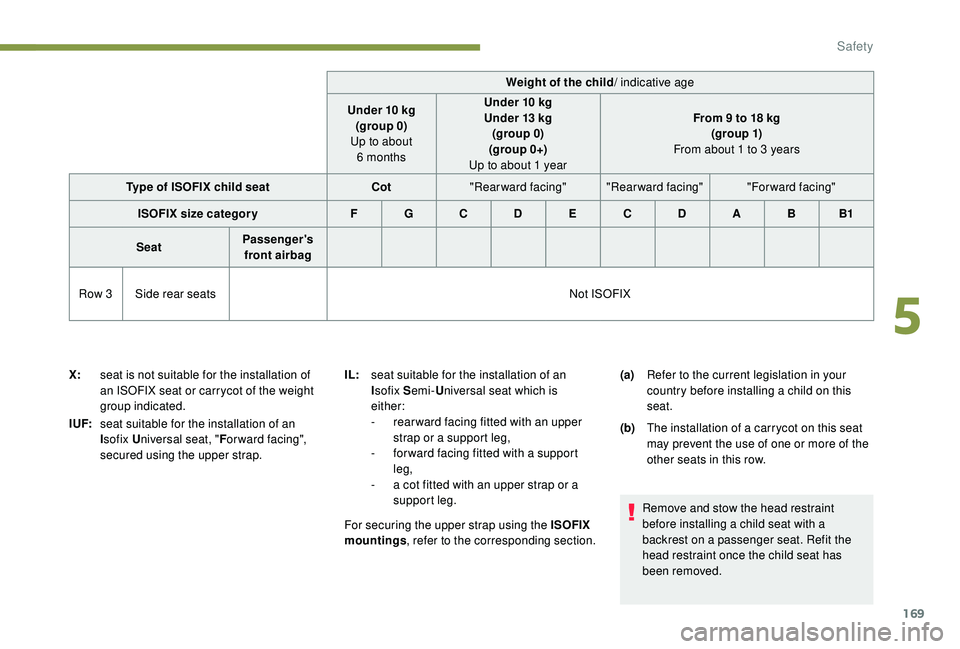
Row 3 Side rear seats Not ISOFIX
X: seat is not suitable for the installation of
an ISOFIX seat or carrycot of the weight
group indicated.
I UF: seat suitable for the installation of an
Isofix U niversal seat, " For ward facing",
secured using the upper strap. IL:
seat suitable for the installation of an
Isofix S emi-Universal seat which is
either:
-
r
ear ward facing fitted with an upper
strap or a support leg,
-
f
or ward facing fitted with a support
leg,
-
a c
ot fitted with an upper strap or a
support leg.
For securing the upper strap using the ISOFIX
mountings , refer to the corresponding section. (a)
Refer to the current legislation in your
country before installing a child on this
seat.
(b) The installation of a carrycot on this seat
may prevent the use of one or more of the
other seats in this row.
Remove and stow the head restraint
before installing a child seat with a
backrest on a passenger seat. Refit the
head restraint once the child seat has
been removed.
5
Safety
Page 178 of 404
176
In case of towing
Driving with a trailer places greater
demands on the towing vehicle and
requires extra care from the driver.
Distribution of loads
F Distribute the load in the trailer so that the heaviest items are as close as possible to
the axle and the nose weight approaches
the maximum permitted without exceeding
it.
Air density decreases with altitude, thus
reducing engine performance. The maximum
towed load must be reduced by 10% for every
1,000
metres of altitude.
Please respect the maximum towable
weights.
Side wind
F Take into account the increased sensitivity to wind.
Cooling
Towing a trailer on a slope increases the
temperature of the coolant.
As the fan is electrically controlled, its cooling
capacity is not dependent on the engine speed.
F
T
o lower the engine speed, reduce your
speed.
The maximum towable load on an incline
depends on the gradient and the exterior
temperature.
In all cases, keep a check on the coolant
temperature.
F
I
f this warning lamp and the
STOP warning lamp come on,
stop the vehicle and switch off
the engine as soon as possible.
New vehicle
Do not pull a trailer before having driven at
least 600
miles (1,000 kilometres).
Braking
Towing a trailer increases the braking distance.
To avoid overheating of the brakes, the use of
engine braking is recommended.
Ty r e s
F Check the tyre pressures of the towing vehicle and of the trailer, observing the
recommended pressures.
Lighting
F Check the electrical lighting and signalling on the trailer and the headlamp beam height
of your vehicle.
For more information on Adjusting the
headlamp beam height , refer to the
corresponding section.
The rear parking sensors will be
deactivated automatically to avoid the
audible signal if a genuine PEUGEOT
towbar is used.
Driving
Page 250 of 404
248
Towing a trailer
Your vehicle is primarily designed for
transporting people and luggage, but it may
also be used for towing a trailer.We recommend the use of genuine
PEUGEOT towbars and their harnesses
that have been tested and approved from
the design stage of your vehicle, and that
the fitting of the towbar is entrusted to a
PEUGEOT dealer or a qualified workshop.
If the towbar is not fitted by a PEUGEOT
dealer, it must still be fitted in accordance
with the vehicle manufacturer's
instructions. Please respect the maximum authorised
towable weights, indicated on the
registration certificate or in your vehicle’s
technical data.
For more information on Weights
(and the
towed loads which apply to your vehicle)
refer to the corresponding section.
Vehicle equipped with motorised
tailgate with "Hands-Free Tailgate
Access" function
To avoid unwanted opening of the tailgate
when using the towing device:
-
p
lease deactivate the "Hands-Free
Tailgate Access" function in advance in
your vehicle's configuration menu,
-
o
r move the electronic key away from
the recognition zone, with the tailgate
closed.
Towbar with quickly
detachable towball
No tools are required to install or remove the
towball on this genuine towbar system.
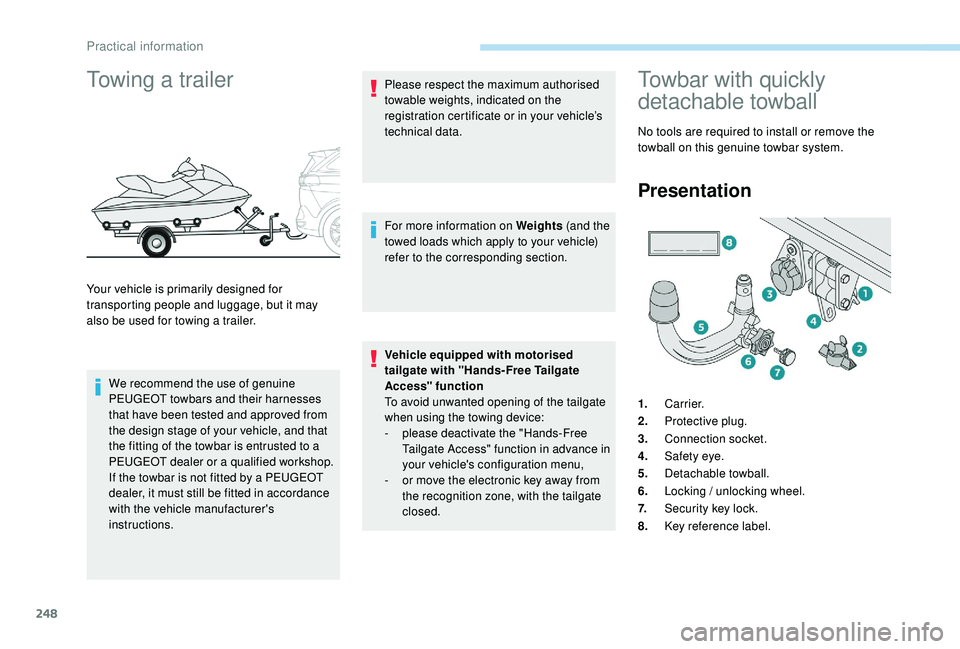
Presentation
1. Carrier.
2. Protective plug.
3. Connection socket.
4. Safety eye.
5. Detachable towball.
6. Locking / unlocking wheel.
7. Security key lock.
8. Key reference label.
Practical information
Page 251 of 404
249
Trailers with LED lamps are not
compatible with the wiring harness of this
device.
To know the technical features, and in
particular the towable weights for your
vehicle, refer to the corresponding section.
For advice on driving safely when To w i n g
a trailer , refer to the corresponding
section.
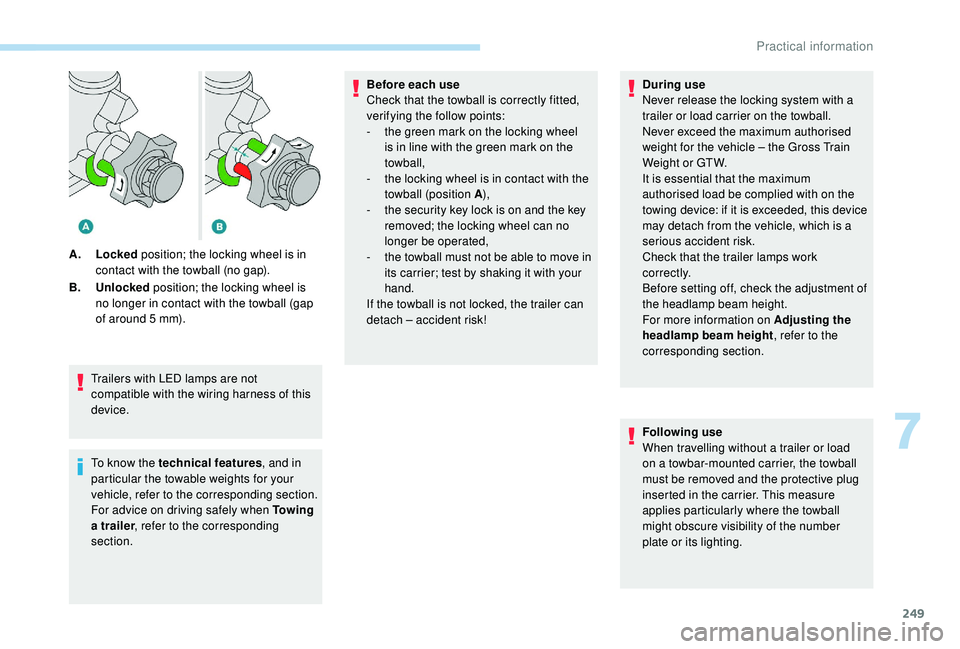
A.
Locked position; the locking wheel is in
contact with the towball (no gap).
B. Unlocked position; the locking wheel is
no longer in contact with the towball (gap
of around 5 mm). Before each use
Check that the towball is correctly fitted,
verifying the follow points:
-
t
he green mark on the locking wheel
is in line with the green mark on the
towball,
-
t
he locking wheel is in contact with the
towball (position A ),
-
t
he security key lock is on and the key
removed; the locking wheel can no
longer be operated,
-
t
he towball must not be able to move in
its carrier; test by shaking it with your
hand.
If the towball is not locked, the trailer can
detach – accident risk! During use
Never release the locking system with a
trailer or load carrier on the towball.
Never exceed the maximum authorised
weight for the vehicle – the Gross Train
Weight or GTW.
It is essential that the maximum
authorised load be complied with on the
towing device: if it is exceeded, this device
may detach from the vehicle, which is a
serious accident risk.
Check that the trailer lamps work
c o r r e c t l y.
Before setting off, check the adjustment of
the headlamp beam height.
For more information on Adjusting the
headlamp beam height
, refer to the
corresponding section.
Following use
When travelling without a trailer or load
on a towbar-mounted carrier, the towball
must be removed and the protective plug
inserted in the carrier. This measure
applies particularly where the towball
might obscure visibility of the number
plate or its lighting.
7
Practical information
Page 292 of 404
290
F Move the gear lever into neutral (N mode with an automatic gearbox).
Failure to follow this instruction may cause
damage to some components (braking,
transmission, etc.) and the absence of
braking assistance when the engine is
restarted. F
S
witch on the hazard warning lamps on
both vehicles.
F
S
et off gently and drive slowly for a short
distance.
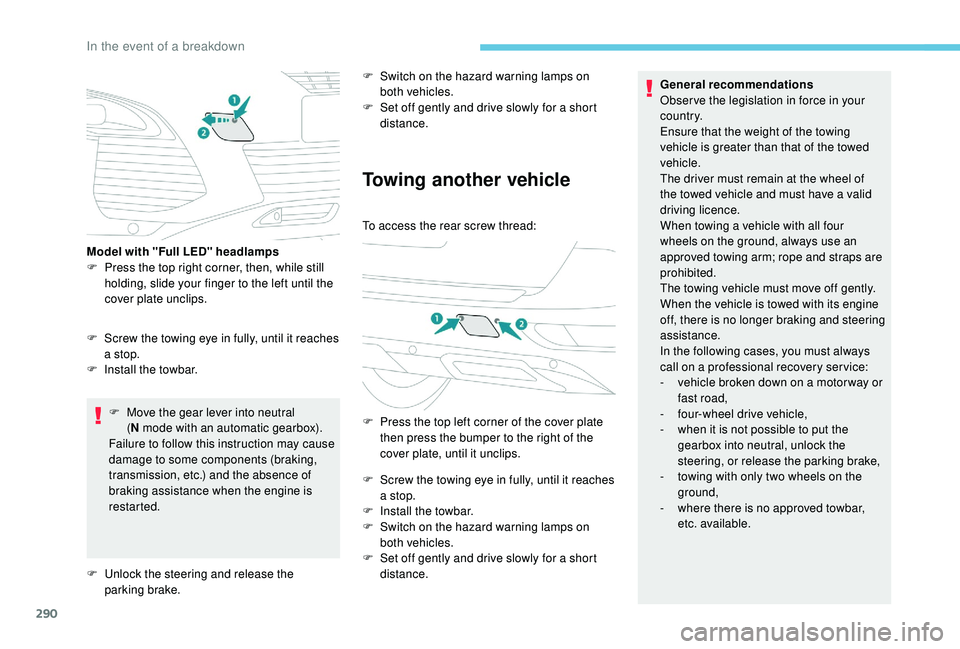
Towing another vehicle
To access the rear screw thread:
F
P
ress the top left corner of the cover plate
then press the bumper to the right of the
cover plate, until it unclips.
F
S
crew the towing eye in fully, until it reaches
a stop.
F
I
nstall the towbar.
F
S
witch on the hazard warning lamps on
both vehicles.
F
S
et off gently and drive slowly for a short
distance. General recommendations
Obser ve the legislation in force in your
c o u nt r y.
Ensure that the weight of the towing
vehicle is greater than that of the towed
vehicle.
The driver must remain at the wheel of
the towed vehicle and must have a valid
driving licence.
When towing a vehicle with all four
wheels on the ground, always use an
approved towing arm; rope and straps are
prohibited.
The towing vehicle must move off gently.
When the vehicle is towed with its engine
off, there is no longer braking and steering
assistance.
In the following cases, you must always
call on a professional recovery ser vice:
-
v
ehicle broken down on a motor way or
fast road,
-
f
our-wheel drive vehicle,
-
w
hen it is not possible to put the
gearbox into neutral, unlock the
steering, or release the parking brake,
-
t
owing with only two wheels on the
ground,
-
w
here there is no approved towbar,
etc. available.
F
S
crew the towing eye in fully, until it reaches
a stop.
F
I
nstall the towbar.
Model with "Full LED" headlamps
F
P
ress the top right corner, then, while still
holding, slide your finger to the left until the
cover plate unclips.
F
U
nlock the steering and release the
parking brake.
In the event of a breakdown