boot PEUGEOT 5008 2018 User Guide
[x] Cancel search | Manufacturer: PEUGEOT, Model Year: 2018, Model line: 5008, Model: PEUGEOT 5008 2018Pages: 364, PDF Size: 13.03 MB
Page 58 of 364
56
Anti-intrusion security
This system allows automatic simultaneous
locking of the doors and boot as soon as the
speed of the vehicle exceeds 6 mph (10 km/h).
Operation
If one of the doors or the boot is open, the
automatic central locking does not take place.
Carrying long or voluminous objects
If you want to drive with the boot open, you
should press the central locking button
to lock the doors. Other wise, every time
the speed of the vehicle exceeds 6
mph
(10
km/h), the locks will rebound and the
alerts mentioned above will appear.
Pressing the central locking button
unlocks the vehicle.
Above 6
mph (10 km/h), this unlocking is
te m p o r a r y.
Activation/Deactivation
Driving with the doors locked may render
access for the emergency services
difficult in an emergency.
This is signalled by the sound of
the locks rebounding, accompanied
by illumination of this symbol in the
instrument panel, an audible signal and
the display of an alert message.
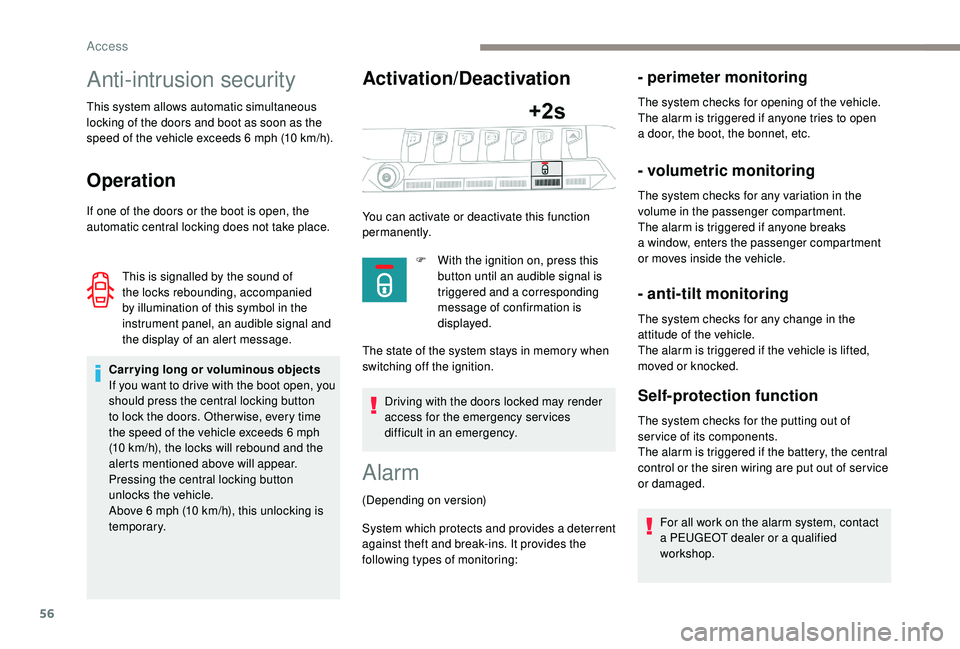
You can activate or deactivate this function
permanently.
F
W
ith the ignition on, press this
button until an audible signal is
triggered and a corresponding
message of confirmation is
displayed.
The state of the system stays in memory when
switching off the ignition.
Alarm
(Depending on version)
System which protects and provides a
deterrent
against theft and break-ins. It provides the
following types of monitoring:
- perimeter monitoring
The system checks for opening of the vehicle.
The alarm is triggered if anyone tries to open
a
door, the boot, the bonnet, etc.
- volumetric monitoring
The system checks for any variation in the
volume in the passenger compartment.
The alarm is triggered if anyone breaks
a
window, enters the passenger compartment
or moves inside the vehicle.
- anti-tilt monitoring
The system checks for any change in the
attitude of the vehicle.
The alarm is triggered if the vehicle is lifted,
moved or knocked.
Self-protection function
The system checks for the putting out of
ser vice of its components.
The alarm is triggered if the battery, the central
control or the siren wiring are put out of ser vice
or damaged.
For all work on the alarm system, contact
a
PEUGEOT dealer or a qualified
workshop.
Access
Page 59 of 364
57
Locking the vehicle with full
alarm system
Activation
Following a vehicle locking request, the
p erimeter monitoring is activated after
5
seconds and the interior volumetric and
anti-tilt monitoring after 45
seconds.If an opening (door, boot or bonnet) is not
fully closed, the vehicle is not locked but
the exterior perimeter monitoring will be
activated after a
delay of 45 seconds at
the same time as the interior volumetric
and anti-tilt monitoring.
Deactivation
F Press the unlocking button on the remote control.
or
F
U
nlock the vehicle with the Keyless Entry
and Starting system.
The monitoring system is deactivated: the
indicator lamp in the button goes off and the
direction indicators flash for about 2
seconds.
When the vehicle automatically locks itself
again (as happens if a
door or boot is not
opened within 30
seconds of unlocking),
the monitoring system is also reactivated
automatically.
Locking the vehicle
with exterior perimeter
monitoring only
Deactivate the interior volumetric and anti-tilt
monitoring to avoid unwanted triggering of the
alarm in certain cases such as:
-
l
eaving a pet in the vehicle,
Deactivating the interior
volumetric and anti-tilt
monitoring
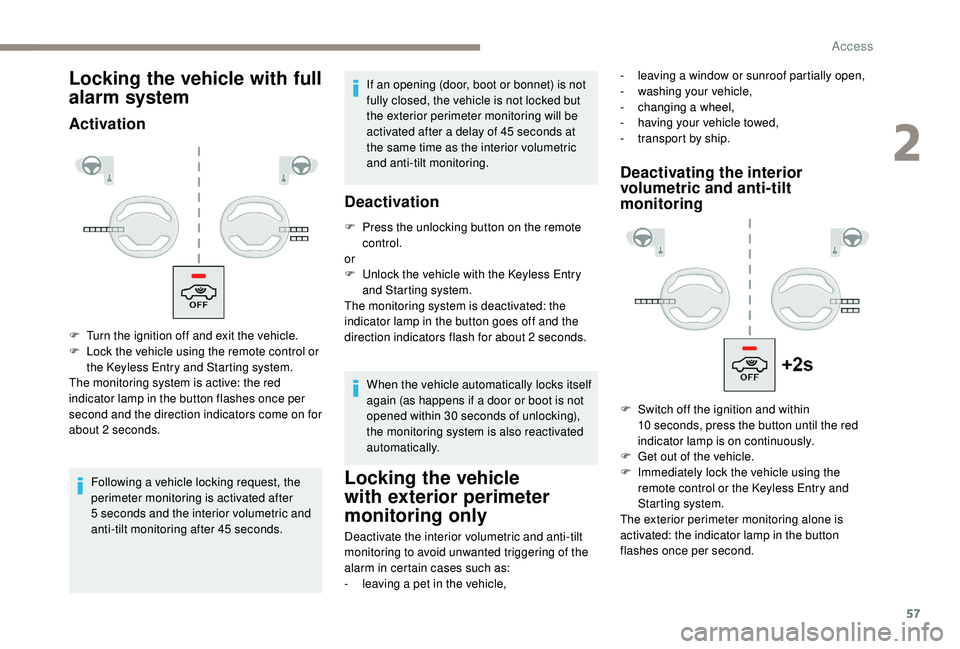
F Turn the ignition off and exit the vehicle.
F L ock the vehicle using the remote control or
the Keyless Entry and Starting system.
The monitoring system is active: the red
indicator lamp in the button flashes once per
second and the direction indicators come on for
about 2
seconds. -
l
eaving a window or sunroof partially open,
-
w
ashing your vehicle,
-
c
hanging a
wheel,
-
h
aving your vehicle towed,
-
t
ransport by ship.
F
S
witch off the ignition and within
10
seconds, press the button until the red
indicator lamp is on continuously.
F
G
et out of the vehicle.
F
I
mmediately lock the vehicle using the
remote control or the Keyless Entry and
Starting system.
The exterior perimeter monitoring alone is
activated: the indicator lamp in the button
flashes once per second.
2
Access
Page 61 of 364
59
From inside
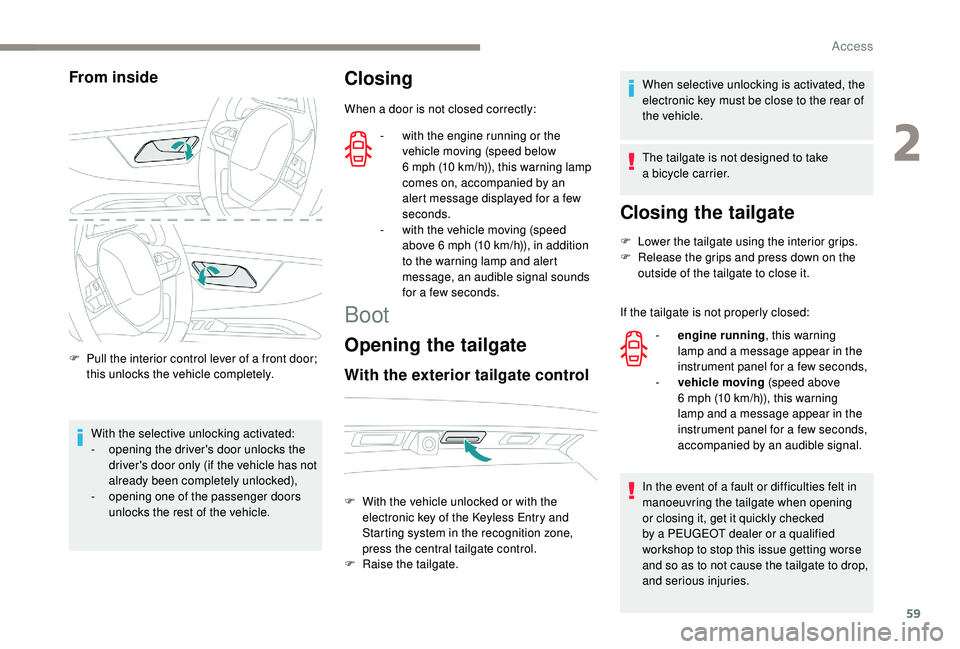
F Pull the interior control lever of a front door;
this unlocks the vehicle completely.
With the selective unlocking activated:
-
o
pening the driver's door unlocks the
driver's door only (if the vehicle has not
already been completely unlocked),
-
o
pening one of the passenger doors
unlocks the rest of the vehicle.
Closing
When a door is not closed correctly:
Boot
Opening the tailgate
With the exterior tailgate control
When selective unlocking is activated, the
electronic key must be close to the rear of
the vehicle.
The tailgate is not designed to take
a
bicycle carrier.
Closing the tailgate
F Lower the tailgate using the interior grips.
F R elease the grips and press down on the
outside of the tailgate to close it.
If the tailgate is not properly closed:
In the event of a
fault or difficulties felt in
manoeuvring the tailgate when opening
or closing it, get it quickly checked
by a
PEUGEOT dealer or a qualified
workshop to stop this issue getting worse
and so as to not cause the tailgate to drop,
and serious injuries.
-
w
ith the engine running or the
vehicle moving (speed below
6
mph (10
km/h)), this warning lamp
comes on, accompanied by an
alert message displayed for a
few
seconds.
-
w
ith the vehicle moving (speed
above 6
mph (10
km/h)), in addition
to the warning lamp and alert
message, an audible signal sounds
for a
few seconds.
F
W
ith the vehicle unlocked or with the
electronic key of the
K
eyless Entry and
Starting system in the recognition zone,
press the central tailgate control.
F
Ra
ise the tailgate. -
e
ngine running , this warning
lamp and a
message appear in the
instrument panel for a
few seconds,
-
v
ehicle moving (speed above
6
mph (10 km/h)), this warning
lamp and a
message appear in the
instrument panel for a
few seconds,
accompanied by an audible signal.
2
Access
Page 62 of 364
60
Hands-free tailgate
General points
The motorised operation of the tailgate can be
activated or deactivated in the vehicle settings
menu.
The motorised tailgate must only be operated
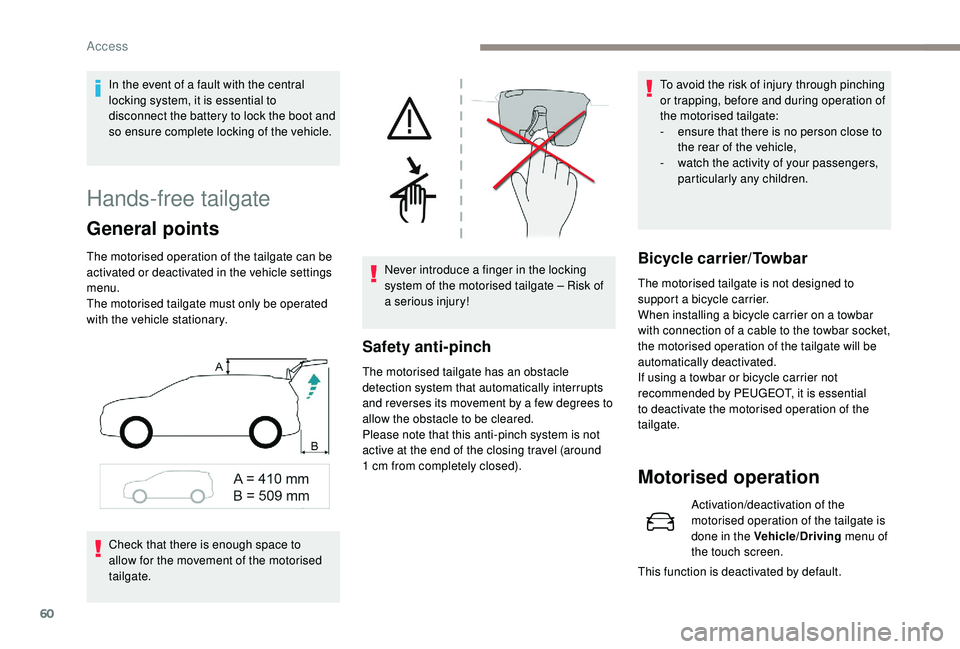
with the vehicle stationary.Check that there is enough space to
allow for the movement of the motorised
tailgate. Never introduce a
finger in the locking
system of the motorised tailgate – Risk of
a
serious injury!
Safety anti-pinch
The motorised tailgate has an obstacle
detection system that automatically interrupts
and reverses its movement by a few degrees to
allow the obstacle to be cleared.
Please note that this anti-pinch system is not
active at the end of the closing travel (around
1
cm from completely closed). To avoid the risk of injury through pinching
or trapping, before and during operation of
the motorised tailgate:
-
e
nsure that there is no person close to
the rear of the vehicle,
-
w
atch the activity of your passengers,
particularly any children.
Bicycle carrier/Towbar
The motorised tailgate is not designed to
support a bicycle carrier.
When installing a
bicycle carrier on a towbar
with connection of a
cable to the towbar socket,
the motorised operation of the tailgate will be
automatically deactivated.
If using a
towbar or bicycle carrier not
recommended by PEUGEOT, it is essential
to deactivate the motorised operation of the
tailgate.
In the event of a
fault with the central
locking system, it is essential to
disconnect the battery to lock the boot and
so ensure complete locking of the vehicle.
Motorised operation
Activation/deactivation of the
motorised operation of the tailgate is
done in the Vehicle/Driving menu of
the touch screen.
This function is deactivated by default.
Access
Page 63 of 364
61
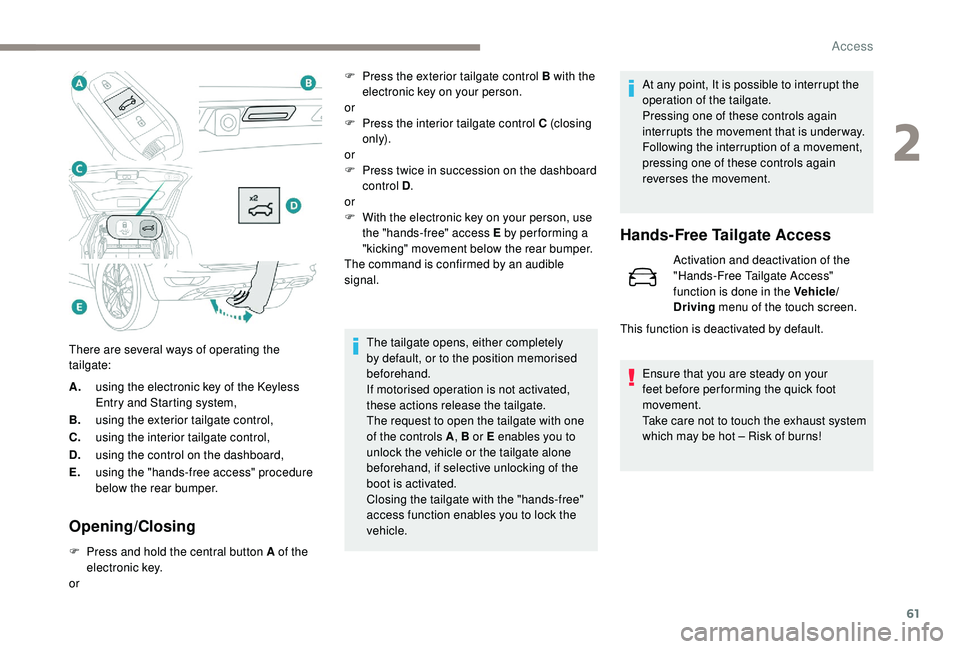
A.using the electronic key of the K eyless
Entry and Starting system,
B. using the exterior tailgate control,
C. using the interior tailgate control,
D. using the control on the dashboard,
E. using the "hands-free access" procedure
below the rear bumper.
Opening/Closing
F Press and hold the central button A of the
electronic key.
or The tailgate opens, either completely
by default, or to the position memorised
beforehand.
If motorised operation is not activated,
these actions release the tailgate.
The request to open the tailgate with one
of the controls A
, B or E enables you to
unlock the vehicle or the tailgate alone
beforehand, if selective unlocking of the
boot is activated.
Closing the tailgate with the "hands-free"
access function enables you to lock the
vehicle. At any point, It is possible to interrupt the
operation of the tailgate.
Pressing one of these controls again
interrupts the movement that is under way.
Following the interruption of a
movement,
pressing one of these controls again
reverses the movement.
Hands-Free Tailgate Access
Activation and deactivation of the
"Hands-Free Tailgate Access"
function is done in the Vehicle/
Driving menu of the touch screen.
Ensure that you are steady on your
feet before per forming the quick foot
movement.
Take care not to touch the exhaust system
which may be hot – Risk of burns!
There are several ways of operating the
tailgate: F
P
ress the exterior tailgate control B with the
electronic key on your person.
or
F
P
ress the interior tailgate control C (closing
only).
or
F
P
ress twice in succession on the dashboard
control D .
or
F
W
ith the electronic key on your person, use
the "hands-free" access E by per forming a
"kicking" movement below the rear bumper.
The command is confirmed by an audible
signal.
This function is deactivated by default.
2
Access
Page 79 of 364
77
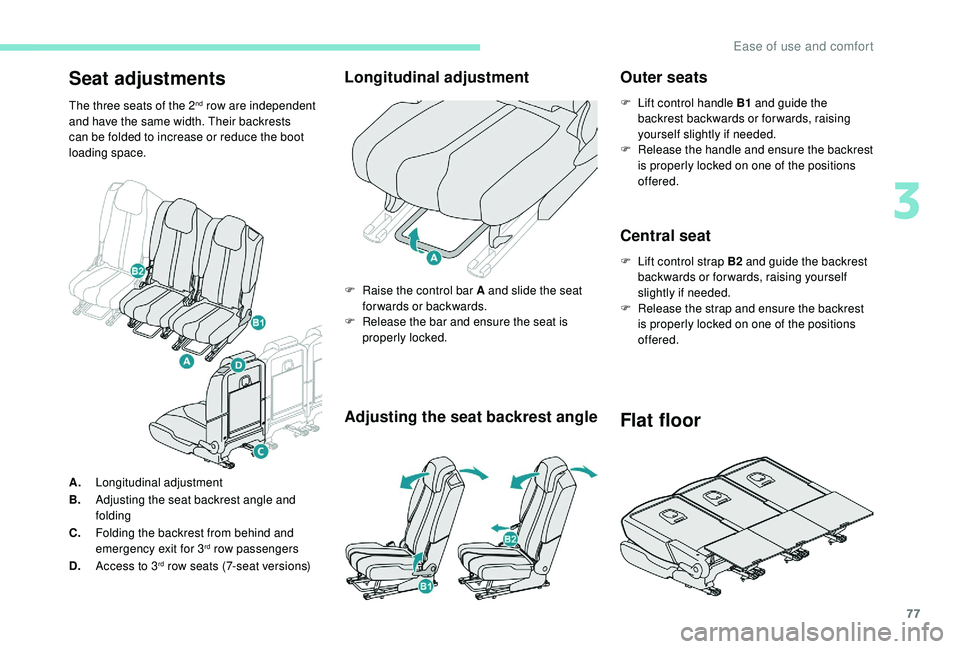
Seat adjustments
The three seats of the 2nd row are independent
and have the same width. Their backrests
can be folded to increase or reduce the boot
loading space.
Longitudinal adjustment
A. Longitudinal adjustment
B. Adjusting the seat backrest angle and
folding
C. Folding the backrest from behind and
emergency exit for 3
rd row passengers
D. Access to 3rd row seats (7-seat versions)
Adjusting the seat backrest angle Outer seats
F Lift control handle B1
and guide the
backrest backwards or for wards, raising
yourself slightly if needed.
F
R
elease the handle and ensure the backrest
is properly locked on one of the positions
offered.
Central seat
F Lift control strap B2 and guide the backrest
backwards or for wards, raising yourself
slightly if needed.
F
R
elease the strap and ensure the backrest
is properly locked on one of the positions
offered.
F
R
aise the control bar A and slide the seat
forwards or backwards.
F
R
elease the bar and ensure the seat is
properly locked.
Flat floor
3
Ease of use and comfort
Page 80 of 364
78
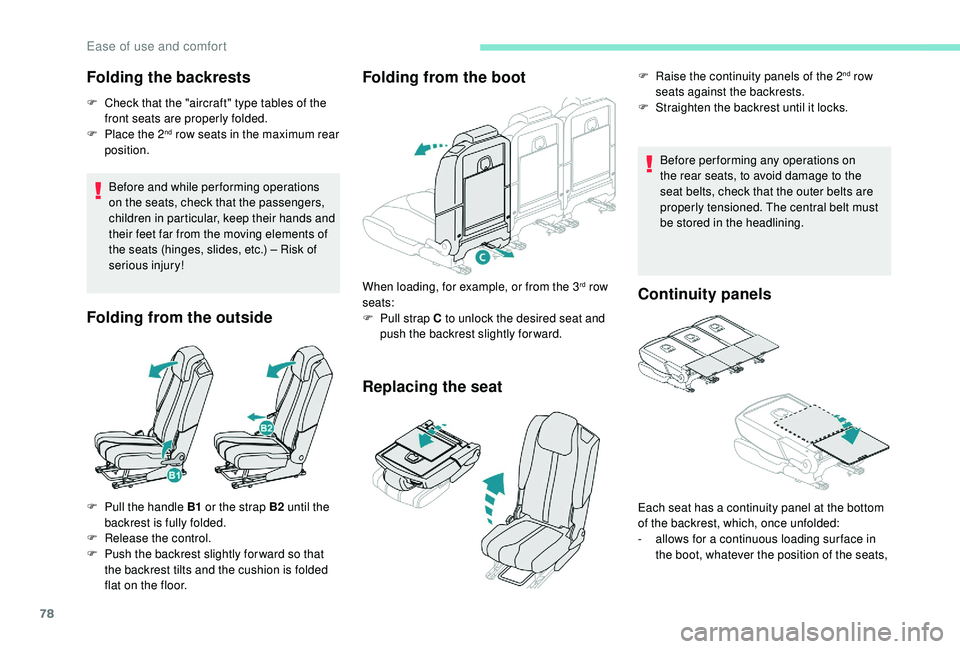
Folding the backrests
F Check that the "aircraft" type tables of the front seats are properly folded.
F
P
lace the 2
nd row seats in the maximum rear
position.
Before and while per forming operations
on the seats, check that the passengers,
children in particular, keep their hands and
their feet far from the moving elements of
the seats (hinges, slides, etc.) – Risk of
serious injury!
Folding from the outside Folding from the boot
Replacing the seat
Before performing any operations on
the rear seats, to avoid damage to the
seat belts, check that the outer belts are
properly tensioned. The central belt must
be stored in the headlining.
Continuity panels
F Pull the handle B1
or the strap B2 until the
backrest is fully folded.
F
R
elease the control.
F
P
ush the backrest slightly for ward so that
the backrest tilts and the cushion is folded
flat on the floor. When loading, for example, or from the 3
rd row
seats:
F
P
ull strap C to unlock the desired seat and
push the backrest slightly for ward. F
R
aise the continuity panels of the 2
nd row
seats against the backrests.
F
S
traighten the backrest until it locks.
Each seat has a
continuity panel at the bottom
of the backrest, which, once unfolded:
-
a
llows for a
continuous loading sur face in
the boot, whatever the position of the seats,
Ease of use and comfort
Page 81 of 364
79
These continuity panels are not designed
to support a weight greater than 30 kg.
Before deploying the continuity panels,
check that the 2
nd row seats are pulled as
far back as possible.
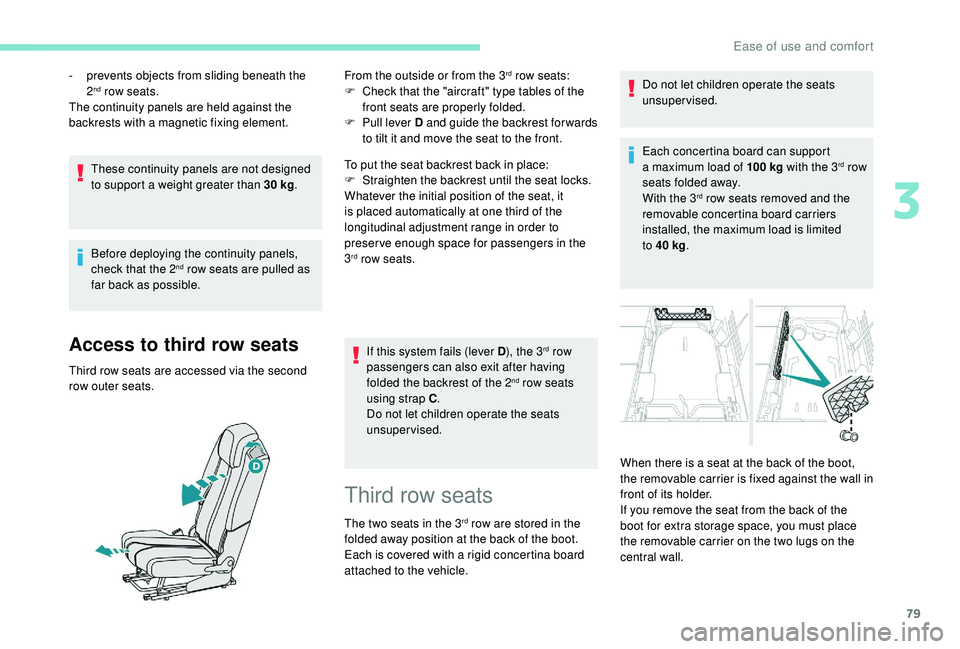
Access to third row seats
Third row seats are accessed via the second
row outer seats. From the outside or from the 3
rd row seats:
F
C
heck that the "aircraft" type tables of the
front seats are properly folded.
F
P
ull lever D and guide the backrest for wards
to tilt it and move the seat to the front.
To put the seat backrest back in place:
F
S
traighten the backrest until the seat locks.
Whatever the initial position of the seat, it
is placed automatically at one third of the
longitudinal adjustment range in order to
preserve enough space for passengers in the
3
rd row seats.
If this system fails (lever D ), the 3
rd row
passengers can also exit after having
folded the backrest of the 2
nd row seats
using strap C .
Do not let children operate the seats
unsupervised.
-
p
revents objects from sliding beneath the
2
nd row seats.
The continuity panels are held against the
backrests with a
magnetic fixing element.
Third row seats
The two seats in the 3rd row are stored in the
folded away position at the back of the boot.
Each is covered with a
rigid concertina board
attached to the vehicle. Do not let children operate the seats
unsupervised.
Each concertina board can support
a
maximum load of 100
kg
with the 3
rd row
seats folded away.
With the 3
rd row seats removed and the
removable concertina board carriers
installed, the maximum load is limited
to 40
kg .
When there is a
seat at the back of the boot,
the removable carrier is fixed against the wall in
front of its holder.
If you remove the seat from the back of the
boot for extra storage space, you must place
the removable carrier on the two lugs on the
central wall.
3
Ease of use and comfort
Page 82 of 364
80
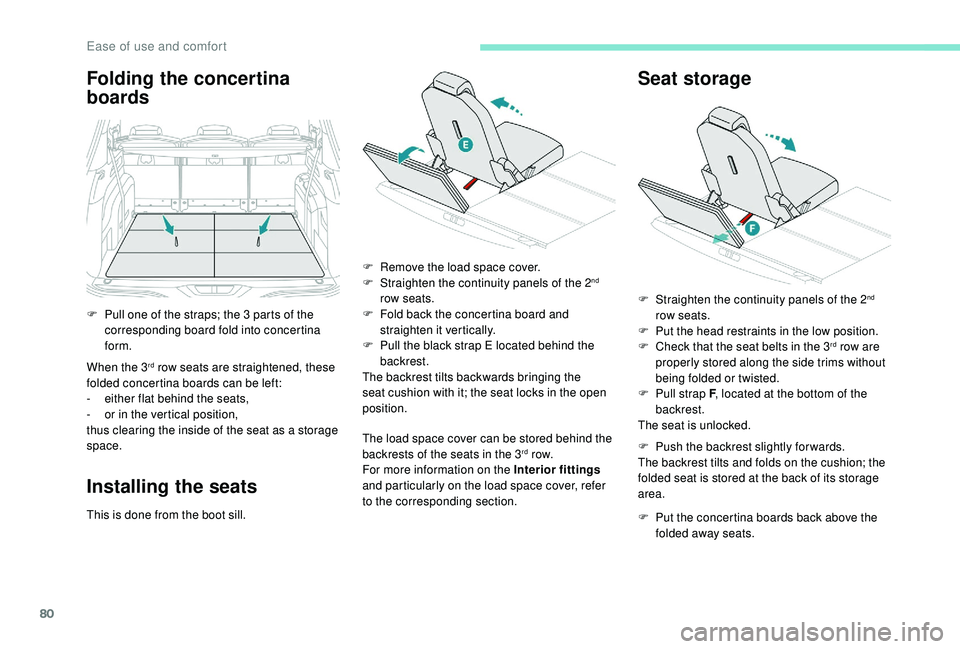
Folding the concertina
boards
When the 3rd row seats are straightened, these
folded concertina boards can be left:
-
ei
ther flat behind the seats,
-
o
r in the vertical position,
thus clearing the inside of the seat as a
storage
space.
Installing the seats
This is done from the boot sill. F
R
emove the load space cover.
F
S
traighten the continuity panels of the 2
nd
row seats.
F
F
old back the concertina board and
straighten it vertically.
F
P
ull the black strap E located behind the
backrest.
The backrest tilts backwards bringing the
seat cushion with it; the seat locks in the open
position.
The load space cover can be stored behind the
backrests of the seats in the 3
rd row.
For more information on the Interior fittings
and particularly on the load space cover, refer
to the corresponding section.
Seat storage
F Pull one of the straps; the 3 parts of the
corresponding board fold into concertina
form. F
S traighten the continuity panels of the 2
nd
row seats.
F
P
ut the head restraints in the low position.
F
C
heck that the seat belts in the 3
rd row are
properly stored along the side trims without
being folded or twisted.
F
P
ull strap F , located at the bottom of the
backrest.
The seat is unlocked.
F
P
ush the backrest slightly for wards.
The backrest tilts and folds on the cushion; the
folded seat is stored at the back of its storage
area.
F
P
ut the concertina boards back above the
folded away seats.
Ease of use and comfort
Page 83 of 364
81
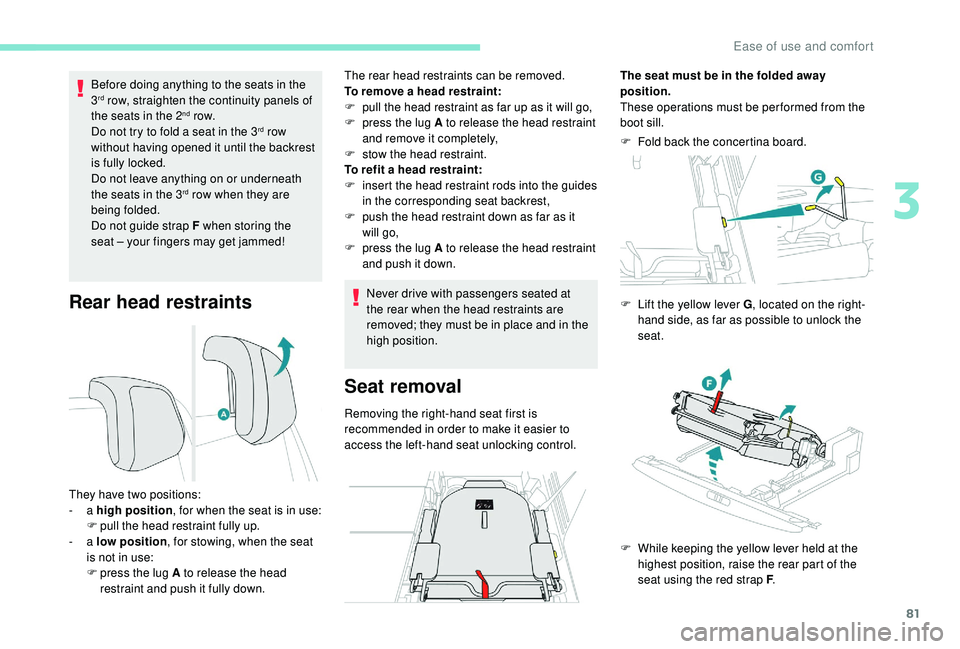
Rear head restraints
Before doing anything to the seats in the
3rd row, straighten the continuity panels of
the seats in the 2nd row.
Do not try to fold a
seat in the 3rd row
without having opened it until the backrest
is fully locked.
Do not leave anything on or underneath
the seats in the 3
rd row when they are
being folded.
Do not guide strap F when storing the
seat – your fingers may get jammed!
They have two positions:
-
a high position , for when the seat is in use:
F
p
ull the head restraint fully up.
-
a low position , for stowing, when the seat
is not in use:
F
p
ress the lug A to release the head
restraint and push it fully down. The rear head restraints can be removed.
To remove a
head restraint:
F
p
ull the head restraint as far up as it will go,
F
p
ress the lug A to release the head restraint
and remove it completely,
F
s
tow the head restraint.
To refit a head restraint:
F i nsert the head restraint rods into the guides
in the corresponding seat backrest,
F
p
ush the head restraint down as far as it
will go,
F
p
ress the lug A to release the head restraint
and push it down.
Never drive with passengers seated at
the rear when the head restraints are
removed; they must be in place and in the
high position.
Seat removal
Removing the right-hand seat first is
recommended in order to make it easier to
access the left-hand seat unlocking control. F
F
old back the concertina board.
The seat must be in the folded away
position.
These operations must be performed from the
boot sill.
F
L
ift the yellow lever G
, located on the right-
hand side, as far as possible to unlock the
seat.
F
W
hile keeping the yellow lever held at the
highest position, raise the rear part of the
seat using the red strap F .
3
Ease of use and comfort