boot PEUGEOT 5008 2018 Owner's Manual
[x] Cancel search | Manufacturer: PEUGEOT, Model Year: 2018, Model line: 5008, Model: PEUGEOT 5008 2018Pages: 364, PDF Size: 13.03 MB
Page 84 of 364
82
Replacing the seats
These operations must be performed from the
boot sill.As long as the seat is not correctly in
position, it must be held with both hands
by the sides, keeping it folded.
F
C
heck in advance that the seat storage well
is empty and that the movable carrier is
properly secured against the front wall. Check that the front hooks of the seat are
properly located on the two lugs.
If they are not, you must lift the seat and
start the procedure again.If the seat is not per fectly horizontal, do
not press on the backrest and do not
tr y to unfold it – Risk of damaging the
mechanism!
Take out the seat and start the operation
again.
Seat modularity
Configuration examples
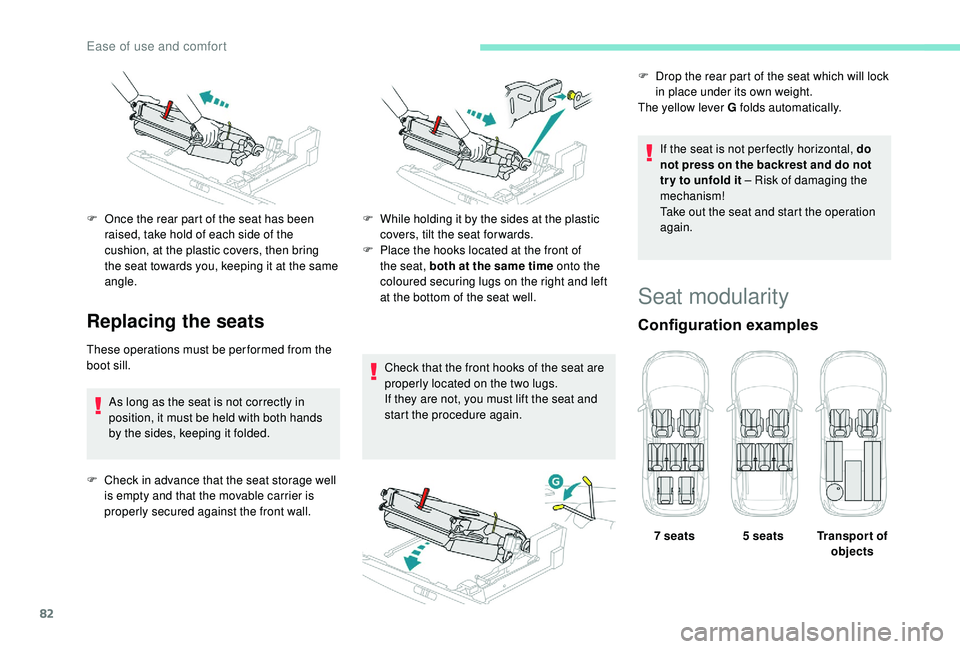
F Once the rear part of the seat has been
raised, take hold of each side of the
cushion, at the plastic covers, then bring
the seat towards you, keeping it at the same
angle. F
W hile holding it by the sides at the plastic
covers, tilt the seat for wards.
F
P
lace the hooks located at the front of
the seat, both at the same time onto the
coloured securing lugs on the right and left
at the bottom of the seat well. F
D
rop the rear part of the seat which will lock
in place under its own weight.
The yellow lever G folds automatically.
7 seats 5 seats Transpor t of objects
Ease of use and comfort
Page 87 of 364
85
To close the air vents:
F s ide vents; place the slider in the central
position, then move it sideways towards the
d o o r.
F
c
entral vents; place the slider in the central
position, then move it sideways towards
you. Recommendations for ventilation and
air conditioning
In order for these systems to be fully
effective, follow the operation and
maintenance guidelines below:
F
T
o ensure that the air is distributed
evenly, keep the external air intake
grilles at the base of the windscreen,
the nozzles, the vents, the air outlets
and the air extractor in the boot free
from obstructions.
F
D
o not cover the sunshine sensor,
located on the dashboard; this is used
for regulation of the automatic air
conditioning system.
F
O
perate the air conditioning system for
at least 5
to 10 minutes once or twice
a
month to keep it in per fect working
o r d e r.
F
E
nsure that the passenger
compartment filter is in good condition
and have the filter elements replaced
regularly. We recommend the use of
a
combined passenger compartment
filter. Thanks to its special active
additive, it contributes to the purification
of the air breathed by the occupants
and the cleanliness of the passenger
compartment (reduction of allergic
symptoms, bad odours and greasy
deposits). F
T
o ensure correct operation of the
air conditioning system, you are also
advised to have it checked regularly
as recommended in the Warranty and
Maintenance Record.
F
I
f the system does not produce cold air,
switch it off and contact a
PEUGEOT
dealer or a
qualified workshop.
When towing the maximum load on a
steep
gradient in high temperatures, switching off
the air conditioning increases the available
engine power and so improves the towing
ability.
6.
Air outlets to the rear footwells.
7. Adjustable air vents with blower.
3
Ease of use and comfort
Page 110 of 364
108
Always guide the blind slowly using the
tab, both up and down.
Storage boxes
Depending on version, the storage boxes are
fitted in the floor, at the foot of the outer seats
on the second row.
On the left side, it may also contain the
temporary puncture repair kit.
To open them, lift the cover by the notch.
Boot fittings
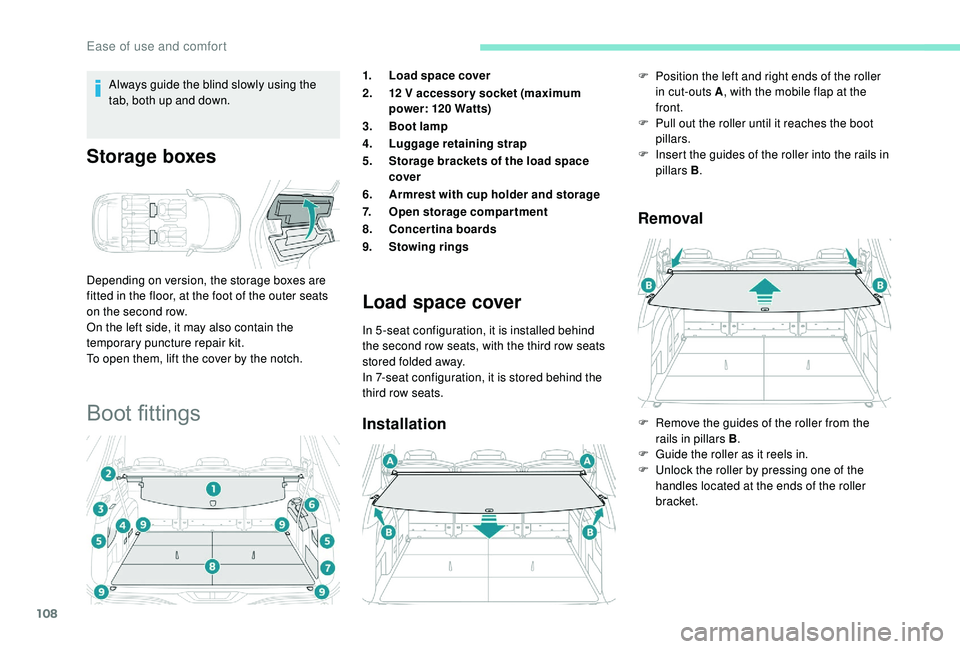
1.Load space cover
2. 12
V accessor y socket (maximum
power: 120
Watts)
3. Boot lamp
4. Luggage retaining strap
5. Storage brackets of the load space
cover
6. Armrest with cup holder and storage
7. Open storage compartment
8. Concertina boards
9. Stowing rings
Load space cover
In 5 -seat configuration, it is installed behind
the second row seats, with the third row seats
stored folded away.
In 7-seat configuration, it is stored behind the
third row seats.
Installation Removal
F Position the left and right ends of the roller
in cut-outs A , with the mobile flap at the
front.
F
P
ull out the roller until it reaches the boot
pillars.
F
I
nsert the guides of the roller into the rails in
pillars B .
F
R
emove the guides of the roller from the
rails in pillars B .
F
G
uide the roller as it reels in.
F
U
nlock the roller by pressing one of the
handles located at the ends of the roller
bracket.
Ease of use and comfort
Page 111 of 364
109
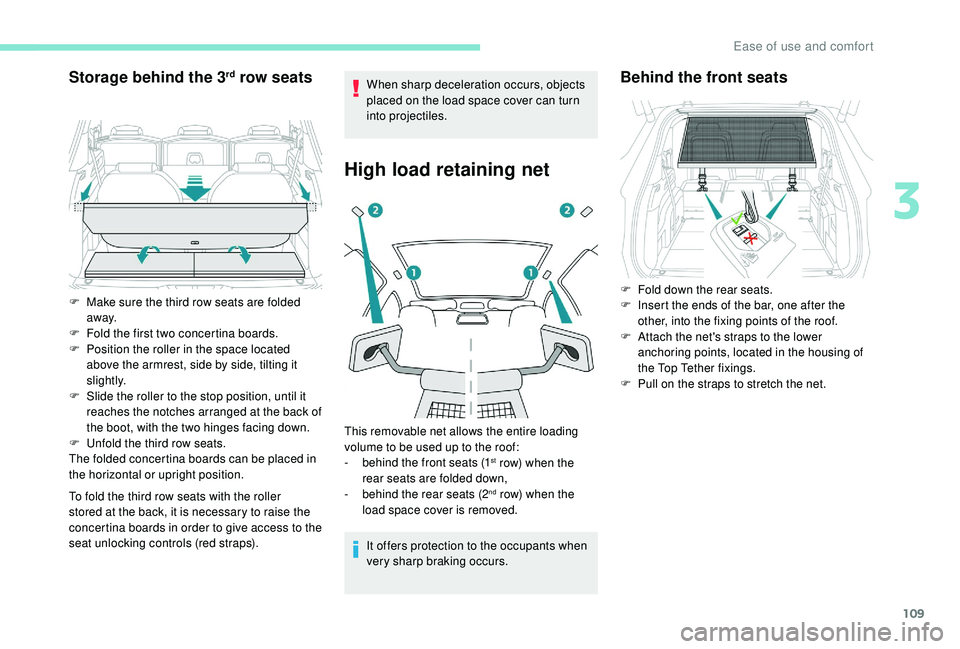
Storage behind the 3rd row seats
To fold the third row seats with the roller
stored at the back, it is necessary to raise the
concertina boards in order to give access to the
seat unlocking controls (red straps).When sharp deceleration occurs, objects
placed on the load space cover can turn
into projectiles.
High load retaining net
It offers protection to the occupants when
very sharp braking occurs.
Behind the front seats
F Make sure the third row seats are folded
away.
F
F
old the first two concertina boards.
F
P
osition the roller in the space located
above the armrest, side by side, tilting it
s l i g ht l y.
F
S
lide the roller to the stop position, until it
reaches the notches arranged at the back of
the boot, with the two hinges facing down.
F
U
nfold the third row seats.
The folded concertina boards can be placed in
the horizontal or upright position. This removable net allows the entire loading
volume to be used up to the roof:
-
b
ehind the front seats (1
st row) when the
rear seats are folded down,
-
b
ehind the rear seats (2
nd row) when the
load space cover is removed. F
F
old down the rear seats.
F
I
nsert the ends of the bar, one after the
other, into the fixing points of the roof.
F
A
ttach the net's straps to the lower
anchoring points, located in the housing of
the Top Tether fixings.
F
P
ull on the straps to stretch the net.
3
Ease of use and comfort
Page 112 of 364
110
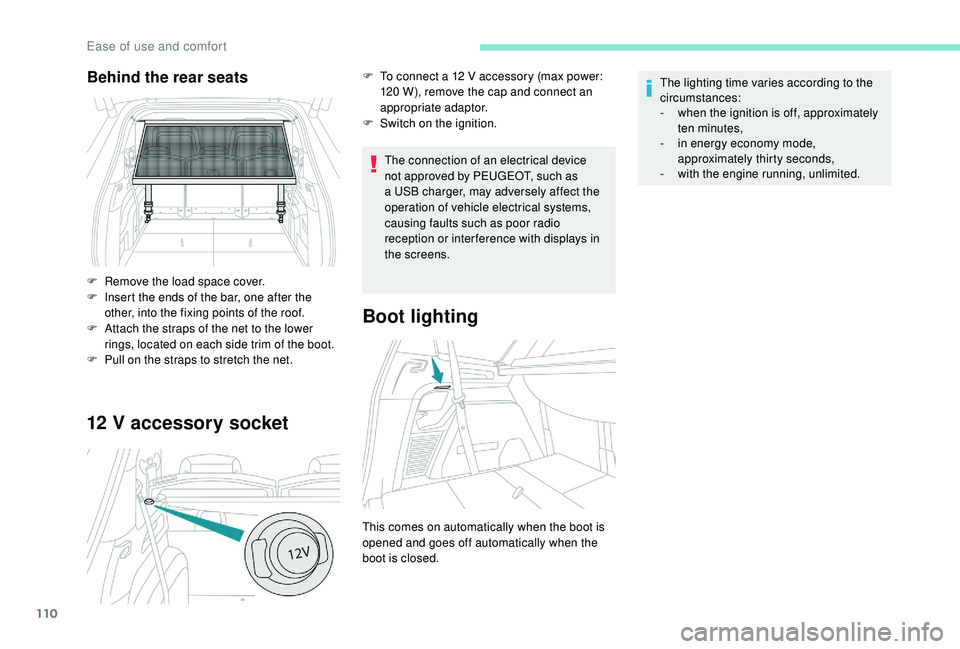
12 V accessory socket
The connection of an electrical device
not approved by PEUGEOT, such as
a
USB charger, may adversely affect the
operation of vehicle electrical systems,
causing faults such as poor radio
reception or inter ference with displays in
the screens.
Boot lighting
This comes on automatically when the boot is
opened and goes off automatically when the
boot is closed. The lighting time varies according to the
circumstances:
-
w
hen the ignition is off, approximately
ten minutes,
-
i
n energy economy mode,
approximately thirty seconds,
-
w
ith the engine running, unlimited.
Behind the rear seats
F Remove the load space cover.
F
I nsert the ends of the bar, one after the
other, into the fixing points of the roof.
F
A
ttach the straps of the net to the lower
rings, located on each side trim of the boot.
F
P
ull on the straps to stretch the net. F
T
o connect a 12 V accessory (max power:
120 W), remove the cap and connect an
appropriate adaptor.
F
S
witch on the ignition.
Ease of use and comfort
Page 116 of 364
114
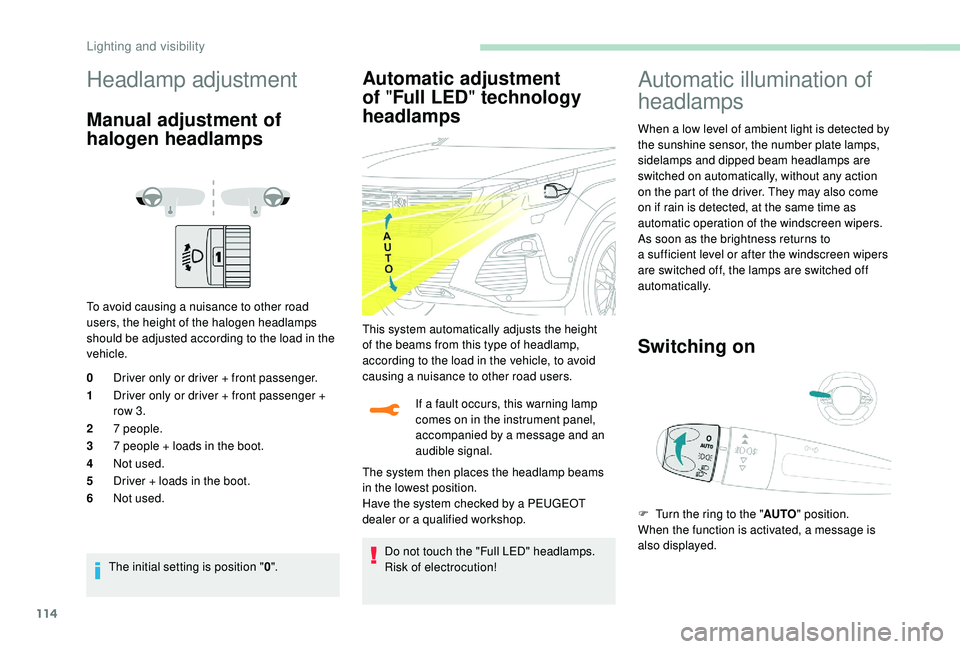
Headlamp adjustment
Manual adjustment of
halogen headlamps
To avoid causing a nuisance to other road
u sers, the height of the halogen headlamps
should be adjusted according to the load in the
vehicle.
0 Driver only or driver + front passenger.
1 Driver only or driver + front passenger +
row 3.
2 7
people.
3 7
people + loads in the boot.
4 Not used.
5 Driver + loads in the boot.
6 Not used.
The initial setting is position " 0".
Automatic adjustment
of "Full LED " technology
headlamps
If a fault occurs, this warning lamp
c omes on in the instrument panel,
accompanied by a
message and an
audible signal.
Do not touch the "Full LED" headlamps.
Risk of electrocution!
Automatic illumination of
headlamps
When a low level of ambient light is detected by
t he sunshine sensor, the number plate lamps,
sidelamps and dipped beam headlamps are
switched on automatically, without any action
on the part of the driver. They may also come
on if rain is detected, at the same time as
automatic operation of the windscreen wipers.
As soon as the brightness returns to
a
sufficient level or after the windscreen wipers
are switched off, the lamps are switched off
automatically.
Switching on
This system automatically adjusts the height
of the beams from this type of headlamp,
according to the load in the vehicle, to avoid
causing a
nuisance to other road users.
The system then places the headlamp beams
in the lowest position.
Have the system checked by a
PEUGEOT
dealer or a
qualified workshop. F
T
urn the ring to the "AUTO" position.
When the function is activated, a message is
also displayed.
Lighting and visibility
Page 134 of 364
132
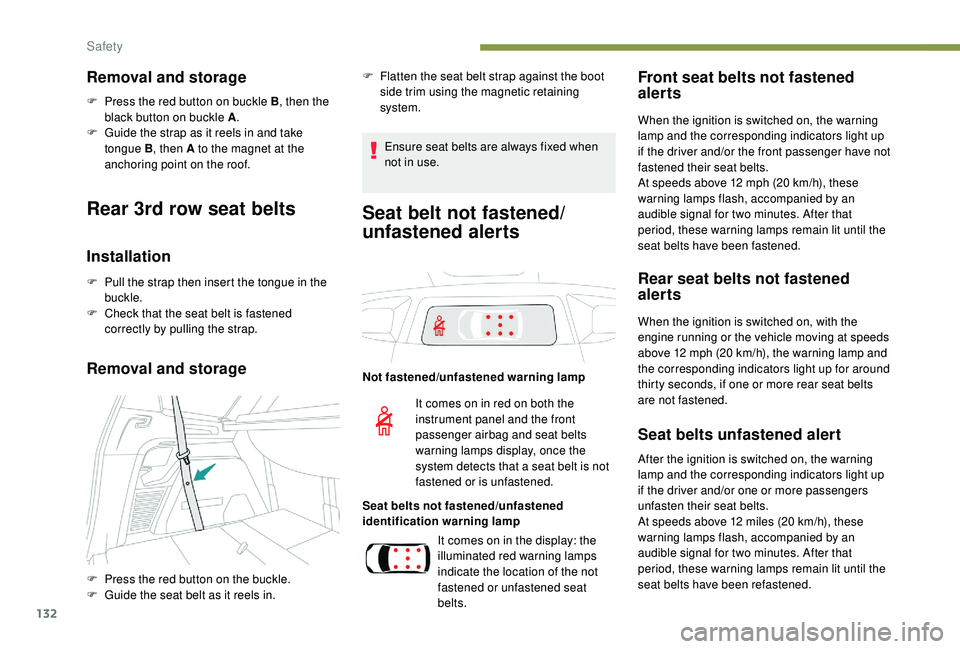
Removal and storage
F Press the red button on buckle B, then the
black button on buckle A .
F
G
uide the strap as it reels in and take
tongue B , then A to the magnet at the
anchoring point on the roof.
Rear 3rd row seat belts
Installation
F Pull the strap then insert the tongue in the buckle.
F
C
heck that the seat belt is fastened
correctly by pulling the strap.
Removal and storage
Ensure seat belts are always fixed when
not in use.
Seat belt not fastened/
unfastened alerts
Not fastened/unfastened warning lamp
Seat belts not fastened/unfastened
identification warning lamp
Front seat belts not fastened
alerts
When the ignition is switched on, the warning
lamp and the corresponding indicators light up
if the driver and/or the front passenger have not
fastened their seat belts.
At speeds above 12
mph (20 km/h), these
warning lamps flash, accompanied by an
audible signal for two minutes. After that
period, these warning lamps remain lit until the
seat belts have been fastened.
Rear seat belts not fastened
alerts
When the ignition is switched on, with the
engine running or the vehicle moving at speeds
above 12
mph (20 km/h), the warning lamp and
the corresponding indicators light up for around
thirty seconds, if one or more rear seat belts
are not fastened.
Seat belts unfastened alert
F Flatten the seat belt strap against the boot side trim using the magnetic retaining
system.
F
P
ress the red button on the buckle.
F
G
uide the seat belt as it reels in. It comes on in red on both the
instrument panel and the front
passenger airbag and seat belts
warning lamps display, once the
system detects that a
seat belt is not
fastened or is unfastened.
It comes on in the display: the
illuminated red warning lamps
indicate the location of the not
fastened or unfastened seat
belts. After the ignition is switched on, the warning
lamp and the corresponding indicators light up
if the driver and/or one or more passengers
unfasten their seat belts.
At speeds above 12
miles (20 km/h), these
warning lamps flash, accompanied by an
audible signal for two minutes. After that
period, these warning lamps remain lit until the
seat belts have been refastened.
Safety
Page 209 of 364
207
- Certain materials (fabrics) absorb sound waves: pedestrians may not be detected.
-
A
ccumulated snow or dead leaves on the
road sur face can inter fere with the vehicle's
sensors.
-
A f
ront or rear impact to the vehicle can
distort the settings of the sensors, which is
not always detected by the system: distance
measurements may be incorrect.
-
T
he tilting of the vehicle if the boot is
very loaded can affect the distance
measurements.
-
T
he sensors may be affected by poor
weather conditions (heavy rain, thick fog,
snowfall, etc.).
Recommendations on care
In bad or wintry weather, ensure that the
sensors are not covered with mud, ice or
snow. When reverse gear is engaged, an
audible signal (long beep) indicates that
the sensors may be dirty. High pressure washing
When washing your vehicle, direct the
lance at least 30
cm away from the
sensors.
Operating fault
If a fault occurs when shifting
t o reverse, this warning lamp
comes on in the instrument panel,
accompanied by a
message and an
audible signal (short beep).
Contact a
PEUGEOT dealer or a qualified
workshop to have the system checked.
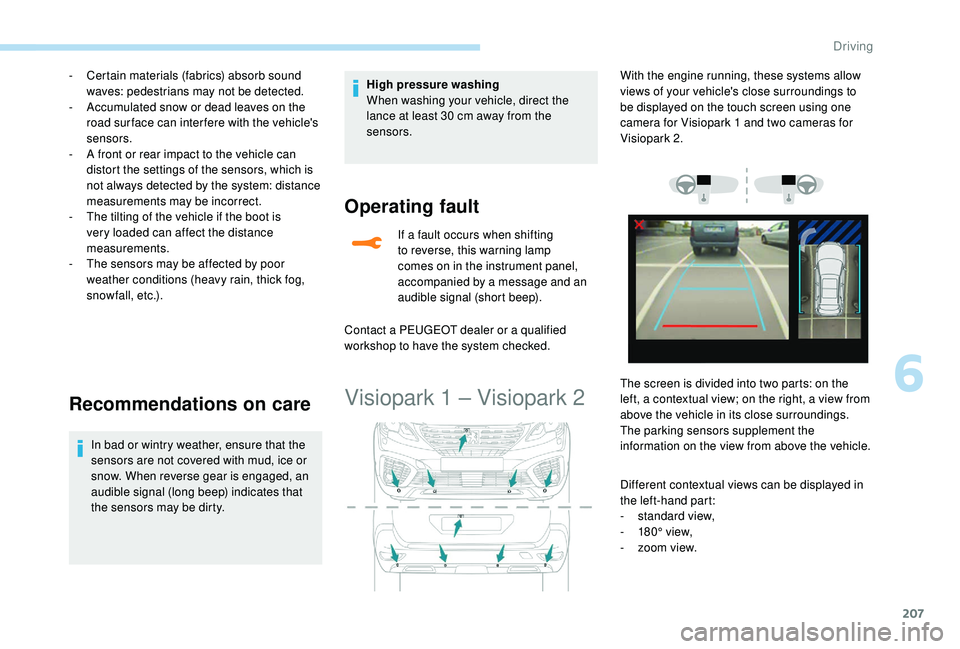
Visiopark 1 – Visiopark 2
Different contextual views can be displayed in
the left-hand part:
-
s
tandard view,
-
1
80° view,
-
z
oom view.
With the engine running, these systems allow
views of your vehicle's close surroundings to
be displayed on the touch screen using one
camera for Visiopark 1
and two cameras for
Visiopark 2.
The screen is divided into two parts: on the
left, a contextual view; on the right, a view from
above the vehicle in its close surroundings.
The parking sensors supplement the
information on the view from above the vehicle.
6
Driving
Page 229 of 364
227
Maintenance
Correct operation is only possible if the towball
and its carrier are kept clean.
Before cleaning the vehicle with a high-
pressure jet wash, the towball must be removed
and the protective plug fitted to the carrier.
Apply the label provided to a
clearly visible
area, close to the carrier or in the boot.
Go to a
PEUGEOT dealer or a qualified
workshop for any work on the towbar
system.
Load reduction mode
System which manages the use of certain
functions according to the level of charge
remaining in the battery.
When the vehicle is being driven, the load
reduction function temporarily deactivates
certain functions, such as air conditioning,
heated rear screen, etc.
The deactivated functions are reactivated
automatically as soon as conditions permit.
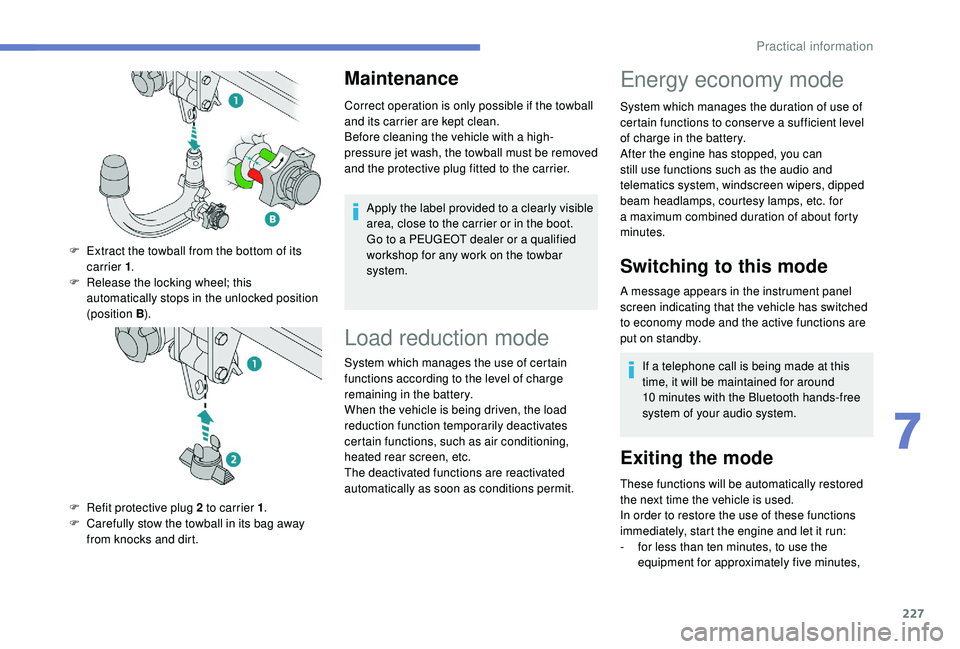
F
E
xtract the towball from the bottom of its
carrier 1 .
F
R
elease the locking wheel; this
automatically stops in the unlocked position
(position B ).
F
R
efit protective plug 2
to carrier 1 .
F
C
arefully stow the towball in its bag away
from knocks and dirt.
Energy economy mode
System which manages the duration of use of
certain functions to conser ve a sufficient level
of charge in the battery.
After the engine has stopped, you can
still use functions such as the audio and
telematics system, windscreen wipers, dipped
beam headlamps, courtesy lamps, etc. for
a
maximum combined duration of about forty
minutes.
Switching to this mode
A message appears in the instrument panel
screen indicating that the vehicle has switched
to economy mode and the active functions are
put on standby.
If a
telephone call is being made at this
time, it will be maintained for around
10
minutes with the Bluetooth hands-free
system of your audio system.
Exiting the mode
These functions will be automatically restored
the next time the vehicle is used.
In order to restore the use of these functions
immediately, start the engine and let it run:
-
f
or less than ten minutes, to use the
equipment for approximately five minutes,
7
Practical information
Page 244 of 364
242
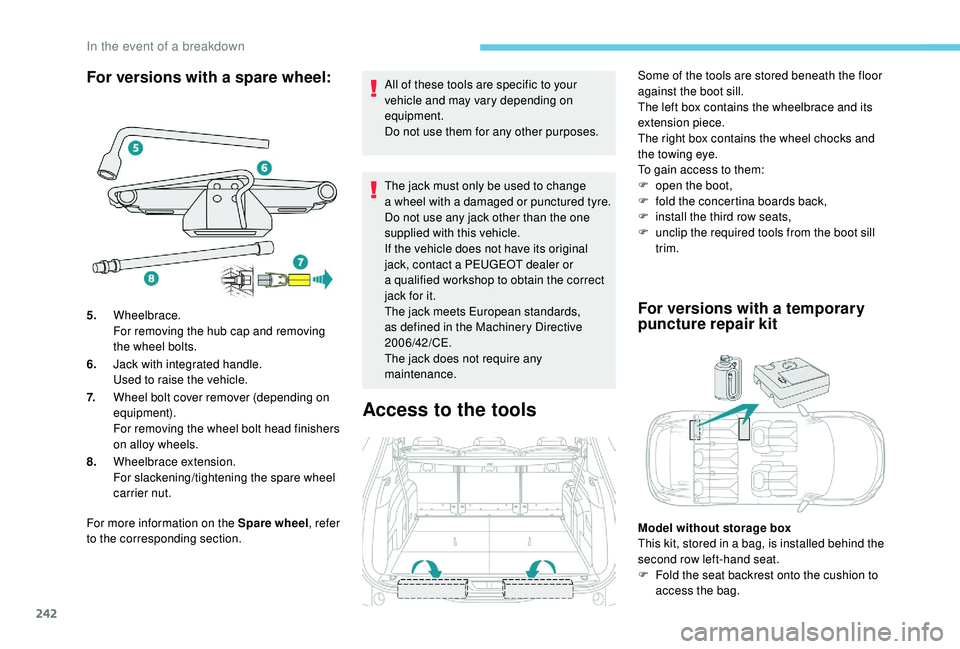
For versions with a spare wheel:
For more information on the Spare wheel, refer
to the corresponding section. All of these tools are specific to your
vehicle and may vary depending on
equipment.
Do not use them for any other purposes.
The jack must only be used to change
a
wheel with a damaged or punctured tyre.
Do not use any jack other than the one
supplied with this vehicle.
If the vehicle does not have its original
jack, contact a PEUGEOT dealer or
a qualified workshop to obtain the correct
jack for it.
The jack meets European standards,
as defined in the Machinery Directive
2006/42/CE.
The jack does not require any
maintenance.
Access to the tools
Some of the tools are stored beneath the floor
against the boot sill.
The left box contains the wheelbrace and its
extension piece.
The right box contains the wheel chocks and
the towing eye.
To gain access to them:
F
o
pen the boot,
F
fo
ld the concertina boards back,
F
i
nstall the third row seats,
F
u
nclip the required tools from the boot sill
trim.
5. Wheelbrace.
For removing the hub cap and removing
the wheel bolts.
6. Jack with integrated handle.
Used to raise the vehicle.
7. Wheel bolt cover remover (depending on
equipment).
For removing the wheel bolt head finishers
on alloy wheels.
8. Wheelbrace extension.
For slackening/tightening the spare wheel
carrier nut.
For versions with a temporary
p uncture repair kit
Model without storage box
This kit, stored in a
bag, is installed behind the
second row left-hand seat.
F
F
old the seat backrest onto the cushion to
access the bag.
In the event of a breakdown