turn signal PEUGEOT 5008 2018 Owners Manual
[x] Cancel search | Manufacturer: PEUGEOT, Model Year: 2018, Model line: 5008, Model: PEUGEOT 5008 2018Pages: 364, PDF Size: 13.03 MB
Page 19 of 364
17
Warning/indicator lampStateCause Action/Observations
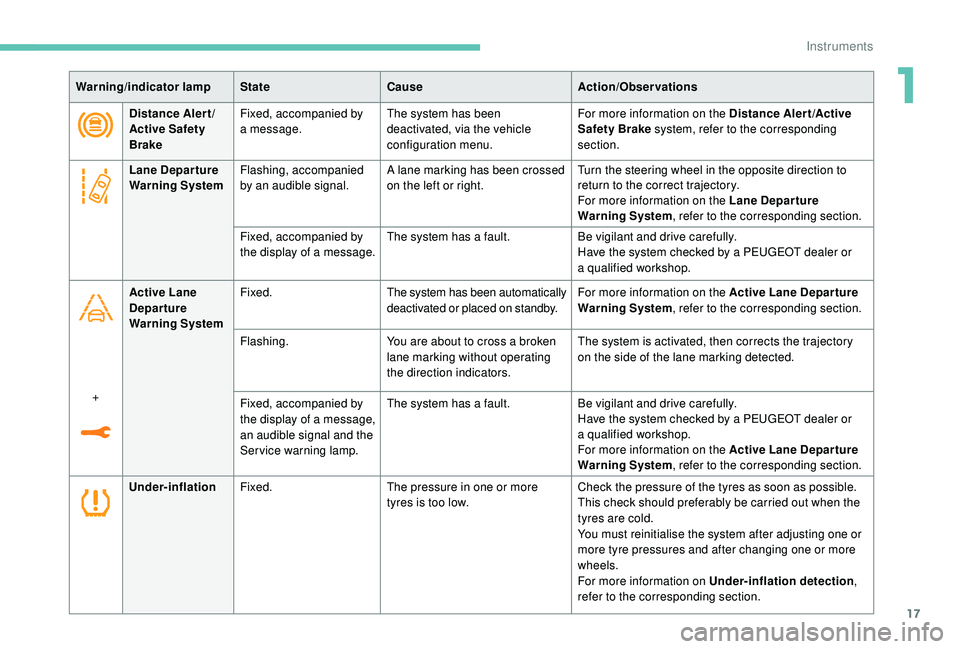
Distance Alert/
Active Safety
Brake Fixed, accompanied by
a
message.The system has been
deactivated, via the vehicle
configuration menu. For more information on the Distance Alert/Active
Safety Brake
system, refer to the corresponding
section.
Lane Depar ture
Warning System Flashing, accompanied
by an audible signal. A lane marking has been crossed
on the left or right. Turn the steering wheel in the opposite direction to
return to the correct trajectory.
For more information on the Lane Depar ture
Warning System
, refer to the corresponding section.
Fixed, accompanied by
the display of a
message.The system has a
fault.Be vigilant and drive carefully.
Have the system checked by a
PEUGEOT dealer or
a
qualified workshop.
Active Lane
Departure
Warning System Fixed.
The system has been automatically
deactivated or placed on standby. For more information on the Active Lane Depar ture
Warning System
, refer to the corresponding section.
Flashing. You are about to cross a
broken
lane marking without operating
the direction indicators. The system is activated, then corrects the trajectory
on the side of the lane marking detected.
+ Fixed, accompanied by
the display of a
message,
an audible signal and the
Service warning lamp. The system has a
fault.Be vigilant and drive carefully.
Have the system checked by a
PEUGEOT dealer or
a
qualified workshop.
For more information on the Active Lane Depar ture
Warning System , refer to the corresponding section.
Under-inflation Fixed. The pressure in one or more
tyres is too low. Check the pressure of the tyres as soon as possible.
This check should preferably be carried out when the
tyres are cold.
You must reinitialise the system after adjusting one or
more tyre pressures and after changing one or more
wheels.
For more information on Under-inflation detection
,
refer to the corresponding section.
1
Instruments
Page 24 of 364
22
Warning/indicator lampStateCause Action/Observations
+
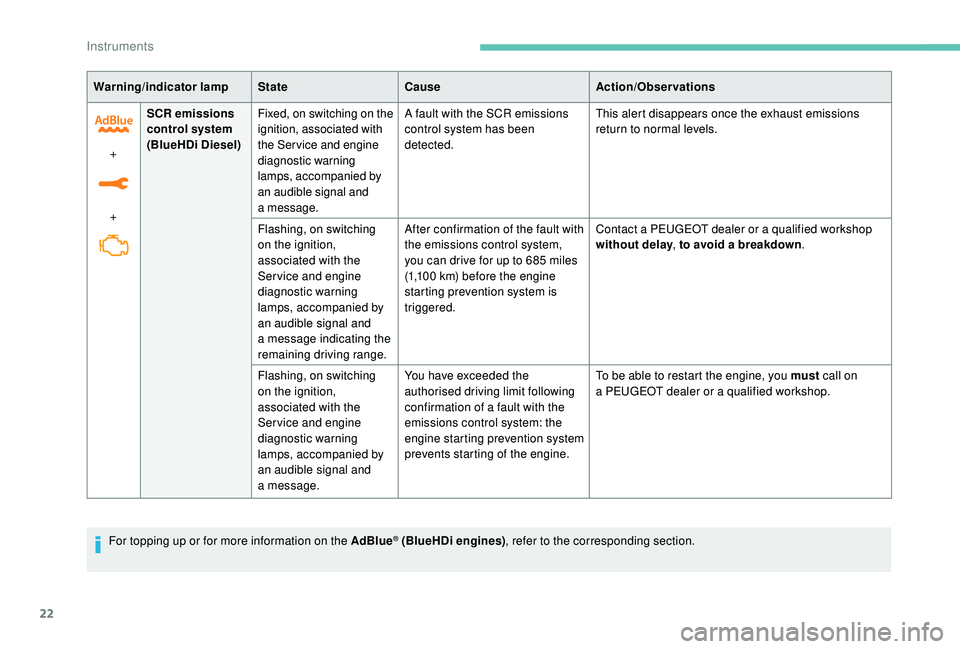
+ SCR emissions
control system
(BlueHDi Diesel)
Fixed, on switching on the
ignition, associated with
the Service and engine
diagnostic warning
lamps, accompanied by
an audible signal and
a
message.A fault with the SCR emissions
control system has been
detected.
This alert disappears once the exhaust emissions
return to normal levels.
Flashing, on switching
on the ignition,
associated with the
Service and engine
diagnostic warning
lamps, accompanied by
an audible signal and
a
message indicating the
remaining driving range. After confirmation of the fault with
the emissions control system,
you can drive for up to 685
miles
(1,100
km) before the engine
starting prevention system is
triggered. Contact a
PEUGEOT dealer or a qualified workshop
without delay , to avoid a
breakdown.
Flashing, on switching
on the ignition,
associated with the
Service and engine
diagnostic warning
lamps, accompanied by
an audible signal and
a
message.You have exceeded the
authorised driving limit following
confirmation of a
fault with the
emissions control system: the
engine starting prevention system
prevents starting of the engine. To be able to restart the engine, you must
call on
a
PEUGEOT dealer or a qualified workshop.
For topping up or for more information on the AdBlue
® (BlueHDi engines) , refer to the corresponding section.
Instruments
Page 27 of 364
25
Warning/indicator lampStateCause Action/Observations
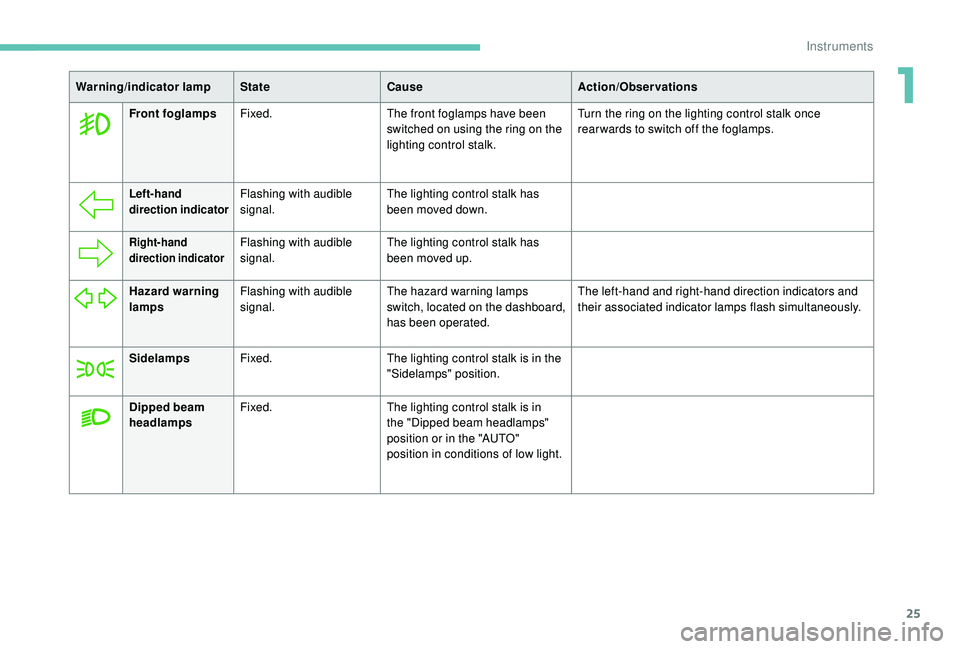
Front foglamps Fixed. The front foglamps have been
switched on using the ring on the
lighting control stalk. Turn the ring on the lighting control stalk once
rearwards to switch off the foglamps.
Left-hand
direction indicatorFlashing with audible
signal.
The lighting control stalk has
been moved down.
Right-hand
direction indicatorFlashing with audible
signal.The lighting control stalk has
been moved up.
Hazard warning
lamps Flashing with audible
signal. The hazard warning lamps
switch, located on the dashboard,
has been operated. The left-hand and right-hand direction indicators and
their associated indicator lamps flash simultaneously.
Sidelamps Fixed. The lighting control stalk is in the
"Sidelamps" position.
Dipped beam
headlamps Fixed.
The lighting control stalk is in
the "Dipped beam headlamps"
position or in the "AUTO"
position in conditions of low light.
1
Instruments
Page 98 of 364
96
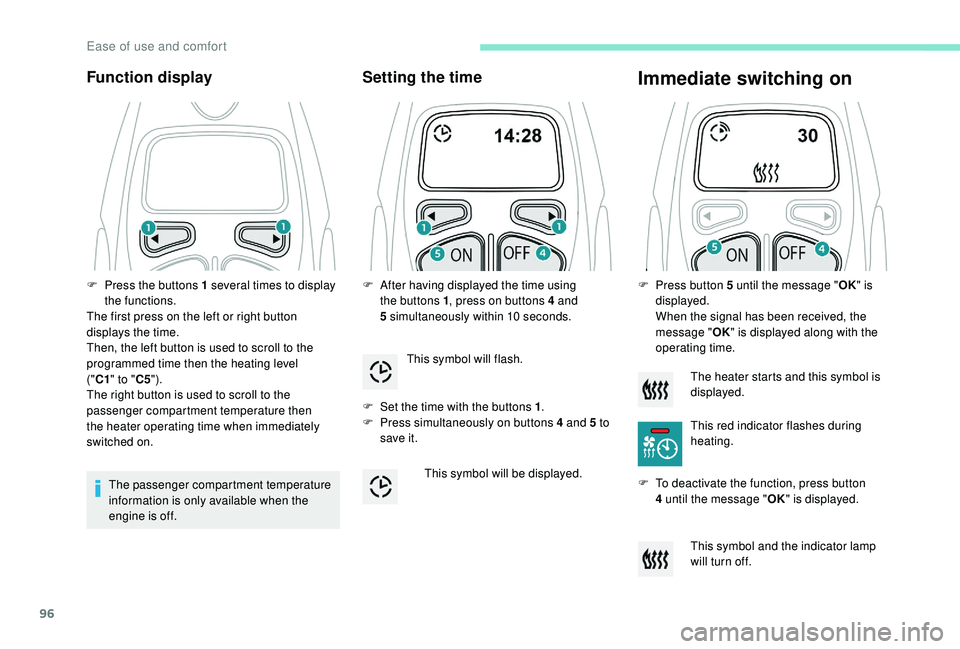
Function display
The passenger compartment temperature
information is only available when the
engine is off.
Setting the time
F Set the time with the buttons 1.
F P ress simultaneously on buttons 4 and 5 to
save it.
Immediate switching on
The heater starts and this symbol is
displayed.
This red indicator flashes during
heating.
F
T
o deactivate the function, press button
4
until the message " OK" is displayed.
F
P
ress the buttons 1
several times to display
the functions.
The first press on the left or right button
displays the time.
Then, the left button is used to scroll to the
programmed time then the heating level
("C1 " to " C5").
The right button is used to scroll to the
passenger compartment temperature then
the heater operating time when immediately
switched on. F
A
fter having displayed the time using
the buttons 1 , press on buttons 4
and
5
simultaneously within 10
seconds.
This symbol will flash.
This symbol will be displayed. F
P
ress button 5 until the message "
OK" is
displayed.
When the signal has been received, the
message " OK" is displayed along with the
operating time.
This symbol and the indicator lamp
will turn off.
Ease of use and comfort
Page 113 of 364
111
Exterior lighting control
stalk
Main lighting
Selection of main lighting mode
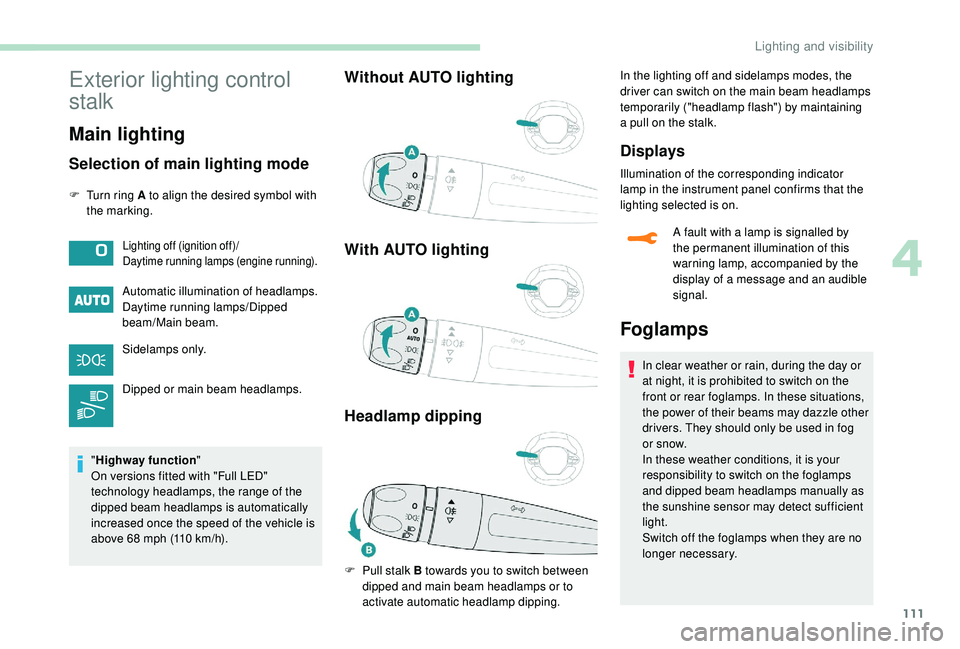
F Turn ring A to align the desired symbol with the marking.
Automatic illumination of headlamps.
Daytime running lamps/Dipped
beam/Main beam.
Sidelamps only.
Dipped or main beam headlamps.
" Highway function "
On versions fitted with "Full LED"
technology headlamps, the range of the
dipped beam headlamps is automatically
increased once the speed of the vehicle is
above 68
mph (110 km/h).
Without AUTO lighting
With AUTO lighting
Headlamp dipping
Lighting off (ignition off)/
Daytime running lamps (engine running).
In the lighting off and sidelamps modes, the
driver can switch on the main beam headlamps
temporarily ("headlamp flash") by maintaining
a pull on the stalk.
Displays
Illumination of the corresponding indicator
lamp in the instrument panel confirms that the
lighting selected is on.
F
P
ull stalk B towards you to switch between
dipped and main beam headlamps or to
activate automatic headlamp dipping. A fault with a
lamp is signalled by
the permanent illumination of this
warning lamp, accompanied by the
display of a
message and an audible
signal.
Foglamps
In clear weather or rain, during the day or
at night, it is prohibited to switch on the
front or rear foglamps. In these situations,
the power of their beams may dazzle other
drivers. They should only be used in fog
or snow.
In these weather conditions, it is your
responsibility to switch on the foglamps
and dipped beam headlamps manually as
the sunshine sensor may detect sufficient
light.
Switch off the foglamps when they are no
longer necessary.
4
Lighting and visibility
Page 114 of 364
112
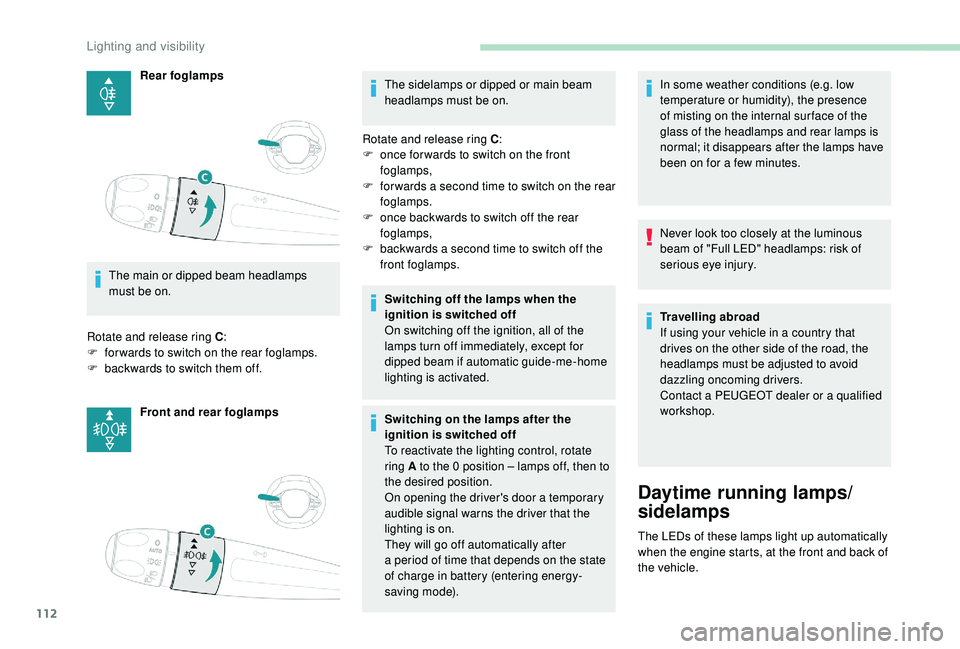
Rear foglamps
The main or dipped beam headlamps
must be on.
Rotate and release ring C :
F
fo
rwards to switch on the rear foglamps.
F
b
ackwards to switch them off. Front and rear foglamps The sidelamps or dipped or main beam
headlamps must be on.
Rotate and release ring C :
F
o
nce for wards to switch on the front
foglamps,
F
f
or wards a second time to switch on the rear
foglamps.
F
o
nce backwards to switch off the rear
foglamps,
F
b
ackwards a second time to switch off the
front foglamps.
Switching off the lamps when the
ignition is switched off
On switching off the ignition, all of the
lamps turn off immediately, except for
dipped beam if automatic guide-me-home
lighting is activated.
Switching on the lamps after the
ignition is switched off
To reactivate the lighting control, rotate
ring A to the 0
position – lamps off, then to
the desired position.
On opening the driver's door a
temporary
audible signal warns the driver that the
lighting is on.
They will go off automatically after
a
period of time that depends on the state
of charge in battery (entering energy-
saving mode). In some weather conditions (e.g. low
temperature or humidity), the presence
of misting on the internal sur face of the
glass of the headlamps and rear lamps is
normal; it disappears after the lamps have
been on for a
few minutes.
Never look too closely at the luminous
beam of "Full LED" headlamps: risk of
serious eye injury.
Travelling abroad
If using your vehicle in a
country that
drives on the other side of the road, the
headlamps must be adjusted to avoid
dazzling oncoming drivers.
Contact a
PEUGEOT dealer or a qualified
workshop.
Daytime running lamps/
sidelamps
The LEDs of these lamps light up automatically
when the engine starts, at the front and back of
the vehicle.
Lighting and visibility
Page 115 of 364
113
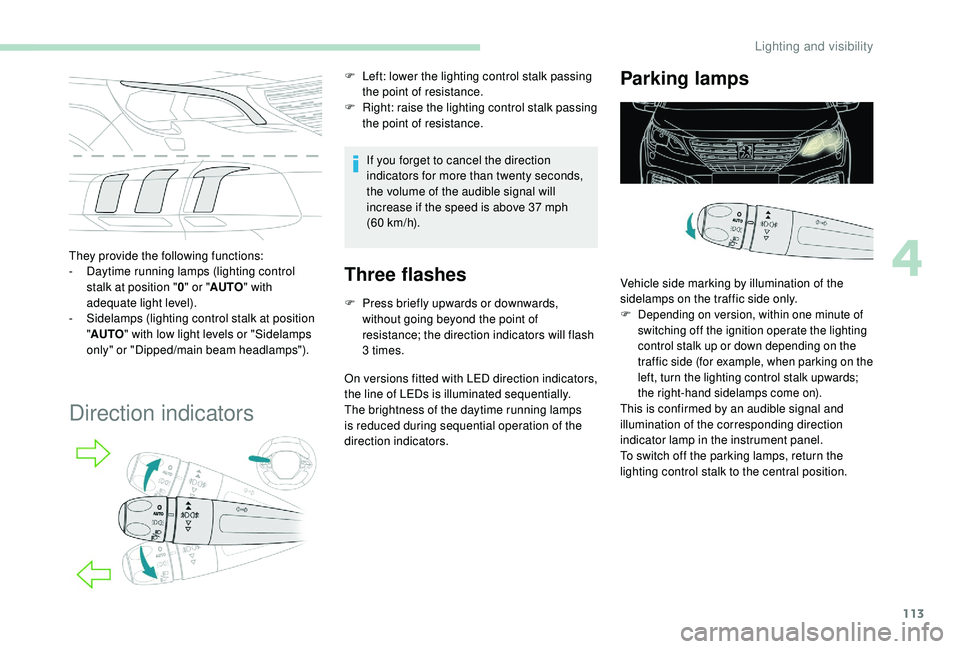
They provide the following functions:
- D aytime running lamps (lighting control
stalk at position " 0" or " AUTO " with
adequate light level).
-
S
idelamps (lighting control stalk at position
" AUTO " with low light levels or "Sidelamps
only" or "Dipped/main beam headlamps").
Direction indicators
If you forget to cancel the direction
indicators for more than twenty seconds,
the volume of the audible signal will
increase if the speed is above 37
mph
(60
km/h).
Three flashes
F Press briefly upwards or downwards, without going beyond the point of
resistance; the direction indicators will flash
3
times.
On versions fitted with LED direction indicators,
the line of LEDs is illuminated sequentially.
The brightness of the daytime running lamps
is reduced during sequential operation of the
direction indicators.
Parking lamps
Vehicle side marking by illumination of the
sidelamps on the traffic side only.
F
Depending on version, within one minute of
switching off the ignition operate the lighting
control stalk up or down depending on the
traffic side (for example, when parking on the
left, turn the lighting control stalk upwards;
the right-hand sidelamps come on).
This is confirmed by an audible signal and
illumination of the corresponding direction
indicator lamp in the instrument panel.
To switch off the parking lamps, return the
lighting control stalk to the central position.
F
L
eft: lower the lighting control stalk passing
the point of resistance.
F
R
ight: raise the lighting control stalk passing
the point of resistance.
4
Lighting and visibility
Page 116 of 364
114
Headlamp adjustment
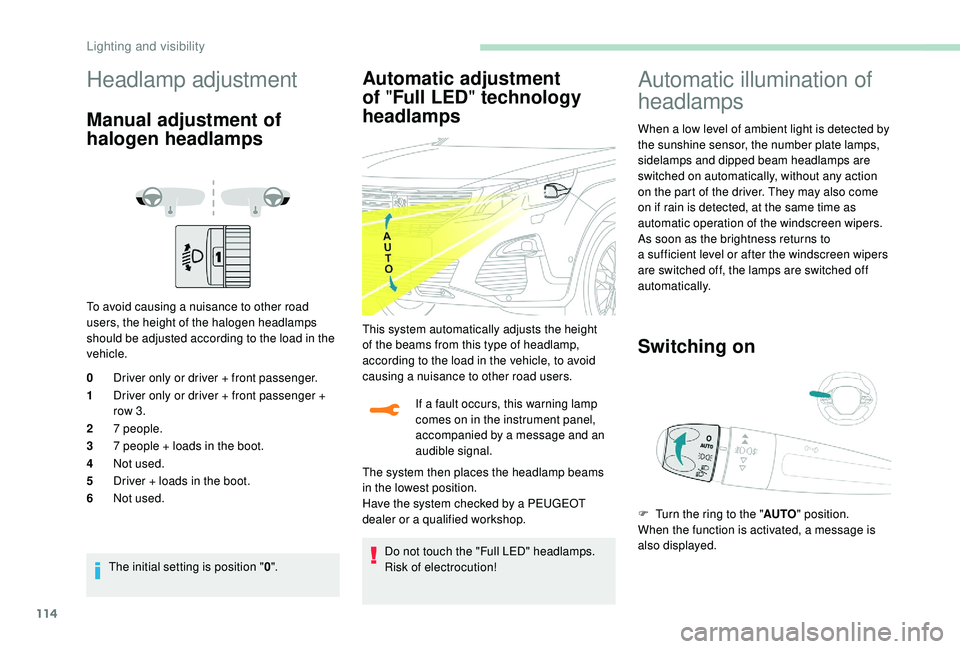
Manual adjustment of
halogen headlamps
To avoid causing a nuisance to other road
u sers, the height of the halogen headlamps
should be adjusted according to the load in the
vehicle.
0 Driver only or driver + front passenger.
1 Driver only or driver + front passenger +
row 3.
2 7
people.
3 7
people + loads in the boot.
4 Not used.
5 Driver + loads in the boot.
6 Not used.
The initial setting is position " 0".
Automatic adjustment
of "Full LED " technology
headlamps
If a fault occurs, this warning lamp
c omes on in the instrument panel,
accompanied by a
message and an
audible signal.
Do not touch the "Full LED" headlamps.
Risk of electrocution!
Automatic illumination of
headlamps
When a low level of ambient light is detected by
t he sunshine sensor, the number plate lamps,
sidelamps and dipped beam headlamps are
switched on automatically, without any action
on the part of the driver. They may also come
on if rain is detected, at the same time as
automatic operation of the windscreen wipers.
As soon as the brightness returns to
a
sufficient level or after the windscreen wipers
are switched off, the lamps are switched off
automatically.
Switching on
This system automatically adjusts the height
of the beams from this type of headlamp,
according to the load in the vehicle, to avoid
causing a
nuisance to other road users.
The system then places the headlamp beams
in the lowest position.
Have the system checked by a
PEUGEOT
dealer or a
qualified workshop. F
T
urn the ring to the "AUTO" position.
When the function is activated, a message is
also displayed.
Lighting and visibility
Page 117 of 364
115
Switching off
F Turn the ring to another position.
Deactivation of the function is accompanied by
the display of a
message.
Operating fault
In the event of a malfunction of the
s unshine sensor, the lighting comes
on, this warning lamp is displayed in
the instrument panel accompanied
by an audible signal and/or
a
message.
Contact a
PEUGEOT dealer or
a
qualified workshop.
Do not cover the sunshine sensor,
combined with the rain sensor and located
at the top centre of the windscreen behind
the rear view mirror; the associated
functions would no longer be controlled.
In fog or snow, the sunshine sensor may
detect sufficient light. In this case, the
lighting will not come on automatically.
Automatic guide-me-home
lighting
With the "Automatic illumination of headlamps"
function activated, under low ambient light, the
sidelamps, dipped beam headlamps and door
mirror spotlamps come on automatically when
the ignition is switched off.
Activation, deactivation and the duration of the
guide-me-home lighting are set in the vehicle
parameters menu in the screen.
Manual guide-me-home
lighting
The temporary illumination of the dipped beam
headlamps after the vehicle's ignition has been
switched off makes the driver's exit easier
when the light is poor.
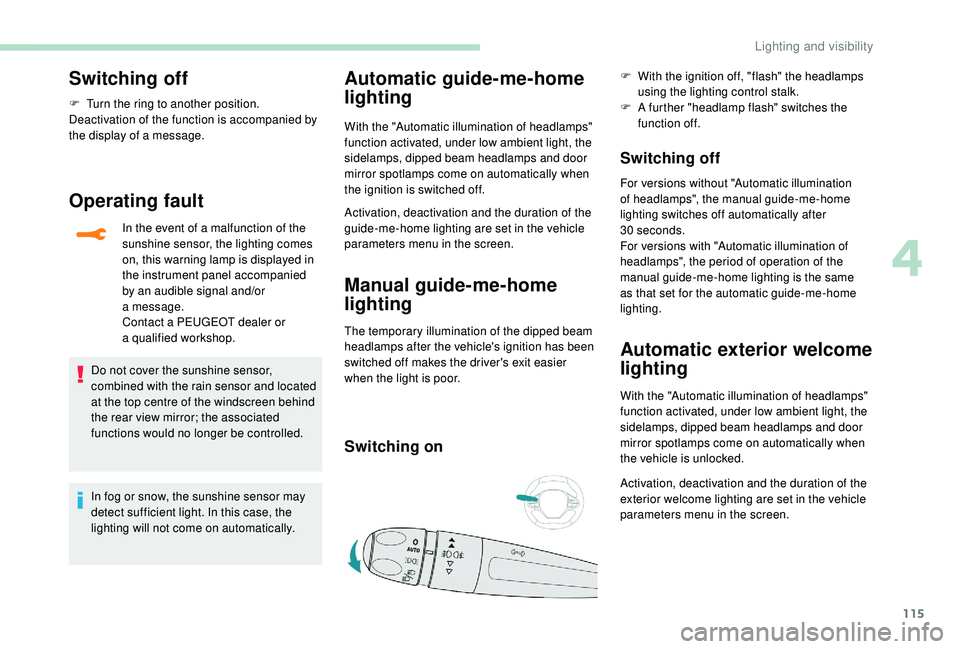
Switching on
F With the ignition off, "flash" the headlamps using the lighting control stalk.
F
A f
urther "headlamp flash" switches the
function off.
Switching off
For versions without "Automatic illumination
of headlamps", the manual guide-me-home
lighting switches off automatically after
30
seconds.
For versions with "Automatic illumination of
headlamps", the period of operation of the
manual guide-me-home lighting is the same
as that set for the automatic guide-me-home
lighting.
Automatic exterior welcome
lighting
With the "Automatic illumination of headlamps"
function activated, under low ambient light, the
sidelamps, dipped beam headlamps and door
mirror spotlamps come on automatically when
the vehicle is unlocked.
Activation, deactivation and the duration of the
exterior welcome lighting are set in the vehicle
parameters menu in the screen.
4
Lighting and visibility
Page 127 of 364
125
For technical reasons and, in particular,
to improve the quality of PEUGEOT
CONNECT ser vices to customers, the
manufacturer reser ves the right to carry
out updates to the vehicle's on-board
telematic system.
Electronic stability control
(ESC)
A set of the following Electronic Stability
systems:
-
a
nti-lock braking system (ABS) and
electronic brake force distribution (EBFD),
-
em
ergency braking assistance (EBA),
-
w
heel anti-slip regulation (ASR) or traction
control,
-
d
ynamic stability control (DSC).
-
t
railer stability assist (TSA).
Definitions
Anti-lock braking system (ABS)
and electronic brake force
distribution (EBFD)
The ABS prevents wheel lock in the event of
emergency braking.
The electronic brake force distribution system
manages the braking pressure wheel by wheel.
Emergency braking assistance
In an emergency, this system enables you to
reach the optimum braking pressure more
quickly and therefore reduce the stopping
distance.
It is triggered in relation to the speed at which
the brake pedal is pressed. This is felt by
a reduction in the resistance of the pedal and
an increase in braking efficiency.
Anti-slip regulation (ASR)
This system optimises traction in order to
avoid wheel slip by acting on the brakes of
the driving wheels and on the engine. It also
improves the directional stability of the vehicle
on acceleration.
Dynamic stability control (DSC)
If there is a difference between the path
f ollowed by the vehicle and that required by the
driver, this system monitors each wheel and
automatically acts on the brake of one or more
wheels and on the engine to return the vehicle
to the required path, within the limits of the laws
of physics.
Trailer stability assist (TSA)
These systems improve the stability and
manoeuvrability of your vehicle when braking
and contribute towards improved control in
corners, in particular on poor or slippery road
surfaces. This system allows control of the vehicle to be
retained when towing a
trailer, so as to avoid
the risk of snaking.
Anti-lock braking system
(ABS) and electronic brake
force distribution (EBFD)
The fixed illumination of this warning
lamp signals that there is a fault with
the ABS.
Illumination of this warning lamp,
linked with the STOP and ABS
warning lamps, accompanied by the
display of a
message and an audible
signal, signals that there is a
fault
with the electronic brake force
distribution (EBFD).
The vehicle retains conventional braking. Drive
carefully at moderate speed.
Contact a
PEUGEOT dealer or a qualified
workshop as soon as possible.
You must stop as soon as it is safe to do so.
Call on a
PEUGEOT dealer or a qualified
workshop.
5
Safety