ECU Peugeot 508 2011 User Guide
[x] Cancel search | Manufacturer: PEUGEOT, Model Year: 2011, Model line: 508, Model: Peugeot 508 2011Pages: 340, PDF Size: 25.72 MB
Page 157 of 340
6
155
Child safety
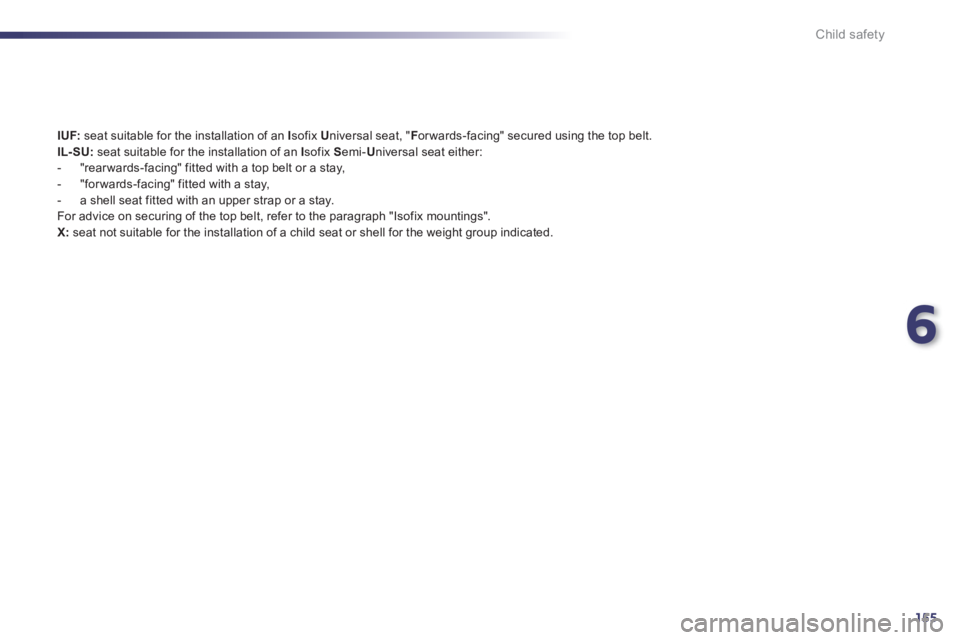
IUF:
seat suitable for the installation of an I
sofix U
niversal seat, " F
or wards-facing" secured using the top belt.
IL-SU:
seat suitable for the installation of an I
sofix S
emi- U
niversal seat either:
- "rear wards-facing" fitted with a top belt or a stay,
- "for wards-facing" fitted with a stay,
- a shell seat fitted with an upper strap or a stay.
For advice on securing of the top belt, refer to the paragraph "Isofix mountings".
X:
seat not suitable for the installation of a child seat or shell for the weight group indicated.
Page 167 of 340
7
165
i
Safety
The driver must ensure that passengers use
the seat belts correctly and that they are all
restrained securely before setting off.
Wherever you are seated in the vehicle,
always fasten your seat belt, even for short
journeys.
Do not interchange the seat belt buckles as
they will not fulfil their role fully.
The seat belts are fitted with an iner tia reel
permitting automatic adjustment of the length
of the strap to your size. The seat belt is
stowed automatically when not in use.
Before and after use, ensure that the seat
belt is reeled in correctly.
The lower part of the strap must be
positioned as low as possible on the pelvis.
The upper par t must be positioned in the
hollow of the shoulder.
The iner tia reels are fitted with an automatic
locking device which comes into operation in
the event of a collision, emergency braking
or if the vehicle rolls over. You can release
the device by pulling firmly on the strap and
releasing it so that it reels in slightly.
Recommendations for children
Use a suitable child seat if the passenger is
less than 12 years old or shor ter than one
and a half metres.
Never use the same seat belt to secure more
than one person.
Never allow a child to travel on your lap. In order to be effective, a seat belt must:
- be tightened as close to the body as
possible,
- be pulled in front of you with a smooth
movement, checking that it does not
twist,
- be used to restrain only one person,
- not bear any trace of cuts or fraying,
- not be conver ted or modified to avoid
affecting its per formance.
In accordance with current safety
regulations, for all repairs on your vehicle,
go to a qualified workshop with the skills
and equipment needed, which a PEUGEOT
dealer is able to provide.
Have your seat belts checked regularly by a
PEUGEOT dealer or a qualified workshop,
par ticularly if the straps show signs of
damage.
Clean the seat belt straps with soapy
water or a textile cleaning product, sold by
PEUGEOT dealers.
After folding or moving a seat or rear bench
seat, ensure that the seat belt is positioned
and reeled in correctly.
In the event of an impact
Depending on the nature and
seriousness of the impact
, the
pretensioning device may be deployed
before and independently of the airbags.
Deployment of the pretensioners is
accompanied by a slight discharge of
harmless smoke and a noise, due to the
activation of the pyrotechnic car tridge
incorporated in the system.
In all cases, the airbag warning lamp comes on.
Following an impact, have the seat belts
system checked, and if necessary replaced,
by a PEUGEOT dealer or a qualified
workshop.
Page 171 of 340
7
169
!
Safety
Sit in a normal upright position.
Wear a correctly adjusted seat belt.
Do not leave anything between
the occupants and the airbags (a child, pet,
object...). This could hamper the operation of
the airbags or injure the occupants.
After an accident or if the vehicle has been
stolen or broken into, have the airbag
systems checked.
All work on the airbag system must be
carried out by a PEUGEOT dealer or a
qualified workshop.
Even if all of the precautions mentioned
are obser ved, a risk of injury or of minor
burns to the head, chest or arms when an
airbag is deployed cannot be ruled out.
The bag inflates almost instantly (within
a few milliseconds) then deflates within
the same time discharging the hot gas via
openings provided for this purpose.
Lateral airbags
Use only approved covers on the seats,
compatible with the deployment the lateral
airbags. For information on the range of seat
covers suitable for your vehicle, you can
contact a PEUGEOT dealer (see "Practical
information - § Accessories").
Do not fix or attach anything to the seat
backs (clothing...). This could cause injury
to the chest or arms if the lateral airbag is
deployed.
Do not sit with the upper par t of the body any
nearer to the door than necessary.
Front airbags
Do not drive holding the steering wheel by its
spokes or resting your hands on the centre
part of the wheel.
Passengers must not place their feet on
the dashboard.
If possible, do not smoke as deployment of
the airbags can cause burns or the risk of
injury from a cigarette or pipe.
Never remove or pierce the steering wheel or
hit it violently.
Curtain airbags
Do not fix or attach anything to the roof.
This could cause injury to the head if the
cur tain airbag is deployed.
Do not remove the grab handles installed
on the roof, they play a par t in securing the
curtain airbags.
For the airbags to be fully effective, observe the following safety rules:
Page 178 of 340
176
Practical information
Changing a wheel
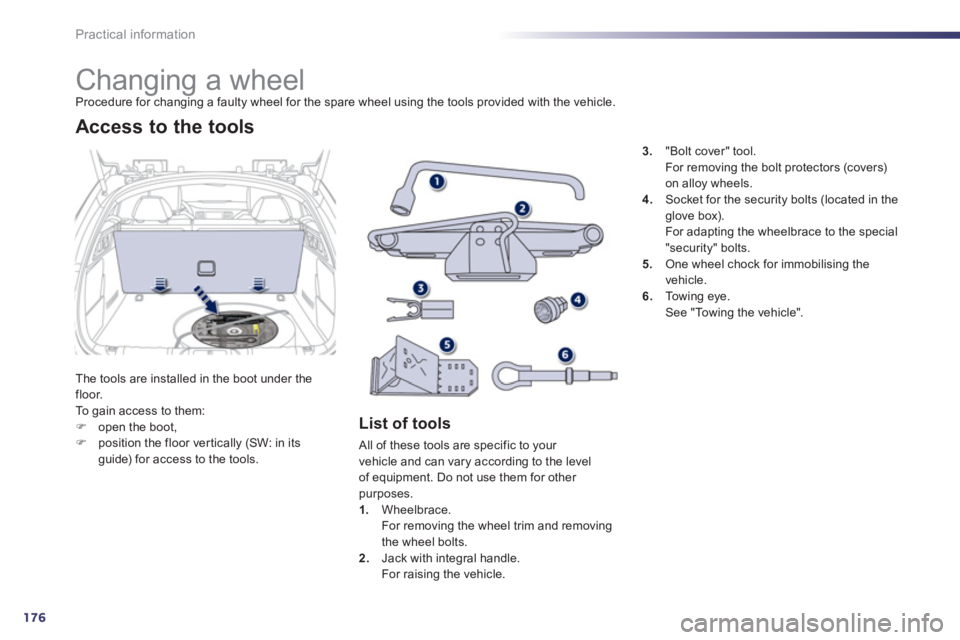
Procedure for changing a faulty wheel for the spare wheel using the tools provided with the vehicle.
The tools are installed in the boot under the
floor.
To gain access to them:
)
open the boot,
)
position the floor ver tically (SW: in its
guide) for access to the tools.
Access to the tools
List of tools
All of these tools are specific to your
vehicle and can vary according to the level
of equipment. Do not use them for other
purposes.
1.
Wheelbrace.
For removing the wheel trim and removing
the wheel bolts.
2.
Jack with integral handle.
For raising the vehicle.
3.
"Bolt cover" tool.
For removing the bolt protectors (covers)
on alloy wheels.
4.
Socket for the security bolts (located in the
glove box).
For adapting the wheelbrace to the special
"security" bolts.
5.
One wheel chock for immobilising the
vehicle.
6.
To w i n g e y e .
See "Towing the vehicle".
Page 179 of 340
8
177
i
Practical information
Wheel with trim
When refitting the wheel
, refit the trim
star ting by placing its notch facing the
valve and press around its edge with
the palm of your hand.
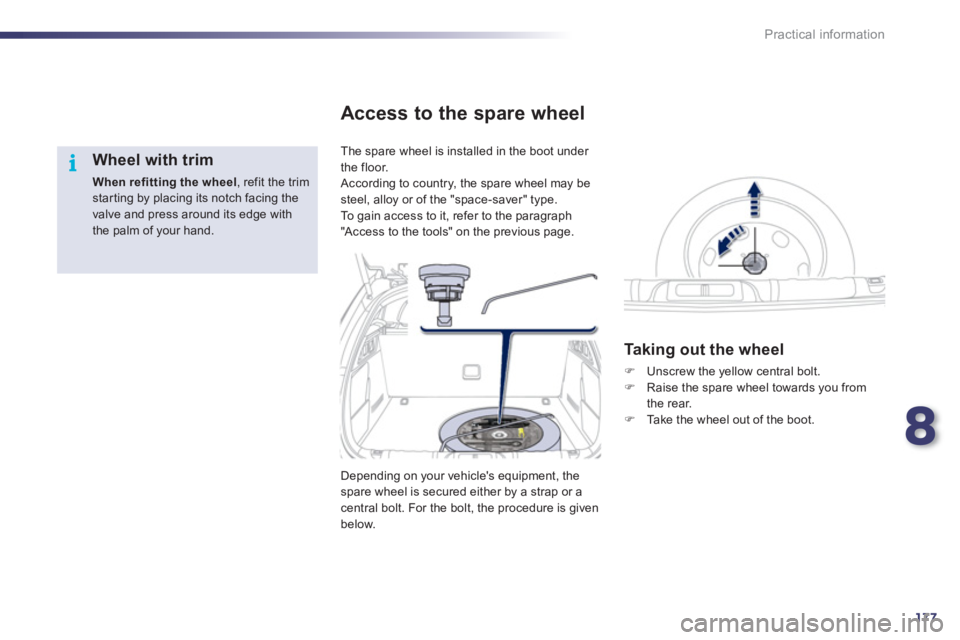
The spare wheel is installed in the boot under
the floor.
According to country, the spare wheel may be
steel, alloy or of the "space-saver" type.
To gain access to it, refer to the paragraph
"Access to the tools" on the previous page.
Access to the spare wheel
Taking out the wheel
)
Unscrew the yellow central bolt.
)
Raise the spare wheel towards you from
the rear.
)
Take the wheel out of the boot.
Depending on your vehicle's equipment, the
spare wheel is secured either by a strap or a
central bolt. For the bolt, the procedure is given
below.
Page 181 of 340
8
179
i
Practical information
Removing a wheel
Parking the vehicle
Immobilise the vehicle where it does not
block traffic: the ground must be level,
stable and not slippery.
Apply the parking brake unless it has
been programmed to automatic mode,
switch off the ignition and engage first
gear * to block the wheels.
Check that the braking warning lamp
and the P
warning lamp in the parking
brake control lever come on.
The occupants must get out of the
vehicle and wait where they are safe.
Never go underneath a vehicle raised
using a jack; use an axle stand.
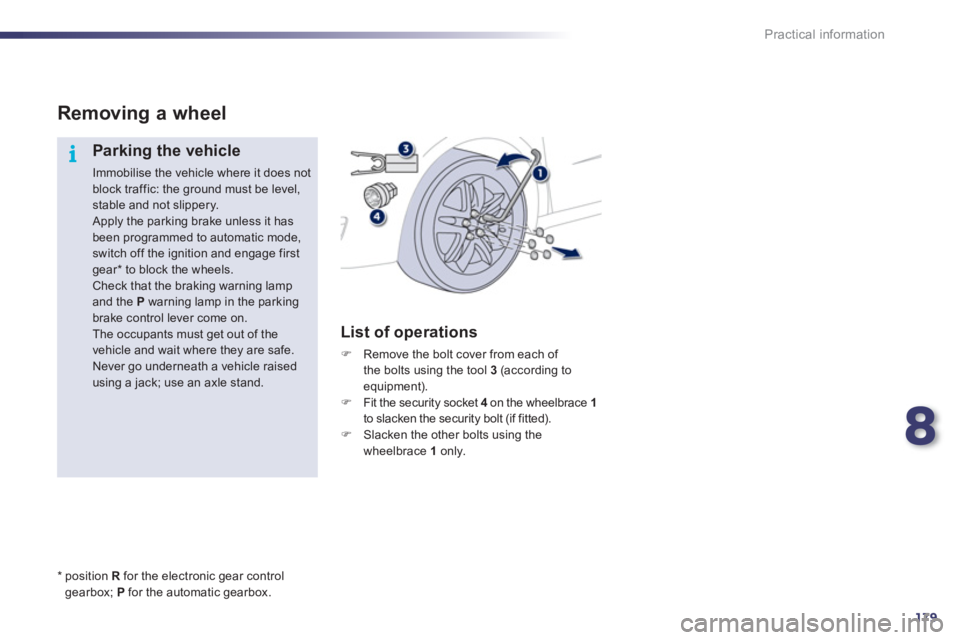
List of operations
)
Remove the bolt cover from each of
the bolts using the tool 3
(according to
equipment).
)
Fit the security socket 4
on the wheelbrace 1
to slacken the security bolt (if fitted).
)
Slacken the other bolts using the
wheelbrace 1
only.
*
position R
for the electronic gear control
gearbox; P
for the automatic gearbox.
Page 183 of 340
8
181
i
Practical information
Fitting a wheel
Fitting the "space-saver"
spare wheel
If your vehicle is fitted with alloy wheels,
when tightening the bolts on fitting, it
is normal to notice that the washers
do not come into contact with the
"space-saver" spare wheel. The wheel
is secured by the conical sur face of
each bolt.
After changing a wheel
To store the punctured wheel in the boot
correctly, first remove the central cover.
When using the "space-saver" type
spare wheel, do not exceed 50 mph
(80 km/h).
Have the tightening of the bolts and the
pressure of the spare wheel checked
by a PEUGEOT dealer or a qualified
workshop without delay.
Have the punctured wheel repaired
and refitted to the vehicle as soon as
possible.
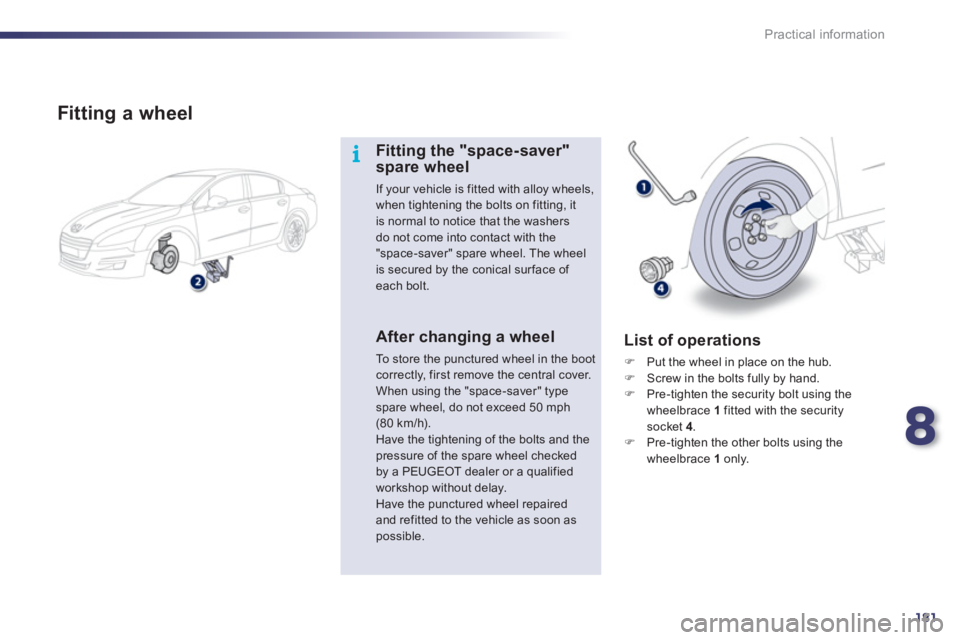
List of operations
)
Put the wheel in place on the hub.
)
Screw in the bolts fully by hand.
)
Pre-tighten the security bolt using the
wheelbrace 1
fitted with the security
socket 4
.
)
Pre-tighten the other bolts using the
wheelbrace 1
only.
Page 184 of 340
182
Practical information
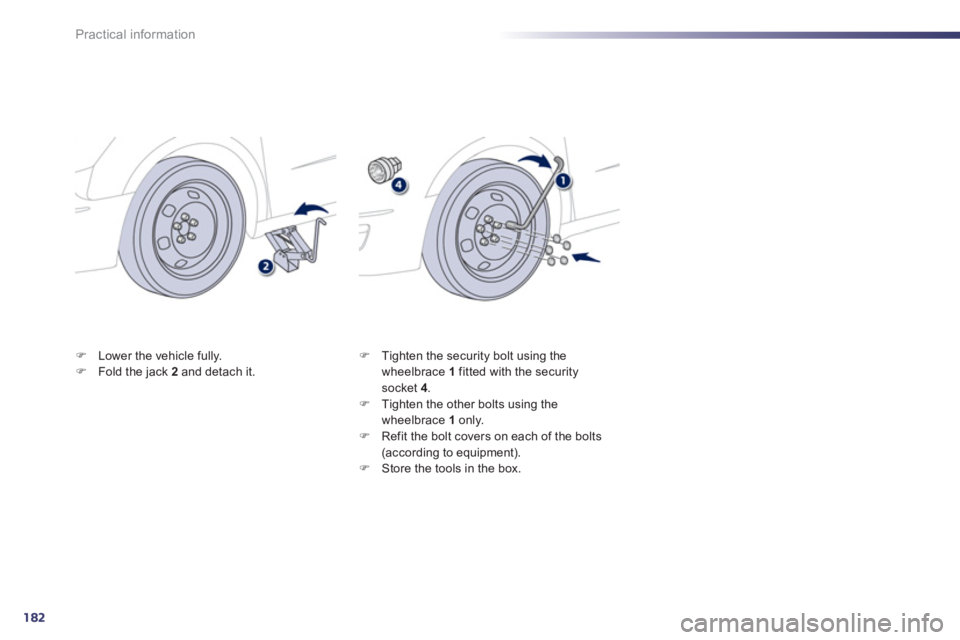
)
Lower the vehicle fully.
)
Fold the jack 2
and detach it.
)
Tighten the security bolt using the
wheelbrace 1
fitted with the security
socket 4
.
)
Tighten the other bolts using the
wheelbrace 1
only.
)
Refit the bolt covers on each of the bolts
(according to equipment).
)
Store the tools in the box.
Page 189 of 340
8
187
Practical information
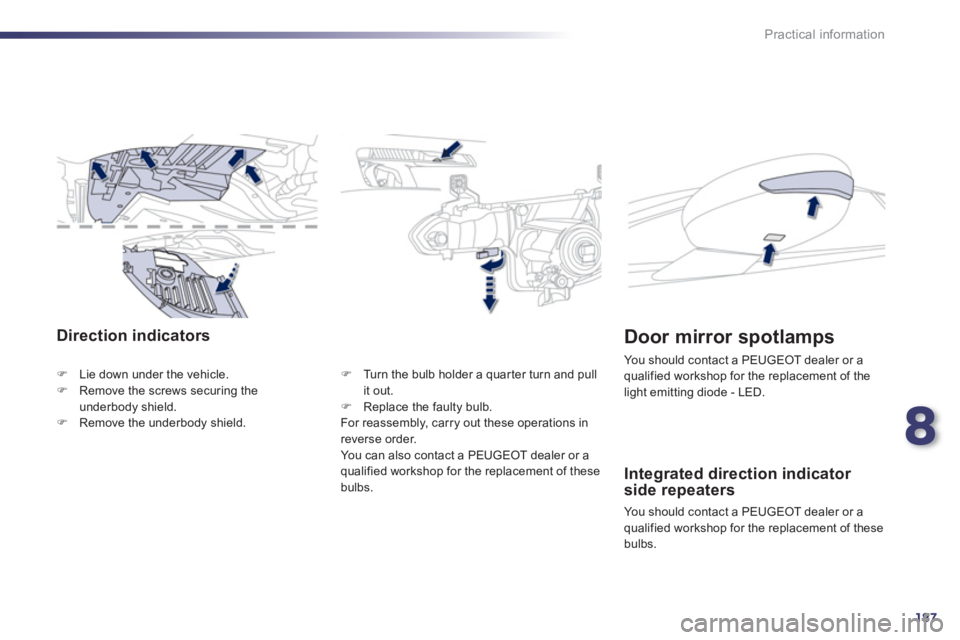
Direction indicators
)
Lie down under the vehicle.
)
Remove the screws securing the
underbody shield.
)
Remove the underbody shield.
)
Turn the bulb holder a quar ter turn and pull
it out.
)
Replace the faulty bulb.
For reassembly, carry out these operations in
reverse order.
You can also contact a PEUGEOT dealer or a
qualified workshop for the replacement of these
bulbs.
Integrated direction indicator
side repeaters
You should contact a PEUGEOT dealer or a
qualified workshop for the replacement of these
bulbs.
Door mirror spotlamps
You should contact a PEUGEOT dealer or a
qualified workshop for the replacement of the
light emitting diode - LED.
Page 207 of 340
8
205
Practical information
Accessories
A wide range of accessories and genuine par ts is available from the PEUGEOT dealer network.
These accessories and par ts have been tested and approved for reliability and safety.
They are all adapted to your vehicle and benefit from PEUGEOT's recommendation and warranty.
"Comfort":
cool box, smoker's kit, 230 V socket, torch...
"Transport solutions":
booster seats and child seats, boot tray, roof
box, ski carrier, towbar-mounted bicycle carrier,
towbars (swan-neck, quickly detachable ball,
folding), harnesses, sliding floor, utility vehicle
conversion kit, ...
The trailer towbar and its harness must be
fitted by a PEUGEOT dealer.
"Style":
spoiler, front and rear mud flaps, aluminium gear
lever knob, alloy wheels (16", 17", 18", 19"), body
kit, door mirror shells, door air deflectors, ...
*
To avoid any risk of jamming of the pedals:
- ensure that the mat is positioned and
secured correctly,
- never fit one mat on top of another.
"Safety and security":
speed limiter/cruise control, anti-theft alarm,
microwave unit, window etching, wheel security
bolts, breathalyser, first aid kit, warning
triangle, high visibility vest, stolen vehicle
tracking system, winter equipment (17" wheels
for snow chains), reversing camera, front and
rear parking sensors, boot spacers...
"Protection":
mats * , seat covers, vehicle covers, sun blinds,
boot net, load protection net, dog guard, door
and boot sill protectors, resin side rubbing
strips...