instrument panel Peugeot 508 2013 - RHD (UK, Australia) Workshop Manual
[x] Cancel search | Manufacturer: PEUGEOT, Model Year: 2013, Model line: 508, Model: Peugeot 508 2013Pages: 340, PDF Size: 14.59 MB
Page 148 of 340
146
Visibility
Additional directional lighting
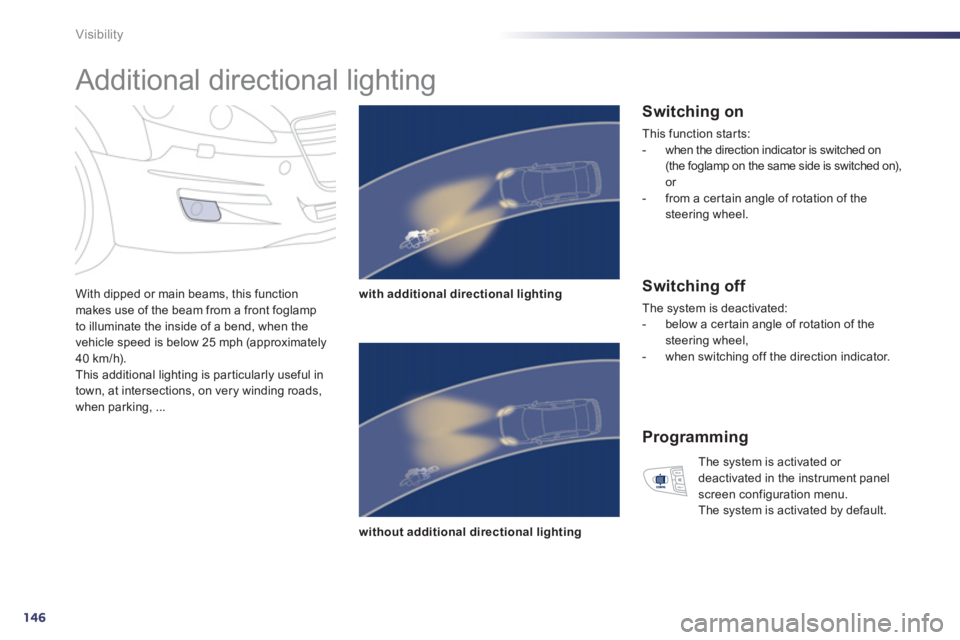
With dipped or main beams, this function makes use of the beam from a front foglamp
to illuminate the inside of a bend, when the
vehicle speed is below 25 mph (approximately40 km/h).
This additional lighting is par ticularly useful in
town, at intersections, on very winding roads,
when parking, ...with additional directional li
ghting
without additional directional lighting
Switching on
This function starts :
- when the direction indicator is switched on
(the foglamp on the same side is switched on),
or
- from a cer tain angle of rotation of the steering wheel.
Switching off
The system is deactivated:
- below a cer tain angle of rotation of thesteering wheel,
- when switching off the direction indicator.
Programming
The system is activated or
deactivated in the instrument panel
screen configuration menu.
The system is activated by default.
Page 150 of 340
148
Visibility
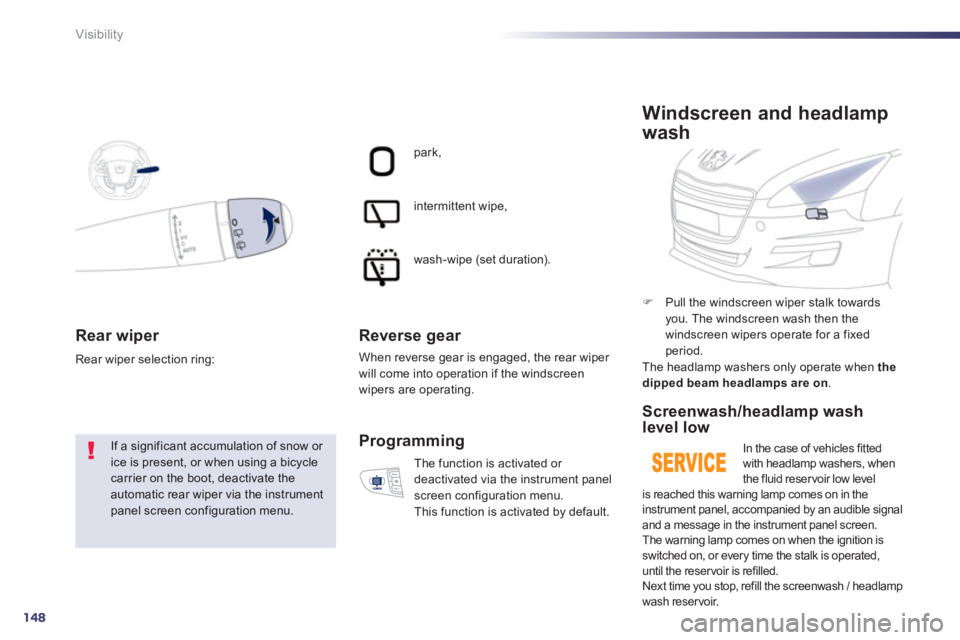
Rear wiper
If a significant accumulation of snow or ice is present, or when using a bicyclecarrier on the boot, deactivate theautomatic rear wiper via the instrument panel screen configuration menu. Rear wiper selection rin
g:
park,
intermittent wipe,
wash-wipe
(set duration).
Reverse gear
When reverse gear is engaged, the rear wiper
will come into operation if the windscreen
wipers are operating.
Th
e function is activated or
deactivated via the instrument panel
screen confi
guration menu.
This function is activated by default.
Programming
F
Pull the windscreen wiper stalk towards you. The windscreen wash then the
windscreen wipers operate for a fixed period.
The headlamp washers only operate when the
dipped beam headlamps are on .
Windscreen and headlamp
wash
Screenwash/headlamp washlevel low
In the case of vehicles fittedwith headlamp washers, when
the fluid reservoir low level
is reached this warning lamp comes on in the
instrument panel, accompanied b
y an audible signaland a message in the instrument panel screen.
The warning lamp comes on when the ignition isswitched on, or every time the stalk is operated,until the reservoir is refilled.
Next time you stop, refill the screenwash / headlamp
wash reservoir.
Page 151 of 340
5
149
Visibility
Automatic rain sensitive
windscreen wi
pers
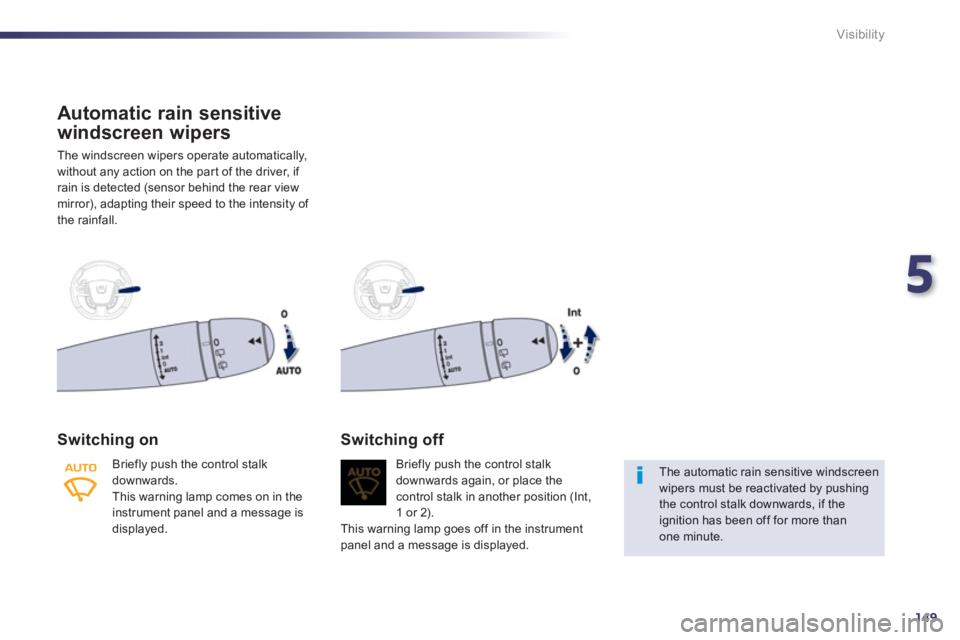
The windscreen wipers operate automatically,
without an
y action on the par t of the driver, if
rain is detected (sensor behind the rear view mirror), adapting their speed to the intensity of
the rainfall.
Switching on
Briefly push the control stalkdownwards.
This warning lamp comes on in the
instrument panel and a message is
displayed.Brie
fly push the control stalk
downwards again, or place thecontrol stalk in another position (Int,
1 or 2).
This warning lamp goes off in the instrument
panel and a message is displayed.
Switching off
The automatic rain sensitive windscreenwipers must be reactivated by pushing the control stalk downwards, if theignition has been off for more than one minute.
Page 154 of 340
152
Visibility
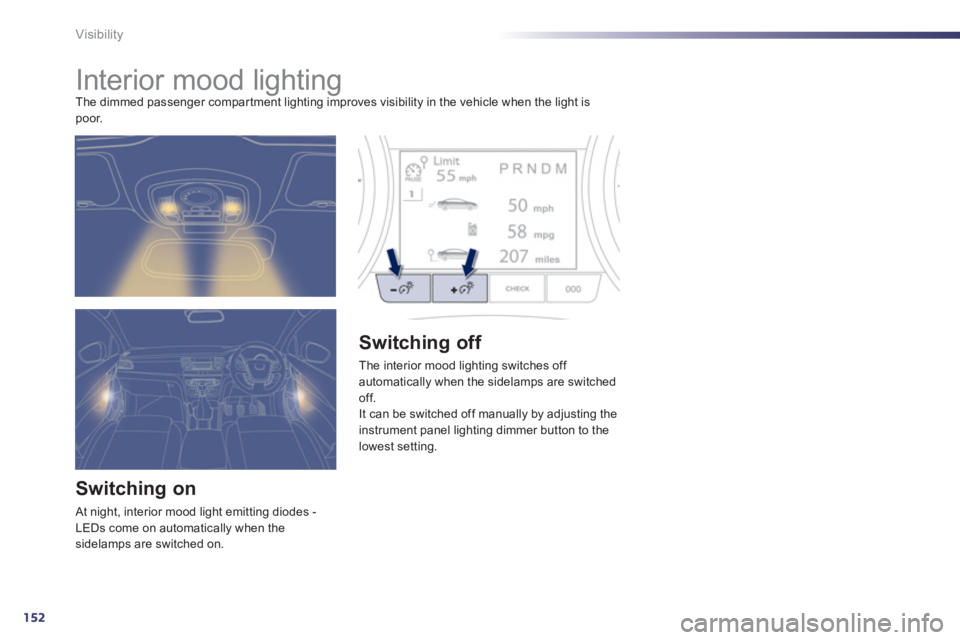
Interior mood lighting The dimmed passenger compar tment lighting improves visibility in the vehicle when the light is poor.
Switching on
At night, interior mood light emitting diodes -LEDs come on automatically when the sidelamps are switched on.
Switching off
The interior mood lighting switches off
automatically when the sidelamps are switchedoff.
It can be switched off manually by adjusting the
instrument panel lighting dimmer button to the lowest setting.
Page 169 of 340
7
167
Safety
Ty r e u n d e r - i nfl ation detection
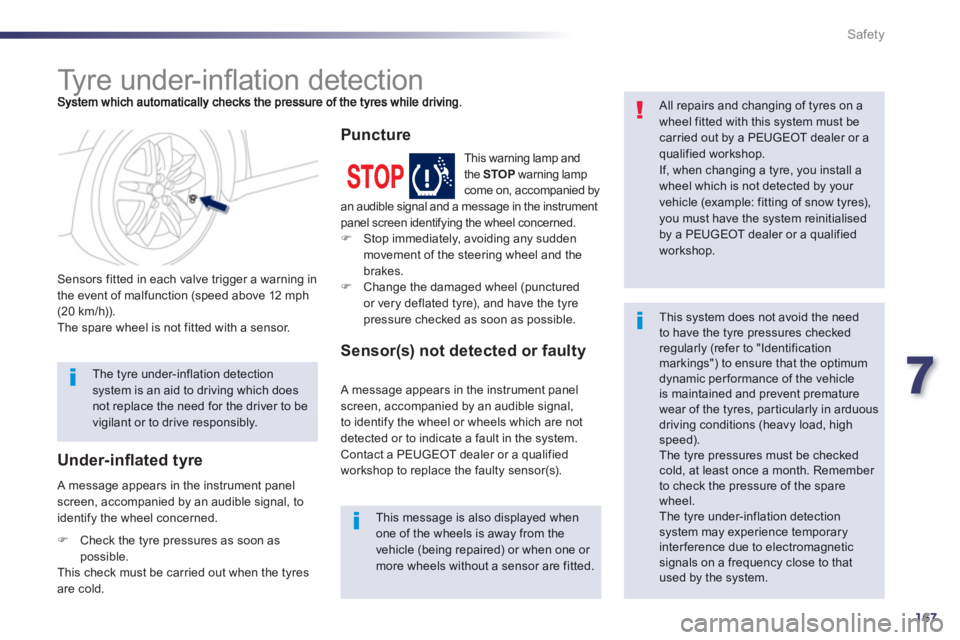
Sensors fitted in each valve trigger a warning in
the event of malfunction (speed above 12 mph (20 km/h)).
The spare wheel is not fitted with a sensor.
All repairs and changing of tyres on awheel fitted with this system must becarried out by a PEUGEOT dealer or a qualified workshop.
If, when changing a tyre, you install awheel which is not detected by your vehicle (example: fitting of snow tyres), you must have the system reinitialised
by a PEUGEOT dealer or a qualifiedworkshop.
This message is also displayed whenone of the wheels is away from thevehicle (being repaired) or when one or more wheels without a sensor are fitted.
The tyre under-inflation detectionsystem is an aid to driving which doesnot replace the need for the driver to bevigilant or to drive responsibly.
This system does not avoid the needto have the tyre pressures checkedregularly (refer to "Identification markings") to ensure that the optimumdynamic performance of the vehicleis maintained and prevent premature wear of the tyres, particularly in arduousdriving conditions (heavy load, highspeed). The tyre pressures must be checked cold, at least once a month. Remember to check the pressure of the spare wheel.
The tyre under-inflation detection system may experience temporary interference due to electromagnetic signals on a frequency close to that used by the system.
A message appears in the instrument panelscreen, accompanied by an audible signal, to
identify the wheel concerned.
Under-infl ated tyre
This warning lamp and
the STOPwarning lamp come on, accompanied by an audible signal and a message in the instrument panel screen identifying the wheel concerned. FStop immediately, avoiding any sudden
movement of the steering wheel and thebrakes.
FChange the damaged wheel (punctured
or very deflated tyre), and have the tyre
pressure checked as soon as possible.
Puncture
A message appears in the instrument panel
screen, accompanied by an audible signal,
to identify the wheel or wheels which are not
detected or to indicate a fault in the system.Contact a PEUGEOT dealer or a qualifiedworkshop to replace the faulty sensor(s).
Sensor(s) not detected or faulty
F
Check the tyre pressures as soon aspossible.
This check must be carried out when the tyres
are cold.
Page 172 of 340
170
Safety
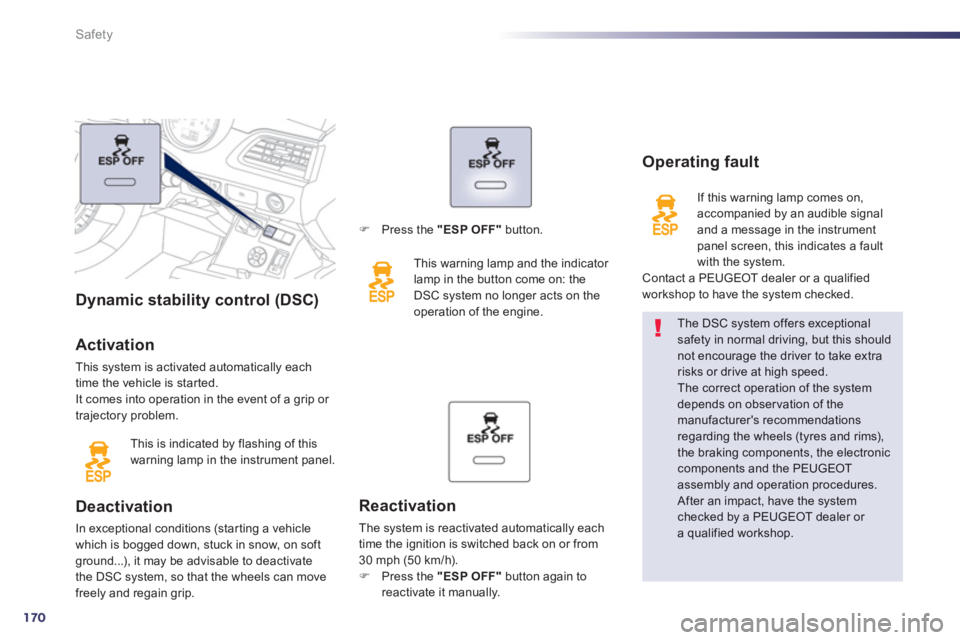
Dynamic stability control (DSC)
Activation
This system is activated automatically each
time the vehicle is started.
It comes into operation in the event of a grip or
trajectory problem.
This is indicated b
y flashing of this
warning lamp in the instrument panel.
Deactivation
In exceptional conditions (starting a vehicle
which is bogged down, stuck in snow, on softground...), it may be advisable to deactivate
the DSC system, so that the wheels can move
freely and regain grip.
The DSC system offers exceptional safety in normal driving, but this should not encourage the driver to take extra risks or drive at high speed.
The correct operation of the system depends on obser vation of the manufacturer's recommendationsregarding the wheels (tyres and rims),the braking components, the electronic components and the PEUGEOTassembly and operation procedures.
After an impact, have the systemchecked by a PEUGEOT dealer or a qualified workshop.
Operating fault
If this warning lamp comes on,
accompanied by an audible signal
and a messa
ge in the instrument
panel screen, this indicates a fault
with the system.
Contact a PEUGEOT dealer or a qualified
workshop to have the system checked.
Reactivation
The system is reactivated automatically eachtime the ignition is switched back on or from
30 mph (50 km/h).F Press the "ESP OFF"
button again to
reactivate it manually.
F Press the "ESP OFF"
button.
This warnin
g lamp and the indicator
lamp in the button come on: the
D
SC system no longer acts on the
operation of the engine.
Page 174 of 340
172
Safety
Front seat belt height adjustment
FTo a djust the anchorage point, squeeze thecontrol and slide it until you find a notch.
From approximatel
y 12 mph (20 km/h),
the warning lamp(s) flash for
two minutes accompanied by an
audible si
gnal. Once these two minutes
have elapsed, the warning lamp(s) remain on until
the driver or one or more passengers fasten their seat belt.
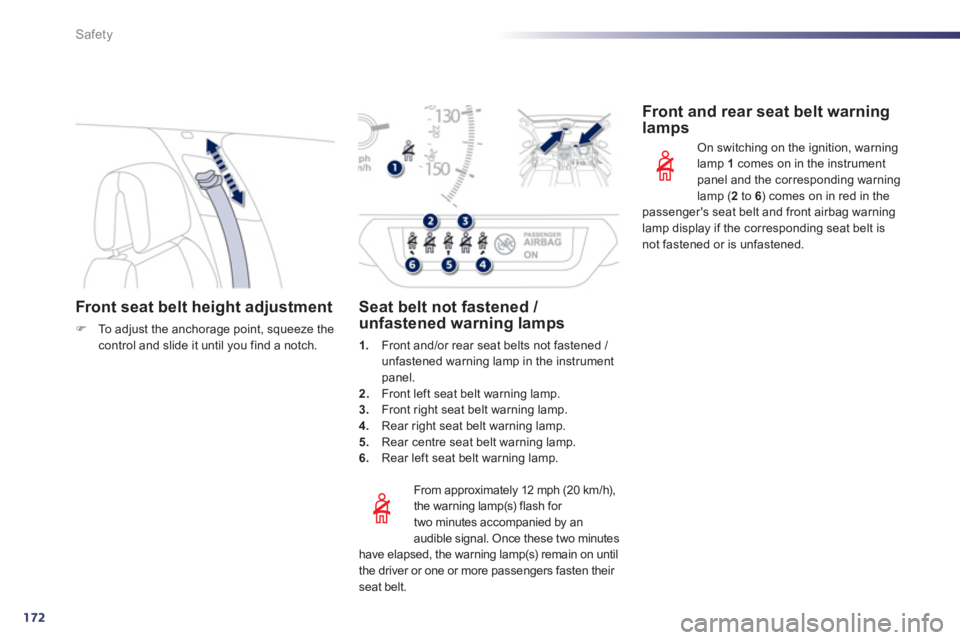
Seat belt not fastened / unfastened warning lamps
1.Front and/or rear seat belts not fastened / unfastened warning lamp in the instrument
panel.
2. Front left seat belt warning lamp.3.
Front right seat belt warning lamp.4.Rear right seat belt warning lamp.
5.Rear centre seat belt warning lamp.
6. Rear left seat belt warning lamp.
Front and rear seat belt warning lamps
On switching on the ignition, warninglamp 1
comes on in the instrument
panel and the corresponding warning lamp (2 to 6) comes on in red in thepassenger's seat belt and front airbag warninglamp display if the corresponding seat belt isnot fastened or is unfastened.
Page 177 of 340
7
175
Safety
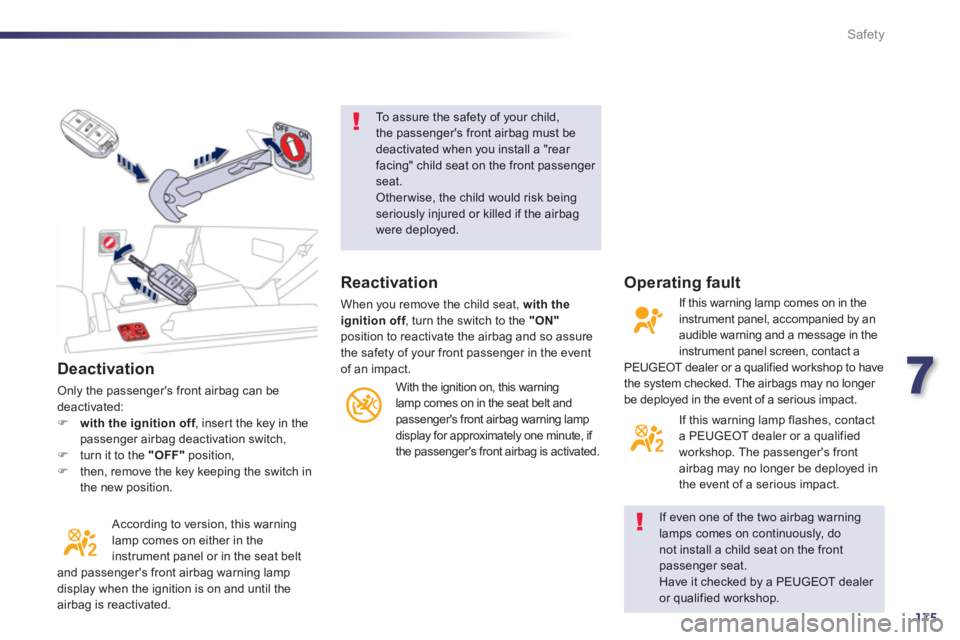
Deactivation
Only the passenger's front airbag can be deactivated:Fwith the ignition off, inser t the key in thefpassenger airbag deactivation switch, F
turn it to the "OFF"position, F
then, remove the key keeping the switch in
the new position.
According to version, this warning lamp comes on either in the instrument panel or in the seat belt
and passenger's front airbag warning lamp
displa
y when the ignition is on and until the
airbag is reactivated.
To assure the safety of your child,the passenger's front airbag must be deactivated when you install a "rear facing" child seat on the front passenger seat.Other wise, the child would risk beingseriously injured or killed if the airbag were deployed.
If even one of the two airbag warning
lamps comes on continuously, donot install a child seat on the frontpassenger seat.
Have it checked by a PEUGEOT dealer or qualified workshop.
Reactivation
When you remove the child seat, with the ignitionoff
, turn the switch to the f"ON"position to reactivate the airbag and so assure
the safety of your front passenger in the event
of an impact.
With the ignition on, this warninglamp comes on in the seat belt and
passenger's front airbag warning lamp
displa
y for approximately one minute, if
the passenger's front airbag is activated.
Operating fault
If this warning lamp comes on in theinstrument panel, accompanied by an audible warning and a message in the
instrument panel screen, contact a
PEUGEOT dealer or a qualified workshop to have
the system checked. The airbags may no longer
be deployed in the event of a serious impact.
If this warnin
g lamp flashes, contacta PEUGEOT dealer or a qualified
workshop. The passenger's front airbag may no longer be deployed in
the event of a serious impact.
Page 178 of 340
176
Safety
Lateral airbags
Deployment
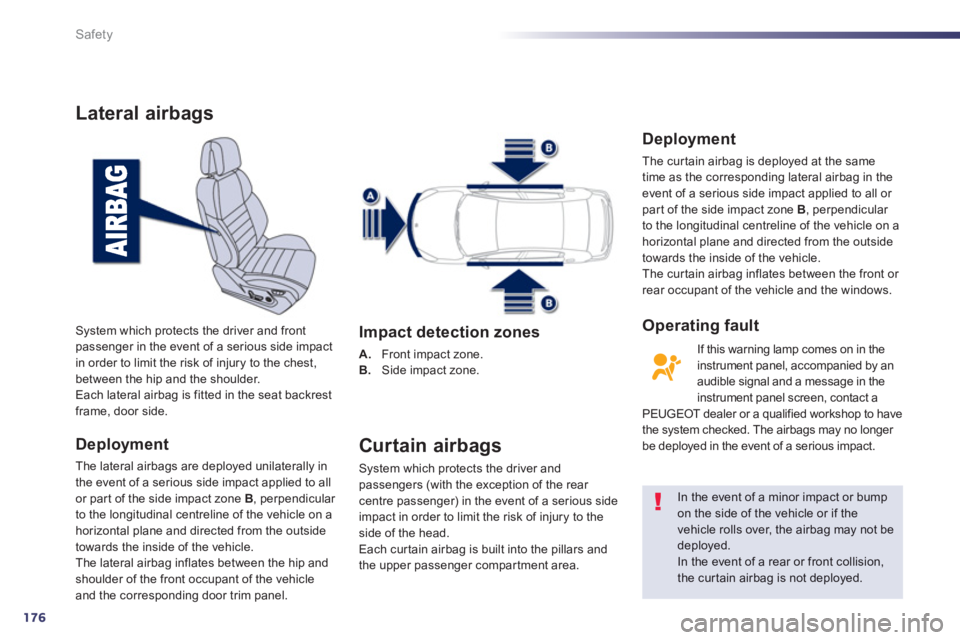
The lateral airbags are deployed unilaterally in
the event of a serious side impact applied to all
or par t of the side impact zone B, perpendicular
to the longitudinal centreline of the vehicle on a horizontal plane and directed from the outside
towards the inside of the vehicle.
The lateral airbag inflates between the hip andshoulder of the front occupant of the vehicle and the corresponding door trim panel.
System which protects the driver and frontpassenger in the event of a serious side impact
in order to limit the risk of injury to the chest,
between the hip and the shoulder.
Each lateral airba
g is fitted in the seat backrest frame, door side.
Impact detection zones
A.
Front impact zone.
B. Side impact zone.
Curtain airbags
System which protects the driver and
passengers (with the exception of the rear centre passenger) in the event of a serious side
impact in order to limit the risk of injury to the side of the head.
Each curtain airbag is built into the pillars and
the upper passenger compar tment area.
In the event of a minor impact or bump on the side of the vehicle or if the vehicle rolls over, the airbag may not be
deployed.
In the event of a rear or front collision, the cur tain airbag is not deployed.
Deployment
The cur tain airbag is deployed at the same
time as the corresponding lateral airbag in the event of a serious side impact applied to all or par t of the side impact zone B, perpendicular
to the longitudinal centreline of the vehicle on a horizontal plane and directed from the outside
towards the inside of the vehicle.
The cur tain airbag inflates between the front or
rear occupant of the vehicle and the windows.
If this warnin
g lamp comes on in theinstrument panel, accompanied by an
audible signal and a message in the instrument panel screen, contact a
PEUGEOT dealer or a qualified workshop to have
the system checked. The airbags may no longer
be deployed in the event of a serious impact.
Operating fault
Page 209 of 340
8
207
Practical information
System which manages the duration of use of certain functions to conserve a sufficient level
of charge in the battery.
After the engine has stopped, you can still use functions such as the audio andtelematics system, windscreen wipers, dipped
beam headlamps, cour tesy lamps, etc. for a maximum combined duration of aboutforty minutes.
Energy economy mode
Switching to economy mode
A message then appears in the instrument panel screen indicating that the vehicle has
switched to economy mode and the active
functions are put on standby.
If a telephone call is being made at this time, it
will be maintained for around 10 minutes with
the Bluetooth hands-free system of your audio
system.
Exiting economy mode
These functions are reactivated automatically
next time the vehicle is driven.
F In order to resume the use of thesefunctions immediately, star t the engine and let it run:
- for less than ten minutes, to use
the equipment for approximatelyfive minutes,
- for more than ten minutes, to use the
equipment for up to approximatelythirty minutes.
Let the engine run for the duration specified toensure that the battery charge is sufficient.
Do not repeatedly and continuously restar t theengine in order to charge the battery.
A flat battery prevents the engine from star ting (refer to the "Battery" section).