battery Peugeot 508 2016 User Guide
[x] Cancel search | Manufacturer: PEUGEOT, Model Year: 2016, Model line: 508, Model: Peugeot 508 2016Pages: 371, PDF Size: 12.12 MB
Page 65 of 371
63
508_en_Chap02_ouvertures_ed01-2016
Do not throw the remote control
batteries away, they contain metals
which are harmful to the environment.
ta
ke them to an approved collection
point.
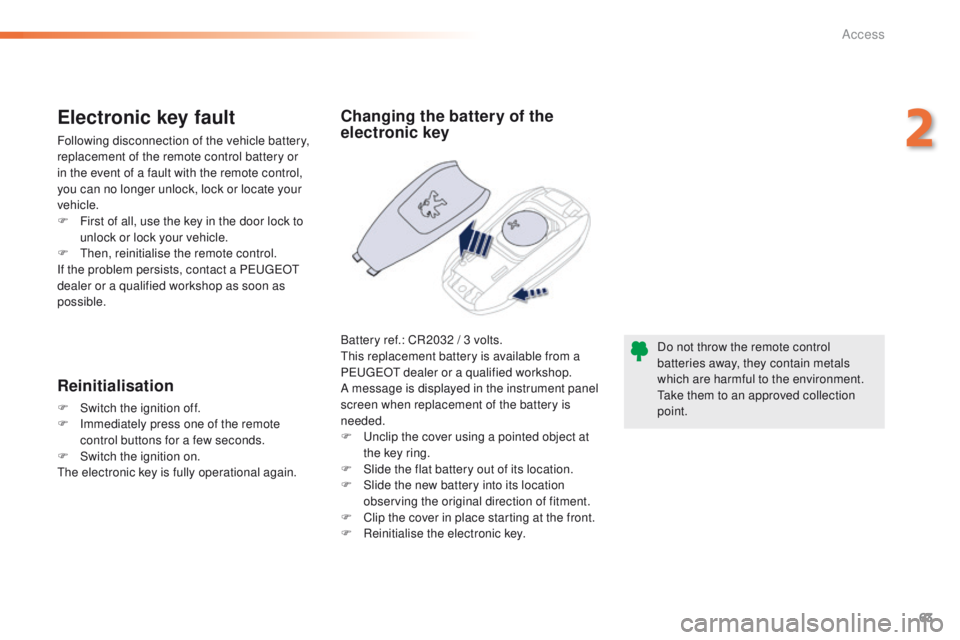
Changing the battery of the
electronic key
Battery ref.: CR2032 / 3 volts.th is replacement battery is available from a
P
e
uge
Ot
dealer or a qualified workshop.
A message is displayed in the instrument panel
screen when replacement of the battery is
needed.
F
u
n
clip the cover using a pointed object at
the key ring.
F
S
lide the flat battery out of its location.
F
S
lide the new battery into its location
observing the original direction of fitment.
F
C
lip the cover in place starting at the front.
F
R
einitialise the electronic key.
Electronic key fault
Following disconnection of the vehicle battery,
replacement of the remote control battery or
in the event of a fault with the remote control,
you can no longer unlock, lock or locate your
vehicle.
F
F
irst of all, use the key in the door lock to
unlock or lock your vehicle.
F
t
hen
, reinitialise the remote control.
If the problem persists, contact a P
e
uge
Ot
dealer or a qualified workshop as soon as
possible.
Reinitialisation
F Switch the ignition off.
F I mmediately press one of the remote
control buttons for a few seconds.
F
S
witch the ignition on.
th
e electronic key is fully operational again.
2
Access
Page 70 of 371
68
508_en_Chap02_ouvertures_ed01-2016
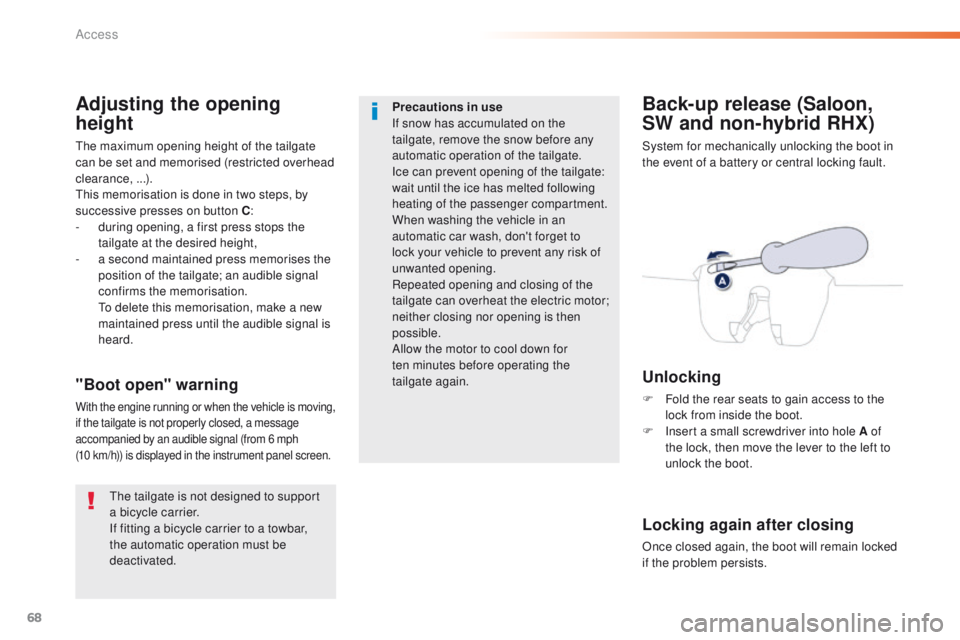
Back-up release (Saloon,
SW and non-hybrid RHX)
System for mechanically unlocking the boot in
the event of a battery or central locking fault.
Unlocking
F Fold the rear seats to gain access to the lock from inside the boot.
F
I
nsert a small screwdriver into hole A of
the lock, then move the lever to the left to
unlock the boot."Boot open" warning
With the engine running or when the vehicle is moving,
if the tailgate is not properly closed, a message
accompanied by an audible signal (from 6 mph
(10
km/h)) is displayed in the instrument panel screen.
Locking again after closing
Once closed again, the boot will remain locked
if the problem persists.
Adjusting the opening
height
the maximum opening height of the tailgate
can be set and memorised (restricted overhead
clearance, ...).
th
is memorisation is done in two steps, by
successive presses on button C :
-
d
uring opening, a first press stops the
tailgate at the desired height,
-
a s
econd maintained press memorises the
position of the tailgate; an audible signal
confirms the memorisation.
t
o d
elete this memorisation, make a new
maintained press until the audible signal is
heard.
th
e tailgate is not designed to support
a bicycle carrier.
If fitting a bicycle carrier to a towbar,
the automatic operation must be
deactivated. Precautions in use
If snow has accumulated on the
tailgate, remove the snow before any
automatic operation of the tailgate.
Ice can prevent opening of the tailgate:
wait until the ice has melted following
heating of the passenger compartment.
When washing the vehicle in an
automatic car wash, don't forget to
lock your vehicle to prevent any risk of
unwanted opening.
Repeated opening and closing of the
tailgate can overheat the electric motor;
neither closing nor opening is then
possible.
Allow the motor to cool down for
ten
minutes before operating the
tailgate again.
Access
Page 72 of 371
70
508_en_Chap02_ouvertures_ed01-2016
System which protects and provides a deterrent
against theft and break-ins. It provides the
following types of monitoring:
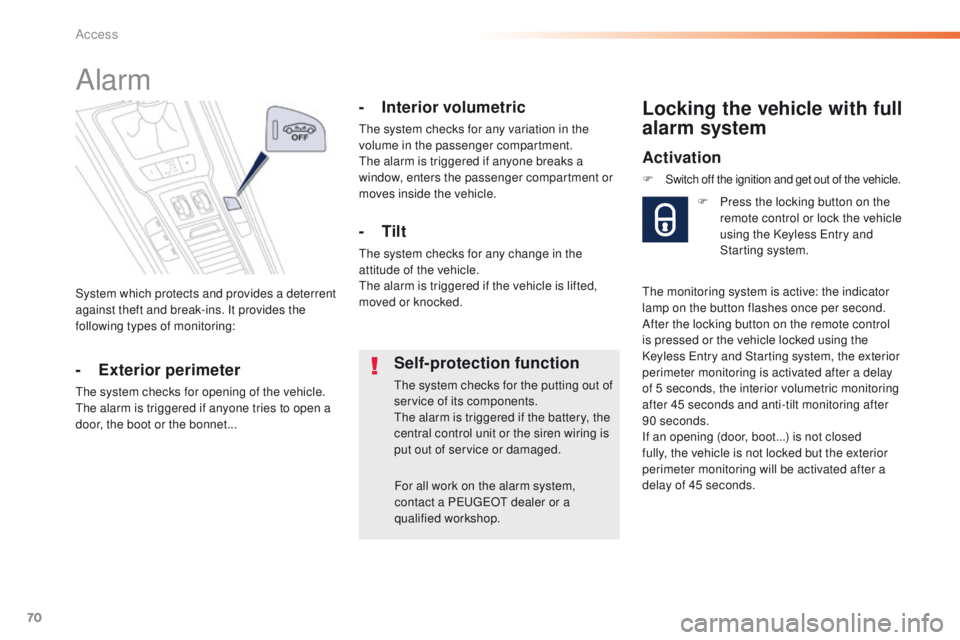
Alarm
- Exterior perimeter
the system checks for opening of the vehicle.the alarm is triggered if anyone tries to open a
door, the boot or the bonnet...
- Interior volumetric
the system checks for any variation in the
volume in the passenger compartment.
th
e alarm is triggered if anyone breaks a
window, enters the passenger compartment or
moves inside the vehicle.
- Tilt
the system checks for any change in the
attitude of the vehicle.
th
e alarm is triggered if the vehicle is lifted,
moved or knocked.
Self-protection function
the system checks for the putting out of
service of its components.
th
e alarm is triggered if the battery, the
central control unit or the siren wiring is
put out of service or damaged.
For all work on the alarm system,
contact a P
e
uge
Ot
dealer or a
qualified workshop.
Locking the vehicle with full
alarm system
Activation
F Switch off the ignition and get out of the vehicle.
F Press the locking button on the remote control or lock the vehicle
using the Keyless
e
n
try and
Starting system.
th
e monitoring system is active: the indicator
lamp on the button flashes once per second.
After the locking button on the remote control
is pressed or the vehicle locked using the
Keyless
e
n
try and Starting system, the exterior
perimeter monitoring is activated after a delay
of 5 seconds, the interior volumetric monitoring
after 45 seconds and anti-tilt monitoring after
90 seconds.
If an opening (door, boot...) is not closed
fully, the vehicle is not locked but the exterior
perimeter monitoring will be activated after a
delay of 45 seconds.
Access
Page 76 of 371
74
508_en_Chap02_ouvertures_ed01-2016
Reinitialising the electric
windows
Always remove the key from the ignition
when leaving the vehicle, even for a
short time.
In the event of contact during operation
of the windows, you must reverse the
movement of the window. t
o d
o this,
press the switch concerned.
When operating the passenger electric
window switches, the driver must
ensure that no one is preventing correct
closing of the windows.
th
e driver must ensure that the
passengers use the electric windows
c o r r e c t l y.
Be aware of children when operating
the windows.
Following reconnection of the battery, the
safety anti-pinch function must be reinitialised.
th
e safety anti-pinch function is not active
during these operations:
-
l
ower the window completely, then raise
it, it will rise in steps of a few centimetres
each time the switch is pressed. Repeat
the operation until the window closes
completely,
-
c
ontinue to press the switch for at least
one
second after reaching this position,
window closed.
Access
Page 100 of 371
98
508_en_Chap03_ergonomie-et-confort_ed01-2016
Always switch off the programmable
heating while refuelling to avoid any risk
of fire or explosion.
to a
void the risk of intoxication and
asphyxiation, the programmable
heating must not be used, even for
short periods, in an enclosed area such
as a garage or workshop not equipped
with exhaust gas extraction.
Do not park the vehicle on an
inflammable sur face (dry grass, dead
leaves, paper…), there is a risk of fire.
Only one programmed or immediate
preheating/preventilation can be
activated between two starts of
the
vehicle.the
heating and the ventilation in
immediate or programmable mode is
not activated when:
-
t
he fuel level is too low,
-
t
he battery is not sufficiently
charged.
to p
rogramme the heating and the
ventilation, it is necessary to first
deactivate the alarm volumetric and tilt
monitoring.
For more information on the alarm, refer
to the corresponding section.
ease of use and comfort
Page 107 of 371
105
508_en_Chap03_ergonomie-et-confort_ed01-2016
Safety anti-pinch
Am anti-pinch system stops the closing of the
roof, whether sliding or from the raised at the
rear position. If the sunroof encounters an
obstacle it partially opens again.
If the sunroof fails to close at a second attempt,
it may be necessary to force the closing of the
sunroof using the reinitialisation procedure.
Reinitialising the system
Following reconnection of the battery, or in the
event of a malfunction in its operation, it may
be necessary to reinitialise the system:
F
t
urn the dial to the right to raise the sunroof
at the rear,
F
w
ait until the sunroof is fully up at the rear,
F
t
hen immediately press the dial for at least
3 seconds.
If the sunroof opens on its own when closing,
as soon as possible after the sunroof stops:
-
p
ut the dial in the fully closed position,
-
p
ress the dial,
-
m
aintain pressure on the dial until the
sunroof closes.
The anti-pinch function is inoperative
during these operations.th e driver should ensure that
passengers use the sunroof correctly.
Be aware of children when operating
the sunroof.
3
ease of use and comfort
Page 108 of 371
106
508_en_Chap03_ergonomie-et-confort_ed01-2016
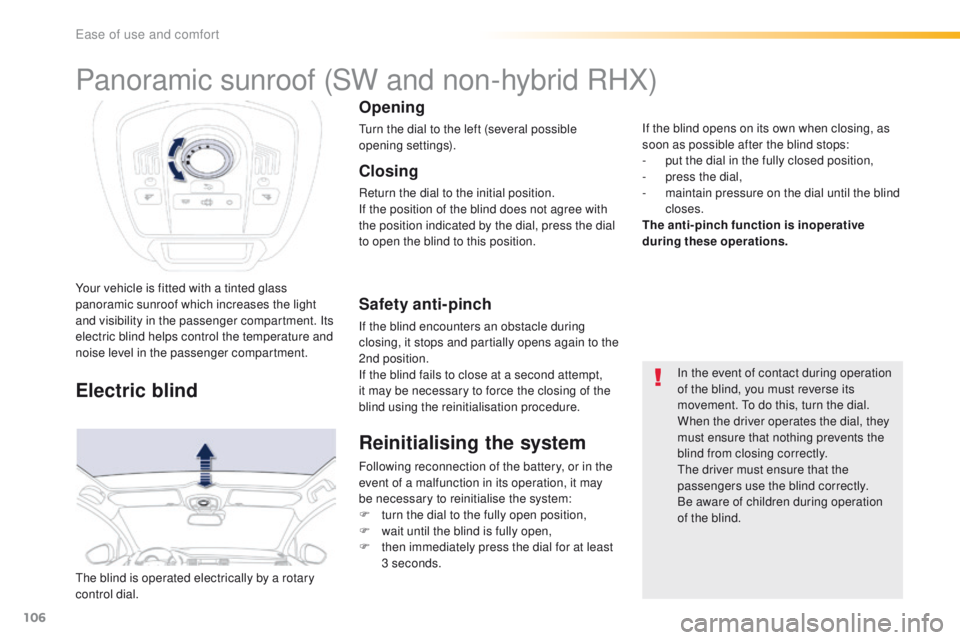
Your vehicle is fitted with a tinted glass
panoramic sunroof which increases the light
and visibility in the passenger compartment. Its
electric blind helps control the temperature and
noise level in the passenger compartment.
th
e blind is operated electrically by a rotary
control dial.
Opening
turn the dial to the left (several possible
opening settings).
Safety anti-pinch
If the blind encounters an obstacle during
closing, it stops and partially opens again to the
2nd position.
If the blind fails to close at a second attempt,
it may be necessary to force the closing of the
blind using the reinitialisation procedure.
Closing
Return the dial to the initial position.
If the position of the blind does not agree with
the position indicated by the dial, press the dial
to open the blind to this position.
Electric blind
In the event of contact during operation
of the blind, you must reverse its
movement.
t
o d
o this, turn the dial.
When the driver operates the dial, they
must ensure that nothing prevents the
blind from closing correctly.
th
e driver must ensure that the
passengers use the blind correctly.
Be aware of children during operation
of the blind.
Reinitialising the system
Following reconnection of the battery, or in the
event of a malfunction in its operation, it may
be necessary to reinitialise the system:
F
t
urn the dial to the fully open position,
F
w
ait until the blind is fully open,
F
t
hen immediately press the dial for at least
3 seconds. If the blind opens on its own when closing, as
soon as possible after the blind stops:
-
p
ut the dial in the fully closed position,
-
p
ress the dial,
-
m
aintain pressure on the dial until the blind
closes.
The anti-pinch function is inoperative
during these operations.
Panoramic sunroof (SW and non-hybrid RHX)
ease of use and comfort
Page 121 of 371
119
508_en_Chap04_eclairage-et-visibilite_ed01-2016
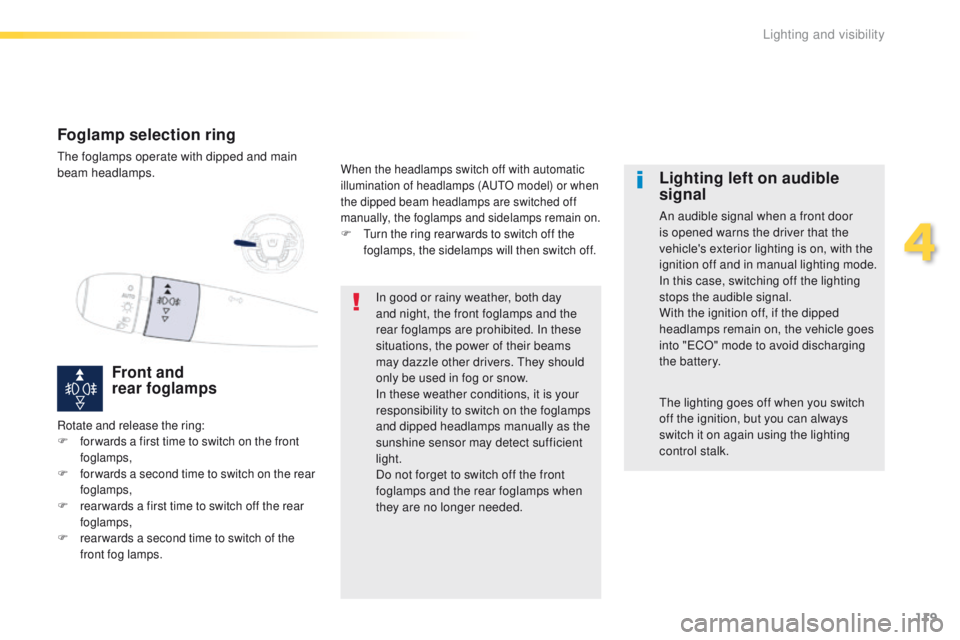
Foglamp selection ring
the foglamps operate with dipped and main
beam headlamps.
Front and
rear foglamps
When the headlamps switch off with automatic
illumination of headlamps (AutO m odel) or when
the dipped beam headlamps are switched off
manually, the foglamps and sidelamps remain on.
F turn the ring rear wards to switch off the foglamps, the sidelamps will then switch off.
In good or rainy weather, both day
and night, the front foglamps and the
rear foglamps are prohibited. In these
situations, the power of their beams
may dazzle other drivers.
t
he
y should
only be used in fog or snow.
In these weather conditions, it is your
responsibility to switch on the foglamps
and dipped headlamps manually as the
sunshine sensor may detect sufficient
light.
Do not forget to switch off the front
foglamps and the rear foglamps when
they are no longer needed.
Rotate and release the ring:
F f or wards a first time to switch on the front
foglamps,
F
f
or wards a second time to switch on the rear
foglamps,
F
r
ear wards a first time to switch off the rear
foglamps,
F
r
ear wards a second time to switch of the
front fog lamps.
Lighting left on audible
signal
An audible signal when a front door
is opened warns the driver that the
vehicle's exterior lighting is on, with the
ignition off and in manual lighting mode.
In this case, switching off the lighting
stops the audible signal.
With the ignition off, if the dipped
headlamps remain on, the vehicle goes
into "
eC
O" mode to avoid discharging
the battery.
th
e lighting goes off when you switch
off the ignition, but you can always
switch it on again using the lighting
control stalk.
4
Lighting and visibility
Page 167 of 371
165
508_en_Chap06_conduite_ed01-2016
For Diesel vehicles, in very cold
weather the engine will not start
until the pre-heater warning
lamp has gone off.
If this warning lap comes on
after pressing the "S TA R T/
STOP " button, you should
maintain pressure on the brake
or clutch pedal until the warning
lamp goes off and not press the
" START/STOP " button, until the
engine starts. If the vehicle is not immobilised, the
engine will not stop.
Switching off
F Immobilise the vehicle.
F
W
ith the electronic key inside
the vehicle, press the " S TA R T/
STOP " button.
th
e engine stops and the steering column is
locked.
Ignition on (accessory) position
With the electronic key inside the vehicle,
press the "StA Rt/ StO P" button, with no
action on the pedals, to switch the ignition
on or off and so allow the use of the ancillary
equipment.
If one of the starting conditions is not
met, a reminder message appears in
the instrument panel screen. In some
circumstances, it is necessary to turn
the steering wheel slightly while pressing
the "S
tA
R
t/
S
tO
P" button to assist
unlocking of the steering; a message
warns you when this is needed.
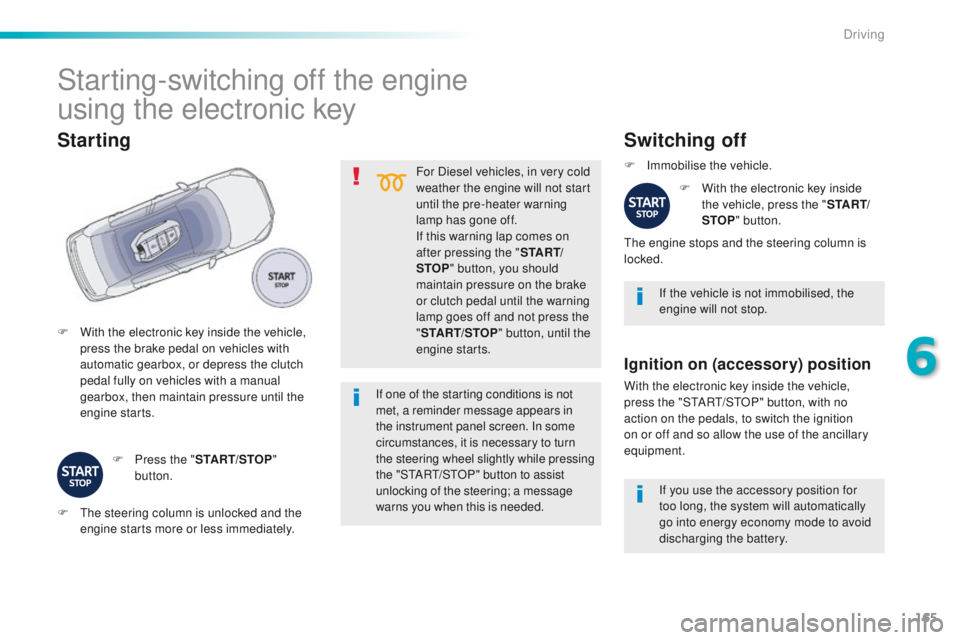
F
W
ith the electronic key inside the vehicle,
press the brake pedal on vehicles with
automatic gearbox, or depress the clutch
pedal fully on vehicles with a manual
gearbox, then maintain pressure until the
engine starts.
Starting
F Press the " START/STOP"
button.
Starting-switching off the engine
using the electronic key
F the steering column is unlocked and the engine starts more or less immediately. If you use the accessory position for
too long, the system will automatically
go into energy economy mode to avoid
discharging the battery.
6
Driving
Page 172 of 371
170
508_en_Chap06_conduite_ed01-2016
Automatic release
the electric parking brake releases
automatically and progressively when you
press the accelerator:
F
M
anual gearbox: press down fully on the
clutch pedal, engage first gear or reverse,
press on the accelerator pedal and
move
off.
F
A
utomatic gearbox: select position D, M
or R then press on the accelerator pedal.
Full release of the parking brake is confirmed by:
-
t
he braking warning lamp and
the P warning lamp in the control
lever A going of f,
-
d
isplay of the message "Parking
brake of f ".
When stationary, with the engine running, do
not press the accelerator pedal unnecessarily,
as you may release the parking brake.
Before leaving the vehicle, check that
parking brake warning lamps in the
instrument panel and the control lever A
are on fixed, not flashing.
Immobilising the vehicle,
engine running
With the engine running and the vehicle
stationary, in order to immobilise the vehicle
it is essential to manually apply the parking
brake by pulling control lever A.
th
e application of the parking brake is
confirmed by:
-
i
llumination of the braking warning
lamp and of the P warning lamp in
the control lever A ,
-
d
isplay of the message "Parking
brake on".
When the driver’s door is opened, a loud beep
is heard and a message is displayed if the
parking brake has not been applied, unless the
gear lever is in position P (Park) in the case of
an automatic gearbox.
Particular situations
In certain situations (e.g. starting the engine),
the parking brake can automatically alter its
force. t
h
is is normal operation.
to a
dvance your vehicle a few centimetres
without starting the engine, but with the ignition
on, press on the brake pedal and release the
parking brake by pushing then releasing
control lever A .
t
h
e full release of the parking
brake is confirmed by the warning lamps in
the control lever A and in the instrument panel
going off and display of the message "Parking
brake of f ".
If a parking brake fault occurs while applied or
if the battery runs flat, an emergency release is
always possible.
In order to ensure correct operation and
so your safety, the number of successive
application/release operations of the parking
brake is limited to eight.
In the event of abuse, you are alerted by a
message "Parking brake faulty" and a warning
lamp flashes.
Driving