warning Peugeot 508 2016 Manual PDF
[x] Cancel search | Manufacturer: PEUGEOT, Model Year: 2016, Model line: 508, Model: Peugeot 508 2016Pages: 371, PDF Size: 12.12 MB
Page 226 of 371
224
508_en_Chap07_info-pratiques_ed01-2016
Topping-up the AdBlue® additive
Filling the AdBlue® tank is an operation
included in every routine service on your
vehicle by a P
e
uge
Ot
dealer or a qualified
workshop.
Nevertheless, given the capacity of the tank,
it may be necessary to top-up the additive
between services, more particularly if an alert
(warning lamps and a message) signals the
requirement.
You can go to a P
e
uge
Ot
dealer or a qualified
workshop.
If you envisage topping-up yourself, please
read the following warnings carefully.Precautions in use
Keep AdBlue® out of the reach of
children, in its original bottle.
Never transfer AdBlue
® to another
container: it would lose its purity.
us
e only AdBlue
® additive that meets the
ISO
22241 standard.th
e AdBlue® additive is an urea-based
solution.
th
is liquid is non-flammable,
colourless and odourless (kept in a cool area).
In the event of contact with the skin, wash
the affected area with soap and water. In the
event of contact with the eyes, wash (irrigate)
the eyes with large amounts of water or with
an eye wash solution for at least 15 minutes.
If a burning sensation or irritation persists, get
medical attention.
If swallowed, immediately wash out the mouth
with clean water and then drink plenty of water.
In certain conditions (high ambient
temperature, for example), the risk of release
of ammonia cannot be excluded: do not inhale
the product. Ammonia vapour has an irritant
effect on mucous membranes (eyes, nose and
throat). Never dilute the additive with water.
Never pour the additive into the Diesel
fuel tank.
th
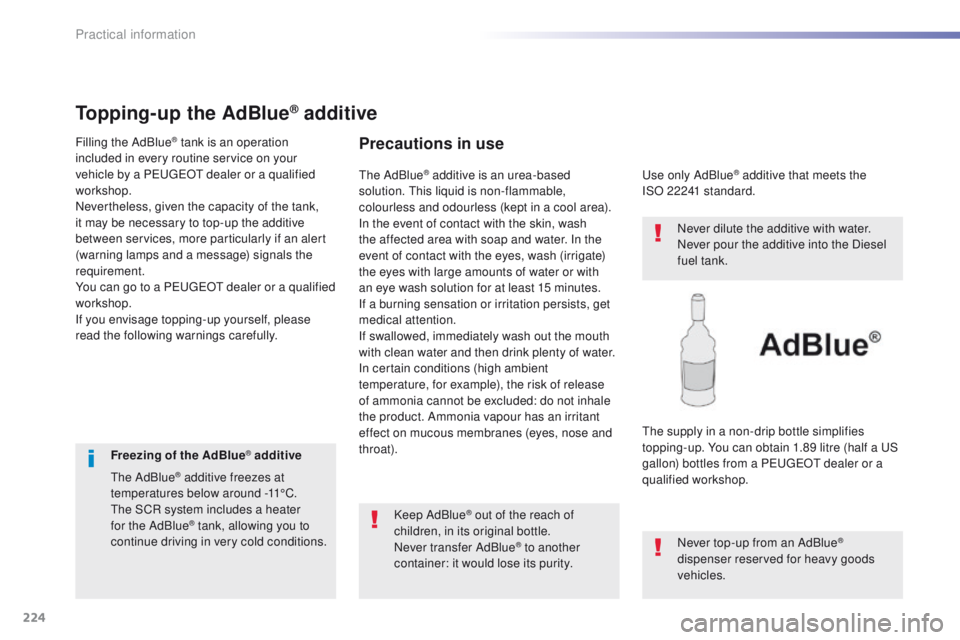
e supply in a non-drip bottle simplifies
topping-up. You can obtain 1.89 litre (half a
u
S
g
allon) bottles from a P
e
uge
Ot
dealer or a
qualified workshop.
Never top-up from an AdBlue
®
dispenser reserved for heavy goods
vehicles.
Freezing of the AdBlue
® additive
th
e AdBlue
® additive freezes at
temperatures below around -11°C.
th
e SCR system includes a heater
for the AdBlue
® tank, allowing you to
continue driving in very cold conditions.
Practical information
Page 229 of 371
227
508_en_Chap08_en-cas-de-pannes_ed01-2016
Warning triangle
Before leaving your vehicle to set up
and install the triangle, switch on the
hazard warning lamps and put on your
high visibility vest.
th
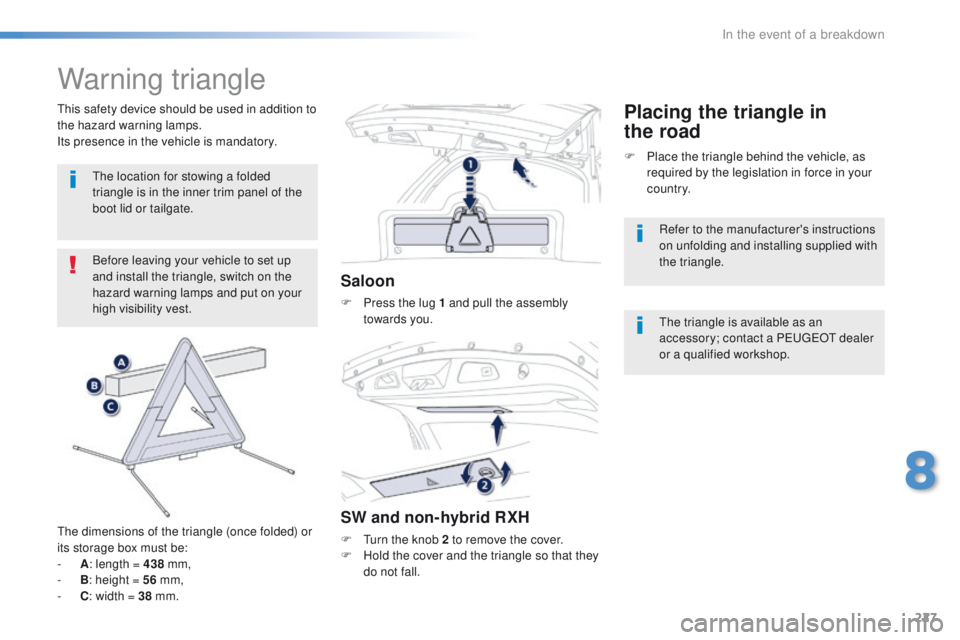
e dimensions of the triangle (once folded) or
its storage box must be:
-
A : l
ength = 438 mm,
-
B : h
eight = 56 mm,
-
C : w
idth = 38 mm.
Saloon
F Press the lug 1 and pull the assembly
towards you.
SW and non-hybrid RXH
F turn the knob 2 to remove the cover.
F H old the cover and the triangle so that they
do not fall. F
P
lace the triangle behind the vehicle, as
required by the legislation in force in your
c o unt r y.
th
e triangle is available as an
accessory; contact a P
e
uge
Ot
dealer
or a qualified workshop.
Placing the triangle in
the roadthis safety device should be used in addition to
the hazard warning lamps.
Its presence in the vehicle is mandatory.
th
e location for stowing a folded
triangle is in the inner trim panel of the
boot lid or tailgate.
Refer to the manufacturer's instructions
on unfolding and installing supplied with
the triangle.
8
In the event of a breakdown
Page 234 of 371
232
508_en_Chap08_en-cas-de-pannes_ed01-2016
If after around 5 to 7 minutes the
pressure is not attained, this indicates
that the tyre is not repairable; contact
a P
e
uge
Ot
dealer or a qualified
workshop for assistance.
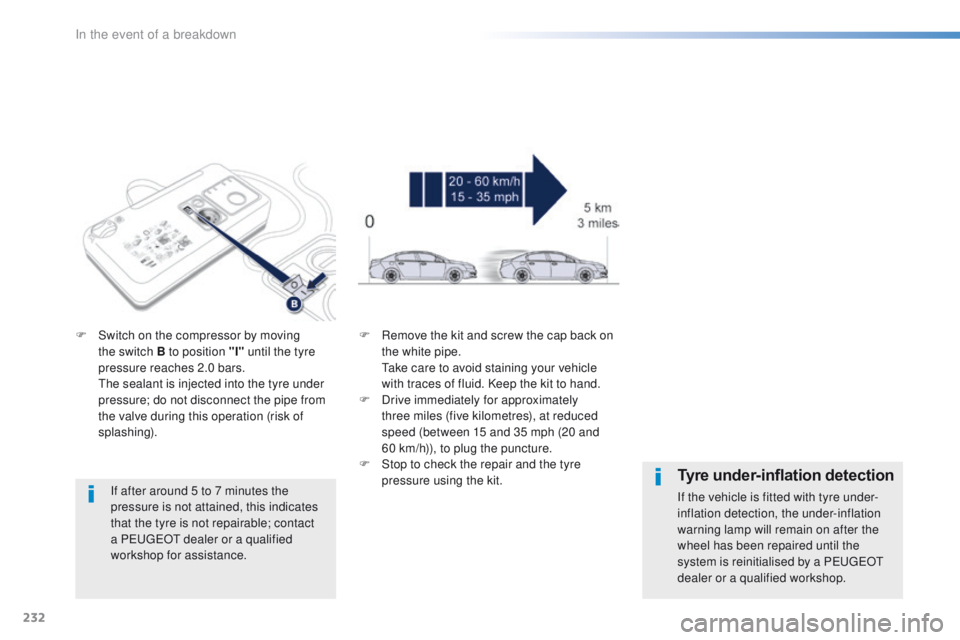
F
S
witch on the compressor by moving
the switch B to position "I" until the tyre
pressure reaches 2.0 bars.
t
h
e sealant is injected into the tyre under
pressure; do not disconnect the pipe from
the valve during this operation (risk of
splashing). F
R
emove the kit and screw the cap back on
the white pipe.
t
a
ke care to avoid staining your vehicle
with traces of fluid. Keep the kit to hand.
F
D
rive immediately for approximately
three miles (five kilometres), at reduced
speed (between 15 and 35 mph (20 and
60 km/h)), to plug the puncture.
F
S
top to check the repair and the tyre
pressure using the kit.Tyre under-inflation detection
If the vehicle is fitted with tyre under-
inflation detection, the under-inflation
warning lamp will remain on after the
wheel has been repaired until the
system is reinitialised by a P
e
uge
Ot
dealer or a qualified workshop.
In the event of a breakdown
Page 240 of 371
238
508_en_Chap08_en-cas-de-pannes_ed01-2016
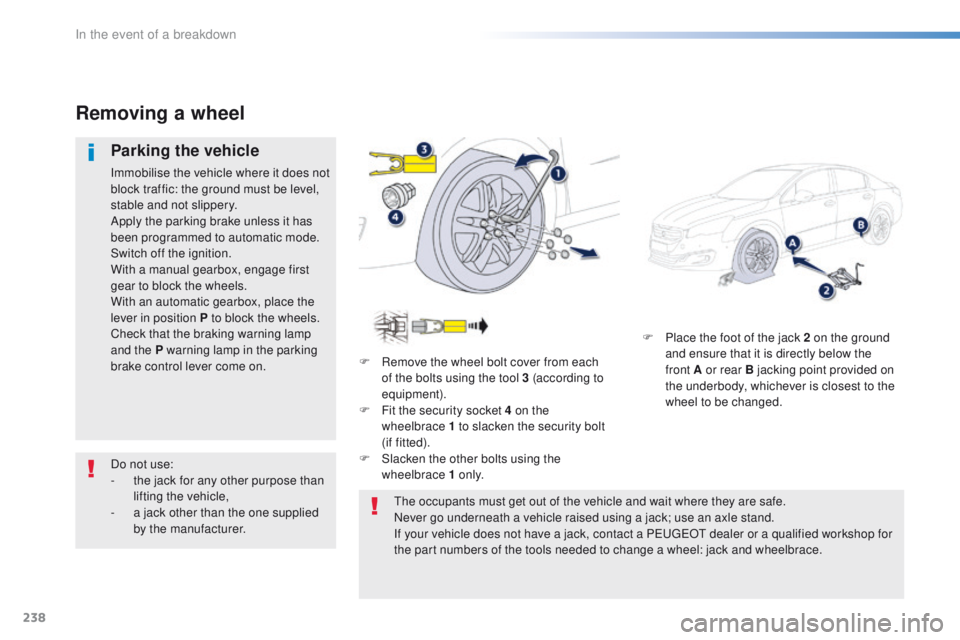
F Place the foot of the jack 2 on the ground and ensure that it is directly below the
front
A or rear B jacking point provided on
the underbody, whichever is closest to the
wheel to be changed.
Removing a wheel
Parking the vehicle
Immobilise the vehicle where it does not
block traffic: the ground must be level,
stable and not slippery.
Apply the parking brake unless it has
been programmed to automatic mode.
Switch off the ignition.
With a manual gearbox, engage first
gear to block the wheels.
With an automatic gearbox, place the
lever in position P to block the wheels.
Check that the braking warning lamp
and the P warning lamp in the parking
brake control lever come on. F
R
emove the wheel bolt cover from each
of the bolts using the tool 3 (according to
equipment).
F
F
it the security socket 4 on the
wheelbrace
1 to slacken the security bolt
(if
fitted).
F
S
lacken the other bolts using the
wheelbrace 1 o n l y.
th
e occupants must get out of the vehicle and wait where they are safe.
Never go underneath a vehicle raised using a jack; use an axle stand.
If your vehicle does not have a jack, contact a P
e
uge
Ot
dealer or a qualified workshop for
the part numbers of the tools needed to change a wheel: jack and wheelbrace.
Do not use:
-
t
he jack for any other purpose than
lifting the vehicle,
-
a j
ack other than the one supplied
by the manufacturer.
In the event of a breakdown
Page 262 of 371
260
508_en_Chap08_en-cas-de-pannes_ed01-2016
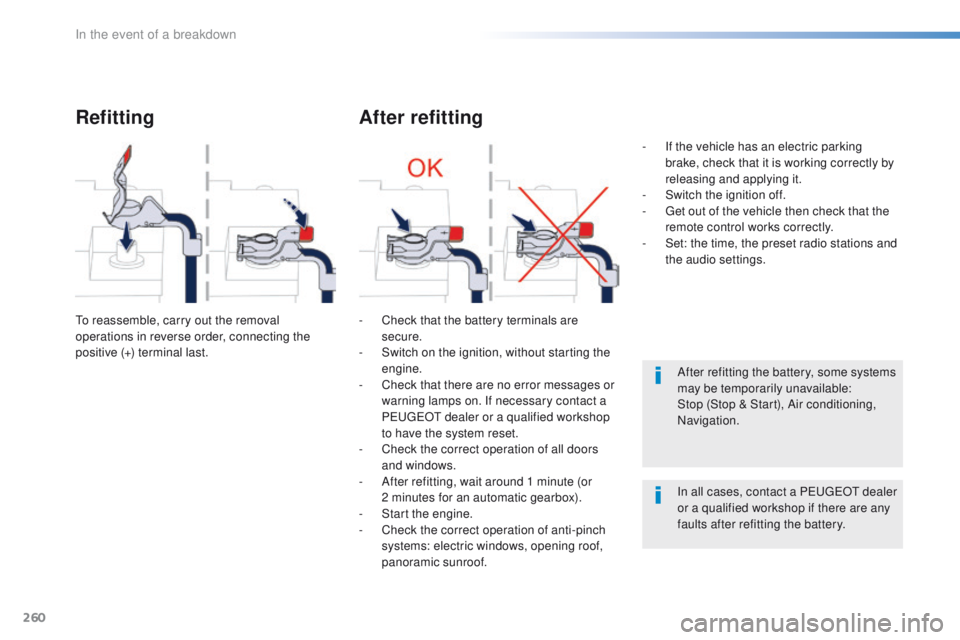
Refitting
to reassemble, carry out the removal
operations in reverse order, connecting the
positive (+) terminal last.
After refitting
- Check that the battery terminals are secure.
-
S
witch on the ignition, without starting the
engine.
-
C
heck that there are no error messages or
warning lamps on. If necessary contact a
P
e
uge
Ot
dealer or a qualified workshop
to have the system reset.
-
C
heck the correct operation of all doors
and windows.
-
A
fter refitting, wait around 1 minute (or
2
minutes for an automatic gearbox).
-
S
tart the engine.
-
C
heck the correct operation of anti-pinch
systems: electric windows, opening roof,
panoramic sunroof. -
I
f the vehicle has an electric parking
brake, check that it is working correctly by
releasing and applying it.
-
S
witch the ignition off.
- g
e
t out of the vehicle then check that the
remote control works correctly.
-
S
et: the time, the preset radio stations and
the audio settings.
After refitting the battery, some systems
may be temporarily unavailable:
Stop (Stop & Start), Air conditioning,
Navigation.
In all cases, contact a P
e
uge
Ot
dealer
or a qualified workshop if there are any
faults after refitting the battery.
In the event of a breakdown
Page 264 of 371
262
508_en_Chap08_en-cas-de-pannes_ed01-2016
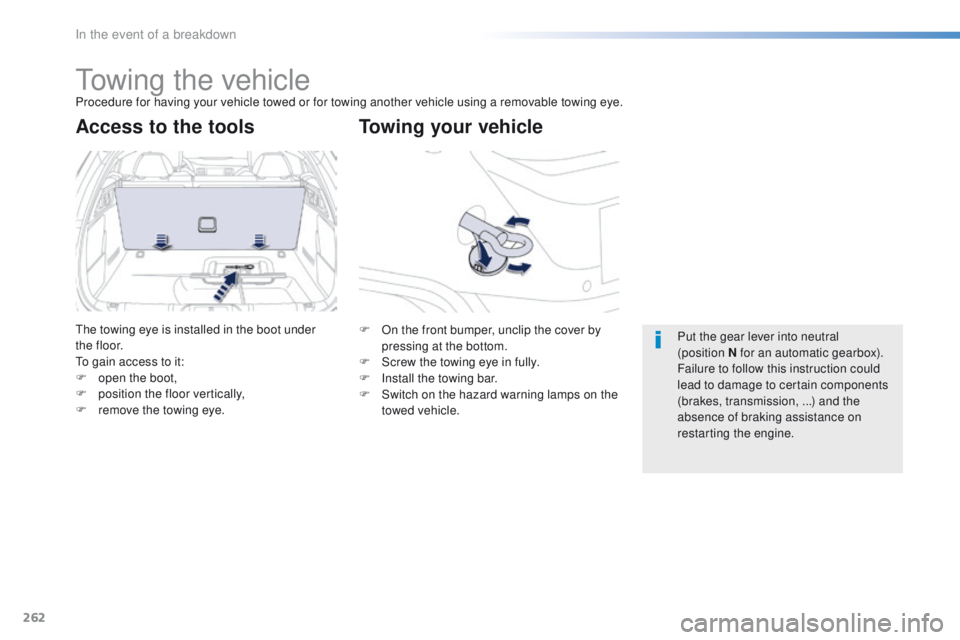
towing the vehicleProcedure for having your vehicle towed or for towing another vehicle using a removable towing eye.
Towing your vehicle
Access to the tools
the towing eye is installed in the boot under
t h e f l o o r.
to g
ain access to it:
F
o
pen the boot,
F
p
osition the floor vertically,
F
r
emove the towing eye. F
O n the front bumper, unclip the cover by
pressing at the bottom.
F
S
crew the towing eye in fully.
F
I
nstall the towing bar.
F
S
witch on the hazard warning lamps on the
towed vehicle. Put the gear lever into neutral
(position
N for an automatic gearbox).
Failure to follow this instruction could
lead to damage to certain components
(brakes, transmission, ...) and the
absence of braking assistance on
restarting the engine.
In the event of a breakdown
Page 265 of 371
263
508_en_Chap08_en-cas-de-pannes_ed01-2016
General recommendations
Observe the legislation in force in your country.ensure that the weight of the towing vehicle is higher than that of the towed vehicle.
th
e driver must remain at the wheel of the towed vehicle and must have a valid driving
licence.
When towing a vehicle with all four wheels on the ground, always use an approved towing
arm; rope and straps are prohibited.
th
e towing vehicle must move off gently.
When towing a vehicle with the engine off, there is no longer any power assistance for
braking or steering.
In the following cases, you must always call on a professional recovery service:
-
v
ehicle broken down on a motor way or fast road,
-
f
our-wheel drive vehicle,
-
w
hen it is not possible to put the gearbox into neutral, unlock the steering, or release
the parking brake,
-
t
owing with only two wheels on the ground,
-
w
here there is no approved towing arm available...
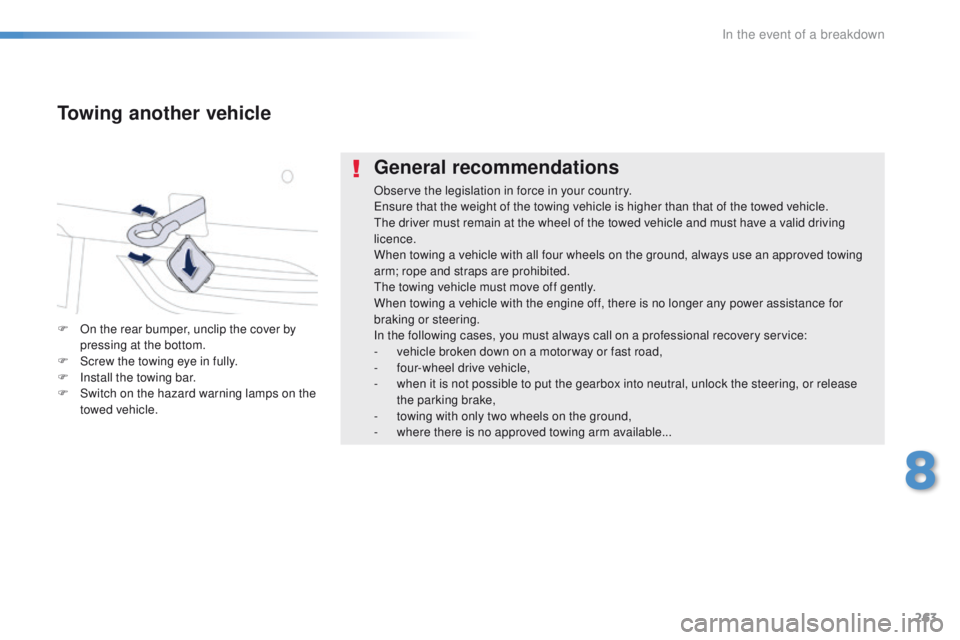
Towing another vehicle
F On the rear bumper, unclip the cover by pressing at the bottom.
F
S
crew the towing eye in fully.
F
I
nstall the towing bar.
F
S
witch on the hazard warning lamps on the
towed vehicle.
8
In the event of a breakdown
Page 267 of 371
265
508_en_Chap09_caracteristiques-techniques_ed01-2016
* the kerb weight is equal to the unladen weight + driver (75 kg).
** th e weight of the braked trailer can be increased, within the gtW l imit, if the gV W of the towing vehicle is reduced by an equal amount; warning,
towing using a lightly loaded towing vehicle may have an adverse effect on its road holding.
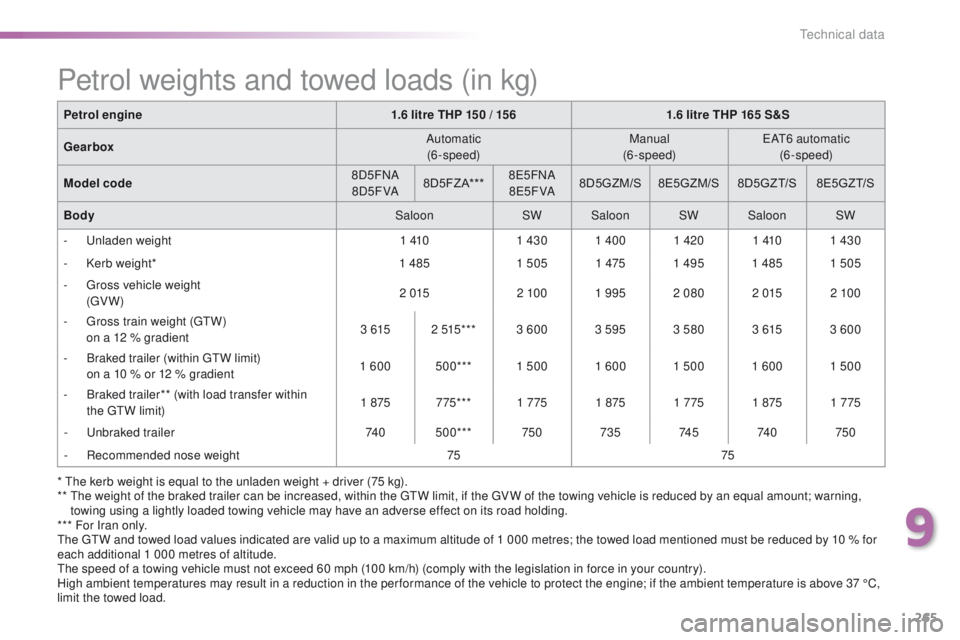
Petrol weights and towed loads (in kg)
Petrol engine 1.6 litre THP 150 / 1561.6 litre THP 165 S&S
Gearbox Automatic
(6-speed) Manual
(6-speed)
eAt6
automatic
(6-speed)
Model code 8D5FNA
8 D5 F VA 8D5FZA*** 8
e5
FNA
8
e5
F VA8D5GZM/S 8E5GZM/S
8 D5G Z T/S8E5GZT/S
Body SaloonSWSaloon SWSaloon SW
-
u
n
laden weight 1 4101 430 1 400 1 4201 4101 430
-
K
erb weight* 1 4851 5051 4751 495 1 485 1 505
-
g
r
oss vehicle weight
(
g
V
W) 2 015
2 10 01 995 2 080 2 0152 10 0
-
g
r
oss train weight (
g
t
W
)
o
n a 12 % gradient 3 615
2 515*** 3 600 3 595 3 580 3 6153 600
-
B
raked trailer (within gt
W l
imit)
o
n a 10 % or 12 % gradient 1 600
500*** 1 500 1 600 1 500 1 600 1 500
-
B
raked trailer** (with load transfer within
the
gt
W l
imit) 1 875
775*** 1 7751 8751 775 1 8751 775
-
u
nb
raked trailer 74 0500*** 750735 74 5 74 0 750
-
R
ecommended nose weight 7575
*** For Iran only.
th
e gt
W a
nd towed load values indicated are valid up to a maximum altitude of 1 000 metres; the towed load mentioned must be reduced by 10 % for
each additional 1 000 metres of altitude.
th
e speed of a towing vehicle must not exceed 60 mph (100 km/h) (comply with the legislation in force in your country).
High ambient temperatures may result in a reduction in the per formance of the vehicle to protect the engine; if the ambient temperature is above 37 °C,
limit the towed load.
9
technical data
Page 270 of 371
268
508_en_Chap09_caracteristiques-techniques_ed01-2016
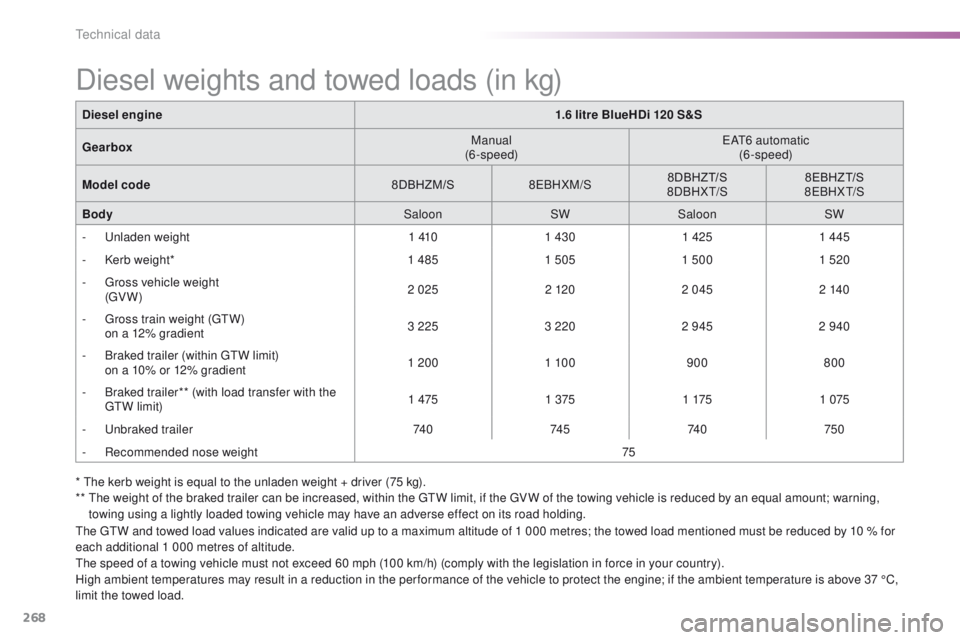
* the kerb weight is equal to the unladen weight + driver (75 kg).
** th e weight of the braked trailer can be increased, within the gtW l imit, if the gV W of the towing vehicle is reduced by an equal amount; warning,
towing using a lightly loaded towing vehicle may have an adverse effect on its road holding.
th
e gt
W a
nd towed load values indicated are valid up to a maximum altitude of 1 000 metres; the towed load mentioned must be reduced by 10 % for
each additional 1 000 metres of altitude.
th
e speed of a towing vehicle must not exceed 60 mph (100 km/h) (comply with the legislation in force in your country).
High ambient temperatures may result in a reduction in the per formance of the vehicle to protect the engine; if the ambient temperature is above 37 °C,
limit the towed load.
Diesel weights and towed loads (in kg)
Diesel engine 1.6 litre BlueHDi 120 S&S
Gearbox Manual
(6-speed)
eAt6
automatic
(6-speed)
Model code 8DBHZM/S8
eB
HXM/S8 D BHZ T/S
8 D BH X
t
/S8 EBHZ T/S
8
eB
H X
t
/S
Body SaloonSWSaloon SW
-
u
n
laden weight 1 4101 430 1 4251 445
-
K
erb weight* 1 4851 5051 500 1 520
-
g
r
oss vehicle weight
(
g
V
W) 2 025
2 1202 045 2 140
-
g
r
oss train weight (
g
t
W
)
o
n a 12% gradient 3 225
3 2202 945 2 940
-
B
raked trailer (within gt
W l
imit)
o
n a 10% or 12% gradient 1 200
1 10 0 900800
-
B
raked trailer** (with load transfer with the
g
t
W
limit) 1 475
1 375 1 1751 075
-
u
nb
raked trailer 74 074 5 74 0750
-
R
ecommended nose weight 75
technical data
Page 271 of 371
269
508_en_Chap09_caracteristiques-techniques_ed01-2016
Diesel engine2.0 litre HDi 1402.0 litre HDi 136 / 163
Gearbox Manual
(6-speed) Manual
(6-speed)
eAt6
automatic
(6-speed)
Model code 8DRHR8
8DRHF8 8DRHHA
8DRHDA 8DRHH8
Body SaloonSaloonSaloon
-
u
n
laden weight 1 4301 5201 480
-
K
erb weight* 1 5051 5951 555
-
g
r
oss vehicle weight
(
g
V
W) 2 065
2 1052 075
-
g
r
oss train weight (
g
t
W
)
o
n a 12 % gradient 3 665
3 405 3 675
-
B
raked trailer (within gt
W l
imit)
o
n a 10% or 12% gradient 1 600
1 3001 600
-
B
raked trailer** (with load transfer with the
g
t
W
limit) 1 875
1 575 1 875
-
u
nb
raked trailer 750750
-
R
ecommended nose weight 7575
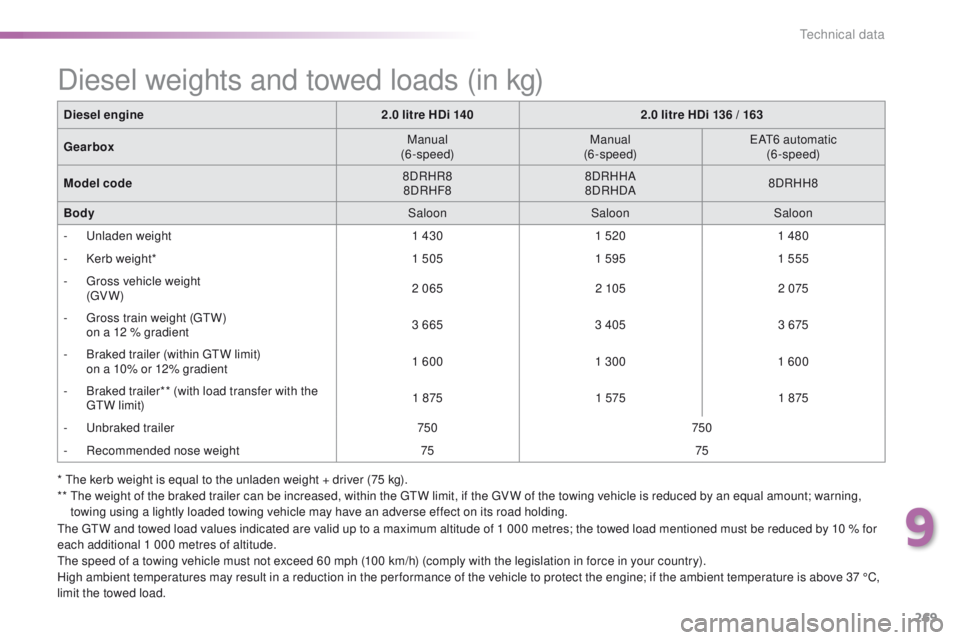
*
t
h
e kerb weight is equal to the unladen weight + driver (75 kg).
**
t
h
e weight of the braked trailer can be increased, within the gt
W l
imit, if the g
V
W of the towing vehicle is reduced by an equal amount; warning,
towing using a lightly loaded towing vehicle may have an adverse effect on its road holding.
th
e gt
W a
nd towed load values indicated are valid up to a maximum altitude of 1 000 metres; the towed load mentioned must be reduced by 10 % for
each additional 1 000 metres of altitude.
th
e speed of a towing vehicle must not exceed 60 mph (100 km/h) (comply with the legislation in force in your country).
High ambient temperatures may result in a reduction in the per formance of the vehicle to protect the engine; if the ambient temperature is above 37 °C,
limit the towed load.
Diesel weights and towed loads (in kg)
9
technical data