neutral Peugeot 508 2019 Owner's Manual
[x] Cancel search | Manufacturer: PEUGEOT, Model Year: 2019, Model line: 508, Model: Peugeot 508 2019Pages: 320, PDF Size: 10.09 MB
Page 45 of 320
43
F With a manual gearbox, place the gear
lever in neutral then fully depress the clutch
pedal.
F
W
ith an automatic gearbox , from mode P,
fully depress the brake pedal.
F
S
witch on the ignition by pressing the
" START/STOP " button.
The electronic key is now fully operational
again.
If the fault persists after reinitialisation, contact
a PEUGEOT dealer or a qualified workshop
without delay.
Central locking
This function allows the doors and boot to be
locked or unlocked simultaneously from inside
the vehicle.
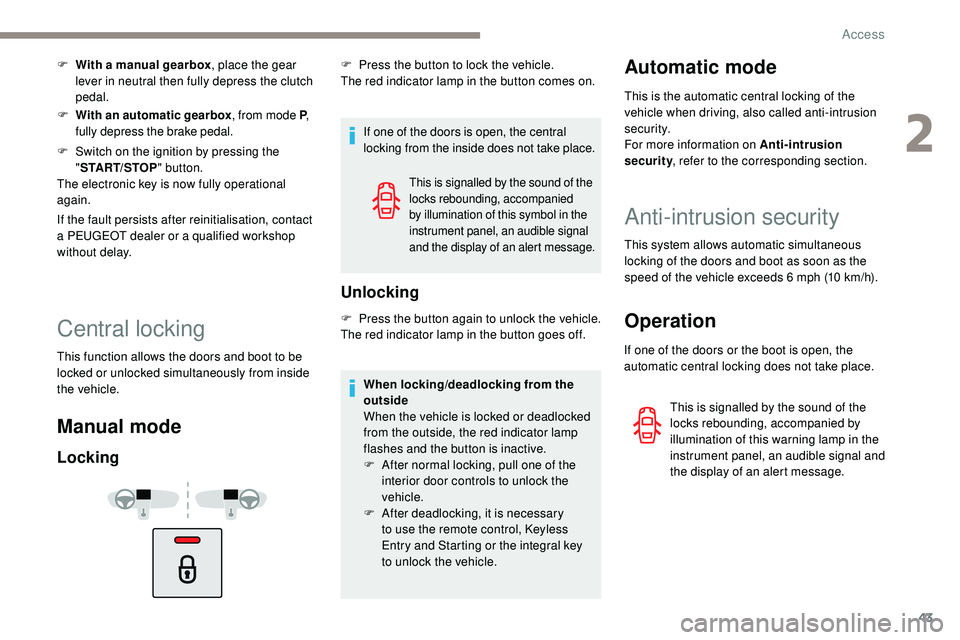
Manual mode
Locking
If one of the doors is open, the central
locking from the inside does not take place.
Unlocking
F Press the button again to unlock the vehicle.
The red indicator lamp in the button goes off.
This is signalled by the sound of the
locks rebounding, accompanied
by illumination of this symbol in the
instrument panel, an audible signal
and the display of an alert message.
F Press the button to lock the vehicle.
The red indicator lamp in the button comes on.
When locking/deadlocking from the
outside
When the vehicle is locked or deadlocked
from the outside, the red indicator lamp
flashes and the button is inactive.
F
A
fter normal locking, pull one of the
interior door controls to unlock the
vehicle.
F
A
fter deadlocking, it is necessary
to
use the remote control, Keyless
Entry and Starting or the integral key
to
unlock the vehicle.Automatic mode
This is the automatic central locking of the
vehicle when driving, also called anti-intrusion
s e c u r i t y.
For more information on Anti-intrusion
security, refer to the corresponding section.
Anti-intrusion security
This system allows automatic simultaneous
locking of the doors and boot as soon as the
speed of the vehicle exceeds 6 mph (10 km/h).
Operation
If one of the doors or the boot is open, the
automatic central locking does not take place.
This is signalled by the sound of the
locks rebounding, accompanied by
illumination of this warning lamp in the
instrument panel, an audible signal and
the display of an alert message.
2
Access
Page 126 of 320
124
Driving recommendations
Observe the driving regulations and remain
vigilant whatever the traffic conditions.
Pay close attention to the traffic and keep your
hands on the wheel so that you are ready to
react at any time to any eventuality.
As a safety measure, the driver should only
carry out any operations that require close
attention when the vehicle is stationary.
On a long journey, a break every two hours is
strongly recommended.
In bad weather, drive smoothly, anticipate the
need to brake and increase the distance from
other vehicles.Never leave the engine running in
an enclosed area without adequate
ventilation: internal combustion engines
emit toxic exhaust gases, such as carbon
monoxide. There is a risk of poisoning and
death!
In very severe wintry conditions
(temperatures below -23°C), to guarantee
correct operation and the longevity of
the mechanical elements of your vehicle
(engine and gearbox), the engine must be
left running for 4 minutes before driving.
Important!
Never drive with the parking brake applied
– Risk of overheating and damage to the
braking system!
As the exhaust system of your vehicle
is very hot, even several minutes after
switching off the engine, never park or run
the engine on inflammable sur faces (dry
grass, fallen leaves, etc.) – Risk of fire!
Never leave a vehicle unsuper vised with
the engine running. If you have to leave
your vehicle with the engine running, apply
the parking brake and put the gearbox into
neutral or position N or P , depending on
the type of gearbox.
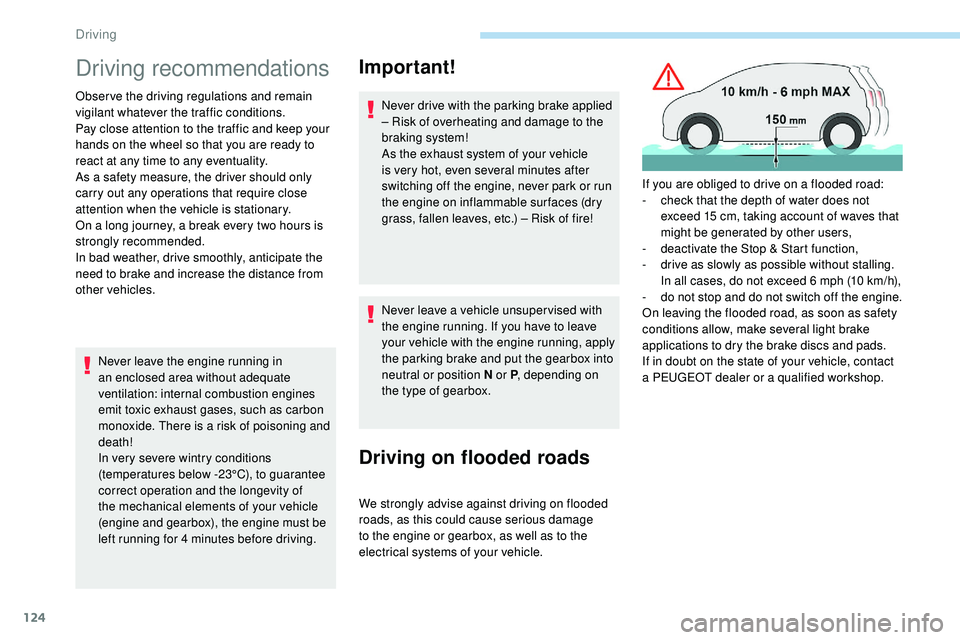
Driving on flooded roads
We strongly advise against driving on flooded
roads, as this could cause serious damage
to the engine or gearbox, as well as to the
electrical systems of your vehicle. If you are obliged to drive on a flooded road:
-
c
heck that the depth of water does not
exceed 15 cm, taking account of waves that
might be generated by other users,
-
d
eactivate the Stop & Start function,
-
d
rive as slowly as possible without stalling.
In all cases, do not exceed 6 mph (10 km/h),
-
d
o not stop and do not switch off the engine.
On leaving the flooded road, as soon as safety
conditions allow, make several light brake
applications to dry the brake discs and pads.
If in doubt on the state of your vehicle, contact
a PEUGEOT dealer or a qualified workshop.
Driving
Page 127 of 320
125
In case of towing
Driving with a trailer places greater
demands on the towing vehicle and
requires extra care from the driver.
Side wind
F Take into account the increased sensitivity to wind.
Cooling
Towing a trailer on a slope increases the
temperature of the coolant.
As the fan is electrically controlled, its cooling
capacity is not dependent on the engine speed.
F
T
o lower the engine speed, reduce your
speed.
The maximum towable load on an incline
depends on the gradient and the exterior
temperature.
In all cases, keep a check on the coolant
temperature.
F
I
f this warning lamp and the STOP
warning lamp come on, stop the
vehicle and switch off the engine
as soon as possible.
New vehicle
Do not pull a trailer before having driven at least
approximately 620 miles (1,000 kilometres).
Braking
Towing a trailer increases the braking distance.
To avoid overheating of the brakes, the use of
engine braking is recommended.
Ty r e s
F Check the tyre pressures of the towing vehicle and of the trailer, observing the
recommended pressures.
Lighting
F Check the electrical lighting and signalling on the trailer and the headlamp beam height
of your vehicle.
For more information on Headlamp
adjustment , refer to the corresponding
section.
Certain driving or manoeuvring aid
functions are automatically disabled
if
an approved towbar is used.
Anti-theft protection
Electronic immobiliser
The keys contain an electronic chip which has
a secret code. When the ignition is switched
on, this code must be recognised in order for
starting to be possible.
A few seconds after switching off the ignition,
this system locks the engine control system,
therefore preventing the engine from being
started in the event of a break-in.
If the system fails, as reported by a message,
the engine will not start.
Contact the PEUGEOT dealer.
Starting/Switching off the
engine
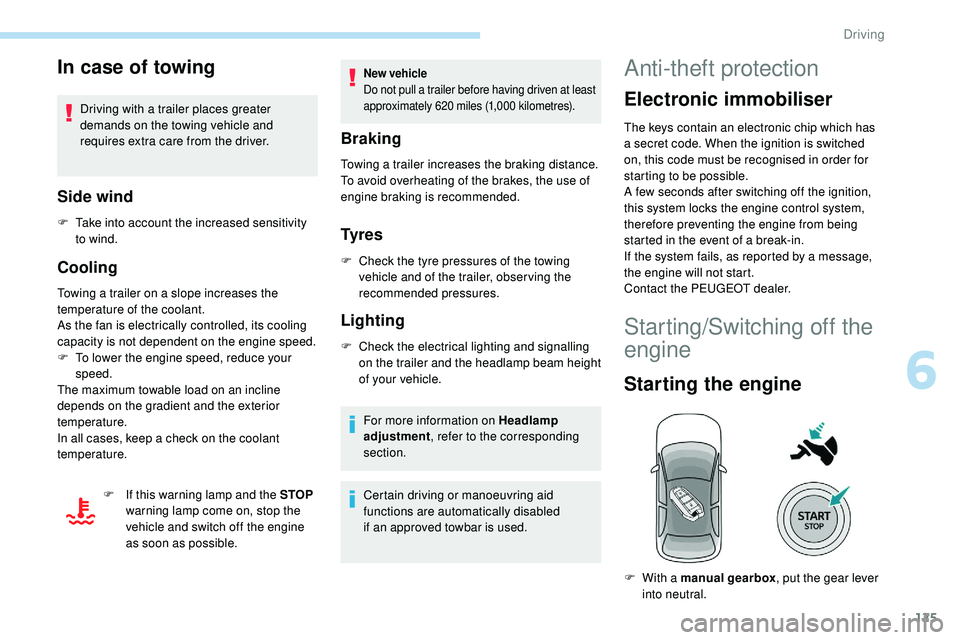
Starting the engine
F With a manual gearbox , put the gear lever
into neutral.
6
Driving
Page 128 of 320
126
The Keyless Entry and Starting electronic
key must be inside the vehicle.
If the electronic key is not detected in this
zone, a message is displayed.
Move the electronic key into this zone so
that the engine can be started.
If there is still a problem, refer to the "Key
not detected – Back-up starting" section.
F
P
ress the " START/STOP " button while
maintaining pressure on the pedal until the
engine starts.
The steering column unlocks and the engine
starts.
On certain versions with the automatic gearbox
(EAT6/EAT8), the steering column does not
lock.
For Diesel engines , in sub-zero temperatures
and/or when the engine is cold, the start will
only take place once the preheater warning
lamp is off. F
W
ith a manual gearbox
, you should keep
the clutch pedal fully depressed and not
press the " START/STOP " button again until
the engine is running.
F
W
ith an automatic gearbox
, you should
keep the brake pedal fully depressed and
not press the " START/STOP" button again
until the engine is running.
If one of the starting conditions is not met,
a reminder message is displayed in the
instrument panel.
In some circumstances, it is necessary to turn
the steering wheel slightly while pressing the
" START/STOP " button to assist unlocking of
the steering column.
F
W
ith the electronic key inside the vehicle,
fully depress the clutch pedal.
or
F
W
ith an automatic gearbox
, select mode P
or N .
F
W
ith the electronic key inside the vehicle,
press the brake pedal. If this warning lamp comes on after
pressing the "
START/STOP " button:
With petrol engines , after a cold start,
preheating the catalytic converter can
cause noticeable engine vibrations for
up to 2 minutes while stationary with the
engine running (accelerated idle speed).
If the engine stalls, release the clutch
pedal and push it all the way down again,
the engine will restart automatically. As a safety measure, never leave the
vehicle while the engine is running.
Switching off the engine
F Immobilise the vehicle, engine at idle.
F
W ith a manual gearbox , preferably put the
gear lever into neutral.
F
W
ith an automatic gearbox , preferably
select mode P or N .
F
W
ith the electronic key inside the vehicle,
press the " START/STOP " button.
The engine stops and the steering column
locks.
In some circumstances, it is necessary to turn
the steering wheel to lock the steering column.
On certain versions with the automatic gearbox
(EAT6/EAT8), the steering column does not
lock, but the gearbox locks in mode P .
If the vehicle is not immobilised, the
engine will not stop.
Never leave your vehicle with the
electronic key still inside.
Switching off the engine leads to a loss of
braking assistance.
Driving
Page 129 of 320
127
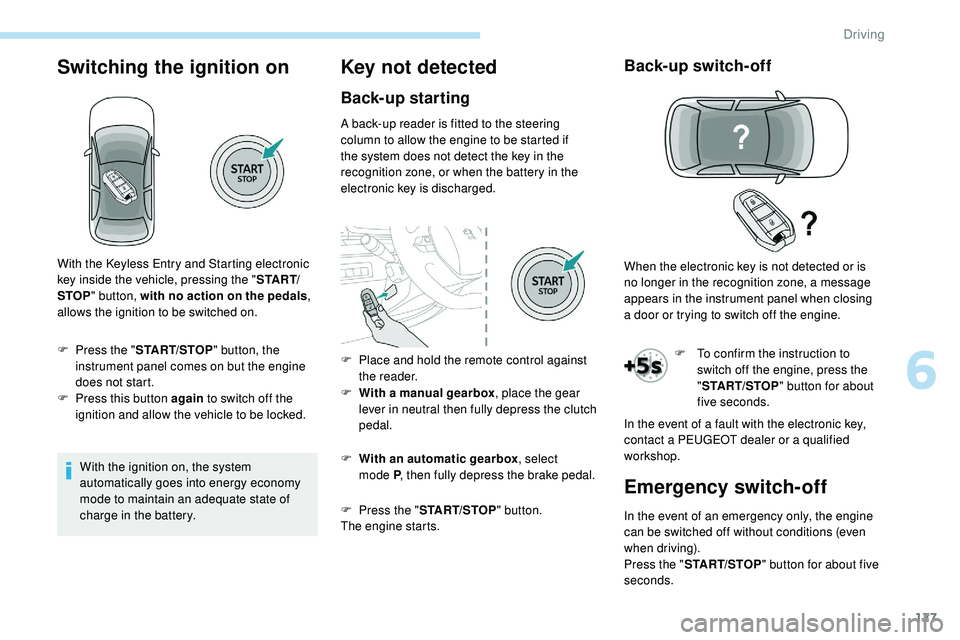
Switching the ignition on
With the ignition on, the system
automatically goes into energy economy
mode to maintain an adequate state of
charge in the battery.
Key not detected
Back-up starting
A back-up reader is fitted to the steering
column to allow the engine to be started if
the system does not detect the key in the
recognition zone, or when the battery in the
electronic key is discharged.
F
W
ith a manual gearbox , place the gear
lever in neutral then fully depress the clutch
pedal.
F
W
ith an automatic gearbox , select
mode
P, then fully depress the brake pedal.
F
P
ress the " START/STOP " button.
The engine starts.
Back-up switch-off
F To confirm the instruction to switch off the engine, press the
"START/STOP " button for about
five seconds.
With the Keyless Entry and Starting electronic
key inside the vehicle, pressing the "
S TA R T/
STOP " button, with no action on the pedals ,
allows the ignition to be switched on.
F
P
ress the "
START/STOP " button, the
instrument panel comes on but the engine
does not start.
F
P
ress this button again to switch off the
ignition and allow the vehicle to be locked. F
P
lace and hold the remote control against
the reader. When the electronic key is not detected or is
no longer in the recognition zone, a message
appears in the instrument panel when closing
a
door or trying to switch off the engine.
In the event of a fault with the electronic key,
contact a PEUGEOT dealer or a qualified
workshop.
Emergency switch-off
In the event of an emergency only, the engine
can be switched off without conditions (even
when driving).
Press the " START/STOP " button for about five
seconds.
6
Driving
Page 133 of 320
131
F Release the control lever and the brake pedal.
From now on, the parking brake can only
be applied and released manually using the
control lever.
Repeat this procedure to reactivate automatic
operation.
Reactivation of automatic operation is
confirmed by the indicator lamp in the
instrument panel going off.
Emergency braking
The emergency braking should only be
used in an exceptional situation.
In the event of a failure of the main ser vice
brake or in an exceptional situation (e.g. driver
taken ill, under instruction, etc.), a continuous
pull on the control lever will brake the vehicle.
Braking takes place while the control lever is
being pulled. It is interrupted if the control lever
is released.
The ABS and DSC systems provide stability of
the vehicle during emergency braking.
If the emergency braking malfunctions, the
message "Parking brake control faulty" will be
displayed in the instrument panel.
6-speed manual gearbox
Engaging 5th or 6th gear
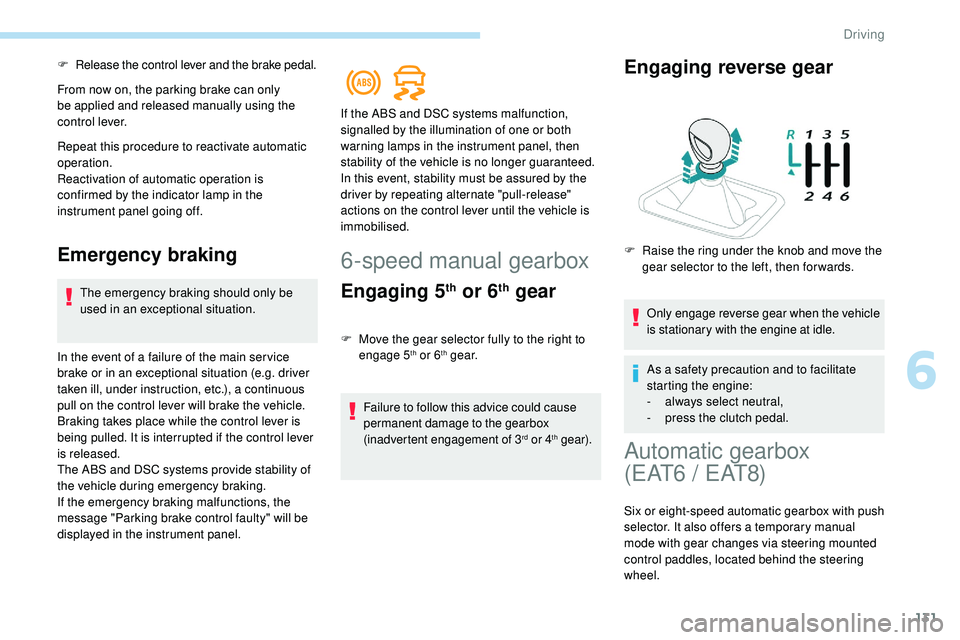
F Move the gear selector fully to the right to engage 5th or 6th g e a r.
Failure to follow this advice could cause
permanent damage to the gearbox
(inadvertent engagement of 3
rd or 4th gear).
Engaging reverse gear
F Raise the ring under the knob and move the gear selector to the left, then for wards.
Only engage reverse gear when the vehicle
is stationary with the engine at idle.
As a safety precaution and to facilitate
starting the engine:
-
a
lways select neutral,
-
p
ress the clutch pedal.
If the ABS and DSC systems malfunction,
signalled by the illumination of one or both
warning lamps in the instrument panel, then
stability of the vehicle is no longer guaranteed.
In this event, stability must be assured by the
driver by repeating alternate "pull-release"
actions on the control lever until the vehicle is
immobilised.
Automatic gearbox
( E AT 6
/ E AT 8)
Six or eight-speed automatic gearbox with push
selector. It also offers a temporary manual
mode with gear changes via steering mounted
control paddles, located behind the steering
wheel.
6
Driving
Page 134 of 320
132
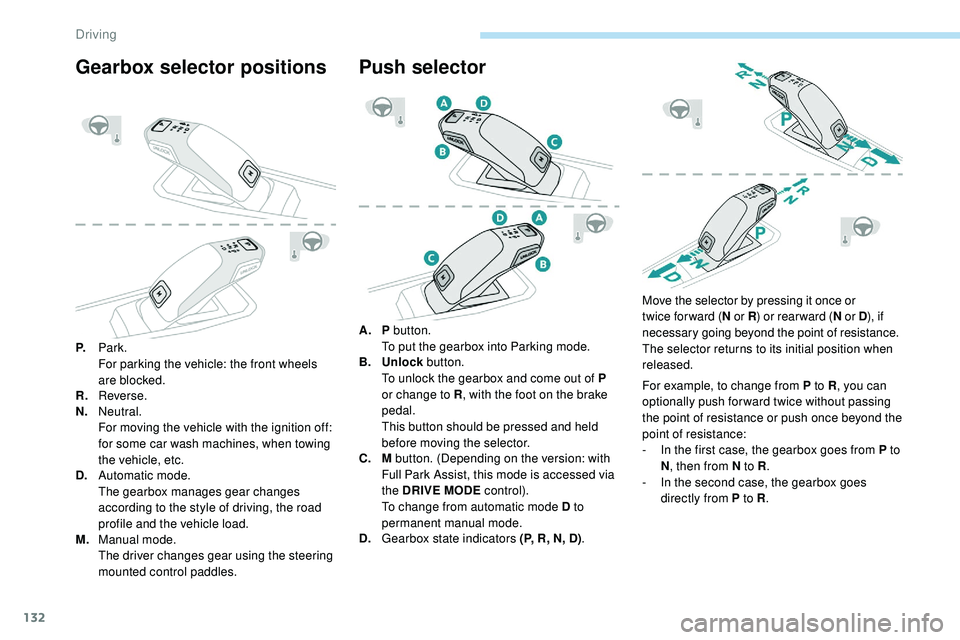
Gearbox selector positions
P.Park.
For parking the vehicle: the front wheels
are blocked.
R. Reverse.
N. Neutral.
For moving the vehicle with the ignition off:
for some car wash machines, when towing
the vehicle, etc.
D. Automatic mode.
The gearbox manages gear changes
according to the style of driving, the road
profile and the vehicle load.
M. Manual mode.
The driver changes gear using the steering
mounted control paddles.
Push selector
A.P button.
To put the gearbox into Parking mode.
B. Unlock button.
To unlock the gearbox and come out of P
or change to R , with the foot on the brake
pedal.
This button should be pressed and held
before moving the selector.
C. M button. (Depending on the version: with
Full Park Assist, this mode is accessed via
the DRIVE MODE control).
To change from automatic mode D to
permanent manual mode.
D. Gearbox state indicators (P, R, N, D) .Move the selector by pressing it once or
twice for ward (
N or R ) or rear ward ( N or D ), if
necessary going beyond the point of resistance.
The selector returns to its initial position when
released.
For example, to change from P to R , you can
optionally push forward twice without passing
the point of resistance or push once beyond the
point of resistance:
-
I
n the first case, the gearbox goes from P to
N , then from N to R .
-
I
n the second case, the gearbox goes
directly from P to R .
Driving
Page 135 of 320
133
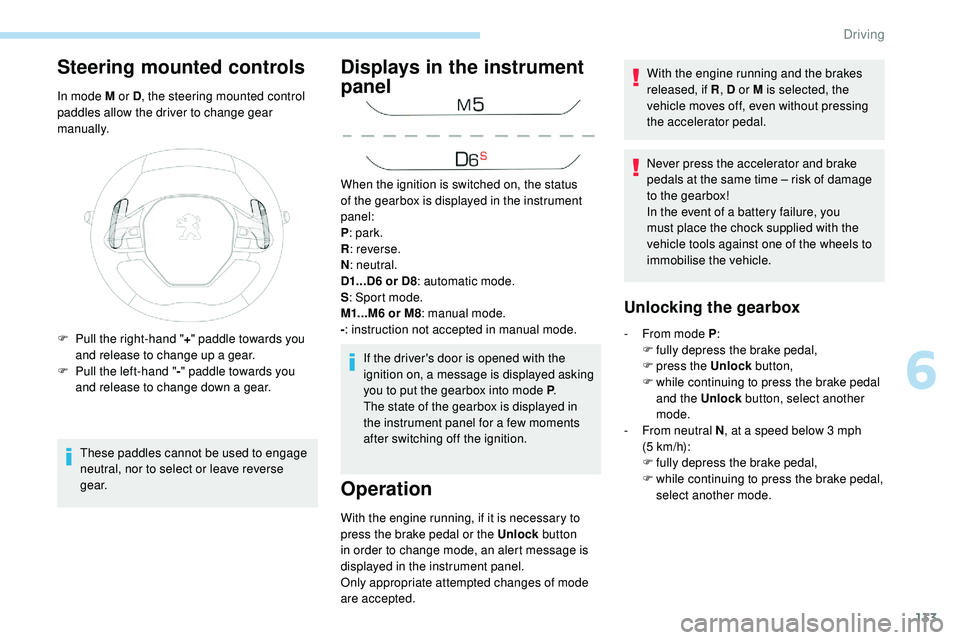
Steering mounted controls
In mode M or D, the steering mounted control
paddles allow the driver to change gear
manually.
These paddles cannot be used to engage
neutral, nor to select or leave reverse
g e a r.
Displays in the instrument
panel
If the driver's door is opened with the
ignition on, a message is displayed asking
you to put the gearbox into mode P .
The state of the gearbox is displayed in
the instrument panel for a few moments
after switching off the ignition.
Operation
With the engine running, if it is necessary to
press the brake pedal or the Unlock button
in order to change mode, an alert message is
displayed in the instrument panel.
Only appropriate attempted changes of mode
are accepted. With the engine running and the brakes
released, if R
, D or M is selected, the
vehicle moves off, even without pressing
the accelerator pedal.
Never press the accelerator and brake
pedals at the same time – risk of damage
to the gearbox!
In the event of a battery failure, you
must place the chock supplied with the
vehicle tools against one of the wheels to
immobilise the vehicle.
-
F
rom mode P
:
F
f
ully depress the brake pedal,
F press the
Unlock button,
F
w
hile continuing to press the brake pedal
and the Unlock button, select another
mode.
-
F
rom neutral N
, at a speed below 3 mph
(5
km/h):
F
f
ully depress the brake pedal,
F
w
hile continuing to press the brake pedal,
select another mode.
F
P
ull the right-hand "
+" paddle towards you
and release to change up a gear.
F
P
ull the left-hand "
-"
paddle towards
you
and release to change down a gear. When the ignition is switched on, the status
of the gearbox is displayed in the instrument
panel:
P
: park.
R : reverse.
N : neutral.
D1...D6 or D8 : automatic mode.
S : Sport mode.
M1...M6 or M8 : manual mode.
- : instruction not accepted in manual mode.
Unlocking the gearbox
6
Driving
Page 136 of 320
134
Special aspects of automatic
mode
For maximum acceleration without touching the
selector, push the accelerator to the floor (kick-
down). The gearbox shifts down automatically
or holds the gear selected until the maximum
engine speed is reached.
The steering mounted controls allow the driver
to temporarily select a gear, if the road and
engine speed permit.
Special aspects of manual mode
The change from one gear to another takes
place only if the road speed and engine speed
permit.
Starting the vehicle
The gearbox selects the gear that offers
optimum per formance, taking account of the
exterior temperature, the profile of the road, the
load on the vehicle and the style of driving.From mode P
:
F
P
ress the brake pedal down fully.
F
S
tart the engine.
F
M
aintaining pressure on the brake pedal,
press the Unlock button.
F
P
ush once or twice rear ward to select the
automatic mode D , or for ward to engage
reverse R .
From neutral N :
F
P
ress the brake pedal down fully.
F S tart the engine.
F M aintaining pressure on the brake pedal,
push rear ward to select the automatic
mode D , or for ward, while pressing the
Unlock
button to engage reverse R.
Engaging reverse gear
F Slow down until you come to a stop.
F
W ith your foot on the brake pedal, press the
Unlock button.
F
Sel
ect mode R while continuing to press the
brake pedal and the Unlock button.
Permanent manual mode
Switching to the mode:
With EAT8 without the Full Park Assist button
a n d E AT 6 :
F
w
ith mode D selected in advance,
F
p
ress button M ; the green indicator lamp in
the button comes on.
With EAT8 and the Full Park Assist button:
F
p
ress the DRIVE MODE control,
F
s
elect "Manual" mode which is displayed in
the instrument panel.
Exiting the mode:
F
p
ush for wards once to go back to D .
or
F
p
ress button M ; the indicator lamp in the
button goes off.
or
F
s
elect another mode using the DRIVE
MODE control.
Switching off the ignition
To switch off the ignition, the vehicle must be
stationary.
Changing to free-wheel
To put the vehicle in free-wheeling mode with
the engine switched off:
F
w
ith the vehicle stationary and the engine
running, select N ,
F
s
witch off the engine,
F
w
ithin 5 seconds, switch the ignition on
again,
F
w
ith your foot on the brake pedal, push the
selector for ward or back once to confirm N
and manually release the electric parking
brake,
F
s
witch off the ignition.
After this time limit, the gearbox engages mode
P ; you should then restart the procedure.
If you open the driver's door when mode N
is engaged, an audible signal will sound.
It
will stop when you close the driver's
door again.
Driving
Page 138 of 320
136
Do not leave the vehicle while it is being
held temporarily by hill start assist.
If you need to leave the vehicle with the
engine running, apply the parking brake
manually then ensure that the parking
brake warning lamp and the indicator
lamp P in the control lever of the electric
parking brake are on fixed.
The hill start assist function cannot be
deactivated. However, use of the parking
brake to immobilise the vehicle interrupts
its operation.
Operation
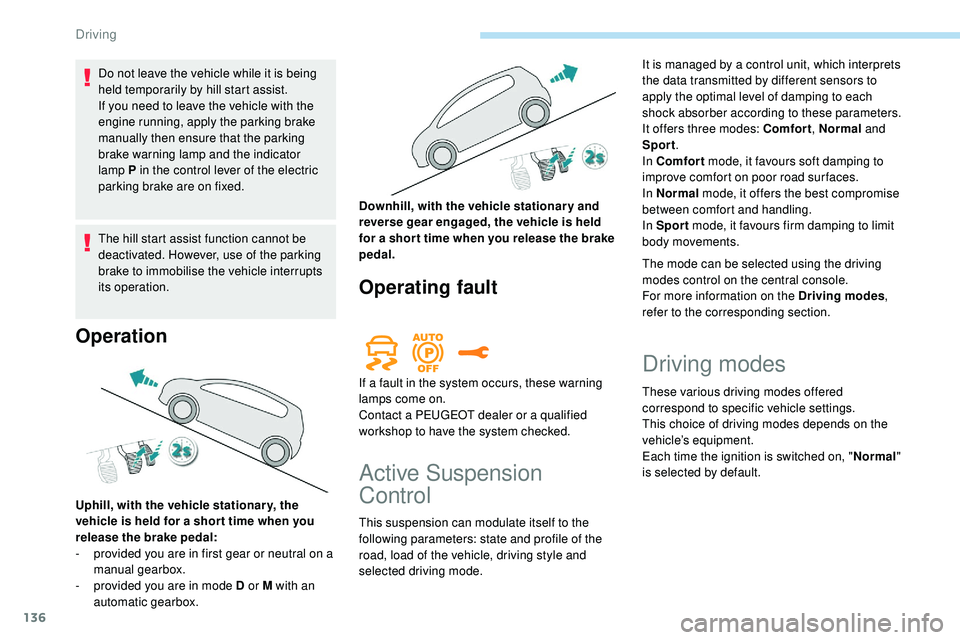
Uphill, with the vehicle stationar y, the
vehicle is held for a shor t time when you
release the brake pedal:
-
p
rovided you are in first gear or neutral on a
manual gearbox.
-
p
rovided you are in mode D or M with an
automatic gearbox. Downhill, with the vehicle stationary and
reverse gear engaged, the vehicle is held
for a shor t time when you release the brake
pedal.
Operating fault
If a fault in the system occurs, these warning
lamps come on.
Contact a PEUGEOT dealer or a qualified
workshop to have the system checked.
Active Suspension
Control
This suspension can modulate itself to the
following parameters: state and profile of the
road, load of the vehicle, driving style and
selected driving mode.
The mode can be selected using the driving
modes control on the central console.
For more information on the Driving modes
,
refer to the corresponding section. It is managed by a control unit, which interprets
the data transmitted by different sensors to
apply the optimal level of damping to each
shock absorber according to these parameters.
It offers three modes: Comfort , Normal and
Sport .
In Comfort mode, it favours soft damping to
improve comfort on poor road sur faces.
In Normal mode, it offers the best compromise
between comfort and handling.
In Sport mode, it favours firm damping to limit
body movements.
Driving modes
These various driving modes offered
correspond to specific vehicle settings.
This choice of driving modes depends on the
vehicle’s equipment.
Each time the ignition is switched on, " Normal"
is selected by default.
Driving