height PEUGEOT 508 2023 User Guide
[x] Cancel search | Manufacturer: PEUGEOT, Model Year: 2023, Model line: 508, Model: PEUGEOT 508 2023Pages: 244, PDF Size: 7.38 MB
Page 97 of 244
95
Safety
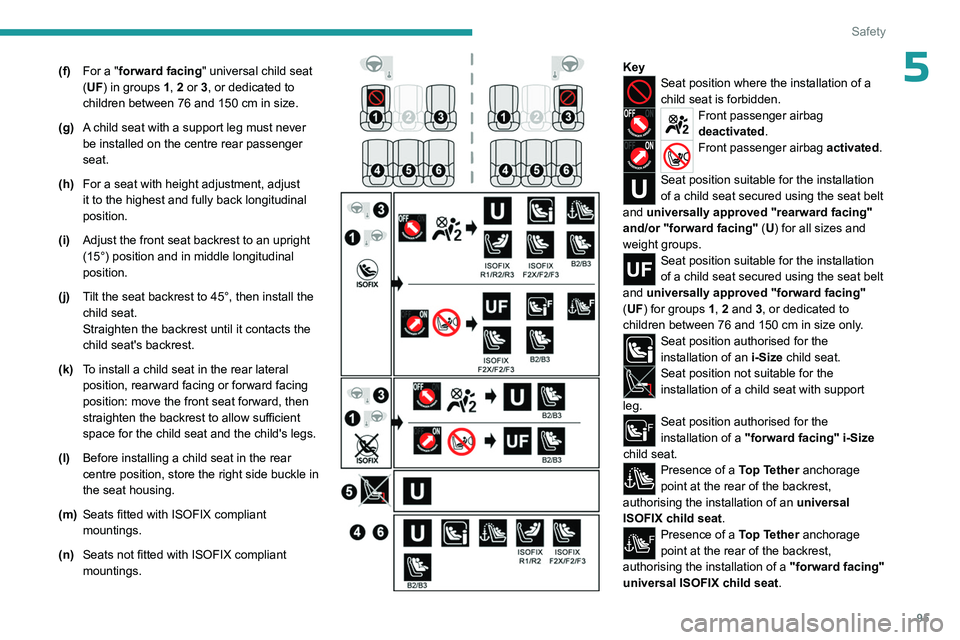
5(f)For a "forward facing" universal child seat
(UF) in groups 1, 2 or 3, or dedicated to
children between 76 and 150
cm in size.
(g) A child seat with a support leg must never
be installed on the centre rear passenger
seat.
(h) For a seat with height adjustment, adjust
it to the highest and fully back longitudinal
position.
(i) Adjust the front seat backrest to an upright
(15°) position and in middle longitudinal
position.
(j) Tilt the seat backrest to 45°, then install the
child seat.
Straighten the backrest until it contacts the
child seat's backrest.
(k) To install a child seat in the rear lateral
position, rearward facing or forward facing
position: move the front seat forward, then
straighten the backrest to allow sufficient
space for the child seat and the child's legs.
(l) Before installing a child seat in the rear
centre position, store the right side buckle in
the seat housing.
(m) Seats fitted with ISOFIX compliant
mountings.
(n) Seats not fitted with ISOFIX compliant
mountings.
KeySeat position where the installation of a
child seat is forbidden.
Front passenger airbag
deactivated.
Front passenger airbag activated.
Seat position suitable for the installation
of a child seat secured using the seat belt
and universally approved "rearward facing"
and/or "forward facing" (U) for all sizes and
weight groups.
Seat position suitable for the installation
of a child seat secured using the seat belt
and universally approved "forward facing"
(UF) for groups 1, 2 and 3, or dedicated to
children between 76 and 150
cm in size only.
Seat position authorised for the
installation of an i-Size child seat.
Seat position not suitable for the
installation of a child seat with support
leg.
Seat position authorised for the
installation of a "forward facing" i-Size
child seat.
Presence of a Top Tether anchorage
point at the rear of the backrest,
authorising the installation of an universal
ISOFIX child seat .
Presence of a Top Tether anchorage
point at the rear of the backrest,
authorising the installation of a "forward facing"
universal ISOFIX child seat .
Page 98 of 244
96
Safety
"Rearward facing" ISOFIX child seat:
–
R1
: ISOFIX child seat for a baby.
–
R2
: ISOFIX reduced size child seat.
–
R3
: ISOFIX large size child seat.
"Forward facing" ISOFIX child seat:
–
F2X
: ISOFIX child seat for toddlers.
–
F2
: ISOFIX reduced height child seat.
–
F3
: ISOFIX full height child seat.
Booster child seat:
–
B2
: reduced width booster seat.
–
B3
: full width booster seat.
Seat position authorised for the
installation of an ISOFIX child seat.
Seat position where the installation of an
ISOFIX child seat is forbidden.
For seat adjustments, refer to the summary table
"Installing universal, ISOFIX and i-Size child
seats ".
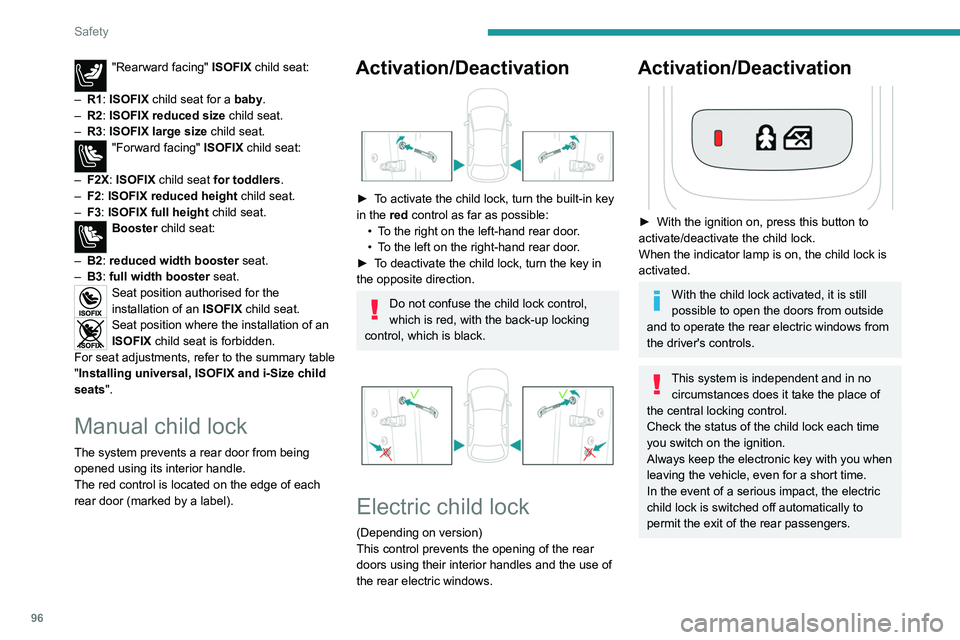
Manual child lock
The system prevents a rear door from being
opened using its interior handle.
The red control is located on the edge of each
rear door (marked by a label).
Activation/Deactivation
► To activate the child lock, turn the built-in key
in the red control as far as possible:
•
T
o the right on the left-hand rear door.
•
T
o the left on the right-hand rear door.
►
T
o deactivate the child lock, turn the key in
the opposite direction.
Do not confuse the child lock control,
which is red, with the back-up locking
control, which is black.
Electric child lock
(Depending on version)
This control prevents the opening of the rear
doors using their interior handles and the use of
the rear electric windows.
Activation/Deactivation
► With the ignition on, press this button to
activate/deactivate the child lock.
When the indicator lamp is on, the child lock is
activated.
With the child lock activated, it is still
possible to open the doors from outside
and to operate the rear electric windows from
the driver's controls.
This system is independent and in no circumstances does it take the place of
the central locking control.
Check the status of the child lock each time
you switch on the ignition.
Always keep the electronic key with you when
leaving the vehicle, even for a short time.
In the event of a serious impact, the electric
child lock is switched off automatically to
permit the exit of the rear passengers.
Page 100 of 244
98
Driving
► Drive as slowly as possible without stalling. In
all cases, do not exceed 6 mph (10 km/h).
►
Do not stop and do not switch off the engine.
On leaving the flooded road, as soon as safety
conditions allow
, make several light brake
applications to dry the brake discs and pads.
If in doubt about the state of your vehicle,
contact a PEUGEOT dealer or a qualified
workshop.
Towing
Driving with a trailer places greater
demands on the towing vehicle and
particular care must be taken.
Do not exceed the maximum towable
weights.
At altitude: reduce the maximum load by
10% per 1,000 metres of altitude; the lower
air density at high altitudes decreases engine
performance.
New vehicle: do not tow a trailer until the
vehicle has driven at least 620 miles
(1,000 kilometres).
If the outside temperature is high, let the
engine idle for 1 to 2 minutes after the
vehicle comes to a stop, to help it to cool.
Before setting off
Nose weight
► Distribute the load in the trailer so that the
heaviest items are as close as possible to the
axle and the nose weight (at the point where it
joins your vehicle) approaches the maximum
permitted without exceeding it.
Tyres
► Check the tyre pressures of the towing
vehicle and of the trailer , observing the
recommended pressures.
Lighting
► Check the electrical signalling on the trailer
and the headlamp beam height of your vehicle.
If a genuine PEUGEOT towing device is
used, the rear parking sensors will be
deactivated automatically to avoid the audible
signal.
When driving
Cooling
Towing a trailer uphill causes the coolant
temperature to increase. The maximum towable
load depends on the gradient and the exterior
temperature. The fan’s cooling capacity does not
increase with engine speed.
►
Reduce speed and lower the engine speed to
limit the amount of heating produced. ►
Pay constant attention to the coolant
temperature.
If this warning lamp and the STOP
warning lamp come on, stop the
vehicle and switch off the engine as soon as
possible.
Brakes
Using the engine brake is recommended to limit
the overheating of the brakes. Braking distances
are increased when towing a trailer.
Side wind
Bear in mind that the vehicle will be more
susceptible to wind when towing.
Anti-theft protection
Electronic immobiliser
The keys contain a code, which must be
recognised by the vehicle before starting is
possible.
If the system malfunctions, indicated by the
display of a message, the engine will not start.
Contact a PEUGEOT dealer.
Page 132 of 244
130
Driving
Operating conditions and
limits
Vehicle moving forward without trailer.
Brake system operational.
ASR system activated.
Seat belts fastened for all passengers.
Stabilised speed on roads with no or low
curvature.
This warning lamp lights up on the instrument panel without any additional
message, to indicate that the automatic braking
system is not available.
This is a normal behavior indicating that a
condition is not fulfilled and which does not
request the support of a workshop.
In any situations with ignition on where automatic
braking presents a risk, deactivating the system
via the driving aids touch screen application is
recommended, for instance:
–
T
owing a trailer (particularly a trailer without its
own braking system).
–
Carrying long objects on roof bars.
–
Driving with snow chains.
–
Using an automatic car wash.
–
Performing any maintenance (e.g.
changing a
wheel, working inside the engine compartment).
–
Placing the vehicle on a rolling bench in a
workshop.
–
T
owing the vehicle.
–
Following a damage of the windscreen close
to the detection camera.
The system is automatically deactivated when the use of certain types of
"space-saver" spare wheel (smaller diameter)
is detected, or if a fault with the brake pedal
switch or at least two brake lamps is detected.
Following a severe crash (e.g.
with airbag
deployment), the system is automatically
deactivated.
Have it checked by a PEUGEOT dealer or a
qualified workshop.
In case the detection is degraded or
temporarily unavailable by environment
conditions, then a driver indication is not
displayed (because a driver action is not
requested).
It can be dangerous to drive if the brake
lamps are not in perfect working order.
The driver must not overload the vehicle (keep within the GVW limit and load
height limits for roof bars).
Collision Risk Alert
This function warns the driver if there is a risk
of collision with the preceding vehicle, or with a
pedestrian or cyclist.
Modifying the alert trigger threshold
The trigger threshold determines the sensitivity
with which the function warns of the risk of
collision.
► In the ADAS touch screen application,
select Functions>Automatic Braking
System .
►
Select one of the 3 preset
thresholds:
"Far", "Medium" or "Near".
The selected threshold is memorised when the
ignition is switched off.
Operation
Depending on the collision risk detected by the
system and the alert trigger threshold chosen
by the driver, different levels of alert may be
triggered and displayed on the instrument panel.
The system takes into account the vehicle
dynamics, the difference speed of the own
vehicle and the object identified for the
collision risk, and the operation of the vehicle
(e.g.
actions on the pedals, steering wheel) to
trigger the alert at the most relevant moment.
(orange)
Level 1: visual alert only, warning that the
preceding vehicle is very close.
The message "Vehicle close" is displayed.
(red)
Level 2: visual and audible alert, warning
that a collision is imminent.
The message "Brake! " is displayed.
Level 3: a micro-braking may be given,
confirming the risk of collision (optional).
Page 161 of 244
159
Practical information
7
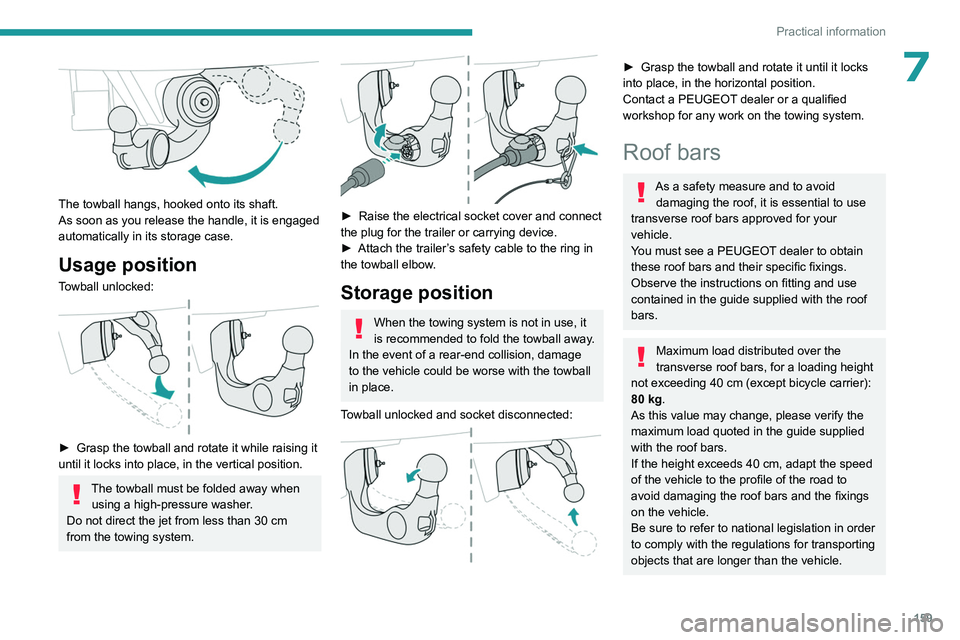
The towball hangs, hooked onto its shaft.
As soon as you release the handle, it is engaged
automatically in its storage case.
Usage position
Towball unlocked:
► Grasp the towball and rotate it while raising it
until it locks into place, in the vertical position.
The towball must be folded away when using a high-pressure washer.
Do not direct the jet from less than 30
cm
from the towing system.
► Raise the electrical socket cover and connect
the plug for the trailer or carrying device.
►
Attach the trailer
’s safety cable to the ring in
the towball elbow.
Storage position
When the towing system is not in use, it
is recommended to fold the towball away.
In the event of a rear-end collision, damage
to the vehicle could be worse with the towball
in place.
Towball unlocked and socket disconnected:
► Grasp the towball and rotate it until it locks
into place, in the horizontal position.
Contact a PEUGEOT
dealer or a qualified
workshop for any work on the towing system.
Roof bars
As a safety measure and to avoid damaging the roof, it is essential to use
transverse roof bars approved for your
vehicle.
You must see a PEUGEOT dealer to obtain
these roof bars and their specific fixings.
Observe the instructions on fitting and use
contained in the guide supplied with the roof
bars.
Maximum load distributed over the
transverse roof bars, for a loading height
not exceeding 40 cm (except bicycle carrier):
80
kg.
As this value may change, please verify the
maximum load quoted in the guide supplied
with the roof bars.
If the height exceeds 40 cm, adapt the speed
of the vehicle to the profile of the road to
avoid damaging the roof bars and the fixings
on the vehicle.
Be sure to refer to national legislation in order
to comply with the regulations for transporting
objects that are longer than the vehicle.
Page 179 of 244
177
In the event of a breakdown
8
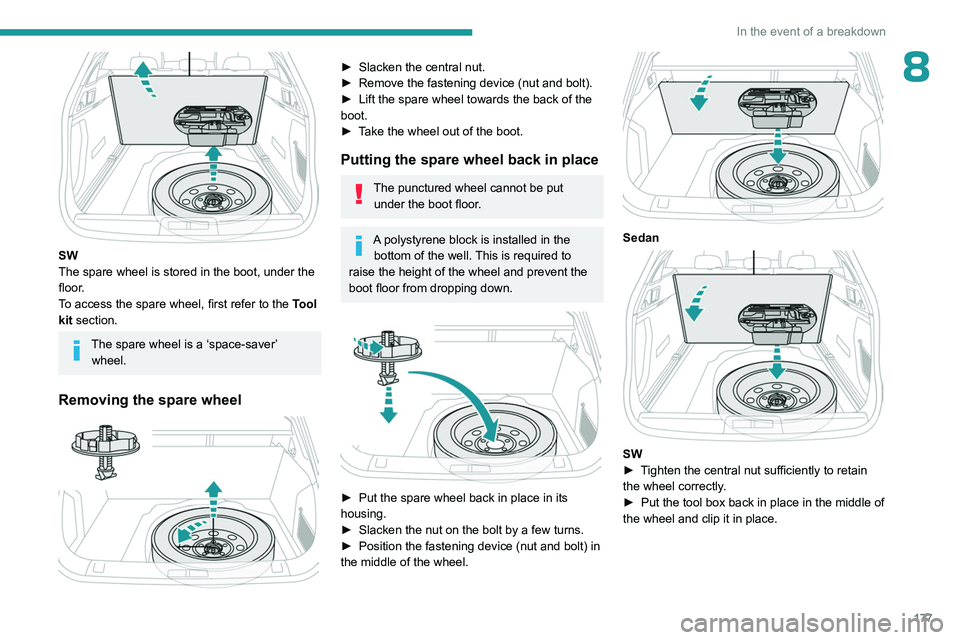
SW
The spare wheel is stored in the boot, under the
floor.
To access the spare wheel, first refer to the Tool
kit section.
The spare wheel is a ‘space-saver’ wheel.
Removing the spare wheel
► Slacken the central nut.
► Remove the fastening device (nut and bolt).
►
Lift the spare wheel towards the back of the
boot.
►
T
ake the wheel out of the boot.
Putting the spare wheel back in place
The punctured wheel cannot be put under the boot floor.
A polystyrene block is installed in the bottom of the well. This is required to
raise the height of the wheel and prevent the
boot floor from dropping down.
► Put the spare wheel back in place in its
housing.
►
Slacken the nut on the bolt by a few turns.
►
Position the fastening device (nut and bolt) in
the middle of the wheel.
Sedan
SW
► T ighten the central nut sufficiently to retain
the wheel correctly.
►
Put the tool box back in place in the middle of
the wheel and clip it in place.
Page 217 of 244
215
Alphabetical index
A
ABS 81
Accelerated charging unit (Wallbox)
149–150
Accessories
77, 160
Accessories, electrical
77
Active Safety Brake
129–131
Active suspension
106
Active Suspension Control
106
Adaptive headlamp lighting
70
Adaptive LED Technology
29
AdBlue®
19, 167
AdBlue® tank
168
Additive, Diesel
165–166
Adjusting headlamps
67
Adjusting head restraints
44
Adjusting seat
44–45
Adjusting the air distribution
51, 53
Adjusting the air flow
51, 53
Adjusting the headlamp beam height
67
Adjusting the height and reach of
the steering wheel
47
Adjusting the lumbar support
44–45
Adjusting the seat angle
44
Adjusting the temperature
52
Adjusting the time
210
Advice on care and maintenance
148, 169
Advice on driving
8, 97–98
Airbags
85–87, 89
Airbags, curtain
86–87
Airbags, front
85–86, 90
Airbags, lateral
86–87
Air conditioning 51, 54
Air conditioning, automatic
54
Air conditioning, dual-zone automatic
51
Air intake
53–54
Air vents
50
Alarm
32–33
Amplifier, audio
58
Anti-lock braking system (ABS)
81
Antitheft / Immobiliser
27
Applications
24
Armrest, front
58
Armrest, rear
60
Assistance call
78–79
Assistance, emergency braking
81, 131
Audio streaming (Bluetooth)
207
B
Battery, 12 V 161, 165–166, 182–186
Battery, ancillaries
182
Battery, charging
182–183, 186
Battery, remote control
31
Bicycle carrier
160
Blanking screen (snow shield)
161
Blind
41–42
Blind spot monitoring
136
BlueHDi
19, 165, 172
Bluetooth (hands-free)
204
Bluetooth (telephone)
204
Bodywork
170
Bonnet
162–163
Bonnet, active 87
Boot
35–37, 65
Brake discs
166–167
Brake lamps
181
Brakes
166–167
Braking
104
Braking assistance system
81
Braking, automatic emergency
129–131
Braking, dynamic emergency
101–103
Bulbs (changing)
180–181
C
Capacity, fuel tank 145
Care of the bodywork
170
Central locking
29–30
Changing a bulb
180–181
Changing a fuse
182
Changing a wheel
172–173, 176
Changing a wiper blade
74–75
Changing the remote control battery
31
Changing to free-wheeling
169
Charge level indicator (Rechargeable
hybrid)
21
Charger, induction
57
Charger, wireless
57
Charging cable
151
Charging cable (Rechargeable
hybrid)
149–150, 156
Charging connector (Rechargeable
hybrid)
149, 155–157