gearbox Peugeot 508 Hybrid 2013 Owner's Manual - RHD (UK, Australia)
[x] Cancel search | Manufacturer: PEUGEOT, Model Year: 2013, Model line: 508 Hybrid, Model: Peugeot 508 Hybrid 2013Pages: 340, PDF Size: 14.59 MB
Page 4 of 340
.
Contents
Instrument panel 22
Indicator and warning lamps 23
Gauges and indicators 33
Tr ip computer 38
Setting the date and time 41
Instruments and controlsFamiliarisation
Remote control key 43
Alarm 53
Electric windows 55
Boot 57
Motorised tailgate (SW) 58
Sunroof 61
Panoramic sunroof (SW) 63
Fuel tank 64
Diesel misfuel prevention 65
Access
Front seats 67
Rear seats 72
Mirrors 74
Steering wheel adjustment 76
Interior fi ttings 77
Boot fi ttings (Saloon) 80
Boot fi ttings (SW) 81
Heating and Ventilation 86
Manual air conditioning 88
Dual-zone digital air conditioning 90
Quad-zone digital air conditioning 93
Rear screen demist - defrost 98
Programmable Heating / Ventilation 99
Comfort
Starting-switching off the engine 101
Electric parking brake 103
Manual parking brake 110
Manual gearbox 111
Gear effi ciency indicator 112
Automatic gearbox 113
6-speed electronic gear control gearbox 117
Stop & Star t 121
Hill start assist 124
Head-up display 125
Speed limiter 128
Cruise control 130
Parking sensors 132
Parking space sensors 134
Driving
Lighting controls 136
Automatic illumination of headlamps 141
Headlamp adjustment 144
Directional lighting 145
Wiper controls 147
Automatic rain sensitive wipers 149
Cour tesy lamps 151
Interior mood lighting 152
Visibility
Eco-driving 20
Page 20 of 340
18
Familiarisation
Driving safely
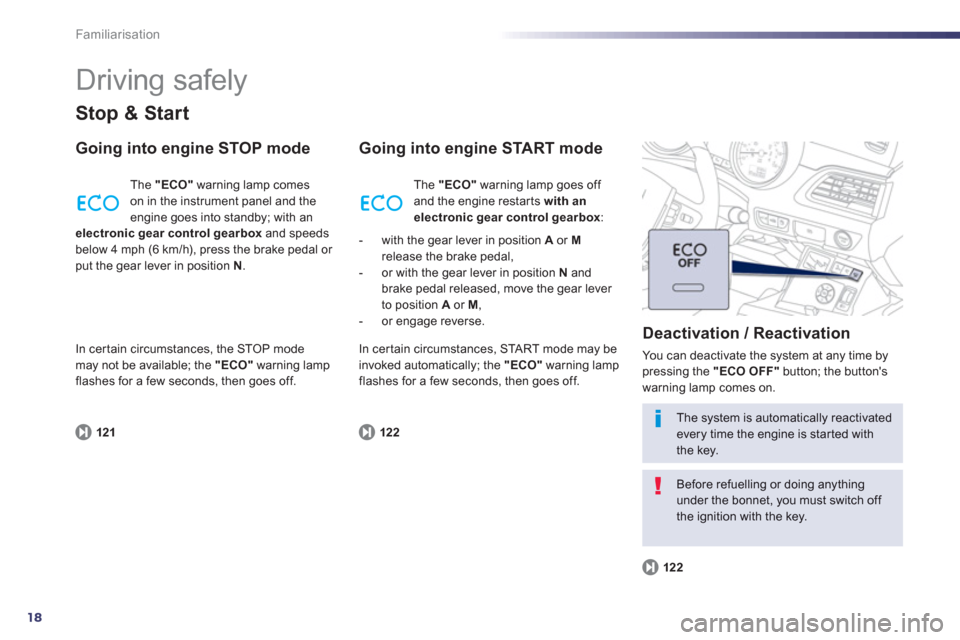
Stop & Start
Going into engine STOP mode
121
The "ECO"warning lamp comes
on in the instrument panel and the
engine goes into standby; with anelectronic gear control gearbox and speeds
below 4 mph (6 km/h), press the brake pedal or put the gear lever in position N.
Going into engine START mode
Deactivation
/ Reactivation
You can deactivate the system at any time bypressing the "ECO OFF"
button; the button's
warning lamp comes on.
122
122
The system is automatically reactivated every time the engine is star ted withthe key.
Before refuelling or doing anything under the bonnet, you must switch off the ignition with the key. Th
e "ECO"
warning lamp goes off
and the engine restar ts with anelectronic gear control gearbox:
- with the gear lever in position A
or Mrelease the brake pedal,
- or with the gear lever in position N
andbrake pedal released, move the gear lever
to position Aor M ,
- or engage reverse.
In certain circumstances, the ST
OP modemay not be available; the "ECO"
warning lamp
flashes for a few seconds, then goes off. In certain circumstances,
STA R T m o d e m ay be
invoked automatically; the "ECO"warning lampflashes for a few seconds, then goes off.
Page 21 of 340
.
19
Familiarisation
Driving safely
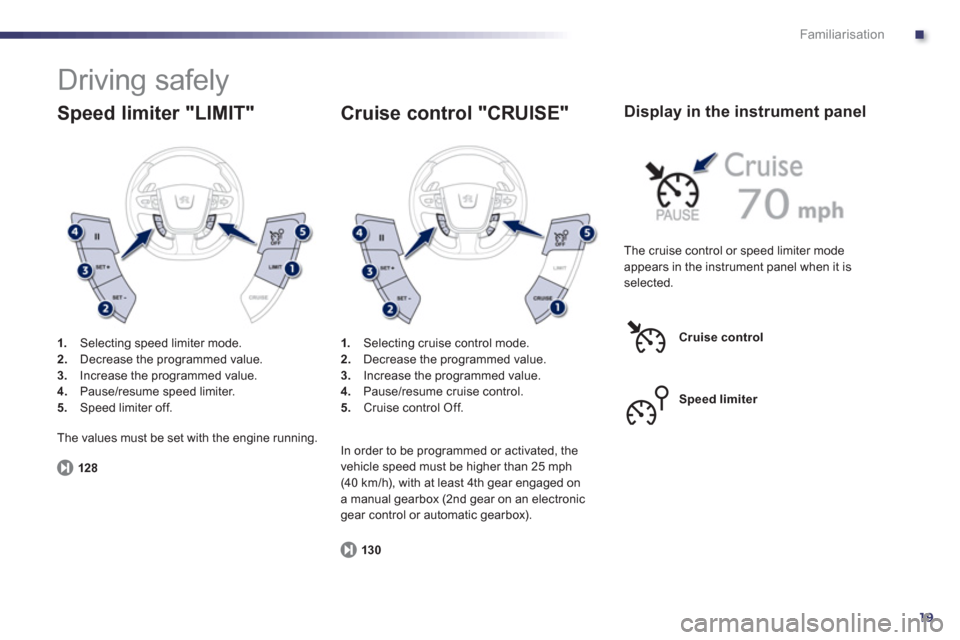
1.
Selecting speed limiter mode.2.Decrease the programmed value.3.Increase the programmed value.4.
Pause/resume speed limiter.
5. Speed limiter off.
Speed limiter "LIMIT"
128
1.Selecting cruise control mode.
2. Decrease the programmed value. 3.
Increase the programmed value. 4.
Pause/resume cruise control.
5. Cruise control Off.
Cruise control "CRUISE"
130 The cruise control or speed limiter mode
appears in the instrument panel when it is
selected.
Display in the instrument panel
Cruise control
S
peed limiter
The values must be set with the engine running. In order to be programmed or activated, the
vehicle speed must be higher than 25 mph (40 km/h), with at least 4th gear engaged on a manual gearbox (2nd gear on an electronicgear control or automatic gearbox).
Page 22 of 340
20
Optimise the use of your
gearbox
With a manual gearbox, move off gently,change up without waiting and drive by changing up quite soon. If your vehicle has the system, the gear efficiency indicator invites you to change up; it is displayed in the instrument panel, follow its instructions.
With an automatic or electronic gearbox, stay in Drive "D"or Auto "A"
, according to the type of gearbox, without pressing theaccelerator pedal heavily or suddenly.
Drive smoothly
Maintain a safe distance between vehicles,use engine braking rather than thebrake pedal, and press the accelerator progressively. These practices contributetowards a reduction in fuel consumptionand CO2emissions and also helps reduce the background traffic noise.
If your vehicle has cruise control, make useof the system at speeds above 25 mph (40 km/h) when the traffic is flowing well.
Control the use of your electrical equipment
Before moving off, if the passenger compartment is too warm, ventilate it byopening the windows and air vents beforeusing the air conditioning.
Above 30 mph (50 km/h), close the windows and leave the air vents open.
Remember to make use of equipment that canhelp keep the temperature in the passenger compartment down (sunroof and windowblinds...).
Switch off the air conditioning, unless it has automatic digital regulation, as soon as thedesired temperature is attained. Switch off the demisting and defrostingcontrols, if not automatic. Switch off the heated seat as soon as possible.
Switch off the headlamps and front foglamps when the level of light does not require their use.
Avoid running the engine before moving off,
particularly in winter; your vehicle will warmup much faster while driving.
As a passenger, if you avoid connecting your multimedia devices (film, music, videogame...), you will contribute towards limitingthe consumption of electrical energy, and soof fuel.
Disconnect your por table devices beforeleaving the vehicle.
Eco-driving Eco-driving is a range of everyday practices that allow the motorist to optimise their fuel consumption and CO2emissions.
Page 24 of 340
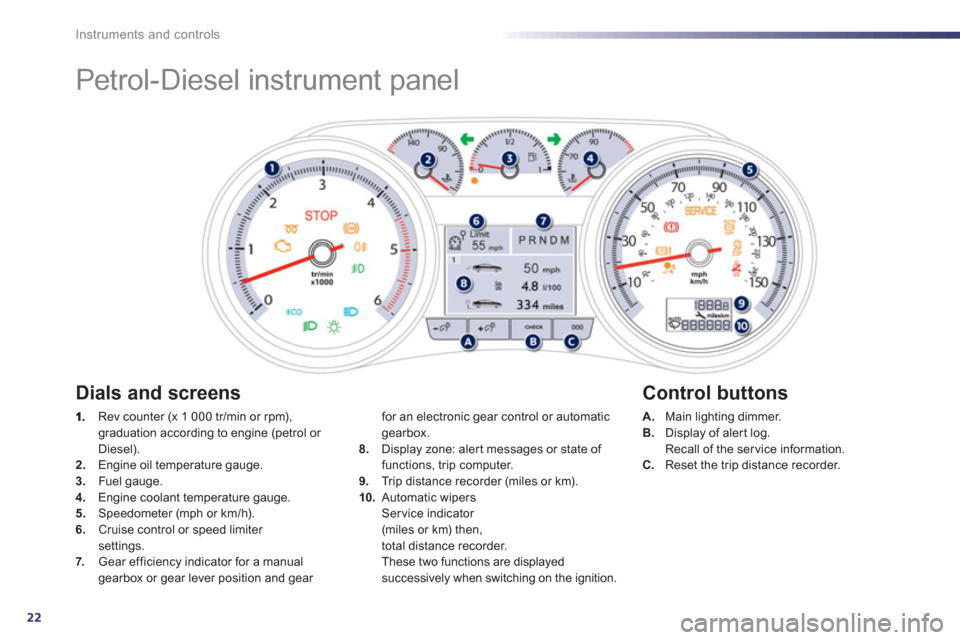
22
Instruments and controls
Petrol-Diesel instrument panel
Rev counter (x 1 000 tr/min or rpm), graduation according to engine (petrol or Diesel).2.
Engine oil temperature gauge. 3.Fuel gauge.4.
Engine coolant temperature gauge. 5.
Speedometer (mph or km/h).
6.Cruise control or speed limiter
settings.
7
. Gear efficiency indicator for a manualgearbox or gear lever position and gear A
.Main lighting dimmer.
B.Display of aler t log.
Recall of the service information. C.Reset the trip distance recorder.
for an electronic gear control or automaticgearbox.8.
Display zone: aler t messages or state of functions, trip computer.9.Trip distance recorder (miles or km).
10. Automatic wipers
Service indicator
(miles or km) then,
total distance recorder.
These two functions are displayedsuccessively when switching on the ignition.
Dials and screens
Control buttons
Page 27 of 340
1
25
Instruments and controls
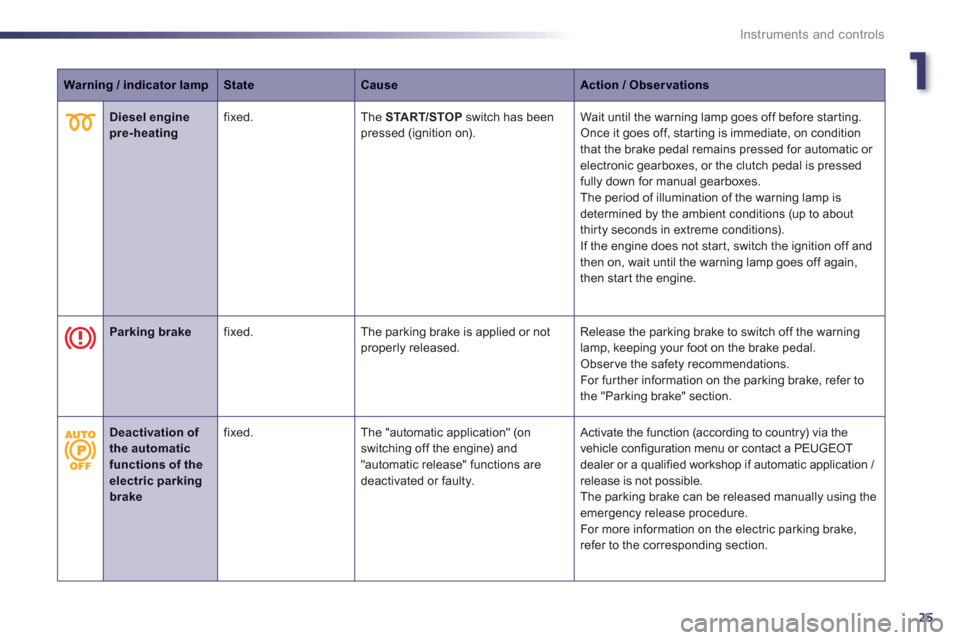
Warning / indicator lampStateCauseAction / Observations
Diesel engine pre-heating fixed. The START/STOP
switch has been pressed (ignition on). Wait until the warning lamp goes off before star ting.
Once it goes off, star ting is immediate, on condition
that the brake pedal remains pressed for automatic or electronic gearboxes, or the clutch pedal is pressed fully down for manual gearboxes.
The period of illumination of the warning lamp is
determined by the ambient conditions (up to about
thirty seconds in extreme conditions).
If the engine does not star t, switch the ignition off and
then on, wait until the warning lamp goes off again,
then start the engine.
Parking brake fixed. The parking brake is applied or notproperly released. Release the parking brake to switch off the warninglamp, keeping your foot on the brake pedal.
Obser ve the safety recommendations.
For further information on the parking brake, refer to
the "Parking brake" section.
Deactivation of the automatic functions of the electric parkingbrake
fixed. The "automatic application" (on switching off the engine) and
"automatic release" functions aredeactivated or faulty.
Activate the function (according to country) via the
vehicle configuration menu or contact a PEUGEOT
dealer or a qualified workshop if automatic application /
release is not possible.
The parkin
g brake can be released manually using the emergency release procedure.
For more information on the electric parking brake,
refer to the corresponding section.
Page 103 of 340
4
101
Driving
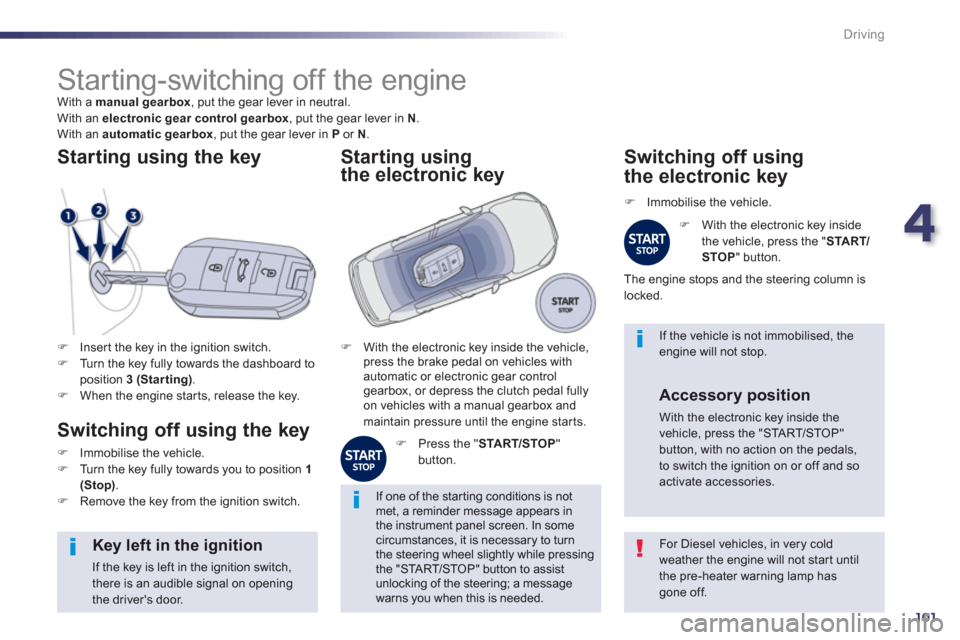
Starting-switching off the engine
With a manual gearbox
, put the gear lever in neutral.
With an electronic gear control gearbox, put the gear lever in N.
With an automatic gearbox
, put the gear lever in P
or N
.
FInser t the key in the ignition switch. FTurn the key fully towards the dashboard toposition 3 (Starting).FWhen the engine star ts, release the key.
Starting using the key
Switching off using the key
FImmobilise the vehicle. FTurn the key fully towards you to position 1(Stop)
. FRemove the key from the ignition switch.
For Diesel vehicles, in very cold weather the engine will not star t until the pre-heater warning lamp has
gone off.
Key left in the ignition
If the key is left in the ignition switch,there is an audible signal on opening the driver's door.
If one of the star ting conditions is not met, a reminder message appears inthe instrument panel screen. In somecircumstances, it is necessary to turn the steering wheel slightly while pressing the "STA R T/STOP" button to assist unlocking of the steering; a message warns you when this is needed.
If the vehicle is not immobilised, theengine will not stop. FWith the electronic key inside the vehicle,
press the brake pedal on vehicles with
automatic or electronic
gear controlgearbox, or depress the clutch pedal fully
on vehicles with a manual gearbox and
maintain pressure until the engine star ts.
Starting using
the electronic key
ggg
FPress the " STA R T/STOP"button.
Switching off using
the electronic key
F
Immobilise the vehicle.
F
With the electronic key inside
the vehicle, press the "START/
STOP"
button.
The en
gine stops and the steering column islocked.
Accessory position
With the electronic key inside the vehicle, press the "STA R T/STOP"button, with no action on the pedals, to switch the ignition on or off and so activate accessories.
Page 105 of 340
4
103
Driving
It is recommended that you do not apply the parking brake in very cold conditions (ice) and during towing
(breakdown, caravan...). Deactivate theautomatic functions and release theparking brake manually.
Before leaving the vehicle, check that parking brake warning lamps in the instrument panel and the control lever Aare on, not flashing.
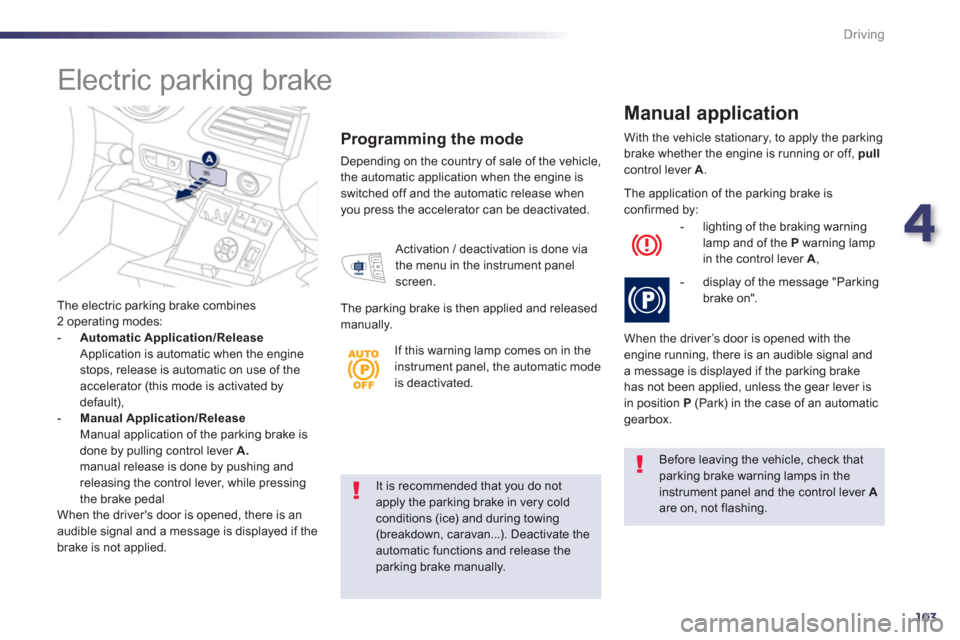
The electric parking brake combines
2 operating modes:
-
Automatic Application/Release Application is automatic when the engine stops, release is automatic on use of the accelerator (this mode is activated by
default), -Manual Application/Release Manual application of the parking brake is done by pulling control lever A. manual release is done by pushing and releasing the control lever, while pressing
the brake pedal
When the driver's door is opened, there is an
audible si
gnal and a message is displayed if the
brake is not applied.
Programming the mode
Depending on the country of sale of the vehicle,
the automatic application when the engine is switched off and the automatic release whenyou press the accelerator can be deactivated. With the vehicle stationary, to apply the parking
brake whether the en
gine is running or off, pull
control lever A
.
Manual application
Activation / deactivation is done via
the menu in the instrument panel
screen.
The parkin
g brake is then applied and released
manually. The application o
f the parking brake isconfirmed by:
- li
ghting of the braking warning lamp and of the Pwarning lamp
in the control lever A,
- displa
y of the message "Parking brake on".
When the driver’s door is opened with the
engine running, there is an audible signal and
a message is displayed if the parking brake
has not been applied, unless the gear lever is in position P(Park) in the case of an automatic gearbox.
Electric parking brake
If this warning lamp comes on in the instrument panel, the automatic modeis deactivated.
Page 107 of 340
4
105
Driving
Automatic release
The electric parking brake releases automatically and progressively
when you press the accelerator:FManual gearbox:
press down fully on
the clutch pedal, engage first gear or reverse, press on the accelerator pedaland move off.FElectronic gear control gearbox : select position A
, M
or Rthen press on theaccelerator pedal. F Automatic gearbox:select position D , Mor Rthen press on the accelerator pedal.
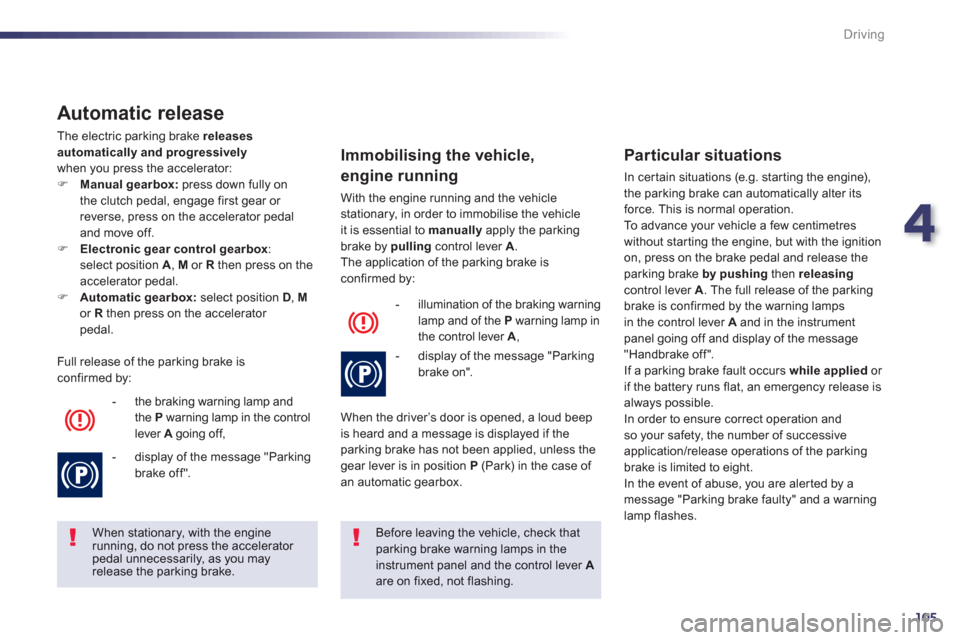
Full release o
f the parking brake is confirmed by:
- the braking warning lamp and
th
e P warning lamp in the control
lever Agoing off, A
- display of the message "Parking brake off".
When stationary, with the engine running, do not press the accelerator pedal unnecessarily, as you may release the parking brake.
Before leaving the vehicle, check thatparking brake warning lamps in theinstrument panel and the control lever Aare on fixed, not flashing.
Immobilising the vehicle,
engine running
With the engine running and the vehicle
stationary, in order to immobilise the vehicle it is essential to manually
apply the parking
brake by pulling
control lever A.
The application of the parking brake is confirmed by:
- illumination o
f the braking warning
lamp and of the Pwarning lamp in
the control lever A ,
- displa
y of the message "Parkingbrake on".
When the driver’s door is opened, a loud beep
is heard and a message is displayed if theparking brake has not been applied, unless thegear lever is in position P (Park) in the case of an automatic gearbox.
Particular situations
In cer tain situations (e.g. star ting the engine),
the parking brake can automatically alter itsforce. This is normal operation.
To advance your vehicle a few centimetres
without star ting the engine, but with the ignition on, press on the brake pedal and release the
parking brake by pushing then releasingcontrol lever A
. The full release of the parking
brake is confirmed by the warning lamps in the control lever Aand in the instrument
panel going off and display of the message
"Handbrake off".
If a parking brake fault occurs while appliedor
if the battery runs flat, an emergency release is
always possible.
In order to ensure correct operation and
so your safety, the number of successive
application/release operations of the parking brake is limited to eight.
In the event of abuse, you are aler ted by a
message "Parking brake faulty" and a warning
lamp flashes.
Page 108 of 340
106
Driving
Emergency braking
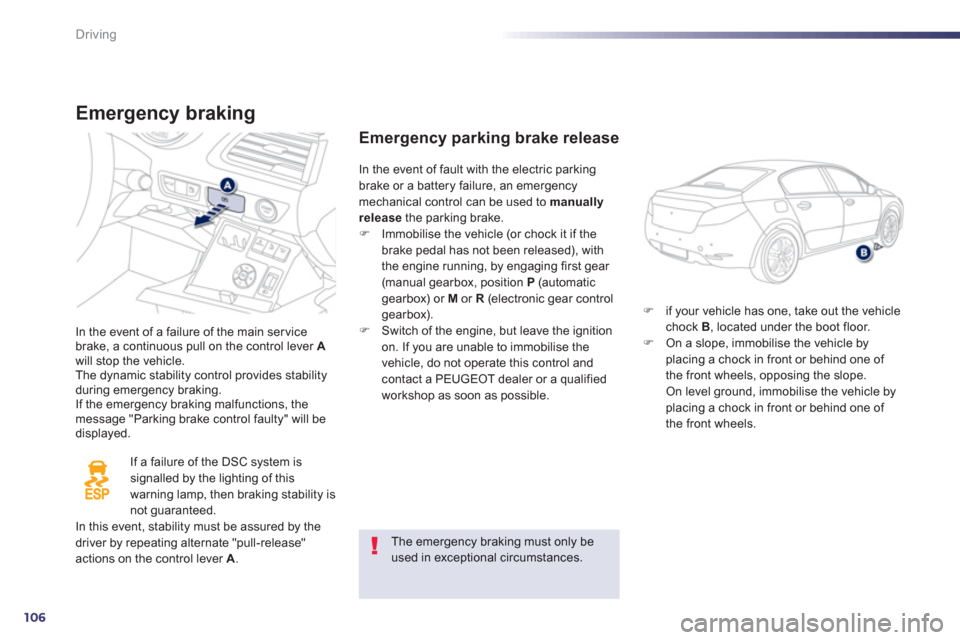
In the event of a failure of the main servicebrake, a continuous pull on the control lever Awill stop the vehicle.The dynamic stability control provides stability during emergency braking.
If the emergency braking malfunctions, themessage "Parking brake control faulty" will be displayed.
If a failure of the DSC s
ystem is
signalled by the lighting of this
warning lamp, then braking stability is
not guaranteed.In this event, stability must be assured by thedriver by repeating alternate "pull-release" actions on the control lever A.
Emergency parking brake release
Fif your vehicle has one, take out the vehicle chock B , located under the boot floor. FOn a slope, immobilise the vehicle byplacing a chock in front or behind one of
the front wheels, opposing the slope. On level ground, immobilise the vehicle byplacing a chock in front or behind one of
the front wheels.
In the event o
f fault with the electric parkingbrake or a battery failure, an emergencymechanical control can be used to manually
releasethe parking brake.F Immobilise the vehicle (or chock it if the
brake pedal has not been released), with
the engine running, by engaging first gear (manual gearbox, position P(automatic gearbox) or M or R(electronic gear control
gearbox). F Switch of the engine, but leave the ignition on. If you are unable to immobilise the
vehicle, do not operate this control and
contact a PEUGEOT dealer or a qualified
workshop as soon as possible.
The emergency braking must only be used in exceptional circumstances.